Homilies
Homilies
May 3, 2026
⭐⭐⭐ Are You a Tombstone or a Living Stone?


NO PLACE LIKE HOME
Fr. Kevin Rettig explores the universal ache of homesickness, using the imagery of Dorothy from The Wizard of Oz and the harrowing experience of refugees to define “home.” He argues that we rarely appreciate home in the present, viewing it instead through the lens of memory or future dreams. This persistent longing, he suggests, is a sign that our true home is not of this world.
Homilies Featured
On this Page
Bishop Barron
Fr. Michael Chua
Blackfriars
Fr. Austin Fleming
Msgr. Peter Hahn
Fr. Charles E. Irvin
Fr. Jagodensky, SDS
Fr. Jude Langeh, CMF
Deacon McCulloch
Msgr. Charles Pope
Fr. Kevin Rettig
Fr. George Smiga
Way, Truth & Life
5th Sunday of Easter (A)


SDS


CMF







PAPAL HOMILIES



RECOMMENDED
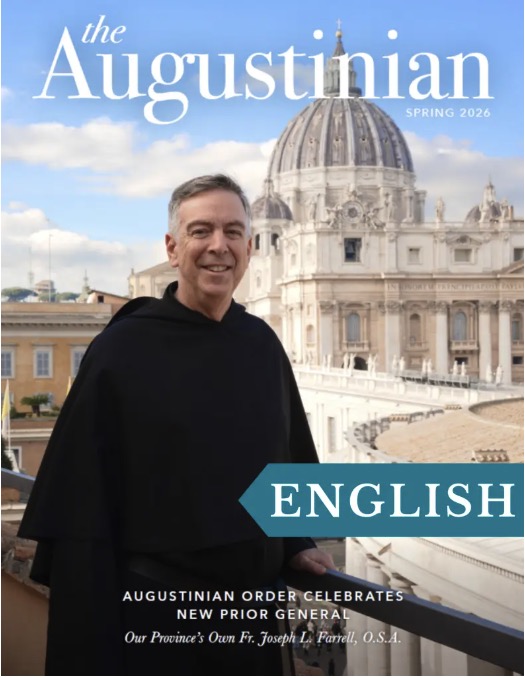
The Augustinian Province of St. Thomas of Villanova maintains a dedicated “Homilies” page with reflections grounded in the Confessions and the Rule of St. Augustine.
✍️ Augustinian Province – Weekly Homilies
📺 Fr. Paul Galetto
📺 Fr. Tom McCarthy
✍️ Fr. Kieran J. O’Mahony
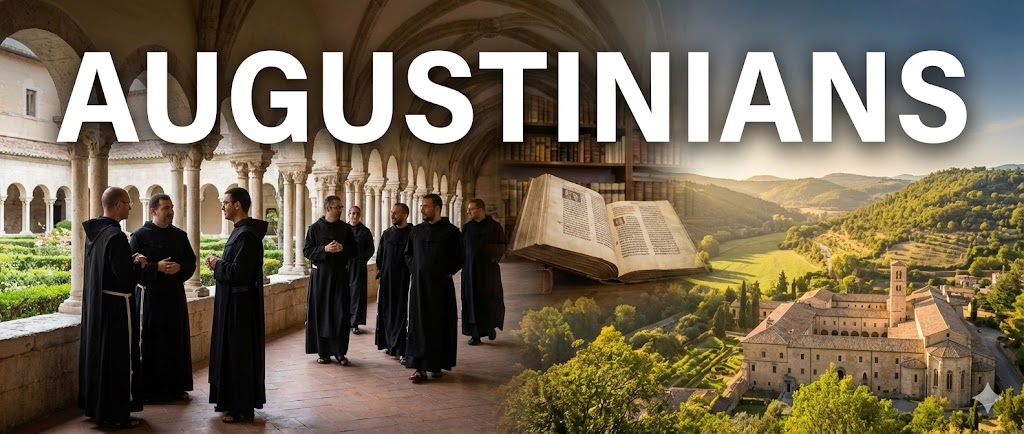
Core Charism: Interiority (searching for God within), community life (“one mind and one heart on the way to God”), and the restless heart that finds repose only in God.
5th Sunday of Easter (A)
Focus Reading: John 14:1-12 (The Way to the Homeland)
- Key Phrase: The Restless Heart Finds Its Path.
- This Sunday’s Hook: We are pilgrims on a journey, and our hearts are restless until they rest in Him. But how do we walk toward a God we cannot see?
- The Approach with Application: St. Augustine’s focus on the interior life and the “City of God.” The application is the interiority of the “Way”—seeking Christ within the “inner room” of the soul so that we can find our way to the eternal homeland together.
- Draft Opening: “St. Augustine once said, ‘Thou hast made us for Thyself, O Lord.’ Today, we hear Jesus describe the ultimate destination of that longing. He is the Way we walk, the Truth we reach, and the Life we shall live forever. We are a people of the ‘Way,’ traveling together toward the rest that only the Father can provide.”
RECOMMENDED
Many Benedictine Abbeys publish the Abbot’s homilies online. Quarr Abbey and Saint Meinrad Archabbey are excellent sources for traditional Benedictine “Lectio” style preaching.
✍️ Saint Meinrad Archabbey Reflections
✍️ Monastery of Christ in the Desert
✍️ Mepkin Abbey

Core Charism: Ora et Labora (Prayer and Work), Stability, Hospitality, Lectio Divina, Listening with the “ear of the heart.”
5th Sunday of Easter (A)
Focus Reading: 1 Peter 2:4-9 (The Living Stones)
- Key Phrase: Stability in the Spiritual House.
- This Sunday’s Hook: We aren’t just individuals following a teacher; we are “living stones” being built into a permanent structure of praise.
- The Approach with Application: Drawing from the Rule of St. Benedict, the homily would focus on community and stability (stabilitas). The application is “Ora et Labora”—how our daily work and prayer stack together like masonry to create a temple where God dwells.
- Draft Opening: “In the monastery, every stone in the cloister has a purpose. St. Peter tells us today that we are not loose pebbles scattered by the wind of the world. We are living stones, hewn by the Master’s hand, called to rest upon the Cornerstone and support one another in the silence of God’s presence.”

LECTIO DIVINA
APRIL 2026 (PDF)
RECOMMENDED
The Carmelites offer a unique “Lectio Divina” style reflection for each Sunday through their international headquarters.
✍️ OCarm.org – Lectio Divina for Sundays
📺 Fr. Greg
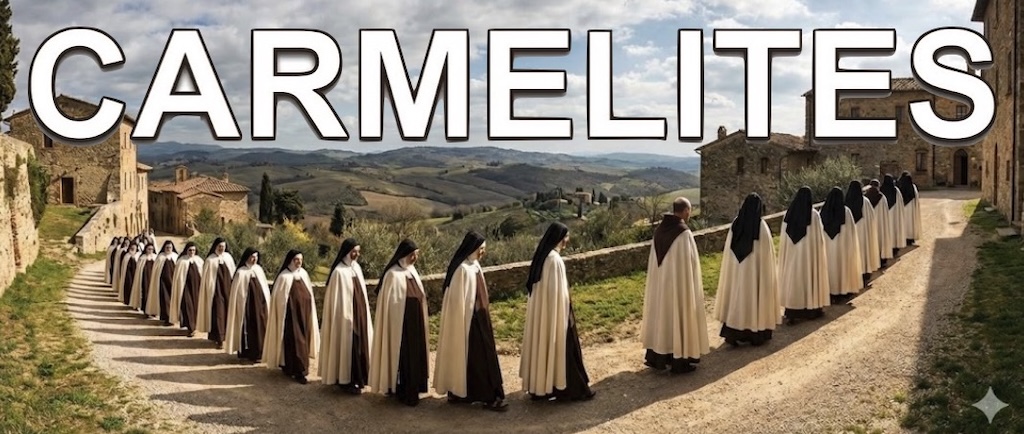
Core Charism: Contemplation, The Desert, Prayer as Friendship, The Dark Night, Elijah, St. Teresa of Avila.
5th Sunday of Easter (A)
Focus Reading: 1 Peter 2:4-9 (A Royal Priesthood in Darkness)
- Key Phrase: Called Out of Darkness into Marvelous Light.
- This Sunday’s Hook: The transition from the “dark night” of the world to the “marvelous light” of God’s presence is a journey of the soul.
- The Approach with Application: Focusing on the contemplative union with God. The “Royal Priesthood” is interpreted as the soul’s ability to offer its own interior life as a sacrifice of praise. The application is the “Interior Castle”—moving from the outer courtyard of distraction to the center where the Cornerstone dwells.
- Draft Opening: “St. John of the Cross spoke of the ‘luminous night’ where the soul finds its Beloved. St. Peter echoes this today, reminding us that we have been called out of the shadows of our own egos and into a ‘marvelous light.’ You are a chosen race, not because of your own power, but because of the fire of love God has lit within you.”
RECOMMENDED
The Dominicans have one of the most robust preaching websites called “Torch.” It features a new homily every week from a different friar.
✍️ English Dominican Friars – Torch
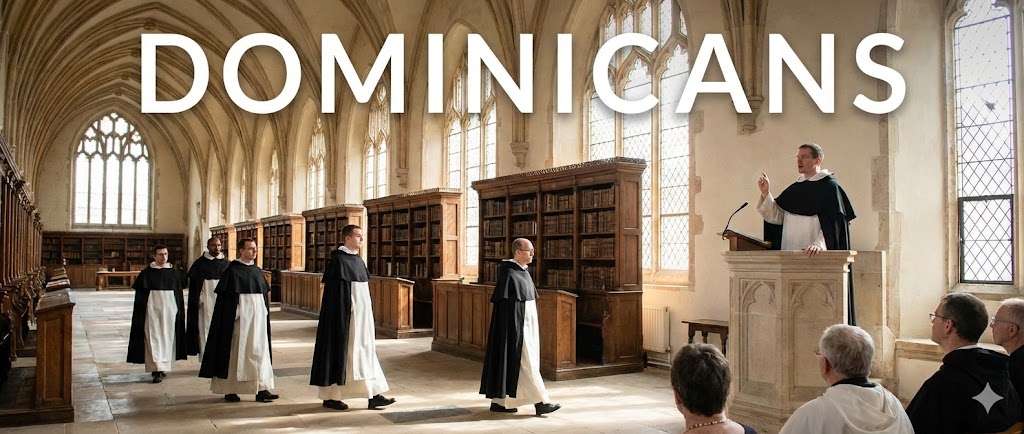
Core Charism: Veritas (Truth), Preaching, Study, Combatting Error with Clarity, Contemplation passed on to others.
5th Sunday of Easter (A)
Focus Reading: John 14:1-12 (The Revelation of the Father)
- Key Phrase: Veritas: To Contemplate and Share the Fruits of Contemplation.
- This Sunday’s Hook: “I am the Way, the Truth, and the Life.” These aren’t just titles; they are the metaphysical reality of the Word Made Flesh.
- The Approach with Application: A Dominican would focus on the intellectual clarity of Christ as the Logos. The application is the “Holy Preaching”—how knowing the Truth (Christ) sets us free to study the world and communicate the Light of the Father to others.
- Draft Opening: “St. Thomas Aquinas taught us that the ultimate end of man is the vision of God. Today, Philip asks for that vision: ‘Show us the Father.’ Jesus’ response is the cornerstone of our faith: to see the Son is to see the Essence of the Father. Let us contemplate this Truth so that we may become its witnesses.”
RECOMMENDED
St. Anthony Messenger and the various provinces often provide “Franciscan Spirit” reflections that focus on the Gospel of the day.
✍️ Franciscan Media – Sunday Homily Helps
📺 Fr. Paul Galetto
📺 Fr. Tom McCarthy
✍️ Fr. Kieran J. O’Mahony

Core Charism: Poverty, Minority (being “lesser”), Fraternity, and finding God in the grit of humanity and creation.
5th Sunday of Easter (A)
Focus Reading: Acts 6:1-7 (The Appointment of the Seven)
- Key Phrase: Minority and Service in the Midst of Growth.
- This Sunday’s Hook: When the community grows, so do the complaints. But in the Kingdom, a “complaint” is actually an invitation to expand the circle of service.
- The Approach with Application: Franciscans would emphasize the “deacon” heart—the call to serve the marginalized (the widows) while maintaining the joy of the Gospel. The application focuses on finding Christ in the “least” of the community and ensuring that administrative growth never stifles fraternal charity.
- Draft Opening: “Brothers and sisters, it’s a very human thing to grumble when we feel overlooked. Even the early Church, fresh from the fire of Pentecost, faced the ‘murmuring’ of the Hellenists. But St. Francis would remind us that these moments of tension are precisely where we find our ‘Lady Poverty’—in the humble service of the table.”


Core Charism: Ad Maiorem Dei Gloriam (For the Greater Glory of God), Discernment of Spirits, Finding God in All Things, Imaginative Contemplation.
5th Sunday of Easter (A)
Focus Reading: John 14:1-12 (The Way, the Truth, and the Life)
- Key Phrase: Finding God in All Things through Christ the Way.
- This Sunday’s Hook: Philip asks for a shortcut: ‘Show us the Father and that will be enough.’ Jesus responds by inviting him into a deeper relationship, not a clearer diagram.
- The Approach with Application: Using Ignatian “composition of place,” the preacher invites the congregation into the Upper Room. The application is the Magis—doing the “greater works” Jesus promises by discerning where the “Way” leads in our daily professional and personal lives.
- Draft Opening: “Imagine the room: the air is thick with the scent of Passover and the heavy weight of impending departure. Thomas is anxious; Philip is confused. They want a destination they can see on a map. But Jesus offers them something far more challenging and beautiful: His very person as the map itself.”
May/June 2026
RECOMMENDED
The Redemptorists of the Baltimore and Denver Provinces often provide weekly reflections, particularly through their “Missionaries of Hope” video series or Lenten booklets.
✍️ The Redemptorists (Baltimore Province) News & Reflections

Core Charism: Preaching “Plentiful Redemption” (Copiosa Redemptio), especially to the abandoned and sinners; Moral Theology (St. Alphonsus Liguori).
5th Sunday of Easter (A)
Focus Reading: John 14:1-12 (In My Father’s House)
- Key Phrase: Copious Redemption and the Comfort of the Father.
- This Sunday’s Hook: “Do not let your hearts be troubled.” In a world of anxiety and fear, Christ offers a home that is already prepared for us.
- The Approach with Application: Following St. Alphonsus Liguori, the tone is one of deep pastoral warmth and “plentiful redemption.” The application is to trust in God’s mercy despite our failures, knowing that the “many dwelling places” are open to even the most broken among us.
- Draft Opening: “How many of you carried a ‘troubled heart’ into this church today? Perhaps it’s a family crisis, a health scare, or a secret sin. To you, Jesus speaks these tender words: ‘In my Father’s house there are many dwelling places.’ He isn’t just a judge; He is the Redeemer who has already built a room for you.”
Bishop Robert Barron

5th Sunday of Easter (A)
The Dwelling Place of God

Friends, on this Fifth Sunday of Easter, there’s a somewhat hidden theme that runs like a golden thread through the readings, and that theme is the temple. To understand the New Testament texts, we have to see the importance of the Jerusalem temple for ancient Israelites. It was the focal point of Jewish life—the political, cultural, and of course religious center of the country. It was seen, in almost a literal sense, as the dwelling place of God on earth.
Fr. Michael Chua
2026 | 2023 | 2020 | 2017 | 2014
5th Sunday of Easter (A)
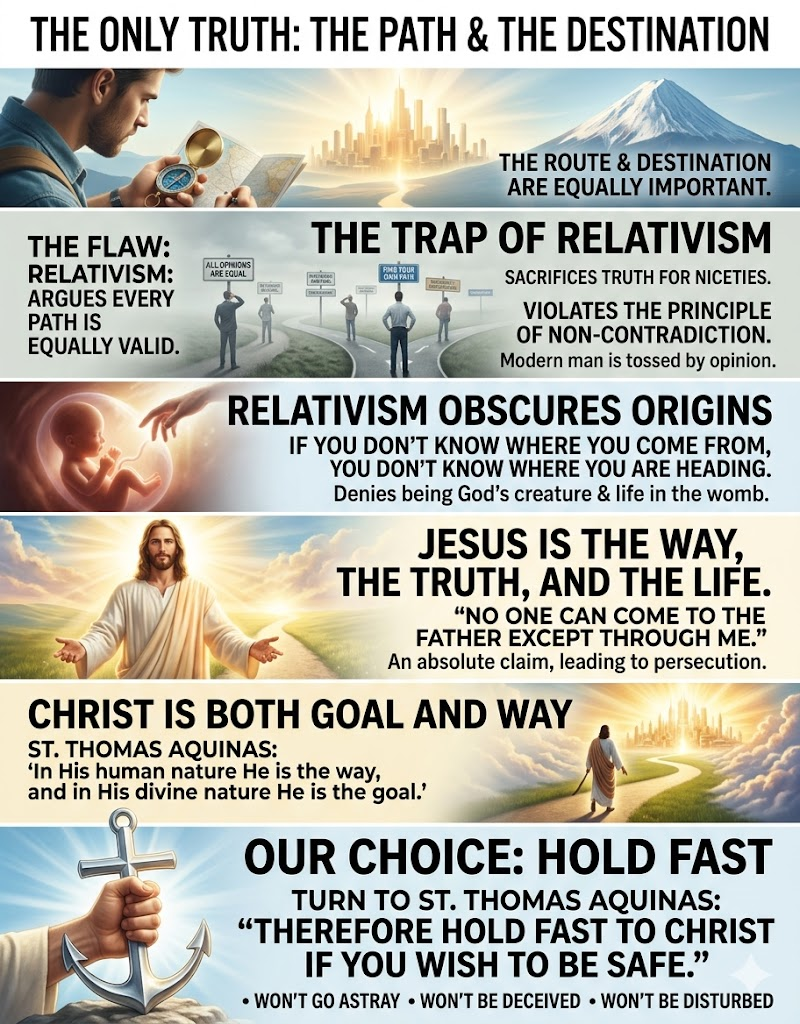
He is the Way, the Truth
and the Life

Father Michael Chua challenges the modern obsession with the “journey over the destination,” labeling it a byproduct of relativism that rejects objective truth. He argues that popular pluralistic sentiments violate the principle of non-contradiction and anchorless man in a sea of shifting opinions. Grounded in the theology of St. Thomas Aquinas, the homily asserts that Jesus Christ is uniquely the Way, the Truth, and the Life—serving as both the path (in His humanity) and the goal (in His divinity). Only by holding fast to Christ can the faithful navigate a world of conflicting ideologies and reach eternal life.
HOMILY HELPER
GO DEEPER
PROMPTS TO KEEP YOU WRITING
Copy/paste one of these command prompts into the Catholic Assistant (bottom right corner). This tool can help you brainstorm and provide you with further ideas to keep you writing.
_
- The Architecture of Truth: Establish a narrative comparing a life without objective truth to a ship without an anchor, lost in a sea of opinions. AI, write a reflection on how relativism fails the basic laws of logic.
- The Double Nature of Christ: Utilize the theology of Thomas Aquinas to explain how Jesus serves as both the road we walk and the destination we seek. AI, emphasize the distinction between Christ’s humanity as the way and His divinity as the goal.
- Beyond the Yellow Brick Road: Use the imagery of Dorothy’s journey to show that every path must lead to a specific, non-negotiable end to have meaning. AI, expand on the necessity of a fixed destination versus the "progress for progress' sake" mentality.
- The Scandal of Exclusivity: Analyze the phrase "No one comes to the Father except through me" as a radical challenge to modern pluralism and secular "niceness." AI, focus on the historical persecution resulting from this uncompromising claim.
- Logic and Non-Contradiction: Define the philosophical principle that a thing cannot be both true and false simultaneously, applying this to moral relativism. AI, rewrite this section to expose the internal inconsistency of the "agree to disagree" culture.
- Origins and Destinations: Incorporate Otto von Habsburg’s quote to argue that forgetting our origin as God’s creatures leads to losing our sense of direction. AI, connect the beginning of life in the womb to our ultimate spiritual end.
- The Marketplace of Ideas: Describe the world as a chaotic bazaar of ideologies, contrasting this noise with the singular, quiet authority of the Gospel. AI, direct the narrative toward the Christian’s definitive choice to remain with Christ.
- Safety in the Word: Adapt the "Angelic Doctor’s" advice to provide comfort to those feeling overwhelmed by the rapid shifts in modern societal values. AI, highlight the themes of safety and protection found in holding fast to the Truth.
- The Subversive Church: Explore why the Church’s claim of Christ as the only Way is considered a "scandal" in a world that demands malleable truth. AI, emphasize the courage required to proclaim Christ as the only source of eternal life.
- Universal Mercy through Christ: Explain how the Holy Spirit works in the consciences of those who do not know the Church, while maintaining Christ’s unique role. AI, focus on explaining that all salvation, even for non-believers, flows exclusively through Jesus.
Dominican Blackfriars
2026 | 2023 | 2020 | 2017 | 2014 | 2011 | 2008 | 2005 | 2002
5th Sunday of Easter (A)
I AM the Way, the Truth
and the Life
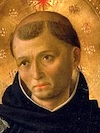
Fr. Andrew Brookes, O.P., explores the potency of Jesus’ declaration, “I am the Way, the Truth and the Life,” by grounding it in the dark context of the Last Supper. Facing imminent, humiliating execution, Jesus proactively redefines His passion not as a defeat, but as a divine mission. By invoking the divine name Ego Eimi, Jesus identifies Himself as God—the source of all path, reality, and vitality. The homily emphasizes that the Resurrection vindicates this claim, offering the faithful a concrete reason to trust Him in their own “dark and difficult” situations.

HOMILY HELPER
Fr. Austin Fleming
2026 | 2023 | 2020 | 2017 | 2014 | 2011 | 2008
5th Sunday of Easter (A)
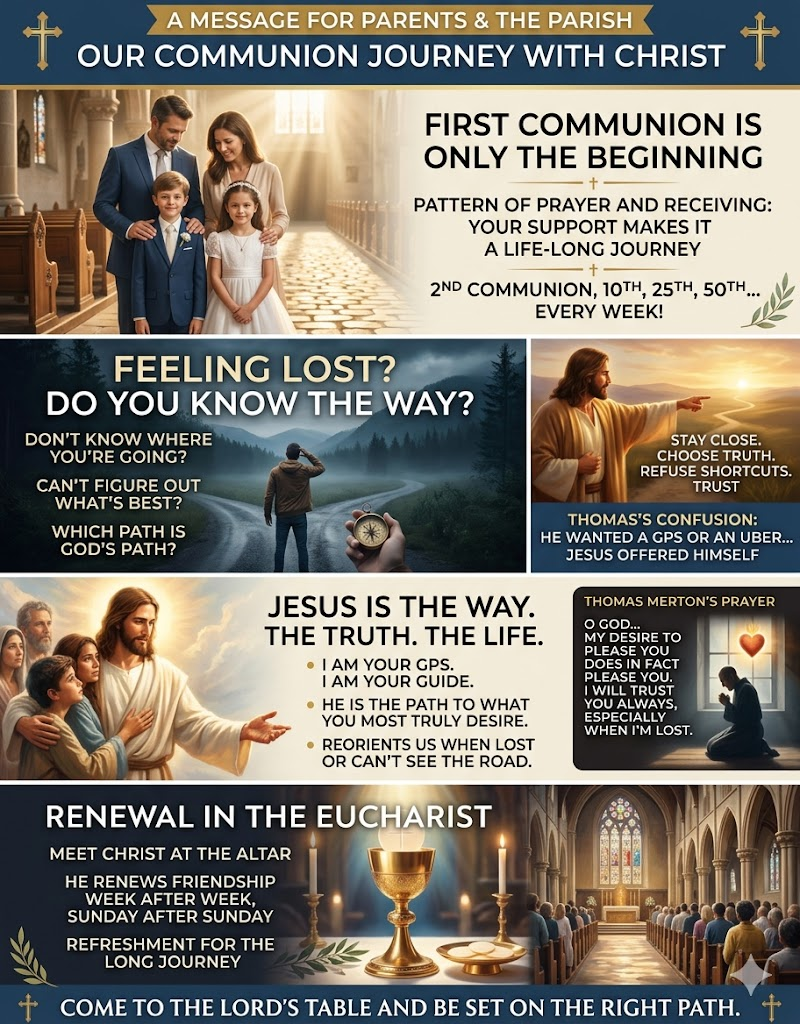
First Communion Homily
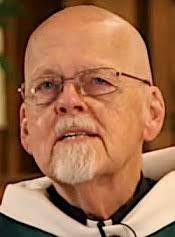
Fr. Austin Fleming addresses a First Communion congregation, shifting the focus from the initial milestone to the lifelong “pattern of praying and receiving.” Using the confusion of the Apostle Thomas, he reframes Jesus not as a provider of a GPS map, but as the GPS itself. He acknowledges the adult experience of feeling lost or uncertain of God’s will, using Thomas Merton’s famous prayer to validate that the desire to please God is the path itself. Ultimately, the Eucharist is presented as the weekly reorientation point where Christ meets us to set us back on the right path.
HOMILY HELPER
GO DEEPER
PROMPTS TO KEEP YOU WRITING
Copy/paste one of these command prompts into the Catholic Assistant (bottom right corner). This tool can help you brainstorm and provide you with further ideas to develop your homily.
_
- The Lifelong Pattern: Establish the theme that a first sacrament is merely the beginning of a lifelong journey of weekly prayer and reception. AI, focus on the parents' responsibility to ensure the child's second and fiftieth communions occur.
- The Thomas Dilemma: Contrast the human desire for a clear, digital roadmap with Jesus’ offer of Himself as the living way. AI, write a reflection on the frustration of needing a GPS but receiving a companion instead.
- Modern Navigation Metaphors: Use the imagery of Uber drivers and GPS programming to explain how Jesus guides the soul through life’s intersections. AI, emphasize that Jesus is the driver rather than the destination's address.
- The Honest Seeker: Incorporate the vulnerability of Thomas Merton’s prayer to reassure those who do not know which direction to head. AI, emphasize that the simple desire to please God is sufficient for those who feel lost.
- Avoiding the Shortcuts: Describe the spiritual danger of taking moral shortcuts that lead to dead ends rather than the Truth. AI, write a section directing the reader to choose the path of goodness even when the destination is invisible.
- Eucharistic Reorientation: Define the Sunday Mass as a weekly "reset" for the internal compass of the believer. AI, focus on how the Bread and Cup of the Eucharist provide strength for a long, confusing journey.
- The Table of Conversation: Draw a direct line between the Last Supper's dialogue and the current liturgical celebration at the altar. AI, emphasize that the same Jesus who answered Thomas is present in the bread and wine today.
- Trust in the Dark: Explore the concept of "perils" and the promise that Jesus will never leave a soul to face them alone. AI, focus on the theme of trust during moments when one cannot see the road ahead.
- Heart’s Deepest Desire: Argue that Jesus is the only path leading to what the human heart "most truly desires" in its heart of hearts. AI, rewrite this to focus on Christ as the fulfillment of every human longing.
- A Father's Advice: Adopt a warm, pastoral tone to encourage families to make the Eucharist a permanent fixture in their domestic lives. AI, direct the AI to write a concluding exhortation to return to the Lord’s table week after week.
Monsignor Peter Hahn

5th Sunday of Easter (A)
Hope of the Resurrection
Note: Mother’s Day 2026 is Next Sunday.
In his homily for the Fifth Sunday of Easter, Msgr. Peter Hahn weaves together the celebration of Mother’s Day 2017 with the profound hope of the Resurrection. Reflecting on his own mother’s wisdom—that “half the world is crying”—Msgr. Hahn acknowledges the pervasive trials and tragedies that define human existence. He posits that the Easter event is the only reality capable of sustaining us through such darkness.
Turning to the Gospel of John, he explores the Last Supper discourse where Jesus comforts his disciples with the assurance of a “dwelling place” in his Father’s house. Msgr. Hahn emphasizes Christ’s declaration, “I am the way and the truth and the life,” as the definitive answer to the world’s confusion. He concludes by urging the faithful to remain inseparable from Christ and the Church, seeking solace not in secular ideologies, but in the sacramental grace that transforms our suffering into a share of the Resurrection.
Fr. Charles E. Irvin
5th Sunday of Easter (A)
Living in Truth and Love

Fr. Charles Irvin confronts the misconception that the Gospel is an idealistic “dream world” for those seeking escape from reality. He argues that Jesus is the ultimate realist, asserting that Christ’s way is not a side street or a refuge, but the “main road”—the only path that actually works and reaches a destination. Using the “cornerstone” as a metaphor for orientation and the Twelve Steps of recovery as evidence of “ruthless honesty,” Irvin posits that sin is the true unreality. He concludes that living as God’s family is the only realistic response to a fragmented, broken world.

HOMILY HELPER
GO DEEPER
PROMPTS TO KEEP YOU WRITING
Copy/paste one of these command prompts into the Catholic Assistant (bottom right corner). This tool can help you brainstorm and provide you with further ideas to develop your homily.
_
- The Myth of Idealism: Contrast the view of Jesus as a "sweet dreamer" with the reality of Him as a cornerstone who sets the quality of all life. AI, write a critique of those who dismiss the Gospel as unrealistic.
- The Only Main Road: Describe the "Way, Truth, and Life" not as a side park or refuge, but as the only highway in the world that avoids a dead-end. AI, emphasize that Christ’s road is the only one with a true destination.
- Sin as Ruination: Analyze the Prodigal Son’s "pig pen" experience to show that sin is a rejection of reality that brings tangible pain and suffering to the sinner. AI, focus on how sin destroys the person rather than just offending God.
- Realism in Recovery: Connect the Twelve Steps of addiction recovery to the Gospel’s requirement for "ruthless and courageous honesty" regarding one's moral inventory and wrongs. AI, write a comparison between the spiritual life and the grit of addiction recovery.
- The Cornerstone's Orientation: Explain how a cornerstone determines the direction and alignment of an entire building, much like Christ orients a believer’s decisions and character. AI, expand on the architectural metaphor of Christ as the essential grounding stone.
- Psychiatry and the Sermon: Incorporate Dr. James Fisher’s quote to argue that all psychiatric and psychological wisdom is merely an incomplete summary of Christ’s teachings. AI, focus on the psychological "meat" of the Sermon on the Mount as a roadmap for health.
- Family Over Fragmentation: Contrast the "broken trust" and "broken hearts" of the world with the reality of living within the family of God, under Mary and the Father. AI, emphasize the healing power of being in Christ’s family.
- Hollywood vs. Holiness: Compare the so-called "reality" depicted in television and media with the true, challenging reality of living out the demands of the Gospel. AI, write a section exposing the unreality of secular culture compared to Christ.
- The Necessity of Repentance: Argue that facing one's wrongs and seeking forgiveness is the only "realistic" way to find resolution and health in a damaged world. AI, focus on taking ownership of decisions as a prerequisite for spiritual healing.
- The Courage of Faith: Conclude with the demand that living in truth and love requires sacrifice and the rejection of "polite manners" in favor of the Cross. AI, direct the AI to write an exhortation on the demanding nature of Christ’s realism.
Fr. Joe Jagodensky, SDS
5th Sunday of Easter (A)
Wellness and Aging

Fr. Joe Jagodensky, SDS, confronts the “un-American” stigma attached to the phrase “I can’t do it,” specifically as it relates to the aging process. Using the poignant example of Peggy Wood—whose voice was dubbed in The Sound of Music because she could no longer sing—he validates the reality of physical diminishment without equating it to a loss of worth. He acknowledges the grief of losing independence, such as the ability to drive, but exhorts the elderly to see their current endurance as a continuation of their “shining moment.” He defines living not by past ability, but by present persistence.

HOMILY HELPER
GO DEEPER
PROMPTS TO KEEP YOU WRITING
Copy/paste one of these command prompts into the Catholic Assistant (bottom right corner). This tool can help you brainstorm and provide you with further ideas to develop your homily.
_
- The American Mandate: Explore the cultural pressure to remain perpetually capable and the shame associated with admitting physical or mental limitations. AI, write a critique of the "climb every mountain" mentality.
- The Dubbed Voice: Narrate the story of Peggy Wood in The Sound of Music, focusing on the humility required to mouth words someone else is singing. AI, emphasize the dignity found in being diminished.
- The Neighbor’s Silent Judgment: Describe the tension between a suffering person and a neighbor who offers simplistic, measurement-based encouragement that ignores the reality of their condition. AI, focus on the frustration of toxic positivity.
- The Grief of Driving: Address the specific sorrow and loss of independence felt by older adults when they can no longer drive their own cars. AI, highlight the emotional weight of "giving in" to aging.
- A Shining Moment: Reflect on the concept that a person's worth is not erased by their current inability to perform past feats of strength. AI, emphasize that past achievements remain part of a person's identity.
- The Gear of Persistence: Catalog the walkers, oxygen tanks, and hearing aids not as signs of defeat, but as tools of a warrior still in the fight. AI, focus on the bravery of showing up.
- Three Tries to Stand: Describe the physical struggle of getting out of a chair and the spiritual victory found in the attempt itself. AI, write about the sanctity of physical struggle in old age.
- Measured by the Unmeasurable: Challenge the people who measure life by productivity and compare siblings or peers to those who are struggling. AI, focus on rejecting the "lazy" or "giving in" labels.
- The Un-American Phrase: Establish "I can't do it" as a radical, honest confession that breaks the myth of self-reliance. AI, rewrite this as a call to communal dependence and honesty.
- The Final Exhortation: Craft a closing message that forbids the phrase "I can't do it" not as a demand for strength, but as a refusal of self-pity. AI, direct the AI to write an inspiring call to keep going.
Deacon Greg Kandra
5th Sunday of Easter (A)
Love One Another
APRIL 28, 2013—Deacon Greg Kandra strips away the sentimental veneer of Jesus’ command to “love one another,” reframing it as an “audacious challenge” that should make us lose sleep. He argues that loving as Jesus loved requires a “martyrdom of self”—a death to selfishness expressed through small but heroic acts of silence, patience, and time. Using the powerful contemporary example of a Jesuit scholastic’s letter of forgiveness to the Boston Marathon bomber, Kandra illustrates that Christian love must include even the betrayer and the enemy. Ultimately, this radical love is fueled by the Eucharist and the hope of Easter.

HOMILY HELPER
GO DEEPER
PROMPTS TO KEEP YOU WRITING
Copy/paste one of these command prompts into the Catholic Assistant (bottom right corner). This tool can help you brainstorm and provide you with further ideas to develop your homily.
_
- The Gauntlet of Love: Contrast the comforting, familiar sound of the "love one another" commandment with the terrifying reality of loving as Christ loved. AI, focus on the discomfort of radical love.
- The Martyred Ego: Define the death of self-interest as a form of "martyrdom" that occurs in the cubicle, the checkout line, or the home. AI, emphasize small, daily acts of self-sacrifice.
- Loving the Betrayer: Explore the specific challenge of loving the "Judas" or the "Thomas" in our lives, moving beyond sentimentality into fierce compassion. AI, write about the difficulty of loving the unlikable.
- The Martyrdom of Silence: Illustrate the spiritual victory found in refraining from an insult or a sarcastic comment during a stressful workday. AI, focus on the power of silence as a Christian witness.
- A Letter to an Enemy: Recount the story of a man offering prayer and joy to a terrorist who tried to kill his family. AI, emphasize the radical rejection of retribution and hate.
- The DMV Sanctified: Use the mundane frustration of a long line at a government office to illustrate the "martyrdom of patience" and gratitude. AI, highlight finding holiness in boring, irritating situations.
- Make Hate a Martyr: Describe the process of "killing" one's own rage and vengeance to allow Christ’s love to take root. AI, focus on the painful but necessary work of forgiveness.
- Nails, Thorns, and Dawn: Connect the physical suffering of Good Friday to the eventual joy of the Resurrection and the Eucharist. AI, write about the sacrifice of love leading to eternal hope.
- Not a Hallmark Card: Critique the modern tendency to turn the Gospel into a sweet, harmless sentiment rather than a demanding, life-altering call. AI, focus on the audacity of Jesus' command.
- The Eucharistic Model: Conclude with the idea that the body and blood of Christ are the fuel for a love that "never fails." AI, direct the AI to write about the Eucharist's power.
Fr. Langeh, CMF

5th Sunday of Easter (A)
Hakuna Matata – No Worries
Fr. Jude Langeh uses the Swahili phrase Hakuna Matata to illuminate Jesus’ command: “Do not let your hearts be troubled.” Grounded in the Last Supper, the homily explains that the apostles’ future is secured through the “rooms” prepared in the Father’s house. Fr. Langeh identifies the root of anxiety as a weak faith that focuses on problems rather than God. He proposes the “Sacrament of the Present Moment” as the cure, arguing that grace is dispensed specifically for today’s needs. We break when we attempt to carry tomorrow’s burdens using only the grace provided for now.

HOMILY HELPER
GO DEEPER
PROMPTS TO KEEP YOU WRITING
Copy/paste one of these command prompts into the Catholic Assistant (bottom right corner). This tool can help you brainstorm and provide you with further ideas to develop your homily.
_
- The Swahili Invitation: Explore the phrase Hakuna Matata as a bridge to understand Jesus’ command to not let hearts be troubled during the Last Supper. AI, emphasize the theme of no worries.
- Rooms in the Mansion: Describe the security and peace that comes from knowing Christ has prepared a specific place for each believer in the Father’s house. AI, focus on assured futures.
- Problem-Focused Faith: Analyze why humans tend to look at their problems rather than looking up to God, resulting in a weakened spiritual state. AI, highlight the consequences of shifting focus.
- Sacrament of the Now: Define the "Sacrament of the Present Moment" as a visible sign of grace given only for current circumstances, not the future. AI, write about present-moment grace.
- The Weight of Tomorrow: Illustrate the psychological and spiritual breakdown that occurs when one tries to carry tomorrow’s burdens with only today’s allotted grace. AI, emphasize the impossibility of over-carrying.
- Intimacy with the Father: Explain how seeing, hearing, and touching Jesus through faith allows the believer to experience the Father’s own heart and presence. AI, focus on the Son’s deep intimacy.
- Biblical Reassurance: Reflect on why the Bible commands us hundreds of times not to worry, acknowledging the universal human prone-ness to fear and anxiety. AI, write about scriptural consistency.
- Physical Toll of Worry: Describe how severe anxiety affects the body, specifically sleep and appetite, and how Christ’s words act as a medicinal remedy. AI, focus on the holistic healing.
- The Only Reality: Argue that the present moment is the only reality we truly possess, as yesterday is gone and tomorrow is not yet here. AI, emphasize living in reality.
- The Final Benediction: Conclude with an exhortation to adopt a "no worries" lifestyle based on the Way, Truth, and Life of Jesus. AI, direct the AI to write an encouraging closing.
Deacon Peter McCulloch
5th Sunday of Easter (A)
Deacons
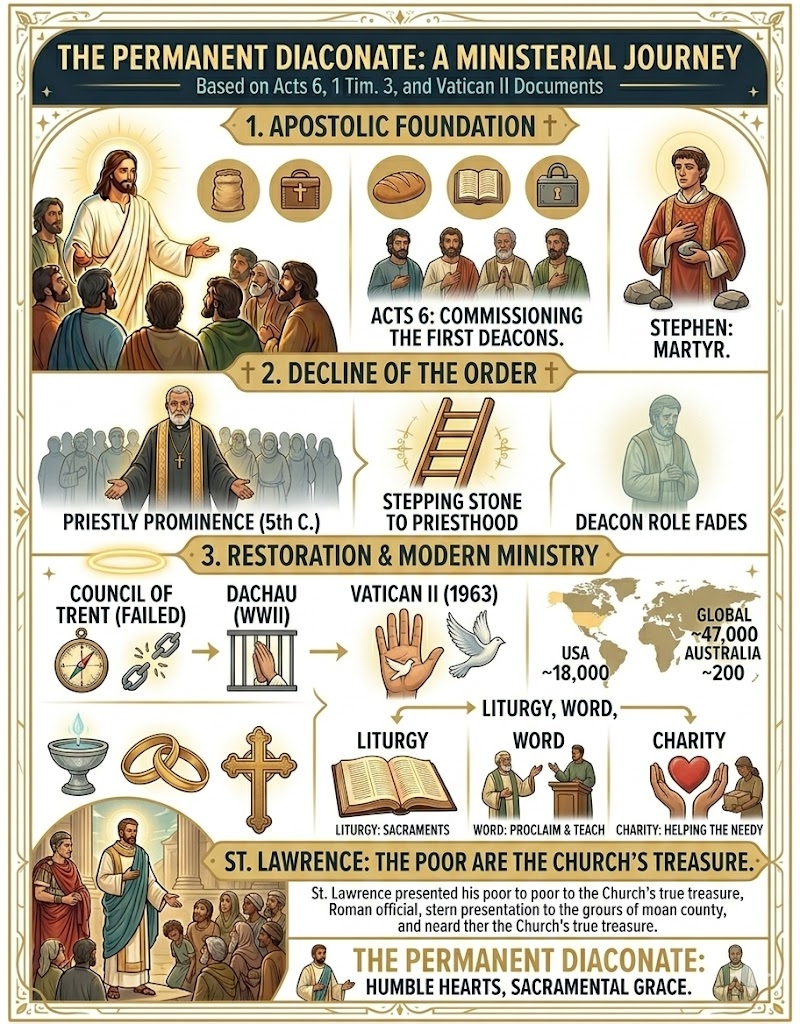
Deacon Peter McCulloch provides a comprehensive historical and theological defense of the diaconate, tracing its origins from the seven men appointed in Acts to its modern restoration after Vatican II. He highlights the order’s decline into a “stepping stone” and its providential rebirth through discussions in Nazi concentration camps. Defined by the term Diakonia, the deacon serves through Liturgy, Word, and Charity, continuing the ministry of Jesus—the ultimate servant. McCulloch concludes that deacons, grounded in real-world family and career experiences, are uniquely positioned to manifest the Church’s “treasure” by serving those on the margins.
HOMILY HELPER
GO DEEPER
PROMPTS TO KEEP YOU WRITING
Copy/paste one of these command prompts into the Catholic Assistant (bottom right corner). This tool can help you brainstorm and provide you with further ideas to develop your homily.
_
- The Seven Appointed: Describe the early Church's struggle to manage both preaching and care for the poor, leading to the appointment of the first deacons. AI, emphasize the necessity of service.
- The Ideal Character: Detail St. Paul’s specific requirements for deacons, focusing on temperance, honesty, and a lack of greed as the foundation for clergy. AI, focus on the virtues of deacons.
- Prominence and Decline: Trace the historical shift from deacons as prominent bishops' assistants to their eventual reduction to a "stepping stone" for the priesthood. AI, write about the diaconate's historical evolution.
- Hope in Dachau: Narrate the profound moment in Nazi Germany when imprisoned priests discussed restoring the diaconate to better serve the world after the war. AI, highlight the providential restoration.
- Jesus as Deacon: Explore the theological claim that because Jesus came "as one who serves," He is the primary model for the diaconal order. AI, focus on the Diakonia of Christ.
- The Threefold Ministry: Break down the specific roles of the deacon in Liturgy, Word, and Charity, from baptizing to prison ministry and social justice. AI, describe the deacon's various functions.
- The Church's Treasure: Recount the story of St. Lawrence presenting the poor and marginalized to the Emperor as the true wealth of the Church. AI, emphasize the deacon's commitment to charity.
- Community Connections: Argue that deacons are uniquely effective because their secular careers and family lives keep them connected to the local needs of the people. AI, focus on the real-world impact.
- The Necessity of Three: Utilize St. Ignatius of Antioch’s teaching that a church is incomplete without the triad of bishops, priests, and deacons. AI, write about the essential hierarchy.
- A Meaningful Difference: Conclude with the modern impact of 47,000 deacons worldwide, acting as the humble, grace-filled heart of the Church’s outreach. AI, emphasize the deacon's role today.
Msgr. Charles Pope
5th Sunday of Easter (A)
Are You a Tombstone or a Living Stone?
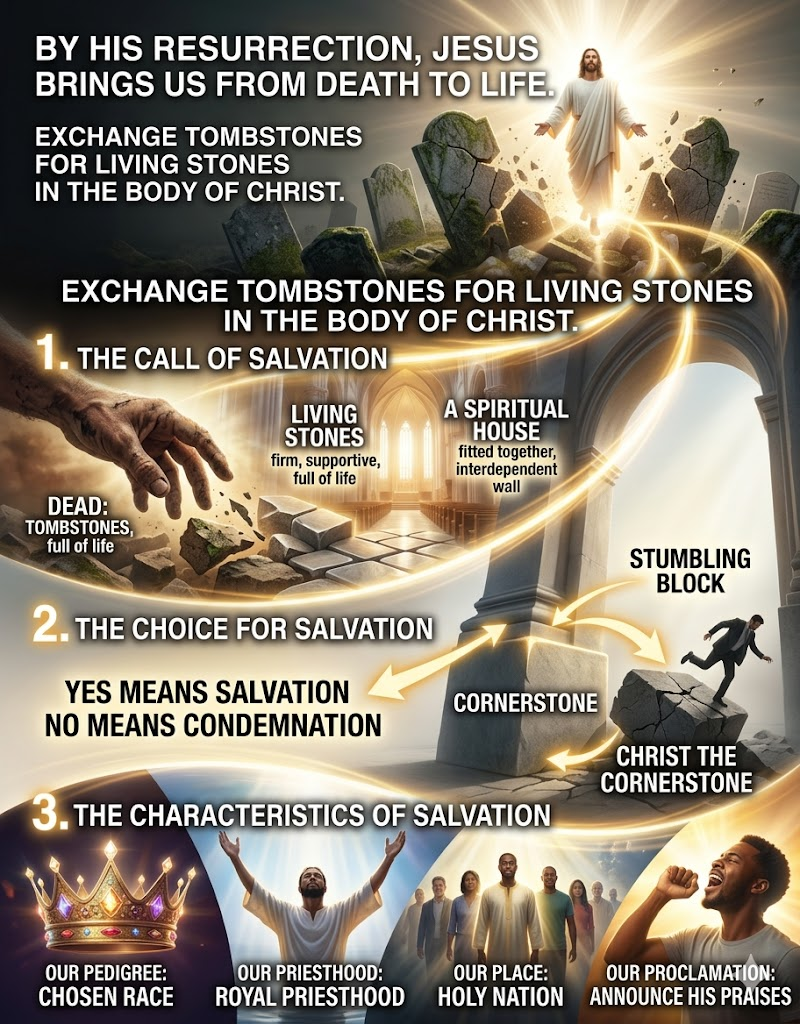
Msgr. Charles Pope uses the imagery of 1 Peter 2 to contrast “tombstones”—those dead in sin—with “living stones” who form the Church. He outlines three stages of this transformation: the Call, where we accept Christ’s invitation to become firm, stable supports in a spiritual house; the Choice, where Christ becomes either our supporting cornerstone or a stumbling block; and the Characteristics, identifying the baptized as a chosen race with a royal priesthood. Ultimately, the homily challenges the faithful to move from the darkness of isolation into the light of witness, offering their lives as a pleasing sacrifice.
HOMILY HELPER
GO DEEPER
PROMPTS TO KEEP YOU WRITING
Copy/paste one of these command prompts into the Catholic Assistant (bottom right corner). This tool can help you brainstorm and provide you with further ideas to develop your homily.
_
- From Death to Life: Contrast the cold, static image of a tombstone with the vibrant, load-bearing strength of a "living stone" in Christ's Body. AI, emphasize the transformation of the soul.
- The Structural Invitation: Explore the invitation "Come to Him" as a structural necessity where Christ rebuilds broken lives into a firm spiritual house. AI, focus on the rebuilding of crumbling lives.
- Weight and Stability: Describe the qualities of a living stone as being firm, weighty, and able to withstand the heavy loads and winds of modern doctrine. AI, highlight the stability of faith.
- The Interdependent Wall: Narrate the reality of being fitted together into a spiritual wall where removing one stone weakens the entire structure of the Church. AI, write about mutual dependence in grace.
- Cornerstone or Stumbling Block: Analyze the binary choice every person faces regarding Jesus, using the image of a life ring tossed to a drowning victim. AI, emphasize that there is no third way.
- The Perfect Alignment: Define the cornerstone as the essential stone at the bottom of an arch that carries the weight and ensures the shape of everything else. AI, focus on Christ’s integrity.
- A Royal Pedigree: Contrast an invitation to the White House with the far greater honor of being a "chosen race" invited to the Wedding Feast. AI, highlight the dignity of the baptized.
- Priest and Victim: Explain the "royal priesthood" of the laity, where the believer has the right to offer their own life as a pleasing sacrifice to God. AI, emphasize the priest-victim identity.
- The Holy Nation: Explore what it means to be "set apart" from a sin-soaked world rather than trying to fit in with secular priorities. AI, write about the responsibility of distinct behavior.
- Proclaiming the Light: Exhort the faithful to give a testimony of how God called them out of darkness, turning their lives into an audible praise. AI, direct the AI to write a witness-focused conclusion.
Father Kevin Rettig

5th Sunday of Easter (A)
No Place Like Home
Fr. Kevin Rettig explores the universal ache of homesickness, using the imagery of Dorothy from The Wizard of Oz and the harrowing experience of refugees to define “home.” He argues that we rarely appreciate home in the present, viewing it instead through the lens of memory or future dreams. This persistent longing, he suggests, is a sign that our true home is not of this world. Christ reveals our origin and destination in the Eternal. Using T.S. Eliot’s poetry, Rettig posits that our earthly sojourn teaches us to finally recognize and appreciate our eternal home with God.

HOMILY HELPER
GO DEEPER
PROMPTS TO KEEP YOU WRITING
Copy/paste one of these command prompts into the Catholic Assistant (bottom right corner). This tool can help you brainstorm and provide you with further ideas to develop your homily.
_
- The Ache of Kansas: Contrast Dorothy’s fantastic journey with her desperate homesickness, using it to mirror the human soul’s restlessness in a world that feels temporary. AI, emphasize the universal longing.
- The Refugee’s Wound: Describe the "gaping wound in the heart" experienced by those violently uprooted from their ancestral homes by war, defining home through its loss. AI, focus on the pain of displacement.
- Building Brick by Brick: Narrate the hope of young couples creating a home for the first time, contrasting their future dreams with the nostalgic memories of the elderly. AI, highlight the perspective shifts.
- Strange Homesickness: Analyze the feeling of being "never quite at home" even when surrounded by loved ones and comfort, revealing this as a spiritual signal. AI, explore the heart’s secret whisper.
- Arrival and Origin: Utilize T.S. Eliot’s poetry to explain that the end of our life's exploration is to return to God and know Him for the first time. AI, focus on the eternal return.
- The School of Contrast: Argue that we only appreciate light through darkness and eternity through our experience of time and space during our earthly sojourn. AI, emphasize the necessity of contrast in appreciation.
- The Eternal Sojourn: Describe the human life as a temporary stay in time meant to prepare the soul for the "music" and "color" of its true, eternal home. AI, focus on eternity.
- Ruby Slippers of Grace: Reinterpret the movie’s magical shoes as the presence of Christ, who shows us that the means to return home are already within us. AI, highlight Christ’s revelatory role.
- Time Standing Still: Reflect on how trauma and loss can make time stop for those who have lost their homes, creating a conservative holding onto the past. AI, analyze the frozen heart.
- The Final Return: Conclude with the declaration "There is no place like home," identifying this home as the eternal dwelling place prepared for us by God. AI, direct a hopeful, concluding witness.
Fr. George Smiga
5th Sunday of Easter (A)
Doing the Work of Christ

Fr. George Smiga challenges the notion that faith is merely an internal “comforting” belief. He argues that while heaven is a gift of grace, true belief in Jesus as the “Way” must manifest through our daily labor. Using a humorous anecdote about a taxi driver and a priest, he illustrates that the value of our work lies in its impact on others. Smiga highlights that biblical figures encountered God in their ordinary jobs, calling modern believers to work with integrity, compassion, and witness. Faith is real only when it makes a visible difference in the secular world.
HOMILY HELPER
GO DEEPER
PROMPTS TO KEEP YOU WRITING
Copy/paste one of these command prompts into the Catholic Assistant (bottom right corner). This tool can help you brainstorm and provide you with further ideas to develop your homily.
_
- The Result of Work: Narrate a humorous encounter at heaven’s gates where a taxi driver is rewarded more than a priest because his driving actually made people pray. AI, emphasize work’s impact.
- Beyond Simple Belief: Contrast the "attractive image" of heaven with Jesus’ demanding command that whoever believes in Him must also perform the works that He does. AI, highlight action over belief.
- Burning Bush Moments: Explore how biblical figures like Moses, Matthew, and the shepherds encountered the divine specifically while they were performing their ordinary, daily jobs. AI, focus on workplace encounters.
- Faith with Integrity: Describe the daily life of a student or worker who refuses to cheat or bend rules, making their word a trusted anchor for others. AI, emphasize moral consistency.
- Compassion in the Cubicle: Illustrate a professional who picks up on the stress of co-workers and offers a listening ear as a manifestation of Christ’s love. AI, focus on workplace empathy.
- The Language of Blessing: Suggest ways to give witness to faith through "God language," such as identifying good news as a blessing rather than mere luck. AI, highlight subtle spiritual witness.
- Manifesting Goodness: Argue that while grace is free, the response to that grace must be a life that makes God’s goodness obvious to onlookers. AI, write about manifesting faith.
- A Question of Reality: Pose the challenging question of whether a faith that doesn’t set a person apart in their daily activities is actually real or authentic. AI, focus on spiritual distinction.
- The Common Good: Contrast selfish ambition and the desire for promotion with a Christian commitment to making decisions based on the needs of the whole community. AI, emphasize selflessness.
- The Weekly Challenge: Conclude with a direct call to action, asking the listener what specific work they will do this week to prove their belief. AI, direct a practical, concluding exhortation.
Additional Homilies
5th Sunday of Easter (A)