Papal Homilies
March 8, 2026
March 8, 2026
3rd Sunday of Lent (A)



Theme of the Readings
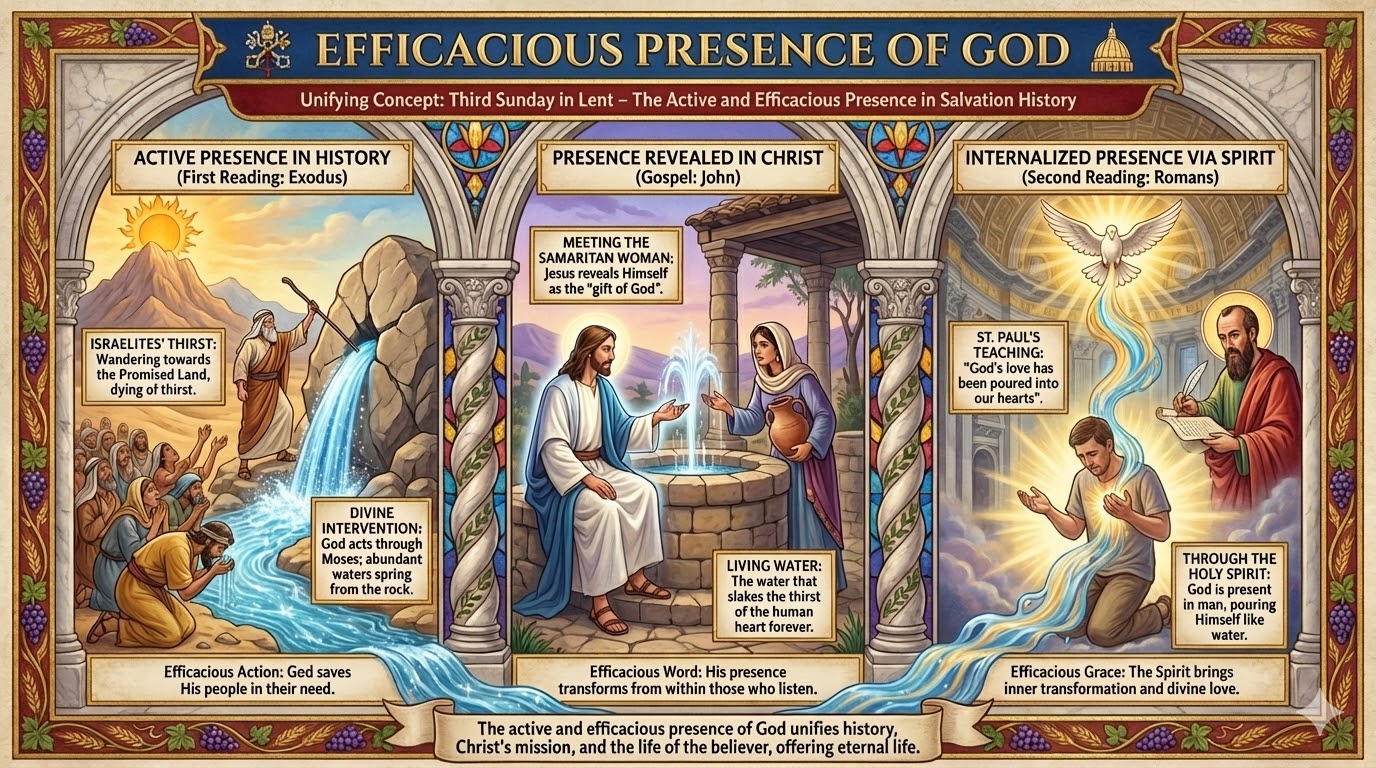
The active and efficacious presence of God in the history of salvation and in the life of mankind can be considered the unifying concept in the liturgy of this third Sunday in Lent. The Israelites are walking through the desert toward the Promised Land, and they are dying of thirst. God intervenes, and through the action of Moses, abundant waters spring from the rock of mount Horeb (First Reading). In the meeting with the Samaritan woman and with the inhabitants of Sychar, Jesus reveals he is the gift of God, the presence of God among the people: the water that slakes the thirst of the human heart, the presence and efficacious word who transforms from within those who see him and listen to him (Gospel). In the letter to the Romans, St. Paul wrote: “God’s love has been poured into our hearts through the Holy Spirit.” God is present in man through the Spirit, pouring himself like water into the human heart (Second Reading).
SOURCE: YEAR A DICASTERY NOTES (2004-05)
Doctrinal Message
God’s Faithful Presence: The History of Salvation
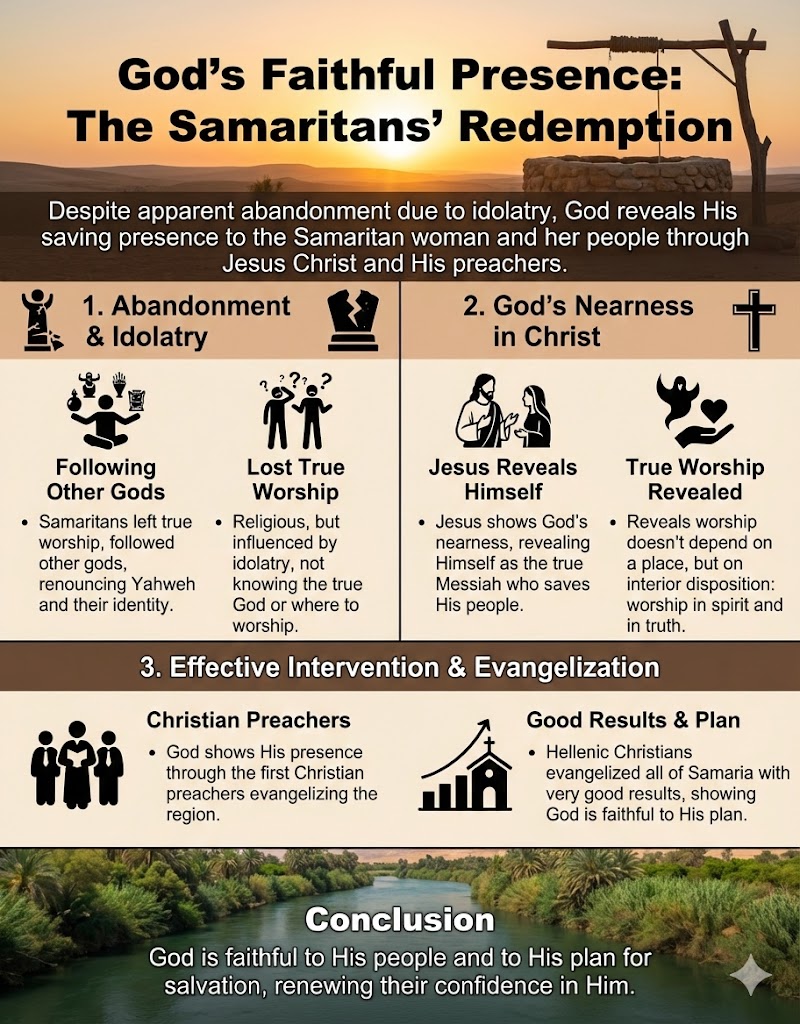
The history of salvation, in which we are immersed, is the theological expression of the divine initiative and of his loving presence and dialogue with mankind. God who “created” the people of Israel, does not abandon them in their need, but fulfills his promise of fidelity in the pact of alliance and accompanies them with his power in their wanderings through the desert. This divine presence is not always “visible.” In fact, the opposite seems true: that God has forgotten his people, and the latter cry out in hunger and thirst in nostalgia for the past. God is moved and intervenes effectively by sending manna, abundance of water, quail, the hope of a “land of milk and honey.” Then the people realize God is truly faithful and renews its confidence in him and his elect: Moses, Joshua, etc.
The Samaritan’s Redemption
The Samaritan woman, and her countrymen, seem abandoned by God, as for centuries they have left the true worship of Yahweh and followed the gods of other peoples, renouncing Yahweh, the only God, and their Jewish identity (cf. 2 Kg 17, 28-31). They are religious persons, but have allowed themselves to be influenced by idolatry, they do not know the true God or where and how to worship him. Nevertheless, God shows his nearness and presence through Jesus Christ and the first Christian preachers. Jesus reveals himself as the true Messiah, the anointed of Yahweh who saves his people, and reveals the true worship of God, which does not depend on a place, but on interior disposition: worship in spirit and in truth. The Hellenic Christians of Jerusalem would evangelize, a few years later, all the region of Samaria with very good results. God is faithful to his people and to his plan for salvation.
God’s faithfulness, his efficacious presence in us and among us, is felt by us through the action of the Holy Spirit, the living water poured into our hearts, the gift the Father has given us to “remind” us of his love. This action of the Holy Spirit gives us the certainty of being “saved” by the work of Jesus Christ, who dies for us, and opens us to hope, a hope that does not deceive, because it is guaranteed by the first fruits of salvation already tasted in this world.
SOURCE: YEAR A DICASTERY NOTES (2004-05)
Pastoral Suggestions
Signs of hope in the world and in the Church
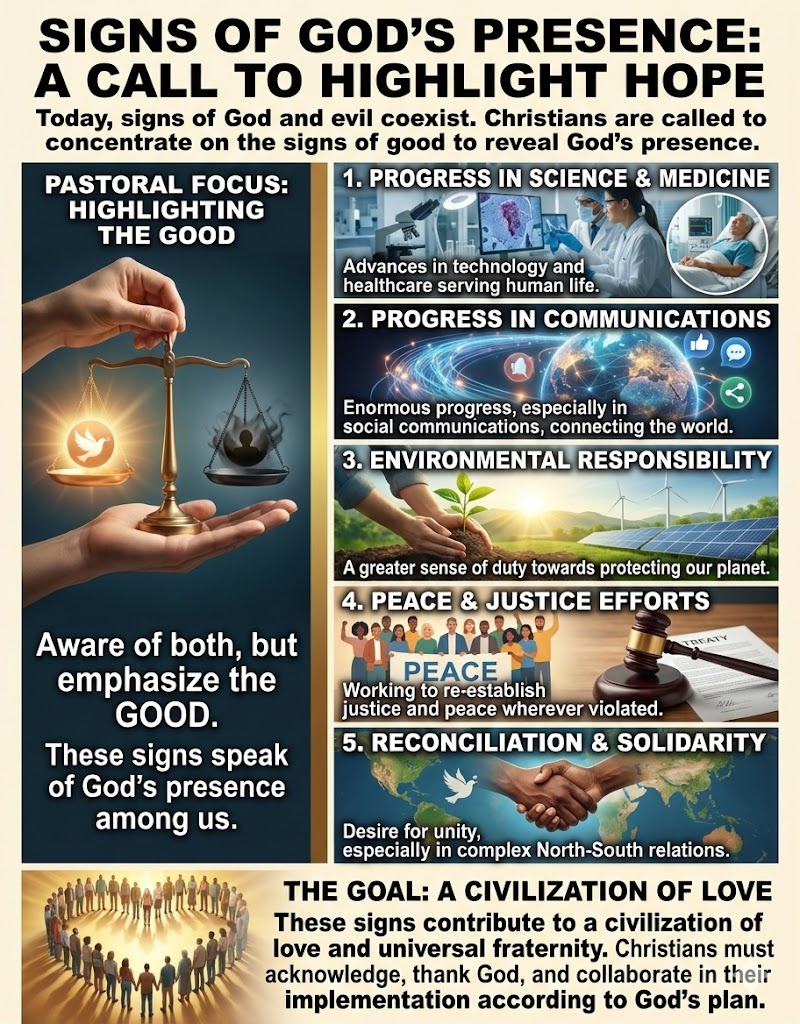
Today there are signs of God and of his presence among us, but there are also signs of evil and of its action in the world. Among the faithful, there will be those who concentrate on the signs of evil, but also those, hopefully the majority, who concentrate on the signs of good and of the divine presence. In the pastoral sense, it is best to be very aware of both kinds, but to highlight the good, as those signs speak to us of God’s presence among us.
Among the signs of hope present in the world: the progress made by science, technology and especially medicine, in the service of human life; the enormous progress in the field of communications, especially social communications; a greater sense of responsibility as regards the environment; the efforts to re-establish peace and justice wherever they have been violated; the desire for reconciliation and solidarity among different peoples, in particular in the complex relation between the North and the South of the world. All these signs of hope, well directed, will contribute to create the civilization of love and to establish universal fraternity. These are signs that Christians must acknowledge, thank God and, wherever possible, collaborate in their implementation according to God’s plan.
SOURCE: YEAR A DICASTERY NOTES (2004-05)
Infographics (visual aids) on this page were designed using Nano Banana Pro with Gemini 3.0. They draw inspiration from the 2004-05 Dicastery for the Clergy Notes (YEAR A | B | C cf. text above), but are not officially associated with or endorsed by the Holy See. They may be copied for personal use or for use in any non-profit ministry (e.g. parish bulletin inserts, classroom or group presentation, posters on community bulletin boards, etc.)
Jesus’ Dialogue with the Samaritan Woman
19 March 2017 – Saint Peter’s Square
The Encounter at the Well and the Promise of Living Water
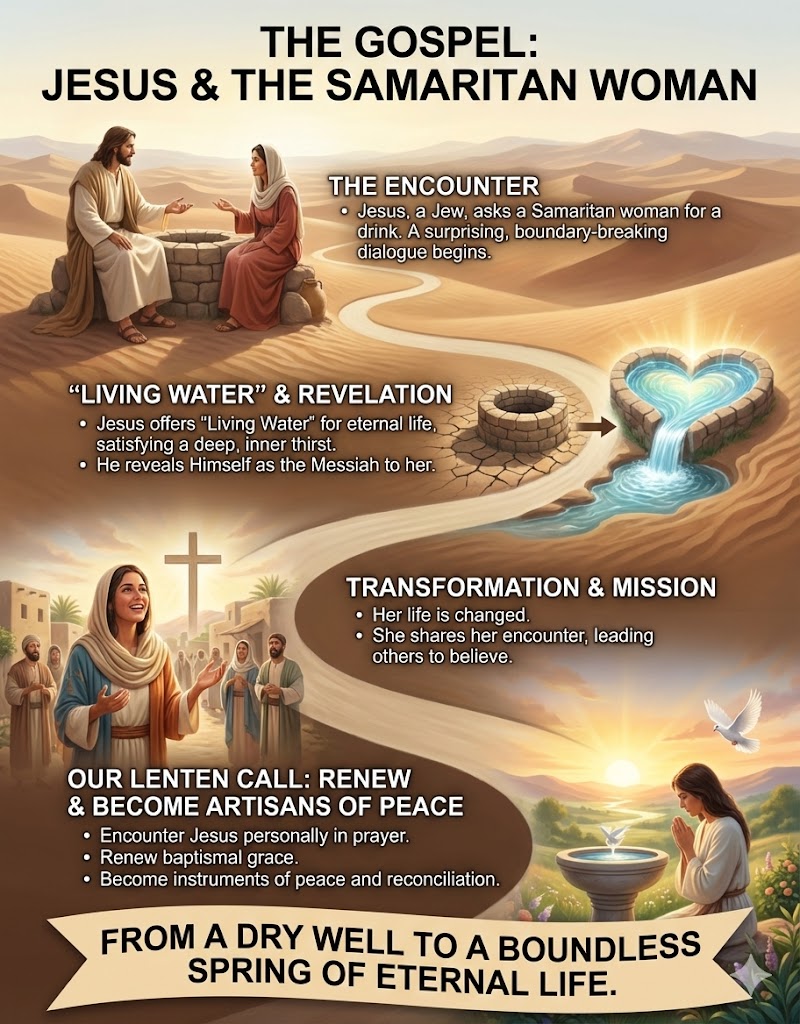
The Gospel for this Third Sunday of Lent presents Jesus’ dialogue with the Samaritan woman (cf. Jn 4:5-42). The encounter takes place as Jesus is crossing Samaria, a region between Judea and Galilee inhabited by people whom the Hebrews despised, considering them schismatic and heretical. But this very population would be one of the first to adhere to the Christian preaching of the Apostles. While the disciples go into the village to buy food, Jesus stays near a well and asks a woman for a drink; she had come there to draw water. From this request a dialogue begins. “How is it that you, a Jew, ask a drink of me, a woman of Samaria?”. Jesus responded: If you knew who I am, and the gift I have for you, you would have asked me for and I would have given you “living water”, a water that satisfies all thirst and becomes a boundless spring in the heart of those who drink it (cf. vv. 9-14).
The Revelation of the Messiah
Going to the well to draw water is burdensome and tedious; it would be lovely to have a gushing spring available! But Jesus speaks of a different water. When the woman realizes that the man she is speaking with is a prophet, she confides in him her own life and asks him religious questions. Her thirst for affection and a full life had not been satisfied by the five husbands she had had, but instead, she had experienced disappointment and deceit. Thus, the woman was struck by the great respect Jesus had for her, and when he actually spoke to her of true faith as the relationship with God the Father “in spirit and truth”, she realized that this man could be the Messiah, and Jesus does something extremely rare — he confirms it: “I who speak to you am he” (v. 26). He says he is the Messiah to a woman who had such a disordered life.
Our Lenten Call: Renewing the Grace of Baptism
Dear brothers and sisters, the water that gives eternal life was poured into our hearts on the day of our Baptism; then God transformed and filled us with his grace. But we may have forgotten this great gift that we received, or reduced it to a merely official statistic; and perhaps we seek “wells” whose water does not quench our thirst. When we forget the true water, we go in search of wells that do not have clean water. Thus this Gospel passage actually concerns us! Not just the Samaritan woman, but us. Jesus speaks to us as he does to the Samaritan woman. Of course, we already know him, but perhaps we have not yet encountered him personally. We know who Jesus is, but perhaps we have not countered him personally, spoken with him, and we still have not recognized him as our Saviour. This Season of Lent is a good occasion to draw near to him, to counter him in prayer in a heart-to-heart dialogue; to speak with him, to listen to him. It is a good occasion to see his face in the face of a suffering brother or sister. In this way we can renew in ourselves the grace of Baptism, quench our thirst at the wellspring of the Word of God and of his Holy Spirit; and in this way, also discover the joy of becoming artisans of reconciliation and instruments of peace in daily life.
“If You Knew the Gift of God…”
27 February 2011 | St Peter’s Square

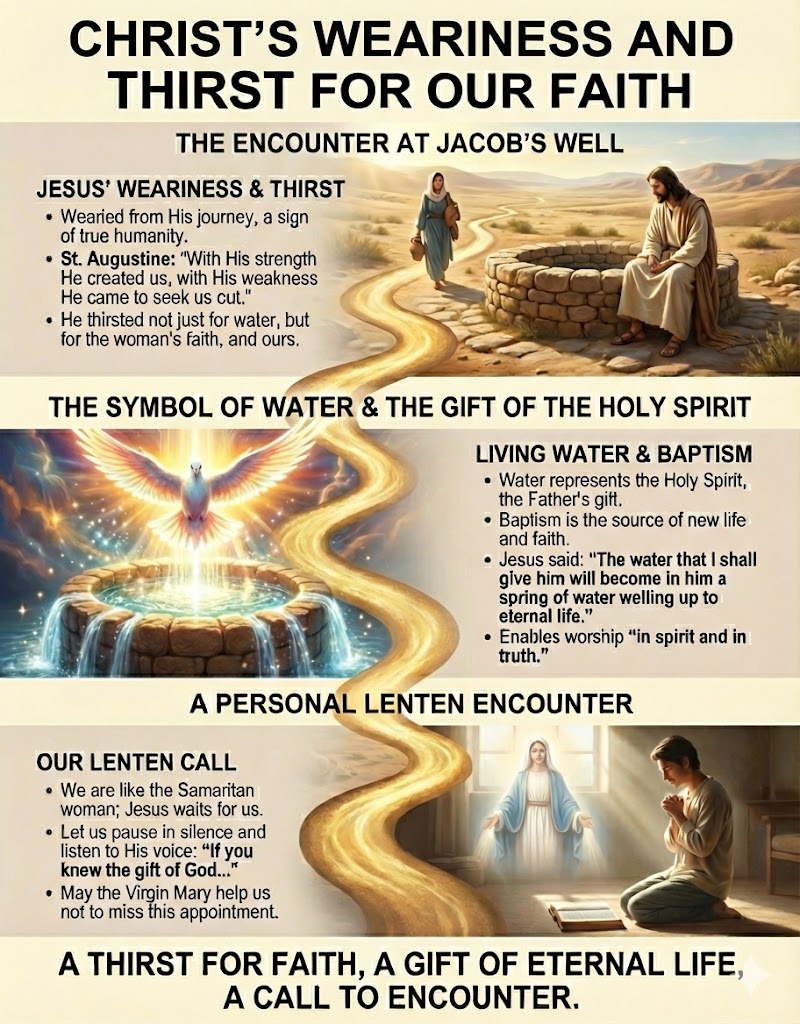
Christ’s Weariness and Thirst for Our Faith
This third Sunday of Lent is characterized by the Jesus’ famous conversation with the Samaritan woman, recounted by the Evangelist John. The woman went every day to draw water from an ancient well that dated back to the Patriarch Jacob and on that day she found Jesus sitting beside the well, “wearied from his journey” (Jn 4:6). St Augustine comments: “Not for nothing was Jesus tried…. The strength of Christ created you, the weakness of Christ recreated you…. With his strength he created us, with his weakness he came to seek us out” (In Ioh. Ev., 15, 2). Jesus’ weariness, a sign of his true humanity, can be seen as a prelude to the Passion with which he brought to fulfilment the work of our redemption. In the encounter with the Samaritan woman at the well, the topic of Christ’s “thirst” stands out in particular. It culminated in his cry on the Cross “I thirst” (Jn 19:28). This thirst, like his weariness, had a physical basis. Yet Jesus, as St Augustine says further, “thirsted for the faith of that woman” (In Ioh. Ev. 15,11), as he thirsted for the faith of us all. God the Father sent him to quench our thirst for eternal life, giving us his love, but to give us this gift Jesus asks for our faith. The omnipotence of Love always respects human freedom; it knocks at the door of man’s heart and waits patiently for his answer.
The Symbol of Water and the Gift of the Holy Spirit
In the encounter with the Samaritan woman the symbol of water stands out in the foreground, alluding clearly to the sacrament of Baptism, the source of new life for faith in God’s Grace. This Gospel, in fact — as I recalled in my Catechesis on Ash Wednesday — is part of the ancient journey of the catechumen’s preparation for Christian Initiation, which took place at the great Easter Vigil. “Whoever drinks of the water that I shall give him”, Jesus said, “will never thirst; the water that I shall give him will become in him a spring of water welling up to eternal life” (Jn 4:14). This water represents the Holy Spirit, the “gift” par excellence that Jesus came to bring on the part of God the Father. Whoever is reborn by water and by the Holy Spirit, that is, in Baptism, enters into a real relationship with God, a filial relationship, and can worship him “in spirit and in truth” (Jn 4:23, 24), as Jesus went on to reveal to the Samaritan woman. Thanks to the meeting with Jesus Christ and to the gift of the Holy Spirit, the human being’s faith attains fulfilment, as a response to the fullness of God’s revelation.
A Personal Encounter in the Season of Lent
Each one of us can identify himself with the Samaritan woman: Jesus is waiting for us, especially in this Season of Lent, to speak to our hearts, to my heart. Let us pause a moment in silence, in our room or in a church or in a separate place. Let us listen to his voice which tells us “If you knew the gift of God…”. May the Virgin Mary help us not to miss this appointment, on which our true happiness depends.
The Exodus of Human Life and the Gift of Living Water
“Whoever drinks of this water that I shall give him will never thirst” (Jn 4:14). Today, on the Third Sunday of Lent, Jesus’ meeting with the Samaritan woman at Jacob’s well is an extraordinary catechesis on faith. To catechumens preparing to receive Baptism and to all believers on their way to Easter, today the Gospel shows us the “living water” of the Holy Spirit, who regenerates man from within, causing him to be reborn to new life “from on high”. Human life is an “exodus” from slavery to the promised land, from death to life. In this journey we sometimes experience the aridity and fatigue of life: poverty, loneliness, the loss of meaning and hope, to the point that we can even wonder, as the Jews did on their journey: “Is the Lord among us or not?” (Ex 17:7). That Samaritan woman, so tried by life, must have frequently thought: “Where is the Lord?”. Until one day she meets a man who reveals the whole truth to her, a woman and even more a Samaritan, in other words, doubly despised. In a simple conversation he offers her the gift of God: the Holy Spirit, a spring of living water welling up to eternal life. He reveals himself to her as the awaited Messiah and tells her of the Father who wants to be worshiped in spirit and truth.
The Martyrs of Motril: Transforming Grace and Heroic Witness
The saints are “true worshipers of the Father”: men and women who, like the Samaritan woman, have met Christ and through him discovered the meaning of life. They have experienced firsthand what the Apostle Paul says in the second reading: “God’s love has been poured into our hearts through the Holy Spirit who has been given to us” (Rom 5:5). The grace of Baptism also came to fruition in the new blesseds. They drank from the fountain of Christ’s love to the point that they were deeply transformed and in turn became overflowing springs to quench the thirst of the many brothers and sisters they met on life’s path.
“Since we are justified by faith, we have peace with God … and we rejoice in our hope of sharing the glory of God” (Rom 5:1-2). Today, in beatifying the martyrs of Motril, the Church puts these words of St Paul on her lips. In fact, Vicente Soler, his six Augustinian Recollect companions and the diocesan priest, Manuel Martín, obtained access to “the glory of the sons of God” by the heroic witness of their faith. They did not die for an ideology but freely gave their lives for the One who had first died for them. They offered Christ the gift they had received from him. By faith these simple men of peace, who had nothing to do with the political debate, worked for years in mission territories, suffered a multitude of hardships in the Philippines, soaked the fields of Brazil, Argentina and Venezuela with their sweat, and started social and educational programmes in Motril and other parts of Spain. When the supreme moment of martyrdom came, by faith they could face death serenely, comforting the other condemned men and forgiving their executioners. “How can this be?”, we ask ourselves, and St Augustine answers: “Because he who reigns in heaven governs the mind and tongue of his martyrs, and through them he has triumphed on earth” (Sermon 329, 1-2). Blessed are you, martyrs of Christ! May everyone rejoice over the honour paid to these witnesses of the faith. God helped them in their tribulations and gave them the crown of victory. May they help those who are working today for reconciliation and peace in Spain and in the world!
Blessed Nicolas Barré: Evangelizing in the Desert of Ignorance
The people who camped in the desert were thirsty, as we are reminded by the first reading from the Book of Exodus (cf. 17:3). The sight of people spiritually thirsting was also before the eyes of Nicolas Barré, of the Order of Minims. His ministry brought him constantly into contact with people who, living in the desert of religious ignorance, were in danger of quenching their thirst at the polluted spring of certain contemporary ideas. That is why he felt it his duty to become a spiritual director and teacher for those he met in his pastoral work. To broaden his range of action, he founded a new religious family, the Sisters of the Child Jesus, whose duty was to evangelize and educate abandoned youth, to show them God’s love, to communicate the fullness of divine life to them and to contribute to their growth as persons. The new blessed never ceased to root his mission in contemplation of the mystery of the Incarnation, for God quenches the thirst of those who live in intimacy with him. He showed that an action performed for God can only unite a person with God and that sanctification also comes through the apostolate. Nicolas Barré invites everyone to trust in the Holy Spirit, who guides his people on the way of abandonment to God, in selflessness, humility and perseverance even in the harshest trials. Such an attitude leads to the joy of steadily experiencing the powerful action of the living God.
Blessed Anna Schäffer: The Workshop of Suffering and Christian Hope
Lastly, if we turn our gaze to Bl. Anna Schäffer, we can see her life as a living commentary on what St Paul wrote to the Romans: “Hope does not disappoint us, because God’s love has been poured into our hearts through the Holy Spirit who has been given to us” (Rom 5:5). The more her life’s journey became a journey of suffering the more clearly she recognized that illness and frailty can be the lines on which God writes his Gospel. She called her sickroom a “workshop of suffering”, to resemble the Cross of Christ ever more closely. She spoke of three keys to heaven: “The largest, which is made of crude iron and heavier than all the others, is my suffering. The second is the needle, and the third the pen. I want to work hard with all these keys every day, so that I can unlock the door of heaven”. Precisely in the most intense pain Anna Schäffer realized that every Christian is responsible for his neighbour’s salvation. For this purpose she used the pen. Her sickbed was the cradle of an extensive letter-writing apostolate. She used what was left of her strength to do embroidery work and in this way give joy to others. In her letters and in her handiwork her favourite motif was the heart of Jesus as the symbol of God’s love. She did not depict the flames of Jesus’ heart as tongues of fire, but as ears of wheat. The reference to the Eucharist, which Anna Schäffer received from her parish priest every day, is unmistakable. The heart of Jesus, as she portrayed it, will thus be the symbol of this new blessed.
A Prayer of Thanksgiving for the Saints
Dear brothers and sisters, let us thank God for the gift of these new blesseds! Despite the trials of life, they did not harden their hearts, but listened to the voice of the Lord, and the Holy Spirit filled them with the love of God. Thus they could experience that “hope does not disappoint” (Rom 5:5). They were like trees planted by streams of water, which yielded abundant fruit in due season (cf. Ps 1:3). For this reason, the whole Church today marvels at their witness and acclaims: Lord, you are truly the Saviour of the world; you are the rock from which flows living water for humanity’s thirst! Lord, give us this water always, so that we may know the Father and adore him in Spirit and Truth. Amen!
