Homilies
Homilies
March 8, 2026
March 15, 2026
4th Sunday of Lent (A)

⬅️  ➡️
➡️

Core Charism: Interiority (searching for God within), community life (“one mind and one heart on the way to God”), and the restless heart that finds repose only in God.
4th Sunday of Lent (A)
Hook: We are all born spiritually blind, wandering in the dark until the unmerited grace of Christ the Divine Physician illuminates our souls.
Approach: St. Augustine preached that the man born blind represents the entire human race. We cannot heal ourselves. The mud on the eyes represents the Incarnation—the Word uniting with the dust of humanity to become our remedy. The reading from Ephesians (“Awake, O sleeper”) is the clarion call of grace.
Application: Acknowledging our absolute dependence on God. Our hearts are restless and our minds are blind until they are illuminated by the grace of God. We must surrender our illusion of self-sufficiency and allow the Physician to wash us in the waters of Baptism and penance.
Key Phrase: “Awake, O sleeper, and let the Divine Physician heal your sight.”

Core Charism: Ora et Labora (Prayer and Work), Stability, Hospitality, Lectio Divina, Listening with the “ear of the heart.”
4th Sunday of Lent (A)
Hook: The miracle begins with an act of radical, simple obedience: Jesus says, “Go, wash,” and the man goes, washes, and comes back seeing.
Approach Application: The Benedictine approach emphasizes the slow, daily rhythm of listening and obeying. God looks into the heart (1 Samuel), not at our outward religious performance. The Pharisees lacked the humility to listen; their hearts were hardened.
Application: The homily would invite the faithful into the practice of conversatio morum (continuous conversion). We are encouraged to wash daily in the waters of prayer and liturgy, cultivating a quiet heart so we can hear Christ’s command to “wake up” (Ephesians) and allow His light to steadily transform our stubbornness.
Key Phrase: “Listen with the ear of your heart, and let His light transform your daily rhythm.”
Core Charism: Contemplation, The Desert, Prayer as Friendship, The Dark Night, Elijah, St. Teresa of Avila.
4th Sunday of Lent (A)
Hook: Paradoxically, it is in the total deprivation of his physical sight that this man’s soul was perfectly prepared for the illuminating light of Christ.
Approach: A Carmelite homily would explore the concept of the “dark night.” The Pharisees are blinded by the “light” of their own intellect and strict rules, living in true spiritual darkness. The blind man, stripped of visual attachments to the world, has a profound interior receptivity.
Application: We are invited into deeper contemplative prayer. Sometimes, God strips away our easy answers and consolations, plunging us into what feels like darkness. We are asked to trust God when we cannot see the path ahead, allowing faith alone to be our guiding light.
Key Phrase: “In the quiet darkness of faith, Christ becomes our only true light.”
Core Charism: Veritas (Truth), Preaching, Study, Combatting Error with Clarity, Contemplation passed on to others.
4th Sunday of Lent (A)
Hook: Christ is the definitive Light of the World, and encountering Him forces an ultimate choice between the Truth and deliberate ignorance.
Approach: Drawing heavily on the stark contrast between light and dark in Ephesians and John, the homily would focus on the intellectual and spiritual blindness of the Pharisees. They have all the data, all the law, and the living miracle before them, but they choose falsehood to protect their power.
Application: A call to rigorous spiritual and intellectual formation. We are urged to “live as children of light” by actively seeking the Truth, conforming our minds to Christ rather than the comfortable blindness of secular culture. True freedom comes only from seeing reality as God sees it.
Key Phrase: “To see clearly is to step courageously into the Light of Truth.”

Core Charism: Poverty, Minority (being “lesser”), Fraternity, and finding God in the grit of humanity and creation.
4th Sunday of Lent (A)
Hook: God does not need grand gestures to work miracles; He uses the humble elements of the earth—dust and saliva—to restore a broken man’s sight and dignity.
Approach: The homily would contrast the Pharisees’ pride and reliance on status with the blind beggar’s simple poverty. Drawing on the reading from Samuel, where God ignores the tall, handsome brothers for the forgotten shepherd boy, the homily points out that society often judges by appearances, but God dwells with the lowly.
Application: We are called to embrace our own spiritual poverty and to look at the marginalized (the homeless, the outcast) not as problems to be solved or “sinners” to be judged (as the disciples initially did), but as places where the glory of God can be revealed.
Key Phrase: “In our simple poverty, Christ uses the dust of the earth to heal us.”

Core Charism: Ad Maiorem Dei Gloriam (For the Greater Glory of God), Discernment of Spirits, Finding God in All Things, Imaginative Contemplation.
4th Sunday of Lent (A)
Hook: The blind man does not receive full spiritual sight instantly; his vision develops through a process of questioning, resistance from others, and gradual discernment.
Approach: An Ignatian homily would trace the blind man’s evolving Christology: he goes from calling Him “the man called Jesus,” to “a prophet,” to a man “from God,” and finally “Lord.” This is contrasted with the Pharisees, whose rigid certainty makes them increasingly blind.
Application: The congregation is invited into an Examen. Where are we spiritually blind due to our own rigid expectations or disordered attachments? We are challenged to pay attention to the gradual ways Christ is opening our eyes to His presence in our daily lives, urging us to step out of the darkness of assumption and into the light of discernment.
Key Phrase: “Lord, open our eyes to discern your steady work in our lives.”
March/April 2026

Core Charism: Preaching “Plentiful Redemption” (Copiosa Redemptio), especially to the abandoned and sinners; Moral Theology (St. Alphonsus Liguori).
4th Sunday of Lent (A)
Hook: When society cast the blind man out, blaming him for his own suffering, the Redeemer actively went searching for him to offer abundant mercy.
Approach: The homily would address the pain of isolation. The disciples ask, “Who sinned?”—reflecting the human tendency to blame the afflicted. But Jesus rejects this. The pivotal moment is in verse 35: when Jesus heard they had thrown him out, he found him.
Application: Lent is the season of Confession and healing. No matter how deep our darkness, our shame, or how rejected we feel by others, Christ the Redeemer is actively seeking us out to offer the light of grace.
Key Phrase: “In our deepest isolation, the Redeemer seeks us out with abundant mercy.
Bishop Robert Barron

2026 HOMILIES | ARCHIVE: 2023 | 2020 | 2017 | 2014 | 2011 | 2005
4th Sunday of Lent (A)
I was Blind and Now I See

Friends, on this Fourth Sunday of Lent, our Gospel is one of the most magnificent stories in the Gospel of John: the healing of the man born blind. John is a theological master, of course, but also a literary master, and this story is beautifully crafted as a sort of icon of the spiritual life. This is not only a story about something that Jesus did; at a deeper level, this is a story about all of us.
4th Sunday of Lent (A)
Featured Homily

Looking Past the Smudges

Fr. Don’s 2011 homily uses a “Family Circus” analogy to explore spiritual blindness in the Gospel of the man born blind. He contrasts a character seeing beauty with another fixated on a dirty window, mirroring the Pharisees who miss the miraculous cure because they focus intently on Sabbath legalities. Fr. Don connects this to the presence of children at Mass, arguing that complaining about their noise is a similar form of spiritual blindness. Instead of hiding children in cry rooms, he asserts they must be welcomed as a vital sign of God’s work within the parish. He concludes by encouraging the congregation to embrace the chaotic “Family Circus” atmosphere of Sunday Mass as the crucial environment where faith grows.

Looking Past the Smudges
Many of us grew up reading the classic Sunday comic strip, The Family Circus. There’s a particularly memorable panel featuring little Jeffy and his older sister, Dolly, standing at the living room window. Bursting with joy, three-year-old Jeffy points outside and marvels at the beautiful birds and blooming flowers. Dolly, however, steps up to the glass and immediately complains about all the dirty fingerprints and smudges covering the pane. Jeffy simply turns to her and drops a wonderful piece of toddler wisdom: windows are meant to be looked through, not looked at.
Isn't that the perspective we all strive for? We want to look past the dirt and distractions of life and see the beautiful reality God has placed before us. Dolly, on the other hand, seems destined for a career in politics, where pointing out the "smudges" on her opponents will come in handy!
Spiritual Blindness and Slinging Mud
We see this exact same dynamic play out in today's Gospel. Jesus grants sight to a man born blind, allowing him to finally experience the vivid world around him—just like Jeffy looking out that window. But the Pharisees aren't celebrating. When they hear the man giving glory to Jesus, they immediately start looking for the dirt on the glass. They zero in on the fact that Jesus performed this miracle on the Sabbath. To them, that makes Jesus a rule-breaker and a sinner, and they dismiss the incredible healing entirely.
Just as Jeffy and Dolly had entirely different ways of seeing, so do the blind man and the religious leaders. The blind man receives his sight and recognizes the Messiah, falling to his knees and saying, "Lord, I believe." The Pharisees, despite having perfect physical vision, are spiritually completely in the dark. In their refusal to accept the truth, they start a smear campaign against the cured man, throwing figurative mud at him. There’s a divine irony there—that Jesus healed him using mud, only to have him wash it all off.
So, where do we stand? Are our eyes open, or are we suffering from the same blindness as the Pharisees? Are we busy throwing mud at the people around us? Today, we are reminded of the pool of Siloam where that man washed. Very shortly, we will pour water over a child here at the font, baptizing them in the name of the Father, the Son, and the Holy Spirit. Just like the man in the Gospel, this child is being washed clean, brought out of the shadows, and welcomed into the radiant light of Christ.
The Controversy of the Crying Child
When you look at the structure of John's Gospel today, the contrast is pretty amazing. The actual miracle—the moment Jesus restores the blind man's sight—is covered in just two short verses. But what about the remaining thirty-nine verses? They are entirely consumed by arguments, interrogations, and the sheer outrage of the Pharisees and neighbors. They were so fixated on the "smudges"—the disruption of their Sabbath rules—that they completely missed the miracle standing right in front of them.
We run the risk of doing the exact same thing right here in church. Think about our reaction to children. During a baptism, a crying baby brings a smile to our faces; it's a beautiful sign of life. But bring that same child back a few years later on a typical Sunday, and the moment they act like a toddler, you can practically feel the temperature in the room drop. The glares start, and people begin wondering why the parents won't "control" their kid. Honestly, the real distraction in many of our parishes isn't the noisy children—it's the adults who have made a habit of complaining.

Seeing the Good in the Sacrifice
I love the old story about a well-meaning priest who paused his homily when he noticed a young mother rushing her crying baby down the aisle toward the exit. Wanting to be welcoming, he called out, "Please, you don't have to leave! Your baby isn't bothering me." The mother stopped, turned around, and said, "No, Father. I'm sorry, but you're bothering my baby."
Jokes aside, let’s look at how today’s Gospel speaks to the tension we sometimes feel with noisy kids in church. When Jesus and His disciples first encounter the man born blind, what’s the very first thing the disciples ask? "Rabbi, who sinned, this man or his parents?" We do the exact same thing today! When a toddler starts fussing in the pew, the immediate thought for some is, "Why aren't the parents doing anything about that?" We automatically look for someone to blame for the distraction.
But listen to how Jesus responds: "He was born blind so that the works of God might be made visible in him." Unfortunately, some people are spiritually blind to those very works. Just like the Pharisees who couldn't see the blessing of a Sabbath healing, complainers in the pews fail to see the incredible good these parents are doing. In a world where it's easier to prioritize personal wealth and quiet weekends, these moms and dads are making real sacrifices to raise children and bring them to the Lord's table. That is absolute Good News. Because when we say, "Through Him, with Him, and in Him," the Holy Spirit isn't just transforming the bread and the wine—He is actively transforming these families, and changing our lives in the process.
Why Cry Rooms Aren't the Answer
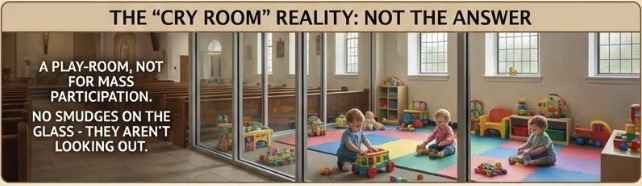
If people can’t blame the parents, they often blame the parish for not having a "cry room." But cry rooms aren’t the answer. Toddlers just treat them like playrooms. In fact, you rarely see smudged fingerprints on those glass windows because the kids aren't even looking through them! If we want perfect silence for meditation, Jesus tells us to go to our rooms and pray in private (Mt 6:6). But if we want our parish to grow, we must follow His other command: “Let the children come to me” (Mt 19:14). Families belong at Mass together; parents shouldn't have to take turns staying home. And if a mom or dad needs to walk a fussy toddler to the back for a five-minute reset, we should support them—not let it distract us—even if they have to walk all the way from the front pew.
Conclusion
Think about the blind man in today's Gospel. He didn't have the perfect theological vocabulary to explain his healing, and he certainly wasn't acting "properly" according to the Pharisees. In the same way, the toddlers in our pews don't fully grasp the mystery of the Mass, and they rarely behave exactly how we'd prefer. But make no mistake: they are here, and they are watching us.
That is exactly why our own reverence is so crucial. We need them to see that something truly profound is happening on that altar. We want them to know, without a doubt, that the Eucharist changes lives. When attending Mass together is simply what a family does, those children absorb that faith, and God's blessings multiply.
Our great hope is that the noisy babies and squirming toddlers in our church today will grow up with the same unshakeable enthusiasm as the man born blind. We pray that no one and nothing will ever steal their joy in Christ, and that they too will boldly declare, "Lord, I believe!" Even if, for the time being, Sunday morning feels a little bit like a Family Circus.
GO DEEPER
PROMPTS TO KEEP YOU WRITING
Copy/paste one of these command prompts into the Catholic Assistant (bottom right corner). This tool can help you brainstorm and provide you with further ideas to keep you writing.
_
- The Perspective of the Window Contrast Jeffy’s joy at the view with Dolly’s focus on window smudges. Show that spiritual vision requires looking through life’s mess to see God’s beauty, rather than fixating on distractions.
- Pharisaic Fixation Link the Pharisees’ focus on Sabbath rules to Dolly’s window smudges. Contrast the blind man’s worship with the leaders’ spiritual blindness, highlighting how they missed a miracle by fixating on dirt.
- The Irony of Mud Analyze the irony of Jesus healing with mud while Pharisees sling mud through accusations. Explain how baptismal washing restores sight, moving the faithful from dark shadows into the Lord's radiant light.
- The Distraction of Judgment Compare Pharisaic glares at Sabbath "violations" to modern parishioners judging noisy toddlers. Argue that a crying child is a sign of life, whereas the real distraction is the adults' judgmental complaining.
- Reframing the Blame Connect the disciples' question about the blind man’s parents to blame directed at parents of fussy toddlers. Use Jesus’ "works of God" response to reframe children as sacred, living blessings.
- The Sacrifice of Parents Focus on parents bringing children to Mass as a "work of God." Contrast secular desires for quiet comfort with the holiness of parents sacrificing weekends to prioritize their family's spiritual life.
- The Bothered Baby Use the anecdote of a mother telling a priest he is "bothering her baby" to highlight parish belonging. Argue that children are not distractions but vital members of the liturgical family.
- The Problem with Cry Rooms Critique "cry rooms" as isolating barriers that prevent children from seeing the altar. Argue that growth requires communal presence, following Jesus’ command to let the little children come to Him.
- Modeling Reverence Emphasize that children absorb faith by watching our reverence. Explain how adult devotion helps kids perceive the mystery of the Eucharist, even if they do not yet fully grasp the theology.
- A Living Faith Conclude by praying that today’s noisy toddlers grow into adults with the blind man’s unshakeable faith, declaring their belief despite the "Family Circus" atmosphere of a living, busy, noisy parish.
4th Sunday of Lent (A)
Fr. Michael Chua
2026 HOMILIES | ARCHIVE: 2023 | 2020 | 2017 | 2014 | 2011
Which Class Do You Belong To?

In his 2023 homily, Fr. Chua uses the story of the man born blind from the Gospel of John to explore the concept of spiritual blindness. He highlights that while many characters in the narrative claim to see, they are spiritually blind, contrasting them with the man born blind who, through his encounter with Jesus, gains both physical and spiritual sight. The homily draws a parallel between the blind man and humanity, suggesting that original sin causes a spiritual blindness that is healed through baptism and the ongoing process of faith. Ultimately, the homily encourages the congregation to recognize their own spiritual blindness and seek the healing grace of God to see with the eyes of faith.
GO DEEPER
PROMPTS TO KEEP YOU WRITING
Copy/paste one of these command prompts into the Catholic Assistant (bottom right corner). This tool can help you brainstorm and provide you with further ideas to keep you writing.
_
- Start a reflection using the Singaporean mother's quote about three types of "seeing." Connect this to the Gospel where only the physically blind man truly admits his lack of sight.
- Describe the disciples' spiritual blindness when they asked Jesus if sin caused the man's physical blindness, assuming a "karma" dynamic that Jesus explicitly rejected as a flawed assumption.
- Contrast the beggar's involuntary physical blindness with the Pharisees' voluntary spiritual blindness. They willfully rejected miracle evidence because it conflicted with their rigid Sabbath interpretations and biased opinions.
- Detail the progressive faith journey of the blind man in John’s Gospel, moving from seeing Jesus as merely a man, then a prophet, and finally worshipping him as Lord.
- Emphasize the narrative's central irony: the man born physically blind is the only one gaining spiritual insight, while those claiming physical sight expose their deep, willful spiritual blindness.
- Discuss the secondary characters' failures to see: the neighbors' disbelief despite evidence, and the parents' refusal to acknowledge the miracle's implications due to their paralyzing fear of authorities.
- Connect the man’s physical blindness to Saint Augustine’s view of it representing humanity's Original Sin, explaining how Baptism acts as the washing that removes this inherited spiritual blindness.
- Expand on St. Paul's call to be "children of light." Describe faith as an ongoing journey from darkness into goodness and truth, rather than a single, completed event.
- Explain the necessity of the Sacrament of Penance in Christian life, using the metaphor of washing blurred vision to restore the spiritual clarity lost through ongoing personal sin.
- Rewrite the narrative, starting with the "three classes of seeing" hook, analyzing the varied blindness of characters in John 9, and concluding with the modern application of Baptismal healing.
4th Sunday of Lent (A)
Dominican Blackfriars
2026 HOMILIES | ARCHIVE: 2023 | 2020 | 2017 | 2014 | 2011 | 2008 | 2005 | 2002
The Creative Judge
In “The Creative Judge,” Fr. Simon Francis Gaine O.P. transforms the Christian view of divine judgment from fear into a longing for grace. He argues that unlike flawed human assessment, God’s judgment as a merciful protector is actively creative, not merely revelatory. Because God’s Word is inherently creative, His judgment establishes a new reality within the believer, putting the old sinful self to death and raising a “new self” to life, much like Jesus restoring sight to the blind man. This divine act liberates humanity from false guilt and inaccurate self-condemnation. Gaine concludes with a Lenten challenge to remove obstacles to this creative mercy in preparation for Easter renewal.

GO DEEPER
PROMPTS TO KEEP YOU WRITING
Copy/paste one of these command prompts into the Catholic Assistant (bottom right corner). This tool can help you brainstorm and provide you with further ideas to keep you writing.
_
- Desiring Judgment: Write a theological reflection exploring why biblical judgment should be deeply desired rather than feared. Frame the divine judge as a protective advocate for the weak and vulnerable.
- The Honest Reckoning: Describe the human tendency to gloss over sins out of fear. Narrate how a fearful soul realizes that true divine judgment brings hidden, liberating truth into the light.
- Flawed Self-Perception: Expand on the concept of human misjudgment. Detail the internal conflict of a person who constantly swings between being too lenient on themselves and condemning themselves without cause.
- The Folly of Blame: Rewrite the biblical scene of the man born blind. Emphasize the disciples' flawed instinct to assign karmic blame for suffering, contrasting it with divine clarity that rejects such assumptions.
- Seeing the Heart: Craft a narrative based on the anointing of David. Contrast human bias toward outward appearances, like height and strength, with divine vision that exclusively evaluates the inner heart.
- Liberation from Guilt: Write a meditation on how perfect divine judgment frees individuals from the crushing weight of false accusations and misplaced blame, offering profound psychological and spiritual relief.
- The Word that Makes: Explore the philosophical concept of a creative divine utterance. Explain how God's spoken word does not merely describe reality but actively brings new existence and truth into being.
- Declared Lovable: Detail the transformative process of divine mercy. Describe how a divine declaration of love actively destroys an individual's old, sinful self and simultaneously breathes life into a renewed spirit.
- Creating Sight: Expand on the healing of physical blindness as a metaphor for spiritual recreation. Describe how divine judgment acts as a creative force, instantly replacing darkness with vibrant, living light.
- Clearing the Path: Formulate a Lenten reflection on human free will. Describe the intentional removal of spiritual obstacles, allowing divine mercy to enter the heart and prepare it for Easter's renewal.
4th Sunday of Lent (A)
Fr. Austin Fleming
2026 HOMILIES | ARCHIVE: 2023 | 2020 | 2017 | 2014 | 2011 | 2008
Do We See or Are We Blind?
In his 2011 Lenten homily on the Gospel of the man born blind, Fr. Fleming explores the narrative as a profound lesson on spiritual illumination, centered on Jesus as the “light of the world.” He challenges listeners to examine the foundational “light” they use to discern truth and reality. Fleming contrasts the spiritual blindness of the Pharisees, whose strict legalism obscured God’s work, with modern culture’s dangerous reliance on subjective truth. To cure this inherent blindness, he urges viewing the world through the “corrective lenses” of God’s word, compassion, and Church wisdom instead of distorted worldly lenses. The homily concludes by linking this spiritual sight to recognizing Christ beneath the physical elements of the Eucharist.

GO DEEPER
PROMPTS TO KEEP YOU WRITING
Copy/paste one of these command prompts into the Catholic Assistant (bottom right corner). This tool can help you brainstorm and provide you with further ideas to develop your homily.
_
- The True Healing: Write a reflection contrasting physical blindness with spiritual darkness. Describe Jesus curing a blind man not just to restore physical sight, but to reveal himself as the ultimate light.
- The Illusion of Sight: Expand on the irony of religious leaders who claim to see clearly but remain trapped in darkness. Highlight how strict adherence to rules blinded them to miraculous divine joy.
- Subjective Truth vs. Divine Reality: Rewrite a narrative exploring how modern society dangerously equates personal opinion with infallible truth. Contrast this chaotic individualism with the clarifying, objective wisdom found in divine compassion and love.
- Lenses of Faith: Create a piece utilizing the metaphor of spiritual corrective lenses. Detail how scripture, ancient wisdom, and divine love act as glasses to fix our distorted, media-driven, profit-focused worldview.
- By What Light: Structure a meditation using repeated, challenging questions about the "light" guiding daily decisions. Force the reader to choose between worldly priorities—like prejudice and profit—and divine wisdom.
- Stripping Away Illusions: Describe a mid-season journey of fasting, prayer, and charity. Explain how these specific disciplines intentionally strip away worldly illusions, allowing believers to step out of darkness and embrace truth.
- Seeing Beyond the Surface: Write a conclusion set during a sacred meal. Explain how true spiritual sight allows believers to look past the physical appearance of bread and wine to find divine presence.
- Formed from the Earth: Expand on the gritty detail of mud and saliva used for healing. Connect this physical, earthy act of recreation to the broader spiritual recreation of the human soul.
- The Heart of the Matter: Contrast looking at the world through a lens of judgment and profit with seeing through divine compassion. Urge the reader to look past superficial appearances directly into the heart.
- Stepping Out of Shadows: Craft a narrative arc following a soul moving from profound spiritual ignorance into brilliant divine illumination. Emphasize that abandoning personal pride is the required first step toward true vision.and loves us anyway. us anyway.
4th Sunday of Lent (A)
Monsignor Peter Hahn

2026 HOMILIES | ARCHIVE: 2023 | 2020 | 2017 | 2014
Let Me See Again
In his 2017 homily, Msgr. Hahn explores the profound difference between physical sight and spiritual understanding, using the Gospel narrative of Jesus healing the man born blind as its central framework. The homily contrasts the man’s miraculous physical and spiritual awakening with the paradoxical blindness of the Pharisees, whose pride and self-sufficiency obstruct their ability to recognize God’s truth. Drawing connections to the liturgical “scrutinies” for catechumens and the Old Testament account of David’s unlikely anointing, the text emphasizes that God judges by the heart rather than outward appearances. Ultimately, it issues a call to believers to shun the “works of darkness” and embrace their identity as “children of light,” specifically urging participation in the Sacrament of Reconciliation as the necessary means to heal personal spiritual blindness and receive Christ’s restorative touch.

GO DEEPER
PROMPTS TO KEEP YOU WRITING
Copy/paste one of these command prompts into the Catholic Assistant (bottom right corner). This tool can help you brainstorm and provide you with further ideas to develop your homily.
_
- The duality of sight. Expand on the phrase "I see," contrasting mere physical vision with the deeper spiritual understanding and faith required to grasp truths that are invisible to the eye.
- The Gospel paradox. Retell the encounter between Jesus and the man born blind, highlighting the irony that physical healing leads to spiritual sight, while the sighted Pharisees remain spiritually blind due to pride.
- Sin as spiritual blindness. Explain how the Gospel connects physical infirmity to sin, illustrating that the Pharisees' self-sufficiency and opposition to God's love reveal their true, hidden spiritual impairment.
- Prayers for the elect. Connect the Gospel theme of sight to the Lenten scrutinies for baptisimal candidates, focusing on the prayer to free them from blinding false values and make them "children of light."
- God’s standard of judgment. Incorporate the Old Testament account of Samuel anointing David to illustrate that God does not judge by outward appearance or stature, but by His own divine standards.
- Unexpected grace. Reflect on how God's choice of the unlikely David demonstrates that grace is continually poured out as an unexpected gift, despite human weakness, sin, and unworthiness.
- Living as children of light. Expound on St. Paul’s call for believers to embrace their baptismal identity as "children of light," purging themselves of the fruitless works of darkness during the Lenten season.
- The danger of self-sufficiency. Warn against the spiritual danger of imitating the Pharisees, who, believing they already understand everything, arrogantly claim they have no need for God's healing or forgiveness.
- The necessity of Confession. Emphasize the indispensable need for the Sacrament of Confession during Lent as the primary means to receive Christ's healing touch and restore spiritual sight, rejecting the denial of sin.
- Invitation to healing. Conclude with an exhortation to open oneself to Jesus's healing gift, so that, having been washed and restored to sight, believers may boldly proclaim Christ's light and truth.
4th Sunday of Lent (A)
Fr. Charles E. Irvin

Seeing is Believing

Fr. Irvin’s homily explores the paradoxical nature of the phrase “seeing is believing” through the Gospel account of Jesus healing the man born blind. The homily contrasts the physical sight and spiritual blindness of the Pharisees with the physical blindness and eventual spiritual sight of the healed man. It highlights Jesus’ use of saliva and clay as symbolic of his divine power and role as Creator. The blind man’s journey to faith is presented as a gradual process of recognizing Jesus, first as a man, then a prophet, and finally as the Son of Man worthy of worship. In contrast, the Pharisees’ skepticism and pride lead them deeper into spiritual darkness. The homily concludes by applying these themes to contemporary life, challenging listeners to overcome the “blindness” of busyness and worldly cares during Lent and to actively seek the light of Christ in their lives.

GO DEEPER
PROMPTS TO KEEP YOU WRITING
Copy/paste one of these command prompts into the Catholic Assistant (bottom right corner). This tool can help you brainstorm and provide you with further ideas to develop your homily.
_
- The central paradox. Expand on the idea that "seeing is believing" is paradoxically proved by the blind man gaining spiritual sight, yet disproved by the sighted Pharisees remaining spiritually blind to Jesus' divinity.
- Creation symbolism. Rewrite the section detailing Jesus using saliva and earth to heal the man, emphasizing the direct parallel to God fashioning humanity from clay in the Book of Genesis.
- Source of power. Explain that Jesus used His own saliva rather than just water to demonstrate that the miraculous healing power came solely from His divine personhood, not an external source.
- Gradual progression of faith. Trace the blind man's evolving recognition of Jesus, moving from identifying Him as merely a man, to a prophet, and finally worshipping Him as the divine Son of Man.
- Descent into darkness. Describe the Pharisees' step-by-step journey into spiritual blindness, starting with initial doubt, rejecting testimony, and ending in stubborn pride that refused to see the Light standing before them.
- Underlying theological themes. Expand on how this narrative exemplifies St. John’s major Gospel themes, specifically the movements from chaos to order, darkness to light, and death to life through Christ.
- Modern spiritual obstacles. Rewrite the application section, suggesting that contemporary spiritual blindness is caused less by pharisaic skepticism and more by being too distracted by worldly concerns to notice God.
- Divine initiative. Elaborate on the theme that God always seeks humanity first, tracing this movement from Adam and Eve, through the Incarnation, to Jesus searching for the blind man.
- The Lenten call. Contextualize the need for spiritual vision within the season of Lent, framing it as a deliberate time to step back from worldly cares to examine the soul.
- A prayer for vision. Expand the conclusion into a supplication for spiritual sight, using the blind man's request to ask for the miracle of recognizing God's presence in daily life.
4th Sunday of Lent (A)
Fr. Joe Jagodensky, SDS
The Blind See & Others Don’t Listen

Fr. Joe Jagodensky uses a humorous anecdote about Alfred Hitchcock’s selective perception on the set of Rear Window to illustrate the human tendency toward spiritual blindness. He connects this to sin, defining it as having “tainted eyes” and stubborn, “wax-ladened” ears that cause people to miss God’s message because they are only listening to formulate their own responses. Lent is presented as a critical time to overcome distractions and truly open one’s senses to the subtle pleas of others and the inner voice of conscience. Drawing on the biblical example of the unlikely election of King David, Fr. Joe emphasizes that redemption requires seeing God’s perspective rather than human expectations. He concludes with a call to actively “rub those eyes” and “clean out that wax” to perceive God communicating.

GO DEEPER
PROMPTS TO KEEP YOU WRITING
Copy/paste one of these command prompts into the Catholic Assistant (bottom right corner). This tool can help you brainstorm and provide you with further ideas to develop your homily.
_
- The Deception of Perception: Rewrite the Grace Kelly anecdote, focusing on how Hitchcock's preconceived notion of her appearance led him to see a non-existent change. Explore the broader implication of how easily human perception can be deceived by expectations.
- The Root of Sin as Blindness: Expand on the idea that sin's root lies in "tainted eyes" and "wax-ladened ears." Connect this concept to the Grace Kelly story, illustrating how selective perception and stubbornness hinder spiritual clarity.
- Listening vs. Formulating a Response: Create a relatable scenario about a political conversation where one person is busy formulating their response while the other is still speaking. Highlight the missed opportunity for understanding and the potential for agreement that goes unnoticed.
- Seeking a Common Vision: Discuss the challenge of "wide open" eyes seeing differences and seeking a "common vision." Use the example of a political conversation to illustrate how people often miss God's message, which may be completely different from their own petty views.
- The Unheard Pleas: Write a reflective piece on the importance of opening our ears to the subtle pleas of children and the unspoken feelings behind their words. Emphasize the need for sensitivity and active listening during Lent.
- The Inner Voice of Conscience: Explore the concept of the "inner voice" that warns us when we are wrong, but we often ignore it. Use the Grace Kelly story as a metaphor for how we can be deceived by our own desires and ignore the truth.
- The Quiet Grief of Others: Write a compassionate reflection on the importance of hearing the whisperings of someone's grief, even when there is nothing we can do but offer a silent prayer. Connect this to the Lenten theme of opening our ears and hearts.
- Escaping Silence: Discuss the modern tendency to escape the "annoyingly noisy silence" of personal reflection through distractions like television, alcohol, drugs, video games, and social media. Contrast this with the Lenten call to open our eyes and ears to God.
- Redemption Through Listening: Expand on the story of David, the youngest and "ruddy" son chosen as King, who found redemption by listening more and seeing God's greatness and forgiveness. Use this as an example for Lenten transformation.
- A Lenten Call to Action: Craft a concluding call to action for the Lenten season, urging readers to "keep rubbing those eyes" to search for God's perspective and to "keep cleaning out that wax," because God is actively speaking and listening.
4th Sunday of Lent (A)
Deacon Greg Kandra
An Encounter with Christ Brings Light to Those in Darkness
This 2023 homily outline submitted to CTU’s Preaching with the Sciences website centers on Jesus healing the man born blind, exploring Christ’s declaration as the “light of the world.” It frames the miracle as a moment of divine reshaping—echoing Jeremiah’s potter’s clay—intended to grant both physiological sight and profound spiritual vision. The outline incorporates a “scientific turn,” acknowledging vision’s immense role in learning and the psychological impact of blindness, while respecting the capabilities of the visually impaired. Christ’s intervention fundamentally restores dignity by reintegrating an outcast into society. The conclusion challenges the congregation to adopt a “Christ-lens” to perceive their own spiritual blindness and fulfill their commission to live as “children of the light.”

GO DEEPER
PROMPTS TO KEEP YOU WRITING
Copy/paste one of these command prompts into the Catholic Assistant (bottom right corner). This tool can help you brainstorm and provide you with further ideas to develop your homily.
_
- Divine Reshaping: Rewrite the opening scene where disciples blame sin for blindness. Have Jesus reject this, then describe the miracle using the clay as a metaphor for God reshaping a broken vessel, echoing Jeremiah the potter.
- Scriptural Echoes of Light: Expand on the scriptural theme of light. Connect Jesus’ declaration “I am the light” with the Old Testament caution regarding outward appearances versus God's vision, and Paul’s exhortation to live as “children of light.”
- The Psychology of Sight Loss: Write a section detailing the psychological impact of physical blindness. Discuss the heavy reliance on sight for learning and how its absence can lead to depression, isolation, anxiety, and a flawed understanding of reality.
- Nuanced Sensory Perception: Create a paragraph acknowledging that while lack of sight limits certain inputs, those who are physically blind often develop enhanced alternative sensory perceptions and complex mental capacities exceeding sighted people.
- Dispelling Fear and Darkness: Describe the immediate impact of Jesus entering the man's life. Focus on restoring sight not just as physical repair, but as dispelling deep-seated fear and introducing overwhelming color and complex reality.
- Restoration of Social Dignity: Explain the sociological impact of healing in 1st-century Palestine. Detail how restoring sight was a restoration of dignity, allowing the man to rejoin society and cease being a marginalized outcast.
- The Christ-Lens Metaphor: Develop the metaphor of the "Christ-lens." Just as an eye lens sharpens focus, explain how viewing the world through Christ brings spiritual clarity, understanding, and ultimate truth to life's chaos.
- Identifying Spiritual Shadows: Write a challenging conclusion asking the audience to identify their own non-physical blindness. Assuming everyone has "spiritual shadows," ask what specific areas of life need Christ’s light to dispel ignorance.
- Fulfillment of Genesis: Connect the healing miracle back to creation narratives. Argue that God's first commands in Genesis, "Let there be light," find their ultimate spiritual fulfillment in Jesus bringing clarity to a human soul.
- Commissioned as Light-Bearers: Draft a final call to action for the congregation. Commission them as empowered "children of light" whose duty is to actively shine.
4th Sunday of Lent (A)
Fr. Langeh, CMF

Looking for fresh ideas? Copy/paste one of these command prompts into the Catholic Assistant (bottom right corner). This tool can help you refine your homily.
_
NOT AVAILABLE
The command prompts above were created using the homily below as a foundation. Please note that Fr. Langeh's homily itself is entirely human-written and was NOT generated by AI.
Open Your Eyes to the Lord!
4th Sunday of Lent (A)
Deacon Peter McCulloch

2026 HOMILIES | ARCHIVE: 2023 | 2020
Divine Spittle
blind in the Gospel of John. It examines various interpretations of this act: as a blessing, ancient folk medicine, and a symbolic representation of creation. Drawing on John Bergsma and the Dead Sea Scrolls, the homily argues that Jesus’ actions mirror God creating Adam from dust and spittle, signifying a new creation. The use of water from the Pool of Siloam, linked to the Garden of Eden, further reinforces this theme. The homily concludes by connecting the man’s healing to Baptism, where believers are reborn as a new creation in Christ. Ultimately, Jesus’ use of spittle demonstrates his intimate and personal love, his willingness to embrace human brokenness, and his desire to restore wholeness.

GO DEEPER
PROMPTS TO KEEP YOU WRITING
Copy/paste one of these command prompts into the Catholic Assistant (bottom right corner). This tool can help you brainstorm and provide you with further ideas to develop your homily.
_
- Varied Healing Modalities: Describe the diverse methods Jesus used for healing in the Gospels, contrasting prayer, spoken commands, physical touch, and remote healing with the specific, unusual instances where he utilized his saliva.
- The Mud Paste Narrative: Recount the Gospel story where Jesus heals a blind beggar by creating a mud paste with spittle, applying it to his eyes, and sending him to wash in the Pool of Siloam for sight restoration.
- Cultural Context of Spittle: Address the historical paradox of Jesus using spittle, contrasting its perception as a grave insult with its accepted use in Jewish folk medicine for healing eye ailments, citing historical sources like Pliny.
- Genesis Creation Echoes: Explain the theological view that mixing spittle and clay mirrors God creating Adam from dust, interpreting Jesus' actions as a deliberate re-enactment of Genesis to form a new "son of the light."
- Dead Sea Scrolls Evidence: Detail John Bergsma’s connection between this healing and the Dead Sea Scrolls, noting how ancient Jewish manuscripts describe humans as vessels kneaded from dust and spittle, reinforcing the creation theme.
- Siloam's Eden Connection: Explore the symbolic importance of the Pool of Siloam, explaining how its water source, the Gihon Spring originating in Eden, reinforces the narrative theme of a new creation being established.
- Baptismal Typology: Connect the imagery of washing in water and gaining sight to the sacrament of Baptism, framing the narrative as an allegory for cleansing the darkness of inherited original sin from Adam and Eve.
- Restoring the Spirit: Clarify that while the man bore no personal guilt, his blindness typifies the inherited absence of the Holy Spirit, which baptismal washing spiritually repairs by restoring divine light and life.
- Pauline New Creation: Use St. Paul’s teaching in 2 Corinthians about being a "new creation" in Christ as a theological lens to interpret how Jesus re-creates and enlightens the man born blind through dust and water.
- The Intimacy of Touch: Conclude by arguing that Jesus using spittle demonstrates his willingness to engage personally with human brokenness, getting his "hands dirty" and using tangible touch as an ultimate sign of divine love.
4th Sunday of Lent (A)
Msgr. Charles Pope
I Went, I Washed, And Now I See
The Gospel story of the man born blind mirrors the Christian journey from spiritual darkness to light. Born blind, symbolizing our state of original sin and lack of spiritual vision, the man encounters Jesus, the Light of the World. Jesus heals him, not by assigning blame, but through a process involving spittle and clay, followed by washing in the Pool of Siloam—a clear prefigurement of Baptism, which enlightens us.
Initially, the healed man has only partial perception, knowing Jesus merely as “the man called Jesus.” However, through persecution by the Pharisees and his own reflection, his understanding deepens. He progresses to seeing Jesus as a prophet, then as someone “from God.” Finally, after being cast out of the synagogue, he encounters Jesus again and comes to full faith, worshiping Him as Lord. This progression illustrates how baptism, faith, and enduring challenges lead us to fully see and embrace Christ.

GO DEEPER
PROMPTS TO KEEP YOU WRITING
Copy/paste one of these command prompts into the Catholic Assistant (bottom right corner). This tool can help you brainstorm and provide you with further ideas to develop your homily.
_
- Defining Spiritual Blindness: Describe the initial state of humanity as being "born in darkness" due to original sin, characterized by a lack of divine purpose and an inability to see God's glory before Christ intervenes.
- Baptismal Allegory: Narrate Jesus healing the blind man with spittle and clay at the Pool of Siloam as a direct prefigurement of Christian Baptism, emphasizing the transition from darkness to becoming "sons of light."
- The Unevangelized Believer: Develop the concept of "partial perception" where a baptized person knows facts about "the man called Jesus" but lacks a personal relationship, mirroring the blind man's initial confusion after healing.
- Growth Through Trial: Explain how facing persecution, interrogation, and ridicule refines faith, using the blind man's evolving testimony—from calling Jesus a "prophet" to declaring Him "from God"—as the primary example.
- Final Enlightenment: Describe the culmination of the Christian journey where, after being rejected by the world, the believer encounters Jesus face-to-face, moving from partial sight to full faith and worship of Him as "Lord."
- The Allegory of Sight: Compose a theological reflection on how the physical healing of the man born blind serves as a step-by-step allegory for the soul's liberation from the prison of original sin through faith.
- The Symbolism of Siloam: Explain the significance of Jesus sending the man to wash in the Pool of Siloam, meaning "Sent," connecting this specific act to the necessity of water and Spirit in Baptism for true sight.
- The Inward Curse: Expand on the state of being "curvatus in se" (turned inward) as the defining characteristic of unredeemed humanity, imprisoned in darkness and unaware of their true created purpose until enlightened by Christ.
- The Challenge of Disbelief: Detail the specific interrogations by the Pharisees against the healed man and his parents, showing how their ridicule and threats paradoxically strengthened the man's conviction that Jesus acted with divine authority.
- The Encounter with the Son of Man: Narrate the final scene where Jesus finds the outcast man and reveals His identity as the Son of Man, prompting the immediate response of complete belief and adoration from the newly enlightened disciple.s to follow her.
4th Sunday of Lent (A)
Father Kevin Rettig
2026 HOMILIES | ARCHIVE: 2023 | 2020
The Light Within
Fr. Kevin Rettig’s homily uses Khalil Gibran’s story of a blind astronomer to explore the concept of inner vision and the loss of wonder in the modern world. It suggests that external distractions and artificial lights blind people to the “stars, moons, and suns” within themselves—representing inner qualities like memory, hope, self-confidence, understanding, and ultimately, love, which is identified as God. The author argues that humanity, like the man born blind in the Gospel, needs to “recapture the gift of blindness” to rediscover this inner divine light. By embracing inner darkness and seeing the light within, individuals can truly see and connect with the divine light in others, leading to a collective embrace by God.

GO DEEPER
PROMPTS TO KEEP YOU WRITING
Copy/paste one of these command prompts into the Catholic Assistant (bottom right corner). This tool can help you brainstorm and provide you with further ideas to develop your homily.
_
- Inner Astronomy Narrative: Retell the story of a blind man introduced as the land's wisest astronomer, who explains that he watches brilliant suns, moons, and stars shining within his own breast because he is not distracted by the outside world.
- The Distracted Gaze: Explain how modern society, distracted by artificial external lights, has lost the ability to see the "brilliant suns and stars" shining within, contrasting the ability to see far-off things with blindness to what is near.
- Loss of Night's Wonder: Describe the spiritual and ecological consequences of light pollution, where a yellow haze replaces star-filled nights, disrupting natural rhythms and replacing celestial wonder with artificial sidewalk stars like those in Hollywood.
- Embracing Voluntary Blindness: Issue a directive for a guided meditation, inviting people to close their eyes to artificial outer lights and re-enter a womb-like darkness so consciousness of brilliant inner lights can finally emerge.
- Mapping First Internal Lights: Describe the initial inner lights encountered in meditative darkness: the comforting waning moon of memory, the star of hope piercing deep darkness, and the revealing ray of self-confidence showing hidden strength.
- The Galaxy of Inner Virtues: Expand on the internal cosmos waiting to be seen, listing stars of understanding, peace, joy, and wisdom, alongside moons of self-knowledge, humility, connectedness, and the full moon of compassion.
- The Central Inner Sun: Culminate the description of inner celestial bodies by focusing on the greatest light reflecting them all: the magnificent Sun of love radiating within since birth, warming every enlightened thought and act.
- Defining Divine Light: Equate the tremendous internal light manifested in these inner suns and stars with God, arguing that humans must recapture the "gift of blindness" to rediscover this magnificent divine life within.
- A New Vision of Others: Explain how rediscovering one's own inner light changes perception upon opening eyes, allowing one to see others in the "light of God" and recognize their hidden divine brilliance, perhaps for the first time.
- The Spiritual Embrace: Conclude by connecting the need for inner "blindness" to the human encounter with Christ, urging readers to embrace inner light to truly see and embrace one another, ultimately leading to being embraced by God.
4th Sunday of Lent (A)
Fr. George Smiga
2026 HOMILIES | ARCHIVE: 2023 | 2020 | 2017 | 2014 | 2011 | 2008 | 2005
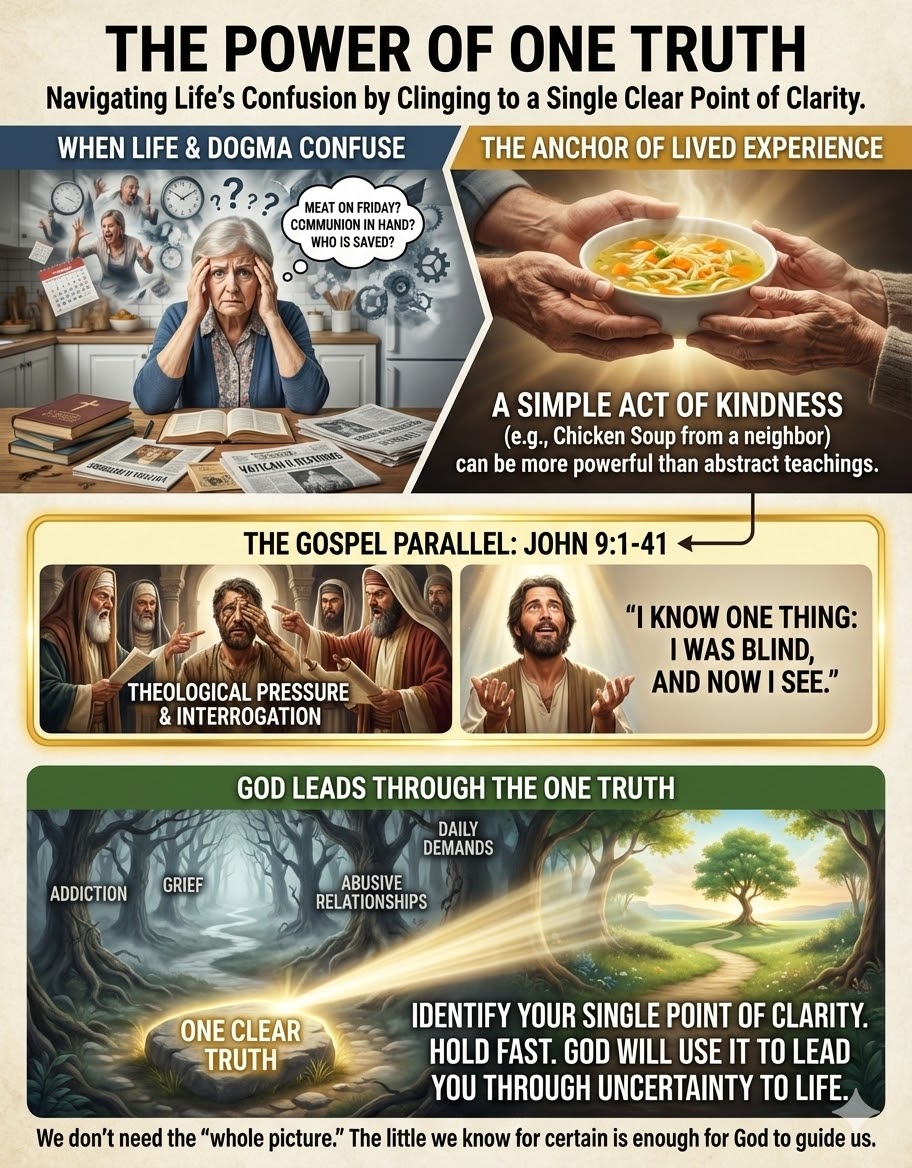
The Power of One Truth

In this sermon based on the Gospel of the man born blind (John 9:1-41), Fr. George explores navigating seasons of overwhelming confusion and theological uncertainty. He opens with an anecdote about his mother, whose traditional Catholicism was shaken by Vatican II reforms. Despite her confusion, she anchored her faith in a singular lived experience: the life-saving kindness of a Jewish neighbor, overriding abstract anti-Semitic teachings. Fr. George connects this to the blind man in the Gospel, who, facing intense religious pressure, clung to his one certainty: “I was blind, and now I see.” The sermon argues that when paralyzed by life’s complexity, we do not need the “whole picture,” but must hold fast to just “one clear truth” to allow God to lead us forward.
GO DEEPER
PROMPTS TO KEEP YOU WRITING
Copy/paste one of these command prompts into the Catholic Assistant (bottom right corner). This tool can help you brainstorm and provide you with further ideas to develop your homily.
_
- The Shock of Reform: Describe the disorientation of an older Polish Catholic immigrant in the 1970s whose foundational faith is shaken by Vatican II changes, specifically regarding dietary rules and receiving Communion in the hand.
- Kindness Over Dogma: Narrate a flashback scene where a Jewish neighbor brings life-saving chicken soup to a sick Polish grandmother, defying the local priest's anti-Semitic teachings through a simple act of shared humanity.
- Lived Experience vs. Teaching: Explore the internal conflict of a believer who adheres to strict church rules on fasting but rejects hostile teachings about Jewish neighbors because her actual experience of their love contradicts the pulpit.
- The Blind Man's anchor: Retell the biblical narrative of the man born blind, focusing on his confusion amidst interrogation by educated religious authorities and his reliance on the single, undeniable fact of his newfound sight.
- The Addict's Clarity: Create a modern vignette about an alcoholic whose life is collapsing. Describe the overwhelming chaos, anchored only by the singular realization that sobriety is the only path to survival.
- Paralysis of Grief: Describe the paralysis of profound grief where the future seems impossible, but the sufferer finds a way forward by clinging to the single truth that others still love them right now.
- The Abused Woman's Truth: Write a scenario about a woman trapped in an abusive relationship, conflicted by self-image and duty, who gains clarity by focusing solely on the one truth that her children are suffering.
- Navigating Moral Confusion: Write a theological reflection on being overwhelmed by complex moral landscapes, arguing that God guides us not through complete understanding, but by holding onto one clear, simple lived truth.
- Concrete Acts as Theology: Explain how a simple, concrete act of human kindness, like bringing soup to the sick, can serve as a stronger spiritual anchor than abstract doctrines during times of theological upheaval.
- From Particular to Universal: Transition from a specific anecdote about a mother's confusion over church reforms to a universal discussion on how all people face overwhelming situations where they lack the "whole picture" of life.w God uses the most improbable people to deliver saving grace.
4th Sunday of Lent (A)