Fr. Tony’s Homily starters, anecdotes and life messages with infographics for use in parish bulletins, presentations, bible studies, and teaching @ Fr. Tony’s Homilies. 1 Samuel 16:1b, 6-7, 10-13a Ephesians 5:8-14 John 9:1-41
Fr. Tony’s Homily, Life Messages, Homily Starters, Anecdotes
DAVID SAVOIE (01:45) – Taken from the movie, “A Man Called Peter” where actor Richard Todd portrays the Reverend Peter Marshall as he becomes the Chaplain for the U.S. Congress in the 1940’s.
VISUAL AID
Peter Marshall’s Prayer to Congress
Peter Marshall, the former chaplain to the United States Congress used to pray, “Give us clear vision that we may know where to stand and what to stand for, because unless we stand for something, we shall fall for anything.”
Today’s Gospel challenges our ability to see clearly. Do we see a terrorist in every member of a particular religion? Do we see people who are addicted to drugs as outcasts and sinners? Do we fail to see God at work in our lives because He has shown us no miracles? Jonathan Swift said, “Vision is the art of seeing things invisible.” Let us remember that this gift belongs to those who can see the good hidden in the kernels of suffering and of failure. It resides in those who never give up hope. Let us pray for the grace to see and experience the presence of a loving and forgiving God.
4th Sunday of Lent (A)
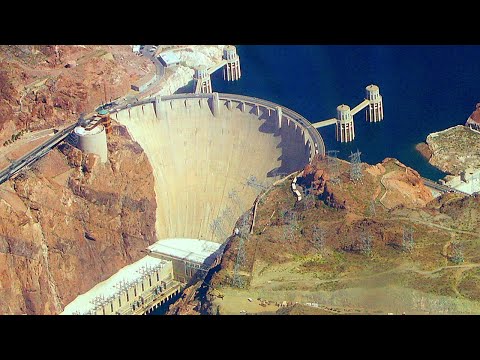
Hoover Dam
SMART HISTORY (0:39) – A brief animation showing the altarpiece in three positions: closed, partially open, and fully open
VISUAL AID
“Why Has This Happened to Me?”
The Hoover Dam, built in 1935 on the Colorado River, is an engineering wonder. Hoover is what is called an arch-gravity dam. It is so designed that greater the pressure applied to the dam the more it is wedged into the solid rock. The greater the forces against the dam, the stronger it becomes.
When heartaches come, as they will, let us not cry out, “Why has this happened to me? Why has this happened to someone I love? What have I done to deserve this?” Rather, let’s surrender our need to a healing God. Let’s allow our hurt to wedge us ever more surely into the solid Rock.
4th Sunday of Lent (A)
Amazing Grace
VISUAL AID
Amazing Grace
“Amazing Grace” is the story of the healing of one person’s personal as well as cultural blindness. John Newton was born in 1740 in England. He grew up in the Anglican Church. As a little boy he went to Church and learned Bible lessons. His mother died when he was only eleven, and so he traveled with his father who was the captain and owner of a cargo ship. The “cargo” was two to three hundred black slaves packed, lying next to each other, in the ship’s hold. In a storm, little John Newton was washed overboard and was picked up on the open seas by a slave trader who trained John in his trade as he grew up. Before his conversion, Newton’s life had become so debauched, irreverent, and immoral that even his fellow sailors were shocked by his conduct and coarse speech. On one return voyage to England, Newton was caught in such a fierce storm that all aboard despaired of life. The Scriptures John had once learned at his mother’s knee returned to his mind, and he began to hope that Jesus could deliver him, dreadful sinner though he was. For the first time in years, John sought the Lord in prayer, and as he later wrote, “the Lord sent from on high and delivered me out of deep waters.” It was on March 21, a date he remembered yearly for the rest of his life, that Newton began to realize the enormity of the evil in his life and his complicity with the evil of slavery in his slave-trading. He left the ship, joined the seminary, was ordained and became a zealous pastor. Thanking God for the grace of conversion, he composed a song which is now one of Americans’ favorite hymns: “Amazing Grace how sweet the sound, that saved a wretch like me. I once was lost but now am found, was blind but now I see.”
Jesus always comes to heal people who are spiritually blind if they ask for help. Newton, like his culture, had a huge personal blind-spot — tolerance for slave-trading. And Jesus healed John Newton’s spiritual blindness.
SOURCE: Fr. Lakra
4th Sunday of Lent (A)
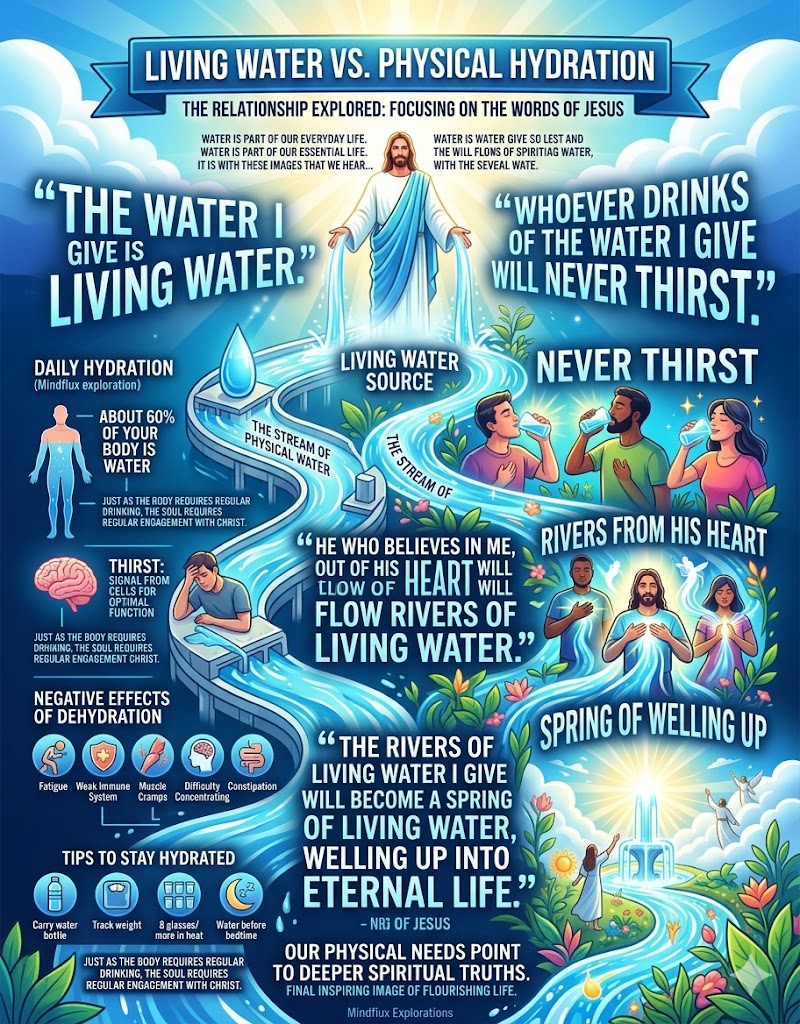
Living Water
Jesus the Source of Living Water
It never ceases to amaze me that my body is composed of seventy percent water. It is hard to imagine that seventy percent of the flesh standing before you today is water. That means about 154 pounds of water is standing before you right now. I am not going to tell you what I weigh but I can guarantee you that 70% of my body weight and your body weight is composed of water. There are two and a half quarts of water in my blood. There are fifteen quarts of water in the extra plasma in my body. There are thirty quarts of water in the cells of my body, allowing all those little cells to grow. It always amazes me that 154 pounds of water are standing before you today at this moment. Truly, I am living water. Some people say that I am a bag of wind. Others say that I am a bag of hot air. But I am really a bag of water. I am a great big bag of water. Standing before you today is walking, breathing, living water. I am truly living water. Water is important to my diet It amazes me that I cannot live without water, that water is more important to my diet than food. It amazes me that I can exist for thirty days without food, but I can exist only one to four days without water. I cannot live without water. It amazes me how absolutely necessary water is for by body to exist. Likewise, it always amazes me that during my first nine months of life, I was in the water of my mother’s womb. I began in a bag of living water. I lived as a fetus for nine months in my mother’s womb. I could not live without that water surrounding me and in me. Truly, as a fetus, I was surrounded by living water. The water around me was truly the water of life. The bag of water around you as a fetus and me as a fetus was living water.
Water is part of our everyday life. Water is part of our essential life. It is with these images that we hear the great words of Jesus when he says, “The water I give is living water. Whoever drinks of the water I give will never thirst. He who believes in me, out of his heart will flow rivers of living water. The rivers of living water I give will become a spring of living water, welling up into eternal life.“
i need something grand that is visually appealing. create 8.5×11 infographic with large sweeping photo realistic images that span the page either vertically or horizontally and with large bold arial fonts.
[Overall Constraint]: Create a photorealistic infographic on an 8.5×11 inch page with a grand, sweeping, cinematic design.
[Main Title]: The title at the top in massive, bold, gold and white Arial font is: “[YOUR MAIN TITLE HERE]”.
[Top Section – Full Width]: Below the title, a dramatic, full-width photorealistic image captures [DESCRIBE THE EPIC TOP SCENE – e.g., a mountain peak at sunrise with blinding light]. A large, transparent banner across this section reads in bold Arial text: “[YOUR TOP SECTION SUMMARY OR THEOLOGICAL POINT]”.
[Middle Section – Split Panel]: The middle section is a sweeping image split vertically down the center by a subtle divider.
Left Panel: On the left, a photorealistic scene shows [DESCRIBE SCENE A – e.g., Moses at the burning bush]. A banner above/below it reads: “[TITLE FOR SCENE A]”. Below that, bold text overlay states: “[DESCRIPTIVE TEXT FOR SCENE A]”.
Right Panel: On the right, a contrasting photorealistic scene shows [DESCRIBE SCENE B – e.g., Elijah in the cave with wind and fire]. A banner above/below it reads: “[TITLE FOR SCENE B]”. Below that, bold text overlay states: “[DESCRIPTIVE TEXT FOR SCENE B]”.
(Optional Central connector): A central banner connects the two panels reading: “[TEXT LINKING THE TWO CONCEPTS]”.
[Bottom Section – Full Width]: The bottom section is another sweeping, emotional photorealistic image showing [DESCRIBE THE FINAL SCENE – e.g., modern people walking towards a light, or a biblical conclusion]. A large banner reads: “[YOUR FINAL THEOLOGICAL CONCLUSION OR CALL TO ACTION]”. Below it, bold text overlay reads: “[SUPPORTING SCRIPTURE REFERENCE OR FINAL THOUGHT]”.
[Style Summary]: All text must be in large, bold, clear Arial font, using a color palette of gold, white, and deep rich tones (blues, purples, earth tones) against atmospheric backgrounds. The entire image must have a cinematic, epic quality with dramatic lighting, vast landscapes, and high detail.
SHOW/HIDE TEXT
For a long time, Israel had been ruled by Judges. Samuel was the last of these Judges, and towards the end of his life he had more or less succeeded in forming a loose confederation among the twelve tribes of the Israelites with the Lord God as their Sovereign Ruler. But the people were displeased with the lack of unity and political security. The pagan nations which surrounded them were ruled by kings who led them to battle and who organized their territories on a sound, political basis. In spite of the Lord’s warning and the wise advice of the elders, the people demanded a king so that they could be like other nations. Finally, the Lord granted them Saul as their first king (1030 BC). Though successful in many battles, Saul offended God, and the kingship was taken from him. The Lord then prompted Samuel, the last Judge in Israel, to go to Bethlehem to anoint the next king. Today’s passage shows us Samuel’s journey to find the Lord’s chosen one and the ritual for anointing the new king. As an old and experienced judge who had studied how the first king (Saul) had failed, Samuel had his own ideas about whom God would choose. But God chose the most unlikely candidate, namely, David, the shepherd boy, the youngest son of Jesse. The reason He gave Samuel for this choice was: “Not as man sees does God see, because man sees the appearance, but the Lord looks into the heart.”
The whole passage extends the darkness-versus-light metaphor, leading to the blindness-versus-sight theme of today’s Gospel. For Paul, Baptism is a “participation in the death and Resurrection of Jesus” (Rom 6:3-4) and a “clothing with Christ’’ (Gal 3:27). In today’s reading, taken from his letter to the Ephesians, Paul echoes Is 26:19; 60 , saying that Baptism is also an “awakening and living in the light”— that is, Christ: “Awake, O sleeper, and arise from the dead, and Christ will give you light.” That is why in the early Greek-speaking Church, Baptism came to be known as photismos meaning “an illumination or bath in light.” Hence, Paul reminds Christians of their new responsibility as children of light: “You were once darkness, but now you are light in the Lord. Live as children of the light, for light produces every kind of goodness and righteousness and truth. Try to learn what is pleasing to the Lord.” The Benedictine Bible scholar, Ivan Havener explicates today’s passage from Paul’s letter to the Ephesians thus: “The readers of this letter were once Gentiles without Christ and were darkness itself, but now as Gentiles in the Lord, they have become light. Their new identity as children of light requires that they live in a different way. The fruit produced by their light-life is all goodness, righteousness, and truth, considering what is pleasing to the Lord. Therefore, instead of participating in the unproductive works of darkness, they should condemn such deeds.”
The paradox of blindness. The healing described in today’s Gospel occurred when Jesus came to Jerusalem with his Apostles to participate in the feast of Tabernacles or the festival of tents (Sukkoth). As part of the celebration of Sukkot, four huge golden four-branched candelabra were set up and lit in the courts of the Temple—each was 50 cubits (=75 feet) high. The Mishnah says that “there was not a courtyard in all of Jerusalem” that did not gleam with the light from the Temple menorahs when they were lit for Sukkot. The healing of the blind man, told so dramatically in today’s Gospel, brings out the mercy and kindness of Jesus, “the light of the world.” Isaiah prophesied, and the Jewish people of that era believed, that when the Messiah came, he would heal blindness and other diseases. The type of blindness which we now call ophthalmic conjunctivitis was very common in Biblical times. Jesus gave to the beggar who was born blind not only his bodily eyesight but also the light of Faith. This story also shows how the stubborn pride and prejudice of the Pharisees prevented them from seeing in the humble “Son of Man” the long-expected Messiah, and that made them incapable of recognizing the miracle. The healed beggar begins by identifying Jesus as “a man.” Questioned further by the Pharisees, he declares that the man who healed him is a Prophet. When the parents of the blind man convinced them that their son had been born blind, the Pharisees argued that the healer was a “sinner,” because the miracle had been performed on the Sabbath. But the cured man insisted that Jesus, his healer, must be a man from God, and they excommunicated him from Temple worship. When Jesus heard this, He sought and found the man He had healed, and asked him, “Do you believe in the Son of Man?” the man answered, “Who is he, sir, that I may believe in him?” In response to Jesus,’ “You have seen Him, and the One speaking with you is He,” the now-sighted man said, “… ‘I do believe, Lord,’ and he worshipped Him.” Fr. Harrington S.J. comments, “The blind man’s progress in spiritual sight reminds us that we need God’s grace and revelation to move toward sharper spiritual vision.”
SHOW/HIDE TEXT
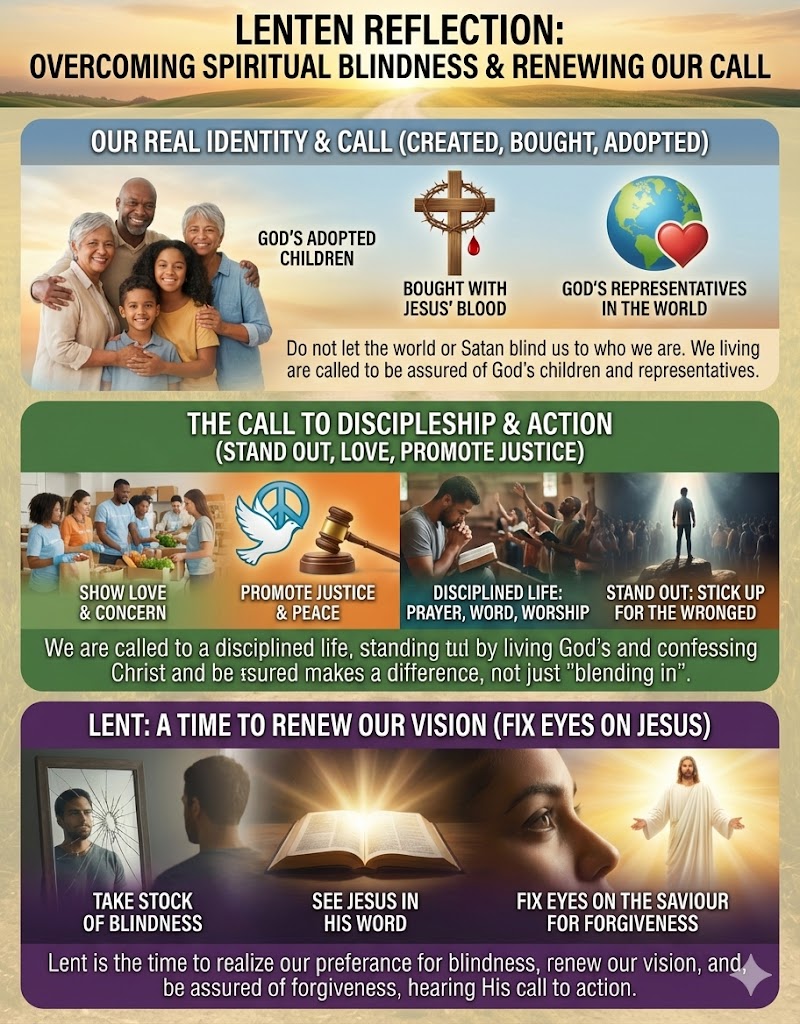
The spiritual blindness of the Pharisees: The Pharisees suffered from spiritual blindness. They were blind to the Holy Spirit. They had the externals of religion but lacked the spirit of Jesus’ love. They were also blind to the suffering and pain right before their eyes. They refused to see pain and injustice. There was no compassion in their hearts. In short, they were truly blind both to the Holy Spirit and to the human misery around them. “The blind man’s progress in spiritual sight is paralleled by the opponents’ descent into spiritual blindness.” (Fr. Harrington). Here is a contrast between those who know they are blind and those who claim to see. According to these blind Pharisees, Jesus, by healing the blind man doubly broke the Sabbath law, which forbade works of healing, and also kneading which was involved in making clay of spittle and dust. Raymond Brown adds a third and fourth reason that increased the seriousness of what Jesus had done: in the Jewish tradition: “there was an opinion that it was not permitted to anoint an eye on the Sabbath,” and “one may not put fasting spittle on the eyes on the Sabbath.” So, they concluded, “The man who did this cannot be from God, because he does not obey the Sabbath law.”
Spiritual blindness of modern Pharisees: Although the Pharisees have long since disappeared from history, there are still many among us who are blinded by the same pride and prejudice. Spiritual blindness is very common in modern times. Perhaps, the most awful disease in our country today is the spiritual blindness which refuses to see the truths of God’s revelation, and even to admit that God or Christ exists. In their pride, the spiritually blind claim that everything ends with death and that there is no life after death. They propagate their errors and accuse believers of childish credulity and folly. They ignore the gifts of the intellect we all possess. God’s revelation through Christ informs us that there is a future life awaiting us in which our spiritual faculties and our transformed bodies will be fully and fittingly glorified. According to Pope Benedict XVI, the miracle of the healing of the blind man is a sign that Christ wants not only to give us sight, but also to open our interior vision, so that our Faith may become ever deeper and we may recognize Him as our only Savior. He illuminates all that is dark in life and leads men and women to live as “children of the light” (Lenten message-2011).
Message #2
Message #3
Infographics were created using Google Gemini 3 and Nano Banana Pro. Inspiration take from Fr. Tony’s Homilies; Non-profits may freely use this infographic in their publications and/or ministry. Please give credit or a shout out to TheWordThisWeek.NET.