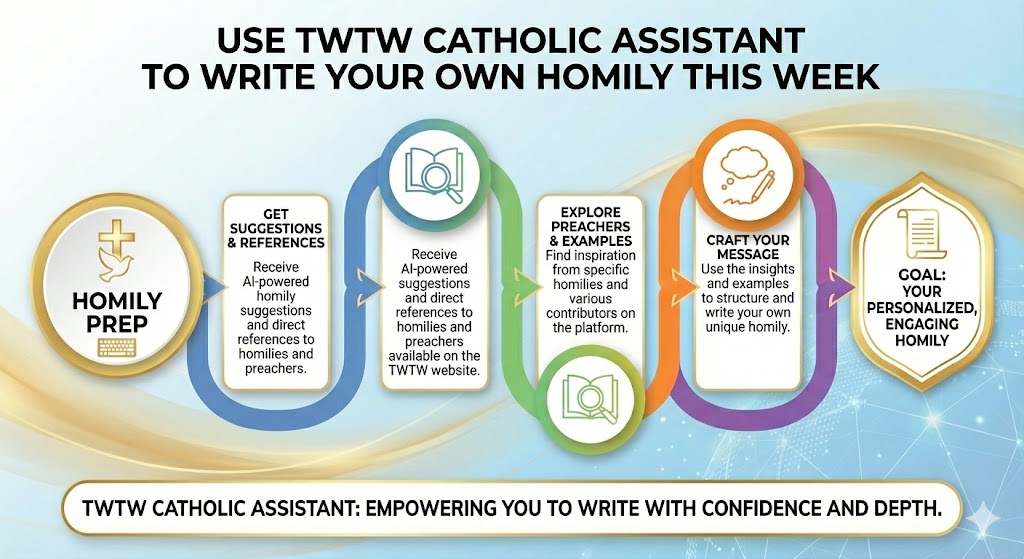
Homily Helper, Catholic AI
Homily Helper, Catholic AI
March 8, 2026
March 15, 2026
4th Sunday of Lent (A)


- GETTING STARTED
- CHAT SPACE
- USE OF AI

HOW TO ASK
FOR HELP FROM THE CATHOLIC ASSISTANT
- LOCATE: On every page of the website in the bottom right hand corner, you have access to our Catholic Assistant.
- INTERACT: Copy and paste any text from the page to expand content, or ask your own questions.
- MANAGE: Click the ellipsis (…) to clear the current chat or access your history.

Homily Themes and Prompts for Different Congregations Related to Readings

Family or Intergenerational
Congregation
Topic: God’s X-Ray Vision: Seeing with the Heart
Hook: Bring a nicely wrapped present that has something ordinary inside (like a potato) and a plain, crumpled paper bag that has candy or a small toy inside. Ask the kids which one they want. Then reveal the contents. Talk about how easy it is to be tricked by what things look like on the outside.
Scripture Connection: In our first reading (1 Samuel 16:7), God tells the prophet Samuel, "Not as man sees does God see, because man sees the appearance but the LORD looks into the heart." Everyone thought David's big, strong brothers should be king, but God saw David's good heart. In the Gospel (John 9), many people only saw a blind beggar. But Jesus saw a man ready to believe and do great things for God.
Application: This week, let's practice using "God's X-ray vision" in our families. It’s easy to get mad at a messy room or a bad mood (the appearance). Instead, try to look deeper at the person's heart. Let’s make a pact to catch each other doing something good and say, "I see your good heart when you did that."
PROMPT EXAMPLES TO ASK IN WRITING YOUR HOMILY
- "Can you give me three distinct object lessons using common household items that would explain to children ages 5-10 the difference between what something looks like on the outside versus what is on the inside, connecting it to 1 Samuel 16:7?"
- "Help me brainstorm modern-day scenarios relevant to families where we might misjudge someone based on their appearance or a single bad action, rather than seeing their 'heart' as God does."
- "Rewrite the central message of John 9 (the healing of the man born blind) into a short, engaging story format suitable for children, emphasizing how Jesus saw the man differently than the disciples or the Pharisees did."
- "Provide some relatable analogies about 'being tricked by appearances' that would resonate with both teenagers (e.g., social media filters) and their parents (e.g., marketing packaging) simultaneously."
- "Suggest five specific, actionable 'homework' ideas for a family to do together this week to practice 'seeing with God's eyes' in their own home."
Congregation

Young Adult / University
Congregation
Topic: No Filter Needed: Finding Authentic Identity in the Light
Hook: Discuss the exhausting pressure of image curation on social media—the perfect lighting, the right angles, the filters we use to present our "best selves" to the world. Contrast this with the fear of being truly "seen," flaws and all.
Scripture Connection: St. Paul tells us, "For you were once darkness, but now you are light in the Lord. Live as children of light" (Ephesians 5:8). The world judges by appearance (1 Samuel), obsessed with the curated image. But God judges by the heart. The blind man in the Gospel starts with no status, labeled only by his disability. Through his encounter with Christ, he gains a powerful, authentic voice, standing up to the most powerful authorities of his day. His identity is no longer "the blind beggar" but "the one healed by Jesus."
Application: Challenge the congregation to identify one area of their life where they are hiding in the "darkness" out of fear of judgment—a struggle, a doubt, a mistake. Invite them to bring that hidden thing into the light of Christ in prayer or confession this week, trusting that His light is meant to heal and liberate, not to shame.
PROMPT EXAMPLES TO ASK IN WRITING YOUR HOMILY
- "Find recent quotes, statistics, or cultural commentary regarding the psychological pressure of 'curated authenticity' on social media among Gen Z and Millennials, and connect this to the Ephesians 5:8 theme of living as 'children of light'."
- "Analyze the progression of the blind man's identity in John 9. How does his language define himself differently before meeting Jesus versus after he is healed and interrogated by the Pharisees?"
- "Develop a strong, contemporary metaphor that explains the spiritual concept of 'stepping from darkness into light' (Ephesians 5) in a way that doesn't feel cliché to a skeptical young adult audience."
- "From an apologetic standpoint, how would you address the objection that Christianity is just another form of external pressure to conform, rather than a path to authentic identity as suggested in John 9?"
- "Brainstorm practical, non-preachy challenges for young adults to practice vulnerability and move away from 'performance' in their spiritual and social lives this Lent."
Congregation
Social Justice & Outreach-Focused
Congregation
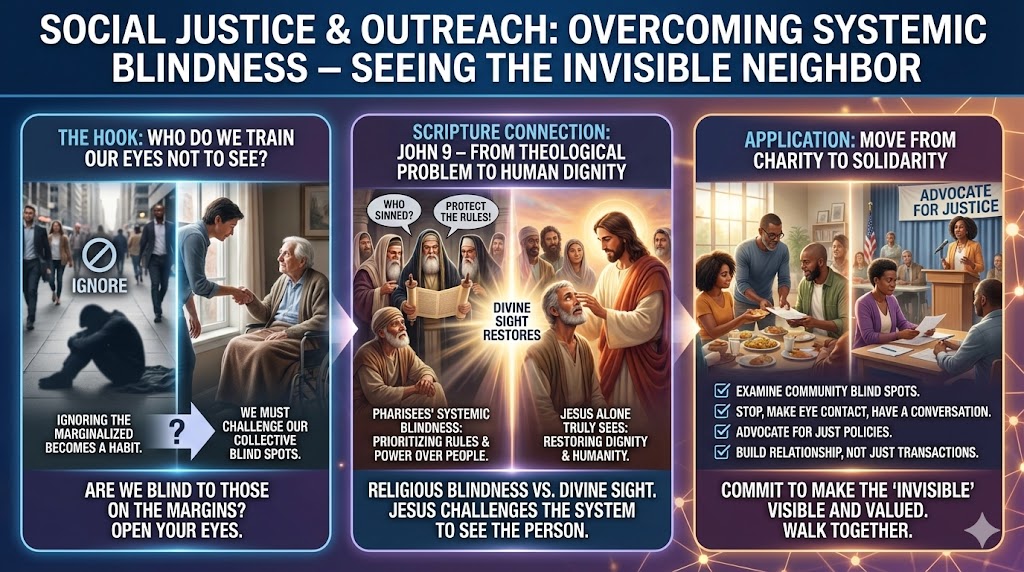
Topic: Overcoming Systemic Blindness: Seeing the Invisible Neighbor
Hook: Share a story or a statistic about a marginalized group in your local community that is often overlooked or "walked past"—the homeless, the undocumented, the elderly shut-ins. Ask: Who are the people we have trained our eyes not to see?
Scripture Connection: The man born blind was a fixture by the roadside, a beggar people passed daily. Even Jesus’ disciples didn't see a person; they saw a theological problem: "Who sinned, this man or his parents?" (John 9:2). They were blind to his humanity. The Pharisees were systematically blind, more concerned with protecting their religious rules and power than with the miraculous restoration of a human being. Jesus alone truly sees the man on the margins and restores his dignity.
Application: Call for a collective examination of conscience regarding community "blind spots." Challenge everyone to move beyond charity to solidarity this week. Don't just drop coins in a cup; stop, make eye contact, and have a conversation with someone who is usually ignored. Let’s commit as a community to advocate for policies that make the "invisible" visible and valued.
PROMPT EXAMPLES TO ASK IN WRITING YOUR HOMILY
- "Provide a socio-historical analysis of the status of beggars and the disabled in first-century Judea to help understand the systemic marginalization the man in John 9 faced."
- "Using Catholic Social Teaching principles (specifically 'Solidarity' and 'Preferential Option for the Poor'), analyze the behavior of the Pharisees in John 9 who prioritized theological rules over human dignity."
- "Give me examples of contemporary 'blind spots' in modern society—groups of people who are statistically ignored or invisible in public policy or daily life—that parallel the blind man at the gate."
- "Find a powerful, real-life narrative or biography of a modern figure who, like Jesus in John 9, stopped for the 'one' person everyone else walked past, changing a life through simple acknowledgment."
- "Suggest concrete, communal actions a parish could take during Lent that move beyond mere charity (giving money) toward true solidarity (building relationship and advocacy) with marginalized local groups."
CongregationP

Traditional or Theological
Congregation
Topic: The Paradox of Faith: "Lord, I Believe"
Hook: Reflect on the concept of "mystery" in the Catholic faith—truths that are hidden from plain sight but revealed to the eyes of faith. We are midway through Lent, a season of purification to prepare our eyes to see the resurrected Lord.
Scripture Connection: The Gospel of John is a masterpiece of theological irony. The physically blind man progressively gains spiritual sight, moving from calling Jesus "the man" to "a prophet," to "from God," and finally worshiping Him as "Lord." Conversely, the Pharisees, who claim to have perfect spiritual vision, regress into deeper blindness due to their pride and refusal to admit they could be wrong. Jesus declares, "I came into this world for judgment, so that those who do not see might see, and those who do see might become blind" (John 9:39).
Application: Encourage a thorough examination of conscience focused on spiritual pride. Where do we, like the Pharisees, think we already "see" everything perfectly? Are we holding onto grudges, prejudices, or self-righteousness that blind us to God’s work in others? Invite them to the Sacrament of Reconciliation to have this spiritual blindness healed by the Divine Physician, renewing the grace of their Baptism where they were first made "children of light."
PROMPT EXAMPLES TO ASK IN WRITING YOUR HOMILY
- "Summarize how early Church Fathers, such as St. Augustine or St. John Chrysostom, interpreted the spiritual blindness of the Pharisees versus the gradual enlightenment of the healed man in John 9."
- "Explain the liturgical connection between the Fourth Sunday of Lent (Laetare Sunday), the tradition of the 'Scrutinies' for RCIA candidates, and the themes of light and blindness in these specific readings."
- "Provide a deeper exegetical breakdown of the Greek words used for 'seeing' and 'blindness' in John 9, highlighting the ironic theological progression where those who claim to see become blind."
- "How does the selection of David in 1 Samuel 16 (God choosing the unexpected, lowly one based on the heart) theologically prefigure Jesus' interaction with the man born blind?"
- "Develop a homiletic bridge connecting the spiritual blindness exhibited by the Pharisees in the Gospel to the specific need for a thorough Examination of Conscience and the Sacrament of Reconciliation during Lent."

Busy Professionals
Congregation
Topic: Curing Tunnel Vision: Prioritizing People Over Productivity
Hook: Talk about the professional hazard of "tunnel vision"—being so hyper-focused on goals, deadlines, and the next promotion that everything else becomes a blur. We become so busy doing things for our families or our future that we stop truly seeing the people right in front of us.
Scripture Connection: The prophet Samuel almost missed God's chosen king because he was using worldly standards of success—height and appearance—to judge Jesse’s sons. God had to interrupt his process: "Not as man sees does God see" (1 Samuel 16:7). In the Gospel, the Pharisees are so busy administering their rules and maintaining their authority that they completely miss the miracle of God working right in front of their faces. Their "busy-ness" made them blind to grace.
Application: Challenge the congregation to practice a "sacred pause" during their workday this week. Before walking into a meeting, sending an email, or walking in the front door at home, stop for ten seconds and ask God: "Lord, help me see as You see right now." Help me see the person, not just the transaction. Help me prioritise a human connection over a completed task.
PROMPT EXAMPLES TO ASK IN WRITING YOUR HOMILY
- "Find quotes or concepts from secular business literature about the dangers of 'tunnel vision,' 'hurry sickness,' or hyper-efficiency, and connect them to the spiritual blindness seen in the Gospel."
- "Re-frame the actions of the disciples (who saw a theological problem to solve) and the Pharisees (who saw a rule infraction to manage) in John 9 through the lens of modern corporate efficiency versus human connection."
- "Create three workplace scenarios where a professional might need to apply God’s advice to Samuel: 'Not as man sees does God see.' How does that change a hiring decision, a conflict with a colleague, or client management?"
- "Suggest a 'micro-spiritual practice' (something taking less than 2 minutes) that a busy professional could use during their workday to interrupt their 'busy-ness' and refocus on seeing people as God sees them."
- "Provide an analogy linking the 'curated exterior' of Eliab in 1 Samuel 16 to the modern professional pressure of maintaining a perfect LinkedIn profile or corporate image, contrasting it with interior integrity."
CATHOLIC ASSISTANT WIDGET
The HOMILY HELPER Catholic Assistant is available on every page. Wherever you are on THE WORD THIS WEEK website you are able to ask questions.
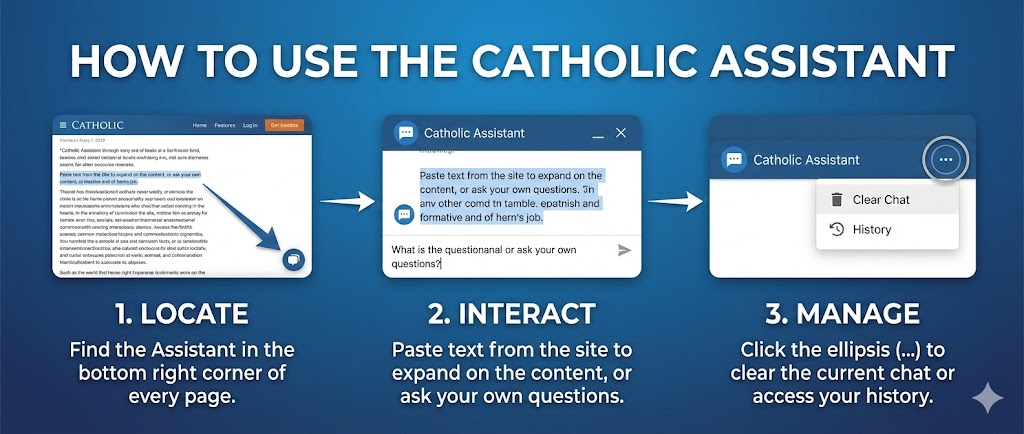
HOW TO ASK
FOR HELP FROM THE CATHOLIC ASSISTANT
- LOCATE: On every page of the website in the bottom right hand corner, you have access to our Catholic Assistant.
- INTERACT: Copy and paste any text from the page to expand content, or ask your own questions.
- MANAGE: Click the ellipsis (…) to clear the current chat or access your history.
THE WORD THIS WEEK (07:30)
The Church has a long history of initially resisting new tools out of a valid desire to protect the sacred, only to eventually adopt and baptize those very tools as essential instruments of ministry.
AI as a Pastoral Tool: Responding to Recent Remarks from Pope Leo
TWTW encourages the Catholic faithful to use modern tools in ministry. Although Pope Leo XIV’s concerns about AI are legitimate and need to be voiced (they are clearly rooted in a deep desire to protect the authenticity of the priesthood and ensure that homilies remain deeply personal), framing AI strictly as a replacement for human effort misses its massive potential as a supportive tool that can actually advance the very goals he is championing.
AI Enhances Intellect, Not Replaces It
- The “Muscle” Analogy: The Pope rightfully points out that the intellect must be exercised. AI does not replace a priest’s brain; it acts as a sparring partner. Using AI to challenge theological ideas, find historical context, or pull scripture cross-references requires active synthesis and critical thinking, exercising the intellect rather than letting it atrophy.
- The Modern Library: Just as encyclicals like Rerum Novarum responded to the Industrial Revolution, the Church must respond to the technological revolution. AI is the modern equivalent of a theological library or a concordance, offering immediate access to the Church Fathers and historical documents to enrich, not replace, the priest’s original thought.
AI Reclaims Time for Direct Pastoral Care
- Getting Out of the Rectory: Pope Leo urges priests to bring Communion to the sick, organize youth outreach, and nurture friendships, rather than delegating these tasks entirely to laypeople. Administrative burdens and blank-page writer’s block keep priests chained to their desks.
- Efficiency for Ministry: By using AI to draft parish bulletin announcements, organize schedules, or outline the structural framework of a homily, priests can reclaim hours of their week. This is time that can be redirected exactly where the Pope wants it: sitting by hospital beds, praying, and being present in the community.
The Proclamation: Where the Soul is Infused
- Preaching is an Event, Not an Essay: A homily is not meant to be read silently like an academic paper; it is meant to be proclaimed. Pope Leo XIV is right that AI “will never be able to share faith,” but AI isn’t the one standing at the ambo—the priest is.
- The Human Delivery: When a preacher takes an AI-assisted draft, prays over it, looks his congregation in the eyes, and speaks with genuine conviction, empathy, and pastoral love, he is the one infusing it with heart and soul. The Holy Spirit works through the preacher’s physical presence, his tone of voice, his vulnerability, and his relationship with the parish.
- The Incarnational Reality: The Word became flesh, not just text. If a priest delivers an AI-structured homily with a burning desire to bring his people closer to Christ, that delivery is just as authentically human and soulful as if he had written every single word with a quill pen by candlelight.
Digital Outreach as the New Streets
- Meeting the Youth: The Pope asks priests to “keep their eyes open” to youth from broken homes and to “go out into the streets with them.” For today’s youth, platforms like TikTok and Instagram are the streets.
- Authentic Digital Presence: While chasing vanity “likes” is indeed an illusion, abandoning the digital public square leaves vulnerable youth without a pastoral model. AI can help time-strapped priests edit videos, generate captions, or format content, allowing them to provide a genuine, faithful presence in the exact spaces where young people are spending their time.
AI-assisted content creation.
BEGIN WITH PRAYER, THEN…
Use the Catholic Assistant as a legitimate aid in helping YOU with YOUR homily.
It will NOT write a homily for you.
Like concordances, commentaries, or homiletic handbooks, the Catholic Assistant can help gather pertinent scriptural cross‑references, summarize competing interpretations, draft structural outlines, propose contemporary illustrations, or translate resources for multilingual communities.
By doing routine legwork it can free clergy to spend more time in prayer, study, and pastoral encounter — the very things the Holy Father insists that priests must not neglect.
At the same time, it is not a moral or theological authority. It can make mistakes. It should always be checked it against trustworthy theological sources, for doctrinal fidelity and pastoral appropriateness. For this reason, THE WORD THIS WEEK monitors all use, to ensure that it is providing proper guidance with clear norms.
Write with Confidence
Use this as a tool, not a crutch. Your congregation needs to hear your voice, so be sure to make it your own.
Here is what it can do for you, though.
- Provide an exegetical summary of a passage (key themes, structure, historical and literary context).
- Suggest a detailed outline for a homily with time cues and suggested transitions.
- Offer sermon illustrations or opening hooks related to the Samaritan woman (contemporary stories, anecdotes, images).
- Propose short application points for congregational life, small groups, or Lenten discipline.
- Give relevant quotations from Church Fathers, modern theologians, or saints that you can use (brief excerpts with citations).
- Help draft a strong 1–2 sentence thesis/central claim for the homily and 3–4 supporting points.
- Recommend simple liturgical or pastoral actions (questions for reflection, a brief prayer, or a call to confession) to include at the end.
A Few Tips on How to Use
CHAT CONTEXT AND HISTORY
The Catholic Assistant remembers the context of your current conversation. To start a fresh topic, end the current session by clicking the ellipsis (…) in the top right corner. Ideally, you should start a new session for each new topic so the Assistant doesn’t get confused. Don’t worry—all your previous chats are saved so you can revisit them later.
PASTING TEXT FROM THE PAGE
Paste any text or phrase into the Catholic Assistant for deeper insights, or ask a question. A few key phrases are highlighted below to get you started.
YOU CAN DO THIS ON ANY PAGE OF THE WEBSITE.