Papal Homilies
March 8, 2026
March 15, 2026
4th Sunday of Lent (A)



Theme of the Readings
From the beginning, Christianity has manifested itself as an amazing paradox; perhaps, this is the key to today’s liturgy. God does not look at appearances, as men do, but at the heart. This is the reason he chose the youngest of Jesse’s sons to anoint him king of Israel (First Reading). In the Gospel, Jesus says: “For judgment I came into this world, that those who do not see may see, and that those who see may become blind.” In the Hellenic world, Ephesus and Corinth, were cosmopolitan, famous and outstanding cities for their culture and ‘spiritual’ refinement. According to St. Paul, Christians are the children of light. The pagans of Ephesus belong, rather, to the kingdom of darkness, which must be uncovered to be illuminated by Christ (Second Reading).
SOURCE: YEAR A DICASTERY NOTES (2004-05)
Doctrinal Message
The Christian Paradox: The Divine Plan And Human Evaluation
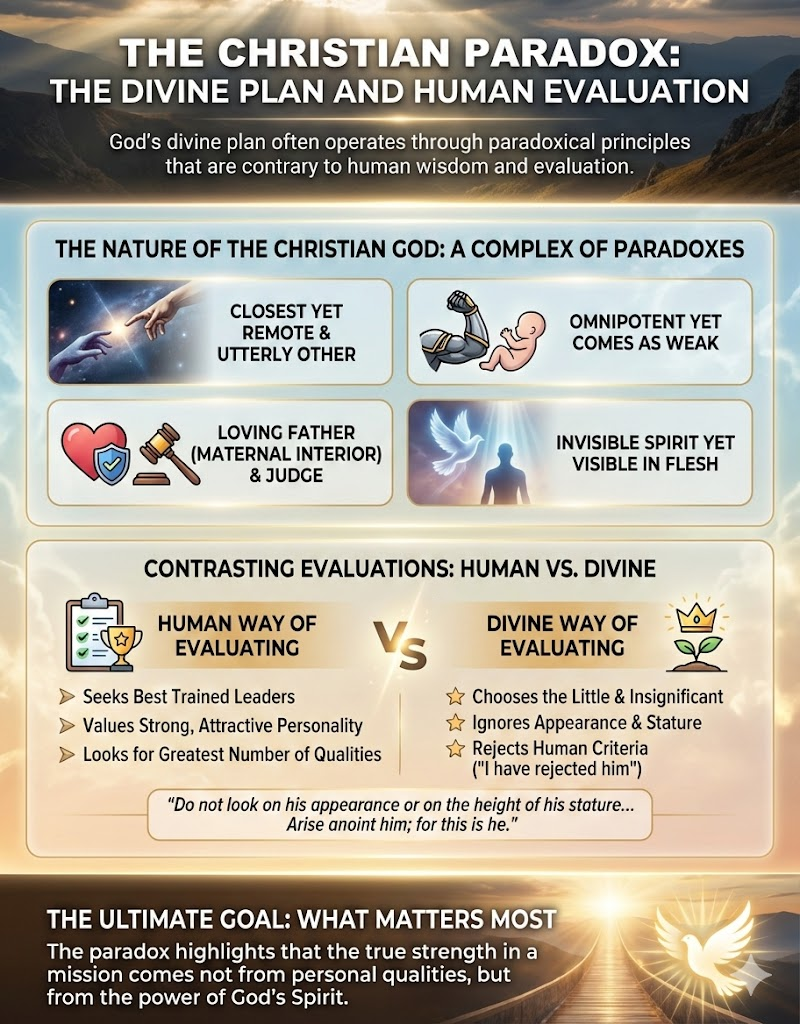
The Christian paradox does not surprise us. It comes from the very revelation God made of himself and of his plan for salvation. The Christian God is the one who is closest and, at the same time, the most remote, utterly other. He is omnipotent but comes to us as weak. He is a loving Father, with an interior that is maternal, and judge who will give to each what he deserves. He is spiritual and invisible but makes himself visible in the transparency of flesh. The paradox the liturgy gives us today is part of this complex of Christian paradoxes. In the human way of evaluating persons and things, the greater the task the more one looks for the best trained leader, with a strong and attractive personality, and a greatest number of qualities. In today’s first reading, God reveals he does just the opposite: he chooses the little, that which does not count in the eyes of men. “Do not look on his appearance or on the height of his stature, because I have rejected him…. Arise anoint him; for this is he.” With this paradox, God highlights what matters most in a mission: not just personal qualities but the strength and power of God’s Spirit.
Christ As The Light: The Blindness Of Pride Vs. Simple Faith
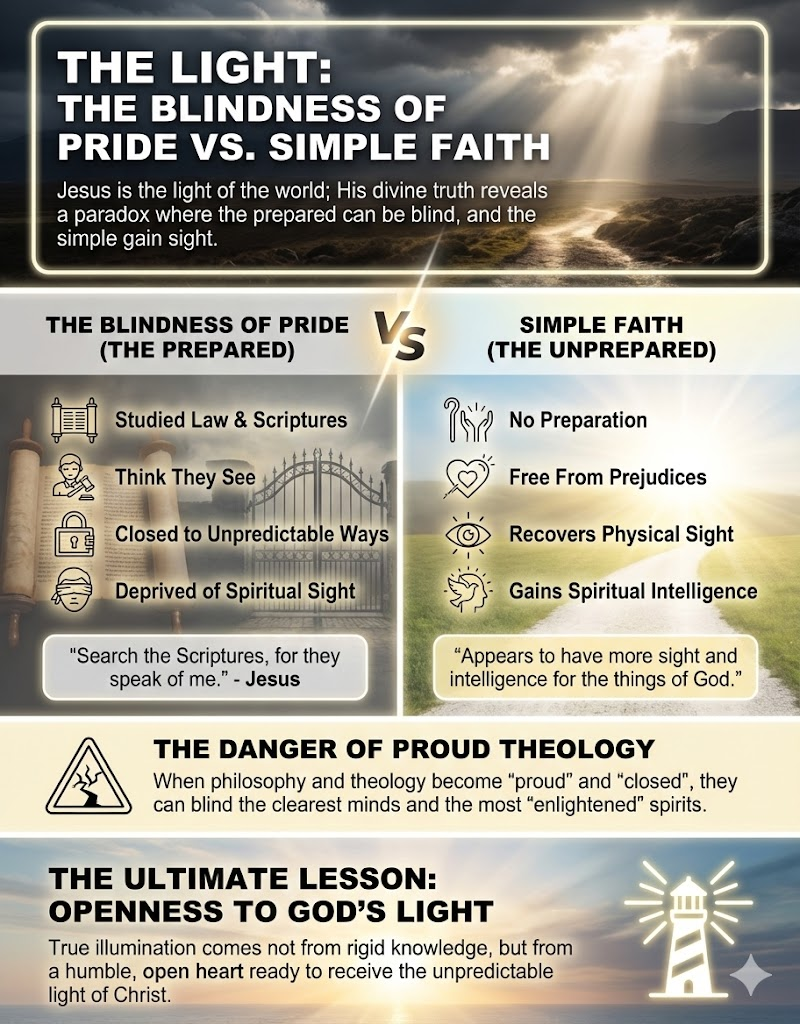
Jesus is the light of the world, in his person, his teaching and his works. The persons most prepared to be illuminated by the light of Christ were, undoubtedly, the Pharisees, who made of the Law and the Scriptures the reason for their whole life. Did not Jesus say to them: “Search the Scriptures, for they speak of me.” In today’s Gospel, Jesus points out the paradox: they think they see, and this is why they are deprived of sight. Whereas the poor man born blind, who had no preparation, but was free from prejudices and prefabricated schemes, not only recovers his physical sight, but appears to have more sight and intelligence for the things of God than the Pharisees themselves. When philosophy and theology become “proud” and “closed” to the unpredictable ways of God, they can blind the clearest minds and the most “enlightened” spirits of every age.
Living In The Light: Uncovering The Darkness Of Ancient Customs
This is, precisely, what happened to many of the inhabitants of Corinth, Athens and Ephesus. They lived content in their thoughts, in their openness to other peoples and religions, in the fact their customs and style of life had spread throughout the Greco-Roman world. St. Paul says this about them: they believe they are light, but they live in the kingdom of darkness (lust, avarice, idolatry, shameless and immodest conversations). All this must be uncovered by the light of the word and of the authentic Christian life so that once in the open it will be penetrated by the light of Christ.
SOURCE: YEAR A DICASTERY NOTES (2004-05)

Pastoral Suggestions
Modern Witnesses: Confounding The Wise Through The Insignificant
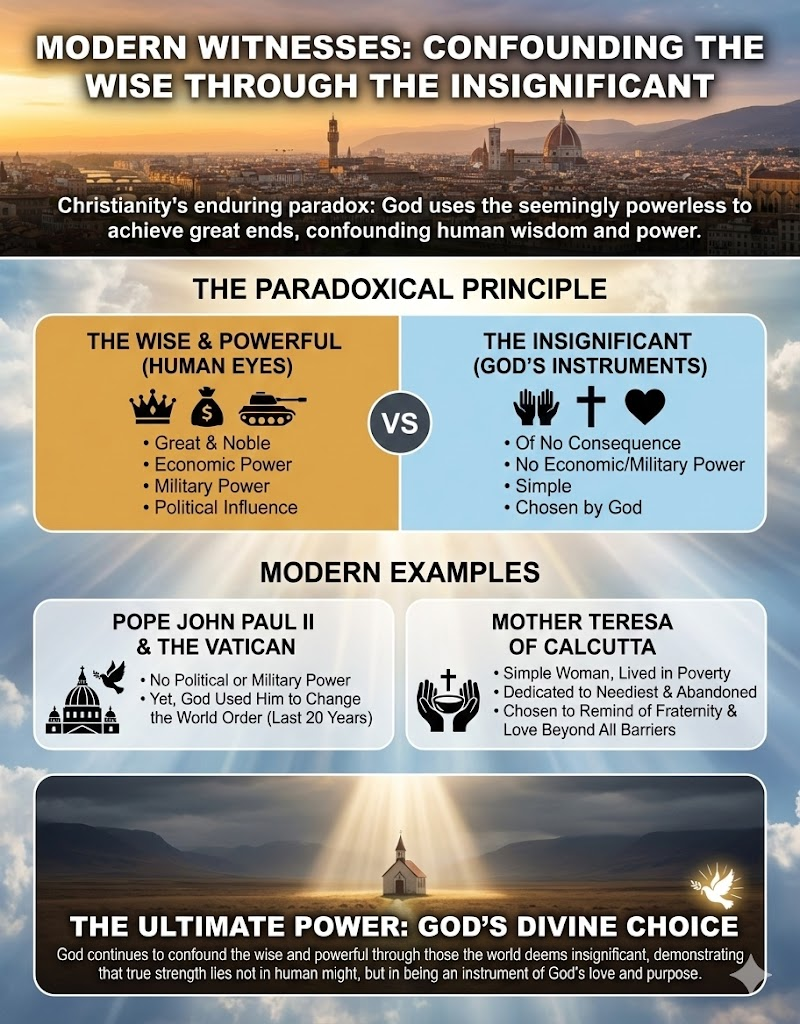
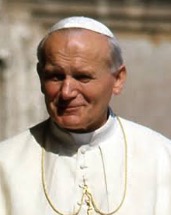
In our time, Christianity continues to be paradoxical and unpredictable. God continues to confound the wise and powerful, the great and the noble, through people who in human eyes are of no consequence, “insignificant,” without any economic or military power. What political or military power does Pope John Paul II or the Vatican have? None, and yet, God used the Pope, during the last twenty years, to change the world order. Who was Mother Theresa of Calcutta? She was a simple woman, who lived in poverty, dedicated to the care of the neediest and the abandoned, but who was chosen by God to remind us of fraternity, of the need to love a brother or sister beyond any barrier of religion, race, social or economic condition, or state of health.
Pastoral Application: Seeking The Saints Among The Lowly
God acts in the same paradoxical way, not only at the international level, but also in the daily life of a parish, of a religious community, or of an ecclesial movement. I believe, for instance, a parish priest should make an effort to know those persons in the parish who are a living incarnation of this paradox. I believe they should approach such people with great confidence and ask for their help, all those who do not count, who are worth little, but who are really saints, who transform the world around them by their goodness, their smile and their total generosity in giving of themselves.
SOURCE: YEAR A DICASTERY NOTES (2004-05)

Infographics (visual aids) on this page were designed using Nano Banana Pro with Gemini 3.0. They draw inspiration from the 2004-05 Dicastery for the Clergy Notes (YEAR A | B | C cf. text above), but are not officially associated with or endorsed by the Holy See. They may be copied for personal use or for use in any non-profit ministry (e.g. parish bulletin inserts, classroom or group presentation, posters on community bulletin boards, etc.)
22 March 2020 – Saint Peter’s Square
The Theme Of Light: The Fourth Sunday Of Lent
At the centre of the liturgy of this fourth Sunday of Lent there is the theme of light. The Gospel (cf. Jn 9:1-41) recounts the episode of the man blind from birth, to whom Jesus gives sight. This miraculous sign confirms Jesus’ affirmation that “I am the light of the world” (v. 5), the light that brightens our darkness. Jesus is thus. He operates illumination on two levels: a physical level and a spiritual level: the blind person first receives the sight of the eyes and then is led to faith in the “Son of Man” (v. 35), that is, in Jesus. It is all a journey. Today it would be good if you were all to take a copy of the Gospel according to John, chapter nine, and read this passage: it is so good and it will do us good to read it once or twice more. The wonders that Jesus performs are not spectacular gestures, but have the purpose of leading to faith through a journey of inner transformation.
The Power Of Reality Vs. The Distrust Of The Law
The doctors of the law – who were there in a group – persist in not admitting the miracle, and ask the healed man insidious questions. But he disconcerts them with the power of reality: “One thing I do know. I was blind and now I see” (v. 25). Amidst the distrust and hostility of those who surround him and interrogate him, incredulous, he takes a route that leads him to gradually discover the identity of the One who opened his eyes and to confess his faith in Him. At first he considers Him a prophet (cf. v. 17); then he recognises Him as one Who comes from God (cf. v. 33); finally he welcomes Him as the Messiah and prostrates himself before Him (cf. vv. 36-38). He understood that by giving him sight Jesus displayed “the works of God” (cf. v. 3).
The Path Of Liberation From Sin
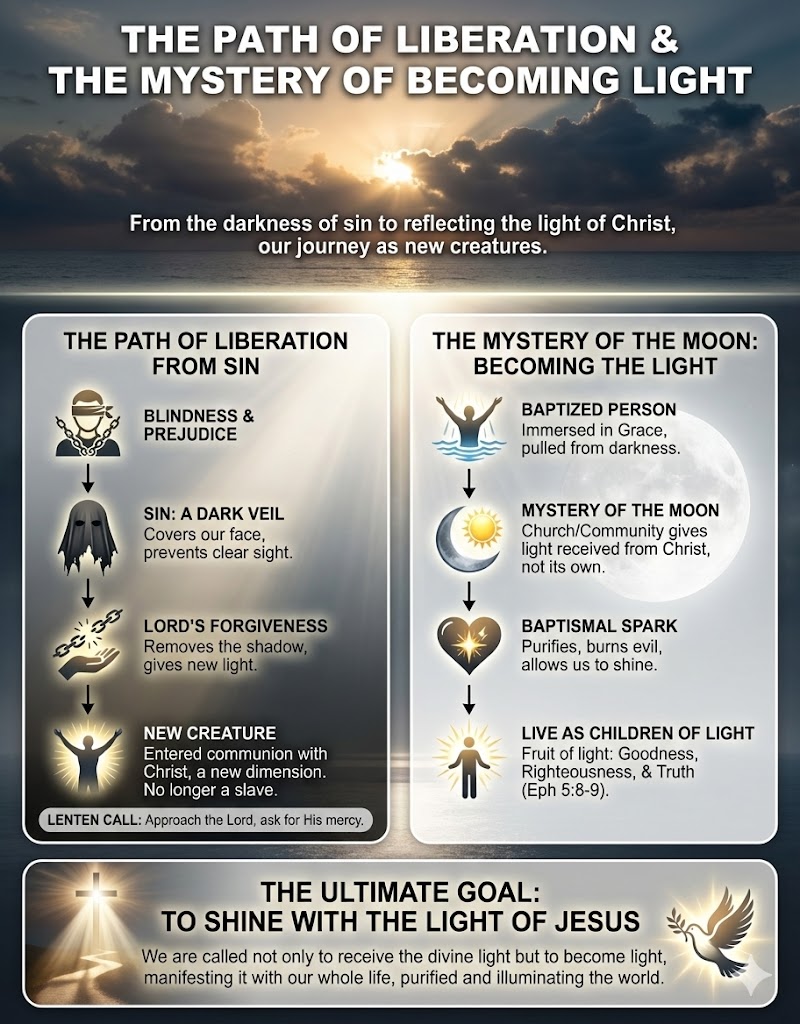
May we too have this experience! With the light of faith he who was blind discovers his new identity. He is now a “new creature”, able to see his life and the world around him in a new light, because he has entered into communion with Christ, he has entered into another dimension. He is no longer a beggar marginalised by the community; he is no longer a slave to blindness and prejudice. His path of enlightenment is a metaphor for the path of liberation from sin to which we are called. Sin is like a dark veil that covers our face and prevents us from clearly seeing ourselves and the world; the Lord’s forgiveness takes away this blanket of shadow and darkness and gives us new light. The Lenten period that we are living is an opportune and valuable time to approach the Lord, asking for His mercy, in the different forms that Mother Church proposes to us.
The Mystery Of The Moon: Becoming The Light
The healed blind man, who now sees both with the eyes of the body and with those of the soul, is the image of every baptised person, who immersed in Grace has been pulled out of the darkness and placed in the light of faith. But it is not enough to receive the light, one must become light. Each one of us is called to receive the divine light in order to manifest it with our whole life. The first Christians, the theologians of the first centuries, used to say that the community of Christians, that is the Church, is the “mystery of the moon”, because it gave light but it was not its own light, it was the light it received from Christ. We too can be “mystery of the moon”: giving light received from the sun, which is Christ, the Lord. Saint Paul reminds us of this today: “Live as children of light; for the fruit of the light consists in all goodness, righteousness and truth” (Eph 5:8-9). The seed of new life placed in us in Baptism is like the spark of a fire, which first of all purifies us, burning the evil in our hearts, and allows us to shine and illuminate. With the light of Jesus.
2 March 2008 | St Peter’s Square

The Baptismal Journey: Water, Light, And Life
On these Sundays in Lent the liturgy takes us on a true and proper baptismal route through the texts of John’s Gospel: last Sunday, Jesus promised the gift of “living water” to the Samaritan woman; today, by healing the man born blind, he reveals himself as “the light of the world”; next Sunday, in raising his friend Lazarus, he will present himself as “the resurrection and the life”. Water, light and life are symbols of Baptism, the Sacrament that “immerses” believers in the mystery of the death and Resurrection of Christ, liberating them from the slavery of sin and giving them eternal life.
Rejecting Prejudice: Suffering As A Manifestation Of God’s Works
Let us reflect briefly on the account of the man born blind (Jn 9: 1-41). According to the common mentality of the time, the disciples take it for granted that his blindness was the result of a sin committed by him or his parents. Jesus, however, rejects this prejudice and says: “It was not that this man sinned, or his parents, but that the works of God might be made manifest in him” (Jn 9: 3).
Provident Love: Christ As The Light In Human Limitation
What comfort these words offer us! They let us hear the living voice of God, who is provident and wise Love! In the face of men and women marked by limitations and suffering, Jesus did not think of their possible guilt but rather of the will of God who created man for life. And so he solemnly declares: “We must work the works of him who sent me…. As long as I am in the world, I am the light of the world” (Jn 9: 5).
The New Creation: Mud, Breath, And The Restoration Of Man
And he immediately takes action: mixing a little earth with saliva he made mud and spread it on the eyes of the blind man. This act alludes to the creation of man, which the Bible recounts using the symbol of dust from the ground, fashioned and enlivened by God’s breath (Gn 2: 7). In fact, “Adam” means “ground” and the human body was in effect formed of particles of soil. By healing the blind man Jesus worked a new creation.
The Conflict Of The Sabbath: Legalism Vs. Healing
But this healing sparked heated debate because Jesus did it on the Sabbath, thereby in the Pharisees’ opinion violating the feast-day precept. Thus, at the end of the account, Jesus and the blind man are both cast out, the former because he broke the law and the latter because, despite being healed, he remained marked as a sinner from birth.
The Judgment Of Christ: Blindness And Ideological Security
Jesus reveals to the blind man whom he had healed that he had come into the world for judgement, to separate the blind who can be healed from those who do not allow themselves to be healed because they consider themselves healthy. Indeed, the temptation to build himself an ideological security system is strong in man: even religion can become an element of this system, as can atheism or secularism, but in letting this happen one is blinded by one’s own selfishness.

The Invitation To Rejoice: Laetare Sunday And The Search For Joy
“Rejoice, Jerusalem, and all of you who love her, rejoice with her” (Entrance Antiphon). Today’s liturgy begins with this invitation to rejoice. It gives a particularly cheerful tone to this Fourth Sunday of Lent, traditionally called Laetare Sunday. Yes, we should rejoice because the true Lenten spirit is a search for the deep joy which is the fruit of our friendship with God. We rejoice because Easter is now close at hand, and in a little while we will celebrate our freedom from evil and sin, thanks to the new life brought to us by Christ who died and rose again.
The Catechumenal Journey: Water And Light As Signs Of Divine Life
On our way to Easter, the liturgy urges us to retrace the catechumenal journey with those who are preparing to receive Baptism. Last Sunday, we meditated on the gift of the living water of the Spirit (cf. Jn 4:5-42); today we reflect near the pool of Siloam with the man born blind, to embrace Christ, the light of the world (cf. Jn 9:1-41). “He went and washed and came back seeing” (Jn 9:7). Like the blind man, we must let ourselves be enlightened by Christ and renew our faith in the suffering Messiah, who reveals himself as the light of our life: “I am the light of the world; he who follows me … will have the light of life” (Gospel Acclamation; cf. Jn 8:12). Water and light are essential elements of life. It is for this reason that Jesus elevates them to signs which reveal the great mystery of man’s participation in the divine life.
Missionary Commitment: Looking At The Heart Beyond Appearances
In this context, it is important to make the most of the propensity for and openness to the Gospel found in society, without stopping at appearances, but looking at the heart of situations. This is what the first reading recalls through the person and mission of the prophet Samuel: “Man looks on the outward appearance, but the Lord looks on the heart” (1 Sam 16:7). In every person we meet, even in those who openly profess not to be interested in the things of the Spirit, the need for God is real: it is the task of believers to proclaim and bear witness to the liberating truth of the Gospel, offering the light of Christ to everyone.
Forming The Next Generation: Combining Faith With Life
Direct all your formative work to teaching them to grow in their knowledge of Jesus, the only Saviour of the world, to helping them to experience God’s mercy and to translate what they learn in catechesis and in the experience of community prayer into a strong witness of life. Is it not true that today, more than ever, the younger generation has a keen desire for truth and are more and more tired of pursuing empty illusions? It is vital to present the Gospel to them with strength and love, and to help them combine faith with life in order to resist the many temptations of the modern world. This is why, like the man born blind in today’s Gospel passage, encountering Jesus in a personal way is indispensable.
The Eucharistic Mystery: Source Of Unity And Solidarity
The Eucharist, the summit and source of Christian life, is Jesus present among us, who makes himself food and drink for our salvation. A true community, an authentic Church, will only be such if it learns to grow in the school of the Eucharist and nourishes itself at the table of the Word and the Bread of eternal life. The Eucharist, the supreme Mystery of love, also calls for a commitment of solidarity and active closeness to those in need. Helping your brothers and sisters in difficulty, opening the arms of your heart to them, helps foster that climate of brotherhood and friendship which the world needs. Only in this way will we be true apostles of Jesus, who left us the commandment of love as a rule of life.
Walking As Children Of Light: A Path Of Conversion
“Walk as children of light” (Eph 5:8). May the words of the Apostle Paul in the second reading be an incentive for us to take this path of conversion and spiritual renewal. By virtue of Baptism, Christians are “filled with light”; they have already received the light of Christ. Therefore, they are called to conform their life to the gift of God: to be children of light! Dear brothers and sisters, may the Lord open the eyes of your faith just as he did with the man born blind, so that you learn to recognize his face in those of your brothers and sisters, especially those of the neediest. May Mary, who offered Christ to the entire world, help us to welcome him into our families, into our communities and into all the living and working areas of our city.
