Papal Homilies
March 8, 2026
March 22, 2026
5th Sunday of Lent (A)

⬅️  ➡️
➡️


Theme of the Readings
In today’s liturgy, everything seems to speak of resurrection and life, through the work of faith and God’s Spirit as a preparation for the mystery of Easter. In Ezekiel’s impressive vision, he heard a voice saying to him: “I shall put my spirit in you, and you will live.” “If the Spirit of him who raised Jesus from the dead is living in you, then he who raised Jesus from the dead will give life to your own mortal bodies,” as St. Paul says in his Letter to the Romans. And in the Gospel according to St. John, Jesus says to Martha: “I am the resurrection,” to assure her that her brother Lazarus will return to the world of the living.
SOURCE: YEAR A DICASTERY NOTES (2004-05)
Doctrinal Message
The God of Judaism and of Christianity is a God of life. He is the Lord of life. He is the God of the living and not the dead. God’s glory, as St. Irenaeus says, is that man lives, in his fullness and integrity. To bring this about, God uses every means with inexhaustible patience and fidelity, as is reflected throughout the long history of God’s relations with his people, Israel. One stage corresponds to the exile in Babylon, between the destruction of the temple and the city of Jerusalem. Exiled in Babylon, the people, and especially its hope in the future, languish and die. This situation prompts Ezekiel to find a symbol in the dry bones, stripped of flesh and dead. Through the prophet, God reveals to the people that he will raise them from the graves in which they are now, that he will give them new life and bring them back to the land of the living, the Promised Land.
Ezekiel’s symbol becomes reality in the case of Lazarus. He is a man of flesh and blood who lives in Bethany with his sisters, Martha and Mary. He had fallen sick and died. When Jesus arrived in Bethany, he had already been in the tomb for four days, a period that in the Jewish mentality confirmed that death was definitive and certain. But Jesus is life, and at the same time he loves Lazarus with the love of a true friend. What does Jesus do? He goes to the tomb and cries loudly: “Lazarus, here! Come out!” And Lazarus returns to be among the living once more. Of course Lazarus, for his part, refers to another, superior reality: the death and resurrection of Jesus Christ, which we will be celebrating in a fortnight, and the new life the risen Christ brings to man, in its full physical and spiritual reality through the action of the Holy Spirit.
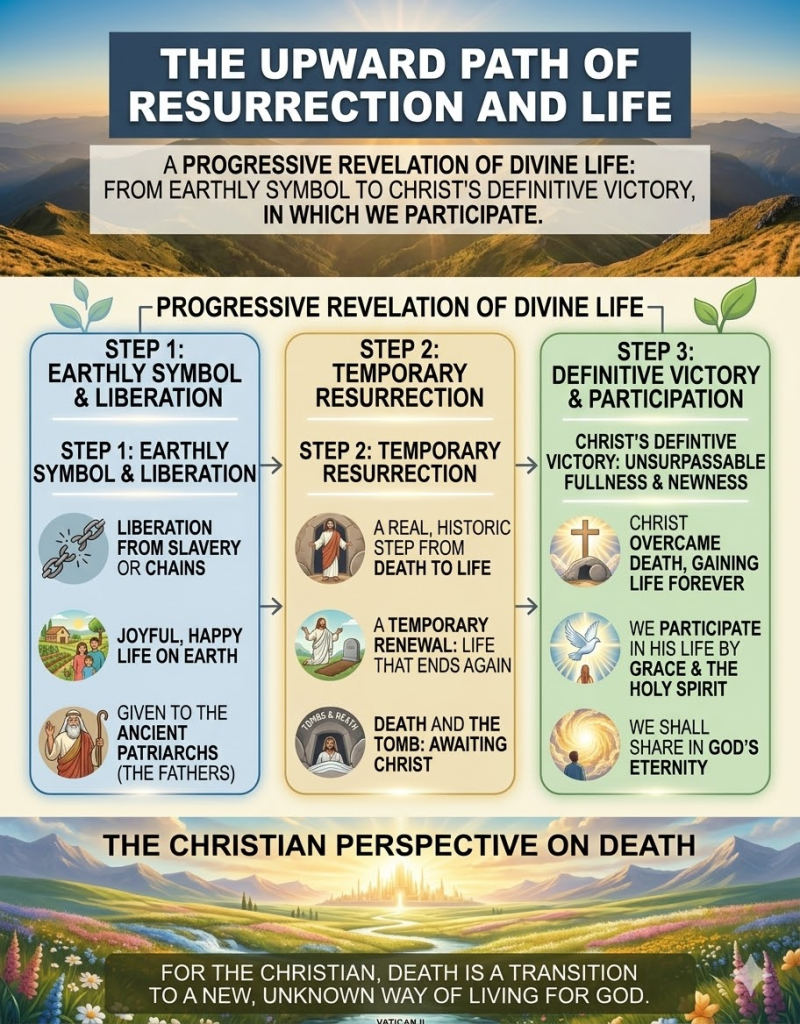
An upward process then takes place in the concept of resurrection and life: first there is the symbol of liberation and participation in a joyful and happy life on earth that God gives “to the fathers”. Then follows the real and historic step from death to life, but a life that will end again with death and the tomb. This step from death to life takes a real form of unsurpassable fullness and disconcerting newness in Christ, who in dying overcame death and regained life forever. Lastly, already in this world the Christian participates in the life of the risen Christ by grace and through the Spirit, and he will likewise share in God’s eternity. This is why for the Christian death is a transition to a new way of living, which makes an impression on us because to us it is “unknown,” however well we may know that it is “living for God.”
SOURCE: YEAR A DICASTERY NOTES (2004-05)


Pastoral Suggestions
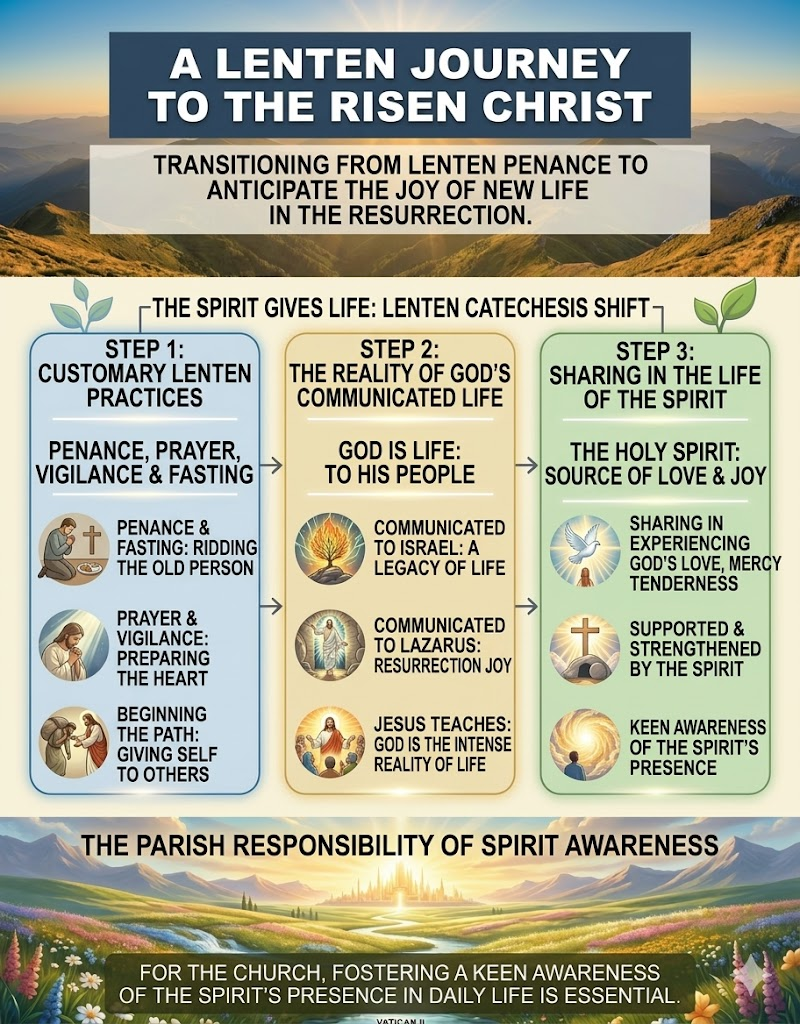
In the season of Lent the predominant themes of liturgical catechesis are customarily penance, prayer, vigilance, and fasting, etc. Today’s liturgy changes tone, to make us think in advance of the mystery of the risen Christ and to fill our hearts with joy. It is the joy of one who can rid himself of the old person and begin to live as new, in a climate of love and truth, giving himself to his brothers and sisters. This Sunday is like a high point on the path, where Jesus teaches us: God is life. The most intense reality of Christianity is life, which God communicates to us as he communicated it to the people of Israel and to Lazarus of Bethany. With this life we share in joy, in the exulting jubilation at the life of God within us, that is, his love, his mercy, and his tenderness. This is all brought about by God’s Spirit within us; we Christians must be keenly aware that it is the Spirit who gives life, and that he supports and strengthens it day after day. How aware are the faithful of your parish of this effective presence of the Spirit in the life of each Christian and in the heart of the Church itself?
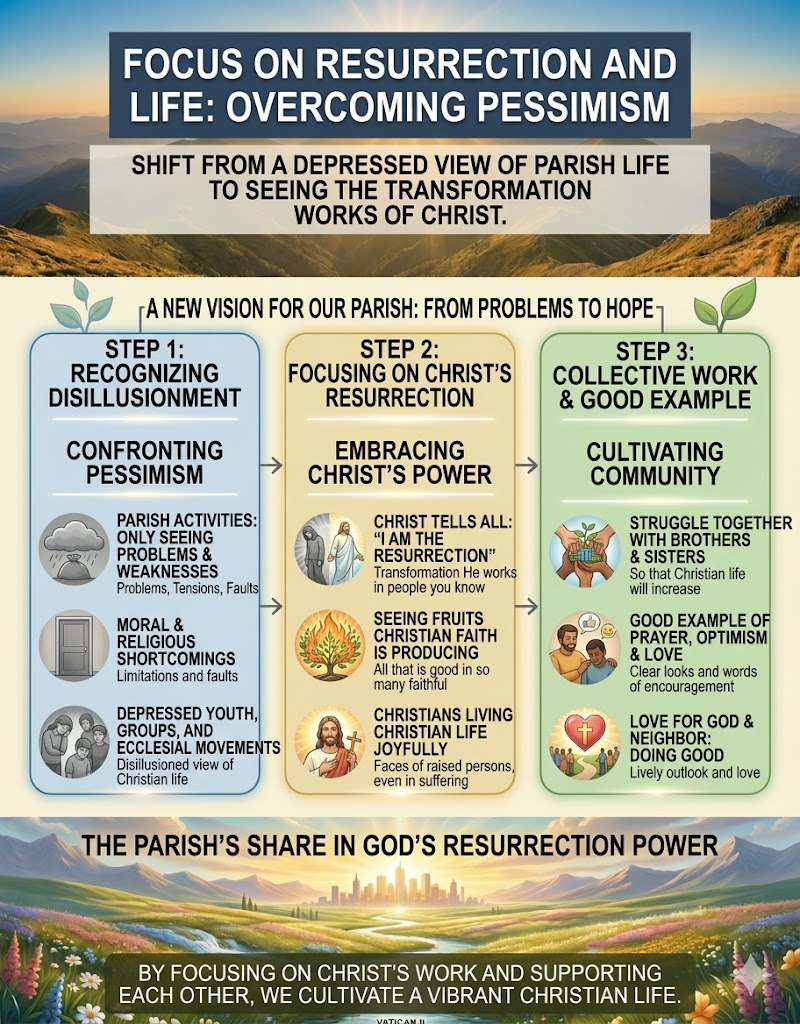
Perhaps in some communities one finds a depressed and disillusioned view of Christian life in the parish, in the diocese, among the youth, in parish groups, or in ecclesial movements existing in the parish or diocese. There exists a view that only sees the problems, tensions, faults, human weaknesses, and limitations, religious and moral shortcomings, etc., in parish activities. Today Christ tells us all: “I am the resurrection.” Focus on life, on all that is good, on the fruits that Christian faith is producing in so many people, among so many of the Christian faithful. Focus on the “resurrection,” on the transformation that Christ works in some of the people you know. Focus on all the persons who pray, who live their Christianity joyfully, who live with faces of those who are raised, even in the midst of suffering. Work and struggle together with other brothers and sisters in the faith so that Christian life will increase in your parish and in your milieu. What a lot of good can be done with a clear and lively look, a word of encouragement, a good example of prayer, optimism, and love for God and neighbor!
SOURCE: YEAR A DICASTERY NOTES (2004-05)
Infographics (visual aids) on this page were designed using Nano Banana Pro with Gemini 3.0. They draw inspiration from the 2004-05 Dicastery for the Clergy Notes (YEAR A | B | C cf. text above), but are not officially associated with or endorsed by the Holy See. They may be copied for personal use or for use in any non-profit ministry (e.g. parish bulletin inserts, classroom or group presentation, posters on community bulletin boards, etc.)
Faith Meeting Divine Omnipotence
29 March 2020 – Saint Peter’s Square
The Gospel Narrative: The Resurrection of Lazarus
The Gospel passage for this fifth Sunday of Lent is the resurrection of Lazarus (cf. Jn 11:1-45). Lazarus was Martha and Mary’s brother; they were good friends of Jesus. When Jesus arrives in Bethany, Lazarus has already been dead for four days. Martha runs towards the Master and says to Him: “If you had been here, my brother would not have died!” (v. 21). Jesus replies to her: “Your brother will rise again” (v. 23) and adds: “I am the resurrection and the life; he who believes in me, though he die, yet shall he live” (v. 25). Jesus makes himself seen as the Lord of life, he who is capable of giving life even to the dead. Then Mary and other people arrive, in tears, and so Jesus — the Gospel says — “was deeply moved in spirit and troubled…. Jesus wept” (vv. 33, 35). With this turmoil in his heart, he goes to the tomb, thanks the Father who always listens to him, has the tomb opened and cries aloud: “Lazarus, come out!” (v. 43). And Lazarus emerges with “his hands and feet bound with bandages and his face wrapped with a cloth” (v. 44).
Faith Meeting Divine Omnipotence: God’s Answer to Death
Here we can experience first hand that God is life and gives life, yet takes on the tragedy of death. Jesus could have avoided the death of his friend Lazarus, but he wanted to share in our suffering for the death of people dear to us, and above all, he wished to demonstrate God’s dominion over death. In this Gospel passage we see that the faith of man and the omnipotence of God, of God’s love, seek each other and finally meet. It is like a two lane street: the faith of man and the omnipotence of God’s love seek each other and finally meet. We see this in the cry of Martha and Mary, and of all of us with them: “If you had been here!”. And God’s answer is not a speech, no, God’s answer to the problem of death is Jesus: “I am the resurrection and the life” … have faith. Amid grief, continue to have faith, even when it seems that death has won. Take away the stone from your heart! Let the Word of God restore life where there is death.
Removing the Stones of Spiritual Death
Today, too, Jesus repeats to us: “Take away the stone”. God did not create us for the tomb, but rather he created us for life, [which is] beautiful, good, joyful. But “through the devil’s envy death entered the world” (Wis 2:24) says the Book of Wisdom, and Jesus Christ came to free us from its bonds.
We are thus called to take away the stones of all that suggests death: for example, the hypocrisy with which faith is lived, is death; the destructive criticism of others, is death; insults, slander, are death; the marginalization of the poor, is death. The Lord asks us to remove these stones from our hearts, and life will then flourish again around us. Christ lives, and those who welcome him and follow him come into contact with life. Without Christ, or outside of Christ, not only is life not present, but one falls back into death.
Regeneration Through Baptism: Journeying as a New Creature
The resurrection of Lazarus is also a sign of the regeneration that occurs in the believer through Baptism, with full integration within the Paschal Mystery of Christ. Through the action and power of the Holy Spirit, the Christian is a person who journeys in life as a new creature: a creature for life, who goes towards life.

9 March 2008 | St Peter’s Square

God’s Perspective on Death
In our Lenten journey we have reached the Fifth Sunday, characterized by the Gospel of the resurrection of Lazarus (Jn 11: 1-45). It concerns the last “sign” fulfilled by Jesus, after which the chief priests convened the Sanhedrin and deliberated killing him, and decided to kill the same Lazarus who was living proof of the divinity of Christ, the Lord of life and death. Actually, this Gospel passage shows Jesus as true Man and true God. First of all, the Evangelist insists on his friendship with Lazarus and his sisters, Martha and Mary. He emphasizes that “Jesus loved” them (Jn 11: 5), and this is why he wanted to accomplish the great wonder. “Our friend Lazarus has fallen asleep, but I go to awaken him out of sleep” (Jn 11: 11), he tells his disciples, expressing God’s viewpoint on physical death with the metaphor of sleep.
Absolute Power: Awakening from the Sleep of Death
God sees it exactly as sleep, from which he can awaken us. Jesus has shown an absolute power regarding this death, seen when he gives life back to the widow of Nain’s young son (cf. Lk 7: 11-17) and to the 12 year-old girl (cf. Mk 5: 35-43). Precisely concerning her he said: “The child is not dead but sleeping” (Mk 5: 39), attracting the derision of those present. But in truth it is exactly like this: bodily death is a sleep from which God can awaken us at any moment. This lordship over death does not impede Jesus from feeling sincere “com-passion” for the sorrow of detachment.
The Divine-Human Heart: Compassion and Incarnate Love
Seeing Martha and Mary and those who had come to console them weeping, Jesus “was deeply moved in spirit and troubled”, and lastly, “wept” (Jn 11: 33, 35). Christ’s heart is divine-human: in him God and man meet perfectly, without separation and without confusion. He is the image, or rather, the incarnation of God who is love, mercy, paternal and maternal tenderness, of God who is Life. Therefore, he solemnly declared to Martha: “I am the resurrection and the life; he who believes in me, though he die, yet shall he live, and whoever lives and believes in me shall never die”.
The Exemplary Response: Entrusting Ourselves to the Christ
And he adds, “Do you believe this?” (Jn 11: 25-26). It is a question that Jesus addresses to each one of us: a question that certainly rises above us, rises above our capacity to understand, and it asks us to entrust ourselves to him as he entrusted himself to the Father. Martha’s response is exemplary: “Yes, Lord; I believe that you are the Christ, the Son of God, he who is coming into the world” (Jn 11: 27). Yes, O Lord! We also believe, notwithstanding our doubts and darkness; we believe in you because you have the words of eternal life. We want to believe in you, who give us a trustworthy hope of life beyond life, of authentic and full life in your Kingdom of light and peace.

Proclaiming Life in the Midst of a Culture of Death
21 March, 1999
“I am the resurrection and the life; he who believes in me, though he die, yet shall he live, and whoever lives and believes in me shall never die” (Jn 11:25-26; cf. Gospel Acclamation). We can imagine the surprise that such an announcement caused in his listeners, who a short time later, however, were able to see the truth of Jesus’ words when, at his command, Lazarus, who had already been in the tomb for four days, came forth alive. An even more striking confirmation of this astonishing statement will be given later by Jesus when, by his own Resurrection, he will win the final victory over evil and death. What had been foretold many centuries before by the prophet Ezekiel in addressing the Israelites deported to Babylon: “I will put my Spirit within you, and you shall live” (Ez 37:14), will become a reality in the paschal mystery and will be presented by the Apostle Paul as the essential core of the new life of believers: “But you are not in the flesh, you are in the Spirit, if the Spirit of God really dwells in you” (Rom 8:9). Does this not show the timeliness of the Gospel message? In a society in which signs of death are increasing but in which at the same time a profound need for hope in life is felt, it is the mission of Christians to continue to proclaim Christ, man’s “resurrection and life”. Yes, faced with the signs of a creeping “culture of death”, Jesus’ great revelation must still be heard today: “I am the resurrection and the life”…
