Children, Catholic Home School, Children’s Liturgy of the Word, Catholic Home School
Children, Catholic Home School, Children’s Liturgy of the Word, Catholic Home School
April 19, 2026
3rd Sunday of Easter (A)

⬅️  ➡️
➡️






LITURGY OF
THE WORD





↩️ ↪️ Catholic Women Preach

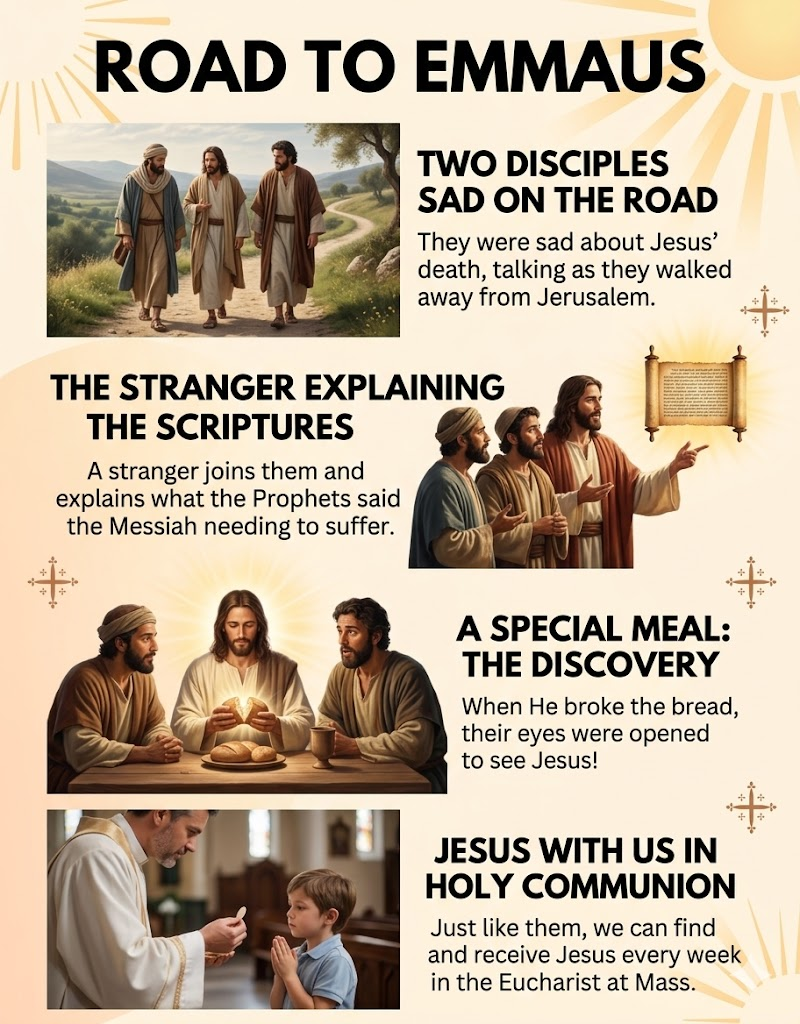
THE WORD THIS WEEK infographics are created using using GOOGLE’S AI Gemini 2.5 Pro. You are free to use the above infographic in any non-profit ministry. Please give credit to TheWordThisWeek.net and Mary Jo Cole which contributed content.
Recognition of Christ
- The disciples recognized the risen Jesus only through the Eucharistic action of taking bread, blessing it, and breaking it—not through conversation or scripture explanation—demonstrating that sacramental encounter reveals Christ’s presence more powerfully than intellectual understanding.
Prophetic Fulfillment
- Jesus used Moses and all the prophets from the Old Testament to prove the Messiah’s suffering before glorification was predetermined in God’s plan, transforming the disciples’ view from disappointment about a dead savior to understanding prophetic necessity.
Emotional Transparency in Faith
- The story models sharing feelings and doubts (sadness, loneliness, fear, sickness) with trusted people and Jesus through prayer for assistance, validating that difficult emotions are legitimate entry points for divine encounter rather than obstacles to faith.
Eucharistic Presence
- Holy Communion at Mass enables believers to carry Jesus’ love in their hearts throughout the week, establishing the Eucharist as the primary means through which Jesus remains with us beyond the resurrection appearances.
Journey from Despair to Joy
- The disciples’ transformation from sadness and hopelessness to joy after recognizing the risen Jesus provides a replicable pattern for personal faith journeys requiring open hearts and minds to encounter Christ.
Initial Misunderstanding
- Cleopas and another disciple believed Jesus was dead despite hearing the tomb was missing his body, illustrating how disappointment over unmet expectations (hoping Jesus would save Israel) can blind followers to resurrection evidence.
↩️ ↪️ Jeff Cavins


THE WORD THIS WEEK infographics are created using using GOOGLE’S AI Gemini 2.5 Pro. You are free to use the above infographic in any non-profit ministry. Please give credit to TheWordThisWeek.net and Heidi Witte – Kid’s Liturgy.
Recognition and Revelation
- The Emmaus disciples failed to recognize Jesus during their journey until the specific moment of breaking bread, demonstrating that the Eucharist serves as the primary means of revealing Christ’s true identity to believers
- The disciples experienced a four-stage emotional journey: sadness over Jesus’ death, surprise at the stranger’s presence, peace when hearing Messianic prophecies explained, and excitement upon recognizing the risen Lord through the breaking of bread
Divine Plan and Salvation
- Peter’s sermon in Acts emphasizes that Jesus’ suffering, death, and resurrection were not accidents but part of God’s predetermined plan to save humanity from sin, establishing the theological foundation for understanding Easter events
- The path of life concept teaches that God provides continuous presence as shelter and safety through both favorable and difficult circumstances, positioning Him as a constant refuge rather than an occasional helper
Practical Spiritual Application
- The Gospel prescribes a two-part remedy for sadness: talking to trusted people and conversing with Jesus, while demonstrating that showing kindness to others simultaneously lifts one’s own spirits, as evidenced by the Emmaus disciples’ experience
- Spiritual Communion offers an alternative when physical reception of Holy Communion is impossible, allowing believers to invite Jesus into their hearts since His presence remains constant in the Eucharist regardless of physical access

↩️ ↪️ Bishop James Golka
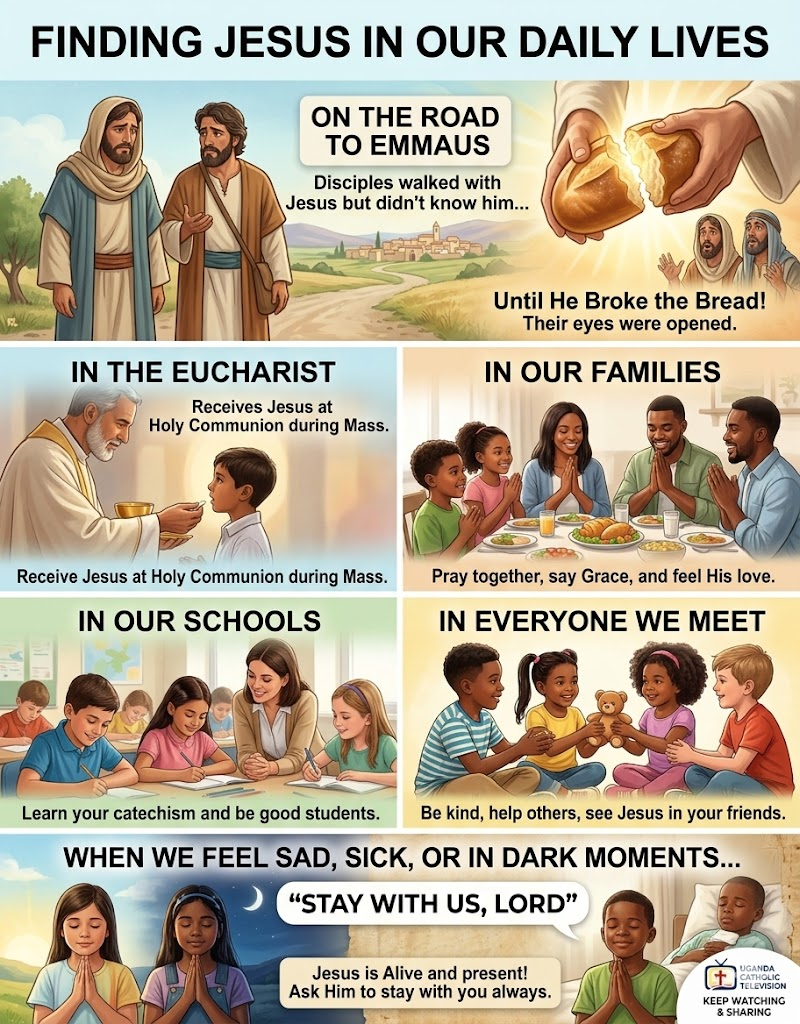
THE WORD THIS WEEK infographics are created using using GOOGLE’S AI Gemini 2.5 Pro. You are free to use the above infographic in any non-profit ministry. Please give credit to TheWordThisWeek.net and Uganda Catholic Television which contributed content.
Eucharistic Recognition
- The disciples failed to recognize Jesus during their walk to Emmaus until the specific moment when he broke bread with them, demonstrating that the Eucharist serves as the primary sacramental encounter where Christ’s presence becomes visible to believers.
- The disciples’ eyes were opened exclusively through the breaking of bread, emphasizing that Eucharistic participation requires faith to perceive Christ’s real presence beyond physical sight.
Scripture as Revelation
- The disciples experienced their hearts burning within them as Jesus opened the Scriptures on the road, illustrating that biblical understanding ignites spiritual recognition and prepares believers for deeper encounters with Christ.
- Jesus expounded all the Scriptures beginning from Moses and the prophets to explain how they pointed to his suffering and glory, showing that Old Testament comprehension is essential for grasping Christ’s mission.
Continuous Prayer Practice
- Children are taught to pray “Stay with us, Lord” during moments of joy, sorrow, anger, and need, establishing a consistent prayer pattern that builds relationship with Christ across all emotional states.
Resurrection Transformation
- Jesus’ resurrection brings light, joy, victory, and hope, with the Easter season designated as the liturgical time to celebrate these specific gifts and the transformation they produce in Christian lives.
↩️ ↪️ Know Before You Go


THE WORD THIS WEEK infographics are created using using GOOGLE’S AI Gemini 2.5 Pro. You are free to use the above infographic in any non-profit ministry. Please give credit to TheWordThisWeek.net and Edmonton Catholic Schools Division.
Recognition of Christ in Daily Life
- Jesus appears in new ways with a glorified body in Luke 24:13-35, deliberately veiling himself from disciples to teach them recognition beyond physical appearance, enabling his presence to reach all people worldwide
- Jesus reveals himself through the four-action Eucharistic sequence: taking bread, blessing, breaking, and giving—the exact pattern from the Last Supper—which unlocks disciples’ eyes to recognize his real presence
Encountering Christ Today
- Prayerful scripture reading and Mass attendance are the two primary channels Jesus uses to reach people today, speaking directly to hearts through the Liturgy of the Word and manifesting physically in the Eucharist
- The Eucharist delivers Jesus’ body and blood as a gift of everlasting life, making his real presence accessible in the same transformative way he appeared to the Emmaus disciples
Physical Presence vs Digital Connection
- Jesus’ Eucharistic presence functions like face-to-face human interaction—more real and significant than internet-mediated connection, comparable to how people prioritize physical attendance at birthdays, weddings, and funerals
- Jesus’ appearance in different forms through his glorified body demonstrates his desire to care for and be present to all people in the world, not limiting himself to a single physical manifestation
↩️ ↪️ 1-Minute Homily


THE WORD THIS WEEK infographics are created using using GOOGLE’S AI Gemini 2.5 Pro. You are free to use the above infographic in any non-profit ministry.
Recognition of Jesus’s Presence
- The two followers walking to Emmaus (11km from Jerusalem) failed to recognize Jesus until he broke bread, demonstrating that the Eucharist serves as the primary means of recognizing Jesus’s presence today
- Jesus’s presence becomes recognizable through two specific ways mirroring the Emmaus encounter: when scripture is proclaimed (creating a burning excitement in hearts) and when bread is broken at Mass by the priest
Fulfillment of Prophecy
- Jesus explained to the Emmaus followers that prophets foretold his necessary suffering before entering glory, emphasizing the requirement to believe everything the prophets said as Old Testament prophecies were being fulfilled
Emotional Response and Mission
- The followers experienced a burning excitement and beautiful warm feeling of love in their hearts when Jesus explained the scriptures, illustrating the transformative power of Jesus’s words in the Bible
- The Emmaus followers ran back to Jerusalem immediately, driven by joy and excitement bursting out of them, to proclaim the news that Jesus had risen
Liturgical Symbols
The white cloth on the prayer table and Pascal candle burning during Easter season serve as physical reminders that Jesus, the light of the world, is alive and present now
↩️ ↪️ Priests for Life

Psalm 18:1–2, 46 & 50ab

THE WORD THIS WEEK infographics are created using using GOOGLE’S AI Gemini 2.5 Pro. You are free to use the above infographic in any non-profit ministry.
Coping with Rejection
- When experiencing disappointment from not making a soccer team, prayer serves as a tool to process feelings of rejection and low self-worth, reinforcing that personal value comes from God rather than performance-based selection.
- The message emphasizes that being not picked for a team doesn’t diminish one’s worth because God holds you in His heart and considers you special, meaning identity exists beyond circumstances and external validation.


The disciples’ reflection on the events after Jesus disappears say much about how we are to encounter Christ today:
1. Scripture “They said to each other, ‘Were not our hearts burning within us while he was talking to us on the road, while he was opening the scriptures to us?’” (Luke 24:32) Turn to the Scriptures with an open heart and let the Lord open them up to you.
2. Eucharist “Then they told what had happened on the road, and how he had been made known to them in the breaking of the bread.” (Luke 24:35) If you want to know Jesus and encounter him today, celebrate the breaking of the bread with other Christians in church. Christ is present in the Eucharist.
Check for Understanding (PDFs)
Our Sunday Visitor

THE WORD THIS WEEK infographics are created using using GOOGLE’S AI Gemini 3 Pro. You are free to use the above infographic in any non profit ministry. Please give credit to TheWordThisWeek.NET and Our Sunday Visitor.


MINISTRY-TO-CHILDREN: Jesus on the Road to Emmaus and God’s Work in our Lives Main Objective: The main point of this message relates to current events in a timely way. Challenging things are happening in our world, and it’s difficult to understand why. We have to trust that God is at work, and that He has a plan in all things. The disciples on the road to Emmaus didn’t recognize Jesus at first, and when He explained things to them, all of the pieces fell into place. We don’t always recognize what Jesus is doing in our lives, but one day we will see Him face to face. Meanwhile, we can look for how He is working through those around us, and commit to daily prayer and Bible study.

3rd Sunday of Easter (A)
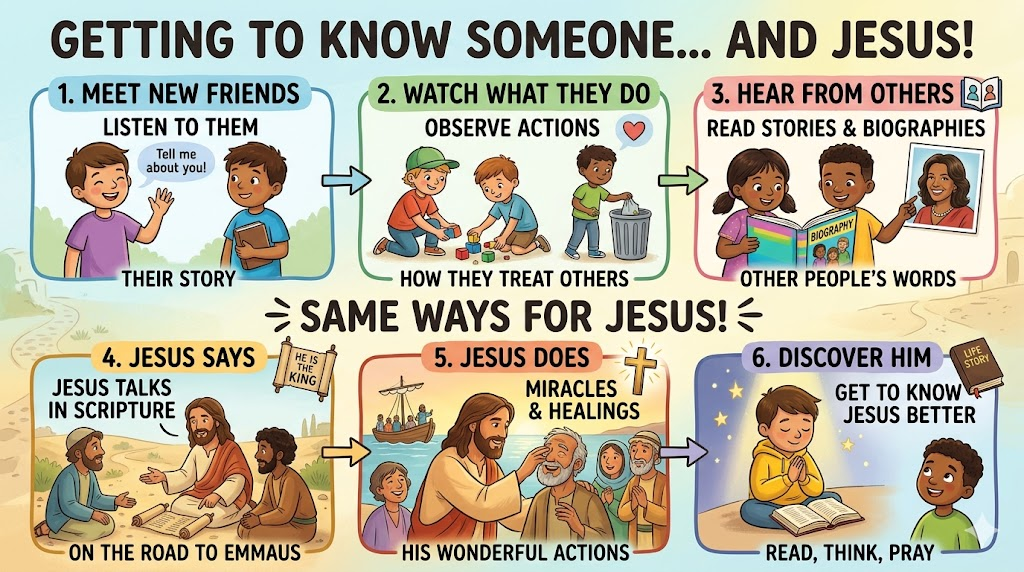
Image added by TWTW; not part of original source material
Getting to Know You
When you are introduced to someone, how do you decide if this is a person you would like to know better? You listen to what the new acquaintance tells you about herself or himself. You can also learn a lot about someone by noticing what they do – how they treat other people and what they choose to do with their time. Actions give us good information about the character of a person.
Another way to learn more about someone you haven’t known long is to listen to how other people describe him or her. Some famous people have books, called biographies, written about their lives.
The same ideas can be used to learn more about Jesus. Before Jesus ascended to heaven he talked with two disciples who were walking along the road, traveling to Emmaus. While he was with them “he explained to them in all the Scriptures the things concerning himself” (24:27).
As we read the Bible, Jesus tells us who he is. We learn about the things he did while he was on earth; his good actions seen in the healings and miracles he performed. And we read how others describe him.

Image added by TWTW; not part of original source material
What’s the Story?
We all have our own story. When you were born someone filled out a birth certificate with your name on it. That birth certificate lists your parent’s names, where you were born, and how much you weighed. It might also include a tiny print of your foot.
As you grow there may be photos collected in an album that include pictures of you when you took your first steps, got your first haircut, or started school. There may be notes about how you liked to dance, play baseball, or it may record some of the funny things you said when you were beginning to talk.
As you progress through school, pictures are taken of you and your classmates and someday, if you marry, there may be pictures of you at your wedding.
During all of your life you are creating your own story. There may be interesting details like the time you broke your arm or went on a trip or discovered a new talent. As you grow you gather friends and each day learn more about the world.
Jesus had his own story too. It began long before he was born. His life story is recorded in the Bible. We can trace his family history as well as events that happened in his life.
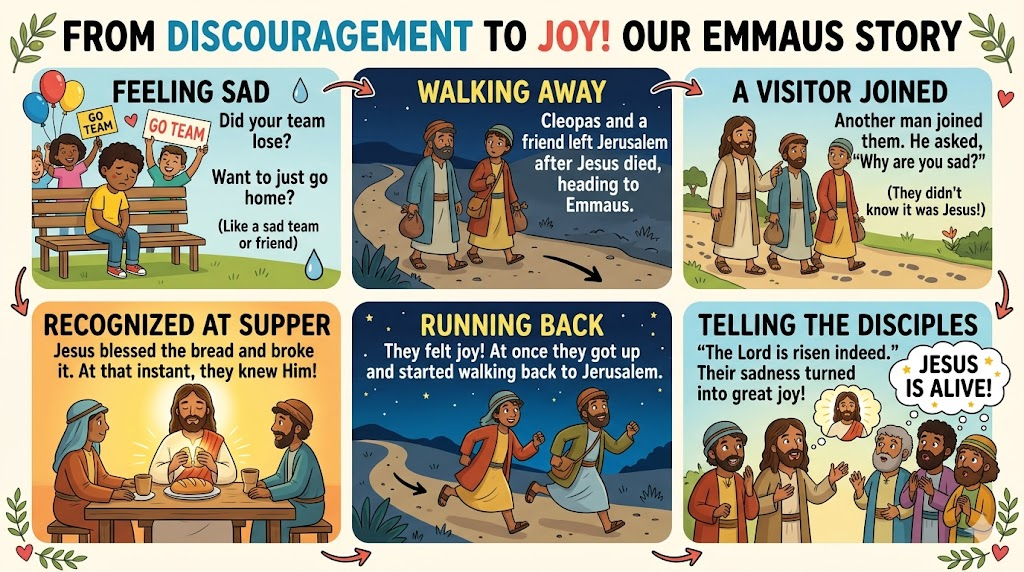
Image added by TWTW; not part of original source material
On the Road to Emmaus
Have you ever been so discouraged you wanted to just go home and not talk to anyone? (Give children an opportunity to respond.) Maybe your team lost, and you didn’t want to go out for burgers and sodas with the team, you just wanted to go home.
Our Bible story today is about two people who were friends of Jesus.After Jesus’ crucifixion, Cleopas and the other traveler left Jerusalem and headed down the road to the village of Emmaus. They were walking along the road talking about all they had seen and heard while in Jerusalem.
Another man joined their walk. He said, “What are you talking about as you walk, and are sad?” (Verse 16) Cleopas said, “Are you the only stranger in Jerusalem who doesn’t know the things which have happened?” (Verse 18)
SOURCE: Sermon Writer – © 1997 – 2026 Richard Niell

THE WORD THIS WEEK infographics are created using using GOOGLE’S AI Gemini 3 Pro Nano Banana and images from Unsplash. You are free to use the above infographic in any non-profit ministry. Please give credit to TheWordThisWeek.net and the Word-Sunday.
Entrance Song
Recognition of Jesus
Q: How did the followers finally recognize Jesus on the road to Emmaus?
A: The followers’ eyes opened wide and they recognized Jesus specifically when bread was broken, after which He vanished quickly but left them with joy, warm hearts, and no more pain.
Jesus’s Teaching Method
Q: How did the stranger respond to the followers’ sadness about the crucifixion?
A: The stranger smiled and shared the greatest tale of God’s promises never failing, revealing Himself through love and His Word rather than immediately disclosing His identity.

Response & Acclaim

Response & Acclaim

Communion
Recognition of Christ’s Presence
Q: How did the disciples finally recognize Jesus on the road to Emmaus?
A: The disciples’ eyes were opened to recognize Jesus at the precise moment when he took bread, gave thanks, broke it, and gave it to them, demonstrating that Christ reveals himself through the Eucharistic action of breaking bread.
Divine Companionship
Q: What does the Emmaus story teach about Jesus’s presence in our lives?
A: Jesus walked beside the disciples even when they couldn’t recognize him, teaching that Christ is always walking beside us even during moments when we cannot perceive his presence.