Homilies
Homilies
March 8, 2026
April 19, 2026
3rd Sunday of Easter (A)

⬅️  ➡️
➡️

RECOMMENDED
The Augustinian Province of St. Thomas of Villanova maintains a dedicated “Homilies” page with reflections grounded in the Confessions and the Rule of St. Augustine.
✍️ Augustinian Province – Weekly Homilies
📺 Fr. Paul Galetto
📺 Fr. Tom McCarthy
✍️ Fr. Kieran J. O’Mahony
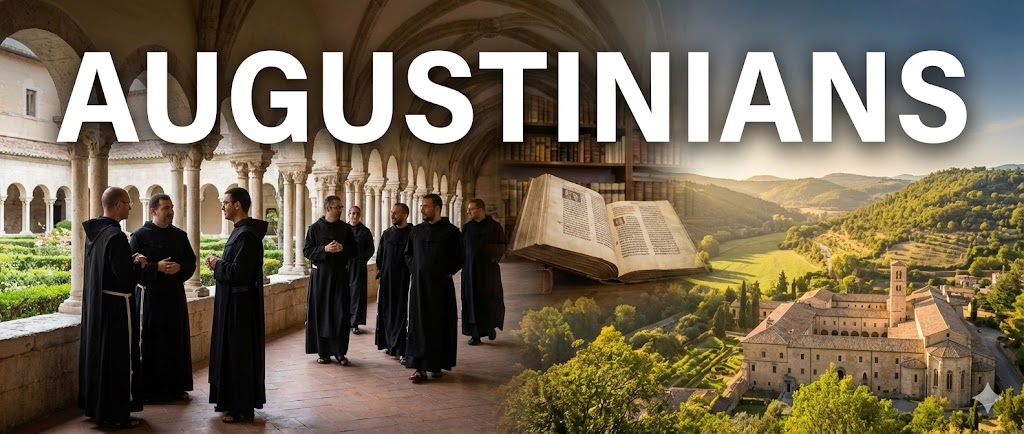
Core Charism: Interiority (searching for God within), community life (“one mind and one heart on the way to God”), and the restless heart that finds repose only in God.
3rd Sunday of Easter (A)
Focus Reading: Luke 24:13–35 (The Restless Heart) Augustinians emphasize the search for God within the community and the “interior teacher.”
Key Phrase: “Our hearts are restless until they rest in You.”
The Hook: Our eyes are often prevented from seeing because our hearts are looking for the wrong things.
The Approach: Focus on the concept of the Christus Totus (The Whole Christ). Jesus teaches from within (the burning heart) and from without (the community/Scripture). Application: Ask yourself, “What am I actually searching for?” and redirect that restlessness toward the Word of God.
Opening: “Restlessness is the hallmark of the human heart. These two disciples were walking seven miles away from the source of their joy, yet their hearts were burning within them the whole time. They were restless because the ‘Interior Teacher’ was already speaking to them. We often travel far and wide looking for God, only to realize He was the one walking in our shoes the entire journey.”
RECOMMENDED
Many Benedictine Abbeys publish the Abbot’s homilies online. Quarr Abbey and Saint Meinrad Archabbey are excellent sources for traditional Benedictine “Lectio” style preaching.
✍️ Saint Meinrad Archabbey Reflections
✍️ Monastery of Christ in the Desert
✍️ Mepkin Abbey

Core Charism: Ora et Labora (Prayer and Work), Stability, Hospitality, Lectio Divina, Listening with the “ear of the heart.”
3rd Sunday of Easter (A)
Focus Reading: Luke 24:13–35 (Hospitality and Recognition) Benedictines prioritize Stability, Prayer (Ora), and Work (Labora) within a community.
Key Phrase: “Receive all guests as Christ himself.”
The Hook: “Stay with us, for it is nearly evening.” The transformative power of monastic hospitality.
The Approach: Highlight the “School of the Lord’s Service.” The disciples recognized Jesus through the ritual action of the breaking of the bread—a liturgical act. Application: Create a “sacred rhythm” in your home where the evening meal is treated with the same reverence as a prayer.
Opening: “In the Rule of St. Benedict, we are told to ‘Listen with the ear of the heart.’ On the road to Emmaus, the disciples were listening with their ears, but their hearts were still closed by grief. It was only when the stranger became a guest, and the guest became the host at the table, that the stability of God’s presence was revealed. We meet that same presence here, in the silence of the sanctuary and the breaking of the bread.”

LECTIO DIVINA
APRIL 2026 (PDF)
RECOMMENDED
The Carmelites offer a unique “Lectio Divina” style reflection for each Sunday through their international headquarters.
✍️ OCarm.org – Lectio Divina for Sundays
📺 Fr. Greg
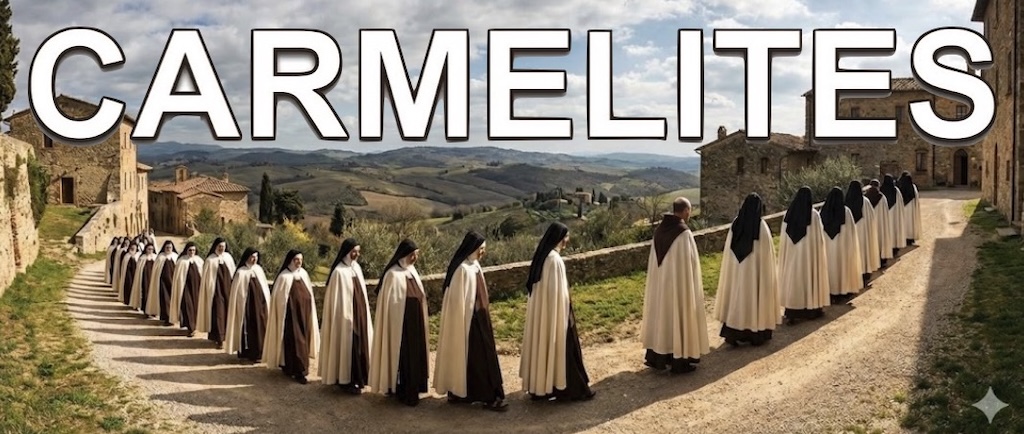
Core Charism: Contemplation, The Desert, Prayer as Friendship, The Dark Night, Elijah, St. Teresa of Avila.
3rd Sunday of Easter (A)
Focus Reading: Luke 24:13–35 (The Veiled Presence) Carmelites focus on the “Interior Castle,” contemplative prayer, and the “Dark Night.”
Key Phrase: “In the evening of life, we will be judged on love alone.”
The Hook: Jesus becomes invisible the moment he is recognized. Why does he disappear when we finally “see” him?
The Approach: Focus on the transition from physical sight to “faith-sight.” The journey to Emmaus is a metaphor for the contemplative life—moving from outward signs to an inward, silent union. Application: Spend 10 minutes in absolute silence today, allowing the “Teacher” to speak to your heart without words.
Opening: “There is a profound mystery in the ‘disappearing’ Jesus. The moment the disciples recognize Him in the bread, He vanishes from their sight. Why? Because the Risen Lord is teaching them—and us—to move from the visible to the invisible. He is calling us into the ‘Interior Castle’ of the soul, where He no longer needs to stand in front of us because He lives within us.”
RECOMMENDED
The Dominicans have one of the most robust preaching websites called “Torch.” It features a new homily every week from a different friar.
✍️ English Dominican Friars – Torch
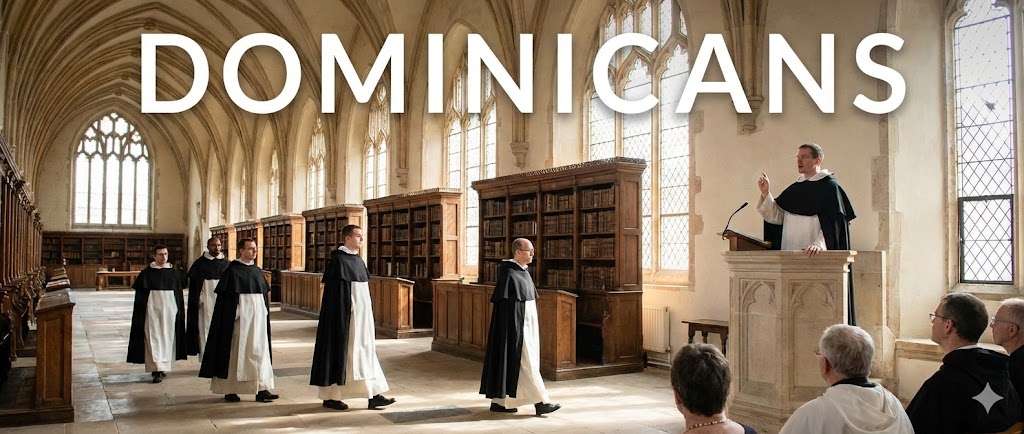
Core Charism: Veritas (Truth), Preaching, Study, Combatting Error with Clarity, Contemplation passed on to others.
3rd Sunday of Easter (A)
Focus Reading: Acts 2:14, 22–33 (Peter’s Proclamation) The Order of Preachers focuses on Veritas (Truth) and the clear, doctrinal explanation of the faith.
Key Phrase: “To contemplate and to give to others the fruits of contemplation.”
The Hook: Peter, once fearful and silent, now stands with theological clarity to explain the “why” behind the Resurrection.
The Approach: Focus on the fulfillment of prophecy (David and the Psalms). The homily should move from the “Word” to “Wisdom,” explaining how the Resurrection is the logical and divine conclusion of God’s plan. Application: Study the Catechism or Scripture this week to be able to “give a reason for your hope.”
Opening: “The Church is born from the mouth of a witness. Today, we see Peter standing up—not as the man who denied Christ, but as the man who has synthesized the Truth. He connects the dots from King David’s ancient songs to the empty tomb. Today’s liturgy demands we ask ourselves: Is our faith merely a feeling, or is it a conviction rooted in the ‘reason’ of the Word made flesh?”
RECOMMENDED
St. Anthony Messenger and the various provinces often provide “Franciscan Spirit” reflections that focus on the Gospel of the day.
✍️ Franciscan Media – Sunday Homily Helps
📺 Fr. Paul Galetto
📺 Fr. Tom McCarthy
✍️ Fr. Kieran J. O’Mahony

Core Charism: Poverty, Minority (being “lesser”), Fraternity, and finding God in the grit of humanity and creation.
3rd Sunday of Easter (A)
Focus Reading: Luke 24:13–35 (The Road to Emmaus) The Franciscans emphasize the “Incarnational” presence of God in the humble and the everyday.
Key Phrase: “The Lord meets us in the ordinary dust of our journey.”
The Hook: Jesus doesn’t wait for us at the finish line; he walks the dusty, discouraged roads of our lives as a fellow traveler.
The Approach: Focus on the “Brotherhood” of Christ. Just as St. Francis found God in the leper and the poor, we find the Risen Lord in the breaking of bread and simple hospitality. Application: Look for “neighbor” moments this week where a simple shared meal or conversation can become a sacred encounter.
Opening: “Peace and good to you all. Have you ever noticed that Jesus is a terrible hiker? On the road to Emmaus, He doesn’t lead the way or set the pace; He just wanders up beside two losers—two men who feel like they’ve lost everything—and asks to walk in their dust. He doesn’t come in the clouds today; He comes in the middle of a long walk and a simple, shared meal.”
RECOMMENDED
The Jesuits typically provide reflections through America Magazine or their provincial websites. Their “The Word” column is the gold standard for Ignatian preaching.

Core Charism: Ad Maiorem Dei Gloriam (For the Greater Glory of God), Discernment of Spirits, Finding God in All Things, Imaginative Contemplation.
3rd Sunday of Easter (A)
Focus Reading: Luke 24:13–35 (The Road to Emmaus) Ignatian spirituality centers on “Finding God in All Things” and the “Discernment of Spirits.”
Key Phrase: “Discern the fire within.”
The Hook: Why were their hearts burning before they recognized him? Understanding the interior movements of the soul.
The Approach: Use the “Composition of Place.” Invite the congregation to imagine themselves on that seven-mile walk. Analyze the shift from desolation (looking downcast) to consolation (hearts burning). Application: Practice a daily “Examen” to look back at where your heart “burned” with God’s presence today.
Opening: “Let’s look closely at the ‘holy frustration’ of the two disciples. They had the facts, but they lacked the fire. St. Ignatius tells us that God deals with us directly; notice how Jesus doesn’t just give a lecture, He asks a question: ‘What are you discussing as you walk along?’ He begins with their experience, their desolation, and their confusion, because that is exactly where the Spirit begins the work of discernment.”
March/April 2026
RECOMMENDED
The Redemptorists of the Baltimore and Denver Provinces often provide weekly reflections, particularly through their “Missionaries of Hope” video series or Lenten booklets.
✍️ The Redemptorists (Baltimore Province) News & Reflections

Core Charism: Preaching “Plentiful Redemption” (Copiosa Redemptio), especially to the abandoned and sinners; Moral Theology (St. Alphonsus Liguori).
3rd Sunday of Easter (A)
Focus Reading: 1 Peter 1:17–21 (Ransomed by the Blood of the Lamb) Founded by St. Alphonsus Liguori, Redemptorists focus on “Copious Redemption” for the most abandoned.
Key Phrase: “With Him, there is plentiful redemption.”
The Hook: You were not bought with perishable things like silver or gold, but with the precious blood of Christ.
The Approach: Focus on the infinite value of a human soul. No matter how far the Emmaus disciples walked away, the “Redeemer” followed them to win them back. Application: Reflect on a “lost” area of your life and trust in the overwhelming mercy of God to buy you back.
Opening: “If you have ever felt like you were walking away from hope—if you’ve ever felt like you were heading toward your own personal ‘Emmaus’ because staying in Jerusalem was too painful—then today’s Gospel is for you. St. Peter reminds us that we weren’t bought with silver or gold, but with Blood. You are so valuable to God that He will chase you down a lonely highway just to tell you that you are redeemed.”
3rd Sunday of Easter (A)
Bishop Robert Barron

Agents of Divine Mercy

Friends, we come to this Third Sunday of Easter, and our Gospel is Luke’s account of the disciples on the road to Emmaus. This masterpiece is a summation of the spiritual life, and it starts with two disciples of Jesus walking the wrong way.
3rd Sunday of Easter (A)
Featured Homily
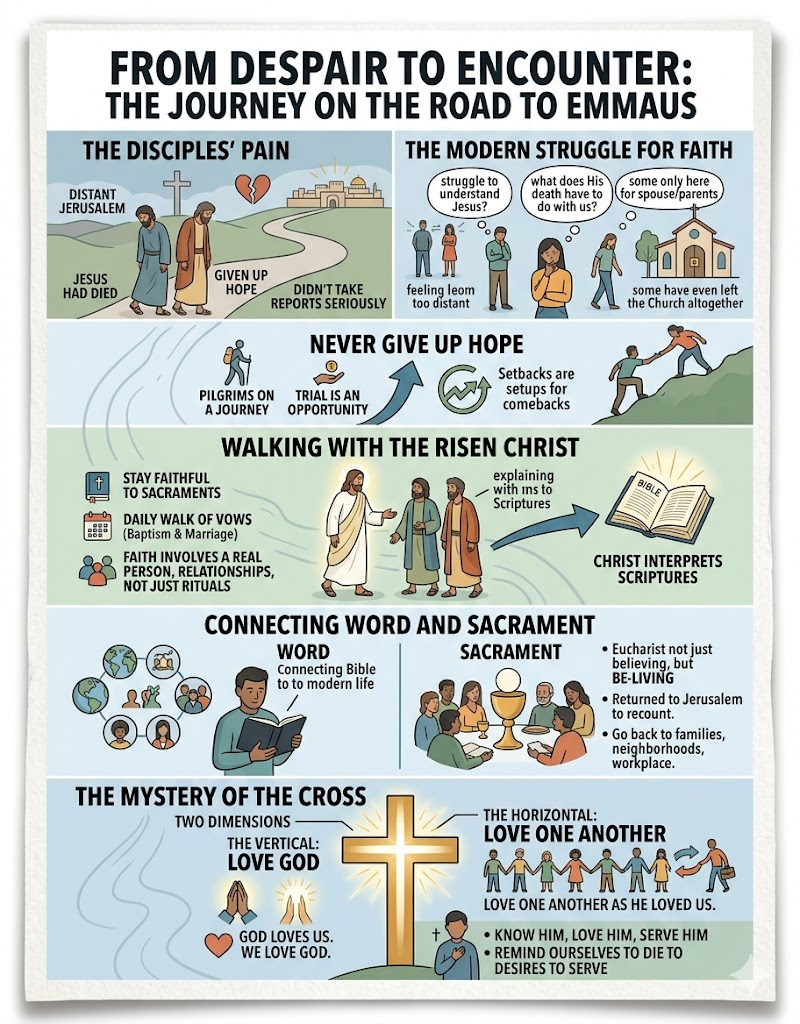
From Despair to Encounter

The homily frames the Emmaus account as a roadmap for “making the connections” between historical facts and a living relationship with Christ. It identifies the despondency of the disciples with modern struggles of faith—particularly among adult children who have left the Church or those who attend Mass out of obligation without “getting it.” The homily posits that Christianity is not a set of programs but a relationship with a Real Person. By linking the “vertical” love of God with the “horizontal” love of neighbor, the homily argues that the Eucharist must be transformed from something we believe into something we are “be-living.”
GO DEEPER
PROMPTS TO KEEP YOU WRITING
Copy/paste one of these command prompts into the Catholic Assistant (bottom right corner). This tool can help you brainstorm and provide you with further ideas to keep you writing.
_
- Putting Distance Between explores the emotional state of the disciples as they try to flee the city of their greatest trauma. Direct the AI to focus on the desire to escape pain.
- The Reluctant Pew-Sitter addresses the person who attends Mass only out of obligation, feeling disconnected from the "distant" stories of faith. Direct the AI to focus on relatable skepticism.
- Economy of Grace develops the theme that every spiritual setback is a potential setup for a divine comeback. Direct the AI to focus on resilience and hope.
- Simply Keep Walking portrays the Christian life as a steady faithfulness to baptismal and marriage vows, even when one "loses heart." Direct the AI to emphasize daily perseverance.
- Not a Program, a Person contrasts dry religious education with a vibrant, lived relationship with the Risen Jesus. Direct the AI to focus on personal encounter.
- The Word Off the Page follows Christ as He interprets the Scriptures, showing how the Bible must move from the book into the world. Direct the AI to focus on biblical application.
- Be-living the Real Presence challenges the believer to manifest the Eucharist in their daily interactions and neighborhood life. Direct the AI to focus on active discipleship.
- Vertical and Horizontal analyzes the Sign of the Cross as a dual commitment to loving God and loving humanity simultaneously. Direct the AI to emphasize the "geometry" of faith.
- The Jerusalem Return depicts the disciples rushing back to the community they once fled, transformed by their encounter at the table. Direct the AI to focus on missionary urgency.
- gDying to Desires reflects on the Cross as a tool for overcoming selfishness in order to serve others more effectively. Direct the AI to focus on sacrificial love.
3rd Sunday of Easter (A)
Fr. Michael Chua
2026 HOMILIES | ARCHIVE: 2023 | 2020 | 2017 | 2014 | 2011
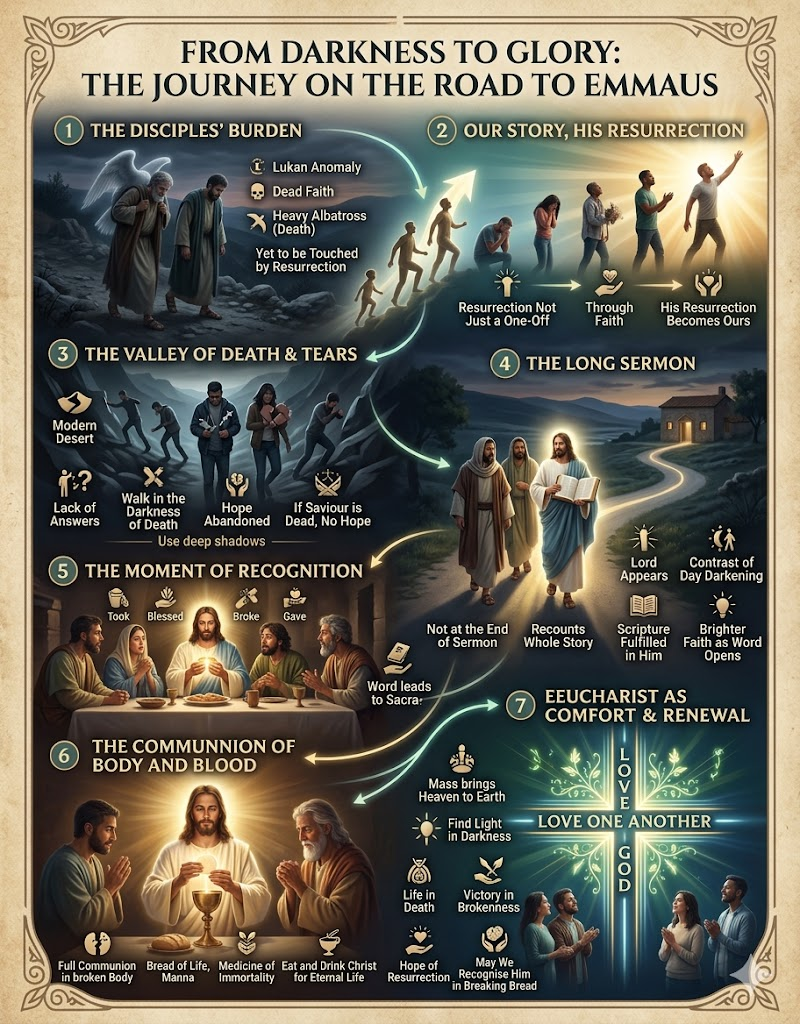
The Road which Leads to the Eucharist

Fr. Michael Chua explores the journey of the disciples on the road to Emmaus, framing it as a movement from the “valley of death and tears” toward the light of the Resurrection. He posits that Christ’s Resurrection is not a distant historical miracle but a reality made accessible through faith and the Eucharist. While the exposition of Scripture begins to illuminate the disciples’ hearts, full recognition only occurs in the Breaking of the Bread. Ultimately, the homily emphasizes that the Word must lead to the Sacrament, where the Risen Lord offers the “medicine of immortality” to a despairing world.

Scriptural References and Allusions
- Gospel of Luke 24:13–35: The primary narrative of the disciples on the road to Emmaus.
- Psalm 23:4: Allusion to walking through "the valley of death" (the valley of the shadow of death).
- Gospel of Luke 22:19: Reference to the institution of the Eucharist ("took... blessed... broke... gave").
- Gospel of John 1:14: The Word becoming flesh and dwelling among us.
- Exodus 16: Reference to "manna from heaven."
- Gospel of John 6:35-58: The "Bread of Life" discourse.
- Ignatius of Antioch: Allusion to the Eucharist as the "medicine of immortality" (pharmakon athanasias).
- Gospel of Matthew: Mentioned as the primary source for Cycle A readings.
- Gospel of John: Mentioned as a source for Lent and Easter seasons.
GO DEEPER
PROMPTS TO KEEP YOU WRITING
Copy/paste one of these command prompts into the Catholic Assistant (bottom right corner). This tool can help you brainstorm and provide you with further ideas to keep you writing.
_
- Walking Through Despair establishes the scene of two travelers burdened by grief and a sense of abandonment. Use vivid imagery of the valley of shadows. Direct the AI to write a reflection on finding hope.
- The Liturgy's Foundation focuses on the transition from the Liturgy of the Word to the Liturgy of the Eucharist. Contrast the spoken word with the physical bread. Direct the AI to emphasize sacramental presence.
- Burning Hearts and Minds explores the intellectual and emotional transformation that occurs when Christ explains the scriptures. Highlight the fulfillment of prophecy. Direct the AI to focus on the power of biblical teaching.
- The Medicine of Immortality treats the Eucharist as a necessary remedy for the spiritual and physical decay of the world. Connect the bread of life to eternal survival. Direct the AI to emphasize healing.
- A Journey of Recognition follows the narrative arc from blindness to sight during a simple shared meal. Detail the specific moment the bread is broken. Direct the AI to write about spiritual epiphany.
- The Tragedy of Disconnection addresses those who have wandered away from the communal life of the Church and the altar. Use a tone of pastoral concern and urgency. Direct the AI to focus on invitation.
- Heaven Meets Earth describes the Mass as a thin place where the celestial and the mundane intersect through the Body of Christ. Focus on the cosmic significance of worship. Direct the AI to emphasize transcendence.
- Scripture’s Golden Thread demonstrates how the entire Bible points toward the suffering and glory of the Messiah. Portray Christ as the master storyteller. Direct the AI to write about biblical fulfillment.
- The Emmaus Path Today modernizes the journey of the two disciples, placing contemporary struggles on that ancient dusty road. Use relatable modern anxieties. Direct the AI to focus on Christ’s accompaniment.
- The Risen Lord’s Presence asserts that the Resurrection is a present reality rather than a past historical event. Focus on the "now" of the faith. Direct the AI to emphasize current transformation.
3rd Sunday of Easter (A)
Dominican Blackfriars
2026 HOMILIES | ARCHIVE: 2023 | 2020 | 2017 | 2014 | 2011 | 2008 | 2005 | 2002
Leaving Jerusalem
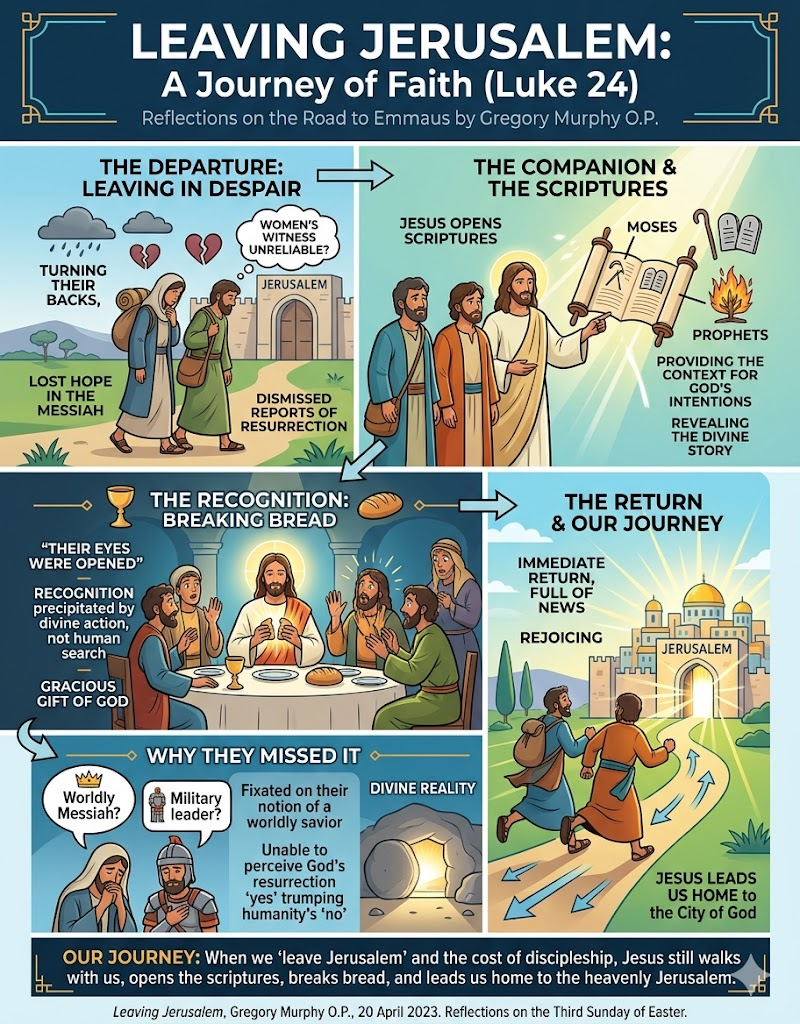
Fr. Gregory Murphy, OP, examines the journey of Cleopas and his companion as an act of desertion—turning their backs on Jerusalem in despondency. Despite hearing reports of the Resurrection, the disciples remain trapped in worldly skepticism and “enlightenment” doubt, unable to reconcile a crucified Messiah with their political expectations. Murphy argues that recognition is a divine gift, not a human achievement; it requires the Risen Christ to provide the interpretive key to Scripture. Ultimately, the encounter in the breaking of bread reverses their flight, transforming their retreat into a joyful return to the community of faith.
GO DEEPER
PROMPTS TO KEEP YOU WRITING
Copy/paste one of these command prompts into the Catholic Assistant (bottom right corner). This tool can help you brainstorm and provide you with further ideas to keep you writing.
_
- Turning from the City depicts the emotional weight of Cleopas leaving Jerusalem, turning his back on the site of his greatest disappointment. Focus on the theme of despondency. Direct the AI to emphasize the feeling of abandonment.
- The Skeptic's Journey portrays the disciples as rationalists who dismiss the women’s testimony as unreliable or hallucinatory. Contrast human logic with divine mystery. Direct the AI to focus on the tension between doubt and faith.
- The Divine Interpreter shows a stranger walking alongside two travelers, reframing their entire history through the lens of the suffering Messiah. Use a tone of intellectual authority. Direct the AI to rewrite the scriptural exposition.
- Eyes Wide Open focuses on the specific moment in the Emmaus house where bread is broken and the passive grace of God restores sight. Emphasize the suddenness of recognition. Direct the AI to focus on the moment of epiphany.
- In but Not Of explores the conflict between worldly wisdom and the Father's will, using the Garden of Gethsemane as a backdrop for the disciples' misunderstanding. Direct the AI to contrast earthly and heavenly perspectives.
- The Return Flight describes the frantic, joyful journey back to Jerusalem once the disciples realize they were wrong. Contrast the slow, heavy walk out with the fast run back. Direct the AI to focus on renewed zeal.
- The Silent Companion highlights the ways Christ accompanies those who are currently "lost" or "wandering" in modern life. Use a gentle, pastoral tone of accompaniment. Direct the AI to write about Christ’s hidden presence.
- God’s Final Yes treats the Resurrection as the ultimate vindication that trumps all human "nos" and failures. Focus on the theme of divine victory over worldly power. Direct the AI to emphasize the triumph of grace.
- The Mosaic Thread traces the story of Jesus back to Moses and the Prophets, showing how the "divine story" only makes sense in light of Easter. Direct the AI to focus on biblical typology.
- The Heavenly City envisions the end of the Christian journey as a return to the "Heavenly Jerusalem," led by the One who breaks bread. Focus on the eschatological hope. Direct the AI to emphasize the final destination.
3rd Sunday of Easter (A)
Fr. Austin Fleming

2026 HOMILIES | ARCHIVE: 2023 | 2020 | 2017 | 2014 | 2011 | 2008
The Light of Christ
Fr. Austin utilizes the imagery of the Paschal candle and a small votive light to illustrate the constant, intimate presence of the Risen Christ. He argues that while a massive candle is a helpful liturgical reminder, the reality of Christ’s light is more like a steady, quiet glow that accompanies us through mundane rituals—showering, driving, and even unkind thoughts. By interpreting the road to Emmaus as “anywhere and everywhere,” Fr. Austin suggests that our daily commutes and routines are the true sites of divine encounter, culminating in the “breaking of the bread” where our eyes are finally opened to the One who has been talking to us all day long.

GO DEEPER
PROMPTS TO KEEP YOU WRITING
Copy/paste one of these command prompts into the Catholic Assistant (bottom right corner). This tool can help you brainstorm and provide you with further ideas to develop your homily.
_
- Rhetorical Strategy: Relatable Personification
- Notice how the preacher describes Jesus as "never shutting up" and "jumping into the car." Use this conversational, slightly humorous personification to make Jesus feel like a persistent, loving companion rather than a distant historical figure. It breaks down the formal "stained-glass" barrier and invites a more intimate relationship.
- Liturgical Strategy: Visual Aid Contrast
- If possible, use a physical votive candle as a prop during the homily to contrast with the large Paschal candle. This visual shift from the "extraordinary" (Easter Season) to the "ordinary" (daily life) reinforces the theology of the Incarnation—that God dwells in the small and the manageable.
- Pastoral Strategy: Compassion in the Shadows
- Address those for whom the "clouds are thick." Validate that walking by faith is hard when the light isn't visible. Offer the image of Christ as a "night light" keeping vigil; this provides a sense of security for those suffering from anxiety or grief, focusing on Christ’s active protection while we are "asleep" or unaware.
- Mystagogical Strategy: Recognizing the Incessant Voice
- Help the faithful understand that the "word of Truth" is being spoken to them "all day long," not just during the Sunday readings. Explain that we come to Mass not to start the conversation with Jesus, but to finally recognize the voice that has been speaking to us since we woke up.
- The Vigilant Nightlight portrays the Risen Lord as a silent guardian keeping watch while the world sleeps. Direct the AI to emphasize safety and peace.
- The Unstoppable Light asserts that no darkness, including the darkness of death or wasted time, can extinguish Christ’s glow. Direct the AI to focus on divine persistence.
3rd Sunday of Easter (A)
Monsignor Peter Hahn

Tragedies and Trials of Contemporary Life
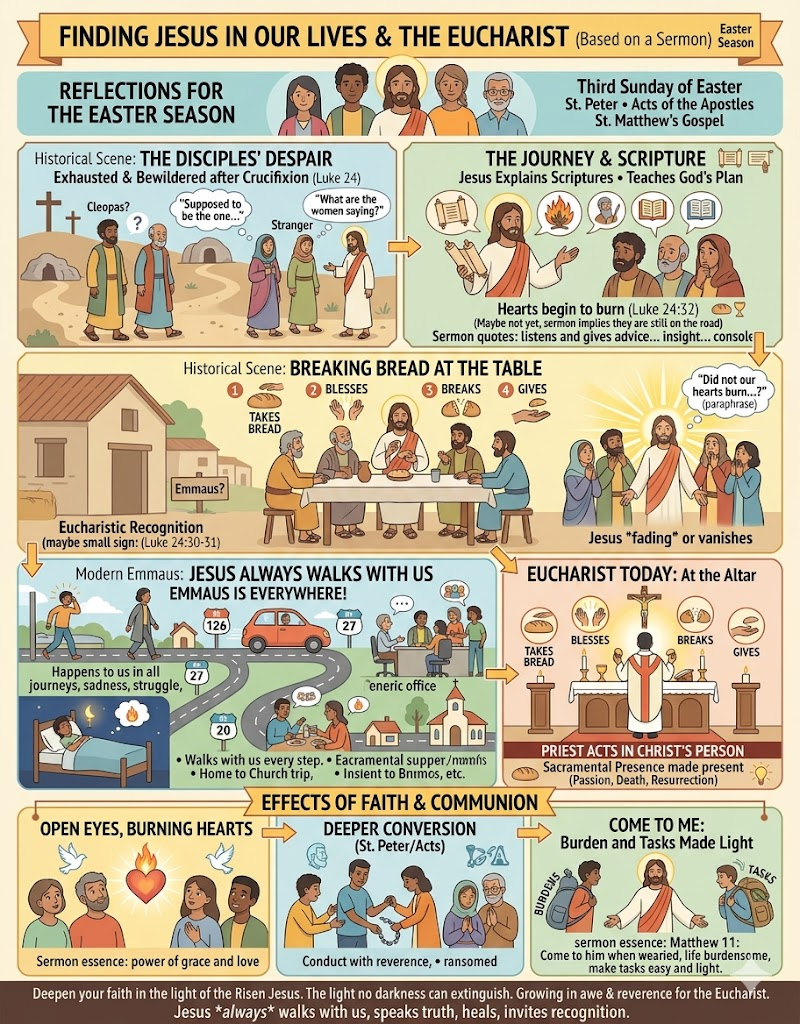
Msgr. Peter Hahn reflects on the Emmaus narrative as a continuous reality for the modern believer, rather than a mere historical event. He identifies the exhaustion and bewilderment of the disciples with the “tragedies and trials” of contemporary life. Msgr. Hahn emphasizes that through the ministry of the priest, the same Christ who walked the road to Emmaus acts at the altar—taking, blessing, breaking, and giving. This sacramental encounter is intended to spark a “burning heart” and a “deeper conversion,” empowering the faithful to carry their own crosses united to Christ’s perfect sacrifice.
GO DEEPER
PROMPTS TO KEEP YOU WRITING
Copy/paste one of these command prompts into the Catholic Assistant (bottom right corner). This tool can help you brainstorm and provide you with further ideas to develop your homily.
_
- The Disheartened Journey describes the exhaustion and bewilderment of the disciples following the trauma of the crucifixion. Direct the AI to emphasize the human feeling of being demoralized.
- The Stranger’s Wisdom follows an unknown traveler as he listens to the disciples’ grief and offers unexpected insight into their situation. Direct the AI to focus on the power of listening.
- Eyes Opened at the Altar connects the moment the bread is broken at Emmaus to the Fraction Rite in the modern Mass. Direct the AI to focus on sacramental recognition.
- The Ransomed Conduct explores the call to live differently after being redeemed by the precious blood of Christ. Direct the AI to focus on moral conversion.
- Rest for the Weary utilizes the promise from Matthew 11 to describe the Eucharist as a place of refreshment for the burdened. Direct the AI to emphasize spiritual rest.
- United in the Cross depicts Christ gathering up the various crosses carried by the faithful and uniting them to his own. Direct the AI to focus on redemptive suffering.
- The Vanishing Presence reflects on the moment Jesus disappears after being recognized, leaving the disciples with "burning hearts" to share the news. Direct the AI to focus on internal transformation.
- An Incessant Presence argues that the walk to Emmaus is a template for every tragedy and trial faced by the modern Church. Direct the AI to emphasize constant accompaniment.
- The Priest’s Privilege reflects on the fundamental ministry of preaching the Gospel and the joy of sharing the Easter message. Direct the AI to focus on the beauty of ministry.
- Awe and Reverence encourages the faithful to approach the Holy Eucharist with a renewed sense of wonder at Christ’s self-gift. Direct the AI to emphasize liturgical devotion.
3rd Sunday of Easter (A)
Fr. Charles E. Irvin
Recognition of Christ Occurs in Brokenness

Fr. Irvin presents the Emmaus account as a lesson in divine revelation, suggesting that Jesus intentionally remained hidden to first illuminate the disciples’ minds through Scripture. He defends the Catholic Church’s deep scriptural roots, highlighting the thematic unity between the Old and New Testaments in the Mass. Fr. Irvin’s central thesis is that recognition of Christ occurs in “brokenness”—just as the disciples recognized Him in the broken bread, modern believers must find Him in the “tsunami” of contemporary economic and social fears, and specifically within the suffering of the marginalized and broken-hearted.

GO DEEPER
PROMPTS TO KEEP YOU WRITING
Copy/paste one of these command prompts into the Catholic Assistant (bottom right corner). This tool can help you brainstorm and provide you with further ideas to develop your homily.
_
- The Intentional Veil explores St. Augustine's idea that Jesus hid His identity to prioritize the teaching of the Scriptures. Direct the AI to focus on divine pedagogy.
- A Scriptural Nourishment defends the Catholic Mass as a deeply biblical liturgy where the Old and New Testaments meet. Direct the AI to focus on liturgical apologetics.
- Burning Hearts on the Road captures the moment of intellectual and emotional awakening as the prophets are revealed in Christ's light. Direct the AI to emphasize internal illumination.
- The Tsunami of Fear addresses modern economic and social anxieties, from mortgage crises to globalization, through the lens of faith. Direct the AI to focus on contemporary relevance.
- Recognizing Human Brokenness identifies the presence of the Risen Lord specifically within those who are suffering, grieving, or marginalized. Direct the AI to focus on social compassion.
- The Liturgy's Two Tables explains the essential relationship between the Liturgy of the Word and the Liturgy of the Eucharist. Direct the AI to emphasize spiritual feeding.
- Seeing Without Recognizing analyzes the psychological and spiritual barriers that prevent us from seeing God in our neighbors. Direct the AI to focus on spiritual inattentiveness.
- The Judgment of Presence connects the Emmaus recognition to the criteria of Matthew 25—finding Christ in the hungry and naked. Direct the AI to focus on active charity.
- Nailing Him Still reflects on how modern sin and the rejection of the suffering continue the "ongoing" Passion of Christ. Direct the AI to emphasize the mystical Body.
- The Road Through Darkness offers the "Promise of Easter" as the only antidote to the deluge of fears in the new millennium. Direct the AI to focus on resurrection hope.
3rd Sunday of Easter (A)
Fr. Joe Jagodensky, SDS
Road to Emmaus

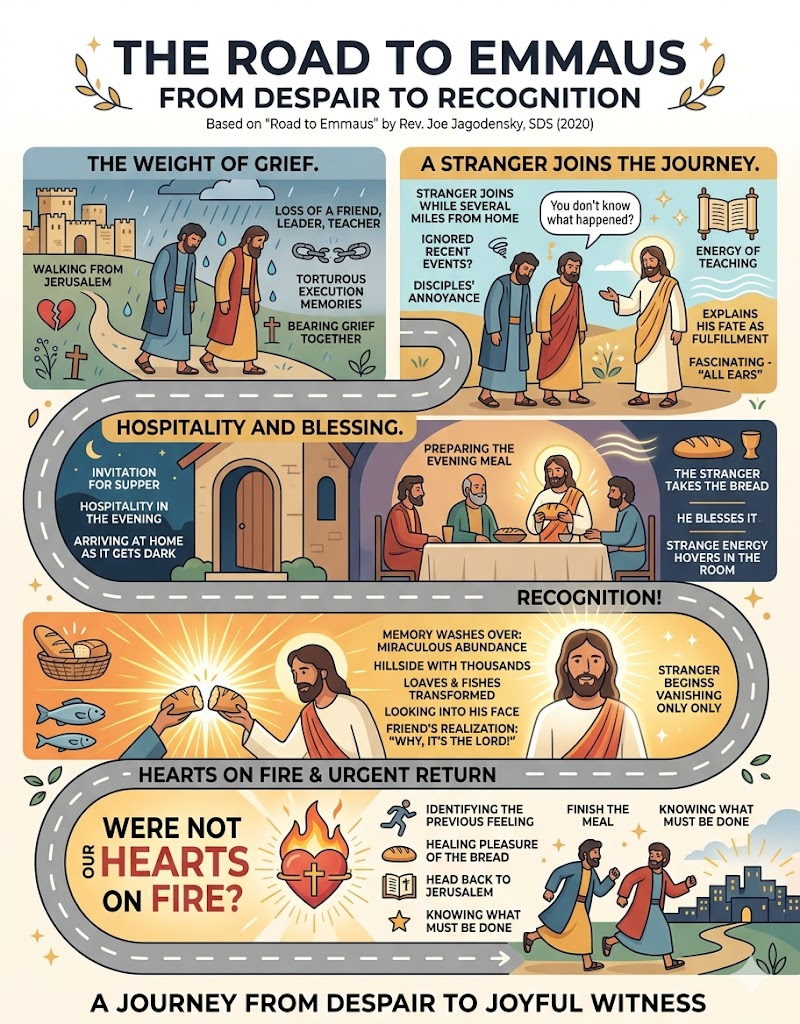
Rev. Joe Jagodensky, SDS, utilizes an Ignatian imaginative approach to the Emmaus narrative, inviting the listener to step into the physical and emotional labor of grief. He portrays the walk not just as a journey of miles, but as a “hard work” of processing trauma, branded by memories of blood and shame. The stranger’s entrance shifts the atmosphere from despondency to fascination, but it is the physical act of blessing bread—recalling the miraculous abundance on the hillside—that triggers an explosive realization. This internal “lightning” compels the disciples to immediately reverse their journey, moving from isolation back to community.
GO DEEPER
PROMPTS TO KEEP YOU WRITING
Copy/paste one of these command prompts into the Catholic Assistant (bottom right corner). This tool can help you brainstorm and provide you with further ideas to develop your homily.
_
- The Branded Memory focuses on the traumatic sights and sounds of the crucifixion that haunt the disciples on their walk home. Direct the AI to focus on processing grief.
- The Hard Work of Walking depicts the physical exertion of a long journey through a rainy afternoon as a metaphor for spiritual struggle. Direct the AI to emphasize physical and emotional labor.
- All Ears for the Truth explores the fascination of the two friends as a stranger explains the fulfillment of ancient prophecies. Direct the AI to focus on intellectual awakening.
- The Miraculous Echo connects the blessing of the bread in the Emmaus house to the multiplication of the loaves and fishes. Direct the AI to focus on the power of memory.
- Lightning in the Room describes the supernatural energy and warmth that remains in the house after Jesus vanishes. Direct the AI to emphasize the "lightning" of the Resurrection.
- The Healing Pleasure reflects on the restorative power of eating bread blessed by the hands of Christ. Direct the AI to focus on the healing nature of the Eucharist.
- A Shared Conviction explores the bond between the two friends as they encourage one another through their darkest hour. Direct the AI to focus on companionship in faith.
- Heading Back to the City portrays the urgent, late-night journey back to Jerusalem to reunite with the other followers. Direct the AI to focus on the mission to share the news.
- The Face of the Lord asks the reader to imagine the specific expression and look in Jesus' eyes at the moment of recognition. Direct the AI to focus on the visual encounter.
- Identified by Fire reflects on the delayed realization that their hearts were already burning before their eyes were even opened. Direct the AI to focus on the "burning heart" phenomenon.
3rd Sunday of Easter (A)
Deacon Greg Kandra
We Do Not Walk Alone

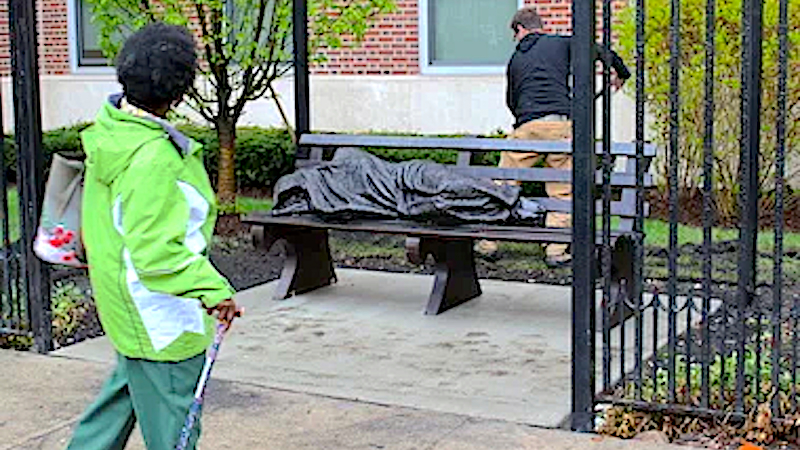
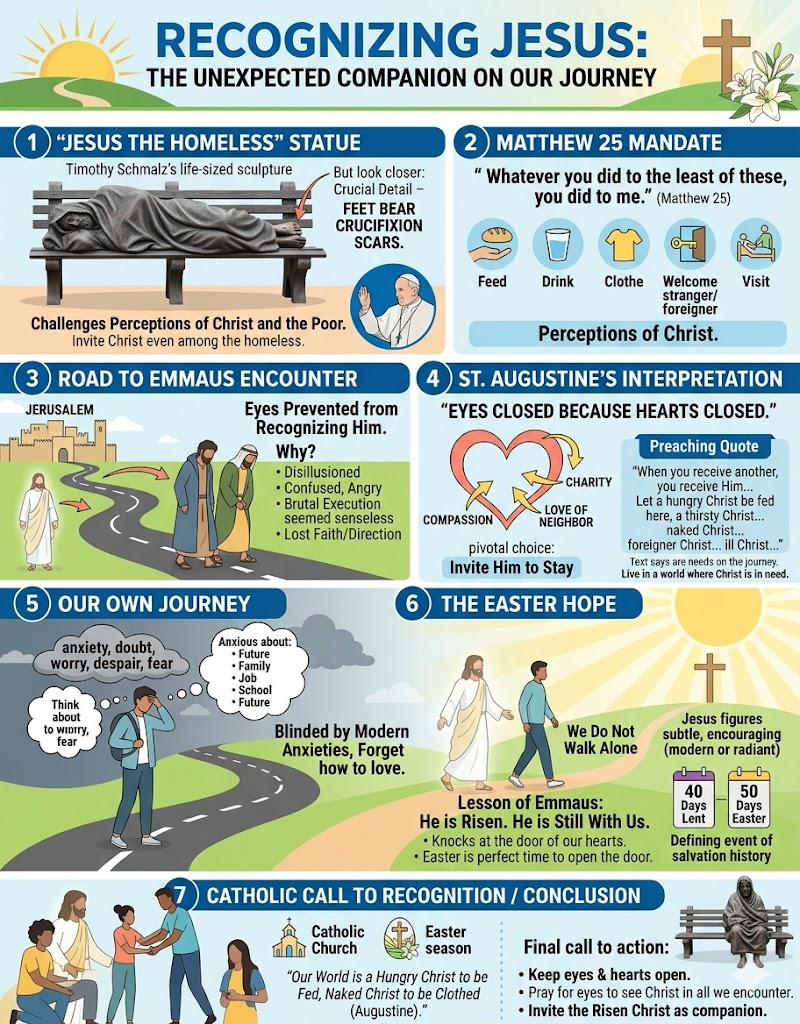
Deacon Greg Kandra opens with the provocative image of the “Homeless Jesus” statue—a figure easily mistaken for a vagrant until one notices the stigmata on the feet. He links this modern “unrecognizability” to the disciples on the road to Emmaus, suggesting that their blindness was not merely physical but a result of closed hearts. Drawing on St. Augustine, Kandra argues that the turning point of the story is the act of hospitality; it is only when the disciples welcome the “stranger” that they encounter the Savior. Ultimately, the homily challenges the faithful to recognize Christ in the marginalized and to sustain the Easter spirit long after the “plastic grass” of the holiday has been discarded.
GO DEEPER
PROMPTS TO KEEP YOU WRITING
Copy/paste one of these command prompts into the Catholic Assistant (bottom right corner). This tool can help you brainstorm and provide you with further ideas to develop your homily.
_
- The Statue on the Bench describes a false alarm where a homeless man is revealed to be a sculpture of the crucified Christ. Direct the AI to focus on challenging perceptions.
- The Bare Scarred Feet zooms in on the only visible parts of a man under a blanket, revealing the marks of the Resurrection. Direct the AI to emphasize hidden identity.
- Closed Hearts and Eyes explores St. Augustine’s theory that the disciples couldn't see Jesus because they had forgotten how to love. Direct the AI to focus on spiritual blindness.
- Stay With Us reflects on the critical moment of hospitality that changes the trajectory of the Emmaus journey. Direct the AI to focus on the power of an invitation.
- A Hungry Christ to Feed applies the mandate of Matthew 25 to the "needs that arise on the journey" of life. Direct the AI to emphasize the corporal works of mercy.
- The Empty Easter Basket confronts the temptation to treat the Resurrection as a finished holiday once the chocolate and flowers are gone. Direct the AI to focus on liturgical persistence.
- A Startling Presence follows the theme of Jesus appearing in "unexpected ways"—from the manger to the park bench. Direct the AI to focus on the element of surprise.
- Walking Through Anxiety addresses the modern worries about jobs, school, and family that prevent us from seeing our Companion. Direct the AI to focus on pastoral reassurance.
- The Pope’s Blessing depicts the "Homeless Jesus" statue at the Vatican and its global impact on how the Church sees the poor. Direct the AI to focus on social impact.
- Companion on the Road prays for the grace to have eyes to see Christ in everyone we encounter, for as long as the journey lasts. Direct the AI to focus on lifelong discipleship.
3rd Sunday of Easter (A)
Fr. Langeh, CMF

On the Road to Emmaus
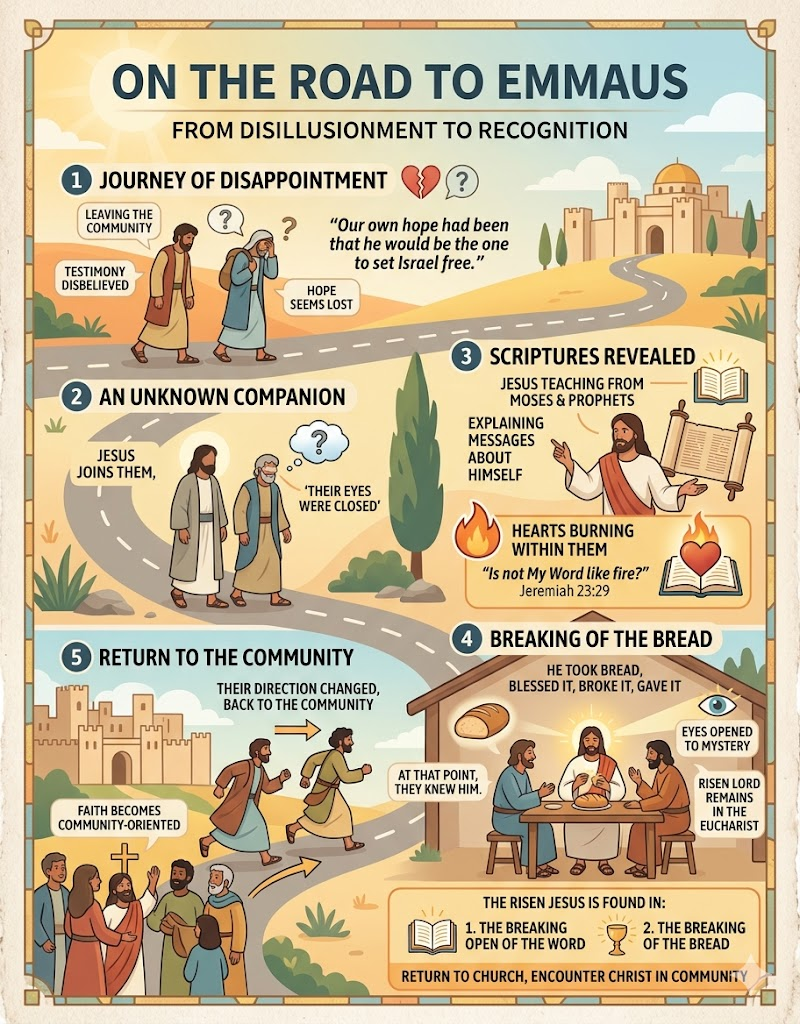
Fr. Langeh presents the Emmaus account as a story of “interrupted journeys” and the restoration of lost hope. He highlights the initial “breaking news” of the Resurrection which, ironically, led the disciples to flee the community in disbelief. By identifying the Risen Christ with the fire of Jeremiah’s prophecy, Fr. Langeh argues that the Word prepares the heart for the eventual recognition in the Eucharist. The homily’s climax is the reversal of direction: the encounter with Christ transforms a private retreat into a community-oriented mission, forcing a return to the Church.
GO DEEPER
PROMPTS TO KEEP YOU WRITING
Copy/paste one of these command prompts into the Catholic Assistant (bottom right corner). This tool can help you brainstorm and provide you with further ideas to develop your homily.
_
- The Breaking News explores the initial reaction of the disciples to the "alleged" resurrection as a confusing and unbelievable headline. Direct the AI to focus on skeptical uncertainty.
- The Jeremiah Fire compares the explanation of the Scriptures to the fire mentioned in the prophets that consumes and transforms. Direct the AI to focus on spiritual combustion.
- The Holy U-Turn depicts the moment the disciples' journey to Emmaus is interrupted and they choose to head back to Jerusalem. Direct the AI to focus on changing direction.
- Forever in the Bread reflects on how Jesus’ disappearance was actually a sign of His new, permanent presence in the Eucharist. Direct the AI to focus on sacramental mystery.
- Continuity of the Lord argues that the Risen Christ is the exact same Jesus who taught in Galilee, despite His transformed glory. Direct the AI to emphasize identity and continuity.
- The Lost Creedence analyzes why the disciples didn't believe the testimony of the women at the tomb and chose to flee. Direct the AI to focus on the struggle for faith.
- A Community Oriented Faith explores the necessity of returning to the group of believers after encountering Christ individually. Direct the AI to emphasize communal life.
- Breaking Down the Word follows Jesus as He meticulously interprets every scriptural passage that referred to His suffering and glory. Direct the AI to focus on biblical teaching.
- The Mystery of Presence captures the moment the disciples' eyes are finally opened to see the Risen Lord in their midst. Direct the AI to focus on the moment of comprehension.
- The Unfinished Destination ponders the idea that the disciples never actually arrived at Emmaus because Christ became their true home. Direct the AI to focus on spiritual redirection.
3rd Sunday of Easter (A)
Deacon Peter McCulloch
2026 HOMILIES | ARCHIVE: 2023 | 2020
Caravaggio’s Supper at Emmaus
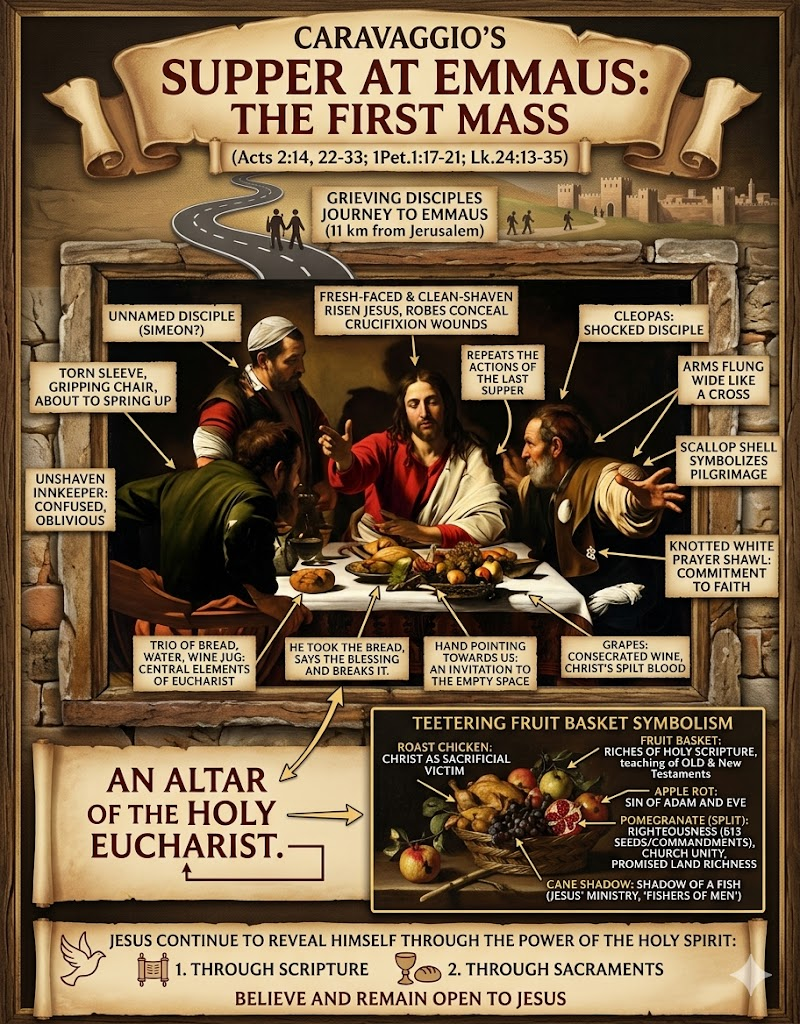
Deacon Peter McCulloch uses Caravaggio’s 1601 masterpiece, The Supper at Emmaus, as a visual lens to explore the mystery of the Resurrection. He interprets the painting not merely as a historical depiction, but as a representation of the first Mass. Through the symbolic “still life” on the table—the precarious fruit basket, the rotting apple of original sin, and the righteous pomegranate—McCulloch illustrates how Christ’s presence upends earthly expectations. Ultimately, the homily posits that just as Jesus revealed himself to the astonished disciples through Scripture and the Eucharist, he continues to invite us to the “empty space” at his table today.
GO DEEPER
PROMPTS TO KEEP YOU WRITING
Copy/paste one of these command prompts into the Catholic Assistant (bottom right corner). This tool can help you brainstorm and provide you with further ideas to develop your homily.
_
- The Caravaggio Canvas recreates the dramatic moment Jesus blesses the bread, capturing the shock and raw emotion of the disciples. Direct the AI to focus on artistic realism.
- The Empty Space explores Christ’s reaching hand as a direct invitation for the viewer to sit at the table of the Eucharist. Direct the AI to focus on personal invitation.
- Teetering Expectations uses the image of a falling fruit basket to show how the Resurrection disrupts our earthly security and plans. Direct the AI to focus on spiritual upheaval.
- Shadow of the Fish analyzes the subtle lighting in a room where a simple cane casts the sign of the fish and the call to ministry. Direct the AI to focus on hidden symbolism.
- Pilgrims on the Way depicts Cleopas with his scallop shell and torn sleeve, representing the weary journey of every believer. Direct the AI to focus on the theme of pilgrimage.
- The First Mass reimagines the supper at Emmaus as the inaugural celebration of the Eucharist following the Resurrection. Direct the AI to emphasize liturgical continuity.
- Righteousness in a Pomegranate explores the Jewish symbolism of the fruit as the fulfillment of the Torah and the unity of the Church. Direct the AI to focus on biblical richness.
- A Fresh-Faced Savior reflects on the transformed appearance of the Risen Christ, whose robes hide the wounds of His execution. Direct the AI to focus on the mystery of the Resurrection.
- The Innkeeper’s Silence ponders the perspective of the bystander who witnesses the miracle without understanding its divine significance. Direct the AI to focus on spiritual awareness.
- The Knot of Commitment uses the prayer shawl on Cleopas' lap to symbolize an absolute and binding commitment to the faith of the apostles. Direct the AI to focus on radical discipleship.
3rd Sunday of Easter (A)
Msgr. Charles Pope

Mass on the Move

Msgr. Charles Pope presents the Road to Emmaus not merely as a story, but as the structural blueprint for the Holy Sacrifice of the Mass. He identifies the two disciples as “broken men” walking in the wrong direction—physically West, away from the rising sun/Son. Msgr. Pope argues that the Lord uses the framework of the Liturgy to reorient them, moving from a Gathering and Penitential Rite on the road to a Liturgy of the Word that sets hearts on fire, and finally to a Liturgy of the Eucharist. The homily concludes that the “vanishing” of Jesus is an invitation to see Him through the eyes of faith in the Sacraments, commissioning the faithful to run back to their “Jerusalem” with joy.
GO DEEPER
PROMPTS TO KEEP YOU WRITING
Copy/paste one of these command prompts into the Catholic Assistant (bottom right corner). This tool can help you brainstorm and provide you with further ideas to develop your homily.
_
- Walking the Wrong Way portrays the disciples heading West toward the sunset, symbolically retreating from the light of the Resurrection. Direct the AI to focus on spiritual reorientation.
- The Anonymous Companion explores the idea that every believer is the unnamed second disciple walking alongside Cleopas on the road. Direct the AI to focus on personal identification with Scripture.
- A Gentle Rebuke depicts the Penitential Rite as a conversation where Jesus asks, "Where are you going with your life?" Direct the AI to focus on healing and recovery of sight.
- Hearts on Fire follows the Liturgy of the Word as Christ "breaks open" the Scriptures, transforming despondency into burning hope. Direct the AI to emphasize the power of the homily.
- Stay with Us, Lord reimagines the intercessory prayers as a plea for Christ to remain with us through the growing shadows of life. Direct the AI to focus on the light that never fades.
- The Consecration Moment captures the exact second the disciples’ eyes are opened through the taking, blessing, and breaking of bread. Direct the AI to focus on the Eucharistic encounter.
- Eyes of Faith reflects on why Jesus "vanishes" immediately after recognition, shifting His presence from the physical to the sacramental. Direct the AI to focus on the mystery of the altar.
- Taste and See explores the sensory experience of the Mass as the fulfillment of Psalm 34’s promise of radiant joy. Direct the AI to focus on the goodness of the Lord.
- The Jerusalem Run depicts the enthusiastic seven-mile journey back to the city to share the news of the Risen Christ. Direct the AI to emphasize missionary zeal.
- Gloom to Glory traces the entire emotional arc of the Mass, from the downcast gathering to the delighted dismissal. Direct the AI to focus on spiritual transformation.
3rd Sunday of Easter (A)
Father Kevin Rettig

2026 HOMILIES | ARCHIVE: 2023 | 2020
Hot Cross Buns

Fr. Kevin Rettig uses the simple nursery rhyme and culinary tradition of the “Hot Cross Bun” to explore how spiritual realities are recognized through physical signs. He notes that while the bun’s spices represent Christ’s burial, it is the visible cross that identifies it. Drawing a parallel to the post-Resurrection appearances, Rettig suggests that just as the disciples recognized Jesus in his wounds or the breaking of bread, we recognize Him today in the “sweet and bitter morsels of life.” Ultimately, Christ is made visible through our hospitality, our shared bread, and our commitment to healing a wounded world.
GO DEEPER
PROMPTS TO KEEP YOU WRITING
Copy/paste one of these command prompts into the Catholic Assistant (bottom right corner). This tool can help you brainstorm and provide you with further ideas to develop your homily.
_
- The Vendor’s Cry explores the history of the hot cross bun nursery rhyme as a physical reminder of Holy Week traditions. Direct the AI to focus on cultural and religious heritage.
- Spices of the Burial connects the ingredients of a sweet bun to the aromatic spices used to prepare Jesus’ body for the tomb. Direct the AI to focus on sensory symbolism.
- A Recognizable Sign reflects on how the cross on the bun serves as a visible path to understanding spiritual realities. Direct the AI to emphasize the importance of symbols.
- Not Just a Smiley Face contrasts the "knot cross bun" with the original, arguing that the cross is a more poignant reminder of Christ's love. Direct the AI to focus on depth over sentimentality.
- Recognition Through Wounds follows the story of Thomas, who identified the Risen Lord specifically through His physical scars. Direct the AI to focus on the theology of the stigmata.
- Breaking Bread and Barriers explores how the Emmaus encounter calls us to dismantle social boundaries through hospitality. Direct the AI to emphasize social justice and communion.
- Sweet and Bitter Morsels treats the varied experiences of life—joy and grief—as places where Jesus can be found. Direct the AI to focus on finding God in all things.
- The Crucified Healer portrays Christ as the one who heals the world through His own brokenness and suffering. Direct the AI to focus on the "wounded healer" archetype.
- Quiet Prayer and Restless Struggle balances the internal life of faith with the external work for a better world. Direct the AI to focus on the tension between contemplation and action.
- Fresh from the Oven uses the metaphor of a fresh bun to describe the immediate, living presence of the Risen Jesus in the current moment. Direct the AI to focus on the "now" of faith.
3rd Sunday of Easter (A)
Fr. George Smiga
Recognizing Jesus

Fr. George Smiga addresses the “shattered dreams” of the Emmaus disciples, identifying their failure to recognize Jesus as a byproduct of being “controlled by fear” and hyper-focused on loss. Writing during the height of the coronavirus pandemic, Smiga parallels the disciples’ flight from Jerusalem with our modern loss of routine, security, and income. He argues that the spiritual challenge of a crisis is to look past what is absent to see what is present. By recognizing the Risen Christ in the work of scientists, governors, and the comfort of our own homes, we move from the darkness of isolation into the light of gratitude.
GO DEEPER
PROMPTS TO KEEP YOU WRITING
Copy/paste one of these command prompts into the Catholic Assistant (bottom right corner). This tool can help you brainstorm and provide you with further ideas to develop your homily.
_
- The Staggering Path describes the disciples as they walk away from Jerusalem, literally and figuratively retreating from a life that has fallen apart. Direct the AI to focus on the weight of shattered dreams.
- Blinded by Absence explores how the focus on what we have lost prevents us from seeing the Risen Christ standing directly in front of us. Direct the AI to focus on the psychology of fear.
- Grace in the Laboratory portrays the work of scientists and healthcare professionals as a direct manifestation of Christ’s blessing during a global crisis. Direct the AI to focus on seeing God in science.
- The Sanctuary of Home reflects on the blessing of familiar surroundings as a place to wait out the storms of the world in the company of Jesus. Direct the AI to focus on domestic peace.
- A Litany of Gratitude follows Fr. Smiga’s advice to begin every prayer with thankfulness for what is present rather than fear of what is missing. Direct the AI to focus on the discipline of thankfulness.
- The Lord of Life asserts that Christ’s love is stronger than any virus or worldly threat, even when He seems to be "lying in the tomb." Direct the AI to emphasize resilient hope.
- Connected in Isolation explores the use of modern communication and relationships to ground and support us during times of distance. Direct the AI to focus on the theme of community.
- Control vs. Sight analyzes how being "controlled by fear" shuts down our spiritual senses, making us deaf to the voice of the Lord. Direct the AI to focus on spiritual awareness.
- Walking Through the Darkness reimagines the journey to Emmaus as a modern-day navigation through the shadows of a global pandemic. Direct the AI to focus on Christ’s accompaniment.
- The Shift of Focus provides a narrative beat-by-beat guide on how to move from a state of being "downcast" to a state of being aware of the Risen Lord. Direct the AI to emphasize spiritual transformation.
3rd Sunday of Easter (A)