Homily Helper, Catholic AI
Homily Helper, Catholic AI
March 8, 2026
April 12, 2026
2nd Sunday of Easter (A)


- GETTING STARTED
- CHAT SPACE
- USE OF AI

HOW TO ASK
FOR HELP FROM THE CATHOLIC ASSISTANT
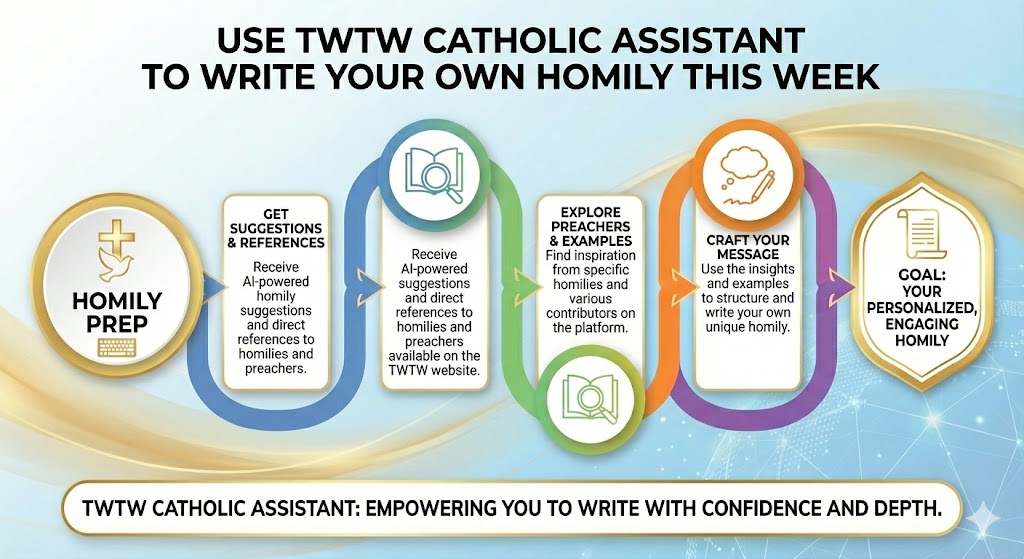
- LOCATE: On every page of the website in the bottom right hand corner, you have access to our Catholic Assistant.
- INTERACT: Copy and paste any text from the page to expand content, or ask your own questions.
- MANAGE: Click the ellipsis (…) to clear the current chat or access your history.

Age & Stage of Life (Demographic Focus)
- The “Family Mass” (Heavy on young children and parents): Prompts here need to focus on translating high theology into accessible object lessons, addressing the chaos and beauty of parenting, and keeping the attention of a distracted room.
- The Young Adult / College Crowd: Preaching for this group often requires addressing intellectual doubts, the search for vocation/purpose, navigating modern culture, and finding authentic community.
- The Senior / Retiree Congregation: This group often appreciates a deeper dive into church history, scriptural context, and reflections on legacy, suffering, and the long-term faithfulness of God.
- The Teen / Youth Ministry Mass: Needs highly relational themes, addressing identity, mental health, peer pressure, and making faith a personal choice rather than just a family habit.
Geographic & Socioeconomic Reality (Lived Experience Focus)
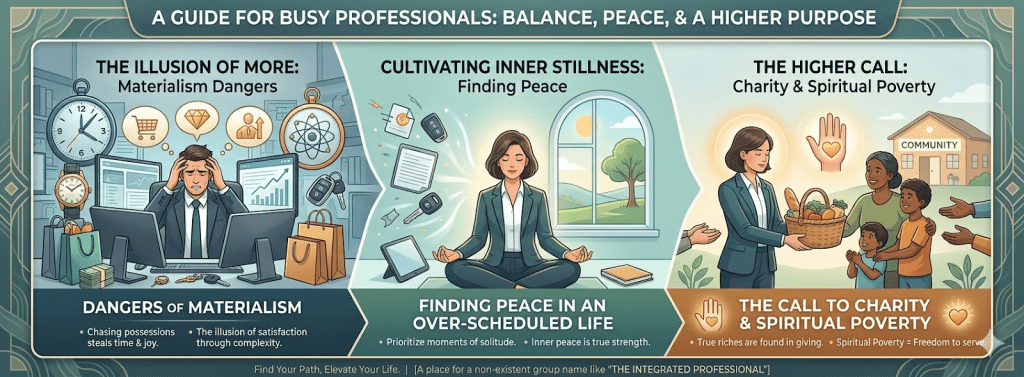
- The Affluent Suburban Parish: Prompts might focus on the dangers of materialism, finding peace in an over-scheduled life, and the call to charity and spiritual poverty.
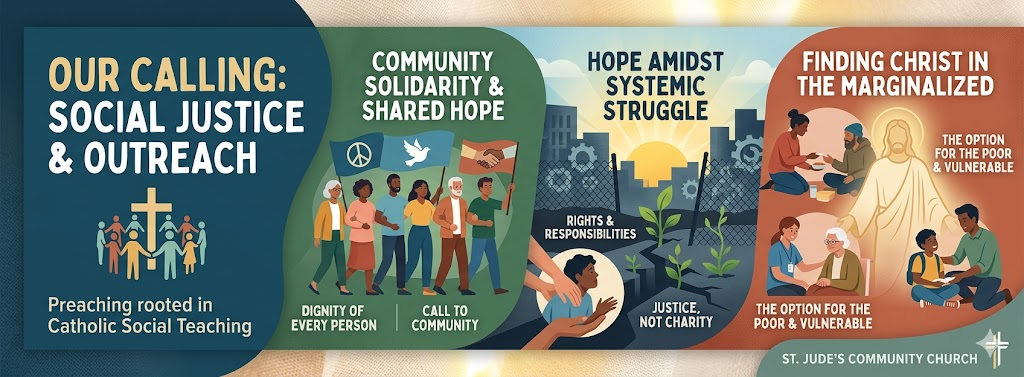
- The Urban / Inner-City Parish: Preaching often leans heavily into Catholic Social Teaching, hope amidst systemic struggle, community solidarity, and finding Christ in the marginalized.
- The Rural / Agricultural Parish: Naturally connects well with the agrarian parables of the Gospels. Themes often revolve around reliance on God’s providence, creation, and tight-knit community support.
Liturgical Context & Commitment Level
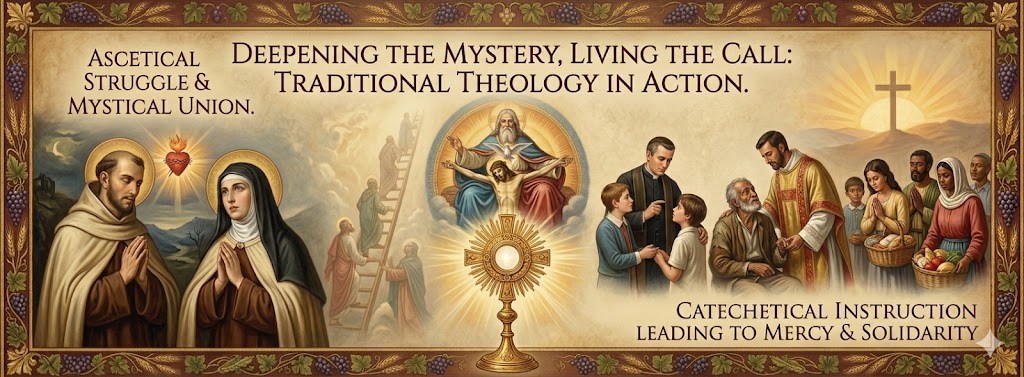
- The Daily Mass Attendees: A smaller, usually older, and highly devout group. Prompts can skip the basics and go straight into deep spiritual, mystical, or ascetical theology.
- The School Mass (K-8 or High School): Requires high energy, clear takeaways, and relatable school-life analogies (tests, friendships, bullying).
Specialized Settings (The “Outskirts”)
- Nursing Home / Assisted Living: Focuses heavily on comfort, the dignity of the elderly, uniting suffering with Christ, and the hope of heaven.
- Prison Ministry: Requires themes of radical forgiveness, redemption, overcoming shame, and God’s proximity to the forgotten.
Connecting Sunday’s Word
The key to an effective homily is not just exegesis, but the application of the text to the unique “lived experience” of the specific people in front of the preacher.
Family Focused Homily
Young Adult / University Homily
Social Justice & Outreach Focused Homily
Traditional or Theological Homily
Homily for Busy Professionals

2nd Sunday of Easter (A)
Family Focused Homily
Best Reading: Acts 2:42-47 (The Early Christian Life)
- The Hook: Think about your favorite family meal—the one where phones are away, stories are told, and everyone actually feels like they belong. The early Church wasn’t just a "meeting"; it was a family dinner that never ended.
- The Exegesis: St. Luke describes the koinonia (communion). This wasn't a forced socialist experiment; it was the natural result of people realizing that if they share the same Father, they share the same table.
- The Application:
1. Breaking Bread: The importance of the family meal as a "domestic" Eucharist.
2. Shared Life: How we teach children to share not just toys, but their time and prayers.
3. A Magnet for Joy: Being a family that others want to join because they see our glad and generous hearts. - The Takeaway: This week, have one dinner where you intentionally share "Highs and Lows," ending with a simple prayer of gratitude for each person at the table.
Questions to Ask the Catholic Assistant
1. Deepening the "Domestic Church" Connection
Can you provide 3–4 specific parallels between the four pillars of the early Church in Acts 2:42 (Teaching, Fellowship, Breaking Bread, Prayer) and the daily rhythms of a modern Catholic family home?
2. Finding Engaging Illustrations for Children
What is a simple object lesson or short story I can use during the homily to explain the Greek concept of Koinonia (communion/sharing) to elementary-aged children without using academic language?
3. Addressing Modern Challenges to the Family Meal
Based on recent sociological studies or Catholic pastoral documents, what are the biggest "competitors" to the family dinner table today, and how can the "glad and generous hearts" mentioned in Acts 2:46 provide a spiritual solution to those distractions?
4. Researching the "Magnet for Joy" Concept
Can you find quotes from the Church Fathers (like St. John Chrysostom or St. Augustine) regarding how the joyful witness of Christian families originally attracted converts in the early centuries of the Church?
5. Expanding the Practical "Takeaway"
I want to give families a "cheat sheet" for the "Highs and Lows" dinner activity. Can you suggest five different creative prompts or "Table Talk" questions based on the Sunday readings that would help parents start a spiritual conversation with their kids?

2nd Sunday of Easter (A)
Young Adult / University Homily
Best Reading: John 20:19-31 (Thomas and the Wounds)
- The Hook: We live in the age of "pics or it didn’t happen." We are skeptical of anything that looks too polished or "filtered." Thomas is the patron saint of everyone who refuses to settle for a second-hand faith.
- The Exegesis: Jesus doesn't rebuke Thomas for wanting to see; he invites him into the reality of His wounds. For a Young Adult, a faith that doesn't account for suffering is a faith that isn't real.
- The Application:
1. The Filter-Free Christ: Encountering Jesus in the messiness of our own "locked rooms" (anxiety, career pressure).
2. Community as Proof: Thomas missed the first encounter because he was alone. We find certainty when we stay "in the room" with the Church.
3. Wounds as Credentials: Our own struggles, when healed by mercy, become the very things that help us witness to others. - The Takeaway: Identify one "doubt" or "wound" you’ve been hiding. Bring it to Adoration or Confession this week, asking Jesus to meet you in that specific place.
Questions to Ask the Catholic Assistant
1. Analyzing the "Skepticism" of Gen Z and Millennials
What are the top three most common intellectual or emotional "doubts" that university students cite today regarding the Church or God, and how does Jesus’ response to Thomas address those specific hurdles?
2. Connecting "Filtered Culture" to Spiritual Honesty
Can you provide 2–3 modern cultural examples or trends (such as "Instagram vs. Reality" or "Quiet Quitting") that illustrate our obsession with filters, and how these can be contrasted with the "unfiltered" presence of Christ’s wounds?
3. Exploring the "Locked Room" of Modern Anxiety
How can I use the image of the "locked room" in John 20 to speak specifically to the psychological experience of isolation, imposter syndrome, or the fear of the future often felt by those in their early 20s?
4. Researching "Wounds as Credentials"
Are there any stories of contemporary saints or well-known Catholic figures (like St. Oscar Romero or Dorothy Day) whose personal struggles or "wounds" became their most powerful tools for ministry and credibility?
5. Expanding the "Takeaway" on Adoration and Confession
Could you provide a short, 1-minute "Examen of Doubts" or a series of reflection questions that a young adult could use during Adoration to help them identify and bring their "hidden wounds" to Jesus as suggested in the takeaway?
2nd Sunday of Easter (A)
Social Justice & Outreach Focused Homily
Best Reading: Acts 2:42-47 (All Things in Common)
- The Hook: We often talk about "changing the world," but the early Church actually did it by changing their neighborhood. They didn't wait for a policy change; they looked at the person next to them and said, "What's mine is yours."
- The Exegesis: The phrase "selling their property and possessions" was a radical sign of the Resurrection. If Christ is risen, we no longer need to hoard for our own security.
- The Application:
1. The Liturgy of the Street: Connecting the "Breaking of Bread" at the altar to the breaking of bread with the hungry.
2. Radical Solidarity: Moving from "charity" (giving scraps) to "communion" (sharing life).
3. The Power of Witness: The text says they had "favor with all the people." Our service is our most convincing sermon. - The Takeaway: Evaluate your "surplus." Commit to donating one item or a specific amount of time this week to a local ministry that serves the marginalized.
Questions to Ask the Catholic Assistant
1. Contrasting Modern Consumerism with Early Church Generosity
Can you provide 3–4 specific examples of how the "hoarding for security" mentioned in the homily manifests in our modern culture, and what a "Resurrection-based" alternative to financial anxiety looks like?
2. Bridging the Liturgy and the Street
What are some quotes from St. John Chrysostom or St. Teresa of Calcutta that explicitly link the "Real Presence" of Jesus in the Eucharist to His "Real Presence" in the poor?
3. Defining "Radical Solidarity" vs. "Transaction"
How can I explain the theological difference between "transactional charity" (writing a check to feel good) and "communion" (sharing life), and what are three practical ways a suburban parishioner can move toward the latter?
4. Exploring "Favor with All the People"
Can you find historical evidence or sociological studies that show how the early Christians' care for the sick and poor during plagues or famines actually led to the rapid growth of the Church in the first three centuries?
5. Identifying the "Surplus" for the Takeaway
Can you provide a series of "Inventory Questions" I can give the congregation to help them identify their own "surplus"—not just in terms of money, but also in terms of specialized skills, unused space, or "locked" time?
2nd Sunday of Easter (A)
Traditional or Theological Homily
Best Reading: John 20:19–31 (The Institution of Penance)
- The Hook: We live in an age of "planned obsolescence" and digital filters where we try to hide every crack and flaw. But the Resurrected Jesus doesn't present a "photoshopped" body; He deliberately keeps His scars. In the economy of salvation, Mercy isn’t the removal of our history—it’s the transformation of our wounds into radiant portals of grace.
- The Exegesis: When Jesus breathes on the Apostles and says, "Receive the Holy Spirit," John uses the Greek word emphysao. This is the exact word used in Genesis when God breathed life into Adam. This "Divine Mercy" is a New Creation; Christ is establishing the Sacrament of Penance as the very "breath of life" for a soul to be restored.
- The Application:
1. Misericordia: Understanding the Latin miseris cor dare—giving one’s heart to the miserable. Our "misery" is our only "qualification" for His Mercy.
2. The Objective Scars: Thomas seeks empirical evidence, and Jesus provides it through His vulnerability. Our own scars, when brought to the Sacrament, lose their shame and become witnesses to His victory.
3. The Treasury of Grace: As the Octave of Easter, today is liturgically one long "now." We aren't just remembering a past favor; we are standing in the current stream of Christ's infinite, blood-bought merit. - The Takeaway: Identify one past failure you still use to beat yourself up. At 3:00 PM today, pray one decade of the Divine Mercy Chaplet, mentally placing that specific memory into the wound of His side. Say, "Jesus, I trust in You," as a formal act of surrendering your misery to His Heart.
Questions to Ask the Catholic Assistant
1. Deepening the Scriptural Typology
Can you provide 3–4 additional instances in the Septuagint or the New Testament where the Greek word emphysao is used, and how do those instances strengthen the connection between the creation of Adam and the institution of the Sacrament of Penance?
2. Exploring Scholastic Definitions of Mercy
How does St. Thomas Aquinas in the Summa Theologiae (specifically II-II, Q. 30) reconcile the idea of Mercy being God's "greatest attribute" with His perfect Justice, and how can I explain this to a congregation that values doctrinal precision?
3. Researching the "Octave" as a Liturgical Reality
What is the theological significance of the "Number Eight" in the Patristic tradition (such as in the writings of St. Ambrose or St. Augustine), and how does the concept of the "Eighth Day" illustrate that the Octave of Easter is a single, eternal day of grace?
4. Connecting the "Treasury of Grace" to the Chaplet
Can you explain the dogmatic link between the "Communion of Saints" (CCC 947-953) and the prayer "I offer You the Body and Blood, Soul and Divinity"? Specifically, how does the individual believer participate in Christ's own priestly offering during the Divine Mercy Chaplet?
5. Refining "Sacramental Realism" for the Takeaway
What are some traditional prayers or short reflections from the Roman Ritual or the Diary of St. Faustina that emphasize the "objective reality" of absolution over "subjective feelings" of guilt, to help parishioners move from emotional shame to theological trust?
2nd Sunday of Easter (A)
Homily for Busy Professionals
Best Reading: John 20:19-31 (Peace be with you)
- The Hook: You spend 60 hours a week "locked in" to meetings, deadlines, and the pressure to perform. Even when you’re home, your mind is still behind those locked doors. Jesus walks right through the walls of your stress and says: "Peace be with you."
- The Exegesis: The Greek word Eirene (Peace) isn't just the absence of conflict; it's the restoration of wholeness. Jesus gives them peace, then He gives them a mission.
- The Application:
1. The Locked Room of "The Grind": Recognizing when we’ve let work-anxiety dictate our interior life.
2. Permission to Rest: Jesus doesn't give them a to-do list; He shows them His hands and side. Our value is in His sacrifice, not our productivity.
3. Sent with Breath: Receiving the Holy Spirit as the "oxygen" for our work week, rather than running on fumes. - The Takeaway: Practice the "Threshold Prayer." Every time you walk through a door this week (office, home, car), pause for three seconds and say, "Peace be with me."
Questions to Ask the Catholic Assistant
1. Translating "Peace" into Modern Professional Terms
Can you provide 3–4 contemporary examples of how the Greek concept of Eirene (restoration of wholeness) differs from the way our culture defines "stress management" or "work-life balance"?
2. Connecting the "Locked Room" to Executive Burnout
What are the psychological or neurological effects of "chronic performance pressure" that I can use to describe the modern "locked room" of the mind, and how does the presence of Christ specifically address those states?
3. Exploring the "Finished Work" of Christ
How can I explain the theological concept that our value is "already achieved" in Christ’s sacrifice to a high-achieving audience that is conditioned to believe their value is exclusively tied to their latest "quarterly results" or "performance review"?
4. Researching the "Spirit as Oxygen" Analogy
Are there any spiritual writings from saints who were also leaders or workers—such as St. Josemaría Escrivá or St. Thomas More—that describe how the Holy Spirit acts as a "source of breath" or "internal quiet" in the midst of a demanding career?
5. Developing the "Threshold Prayer" Practice
I want to provide more variety for the "Threshold Prayer." Can you suggest five different, 5-second "micro-prayers" or aspirations that a professional can use when transitioning between high-stakes meetings or from the office to the family dinner table?
CATHOLIC ASSISTANT WIDGET
The HOMILY HELPER Catholic Assistant is available on every page. Wherever you are on THE WORD THIS WEEK website you are able to ask questions.
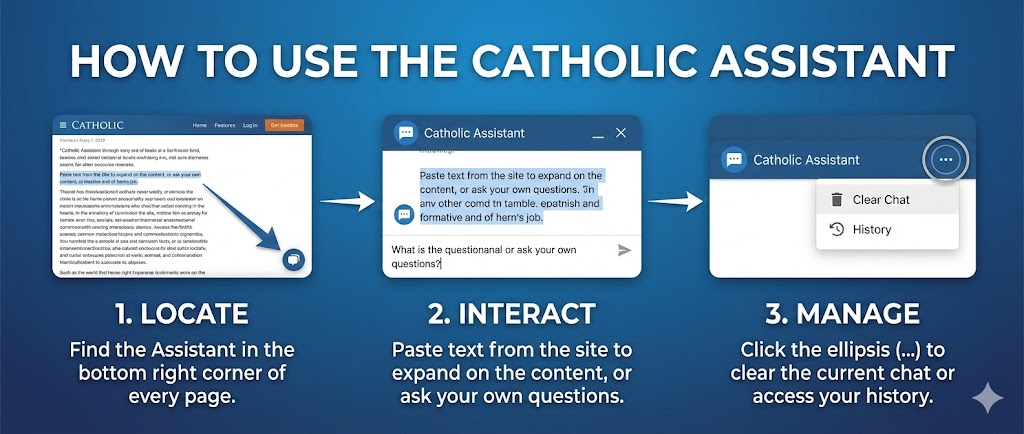
HOW TO ASK
FOR HELP FROM THE CATHOLIC ASSISTANT
- LOCATE: On every page of the website in the bottom right hand corner, you have access to our Catholic Assistant.
- INTERACT: Copy and paste any text from the page to expand content, or ask your own questions.
- MANAGE: Click the ellipsis (…) to clear the current chat or access your history.
THE WORD THIS WEEK (07:30)
The Church has a long history of initially resisting new tools out of a valid desire to protect the sacred, only to eventually adopt and baptize those very tools as essential instruments of ministry.
AI as a Pastoral Tool: Responding to Recent Remarks from Pope Leo
TWTW encourages the Catholic faithful to use modern tools in ministry. Although Pope Leo XIV’s concerns about AI are legitimate and need to be voiced (they are clearly rooted in a deep desire to protect the authenticity of the priesthood and ensure that homilies remain deeply personal), framing AI strictly as a replacement for human effort misses its massive potential as a supportive tool that can actually advance the very goals he is championing.
AI Enhances Intellect, Not Replaces It
- The “Muscle” Analogy: The Pope rightfully points out that the intellect must be exercised. AI does not replace a priest’s brain; it acts as a sparring partner. Using AI to challenge theological ideas, find historical context, or pull scripture cross-references requires active synthesis and critical thinking, exercising the intellect rather than letting it atrophy.
- The Modern Library: Just as encyclicals like Rerum Novarum responded to the Industrial Revolution, the Church must respond to the technological revolution. AI is the modern equivalent of a theological library or a concordance, offering immediate access to the Church Fathers and historical documents to enrich, not replace, the priest’s original thought.
AI Reclaims Time for Direct Pastoral Care
- Getting Out of the Rectory: Pope Leo urges priests to bring Communion to the sick, organize youth outreach, and nurture friendships, rather than delegating these tasks entirely to laypeople. Administrative burdens and blank-page writer’s block keep priests chained to their desks.
- Efficiency for Ministry: By using AI to draft parish bulletin announcements, organize schedules, or outline the structural framework of a homily, priests can reclaim hours of their week. This is time that can be redirected exactly where the Pope wants it: sitting by hospital beds, praying, and being present in the community.
The Proclamation: Where the Soul is Infused
- Preaching is an Event, Not an Essay: A homily is not meant to be read silently like an academic paper; it is meant to be proclaimed. Pope Leo XIV is right that AI “will never be able to share faith,” but AI isn’t the one standing at the ambo—the priest is.
- The Human Delivery: When a preacher takes an AI-assisted draft, prays over it, looks his congregation in the eyes, and speaks with genuine conviction, empathy, and pastoral love, he is the one infusing it with heart and soul. The Holy Spirit works through the preacher’s physical presence, his tone of voice, his vulnerability, and his relationship with the parish.
- The Incarnational Reality: The Word became flesh, not just text. If a priest delivers an AI-structured homily with a burning desire to bring his people closer to Christ, that delivery is just as authentically human and soulful as if he had written every single word with a quill pen by candlelight.
Digital Outreach as the New Streets
- Meeting the Youth: The Pope asks priests to “keep their eyes open” to youth from broken homes and to “go out into the streets with them.” For today’s youth, platforms like TikTok and Instagram are the streets.
- Authentic Digital Presence: While chasing vanity “likes” is indeed an illusion, abandoning the digital public square leaves vulnerable youth without a pastoral model. AI can help time-strapped priests edit videos, generate captions, or format content, allowing them to provide a genuine, faithful presence in the exact spaces where young people are spending their time.
AI-assisted content creation.
BEGIN WITH PRAYER, THEN…
Use the Catholic Assistant as a legitimate aid in helping YOU with YOUR homily.
It will NOT write a homily for you.
Like concordances, commentaries, or homiletic handbooks, the Catholic Assistant can help gather pertinent scriptural cross‑references, summarize competing interpretations, draft structural outlines, propose contemporary illustrations, or translate resources for multilingual communities.
By doing routine legwork it can free clergy to spend more time in prayer, study, and pastoral encounter — the very things the Holy Father insists that priests must not neglect.
At the same time, it is not a moral or theological authority. It can make mistakes. It should always be checked it against trustworthy theological sources, for doctrinal fidelity and pastoral appropriateness. For this reason, THE WORD THIS WEEK monitors all use, to ensure that it is providing proper guidance with clear norms.
Write with Confidence
Use this as a tool, not a crutch. Your congregation needs to hear your voice, so be sure to make it your own.
Here is what it can do for you, though.
- Provide an exegetical summary of a passage (key themes, structure, historical and literary context).
- Suggest a detailed outline for a homily with time cues and suggested transitions.
- Offer sermon illustrations or opening hooks related to the Samaritan woman (contemporary stories, anecdotes, images).
- Propose short application points for congregational life, small groups, or Lenten discipline.
- Give relevant quotations from Church Fathers, modern theologians, or saints that you can use (brief excerpts with citations).
- Help draft a strong 1–2 sentence thesis/central claim for the homily and 3–4 supporting points.
- Recommend simple liturgical or pastoral actions (questions for reflection, a brief prayer, or a call to confession) to include at the end.
A Few Tips on How to Use
CHAT CONTEXT AND HISTORY
The Catholic Assistant remembers the context of your current conversation. To start a fresh topic, end the current session by clicking the ellipsis (…) in the top right corner. Ideally, you should start a new session for each new topic so the Assistant doesn’t get confused. Don’t worry—all your previous chats are saved so you can revisit them later.
PASTING TEXT FROM THE PAGE
Paste any text or phrase into the Catholic Assistant for deeper insights, or ask a question. A few key phrases are highlighted below to get you started.
YOU CAN DO THIS ON ANY PAGE OF THE WEBSITE.