Papal Homilies
May 17, 2026



NOTABLE QUOTES
The Solemnity of the Ascension marks a pivotal transition in salvation history—the moment Christ’s physical presence ends so His mystical presence through the Church can begin.
Here are reflections from modern Popes specifically addressing the themes found in the Year A readings (Acts 1:1-11, Ephesians 1:17-23, and Matthew 28:16-20).
Pope Francis
On the Great Commission (Matthew 28)
“Jesus’ departure does not imply his absence. He goes before us to the Father, but he remains with us in a new way… His presence is not a physical one, but a spiritual and missionary one. By saying, ‘I am with you always, to the close of the age,’ Jesus reminds us that our mission is sustained by his power.” — Regina Caeli, May 2014
On “Why are you standing there looking at the sky?” (Acts 1)
“The Ascension does not point to Jesus’ absence, but tells us that he is alive in our midst in a new way. He is no longer in a specific place… he is now in the space of God, present in every space and time, close to each one of us.” — General Audience, April 2013
Pope Benedict XVI
On the “Hope of His Calling” (Ephesians 1)
“The Ascension does not mean that He has gone to some remote part of the universe. It means that He no longer belongs to the world of corruption and death that conditions our life. It means that He belongs entirely to God. He, the Eternal Son, led our human existence into God’s presence, taking with him flesh and blood in a transfigured form.” — Homily, May 2005
On the Sovereignty of Christ (Ephesians 1)
“Christ’s Ascension means… that he is near to each of us forever. We can each call upon him; he is always within earshot. We can move away from him in our hearts, but he is always waiting for us to return.” — Homily at Cassino, May 2009
St. John Paul II
On the Witness of the Apostles (Acts 1)
“The Apostles, after the Ascension, returned to Jerusalem ‘with great joy.’ Their joy came from the realization that the Master, though hidden from their eyes, was now more than ever active in them through the Holy Spirit. They understood that the Ascension was not a departure, but the beginning of a new form of presence.” — Regina Caeli, May 1996
On the Universal Mission (Matthew 28)
“The words ‘Go, therefore, and make disciples of all nations’ constitute the ‘Magna Carta’ of the Church’s mission. The Ascension is the feast of the Church’s maturity; it is the moment she accepts the mandate to be the visible sign of the invisible Christ in the world.” — Homily, Ascension Thursday 1980
The Ascension of the Lord (A)

Theme of the Readings
FROM THE ARCHIVES (2005)
The ascension of Jesus Christ into heaven marks the end of his historical presence in the world, but even more, it emphasizes the power and sovereignty he exercises from heaven as Lord of history and of the universe. When the risen Jesus takes his leave, he addresses his disciples with these words: “All authority in heaven and on earth has been given to me” (Gospel).
At the beginning of the Acts of the Apostles, the disciples ask Jesus if he is going to restore the kingdom to Israel. Jesus replies: “It is not for you to know times or dates that the Father has decided by his own authority, but you will receive power when the Holy Spirit comes upon you…” (first reading).
In the Letter to the Ephesians, St. Paul asks God to grant us a revelation that will bring us to full knowledge of him, that will enable us to know the risen Christ who “sits at his right hand, in heaven, far above every Sovereignty, Authority, Power, or Domination … and that [God] has put all things under his feet” (second reading).

Doctrinal Messages
The ascension of Jesus Christ into heaven is a mystery of our faith, utterly foreign to our physical and earthly experience. But for God nothing is impossible. This is why the readings of the liturgy, on various occasions, mention the power, force, and authority of God. Anyone contemplating the history of salvation, as it is narrated in the Old and New Testaments, can see God’s powerful action deployed in the people of Israel and the disciples of Jesus. He will keep his mind and heart more open to this mystery in which, together with the resurrection, God’s power reaches the most sublime peaks. When he had ascended into heaven, the Father seated Jesus at his right hand, that is, he inaugurated the messianic kingdom, fulfilling the Prophet Daniel’s vision: “On him was conferred sovereignty, glory and kingship, and men of all peoples, nations and languages became his servants. His sovereignty is an eternal sovereignty which shall never pass away, nor will his empire ever be destroyed” (Dan 7:13) and thus showing his power and strength.
In this way the Father communicates his power to the Son, to Jesus Christ in glory. Christ’s power is a universal power that embraces all the realities and beings of heaven and earth. It is a power of salvation, never condemnation. His name, by antonomasia, is redeemer, savior. Thus he says to his disciples: “Go, therefore, make disciples of all the nations; baptize them in the name of the Father and of the Son and of the Holy Spirit” (Gospel). It is a power that he exercises in history, not directly but through the power of the Spirit, which the disciples receive in order to be “[his] witnesses not only in Jerusalem but throughout Judaea and Samaria, and indeed to the ends of the earth” (first reading).
Jesus Christ’s redemptive and salvific power is expressed above all in the Church, “his body, the fullness of him who fills the whole creation” (second reading). In the Church and for the Church, Jesus Christ in glory continues to exercise it among men in order to save them. For this reason Christ’s kingdom is already active in the Church and possesses the dynamism of hope for the definitive and eternal kingdom, at the end of time.
Pastoral Suggestions
In Christian life one must be wary of two possible deviations. One, which I will call Pelagian, is to think and act as if man had the “power” to conquer heaven for himself; the other, Lutheran, consists in being convinced that “deeds do not count,” and that everything depends totally on abandonment to God’s power. We Christians must keep the difficult balance between the two tendencies that we perhaps find in our own hearts. If this balance is upset, Christian life itself is also upset. Either we will place our trust in our own “strength,” considering holiness as a titanic undertaking – and therefore for the very few privileged – and seeing heaven as a deserved reward for our gigantic effort; or, on the contrary, we will totally mistrust our own strengths and efforts because of our congenital powerlessness, and will consequently “oblige” God to manifest his power in us, imagining heaven as a “gift” of God, unrelated to our will and moral conduct.
The priest is teacher, educator, and witness. As a teacher he must teach the faithful the ways of faith and morals, the ways of holiness, the ways that lead to the Father of heaven. As educator, with patience and respect, he should speak to men and women of heaven as their destiny. He should enlighten their consciences in order not to deflect them. He should accompany them in their daily difficulties and struggles on their way toward the Father’s house. He should always be available for those who need God’s mercy and spiritual guidance. As a witness, he should make others feel, by his life and conduct, that “his true homeland is heaven.” He should proclaim and confess with his actions what he really feels in his heart. He should live detached from earthly ambitions, over materialistic compensations and notably worldly behavior, which do not help the faithful to raise their gaze to heaven and to God.
SOURCE: YEAR A DICASTERY NOTES (2004-05)
Message of Pope Francis
AT A GLANCE
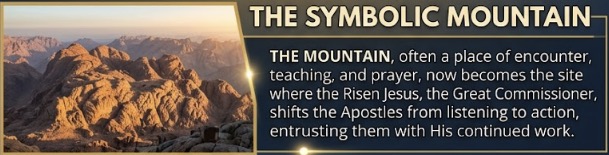
- The Symbolic Mountain: Jesus shifts from the Master who teaches to the Risen One who commissions, marking the transition from His earthly ministry to the mission of the Church.
- The Great Commission: Believers are entrusted with a fourfold mandate: to proclaim, baptize, teach, and walk the path of the living Gospel.
- A New Style of Presence: The Ascension is not a departure but a transformation. Jesus remains present through the Word, the Sacraments, and the Holy Spirit.
- The Source of Strength: Our adequacy for the mission doesn’t come from our own abilities, but from Christ’s promise to remain with us “to the close of the age.”
QUESTIONS FOR REFLECTION
- In what areas of your life do you feel “inadequate” to share your faith, and how does Jesus’ promise of His constant presence change that perspective?
- The homily mentions that one cannot proclaim the Gospel without witness. Does your daily life reflect the “living Gospel” you wish to share with others?
- How can you become more sensitive to the “new style” of Jesus’ presence—specifically through the Holy Spirit—in your ordinary routines?
ACTIONABLE
TAKEAWAYS
- Identify Your “Galilee”: This week, identify one specific “nation” or group in your life (family, workplace, or social circle) where you are called to witness through your actions.
- Practice Interior Awareness: Set a brief daily reminder to acknowledge the presence of the Holy Spirit, asking for the “strength, perseverance, and joy” mentioned in the text.
- Study to Teach: Choose one command of Jesus (e.g., a Beatitude or a parable) to study deeply this week so that you are better prepared to “explain your faith” to someone else.
The Ascension of the Lord (A)
The Risen Presence from Mandate to Mission
24 May 2020 – Library of the Apostolic Palace
Today, in Italy and in other countries, the Solemnity of the Ascension of the Lord is being celebrated. The Gospel reading (cf. Mt 28:16-20) shows us the Apostles who gather in Galilee, at “the mountain to which Jesus had directed them” (v. 16). The Lord’s final encounter with his followers takes place here, on the mountain. The “mountain” has a strong symbolic and evocative charge. Jesus proclaimed the Beatitudes on the Mount (cf. Mt 5:1-12); He withdrew to the mountains to pray (cf. Mt 14:23). He welcomed the crowds there and healed the sick (cf. Mt 15:29). However this time on the mountain, he is no longer the Master who acts and teaches, but rather the Risen One who asks the disciples to take action and to proclaim, entrusting to them the mandate to continue his work.

He assigns to them the mission to all the peoples. He says: “Go, therefore, and make disciples of all the nations, baptizing them in the name of the Father, and of the Son, and of the Holy Spirit, teaching them to observe all that I have commanded you” (vv. 19-20). The contents of the mission entrusted to the Apostles are the following: to proclaim, baptize, teach and walk the path traced by the Master, that is, the living Gospel. This message of salvation first of all implies the duty of witness — one cannot proclaim without witness — to which we too, today’s disciples, are called to explain our faith. Faced with such a demanding task, and thinking of our weaknesses, we feel inadequate, as the Apostles themselves surely felt. But we must not be discouraged, remembering the words Jesus addressed to them before ascending to Heaven: “I am with you always, to the close of the age” (v. 20).

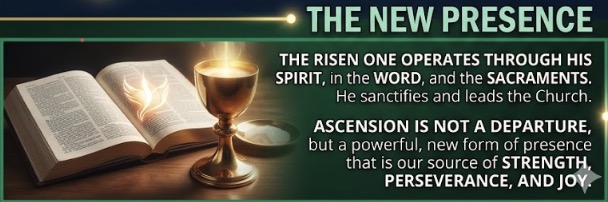
This promise ensures the constant and consoling presence of Jesus among us. But how is this presence realised? Through His Spirit, who leads the Church to walk through history as the companion of every person. That Spirit sent by Christ and the Father, who works the remission of sins and sanctifies all those who are repentant and open themselves with confidence to his gift.
With the promise to remain with us until the end of time, Jesus inaugurates the style of his presence in the world as the Risen One. Jesus is present in the world but with another style, the style of the Risen One, that is a presence that is revealed in the Word, in the Sacraments and in the constant and interior action of the Holy Spirit. The Feast of the Ascension tells us that although Jesus ascended to Heaven to dwell gloriously at the right hand of the Father, he is still and always among us: this is the source of our strength, our perseverance and our joy, from the very presence of Jesus among us with the strength of the Holy Spirit.

Message of Pope Benedict XVI
AT A GLANCE
- The Culmination of Mission: The Ascension is not a departure but the fulfillment of Christ’s mission to lead humanity back to the Father, acting as a “Shepherd” rather than a mere philosopher.
- The Divinization of Humanity: In Christ, humanity has entered the glory of God. This is a present reality—”God in man, man in God”—rather than a distant theory.
- The Anchor of Hope: Christian hope serves as a “sure and steadfast anchor” for the soul, firmly grounded in the reality of Christ’s presence in the heavenly Homeland.
- The Role of Mary: Following the example of the Upper Room, Mary points the faithful toward Jesus and models what it means to be “born from on high” through the Holy Spirit.ds.
QUESTIONS FOR REFLECTION
- How does the reality of “man in God” change the way you view your own dignity and the dignity of those around you?
- In moments of uncertainty, do you feel your soul “anchored” in Heaven, or are you drifting based on earthly circumstances?
- Are you currently “lingering looking upwards” in a state of passivity, or are you actively seeking the gift of the Holy Spirit to empower your mission on earth?
- How can Mary’s spiritual presence help direct your daily focus away from yourself and toward the person of Jesus?
ACTIONABLE
TAKEAWAY
- Practice “Heavenly Anchoring”: This week, when you feel overwhelmed, take a moment to consciously visualize your soul anchored in the presence of the ascended Christ. Let this reality provide the stability you need to handle immediate stress.
- Invoke the Spirit: Following the example of the disciples in the Upper Room, begin each day by asking for the gift of the Holy Spirit, specifically requesting the grace to be “born from on high” in your reactions and decisions.
- Marian Direction: Use the Rosary or a brief Marian prayer to ask Mary to “point the way” to her Son in a specific area of your life where you feel lost or distant from God.
- Active Presence: Identify one way to be a “shepherd” to someone else this week—leading them toward hope or peace through a concrete act of service rather than just words.
The Ascension of the Lord (A)
Solemnity of the Ascension
4 May 2008 | Saint Peter’s Square

Today the Solemnity of the Ascension of Christ into heaven is being celebrated in various countries, including Italy, a mystery of faith which the Acts of the Apostles places 40 days after the Resurrection (cf. Acts 1: 3-11) and for this reason it was celebrated last Thursday in the Vatican and in several other Nations of the world.
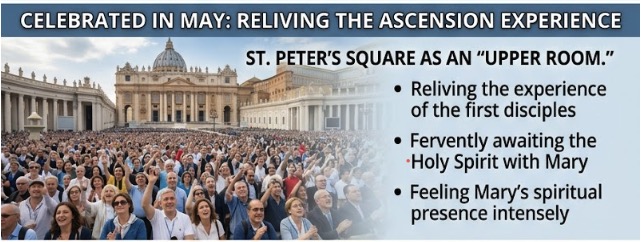
After the Ascension, the first disciples remained together in the Upper Room gathered around the Mother of Jesus, fervently awaiting the gift of the Holy Spirit, promised by Jesus (cf. Acts 1: 14). [In May], the month of Mary, we too relive this experience, feeling Mary’s spiritual presence more intensely.
And St Peter’s Square looks almost like an “Upper Room” under the open sky, packed with the faithful, most of whom belong to the Italian Catholic Action to whom I shall speak after the Marian prayer of the Regina Caeli.

In his farewell discourses to the disciples, Jesus stressed the importance of his “return to the Father”, the culmination of his whole mission: indeed, he came into the world to bring man back to God, not on the ideal level – like a philosopher or a master of wisdom – but really, like a shepherd who wants to lead his sheep back to the fold. This “exodus” toward the heavenly Homeland which Jesus lived in the first person, he faced solely for us. It was for our sake that he came down from Heaven and for our sake that he ascended to it, after making himself in all things like men, humbling himself even to death on a cross and after having touched the abyss of the greatest distance from God. For this very reason the Father was pleased with him and “highly exalted” him (Phil 2: 9), restoring to him the fullness of his glory, but now with our humanity. God in man – man in God: this is even now a reality, not a theoretical truth. Therefore, Christian hope, founded on Christ, is not an illusion but, as the Letter to the Hebrews says, “we have this as a sure and steadfast anchor of the soul” (Heb 6: 19), an anchor that penetrates Heaven where Christ has gone before us.

And what does the human person in every epoch need other than this: a firm anchorage in life? Here once again is the wonderful meaning of Mary’s presence among us. Turning our gaze to her, like the first disciples, we are immediately directed to the reality of Jesus: the Mother points to the Son who is no longer physically among us but awaits us in the Father’s house. Jesus invites us not to linger looking upwards, but to be united in prayer together, to invoke the gift of the Holy Spirit. Indeed, only those who are “born from on high”, that is, from God’s Spirit, have access to the Kingdom of Heaven (cf. Jn 3: 3-5), and the first to be “born from on high” was, precisely, the Virgin Mary. To her, therefore, let us turn in the fullness of Easter joy.

Message of Pope Saint John Paul II
AT A GLANCE
- The Dual Mystery: The Ascension is defined by two pivotal movements: Christ giving instructions to His Church and Christ taking His place at the right hand of the Father.
- The Great Commission: The missionary era of the Church is fueled by the Holy Spirit rather than human wisdom. Its core mandate is to guard the “deposit of faith” and proclaim the Kingdom of God.
- Head and Body: As the “firstborn among many brethren,” Christ’s entrance into heaven is not a departure but a victory. Our human nature now resides with God, making His glory the hope of the entire Body (the Church).
- Divine Victory: Because Christ is seated in glory, the Church can never know ultimate defeat. His intercession provides the superabundant strength needed for holiness and fidelity.
QUESTIONS FOR REFLECTION
- In my daily life, do I rely more on “human wisdom and strength” or do I consciously wait for the power of the Holy Spirit to guide my actions?
- How does the reality of Christ’s human nature being present in heaven change the way I view my own dignity and the “vocation of joyful hope”?
- Am I a faithful steward of the instructions of Jesus? Do I seek to keep the Word of God in its “purity and integrity” within my own heart?
- When faced with setbacks or difficulties, do I look to Christ’s “session at the right hand of God” as a guarantee of ultimate victory, or do I allow myself to be overcome by the world’s weakness?
ACTIONABLE
TAKEAWAY
- Prioritize the Word: Commit to a daily study of the “sacred deposit of Christian doctrine.” Ensure that God’s Word is the dynamic basis for your personal decisions and ministry.
- Live the Mission: Identify one concrete way to “give witness to Christ” this week—whether through explicit conversation about the Kingdom of God or a specific act of charity that reflects the Gospel.
- Cultivate Ascension Hope: Replace a habit of anxiety with a habit of “joyful hope.” When feeling overwhelmed, recite a short prayer acknowledging that Christ has already “taken his place” and his victory is yours.
- Intercede with the Intercessor: Align your prayer life with Christ’s eternal intercession. Specifically, pray for the “fervour of the forefathers” to take root in your own community, asking for the grace of fidelity to the Catholic faith.
The Ascension of the Lord (A)
Christ’s Ascension in
Two Truths
24 May 1979 | HOMILY
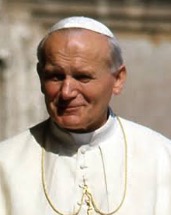
ON THIS SOLEMNITY of the Ascension of our Lord, the Pope is happy to offer the Eucharistic Sacrifice with you and for you. I am happy to be with the students and staff of the Venerable English College in this year in which you are celebrating your fourth centenary. And today, in a special way, I feel spiritually close to you, to your parents and families, and to all the faithful of England and Wales – to all who are united in the faith of Peter and Paul, in the faith of Jesus Christ. The traditions of generosity and fidelity that have been exemplified in the life of your College for four hundred years are present in my heart this morning. You have come to give thanks and praise to God for what has been accomplished by his grace in the past, and to find strength to go forward – under the protection of our Blessed Lady – in the fervour of your forefathers, many of whom laid down their lives for the Catholic faith.
A cordial word of welcome goes also to the new priests from the Pontifical Beda College. For you too this is a moment of special challenge to keep alive the ideals manifested in your patron, Saint Bede the Venerable, whom you will commemorate tomorrow. Welcome also to the staff and to your fellow studente.
The Mystery of the Ascension
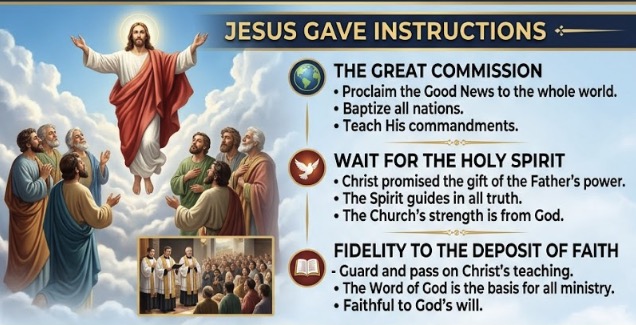
With joy then and fresh resolves for the future, let us reflect briefly on the great mystery of today’s liturgy. In the Scripture readings the whole significance of Christ’s Ascension is summarized for us. The richness of this mystery is spelled out in two statements: Jesus gave instructions, and then Jesus took his place.
Mission and Instructions of Christ
In the providence of God – in the eternal design of the Father – the hour had come for Christ to go away. He would leave his Apostles behind, with his Mother Mary, but only after he had given them his instructions. The Apostles now had a mission to perform according to the instructions that Jesus left, and these instructions were in turn the faithful expression of the Father’s will.
The Gift of the Holy Spirit
The instructions indicated, above all, that the Apostles were to wait for the Holy Spirit, who was the gift of the Father. From the beginning, it had to be crystal-clear that the source of the Apostles’ strength is the Holy Spirit. It is the Holy Spirit who guides the Church in the way of truth; the Gospel is to spread through the power of God, and not by means of human wisdom or strength.
The Great Commission and
the Missionary Era
The Apostles, moreover, were instructed to teach – to proclaim the Good News to the whole world. And they were to baptize in the name of the Father, and of the Son, and of the Holy Spirit. Like Jesus, they were to speak explicitly about the Kingdom of God and about salvation. The Apostles were to give witness to Christ to the ends of the earth. The early Church clearly understood these instructions and the missionary era began. And everybody knew that this missionary era could never end until the same Jesus, who went up to heaven, would come back again.
Fidelity to the Deposit of Faith
The words of Jesus became a treasure for the Church to guard and to proclaim, to meditate on and to rive. And at the same time, the Holy Spirit implanted in the Church an apostolic charism, in order to keep this revelation intact. Through his words Jesus was to live on in his Church: I am with you always. And so the whole ecclesial community became conscious of the need for fidelity to the instructions of Jesus, to the deposit of faith. This solicitude was to pass from generation to generation – down to our own day.
The Priority of Word and Formation
And it was because of this principle that I spoke recently to your own Rectors, stating that the first priority for seminaries today is the teaching of God’s word in all its purity and integrity, with all its exigencies and in all its power. The word of God – and the word of God alone – is the basis for all ministry, for all pastoral activity, for all priestly action. The power of God’s word constituted the dynamic basis of the Second Vatican Council, and John XXIII pointed out clearly on the day it opened: ‘The greatest concern of the Ecumenical Council is this: that the sacred deposit of Christian doctrine should be more effectively quarded and taught’. And if the seminarians of this generation are to be adequately prepared to take on the heritage and challenge of this Council they must be trained above all in God’s word: in ‘the sacred deposit of Christian doctrine’ Yes, dear sons, our greatest challenge is to be faithful to the instructions of the Lord Jesus.

Christ at the Right Hand of God
And the second reflection on the meaning of the Ascension is found in this phrase: Jesus took his place. After having undergone the humiliation of his passion and death, Jesus took his place at the right-hand of God; he took his place with his eternal Father. But he also entered heaven as our Head. Whereupon, in the expression of Leo the Great, the glory of the Head became the hope of the body. For all eternity Christ takes is place as the firstborn among many brethren: our nature is with God in Christ. And as man, the Lord Jesus lives for ever to intercede for us with Father. At the same time, from his throne of glory, Jesus sends out to the whole Church a message of hope and a call to holiness.
The Triumph of the Church in Christ
Because of Christ’s merits, because of his intercession with the Father, we are able to attain justice and holiness of life, in him. The Church may indeed experience difficulties, the Gospel may suffer setbacks, but because Jesus is at the right-hand of the Father the Church will never know defeat. Christ’s victory is ours. The power of the glorified Christ, the beloved Son of the eternal Father, is superabundant, to sustain each of us and all of us in the fidelity of our dedication to God’s Kingdom and in the generosity of our celibacy. The efficacy of Christ’s Ascension touches all us in the concrete reality of our daily lives. Because of this mystery it is the vocation of the whole Church to wait in joyful hope for the coming of our Saviour, Jesus Christ.
A Call to Hope and Joy
Dear sons, be imbued with the hope that is so much a part of the mystery of the Ascension of Jesus. Be deeply conscious of Christ’s victory and triumph over sin and death. Realize that the strength of Chist is greater than our weakness, greater than the weakness of the whole world. Try to understand and share the joy that Mary experienced in knowing that her Son had taken his place with his Father, whom he loved infinitely. And renew your faith today in the promise of our Lord Jesus Christ, who has gone to prepare a place for us, so that he can come back again and take us to himself.
Conclusion
This is the mystery of the Ascension of our Head. Let us always remember: Jesus gave instructions, and then Jesus took his place. Amen.
