Catholic Digest, Homily Themes
Catholic Digest, Homily Themes
May 17, 2026
⭐⭐⭐ What’s New








Theology, Apologetics & Evangelization
These channels focus on explaining and defending the Catholic faith, often engaging with modern culture and other viewpoints.
- Bishop Robert Barron (Word on Fire): One of the most influential voices in the Church, offering cultural commentary, movie reviews, and deep theological deep-dives.
- Ascension Presents: A powerhouse channel featuring popular figures like Fr. Mike Schmitz (known for the “Bible in a Year” and “Catechism in a Year” podcasts) and Fr. Josh Johnson, offering accessible videos on faith and life.
- Catholic Answers: The premier channel for Catholic apologetics, featuring live Q&A shows where apologists answer tough questions from callers.
- Pints with Aquinas (Matt Fradd): Long-form interviews and discussions on theology, philosophy, and culture, often over a drink.
- The Counsel of Trent (Trent Horn): Trent Horn, a Catholic Answers apologist, provides rebuttals to atheist and Protestant arguments, as well as commentary on current events.
- Jimmy Akin: A senior apologist at Catholic Answers known for his fairness and deep knowledge, covering everything from bizarre questions to deep theology.
- Breaking In The Habit (Fr. Casey Cole, OFM): A young Franciscan friar who offers fresh, accessible reflections on faith, vocations, and everyday life.
- Thomistic Institute: Excellent, high-quality animated videos and lectures explaining the philosophy and theology of St. Thomas Aquinas.
The Ascension of the Lord (A)
PRACTICAL
ACTIONS
Acts 1:1-11 | The Promise of Power and the Ascension
This passage marks the transition from Jesus’ earthly ministry to the mission of the Church through the Holy Spirit.
- Prioritize Prayerful Waiting: Before jumping into new projects or ministry efforts, dedicate specific time to “wait” on God’s timing. Practice a “Sabbath of stillness” this week where you listen rather than act.
- Identify Your “Jerusalem”: The mission started at home. Identify one person in your immediate circle—family, neighbor, or coworker—and commit to a specific act of service for them this week.
- Focus on the Present Mission: When the disciples asked about the future kingdom, Jesus redirected them to the present task. Audit your spiritual life: are you more focused on “end-times” speculation or on being a witness in your current environment?
Ephesians 1:17-23 | The Prayer for Revelation and Authority
Paul prays for the believers to have a deeper spiritual understanding of Christ’s supreme authority over all things.
- Pray for Spiritual Sight: Incorporate Paul’s petition into your own daily routine. Specifically, pray for “the spirit of wisdom and revelation” to see a difficult situation in your life from a divine perspective rather than a purely logical one.
- Acknowledge Christ’s Sovereignty: List three things currently causing you anxiety. Explicitly “place” them under the feet of Jesus, verbally acknowledging that He is seated far above these specific concerns.
- Engage with the Body: Since the Church is described as “His body, the fullness of Him,” seek to contribute one unique gift or talent to your local community this weekend to help complete that “fullness.”
Matthew 28:16-20 | The Great Commission
These final instructions provide the “marching orders” for every believer, centered on authority and companionship.
- Audit Your “Going”: The Great Commission happens “as you are going.” Look at your daily routine (the gym, the grocery store, the office) and identify how you can represent Christ’s teachings in those mundane spaces.
- Commit to Mentorship: “Making disciples” involves teaching others to observe what Jesus commanded. Find one person—perhaps someone younger in their faith—and invite them to coffee to share what you are currently learning.
- Practice Presence Awareness: Jesus promised to be with us “always, to the end of the age.” End each day this week by journaling two moments where you felt or noticed God’s presence during your tasks.
The Ascension of the Lord (A)

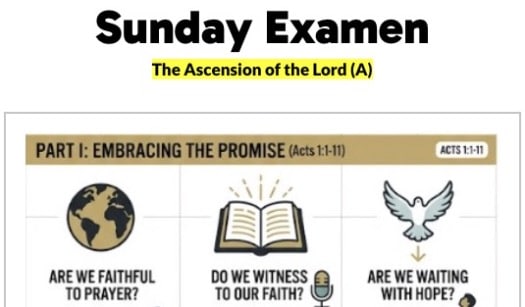
I. THE ASCENSION:
Embracing the Promise
These readings from Acts and Ephesians point to Jesus returning to the Father, his triumph, and his continued presence and power through the Holy Spirit.
- Trusting in God’s Timing: Jesus told his apostles, “It is not for you to know the times or periods that the Father has set by his own authority” (Acts 1:7).
- Do I worry excessively about the future, trying to control things that are beyond my power?
- Am I content with God’s plan, even when it is unfolding in ways I do not understand or at a pace that is slower than I would like?
- Do I often focus on the small details and lose sight of the bigger spiritual picture?
- Welcoming the Spirit: Acts reminds us that we are to receive “power when the Holy Spirit has come upon you” (Acts 1:8).
- Do I actively seek the guidance of the Holy Spirit in my daily decisions and actions?
- Am I open to the gifts the Holy Spirit wants to give me, and am I a good steward of them?
- Am I receptive to the “wisdom and revelation” that the Father gives, allowing the eyes of my heart to be enlightened (Ephesians 1:17-18)?
- Living in Hope: Ephesians speaks of the “hope to which he has called you” and the “glorious inheritance among the saints” (Ephesians 1:18).
- Does my daily life reflect a deep and abiding hope in Christ’s ultimate victory and the promise of eternal life?
- Do I get easily discouraged by the challenges and difficulties I face, forgetting the power and presence of Christ in my life?
- Am I grateful for my inheritance as a child of God, or do I take it for granted?

II. THE LORDSHIP OF CHRIST:
Recognizing His Sovereignty
These readings, especially from Ephesians and Matthew, celebrate the supreme authority of Jesus Christ over all things and in the Church.
- Seeking Spiritual Wisdom: Do I find myself seeking a “spirit of wisdom and revelation” so that I can know God better (Ephesians 1:17)?
- Is getting to know the Lord a priority for me, above all other knowledge?
- How often do I engage in spiritual practices (like reading the Scriptures, praying, receiving the Sacraments, or service to others) that are designed to help me grow in my understanding and love for God?
- Appreciating Christ’s Power: Ephesians describes the “immeasurable greatness of his power for us who believe” (Ephesians 1:19).
- Do I truly believe that Jesus has “all authority in heaven and on earth” (Matthew 28:18)?
- How does this belief translate into a sense of confidence and courage in my daily life?
- Do I tend to rely on my own strength and resources, or do I trust in the power of Christ to work in and through me?
- Recognising Christ’s Headship: Christ is “the head over all things for the church” (Ephesians 1:22).
- Do I respect the authority of the Church as the “body of Christ, the fullness of him who fills all in all” (Ephesians 1:23)?
- How does my relationship with my parish and the wider Church reflect my love and commitment to Christ?
- Do I contribute to the Church’s mission, or am I a passive observer?

III. THE GREAT COMMISSION:
Carrying the Mission
Matthew’s Gospel ends with the powerful command from Jesus to go and make disciples of all nations, to baptize them, and to teach them his commandments.
- Sharing the Good News: Jesus said, “Go therefore and make disciples of all nations” (Matthew 28:19).
- Am I a credible witness of my faith to others? Do my words, actions, and attitude draw people closer to Christ?
- Have I shared the joy and hope of the Gospel with anyone in the past week, month, or year?
- Am I mindful of the need for evangelization in my family, workplace, and community?
- Living Out the Sacramental Life: We are to be “baptizing them in the name of the Father and of the Son and of the Holy Spirit” (Matthew 28:19).
- How does my own baptismal call shape my life?
- Do I live as a person who has been set apart for God and is called to holiness?
- Am I conscious of my duty to support and guide others (especially children and godchildren) in their sacramental journey?
- Keeping Christ’s Commandments: We are to be “teaching them to obey everything that I have commanded you” (Matthew 28:20).
- How familiar am I with the teachings of Jesus, as they are recorded in the Scriptures?
- Do I strive to keep his commandments, especially the great command to love God and to love my neighbor?
- Where do I fall short in my obedience to Christ, and what am I doing to address these areas in my life?
- Trusting in Christ’s Presence: Jesus promises us, “I am with you always, to the end of the age” (Matthew 28:20).
- Do I truly believe and draw strength from this promise of Christ’s constant presence in my life?
- Am I aware of his presence in times of joy, in times of sorrow, and in the everyday moments of my life?
- How does this belief influence my prayer and my relationship with others?
Non-profits have permission to copy and paste infographics into their publications.
The Ascension of the Lord (A)
The Commission to ‘Go’
Gospel: Matthew 28:16–20
Theme: Go, make disciples of all nations.
McCulloch
(Diocese of Broken Bay)
The Ascension is not a story of departure; it’s a story of commissioning. Christ’s work on earth concludes with his final command, the Great Commission, which becomes the charter for the entire Church. He sends his disciples – who are still human, still ‘doubting’ even as they worship – to the ends of the earth.
And He gives them the promise that makes this impossible mission possible: ‘Behold, I am with you always, until the end of the age.’ The Ascension does not mean that Jesus has left; it means that His presence is no longer localized in one body, but is now universal, available to “all nations” through the work of His Church.
The deacon is, in a unique way, a man of this Great Commission. His vocation is a direct ‘yes’ to the command to ‘Go.’ As St. Francis Xavier, the great missionary, prayed, ‘Lord, I am here! What do you want of me?’ The deacon’s life is this prayer in action, keeping the Church faithful to her outward-looking, ‘sending’ God.
AT MASS
The Ministry of “Go” (At Mass)
The deacon’s liturgical role is to perpetually echo this command to ‘Go.’ He stands at the threshold, connecting the worship of the ‘mountain’ (the altar) to the mission in the nations of the world.
• The Herald of the Commission: When the deacon proclaims this Gospel, he is the voice of the Risen Lord issuing the command anew. He speaks the ‘Go…’ to the assembly, reminding them that their worship is incomplete until it becomes mission.
• Minister of Baptism: The deacon is an ordinary minister of the very sacrament Christ commands: ‘…baptizing them in the name of the Father, and of the Son, and of the Holy Spirit.’ Every time he stands at the font, the deacon is a direct agent of the Great Commission, ‘making a new disciple.’
• The Great Dismissal: The deacon’s entire liturgical function is summed up in the dismissal. He is the one who sends the Church. His words, ‘Go and announce the Gospel of the Lord,’ or ‘Go in peace,’ are the living voice of Christ from the mountain. He ascends the steps of the sanctuary, receives the Word, and then descends to send the people out into the world.
IN THE PARISH
The Ministry of Teaching (In the Parish)
Christ’s command is twofold: ‘baptizing’ and ‘teaching them to observe all that I have commanded.’ The deacon is a primary minister of this teaching.
• Teaching from the World: As a man typically with a family and a secular job, the deacon is the Church’s missionary in the midst of the nations. His teaching is not just in the homily; it’s his witness in the workplace, his integrity in his family, and his presence in the community. He shows the parish how the Gospel is observed in daily life.
• The Catechist: The deacon’s work in the RCIA, adult faith formation, and marriage and baptismal preparation is the work of making disciples. He is the patient teacher who, like Christ with the doubting disciples, walks with those who are learning, instructing them in the faith.
• “Lord, I am here!”: The deacon’s parish life is a constant ‘yes’ to the question, ‘What do you want of me?’ He is the Church’s man of availability, the go-to servant who makes the Church’s mission of care a present reality.
AT THE MARGINS
The Ministry of Always (At the Margins)
The Great Commission is fuelled by the Great Promise: ‘I am with you always.’ The deacon’s ministry of diakonia is the most tangible, living proof of this promise.
• The ‘I Am with You’ Made Flesh: The deacon is sent to the ‘ends of the earth’ in his own community – to the hospital, the prison, the home of the shut-in, the shelter. His presence is the fulfillment of Christ’s promise. He is the living sign that the Church has not forgotten that Christ is still with the most lonely, the most forgotten, and the most broken.
• The Small Ascension: The deacon’s service is a small ascension. He remains rooted on earth, in the messy, tangible realities of human need, but his every act of service lifts hearts toward heaven. By feeding the hungry, he lifts their dignity. By comforting the grieving, he lifts their hope.
• Rooted on Earth, Pointing to Heaven: The deacon’s ministry is the perfect image of the Ascension. He stands with his feet on the ground of the world, but his arms are stretched out in service, and his voice is always pointing upward, guiding the ‘nations’ he serves toward the glory of the Father.
MAY 2026
PDF (68 pages)
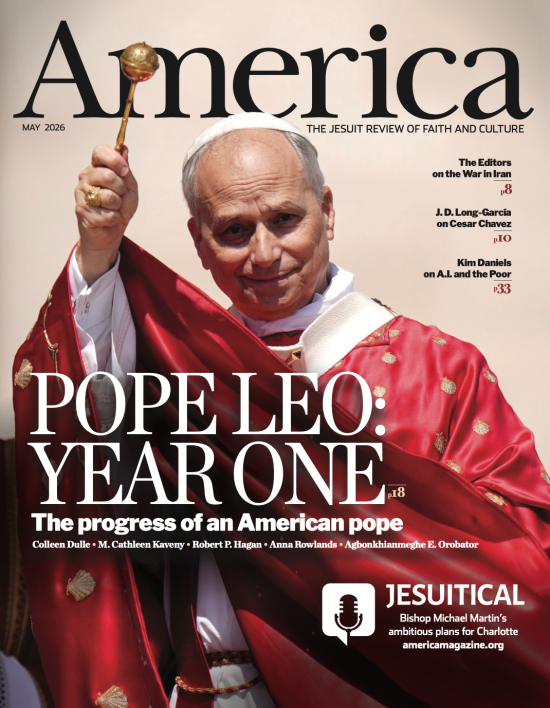
America Magazine: Published by the Jesuits, this leading national review is highly regarded for its thoughtful, nuanced commentary on religion, politics, and contemporary culture.
Commonweal: An independent, lay-edited journal of opinion that provides rigorous intellectual perspectives on faith, society, the arts, and public policy.
MAY-JUNE 2026
PDF (48 pages)
Liguorian is an award-winning Catholic magazine published since 1913 by the Redemptorists to provide spiritual guidance, pastoral messages, and inspiring stories, helping readers navigate modern life through faith. It acts as a trusted resource for Catholic spirituality, offering insights on faith, social justice, and daily Christian living.
U.S. Catholic: This publication focuses on everyday faith, social justice, and practical insights for living out Catholic teachings in modern, daily life.
MAY 2026
Magnificat: A beautifully designed monthly publication intended for daily use. It includes the texts of the daily Mass, morning and evening prayers, and spiritual reflections. Exploring its Spanish edition, Magnificat en Español, can also be an excellent way to weave language practice into a daily spiritual routine.
Catholic.com
The Ascension of the Lord (A)
Scroll to view all 50 states
Alabama
- One Voice (Diocese of Birmingham)
- The Catholic Week (Archdiocese of Mobile)
Alaska
- The North Star Catholic (Archdiocese of Anchorage-Juneau)
- The Alaskan Shepherd (Diocese of Fairbanks)
- Missionary Disciples (Diocese of Fairbanks)
Arizona
- Voice of the Southwest (Diocese of Gallup)
- The Catholic Sun (Diocese of Phoenix)
- New Outlook (Diocese of Tucson)
Arkansas
- Arkansas Catholic (Diocese of Little Rock)
California
- Angelus Magazine | DIGITAL (Archdiocese of Los Angeles)
- The Catholic Voice | DIGITAL (Diocese of Oakland)
- The Catholic Herald | DIGITAL (Diocese of Sacramento)
- Orange County Catholic (Diocese of Orange)
- Catholic Herald (Diocese of Sacramento)
- Inland Catholic Byte (Diocese of San Bernardino)
- The Southern Cross | DIGITAL (Diocese of San Diego)
- Catholic San Francisco (Archdiocese of San Francisco)
- San Francisco Católico (Archdiocese of San Francisco)
- The Valley Catholic | DIGITAL (Diocese of San Jose)
Colorado
- The Colorado Catholic Herald (Diocese of Colorado Springs)
- Denver Catholic (Archdiocese of Denver)
Connecticut
- Fairfield County Catholic (Diocese of Bridgeport)
- The Catholic Transcript | DIGITAL (Archdiocese of Hartford)
- Four County Catholic | DIGITAL (Diocese of Norwich)
Delaware
- The Dialog (Diocese of Wilmington)
Florida
- Florida Catholic | E-EDITIONS (Archdiocese of Miami; Dioceses of Orlando, Palm Beach, Pensacola–Tallahassee, St. Augustine, Saint Petersburg, Venice)
Georgia
- The Georgia Bulletin (Archdiocese of Atlanta)
- Southern Cross (Diocese of Savannah)
Hawaii
- Hawaii Catholic Herald (Diocese of Honolulu)
Idaho
- Idaho Catholic Register (Diocese of Boise)
Illinois
- The Messenger (Diocese of Belleville)
- Chicago Catholic (Archdiocese of Chicago)
- Catolico (Archdiocese of Chicago)
- Christ is Our Hope (Diocese of Joliet)
- The Catholic Post (Diocese of Peoria)
- The Observer (Diocese of Rockford)
- Catholic Times (Diocese of Springfield)
Indiana
- The Message (Diocese of Evansville)
- Today’s Catholic News (Diocese of Fort Wayne–South Bend)
- Northwest Indiana Catholic (Diocese of Gary)
- The Criterion (Archdiocese of Indianapolis)
- The Catholic Moment | DIGITAL (Diocese of Lafayette)
Iowa
- The Catholic Messenger (Diocese of Davenport)
- The Catholic Mirror | DIGITAL (Diocese of Des Moines)
- The Witness (Archdiocese of Dubuque)
- The Lumen (Diocese of Sioux City)
Kansas
- Southwest Kansas Register (Diocese of Dodge City)
- The Leaven (Archdiocese of Kansas City)
- The Register | DIGITAL (Diocese of Salina)
- Catholic Advance (Diocese of Wichita)
- Avance Católico (Diocese of Wichita)
Kentucky
- Messenger (Diocese of Covington)
- Cross Roads | DIGITAL (Diocese of Lexington)
- The Record | DIGITAL (Archdiocese of Louisville)
- Western Kentucky Catholic (Diocese of Owensboro)
Louisiana
- Church Today (Diocese of Alexandria)
- The Catholic Commentator (Diocese of Baton Rouge)
- Bayou Catholic (Diocese of Houma–Thibodaux)
- Clarion Herald (Archdiocese of New Orleans)
- The Catholic Connection | DIGITAL (Diocese of Shreveport)
Maryland / Washington, DC
- The Catholic Review (Archdiocese of Baltimore)
- Catholic Standard (Archdiocese of Washington)
- El Pregonero (Archdiocese of Washington)
Massachusetts
- The Pilot (Archdiocese of Boston)
- The Anchor (Diocese of Fall River)
- SOPHIA | DIGITAL (Diocese of Springfield)
- The Catholic Free Press | DIGITAL (Diocese of Worcester)
Michigan
- Detroit Catholic (Archdiocese of Detroit)
- FAITH along Michigan’s 45th Parallel | DIGITAL (Diocese of Gaylord)
- Faith Grand Rapids (Diocese of Grand Rapids)
- The Good News (Diocese of Kalamazoo)
- FAITH (Diocese of Lansing)
- The U.P. Catholic (Diocese of Marquette)
- Great Lakes Bay | DIGITAL (Diocese of Saginaw)
Minnesota
- Our Northland Diocese (Diocese of Crookston)
- The Northern Cross (Diocese of Duluth)
- The Prairie Catholic (Diocese of New Ulm)
- Central Minnesota Catholic | DIGITAL (Diocese of Saint Cloud)
- The Catholic Spirit (Archdiocese of Saint Paul and Minneapolis)
- The Courier | DIGITAL (Diocese of Winona-Rochester)
Mississippi
- Gulf Pine Catholic | DIGITAL (Diocese of Biloxi)
- Mississippi Catholic | DIGITAL (Diocese of Jackson)
Missouri
- Catholic Missourian | DIGITAL (Diocese of Jefferson City)
- The Catholic Key | DIGITAL (Diocese of Kansas City–Saint Joseph)
- The Mirror (Diocese of Springfield–Cape Girardeau)
- St. Louis Review (Archdiocese of St. Louis)
- Catholic St. Louis | DIGITAL (Archdiocese of St. Louis)
Montana
- The Harvest (Diocese of Great Falls–Billings)
Nebraska
- West Nebraska Catholic | DIGITAL (Diocese of Grand Island)
- Southern Nebraska Register (Diocese of Lincoln)
- The Catholic Voice (Archdiocese of Omaha)
Nevada
- Desert Clarion (Diocese of Las Vegas)
- High Desert Catholic | DIGITAL (Diocese of Reno)
New Hampshire
New Jersey
- Catholic Star Herald (Diocese of Camden)
- The Catholic Spirit | DIGITAL (Diocese of Metuchen)
- The Catholic Advocate (Archdiocese of Newark)
- The Beacon | DIGITAL (Diocese of Paterson)
- The Monitor (Diocese of Trenton)
New Mexico
- Voice of the Southwest (Diocese of Gallup)
- Agua Viva (Diocese of Las Cruces)
- People of God (Archdiocese of Santa Fe)
New York
- The Evangelist (Diocese of Albany)
- The Tablet (Diocese of Brooklyn)
- The Catholic Union / The Catholic Union and Times (Diocese of Buffalo)
- Western New York Catholic (Diocese of Buffalo)
- The Good Newsroom (Archdiocese of New York)
- North Country Catholic (Diocese of Ogdensburg)
- Catholic Courier (Diocese of Rochester)
- El Mensajero Católico (Diocese of Rochester)
- The Long Island Catholic (Diocese of Rockville Centre)
- The Catholic Sun (Diocese of Syracuse)
North Carolina
- Catholic News Herald (Diocese of Charlotte)
- NC Catholics | DIGITAL (Diocese of Raleigh)
North Dakota
- Dakota Catholic Action | DIGITAL (Diocese of Bismarck)
- New Earth Magazine | DIGITAL (Diocese of Fargo)
Ohio
- The Catholic Telegraph (Archdiocese of Cincinnati)
- Northeast Ohio Catholic (Diocese of Cleveland)
- Catholic Times | DIGITAL (Diocese of Columbus)
- Steubenville Register (Diocese of Steubenville)
- The Catholic Echo (Diocese of Youngstown)
Oklahoma
- Sooner Catholic | DIGITAL (Archdiocese of Oklahoma City)
- Eastern Oklahoma Catholic | DIGITAL (Diocese of Tulsa)
Oregon
- Catholic Sentinel / El Centinela (Diocese of Baker / Archdiocese of Portland)
- The Diocesan Chronicle (Diocese of Baker / Archdiocese of Portland)
- Harvest | DIGITAL (Diocese of Baker / Archdiocese of Portland)
Pennsylvania
- The A.D. Times | DIGITAL (Diocese of Allentown)
- Proclaim TV! | DIGITAL (Diocese of Altoona–Johnstown)
- The Catholic Accent | DIGITAL (Diocese of Greensburg)
- The Catholic Witness | DIGITAL (Diocese of Harrisburg)
- Catholic Philly (Archdiocese of Philadelphia)
- Pittsburgh Catholic | DIGITAL (Diocese of Pittsburgh)
- The Catholic Light (Diocese of Scranton)
Rhode Island
- Rhode Island Catholic (Diocese of Providence)
- El Católico de Rhode Island (Diocese of Providence)
South Carolina
- The Catholic Miscellany | DIGITAL (Diocese of Charleston)
South Dakota
- West River Catholic | DIGITAL (Diocese of Rapid City)
- The Bishop’s Bulletin | DIGITAL (Diocese of Sioux Falls)
Tennessee
- East Tennessee Catholic (Diocese of Knoxville)
- The West Tennessee Catholic (Diocese of Memphis)
- Faith West Tennessee (Diocese of Memphis)
- Catholic Awakenings | DIGITAL (Diocese of Nashville)
Texas
- The West Texas Catholic | DIGITAL (Diocese of Amarillo)
- Catholic Spirit (Diocese of Austin)
- East Texas Catholic | DIGITAL (Diocese of Beaumont)
- South Texas Catholic | DIGITAL (Diocese of Corpus Christi)
- The Texas Catholic (Diocese of Dallas)
- Revista Católica (Diocese of Dallas)
- The Rio Grande Catholic | DIGITAL (Diocese of El Paso)
- North Texas Catholic | DIGITAL (Diocese of Fort Worth)
- Texas Catholic Herald | DIGITAL (Archdiocese of Galveston–Houston)
- West Texas Angelus | DIGITAL (Diocese of San Angelo)
- Today’s Catholic Newspaper | DIGITAL (Archdiocese of San Antonio)
- Catholic East Texas | DIGITAL (Diocese of Tyler)
- The Catholic Lighthouse | DIGITAL (Diocese of Victoria)
Utah
- Intermountain Catholic (Diocese of Salt Lake City)
Vermont
- Vermont Catholic (Diocese of Burlington)
Virginia
- Arlington Catholic Herald (Diocese of Arlington)
- The Catholic Virginian (Diocese of Richmond)
Washington
- Northwest Catholic | DIGITAL (Archdiocese of Seattle)
- Inland Catholic | DIGITAL (Diocese of Spokane)
West Virginia
- The Catholic Spirit (Diocese of Wheeling–Charleston)
Wisconsin
- The Compass | DIGITAL (Diocese of Green Bay)
- Catholic Life | DIGITAL (Diocese of La Crosse)
- Madison Catholic Herald (Diocese of Madison)
- The Catholic Herald (Archdiocese of Milwaukee)
- The Superior Catholic Herald (Diocese of Superior)
Wyoming
- Wyoming Catholic Register (Diocese of Cheyenne)
FORMED is a premier on-demand digital streaming platform dedicated to Catholic media. It is frequently described as a “Catholic Netflix.” Created by the Augustine Institute—in collaboration with Ignatius Press and over 100 other Catholic content providers—FORMED provides a vast library of faith-based media designed to help individuals, families, and parishes learn and grow in their faith.
RECENTLY ADDED

Many Catholic parishes purchase an annual subscription to FORMED for their congregation. If your local church has a subscription, you can usually sign up for a free account by entering your parish’s name or zip code on the site.

The Ascension of the Lord (A)
Click banner to SHOW/HIDE latest updates
AI as a Handmaid to Catholic Evangelization
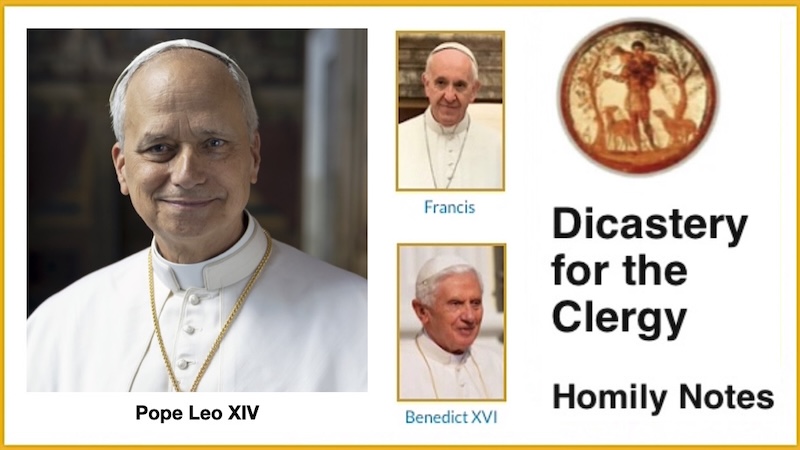
Each week TWTW explores Artificial Intelligence through the rhythm of the church calendar by looking at the Sunday Mass readings. Using insights from Pope Leo XIV’s encyclical, the series hopes to offer a balanced view for understanding this emerging technology.
The command to evangelize, delivered by Jesus Christ himself, is a challenge of cosmic scale and intimate personal connection. For nearly two millennia, the Catholic Church has grappled with the mandate to reach “all nations” (Matthew 28:19) while ensuring profound spiritual transformation.
In the twenty-first century, a powerful and unexpected tool, Artificial Intelligence (AI), is emerging as a potential ally in this enduring mission. Far from replacing the human person in the work of grace, AI can, when guided by the Holy Spirit and used ethically according to Catholic teaching, act as a crucial ‘helping hand,’ accelerating the reach and depth of the Gospel in unprecedented ways that align profoundly with Jesus’ universal plan for salvation.
Receiving Power as Divine Witnesses
The blueprint for evangelization begins with power. In the opening chapter of Acts, Jesus promises the disciples, “you will receive power when the Holy Spirit comes on you, and then you will be my witnesses not only in Jerusalem but throughout Judea and Samaria, and indeed to the earth’s remotest end” (Acts 1:8). Catholic evangelists today, directed by this same Spirit, must discern how technological tools can amplify this witness.
AI’s capacity for rapid data synthesis and analysis can identify emerging digital spiritual needs and optimize content for vast digital communities, acting as a catalyst that amplifies the reach of Spirit-led voices but never substituting for the authentic human encounter. Just as ancient roads facilitated the apostles’ journeys, modern digital algorithms can pave the way for modern witnesses, freeing them from transactional tasks to focus on the essential relational and sacramental ministry, the true source of spiritual power.
A Spirit of Wisdom for Enlightened Minds
This connection and knowledge find deeper echo in the letter to the Ephesians, where St. Paul prays for a spirit of wisdom and enlightened minds to bring believers to “full knowledge” of God’s call and the vastness of Christ’s cosmic power (Ephesians 1:17-19).
AI can contribute to this intellectual and spiritual growth within the Church, which is the “body of Christ” (Ephesians 1:23). AI-powered tools can provide personalized scriptural and theological resources, deep-dive doctrinal analysis for educators, and connect diverse Catholic communities and individuals globally, as seen in apps that facilitate daily prayer or offer interactive catechesis.
This fosters a more profound understanding and unity, enabling the body of Christ to grow in knowledge and connect with those searching for truth across the digital landscape. AI becomes a means to draw nearer to divine wisdom and to fellow members, supporting the Church’s growth.
Scaling the Call to Make Disciples and Teach
The clearest application of AI in evangelization, however, is directly linked to the Great Commission in Matthew’s Gospel: “Go, therefore, make disciples of all nations; baptise them in the name of the Father and of the Son and of the Holy Spirit, and teach them to observe all the commands I gave you” (Matthew 28:19-20). The task is simultaneously one of vast scale (“all nations”) and meticulous detail (“teaching them”).
AI’s unparalleled ability to scale communication and translation is a direct “helping hand.” Generative AI can instantly translate scriptural and theological resources into myriad languages, including those of remote or historically overlooked populations, fulfilling the geographical scope implied by “all nations” and enabling evangelists to literally speak new languages and reach new people, as called for by Catholic tradition.
Furthermore, AI tools can help personalizing catechetical and educational content for individual learners, ensuring that “teaching” can be delivered in ways that truly resonate with individual hearts and minds, much like Christ tailored his parables, thus facilitating the process of making true disciples.
An Ethical Handmaid to the Timeless Mission
However, a Catholic approach must always view AI as a servant, not a master, of the true mission, which must remain human-centered and ethically grounded, as Vatican guidelines and papal statements increasingly emphasize. Machines mimic and perform computations, but authentic human relationships, pastoral sensitivity, and the grace of the sacraments are irreplaceable in lived faith. Jesus’ plan, revealed in these very scriptures, is ultimately about personal encounter and the work of the Holy Spirit through the body of Christ.
AI outputs must be continually judged against Scripture and Tradition, under human discernment and oversight, serving truth, human dignity, and the common good without creating dependency or diluting the Gospel message. Ethical governance is vital, preventing bias and preserving the moral agency intrinsic to the human person created in God’s image. Thus, a deacon or evangelist might prayerfully use AI for resource creation, translation, and outreach, but would understand that the final pastoral and human dimension, the authentic “I am here, Lord!” availability, remains essential.
In conclusion, AI, when used ethically, prayerfully, and under true human supervision, is not an alternative to the Spirit-led human mission of evangelization, but a powerful modern amplifier. It acts as an invaluable handmaid, breaking down barriers of distance, language, and knowledge that have long challenged the Church’s universal call.
By scaling communication, personalizing teaching, and enabling global connection, AI can help the Catholic Church better fulfill its timeless mandate to reach “all nations” with the joy of the Gospel. Thus, this unexpected technological force can, under the guidance of the eternal Spirit and in faithful obedience to the original command, lend a profound and accelerated helping hand in bringing the whole Christ to the whole person across the entire world, closer in scope and depth to the cosmic plan envisioned by Jesus Christ.—keeping the commands of the One who promised we would never be left as orphans in any age, digital or otherwise.
TWTW used AI to help write/edit this essay.
The Ascension of the Lord (A)
- MOVIES
- TV EPISODES
- SONGS
Mainstream movies that offer strong, theologically rich connections to this Sunday’s Gospel, though viewers should exercise discernment as these secular releases may contain mature themes. Videos may contain spoilers.
Inception (2010)


Inception is a mind-bending thriller following Dom Cobb, a skilled thief who steals secrets from deep within the subconscious during the dream state. Instead of heist, he is tasked with “inception”—planting an idea into a target’s mind. To succeed, his team must navigate multiple, unstable dream layers.
The Kick and the Totem’s Spin: Following the completion of the complex multi-level heist within the mind, Dom Cobb (Leonardo DiCaprio) finally ascends from the dream world and returns to his reality. He is reunited with his children, whose faces he can finally see. He takes out his totem—the spinning top—and sets it spinning on the table to verify he is not still dreaming. He does not wait to see if it topples. Instead, he turns away from the unseen confirmation and walks toward his family, embracing the new life he was promised, while the top continues to spin, its final state remaining unknown to the audience.
Theological Connection (Trust in the Unseen Reality): This scene powerfully mirrors the dynamic of Acts 1:9 (the Ascension). Just as the cloud hid Jesus from the disciples’ sight, the uncertainty of the totem’s fall symbolizes that Cobb’s final reality is “hidden from sight.” Both the disciples and Cobb must trust in the guarantee of the new life given to them. Cobb’s decision to walk away from the totem and toward his family is an act of total surrender to the promise of his “ascended” life, matching the disciples’ transition from staring at the sky to embarking on their mission based on faith in the unseen Christ.
The Truman Show (1998)


The film follows Truman Burbank, a man who unknowingly lives his entire life inside a massive, constructed reality TV show. The world around him is completely artificial, and every person he interacts with is an actor. The film explores themes of surveillance, control, free will, and the nature of reality.
The Exit of Truth: Ater sailing to the very edge of his dome-encased world, Truman Burbank (Jim Carrey) finds a staircase leading up the “sky.” He ascends the stairs, reaching a small door in the horizon labeled “EXIT.” The creator of his world, Christof, speaks from above, warning him that the outside world is cruel. Truman, now possessing full knowledge of the truth of his life, turns to the global audience that has been watching him, gives his iconic bow, and steps through the door, ascending out of the artificial world and into the messy reality of the “nations.”
Theological Connection (The Great Commission to the World): Truman’s climb up the stairs and exit through the horizon door is a powerful visualization of the Small Ascension and The Great Commission (Acts 1:9-11). Truman must leave the “mountain” (the artificial, safe world) where he has seen the “truth” and be sent out into the “margins” and the “world” (Acts 1:8). Just as the deacons liturgical role is to “perpetually echo this command to ‘Go’,” Truman’s final bow is his ultimate “Yes” to his vocation of living a “witness” in the real world, guided by the knowledge of what is truly real.
Interstellar (2014)


Interstellar (2014) is a sci-fi epic about humanity’s search for a new home in a dystopian future where Earth is dying from blight. Astronauts travel through a, wormhole near Saturn to explore distant galaxies, with the story exploring themes of survival, time dilation, and the power of love. [1, 2, 3, 4]
The Gift of the Tesseract and the Plan: Pilot Cooper (Matthew McConaughey), trapped within a non-linear five-dimensional “Tesseract” constructed by a future humanity, realizes he can communicate across time. He uses gravitational waves to manipulate the seconds-hand of a watch he gave his daughter, Murphy. In the past, Murphy decodes the message, realizing it is the final piece of the “plan” to save humanity. In the Tesseract, as the localized structure dissolves around him, sending his data “presence” everywhere, Cooper understands that his physical departure was necessary to give Murphy the “gift” and “enlightened mind” she needed to complete the mission from Earth.
Theological Connection (Departure that Facilitates the Gift): This scene embodies the theology that Ascension does not mean that Jesus has left; it means that His presence is no longer localized (Acts 1:9). Cooper’s physical removal from his daughter and Earth was necessary so that he could facilitate the giving of the “gift” (the plan for salvation/the Holy Spirit of Acts 1:8). His localized existence is broken to allow a universal, non-linear interaction with Murphy’s mind, fulfilling the Great Promise (“I am with you always”) and providing the “spirit of wisdom” (Ephesians 1:17) needed to save humanity through the established Church (Murphy’s work).
Episodes of popular television series that offer strong, theologically rich connections to this Sunday’s Gospel. Videos may contain spoilers.
MAS*H: “Goodbye, Farewell and Amen”
Season 5, Episode 10

The Episode: “Goodbye, Farewell and Amen,” the 2.5-hour finale of MAS*H aired on February 28, 1983, chronicling the final days of the Korean War at the 4077th unit. The episode focuses on the staff’s psychological trauma, emotional goodbyes, and the dismantling of the camp before they return home, marked by, among other things, Hawkeye’s breakdown and Klinger staying in Korea to search for his new wife’s family.
Scene (The Message in the Sand): As B.J. Hunnicutt takes off in his chopper, Hawkeye looks down from his own departing helicopter to see that B.J. has used white stones to spell out the word “GOODBYE” on the helipad. They are both leaving the war, separated by distance but united by the experience they shared. The GOODBYE note was also a “Goodbye” from the cast & crew of M*A*S*H to the audience itself. Brilliant.
Theological Connection: This captures the visible sign of invisible grace. In Acts 1:11, the angels promise that Jesus will return in the “same way.” The scene reflects the theological concept of the “Blessed Hope”—a parting sign that serves as a permanent reminder of a promise made, sustaining the “disciples” as they head back into their respective “Jerusalems.”
The West Wing: “Two Cathedrals”
Season 2, Episode 22
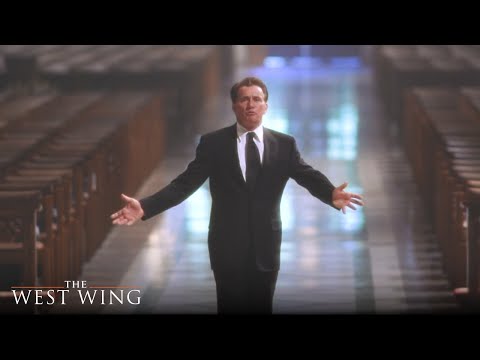
The Episode: President Bartlet, reeling from the death of his secretary Mrs. Landingham and facing political fallout for concealing his MS, decides to seek reelection. Amidst a crisis in Haiti and a tropical storm, Bartlet finds resolve, culminating in a defiant, emotional confrontation with God in the National Cathedral.
Scene (The Storm and the Mandate): After the funeral of a beloved friend, President Bartlet stands alone in the National Cathedral, railing against God in Latin. Later, amidst a tropical storm, he faces a choice about his political future. He sees a vision of his friend, who challenges him to stop looking for signs and start leading. He eventually walks into a press conference, hands in his pockets, ready to face the world.
Theological Connection (John 14:15-21): Much like the disciples staring into the sky after the Ascension, Bartlet is caught in grief and confusion. Acts 1:11 asks, “Why do you stand here looking into the sky?” This scene resonates with the shift from mourning a physical presence to accepting a divine commission to serve in the world.
Ted Lasso: “So Long, Farewell”
Season 1, Episode 8

The Episode: “So Long, Farewell” is the twelfth episode and season three finale of Ted Lasso, released on May 31, 2023, on Apple TV+. The 75-minute finale, directed by Declan Lowney and written by Brendan Hunt, Joe Kelly, and Jason Sudeikis, serves as the final episode of the series, detailing Ted’s departure to return to the U.S. and the team’s future.
Scene (The Total Football of the Heart): As Ted prepares to leave Richmond to return to Kansas, the team performs a choreographed musical goodbye. Later, at the airport, Ted gives Beard a final nod, entrusting the “Lasso Way” to the players and coaches he spent three years molding. He isn’t there for the final match, but his influence is visible in every pass and every “Believe” sign.
Theological Connection: This mirrors the ascension as a hand-off. Acts 1:1-2 notes that Jesus began to do and teach until he was taken up. This scene captures the theology of succession and empowerment—the leader’s physical absence is the catalyst for the community to finally step into their own power and identity.
Though not written as “worship music,” the human experiences expressed in the following pop songs echo the universal truths contained in this Sunday’s Gospel. Listeners should exercise discernment, though, as some secular releases may contain mature themes.
I’ll Be There for You
(Theme from Friends)
The Rembrandts

The Scripture: Matthew 28:20
The Lyric:
“I’ll be there for you / (When the rain starts to pour) / I’ll be there for you / (Like I’ve been there before) / I’ll be there for you / (‘Cause you’re there for me too).”
The Context: This perfectly captures the closing promise of Matthew 28:20: “And behold, I am with you always, to the end of the age.”
Theological Connection: The Immanence of the Ascended Christ. In Acts 1, Jesus physically leaves, but the Great Commission ends with a promise of eternal presence. This song mirrors that unwavering commitment—the promise that despite the physical distance (Ascension), the “being there” remains the fundamental reality.
Higher Ground
Stevie Wonder

The Scripture: Ephesians 1:17-18
The Lyric:
“I’m so glad that I know more than I ever knew before / I’m gonna keep on tryin’ / ‘Til I reach my highest ground.”
The Context: This resonates with Ephesians 1:17-18, where Paul prays for the “Spirit of wisdom and revelation” so that the eyes of our hearts may be enlightened. Stevie’s “highest ground” mirrors the upward trajectory of spiritual understanding and the eventual destination of the believer.
Theological Connection: The song captures the forward-leaning, upward-looking nature of a life lived in light of the “hope to which he has called you.” It suggests that there is a higher reality (a “higher ground”) that we are constantly being drawn toward by a power greater than ourselves.
Send Me on My Way
Rusted Root
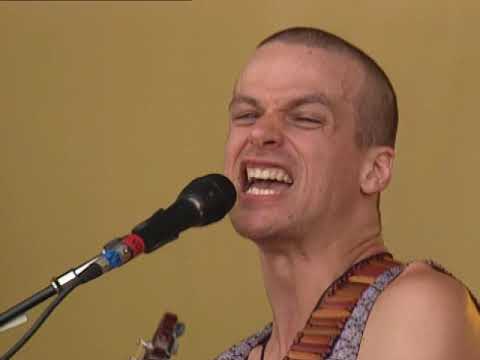
The Scripture: Matthew 28:19-20
The Lyric:
“I would like to reach out my hand / I may see you, I may tell you to run… You know what they say about the young / Well, pick me up with golden hand / I may see you, I may tell you to run.”
The Context: This song captures the kinetic energy and “sent-ness” of Matthew 28:19-20 (The Great Commission). It’s a song of movement, journey, and the urgency of a message being carried.
Theological Connection: Missiology (The Sending). The repetitive, joyful rhythm mirrors the “Go” of the Great Commission. It reflects the apostolic nature of the Church—being “sent on our way” with a specific purpose to reach out to others and invite them into the journey.
The Ascension of the Lord (A)

Download PDF (High Resolution)
Non-profits have permission to use in their ministry.
Priesthood as a Life of Presence through Absence
The journey toward the priesthood is not a career path to be managed, but a mystery to be entered. This Sunday’s readings—the account of the Ascension in Acts, Paul’s prayer for enlightenment in Ephesians, and the Great Commission in Matthew—offer a profound map for your discernment, framing the priesthood not as a position of power, but as a life of “presence through absence.”
The Holy Tension of Acts: Watching and Waiting
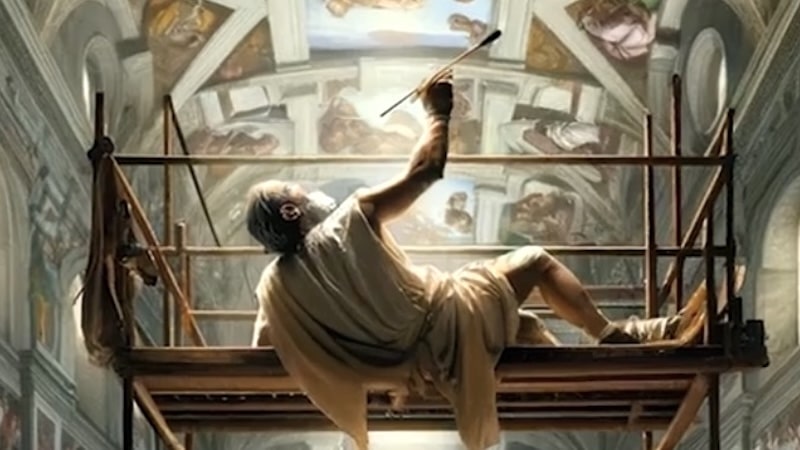
In Acts 1:1-11, we witness the disciples standing on the Mount of Olives, gazing into the sky. Jesus has ascended, and they are left in a moment of profound transition. For a man discerning the priesthood, this scene is a mirror. You likely feel the pull of “the heavens”—the desire for the sacred, the call to the altar—while still being firmly rooted on the “earth” of your current life.
The angels’ question to the disciples is a question for you: “Why do you stand looking into heaven?” A vocation is not an escape from the world into a spiritual cloud. Jesus ascends so that He might fill the universe in a new way, and the priest is the man called to facilitate that presence on the ground. In contemporary life, where we are often paralyzed by “option paralysis,” the lesson here is holy patience. You do not need to see the whole staircase to take the first step. Like the disciples, your task is to wait for the “power from on high” rather than trying to manufacture your own spiritual authority.
The Ephesian Prayer: The Eye of the Heart
St. Paul’s letter to the Ephesians (1:17-23) provides the intellectual and spiritual “fuel” for your journey. He prays for a “Spirit of wisdom and revelation” so that the “eyes of your hearts may be enlightened.” In the digital age, our eyes are constantly bombarded with flickering images, social media metrics, and the noise of secular skepticism. Discernment requires a different kind of sight.
To be a priest is to see Christ where others see only bread, wine, or a broken person. Paul describes Christ as “head over all things for the church.” Practical discernment today means training your “heart-vision.” You must look at the world’s suffering and the Church’s current struggles not with the eyes of a commentator, but with the eyes of a shepherd who knows that the “surpassing greatness of His power” is still at work. If you find yourself more concerned with the politics of the Church than the person of Jesus, stop and ask for the Ephesian enlightenment.
The Great Commission: Authority in Accompaniment
Finally, Matthew 28:16-20 brings us to the “mountain in Galilee.” Here, we see a detail often overlooked: “When they saw him, they worshiped, but some doubted.” If you feel doubt, you are in good company. The priesthood is not for the “undoubting” but for the “obedient.”
Jesus gives the Great Commission: Go. In modern ministry, “going” looks different than it did two thousand years ago. It means going into the “digital peripheries,” the lonely cubicles of corporate life, and the broken homes of our neighbors. The authority Jesus speaks of is not a permit to rule, but a mandate to serve. The priesthood is the radical commitment to being “with them always,” mirroring Christ’s promise at the end of the age.
Practical Applications for Your Journey
The Rule of Presence: In an era of constant distraction, practice being fully present. If you cannot sit in silence for twenty minutes before the Blessed Sacrament, it will be difficult to listen to a soul in the confessional. Turn off your phone and let the “eyes of your heart” adjust to the quiet.
The Ministry of “The Between”: Acts 1 shows us a Church in transition. If you are in seminary, do not just “wait for ordination.” Be a priest-in-training by seeking out the marginalized now. Offer a word of hope to a friend, or volunteer in a capacity that challenges your comfort zone.
Theologize Your Reality: Relate your studies to the real world. When you read about Christ’s “dominion” in Ephesians, look for where that dominion is needed in your city—in the face of poverty, addiction, or despair.
The world does not need more administrators; it needs men who have been “lifted up” with Christ so they can reach down into the dirt of human experience. Trust the promise: He is with you always. If the call is real, He will provide the grace to fulfill the commission. Stay on the mountain, keep your eyes open, and when He says “Go,” do not be afraid to move.for our hope is a Person, and He has already overcome the world. Walk forward with gentleness, speak with truth, and live with a joy that the Samarias of this world can neither give nor take away. One who is the Life will make your life a “greater work” than you ever imagined possible. Stay close to the Word, stay constant in prayer, and let yourself be built into the spiritual house that Christ is raising up for the salvation of the world.
TWTW used AI to help write/edit this essay.
The Ascension of the Lord (A)
Faith in the Balance: An Ascension Vision for Addiction and Recovery
The Ascension of Christ is more than a dynamic departure; it is a profound transformation of divine presence. For we, the Catholic faithful gathering in the pews, this Sunday’s readings offer a unique map for understanding the arduous journey of addiction and the essential path of recovery. While the Ascension might seem like a final historical event, its themes of transition, sight, and accompaniment speak directly to the profound and sometimes messy work of living Christ’s presence when His physical self is absent.
Watching and Waiting
In the account from Acts, the disciples are left on the Mount of Olives, gazing into the wide sky. Jesus has ascended, and they stand in a moment of acute transition. For anyone facing addiction, or for those who love them, this scene is a powerful mirror. Addiction is often a state of tension between two realities: the “heavens”—the deep, often painful desire for freedom and the pull of the sacred—and the powerful, visible gravity of a current habit. The angels’ question, “Why do you stand looking into heaven?” is a question for all of us. We can feel paralyzed by the pull. The angel’s question is not a rebuke of their gaze, but an invitation to turn that vision back to the earth where the real work must begin. Addiction is not an escape, but a grounded reality that requires a particular kind of sight and action. Like the disciples, those on the path to recovery must wait for the true “power from on high”—the support and grace that comes from the Holy Spirit, the Church, and a dedicated community—rather than trying to manufacture a spiritual authority alone.
Example: Consider the story of Sarah, a young mother struggling with a long-term addiction to alcohol.
“Gazing into the wide sky”: Sarah’s Vision of Freedom. One evening, after a particularly painful episode, Sarah hits a moment of clarity. She visualizes a life without alcohol—reconnecting with her daughter, regaining her health, and succeeding in her career. This is her “gazing into the heavens”—the deep, painful desire for freedom and the pull of the sacred, of a life meant for better things.
“The powerful, visible gravity of a current habit”: Sarah’s Immediate Reality. The next morning, she wakes up facing intense physical withdrawal and the mental temptation that accompanies it. Her current life is firmly “rooted on the ‘earth'”—the physical setting of her home, the anxiety, the physical dependency. This is the powerful gravity of her habit, pulling her back.
“Why do you stand looking into heaven?” is Sarah’s moment of Paralysis. Sarah stands in her kitchen, overwhelmed by the chasm between her vision (the heavens) and her reality (the earth). She is stuck, thinking about what could be, but not knowing the first step. She is effectively “standing looking into heaven,” waiting for the solution to appear, and is “paralyzed by the pull.”
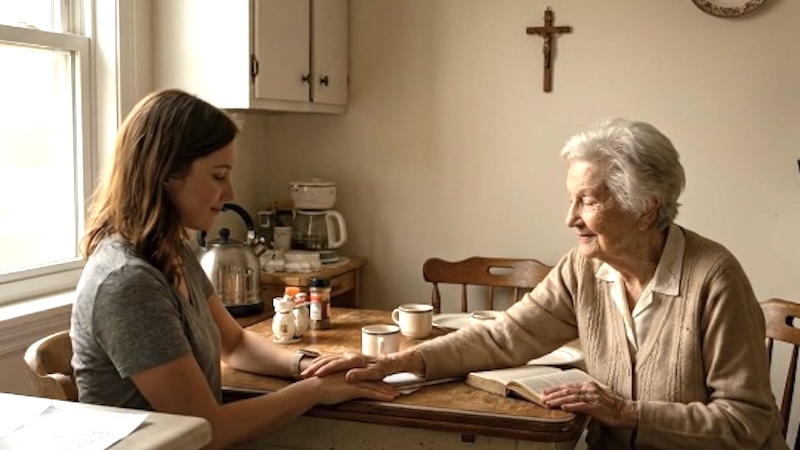
“The angel’s invitation… back to the earth where the real work must begin”: Her mother, acting as the “angel,” sits Sarah down. She validates Sarah’s desire for a sober life but gently says, “Thinking about it won’t change it. We need to focus on what you need to do right now.” This is the invitation to turn the vision from a spiritual escape back to the grounded reality of recovery.
“Waiting for the true ‘power from on high’”: Sarah’s Real Work. Sarah takes action. Her real work on earth begins. She makes a grounded plan with her mother: setting an appointment at a medical detox center, scheduling her first AA meeting, removing all alcohol from her home, and calling her parish priest for spiritual support.
“Rather than trying to manufacture a spiritual authority alone”: Sarah actively seeks the power of community. She admits her own inability (“I cannot make it happen on my own”) and accepts the “power from on high”—the grace and support that comes through her AA group’s steps, her sponsor’s guidance, the community fund that helps cover the cost of detox, and the prayers of her family. She relies on this external power, rather than trying to manufacture her own control.
Seeing with a Shepherd’s Eyes: The Ephesian Call to Recovery
St. Paul’s letter to the Ephesians provides the spiritual and perspective “fuel” for this journey. Paul prays for a “Spirit of wisdom and revelation” that will enlighten the “eyes of our hearts.” In our digital age, where we are bombarded with flickering images and a different kind of noise, clear sight can be impossible. Discernment and recovery require training our heart-vision. We look at the world’s suffering and look at the Church’s current struggles not with the eyes of a commentator, but with the eyes of a shepherd. For the faithful in the pews, this means moving beyond the judgments and metrics of social media to see the person behind the addiction, seeing Christ in their own or their neighbor’s brokenness. We must look at the digital peripheral, the lonely cubicles of corporate life, and the broken homes of our neighbors with the same compassionate gaze Paul calls for.
The Radical Commitment of Accompaniment
Finally, in the Great Commission of Matthew, we stand on the “mountain,” where some “worshiped, but some doubted.” This detail is often overlooked and offers profound reassurance. Faith and doubt can exist side-by-side. The Great Commission is Jesus’ imperative to the entire Church: Go. For the faithful in the pews, “going” looks different than it did two thousand years ago. In an era of constant distraction, “going” means practicing the difficult rule of fully being present. It is the radical commitment of accompaniment. If we cannot sit in silence for twenty minutes before the Blessed Sacrament, it will be difficult to listen to a soul in the confessional. We are all called to a radical commitment to being “with them always.” When we see Christ’s “dominion” in Ephesians, look for where that dominion is needed in our city—in the face of poverty, addiction, or despair.
The world needs men and women who have been “lifted up” with Christ so they can reach down into the dirt of human experience. He is with you always. If the call is real, He will provide the grace to fulfill the commission. Stay off the mountain, keep your eyes open, and when He says “Go,” do not be afraid to move. We carry this universal, powerful presence of Christ into the visible work of recovery. It is a work of faith we are all called to share.
TWTW used AI to assist him in writing this essay.