
Featured Video Homily
3rd Sunday of Advent B

Homiletic Pastoral Review
3rd Sunday of Advent B
Third Sunday of Advent
Fr. Timothy Eck
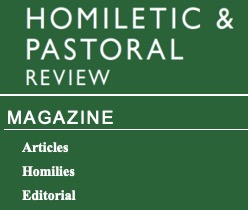
This third Sunday in Advent is known as Gaudete Sunday, which is Latin meaning Rejoice! And truly our Mass this day is one of rejoicing. From our entrance antiphon where we sing “Rejoice in the Lord always; again I say, rejoice. Indeed, the Lord is near,” to our opening Collect, we hear of celebrations and rejoicing, and so to this theme continued throughout our readings and psalm.
But there is a natural question which we should ask ourselves: Why are we rejoicing? Sure, we are already at the seventeenth of December, we have made it through some of our Christmas parties. We are only eight days away from Christmas itself. The hurry of December is quickly coming to a close. There is reason to rejoice for some, and anguish, I suppose, for others.
Fr. Charles E. Irvin
3rd Sunday of Advent B

Fr. Jim Chern
3rd Sunday of Advent B
Full, Empty—Rejoice Always…

Is the glass half full or half empty? Which are you? So goes the common expression to probe what is your outlook, your attitude, your demeanor in life. In 2020, people have had a little more time on their hands for a lot of obvious reasons to ponder that, philosophize, theorize on that saying and have added some further points of reflection to the old adage – Is the glass half full or half empty?
Dominican Blackfriars
3rd Sunday of Advent B

Bishop Robert Barron
3rd Sunday of Advent B


Fr. Austin Fleming
3rd Sunday of Advent B

Rejoice Always! A Homily for Almost Christmas
Remember these words from the second scripture?
Rejoice always! Pray without ceasing! In all circumstance give thanks!
That’s a tall order, especially if you find the holidays to be a difficult time.
But it’s a tall order that might serve us very well. Rejoice always! In the hard times, on the most difficult days, on the loneliest of nights, rather than sitting with the sadness / and losing ourselves to grief, we might search our hearts for the memories and stories of joy that has been ours.
Fr. Joe Jagodensky, SDS
3rd Sunday of Advent B

“Rejoice,” Third Sunday in Advent
A simple question is asked with many different many different responses:
“How are you today?”
“I feel fine”… Doesn’t mean it
“I’m Okay”… Be a little more sincere
“I’m all right”… Let’s talk about something else
“Not so good today,”…words said from the heart
“As best as I can under the circumstances”… Situational stuff
“Same old same old”… bored at 20 years old
“Fair to Midland”… Absolutely no idea what that means
“Oh, you know”… No, I don’t know, or I would not have asked you
“I’d be good if only”…Let’s blame everyone else except yourself
Isaiah says, “Rejoice” through all times of life, especially in uncertain and difficult times. St. Paul repeats that rarely used word “Rejoice” twice it’s so important. I add it a third time just to make sure everyone hears, feels and experiences this invisible, enduring, hard-to- define-word that transcends any situation or circumstance.
Fr. George Smiga
3rd Sunday of Advent B

Joy and How to Get It
We want to exchange gifts at Christmas time to show the gift that Christ is for us. So we wrack our brains trying to think what people want. We run to the mall. We buy presents. We take them home. We wrap them up. We put them under the tree. On Christmas morning we un-wrap them. We thank everyone for giving them to us. We throw the wrapping away. We take the gifts the mall to exchange them. We have honored the tradition. We did it. But, where is the joy?
It’s one of the ironies of this season that the very things that we do to increase joy at times prevent joy. We are so busy celebrating Christmas that we effectively block Christ’s coming. So the question is what can we do about this?
RELATED HOMILIES
Fr. Anthony Ekpunobi, C.M.
3rd Sunday of Advent B

Msgr. Joseph Pellegrino
3rd Sunday of Advent B

Heralds

If we cry out to God for help when we suffer a crisis or a traumatic event, how much more must people whose very way of life is a continual crisis call out to God. People who are oppressed, people who are trying to bring their children up in neighborhoods where crime and drugs rule, people who are physically or mentally challenged, people who are suffering pain afflicted upon them by an unfaithful spouse, a dishonest business partner or a wayward adult child, people who are hungry for food that cannot be found or who need medicine for their children that they cannot afford; how many times do these people cry out to God?
Msgr. Charles Pope
3rd Sunday of Advent B
The theme of preparation (and much of the season itself) is couched in the dramatic struggle between light and darkness. This makes sense (at least in the northern hemisphere, where the darkness deepens and the days grow shorter). In these darkest days, we light candles and sing hymns that speak of the light that will come: Jesus, the true Light of the World. Let’s take a look at Advent in three ways.
Bishop John Louis
3rd Sunday of Advent B

Fr. Michael Chua
3rd Sunday of Advent B

Fr. Tom Lynch
3rd Sunday of Advent B

Clergy E-Notes
“…if the family is the sanctuary of life, the place where life is conceived and cared for, it is a horrendous contradiction when it becomes a place where life is rejected and destroyed. So great is the value of a human life, and so inalienable the right to life of an innocent child growing in the mother’s womb, that no alleged right to one’s own body can justify a decision to terminate that life, which is an end in itself and which can never be considered the “property” of another human being.”
— Pope Francis
Bishop Anthony B. Taylor
3rd Sunday of Advent B
Sent by God
In our Gospel today we read about John the Baptist, that he was “sent by God to testify to the light, so that all might believe through him. He was not the light, but he came to testify to the light.”
And the same is true for you and me. We too are “sent by God.” We each have a role in his plan of salvation. And what we are sent to do, in one way or another, is to “testify to the light.”
To proclaim Jesus Christ as lectors, to glorify him in worship as acolytes and to offer ourselves as candidates, ready for whatever the Lord asks of us. In our case to live a life of sacrificial love, serving him as priests of the Diocese of Little Rock.
3rd Sunday of Advent B


3rd Sunday of Advent B

Fr. Phil Bloom
3rd Sunday of Advent B

Rejoice Always
Bottom line: Today we prepare our hearts for Jesus’ coming by taking seriously Paul’s command, “Rejoice always.”
Last week we heard the words, “Comfort, give comfort to my people, says your God.” God’s comfort, as we saw, is different from the false comfort this world offers. The world tries to comfort with lies, especially the lie that sin does not exist. The world then compounds that lie by saying some things are so terrible they cannot be forgiven. That’s why you hear people say, “I’m a very forgiving person but what he did is unforgivable.” No, when we confess our sins, when we take responsibility, God forgives. That forgiveness brings deep lasting comfort, also known as joy.
Fr. Vincent Hawkswell
3rd Sunday of Advent B
Looking for Homilies with Catechism Themes?

AND MORE
Fr. Tommy Lane
3rd Sunday of Advent B

God With Us
John the Baptist was out in the desert. Jewish priests and Levites went to him in a state of bewilderment. They wondered if he might be the Messiah. For any one of us, life could sometimes seem a bit like a desert, and we might ask, “Where is the Lord?” John the Baptist’s answer to those who asked was, “The Lord is coming.” Whenever we are in the desert, whether it is because of Covid-19 (2020) or anything else, and we wonder about the Lord, the answer is not only “The Lord is coming” but “The Lord is with you. The Lord has not abandoned you.” Sometimes people think that because they are suffering God has abandoned them. That is not the case. Whenever we are in the desert, whether it is because of Covid-19 or anything else, and we wonder about the Lord, the Lord is with us. God’s love for you has not changed even when suffering and sorrow come your way.
Fr. John Kavanaugh, S.J.
3rd Sunday of Advent B

Gaudete: Rejoice
Among the many ways we might receive the word of God, we can hear and read it in the context of its presumed original setting. Thus Isaiah’s beautiful prophecy of glad tidings to the poor, healing for the broken-hearted, and liberty to captives is the likely promise of restoration of homeland and freedom to an exiled and defeated ancient people.
We could also investigate the word from the point of view of the author and the author’s audience. This could be our focus, whether we investigate the historical situation of the Hebrew people and the actual time a prophecy was recorded or look into the matter of this prophecy’s presence in the Gospel of Luke, when Jesus reveals his ministry in Nazareth’s synagogue. No matter what might have been on Jesus’ mind and lips, the use of Isaiah was certainly in the minds and hearts of the early church’s articulation of its encounter with Christ.
Bishop Frank Schuster
3rd Sunday of Advent B
We Will Not Surrender
This year, I decided I needed to put up my Christmas tree earlier than I normally do. With everything weighing us down this year, I just felt that getting my Christmas decorations out sooner was the right thing to do. I was entertained that when I went to the tree lot a week ago, the guy there told me that he normally sells around 500 trees each season. This year, however, he said he had already sold 400 trees by the first few days of December and was down to his last shipment. I found that very curious. I have also been enjoying going around the neighborhoods and looking at people’s Christmas lights. It is something to do in the evening. I don’t know if it just me, but it seems that people’s yard displays are a lot more robust this year than in year’s past. Have you noticed that? And something about that just seemed right. You have heard me talk in the past about defiant joy. I think people’s instinct about Christmas decorations this year of all years is an example of this. We seem to be letting 2020 know that you can’t beat us. We will not surrender.
Fr. Michael Cummins
3rd Sunday of Advent B
John the Baptist and Atticus Finch
Is not Atticus, in many ways, a figure of John the Baptist? Atticus can be seen as a man proclaiming the truth even in the face of persecution, misunderstanding and ridicule. Like John the Baptist, he proclaimed and held to the light even in the very midst of darkness. Both men faced the same temptations – the temptation to remain quiet, to keep ones head down, to not make waves. Both also faced the temptation to proclaim oneself.
Throughout the play, Atticus is a soft spoken, humble man even as others talk about all his achievements and abilities. In his final speech in the courtroom Atticus does not proclaim his own skill as a lawyer nor his gift of rhetoric; rather, he proclaims and points to truth and justice for Tom Robinson. It was a proclamation to those gathered in the courtroom just as pointed as the cry of the Baptist in the wilderness.
