OUR SUNDAY READINGS offers a weekly PDF handout that can be used in various settings, including church bulletins, Bible study groups, homeschooling, and small group discussions. This resources is provided courtesy of Edrianne Ezell who has a Master of Divinity, Weston Jesuit School of Theology.
ANSWER KEY & DISCUSSION PROMPTS
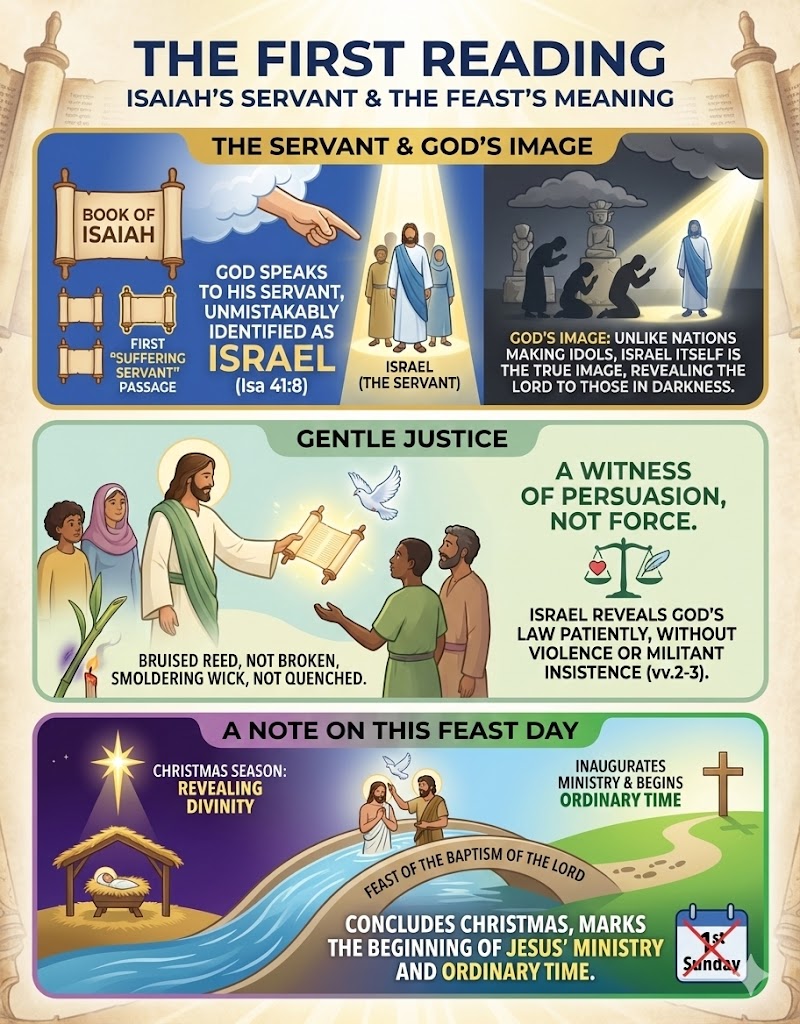
Isaiah 42:1-4, 6-7
Reading Closely
Why do you think God is pleased with his servant? God is pleased because the servant is His "chosen one" who perfectly aligns with His will. The servant is not self-seeking but is entirely dedicated to God's mission of bringing justice to the nations.
How does God prepare his servant? God prepares him by putting His Spirit upon him (v. 1) and by taking him by the hand and keeping him safe (v. 6). It is a preparation of spiritual empowerment and divine protection.
How will the servant proceed? He will proceed quietly and gently. He will not "cry out," "shout," or make his voice heard in the street (v. 2). His ministry is not one of political demagoguery or noise.
How will the servant’s methods persuade and reassure people? His methods are non-threatening and restorative. By not breaking the "bruised reed" or quenching the "smoldering wick" (v. 3), he reassures the weak and broken that they are safe with him. He persuades through mercy rather than force.
What justice will the servant bring? He brings a faithful justice that opens eyes that are blind and brings prisoners out of darkness (v. 7). This is restorative justice—liberating people from the prisons of ignorance and sin.
What parts of this passage stand out to you?(Personal reflection) Often, the image of the "smoldering wick" stands out. It illustrates God's incredible patience; even if our faith is barely a spark, He tends to it rather than snuffing it out.
How might the people of Israel have first responded to these words? They might have been confused or hopeful. They likely expected a warrior-king to crush their enemies, so a "quiet" servant might have been surprising. However, the promise of being a "covenant of the people" would have given them great hope during exile.
How might other people (Gentiles) have responded? The prophecy that he would be a "light for the nations" (v. 6) would eventually offer Gentiles hope of inclusion, though at the time, they likely would not have known these Jewish prophecies.
Living the Word
Would you want to be the servant? Being the servant implies suffering and immense responsibility, but also great intimacy with God ("in whom my soul delights"). It is a high calling that requires total self-emptying.
In what ways is Jesus like the servant? Jesus fulfilled this perfectly: He withdrew from crowds when they tried to make Him king (avoiding "shouting in the streets"), He healed the sick and forgave sinners (tending the "bruised reeds"), and He ultimately brought the light of salvation to all nations.
In what ways could you act like the servant? You can act like the servant by treating people with gentleness rather than harsh judgment. When someone is struggling ("a bruised reed"), you can offer support rather than criticism. You can also work for justice without needing to be the loudest voice in the room.
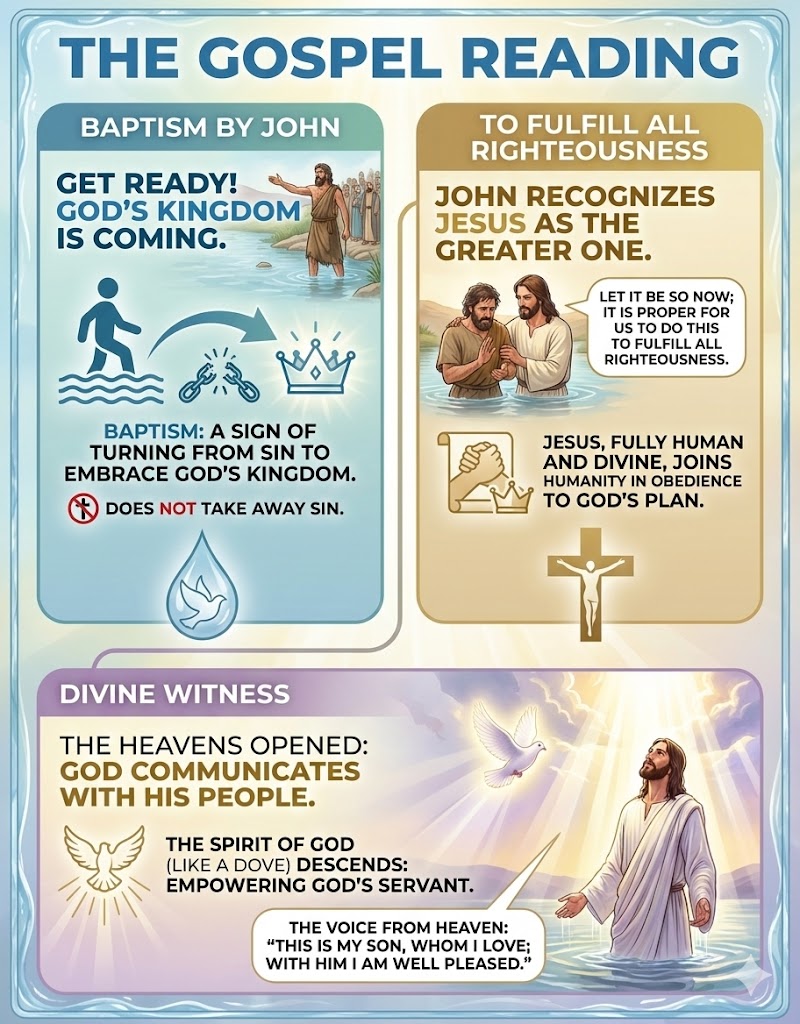
Matthew 3:13-17
Reading Closely
What all might draw Jesus to John the Baptist? Jesus was drawn by obedience to the Father’s plan, the desire to validate John’s ministry, and the need to publicly inaugurate His own mission by identifying with the people He came to save.
How might John feel as Jesus arrives to be baptized? John likely feels shocked, unworthy, and resistant. He recognizes Jesus’ spiritual superiority immediately, which is why he tries to prevent Him.
What does John seem to know about Jesus? John knows that Jesus is "mightier" than he is and that Jesus is the one who will baptize with the Holy Spirit. He recognizes Jesus’ sinlessness, noting that he (John) needs baptism from Jesus, not the other way around.
What all might John think as he baptizes Jesus? He is likely awestruck, wondering how the Messiah could submit to a sinner's ritual. He may also be feeling a sense of culmination—that his life’s work of "preparing the way" is now reaching its climax.
What all might Jesus be thinking as John baptizes him? Jesus is likely focused on His Father, offering Himself as a living sacrifice. He is accepting the burden of humanity's sin and committing Himself to the path of the Cross.
How do you think John reacts to everything that happens after this baptism? John is likely vindicated and overjoyed. Seeing the Spirit descend and hearing the voice confirms everything he believed. It likely gives him the confidence to later point his own disciples to Jesus ("Behold the Lamb of God").
How do you think other people react to what happens after Jesus is baptized? Those who saw and heard it would be terrified and amazed. It would create a buzz of anticipation: "Could this be the one?"
Living the Word
What has helped you to understand more fully who Jesus is?(Personal reflection) Often, seeing Jesus in the "distressing disguise" of the poor (as Mother Teresa said) or reading the Gospels with a focus on His emotions helps verify His true humanity and divinity.
When have you humbly submitted to God?(Personal reflection) Think of a time you accepted a difficult situation, forgave someone when you didn't want to, or followed a calling that didn't make sense on paper. That is humble submission.
In what ways can you try to understand better someone else’s experience? By "walking into the river" with them—meeting them where they are rather than demanding they come to where you are. Active listening and suspending judgment are key ways to emulate Jesus’ solidarity.
Does your membership in Christ’s body take precedence over all your other allegiances? This is the ultimate challenge of discipleship. It asks if our identity as "Christian" comes before our political party, our nationality, or even our family ties. If the waters of baptism truly mark us as God's children, that allegiance must be primary.
Feel free to use TWTW‘s AI generated visual summaries of Edrianne Ezell ‘s commentary. They are not intended to replace it. Please use them in conjunction with her guide. You can cut, copy and paste any portion of them to use as clip art for your bulletin, or use them as is. When using above infographics please give credit to TWTW and Our Sunday Readings.
SUNDAY SCRIPTURE STUDY FOR CATHOLICS offers a weekly PDF handout that can be used in various settings, including church bulletins, Bible study groups, homeschooling, and small group discussions.
ANSWER KEY & DISCUSSION PROMPTS
1. The Beginning of Ministry (Acts 10:34-38)
When did it begin? According to St. Peter in Acts 10:37-38, Jesus’ public ministry began "after the baptism that John preached." The baptism in the Jordan served as the inaugural event.
How was power manifested? From that moment on, God "anointed him with the Holy Spirit and power." This power was manifested through action: "He went about doing good and healing all those oppressed by the devil, for God was with him."
2. The Servant’s Anointing (Isaiah 42 & Application)
Applying Isaiah to Jesus: Isaiah describes God's chosen servant upon whom He has "put [His] spirit" to bring forth justice to the nations. At Jesus’ baptism, the Spirit visibly descended, fulfilling this prophecy. Jesus embodies the servant who does not cry out or break the "bruised reed"—a ministry marked not by military conquest, but by gentle, healing mercy and being a "light for the nations."
Applying to Your Baptism/Confirmation: Just as the Spirit rested on Jesus to empower His mission, the sacraments of Baptism and Confirmation confer the same Holy Spirit upon you. You are anointed to be "priest, prophet, and king." Practically, this means your mission is to bring "light" to those in darkness (ignorance or despair) and to treat the fragile (the "bruised reeds") in your life with the same gentleness Jesus showed, rather than judgment.
3. The Baptism of the Sinless One (Matthew 3:13-17)
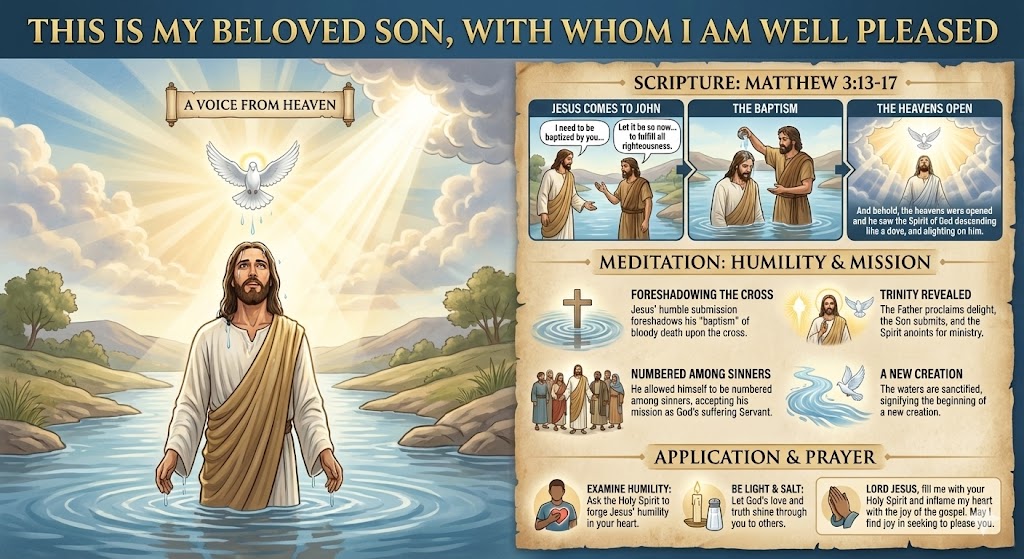
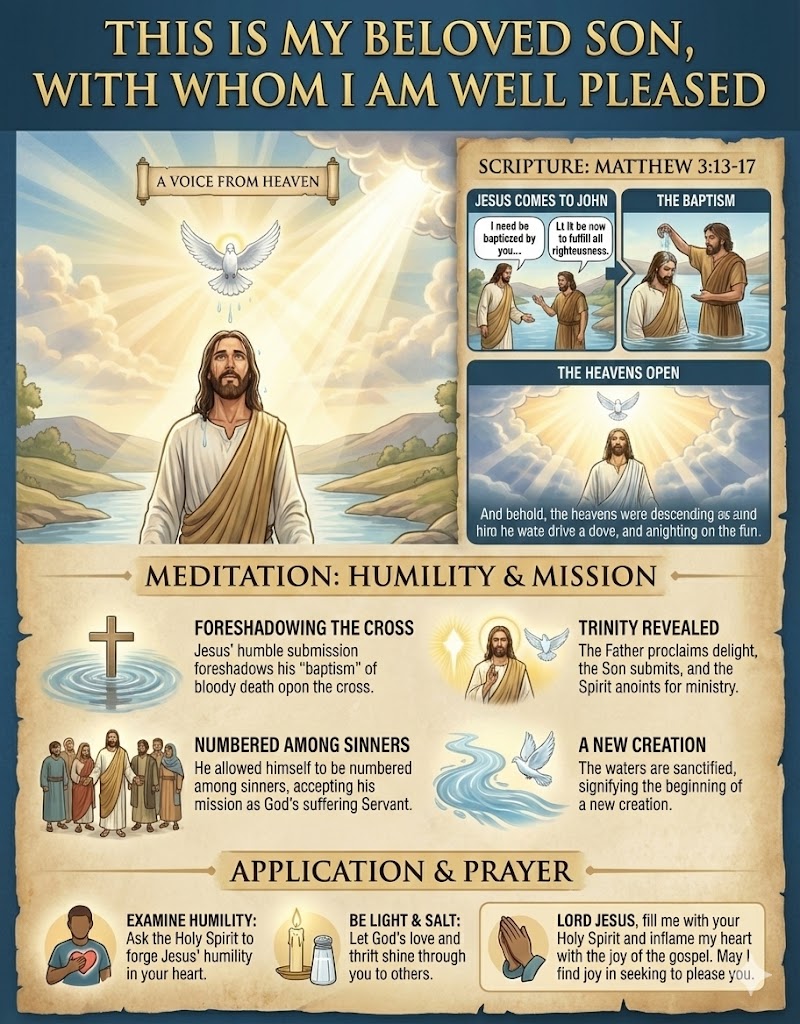
Why was He baptized? Jesus had no sin to repent of. He submitted to baptism to show total solidarity with sinful humanity. By stepping into the waters, He sanctified them for us and signaled His willingness to be "numbered among the transgressors" (Isaiah 53:12).
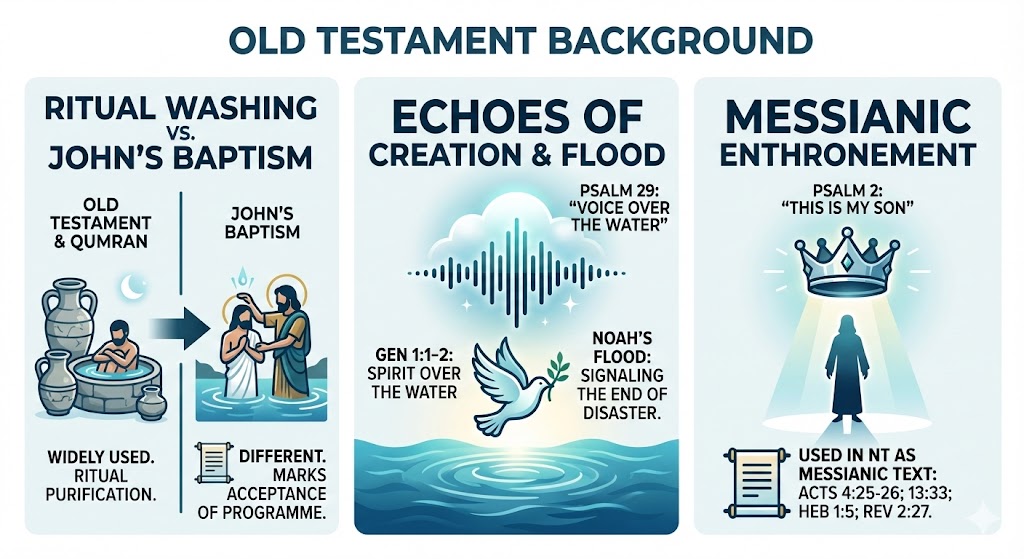
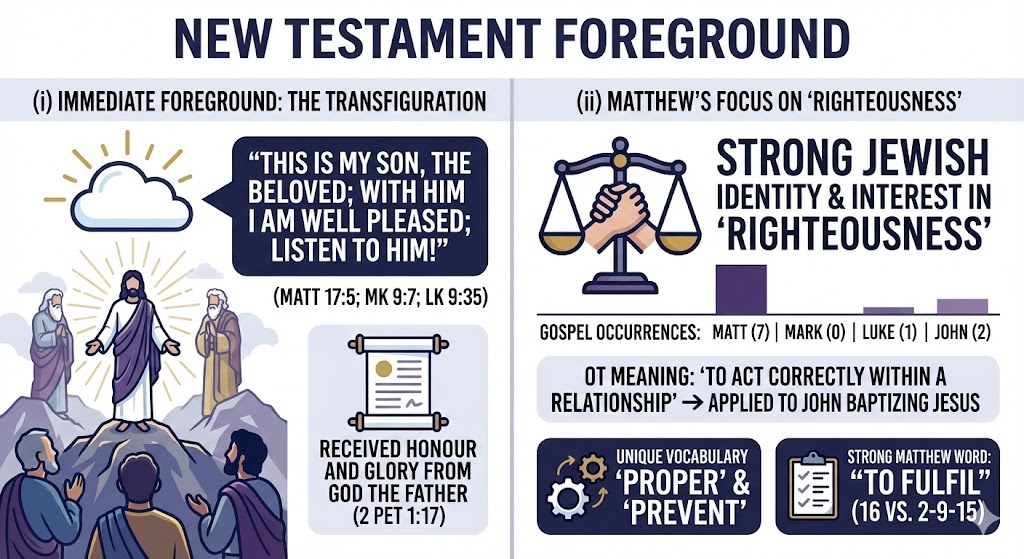
Fulfilling "All Righteousness": In this context, "righteousness" refers to faithful submission to God’s plan of salvation. Jesus was obeying the Father's will to identify with His people and inaugurate the new Messianic age.
The Meaning of Verse 17: The voice from heaven ("This is my beloved Son, with whom I am well pleased") was the ultimate affirmation of Jesus’ identity. For Jesus, in his human nature, this was the Father’s "seal" of approval and love.
Setting the Stage: This event publicly identified Him as the Messiah (the Anointed One). It equipped Him with the visible presence of the Spirit to face the temptation in the desert and then begin preaching the Kingdom of God.
4. The Audible Announcement (Luke 3; John 11)
Why this time? The people were "filled with expectation" (Luke 3:15), and John the Baptist had completed his task of preparing the way. It was the "fullness of time" to transition from the era of the prophets (John) to the era of the Son.
Why Audible? As Jesus prays in John 11:42 ("I knew that you always hear me, but I said this on account of the crowd standing around"), the audible voice was for the benefit of the witnesses. It ensured that John the Baptist and the onlookers understood that this was not merely a prophet, but the Son of God. It removed ambiguity regarding His authority.
Personal Reflection Points
Since the final two questions ask about your personal life, here are guiding thoughts to help you formulate your own answers:
5. What kind of righteousness does God have in mind for you?
Reflection: God likely does not ask for the righteousness of the Pharisees (strict rule-following), but the righteousness of Jesus: a heart aligned with God’s will.
Outcome: Consider that God wants the outcome of your life to be fruitfulness—that your life brings others closer to Him and leaves a legacy of charity and truth.
6. How has God affirmed you as his child in Christ?
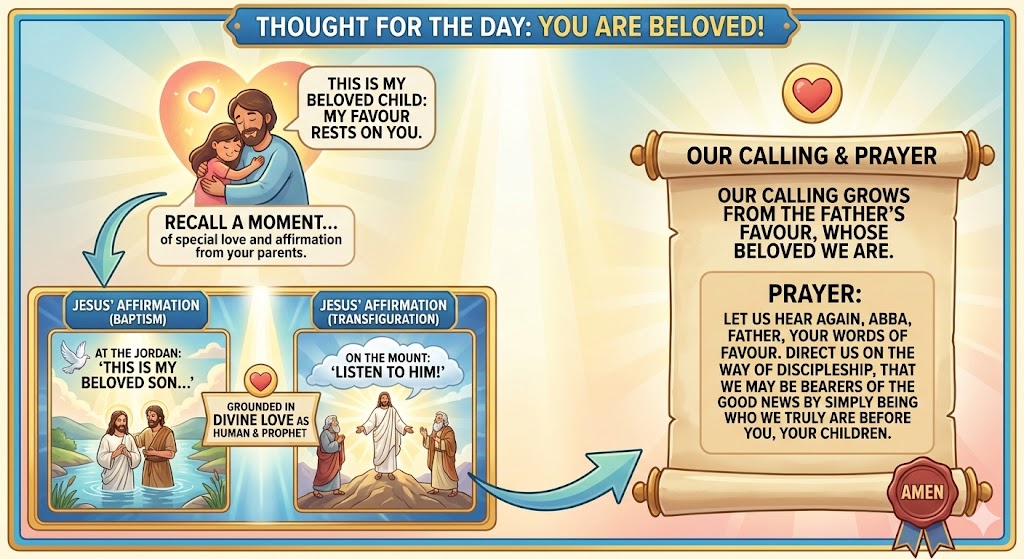
Reflection: Look for moments of grace in your life. Has God affirmed you through peace during a difficult time? Through the words of a friend? Through a specific scripture passage that "spoke" to you? These are the echoes of the Father saying, "You are my beloved child."
TWTW infographics below were created using core concepts from the PDF above
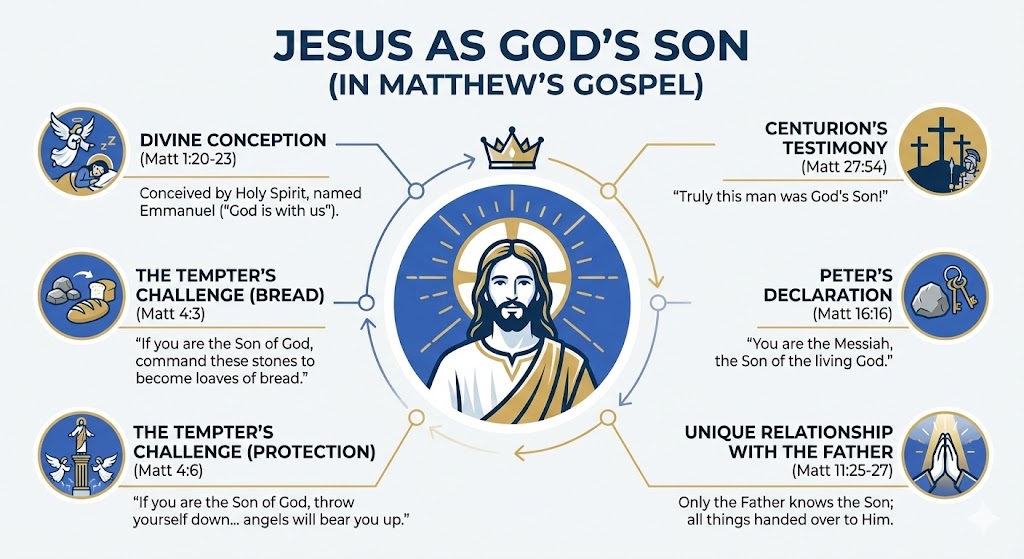
TWTW infographics on this page present Fr. Kieran’s “GOSPEL COMMENTARY” and “POINTER FOR PRAYER” which are presented after each reading’s commentary. Please cross-reference the slides with the PDF if you notice any errors. Non-profits are welcome to utilize the provided graphics in their materials and presentations. Please acknowledge Fr. Kieran O’Mahony, OSA, and his website, taurus.ie. The graphics were designed by TheWordThisWeek.net using Gemini Pro 3 and Nano Banana. Proper attribution is appreciated.
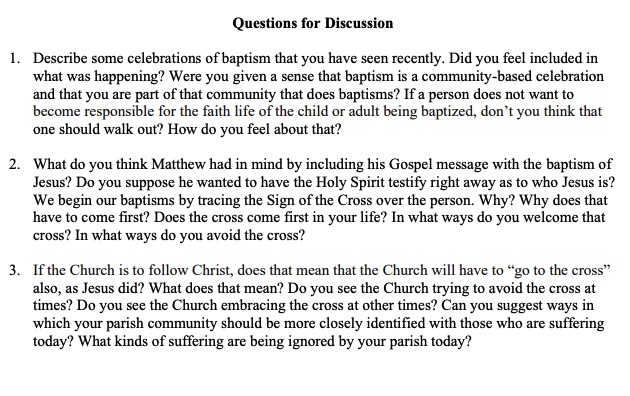
Reflection: Ideally, a baptism celebrated within Mass offers the strongest sense of inclusion. When the priest or deacon asks the congregation, "Do you are ready to help the parents of this child in their duty as Christian parents?" and the people respond, "We are," it solidifies that this is a community act, not a private family function.
The Feeling of Belonging: If the baptism is held privately on a Sunday afternoon with only immediate family, the sense of the "wider Church" is often lost. The most powerful celebrations are those where the newly baptized is paraded through the church, and the congregation applauds, signifying a joyous welcome into the family of God.
The Responsibility of the Assembly ("Walking Out"):
The Challenge: The suggestion that one should "walk out" if they don't want to be responsible is a provocative thought experiment. It highlights a hard truth: There are no spectators in the Body of Christ.
The Reality: When we stay in the pews during a baptism, we are making a vow to be examples of faith for that person. If we are indifferent to their spiritual growth, we are failing in our duty as the "Village of God." While physically walking out might be dramatic, spiritually checking out is a failure of charity.
2. Matthew, The Spirit, and The Sign of the Cross
Matthew’s Intent:
Immediate Testimony: Yes, Matthew likely wanted to establish Jesus' identity immediately. Writing for a Jewish audience, Matthew needed to show that Jesus was not just another prophet but the Son of God. having the Trinity present (Voice of Father, Son in water, Spirit as dove) at the very start of the public ministry validates everything Jesus does afterward.
The Sign of the Cross:
Why First? The Sign of the Cross is the "seal" or "brand" of ownership. By tracing it on the forehead, the Church claims the person for Christ before they do anything else. It signifies, "You belong to God now."
Personal Application: The cross comes first because without the death of the self, there is no resurrection.
Welcoming vs. Avoiding the Cross:
Welcoming: We welcome the cross when we accept suffering without bitterness, when we forgive those who hurt us (a type of dying to self), and when we sacrifice our time for others.
Avoiding: We avoid the cross when we compromise our morals to fit in, when we distract ourselves with noise/pleasure to avoid facing pain, or when we refuse to speak the truth because it is uncomfortable.
3. The Church and The Cross
Does the Church have to "go to the cross"?
The Theology: Yes. The Church is the "Body of Christ." The Body cannot go where the Head (Jesus) has not gone. Since the Head went to the Cross, the Body must follow. A Church without the Cross is merely a social club.
Avoiding vs. Embracing:
Avoiding: The Church avoids the cross when it prioritizes political power, wealth, or public approval over the Gospel. It avoids the cross when it covers up sin to protect its reputation rather than suffering the humiliation of truth.
Embracing: The Church embraces the cross in the martyrdom of missionaries, in the tireless (and often thankless) work of serving the poor, and when it stands firm on moral teachings despite being mocked by the culture.
Identifying with Suffering Today:
Suggestions for the Parish:
The Lonely Elderly: Many parishes focus heavily on youth (which is good), but the suffering of isolation among the widowers and homebound is often invisible.
Addiction and Mental Health: These are the modern "lepers"—people often pushed to the margins. A parish identifying with the cross would host AA meetings or support groups for families of the mentally ill.
The Divorced and Separated: This group often feels alienated from the Church. Walking with them in their pain is a way of sharing their cross.
RELATED INFOGRAPHICS
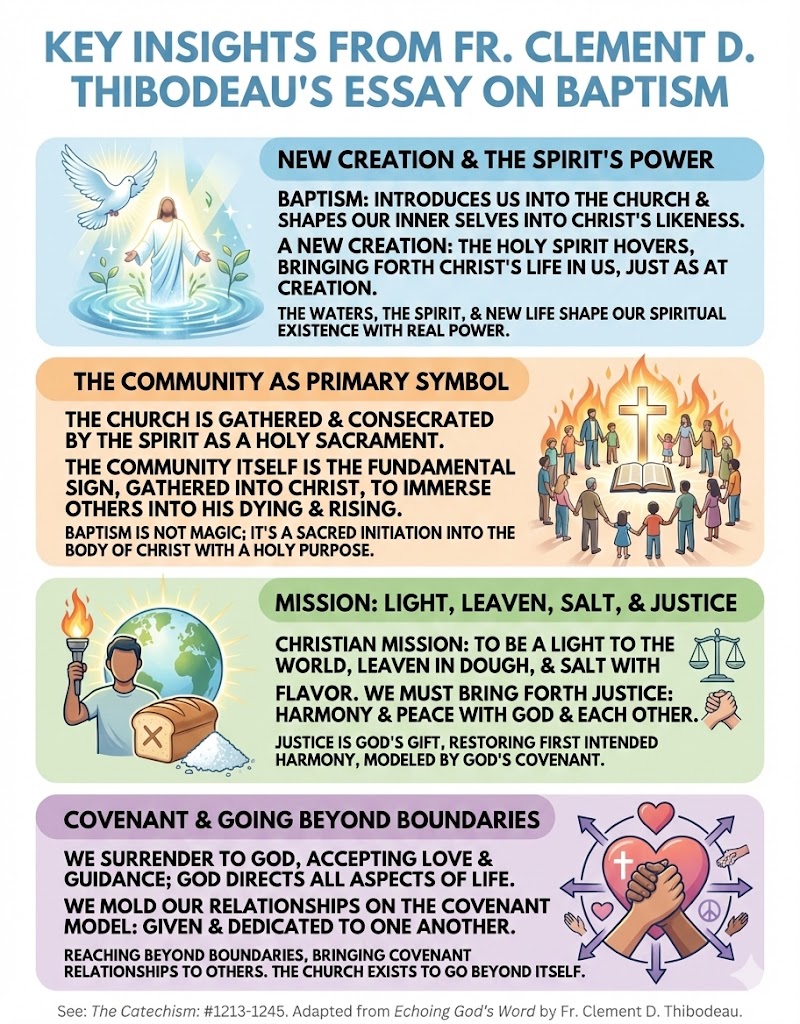
create an 8.5x11 inch infographic with images based on an essay of Fr. Clement D. Thibodeau.
create an 8.5x11 inch infographic with images on a white background based on an essay of Fr. Clement D. Thibodeau.
The above bulletin insert was created using Nano Banana Pro with Gemini 3.0. The infographics draw inspiration from the content found in Fr. Clement Thibodeau's Echoing The Word weekly column which was published nearly a decade ago. It may be used by any non-profit ministry.
Trigger Assets
Trigger
Highlight text or double-click a paragraph anywhere on the site to ADD TO NOTES. You can also click ASK AI to copy your selection to the clipboard with a command prompt, ready for you to paste manually into the chat above.
Sunday
Loading...
My Notes
🔍
0 wordsSaved: Never
Clear Workspace?
Are you sure you want to delete all your notes? This cannot be undone.












 Highlight text or double-click a paragraph anywhere on the site to ADD TO NOTES. You can also click ASK AI to copy your selection to the clipboard with a command prompt, ready for you to paste manually into the chat above.