


Our Sunday Readings
Edrianne Ezell
Catholic Scripture Study
Vince Contreras
Hearers of the Word
Fr. O’Mahony OSA
Friar Musings, OFM
Fr. George Corrigan, OFM
Echoing God’s Word
Fr. Clement Thibodeau
Word-Sunday
Larry Broding
Doctrinal Homily Outlines
Kevin Aldrich
Bergsma, John. The Word of the Lord: Reflections on the Sunday Mass Readings for Year A. Steubenville, OH:
Emmaus Road Publishing, 2022
Durken, Daniel, ed. New Collegeville Bible Commentary:
One Volume Hardcover Edition. Collegeville, MN:
Liturgical Press, 2017.

St. Charles Borromeo
Videos
Dr. Nina Heereman, SSD
St. Patrick’s Seminary
Dr. Tim Peters, STD
St. John’s Seminary
Hector Molina
A Walk in the Word
Brant Pitre
Mass Readings Explained
Fr. Geoffrey Plant
Homily Presentation
Fr. Francis Martin
The Word Proclaimed
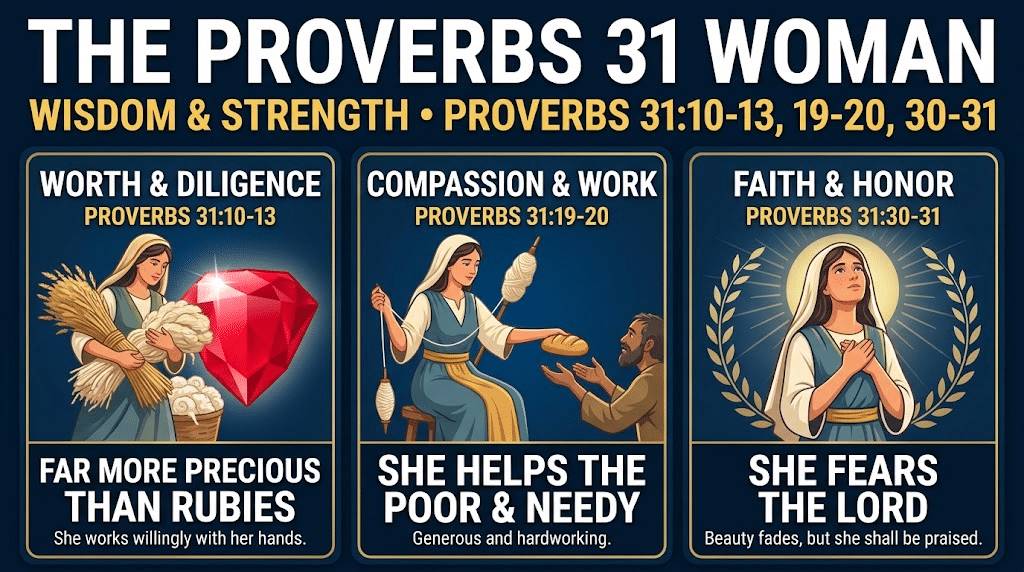

Prov 31:10-13, 20ff

Bergsma, John. The Word of the Lord: Reflections on the Sunday Mass Readings for Year A. Steubenville, OH: Emmaus Road Publishing, 2022, 578-581.
Durken, Daniel, ed. New Collegeville Bible Commentary: One Volume Hardcover Edition. Collegeville, MN: Liturgical Press, 2017. 1571–1573.
West, Christopher. Word Made Flesh: A Companion to the Sunday Readings (Cycle A) (pp. 112-113).
Point of Comparison | John Bergsma | Daniel Durken | Christopher West |
Primary Theme | Heroism and valor in faithfully executing everyday, behind-the-scenes domestic duties. | The practical, industrious application of wisdom in a real woman’s daily life and character. | The necessity of inner “heart-love” and vulnerability over superficial “surface-love.” |
View of the “Ideal Woman” | Emphasizes her as a literal ideal wife and a symbolic incarnation of divine Wisdom. Focuses on her quiet “duties of state” that hold the community together. | Views her as the tangible embodiment of Proverbs 1-9. Highlights her active, wide-ranging industry (business, charity, household, real estate). | Views her through a relational lens as a partner of deep inner value to whom a husband can safely entrust his genuine, unmasked self. |
Textual & Linguistic Focus | Highlights the acrostic structure as conveying “completeness.” Emphasizes the Hebrew esheth hayil as a robust, military term meaning “woman of valor” or “force.” | Highlights the acrostic structure as an “a to z” summation of the book. Points to specific wordplay (e.g., “clothed” in strength) and parallels to ancient literature like the Odyssey. | Focuses narrowly on verse 30 (“Charm is deceptive and beauty fleeting”) and the phrase “entrusting his heart to her.” Does not analyze the poem’s broader structure. |
Modern Societal Application | Sharply critiques modern society’s devaluation of traditional motherhood and domestic roles, calling anti-mothering attitudes “demonic.” | Focuses on timeless character building, reverence for God, and the lasting public impact of private generosity and kindness. | Critiques modern culture’s fixation on outward appearance and fleeting beauty, warning that relationships built solely on this will fail. |
Key Associations & Quotes | St. Theresa of Calcutta, St. Josemaría Escrivá; equates her small tasks done with great love to true heroism. | Penelope from the Odyssey; connects her spinning and weaving to the “feminine arts” of the ancient world. | The modern dating/marriage culture; emphasizes taking down walls and loving the “real humanity, warts and all.” |
Excerpts
Fr. Francis Martin

TRANSCRIPT: Verbal fillers, stumbles, and repetitions have been removed while keeping the original phrasing, theological precision, and cadence intact.
The Active and Living Wisdom of Proverbs
Now we’re going to be looking at the first reading and the Psalm. The first reading is from the Book of Proverbs, Chapter 31. It includes some chosen verses, and I’m going to read some that aren’t chosen as well. Then the Psalm, which is a very beautiful Psalm. It’s all about how all those who believe and fear the Lord and walk in His ways shall eat the fruit of their handiwork.
The theme is wisdom once again, but this time it is wisdom as living and active—wisdom that does things. The Gospel is going to be about the people who get talents from the ruler and trade with them, while the last guy doesn’t do anything. To prepare to understand what our Lord is getting at, the Church gives us this text from the Book of Proverbs.
It’s in Chapter 31, which is the last chapter, and it’s what’s called an acrostic. That is, it goes alphabetically: the first line begins with Aleph, the second line begins with Bet, the next line Gimel—ABC all the way through the 22 verses of the Hebrew alphabet. It’s a description of a good wife, but a good wife embodies, shows forth, and symbolizes wisdom. First, because wisdom is feminine; wisdom comes to us with gentleness and attractiveness.
Wisdom’s Maternal and Energetic Presence
This beautiful text—we were doing something like this a few weeks ago, and I read it for you from the Book of Sirach, Chapter 15. I have a bunch of wisdom texts back here; let me take a look. Yes, he’s been describing the wise man. Now, Sirach says, “He who fears the Lord will do this. He who is practicing the law will come to wisdom.” And now he describes what it’s like to have wisdom enter your spirit as a gift from God: “Mother-like she will meet him, like a young bride she will embrace him, nourish him with the bread of understanding, and give him the water of learning to drink. He will lean upon her and not fall; he will trust in her and not be put to shame.”
Do you see how wisdom is powerful, and yet the only word for it is feminine? This is something someone has to experience themselves. Jesus Christ is the wisdom of God, but when He impresses Himself on us, it comes through—I’m daring when I say this—there is where He most has the traits of His mother. Coming to us mother-like, you see; she greets him like a bride, she embraces him. There’s a softness, there’s a femininity.
But the text we have today talks about something else: energy. Wisdom is energetic. At the end of this beautiful Book of Proverbs, where we have many feminine images for wisdom, I have some of them here that I’ve collected for you. Proverbs 8 is the famous one, right? Dame Wisdom: “Does not wisdom call, and understanding raise her voice? On the top of the heights along the road, at the crossroads, she takes her stand; by the gates at the approaches she cries aloud: ‘To you, O men, I call; my appeal is to the children of men.'”
Do you hear the energy? There’s energy in wisdom. Wisdom is not gazing at the stars; it’s a feel for God born of love. That is the energy by which we can act. “Wisdom cries aloud in the streets, in the open squares she raises her voice; down the crowded ways she calls out, at the city gates she utters her words: ‘How long, you simple ones, will you love inanity? How long will you turn away at my reproof? Lo, I will pour out to you my spirit, I will acquaint you with my words.'”
So when Jesus cries out in John 7 on the last and greatest day of the feast, Jesus cries out as wisdom. It’s mysterious, isn’t it? This force, this light, this energy that gets things done, and yet it’s not like a hard-hat construction worker. It’s another power. When it enters your spirit, it enters with such delight, such softness—but not soft in the sense of sensual or giving up.
The Ideal of the Worthy Wife
This brings us to a translation problem right from the start. The text says, “A woman of power, where can she be found?” Let’s see what this translation says: “When one finds a worthy wife.” No, that’s pretty flat. The text actually says, “This woman, where can she be found? Her value is far above pearls.” And the next line: “Her husband, entrusting his heart to her, has an unfailing prize.”
So it’s talking about a competent woman who loves her husband and runs the household, but not like a tyrant—like a woman. And that’s wisdom. You see how these images work, because ultimately the wisdom of God is Jesus. But Mary is called the Seat of Wisdom because her womb was His dwelling place, and she is also the place where wisdom most dwells.
“She brings him good, and not evil, all the days of her life. She obtains wool and flax and works with loving hands.” Works with skillful hands, loving hands. “Like merchant ships, she secures her provisions from afar. She rises while it is still night and distributes food to her household.”
Love Inspiring Intelligent Action
Now, all of this is symbolic. This is what a woman who cares for her household does, but what is the drive? What’s behind all this intelligent activity? Love. And love inspiring intelligent activity is wisdom. That’s why creation is a work of wisdom. It’s the Father’s love inspiring Him to share His divinity, to share His being, and so He does through His Son. You made all things in wisdom.
“She puts her hands to the distaff, and her fingers ply the spindle.” I’m going to read you some lines that are omitted in the lectionary: “Like merchant ships, she secures her provisions from afar. She rises while it is still night and distributes food to her household. She picks out a field to purchase; out of her earnings she plants a vineyard. She is girt about with strength, and sturdy are her arms.”
You see how it slides back and forth? A woman who loves her family and is energetic like this is a delight to behold. It’s just something special. Sometimes they have five kids, sometimes they’ve got twelve, but it’s wisdom in action. If all that planning and activity is moved by love, it is wisdom.
“She reaches out her hands to the poor, and extends her arms to the needy. She does not fear the snow; all her charges are doubly clothed. She makes her own coverings. Her husband is prominent at the gate.” Why wouldn’t he be? He’s got total confidence. Everything at home is fine—my wife, my children, my household, everything is fine. And not just because she’s an efficiency freak, but because she loves. That’s what makes it wisdom.
Wisdom Always Alert
“She is clothed with strength and dignity; she laughs at the days to come. She opens her mouth in wisdom, and on her tongue is kindly counsel. She watches the conduct of her household, and does not eat her food in idleness.” That doesn’t mean she jumps up and down from the table. It just means wisdom is always alert.
That’s what this text is teaching us, and it’s going to be important when we get to the Gospel. This alert love-energy is what the guy who went and hid his talent didn’t have. He had one talent, but he didn’t do anything with it. That’s not wisdom, because it’s not love, it’s not energy, and it’s not intelligent.
“Her children rise up and praise her; her husband, too, extols her: ‘Many are the women of proven worth, but you have excelled them all.’ Charm is deceptive and beauty fleeting; the woman who fears the Lord is to be praised.”
Now, you see this person—I know people like this. Women who run a big household and are busy all the time, but never frantic. You can tell what’s driving them and making them make such intelligent decisions: it is love. The key is love. And when love inspires action, that action is wise.
Applying the Lesson: Love Energizing Our Lives
If you take that and apply it, as I say when we get to the Gospel, to these three fellows who got the talents from their master—it’s love that drives us to work. That love that drives us to stand in front of an abortion clinic in the snow and witness. It’s love that drives us to talk to people. It’s love that drives us to talk to a stranger on the bus and see if they’re interested in learning about Jesus. It is love. That love is the Holy Spirit; that’s why He is the Spirit of wisdom.
This is a beautiful text, and I encourage you to read the whole thing. The editors always have their time problem; they have to get the reading done so they can get in and out of the parking lot for the next Mass. But when you’re home, you don’t have that problem. Just pick up Proverbs 31 and read it. Yes, it’s an ideal for a wife, but that ideal wife is an ideal for everyone: to have love energizing your activity, guiding it, making it wise, making it thoughtful, and making it lightsome.


1 Thess 5:1-6
Bergsma, John. The Word of the Lord: Reflections on the Sunday Mass Readings for Year A (pp. 584).
Durken, Daniel. New Collegeville Bible Commentary: One Volume Hardcover Edition (pp. 3320-3321).
Point of Comparison | John Bergsma | Daniel Durken |
Primary Theme & Focus | Personal moral discipline, asceticism, and spiritual readiness through bodily temperance. | Eschatology, apocalyptic imagery, and the theological basis of Christian hope. |
Interpretive Lens | Devotional/Ascetical: Applies the text directly to the individual believer’s daily lifestyle and habits. | Historical-Critical/Theological: Contextualizes Paul’s limited worldview and balances his writings with modern Church teaching (Vatican II). |
Meaning of “Alert and Sober” | Figurative language for practicing temperance, restricting physical pleasures, and avoiding worldly attachments that make the soul “drowsy.” | A call to live by a different code as “children of light,” avoiding idle carousing and instead “putting on” faith, love, and hope. |
Use of Biblical Cross-References | Wisdom & Parables: Connects the text to the “Woman of Valor” (Proverbs 31) and the wise virgins (Matthew 25) to emphasize diligent preparation. | Apocalyptic & Prophetic: Connects the text to “day of the Lord” prophecies (Joel, Amos), Jewish apocalyptic literature (1 Enoch), and the final judgment (Matthew 25). |
View of the “World” / Unbelievers | The world is viewed as a source of physical comforts, sensual indulgence, and temptations that weaken a disciple’s spiritual resistance. | Acknowledges Paul’s “us vs. them” apocalyptic dualism but actively critiques strict exclusivism, arguing that unbelievers can attain salvation. |
Application of Scripture | Scripture is applied directly as a timeless, behavioral mandate for how disciples must conduct their daily lives. | Scripture’s strict laws and judgments should not be applied rigidly; believers must use discernment, tradition, and secular sciences to evaluate the text. |
Excerpts
Fr. Francis Martin

TRANSCRIPT: Verbal fillers, stumbles, and repetitions have been removed while keeping the original phrasing, theological precision, and cadence intact.
The Context of First Thessalonians and the Day of the Lord
In our third part, we are going to be looking at the First Letter to the Thessalonians, chapter 5, verses 1 to 6. It is short. It is Paul trying to comfort the Thessalonians, who were among the first people ever preached to. They were expecting the Lord to come back any day to take them to heaven, and they wondered what would happen to those who had already died. Paul, the mystic instructed by God, explains to them what is going to happen, and that is what this text is all about.
He calls it the coming of the Lord to end history; he calls it “the day of the Lord” (Yom Adonai). That is a very famous biblical designation. It is a moment of crucial action on the part of God. The prophets—for instance, I think it is Amos—say, “You’re expecting the day of the Lord to come, and God will beat up all your enemies and make you the big shot of the world. But when He comes, you are His first enemy. You are more disobedient than the rest of the world put together.” He is talking to you Christians; do you hear it? He is talking to us. We have the Bible; we have the Holy Spirit. It will go easier for the Chinese communists than it will for us, unless we obey Him, love Him, act like wise people, and go to work.
Paul writes, “Concerning times and seasons, brothers and sisters, you have no need for anything to be written to you.” He goes ahead and writes anyway, which is a polite way of saying, “You don’t really need this; you know it.”
Like a Thief in the Night and Labor Pains
Paul continues, “For you yourselves know very well that the day of the Lord will come like a thief at night.” Who invented that image? Jesus. Don’t you remember in the eschatological discourse? “If the owner of the house knew at what time the thief was coming, he would stay awake. He wouldn’t let him break into his house.” So you have got to stay awake for the Lord continually. You find that in the Gospels, usually toward the end of each Gospel—at least the synoptics—getting ready for the eschatological discourse, the Passion narrative, and the Resurrection. All of that starts to happen close to our time in the liturgical year. Here we are in the 33rd Sunday; pretty soon it will be Christ the King, and then the end of the portrayal of the history of the world. The day of the Lord, the Yom Adonai, comes, and everything is over. That is what he is saying here: “You know very well that the day of the Lord will come like a thief at night.” He picks up our Lord’s image.
It is interesting when people ask how much of the Gospel tradition Paul knew. He knew a lot. He knew it in oral tradition because his letters were probably written before any of the Gospels achieved their final written form. Paul adds, “When people are saying, ‘Peace and security,’ then sudden disaster comes upon them, like labor pains upon a pregnant woman.” Now, that image, as you know, is prophetic; you see it in Jeremiah and Isaiah. Why is it a valid image? Because a woman cannot say, “I think I’m going to have labor pains in five minutes.” They just come. She gets used to the rhythm a little bit, but they just come. You are going to have your baby this afternoon, ready or not.
The Unexpected Earthquake
You may remember a few months ago, at least those of us on the East Coast, we had an earthquake. How many people were sitting around waiting for the earthquake? Nobody. Nobody expected an earthquake; it came like a thief in the night. That is what our Lord is telling us: “I am going to come like an unexpected earthquake or like a thief in the night.” Unless you are alert, thinking hard, praying hard, and imitating all these examples of wisdom we just looked at, you are going to lose out. Especially if you need to go to confession—don’t wait for the next earthquake, go!
So, sudden disaster comes like labor pains. It is like a thief; it is like labor pains. How good our Lord is to us to give us all these vivid images to wake us up. We keep saying, “Oh, He’s not going to come for a long time.” “Coming” is a relative term. Even the famous term “eschatological” comes from eschaton, which doesn’t only mean “last”; it means “ultimate.” We can live through an ultimate moment where all the factors that make this day of the Lord are present, even if it is not the end of the world. It is eschatological. Down the road, when we look at the Agony in the Garden, that was an eschatological moment. The history of the world hung on that decision, and the leaders of the Church were all sound asleep. It is a sad commentary on us today. Peter, James, and John were asleep. We think we are so smart, but how are we reading the signs of the times?
Children of the Light vs. Children of the Darkness
Paul says, “But you, brothers and sisters, are not in darkness, for that day to overtake you like a thief. For all of you are children of the light and children of the day. We are not of the night or of darkness. Therefore, let us not sleep as the rest do, but let us stay alert and sober.”
That is like the woman in Proverbs: awake, interested, moving, wise. Not stuck in front of the TV, not spending all your time finding out how your finances are doing, and not just eating out and drinking whiskey. Once in a while, that is fine, but is your life consumed by making money, being popular, and having power? Or worse, is your life consumed with doing dope or having sexual relations with people who are not your spouse? If so, you are living a life in the night, and the thief will come in the night and catch you totally unaware. That earthquake was a great example. I kept thinking about it. I was just sitting there, and all of a sudden—boom, boom, boom! I wasn’t waiting for an earthquake, which is fair enough because we don’t have a lot of them on the East Coast. But if I am not waiting for the Lord, that is not fair enough.
Active Preparation and Opening the Door
Does waiting for the Lord mean I sit around and twiddle my thumbs? There is a part in Thessalonians where some of these people said, “Oh, the Lord is coming back. Just lend me twenty bucks so I can go get supper. You’re not going to need it; the Lord is coming back anyway.” Remember what Paul says? He tells everyone to work with their own hands. Be busy; don’t be busybodies. They translate it as going around bumming from this one and that one, chatting all day. No!
Don’t you want to be ready, not just for survival, but to welcome Him? Suppose your favorite person in the world were coming to your house. Wouldn’t you get the house ready? Wouldn’t you want to open the door and say, “Come in, the whole house is ready. I have a meal ready for you”? Jesus uses that in the Book of Revelation: “I stand at the door and knock. If anyone opens the door, I will come in and sup with him, and he with me.” He could knock at the door today—not to end the world, or even to end your world, but to come and dine with you, chat with you, and be with you. But if you are so worried about the stock market, the football scores, or whatever else, you may not hear the knock. If you are alert and paying attention to the right things, you will be set. If you are not, you won’t.
Staying Alert to the Holy Spirit’s Guidance
Paul takes this example from our Lord’s words: “Therefore, let us not sleep as the rest do, but stay awake and sober.” That comes from the Greek word gregoreuo, meaning to be alert, to watch. You know the famous line in the Agony in the Garden: “Watch and pray that you may not enter into temptation.” Here we are on this 33rd Sunday. The whole Church is showing us that we have lived through another liturgical year, which traces the history of the world getting ready for Christ, His coming, His death and Resurrection, the coming of the Holy Spirit, life in the Holy Spirit, and finally, Christ the King. The Church is not in time; time is in the Church. Don’t let the day overtake you. Stay alert.
How do we stay alert? There are tons of ways. One way is to beg the Holy Spirit to keep talking to you and to obey Him. I think I’ve given you this example before: the Holy Spirit is like a baseball coach. He is standing near home plate knocking out grounders, watching to see who picks them up and how they get the ball to first base. Our Lord probably knocks out 200 grounders to us a day. We see about forty of them, and if we’re lucky, we field about twenty. You think He’d get discouraged, wouldn’t you? But if we keep praying and stay alert, pretty soon we are hearing Him more and more.
To be alert means to keep watch. It is the word used about shepherds who stay awake at night making sure the flock is okay. That is the very thing the leaders of the Church didn’t do in the Garden. Our Lord went back to them and said, “Peter, are you asleep? Could you not watch one hour with me?” You know what He just went through—He was sweating blood, and the leaders were sound asleep. He had no consolation, no help. Mark says He began to be deeply distressed and troubled. He goes back to His friends, the leaders, and they are all sound asleep. They couldn’t even pray with Him to support Him. He was all alone in this moment. So He is saying to us, “Don’t leave me alone. Stay awake.”
Living a Sober and Prayerful Life
“Let My Spirit keep you in My Church’s heart so you see what is going on and know what to do about it for yourselves, your family, and your neighbors.” Stay awake! And the second part is to stay sober. Don’t get drunk. Don’t even get “drunk” on the NFL, glued to the TV set like a robot. There is nothing wrong with the NFL, but we can get so consumed that we lose our sense of what life is all about.
Years ago, I was about to turn on the radio while driving from here down to the university or the house of studies, and the Lord said to me, “Don’t do that; just pray all the way down.” And I’ve done that from that day to this. Stay awake.


Matthew 25:14-30
Bergsma, John. The Word of the Lord: Reflections on the Sunday Mass Readings for Year A.
Durken, Daniel. New Collegeville Bible Commentary: One Volume Hardcover Edition. (pp. 2477-2478).
Pope Francis. The Gospel of Matthew: A Spiritual and Pastoral Reading (pp. 217-220).
Point of Comparison | John Bergsma | Daniel Durken | Pope Francis |
Identity of the Master | Represents God/the Lord. He is joyful, generous, and rewards faithfulness. | Represents a greedy, exploitative, and wicked rich man—not a figure for God. | Represents Jesus/God, who places immense trust and hope in humanity. |
Meaning of the “Talents” | Represents the small matters, daily duties, and ordinary responsibilities of our state in life. | Strictly literal: a very large sum of money or weight measurement. Does not represent natural gifts. | Represents God’s spiritual inheritance: the Word, the Eucharist, mercy, forgiveness, and faith. |
The First Two Servants | Virtuous and faithful. The second servant is the “hero” for ordinary people who do their best without jealousy. | Collaborators in a corrupt system. They participate in unfettered greed, exploiting others to increase wealth. | Active, supportive Christians who take risks to share and multiply God’s grace and love with others. |
The Third Servant | Lazy, joyless, and disingenuous. Uses slander and suspicion to cover up his own sloth. | The only honorable character. Bravely refuses to participate in exploitation and safely guards the money. | A Christian paralyzed by fear and egoism. Withdraws into himself and hoards grace instead of sharing it. |
Cultural/Theological Lens | Moral and Spiritual: Focuses on individual virtue, faithfulness in small things, and the final judgment. | Socio-Economic (1st Century): Focuses on the agrarian concept of “limited good,” where amassing wealth equals stealing from others. | Pastoral and Evangelical: Focuses on active discipleship, spreading the Gospel, and community relationships. |
Core Application | Focus on daily duties; do the small things in life with great love to eventually share in the Master’s joy. | Expose greed as a sin, stand against unjust capitalist systems, and stop exploiting the poor. | Do not lock faith in a safe. Take risks to actively share God’s mercy, hope, and forgiveness with the world. |
Excerpts
Fr. Francis Martin

TRANSCRIPT: Verbal fillers, stumbles, and repetitions have been removed while keeping the original phrasing, theological precision, and cadence intact.
The Context of Matthew and Love-Inspired Wisdom
Now we arrive at the great climax of the Gospel. This is the diamond in the setting in every liturgy; that’s why we had all that beautiful material on love-inspired action. That’s wisdom. But it’s a wisdom that is not overpowering. That’s not mechanical; it is not just power. You see, wisdom gets things done, but not through sheer power. It’s through energy, but not raw dominating power.
We have this parable of our Lord warning us. Jesus told his disciples this parable, from Matthew 25:14-30. We see where we are in Matthew. We’re getting to the end of Matthew, even with all the Passion, Resurrection, and the farewell—you know, the Great Commission at the end. We’ve only got 28 chapters in Matthew. We’re up to 25 already, so it won’t be long before we’re going to stop. That will be it for Cycle A, and then we’ll start, after all the feast days and everything, Cycle B.
Jesus told his disciples this parable: “A man going on a journey called his servants and entrusted his possessions to them.” You see, he gave them his possessions; generous to one, he gave five talents, to another two, to a third one.
The Entrusted Talents and Fruitful Work
A talent, commentators estimate, is what someone might earn in about half a lifetime, so five talents would be two and a half lifetimes. In other words, he gave him a lot of money. Likewise, the one who received two went and made another two. The one who got five made another five. But the man who received one went off and dug a hole in the ground and buried his master’s money.
Now, you might say at least the guy was smart; if his master is this tough, at least he’s going to get his half a lifetime’s wages back. He’s not smart; he doesn’t love. That was the reason why we had that whole text from the Book of Proverbs to begin this thing. You see, wisdom is what inspires fruitful work. After a long time—well, it couldn’t have been more than half a lifetime because they’re still around—the master of those servants came back and settled accounts with them.
The one who had received five talents—now remember, that’s two and a half lifetimes’ wages, that’s a lot of money—brought an additional five. Now you’re not going to get that in a bank; this guy must have been trading, dealing, buying, selling. He’s got energy. He’s doing something. Likewise, the one who received two made another two. But the man who received one went off and dug a hole in the ground and buried his master’s money. That would have to be a pretty big hole for half a lifetime’s worth of money.
Sharing the Master’s Joy
Then, after a long time, the master of those servants came back and settled accounts with them: “What did you do with my money?” You see, the one who had received five talents came forward bringing the additional five. He said, “Master, you gave me five talents; see, I have made five more.” Now that takes a lot of energy. This fellow has two and a half lifetimes’ worth of money and he doubles it. Of course, there was no stock market in those days, but there was speculation. How did he do it? The Lord is not interested in telling us. But he did it, and he brings it back. “It’s all for you, Master. Here, I did it for you. You’re the master.”
And he says, “Well done, my good and faithful servant. Since you were faithful in small matters”—that’s a small matter, yes, compared to eternal life, this is peanuts, that’s what he’s saying—”I will give you great responsibilities.” Now this parable, the wording is different than some of the other synoptics, but you get the idea. “I will put you over five cities; I will give you great responsibilities.”
But here is the punchline: it is not in getting five more talents, or however many lifetimes’ worth of money. The reward is here; it says, “Come, share your master’s joy. Be with me, share my joy.” That’s the reward. The talents come and go, but the joy stays.
Love Directing Intelligent Action
Now he’s going to share the joy because he did work hard. There’s nothing wrong with working hard. The problem is that we work hard for the wrong reason. We know this principle in research, which goes beyond research: we would rather kill ourselves reading, getting research, getting all the languages, and working so hard at that rather than stop and have insight. That’s the great occupational hazard of researchers, including biblical researchers. I can know exactly what a talent is and what it was made of, but I have no insight.
“Come, share your master’s joy” means you work with this stuff, whatever it is. This is where we get the word, of course; the talentum is a measure of money, but we use it to say “a very talented person, what are you doing with your talents?” There’s some truth to that, but what we have to realize is this man is working for his master, and so he shares his master’s joy. He’s not just out making shrewd investments; he’s working for his master, and he’s thrilled to come back and say, “I’ve got five more.” That’s why the master can say, “Come, share your master’s joy. Sit here, have a meal.” I’m trying to point out that the underlying clue to understanding this parable is love. Love that directs intelligent action, in other words, wisdom, just like the first reading.
The Hidden Stream of Relationship
The one who had received two talents also came forward and said, “Master, you gave me two talents; see, I have made two more.” His master said the same thing to him: “Well done, my good and faithful servant.” Good and faithful. “Since you were faithful in small matters”—even the two talents, it’s not a small matter, but it is when the whole point of it is the relationship with the master. “You were faithful, and I will give you great responsibilities. And again, come, share your master’s joy.” You loved me enough to work for me, to do something with my money. Look, come, sit, relax, share my joy. I love you. I’m trying to point out there’s a hidden stream in this parable.
The Consequence of Fear vs. Love
Then I’m going to try to apply it. The one who had received one talent said, “Master, I knew you were a demanding man, harvesting where you did not plant and gathering where you did not scatter; so out of fear, I went off and buried your talent in the ground. Here it is back.”
Servant, you missed the whole point! I’m not worried about losing my talent. I’m worried about having you grow, cooperate with me, and share my joy. That’s what I want. Talents, I can make them out of the air, don’t get the wrong idea. “So you knew I harvest where I did not plant and gather where I did not scatter.” Now, he didn’t say whether the servant was right. He said, “This is what you knew. You knew that I did that? How did you know that? Did you ever see me do it? Anyway, you knew. Take the talent from him and give it to the one with ten. For to everyone who has, more will be given, and he will grow rich.”
Don’t you see that all the time? Don’t you see somebody trying hard to serve the Lord, pouring out their life? If they get suffering in their life, they give it to the Lord. They’re concerned about their neighbors. I’m thinking of a family I know now; they have about six or seven kids, I think they’re homeschoolers. Their neighbor hates them, so every once in a while, the wife bakes a cake and they bring it over, saying, “We want you to share this cake.” That’s the smart servant. He’s investing the love to make more love.
At least if you put it in the bank, I would have gotten the interest. So take it and give it to the one who has; to the one who has, more will be given. You see that; if you know somebody very holy, you watch them grow in holiness. He’s got, she’s got, and then more is given. But from the one who has not, even what he has will be taken away, because he didn’t love me enough to work with it. He took my money and hid it, like all I’m interested in is the money. How can he say to that one, “Share your master’s joy”?
Practical Application: Taking a Chance for the Lord
I do believe that’s the key to the whole parable. It’s not “keep your talents, go get rich, get fat, do what you want.” No, “share your master’s joy.” That’s the key. So then, “throw this useless servant out into the darkness, where there will be wailing and grinding of teeth.” What does that mean? In one way, he’s portraying a servant who’s afraid of the master. Are you afraid of Jesus? Are you afraid to take a chance?
I always give classic examples of this, you know, striking up a conversation. I’m a New Yorker; we do that more easily than in other parts of the country. But nevertheless, striking up a conversation with an agenda—I don’t mean a tricky agenda, I mean a real one. I want this person to know something about Jesus. I’ve given this example before: suppose the Lord plans that this person needs 120 hits before they’re going to get it and turn their life over to Him. You might be number 97 on the list. You do your 97th hit, somebody else will do the 98th, but everyone is making a dent. Finally, that person’s soul is open, and they accept the Lord, and they come to love the Lord.
When we get to heaven, we’ll say, “Oh, you’re the other 119! That’s great. Look what we found, look at this guy, how happy he is.” Wouldn’t that be great? That’s what he means, so work with this stuff. What drives the work? The need for money? No. Fear of the master? No. Love for the master! And then, “Come, share your master’s joy. Be with me. Let’s enjoy this.” Amen.
33rd Sunday of Year A
 Highlight text or double-click a paragraph anywhere on the site to ADD TO NOTES. You can also click ASK AI to copy your selection to the clipboard with a command prompt, ready for you to paste manually into the chat above.