DEC 15, 2024
Maintaining a Positive Outlook in the Face of Life's Challenges
✨ One morning, as Mark Twain (Samuel Clemens: 1835-1910) and a companion were walking home from Church, they heard a loud rumble of thunder and almost immediately rain began to fall heavily. As they scurried for shelter, Twain’s friend asked, “Do you think it will ever stop?!” “It always has,” quipped the author.
This mindset resonates with the message found in Philippians 4:4-7, where the apostle Paul urges the believers in Philippi to "rejoice always" and maintain an attitude of joy and gratitude, regardless of their circumstances. Paul's encouragement stems from his understanding of God's presence and provision in the lives of believers.
Just as Twain's optimistic perspective helps him face life's uncertainties with a healthy outlook, Paul reminds the Philippians that their source of joy and peace is not dependent on their ability to maintain positivity alone, but rather on the nearness and faithfulness of God.
By focusing on God's nearness and provision, believers can find the strength and perspective to face life's challenges with resilience and hope. Paul emphasizes this point by encouraging the Philippians to turn their worries into prayers, petitions, and thanksgiving, ensuring that the peace of God, which surpasses all understanding, will guard their hearts and minds in Christ Jesus (Philippians 4:6-7).
SCROLL TO READ MORE

RELAXING AMBIENCE—Rain Sound On Window with Thunder SoundsㅣHeavy Rain for Sleep, Study and Relaxation, Meditation
Sunday Readings Commentary
Sunday Readings Commentary
- HERMENEUTICAL SCHOLARS
- CHURCH FATHERS
- CATECHISM
- PRESENTATION SLIDES
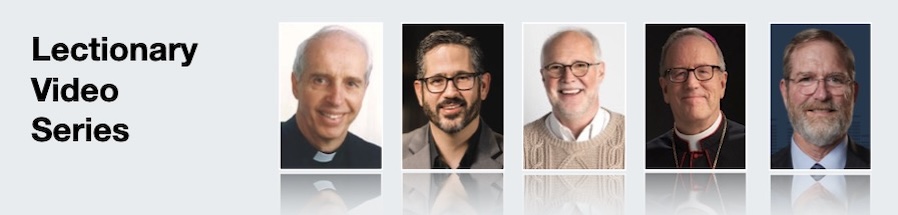
⬇️ A Walk in the Word
Hector
Molina
Gaudete Sunday emphasizes the importance of joy, genuine repentance, and acts of charity as believers prepare for the coming of Christ, following the teachings of John the Baptist.
3rd Sunday of Advent - YEAR C

⬇️ Encountering the Word
Jeff
Cavins
Advent’s third Sunday invites us to eagerly await Jesus’ arrival, inspiring repentance and tangible expressions of joy and hope as we prepare our hearts for His transformative presence.
3rd Sunday of Advent - YEAR C

⬇️ Hearers of the Word
Kieren J.
O’Mahony
Uplifting guidance from the Bible and saints like John the Baptist highlights the importance of rejoicing in the Lord through trust in God, sharing with others, and cultivating inner peace through prayer and faith.
3rd Sunday of Advent - YEAR C

⬇️ Bishop Robert Barron
Bishop Robert
Barron
Deep-rooted joy and peace are discovered when one’s life is firmly anchored in Christ, empowering individuals to face life’s adversities with unwavering faith and perseverance.
3rd Sunday of Advent - YEAR C

⬇️ Catholic Sunday Scriptures in Context
Fr. Paul
Galetto, OSA
Eager anticipation fills the hearts of believers during the third Sunday of Advent, as the liturgy invites us to rejoice in the hope and joy found in God’s presence. As we eagerly await the coming of Jesus and the transformative power of the Holy Spirit, we are called to approach our daily responsibilities with honesty, generosity, and a deep commitment to fostering love and unity within our communities.
3rd Sunday of Advent - YEAR C

⬇️ Mass Readings Explained
Brant
Pitre
Transcending anxiety becomes possible when we integrate gratitude into our prayer practices, enabling us to concentrate on the essential aspects of our lives.
3rd Sunday of Advent - YEAR C

⬇️ The Word Proclaimed
Fr. Francis
Martin
Embodying the spirit of Christmas necessitates sincere repentance and dedicated service to the less fortunate, ensuring that our love and good works mirror the depth of our faith.
3rd Sunday of Advent - YEAR C

Early Church
Wisdom
SCRIPTURE
SEARCH
FIRST READING (1)
SECOND READING (48)
GOSPEL (44)
This tool created by Jeff Pinyan uses the CCEL Early Church Fathers digital edition of the Philip Schaff collection.
3rd Sunday of Advent - YEAR C

Click on card to view full screen
Just Jr., A., Oden, T. C., Carson, D. A., & Oden, E. (Eds.). (2003). Ancient Christian Commentary on Scripture: New Testament III, Luke (Vol. 3). IVP Academic.
IN BRIEF
John Advises the Multitudes, Publicans, and Soldiers
In this passage, John the Baptist is approached by three groups of people seeking guidance on their salvation. The first group is referred to as the “multitude,” the second as “Publicans,” and the third as “soldiers.”
The Multitudes
John advises the multitudes, who are not living in evil conditions, to perform good works. He specifically mentions sharing one’s extra coat and food with those who have none. This signifies the importance of sharing not only our extra belongings but also our necessities, including clothing and food. By doing this, we demonstrate our love for our neighbors, as the law says, “You shall love your neighbor as yourself.”
Publicans and Soldiers
John instructs the Publicans and soldiers to stop committing evil acts. He tells the Publicans not to demand more than what is due and soldiers not to use their position for personal gain. This is a first step in helping them refrain from desiring others’ possessions and eventually encouraging them to share their own.
The Importance of Mercy
Throughout John’s teachings, mercy is a recurring theme. Mercy is a universal obligation that applies to everyone, and it is considered the highest virtue. However, John also emphasizes the importance of considering each person’s circumstances and abilities when giving to the poor. This means that each person shouldn’t give away everything they have but should share what they have with the poor.
Military Duty and the Use of Force
In this passage, Augustine clarifies that soldiers using their arms as ministers of the law and defenders of public safety are not murderers. John didn’t condemn military service but addressed the evils associated with it, such as the desire to injure, cruelty of revenge, savage disposition, rebellion, and lust for power. He sought to lead Publicans and soldiers to higher wisdom but shared common truths with them, knowing they weren’t ready for deeper truths.
The Multilayered Message
On a deeper level, the teaching on sharing one’s coats represents the importance of discarding the old man (symbolized by one coat) and giving his coat to the one who is naked. This is analogous to casting our sins into the depths of the sea and discarding our vices and errors by laying them upon the one who caused them.
A Modern Adaptation of
Catena Aurea
The Catena Aurea, which means “Golden Chain” in Latin, is a comprehensive biblical commentary comb is a 13th-century biblical commentary compiled by St. Thomas Aquinas. This anthology features insights from over eighty Church Fathers on the four Gospels.
THE WORD THIS WEEK has used AI generative technology to create this modern translation, outline and study notes, enhancing accessibility and comprehension of the text for contemporary audiences.
Luke 3:10-14
GREGORY: In the previous passage, it’s clear that John’s listeners were troubled and sought his advice. This is indicated by the phrase, “And they asked him.”
ORIGEN: Three groups of people are mentioned here who are asking John about their salvation. The first group is referred to as the “multitude”, the second group is called “Publicans”, and the third group is identified as “soldiers”.
THEOPHYLACT: John tells the Publicans and soldiers to stop doing evil things, but he commands the multitudes, who aren’t living in evil conditions, to do good works. For example, he says, “He who has two coats, let him give one.”
GREGORY: Because a coat is more essential for daily use than a cloak, it’s important to not only share our extra belongings with our neighbors but also the necessities. This includes our clothing and food. That’s why John says, “He who has food, let him do likewise.”
BASIL: This teaches us that we are obligated to give away anything we have beyond what we need for our daily support. We should give it to those who have nothing, for God’s sake, as God has generously given us everything we possess.
GREGORY: Since the law says, “You shall love your neighbor as yourself,” it’s clear that we love our neighbors less than ourselves when we don’t share our necessities with them in times of distress. Therefore, we are instructed to share our two coats, because if we only share one, nobody is clothed. This shows how valuable acts of mercy are, as they are commanded before all other works worthy of repentance.
AMBROSE: Other commands may only apply to certain individuals, but mercy applies to everyone. Therefore, everyone is commanded to contribute to those who have nothing. Mercy is the highest virtue, but we must consider each person’s circumstances and abilities. This means that each person shouldn’t give away everything they have but should share what they have with the poor.
ORIGEN: This passage carries a deeper meaning. Just as we shouldn’t serve two masters, we also shouldn’t have two coats. This could mean having one coat for the old man and one for the new man. Instead, we should discard the old man and give his coat to the one who is naked. One person has a coat, while another has none. Their strengths are opposites. As we’re told to cast our sins into the depths of the sea, so we should discard our vices and errors, laying them upon the one who caused them.
THEOPHYLACT: Some say the two coats represent the spirit and letter of Scripture. John advises those who have both to teach the ignorant, giving them at least the letter.
BEDE: The Baptist’s virtue is evident in how he made even Publicans and soldiers seek his counsel for salvation.
CHRYSOSTOM: The power of virtue makes the rich seek salvation from the poor, from one who has nothing.
BEDE: John commands the Publicans not to demand more than what is due and soldiers not to use their position for personal gain, so they might first refrain from desiring others’ possessions and eventually share their own.
AMBROSE: John’s teaching implies that military duty has fixed wages to prevent soldiers from acting like robbers.
AUGUSTINE: Soldiers using their arms as ministers of the law and defenders of public safety are not murderers. John didn’t say, “Put away your arms, abandon warfare, strike no one, wound no one, destroy no one.” Instead, he addressed the evils in war: the desire to injure, cruelty of revenge, savage disposition, rebellion, lust for power. These evils are justly blamed, but good men undertake war to punish violence and maintain order, either by God’s command or lawful authority.
CHRYSOSTOM: John wanted to lead Publicans and soldiers to higher wisdom. Knowing they weren’t ready, he revealed common truths, fearing that if he shared higher truths, they might disregard them and lose the others as well.
IN BRIEF
John’s Unique
Life and Love
John lived a unique life, prompting people to respect him more than others. However, this love sometimes became uncontrolled, as people wondered if he was the Christ. John remained humble, answering those who thought he was the Christ.
Uncontrolled Love
and Humility
John recognized the dangers of uncontrolled love, emphasizing that love should not exceed proper limits. Excessive love can lead to sin for both the lover and the loved one. John’s humility is evident in his response to people’s high regard for him. He acknowledged people’s expectations and clarified his role.
John’s Role and
Christ’s Greatness
John proved he wasn’t the Christ by highlighting the difference in their actions and divine works. John’s baptism used water for repentance, while Christ’s baptism provided grace through the Holy Spirit and fire. John emphasized that Christ’s power and grace surpassed his own, as Christ is God’s Son and mightier than anyone.
The Symbolism of
Christ’s Shoes
John’s statement about being unworthy to untie Christ’s sandals demonstrates his humility and lack of full understanding of Christ’s incarnation. The metaphor of shoes represents Christ’s mortal body and the mystery of His divine and human natures.
The Holy Spirit
and Fire
John differentiated between his baptism with water and Christ’s baptism with the Holy Spirit and fire. The fire symbolizes the purifying power of grace and the consuming of sins. The Holy Spirit ignites love and wisdom, providing a more abundant and transformative grace compared to John’s baptism.
John’s Purifying Baptism
and Christ’s Judgment
John’s baptism by the river Jordan foreshadows Christ’s purifying role in the afterlife. Those who have not received the seal of baptism will not experience this purifying baptism. Christ’s baptism with the Holy Spirit and fire signifies abundant grace and mercy, but it also warns of His judgment and punishment for the disobedient.
The Symbolism of
the Fan and Floor
The fan in Christ’s hand represents the swiftness of His judgment, separating the condemned from the saved without trial. The “floor” symbolizes the Church on Earth, where Christ purges impurities both in the present and universally at the end of the world.
Separating Wheat
from Chaff
The fan is a symbol of the Lord’s power to discern merits, distinguishing genuine virtue from empty boasting. The wheat represents those with true virtue, while the chaff symbolizes the trivial, unstable, and easily swayed individuals prone to sin. Temptation serves as a means to separate the wheat from the chaff and reveals hidden virtue in those who endure it.
Unquenchable
Fire
The “unquenchable fire” of hell is not like earthly fire, as it needs no fuel and burns perpetually. This metaphor emphasizes the incomprehensible nature of the rewards and punishments in the afterlife, which are beyond human understanding and expression.
Luke 3:15-17
ORIGEN: It was appropriate to pay more respect to John than to other men because he lived a unique life. People loved him, but their love wasn’t always within proper limits, as it says, “But while the people were expecting whether he were the Christ.”
AMBROSE: It’s absurd that John wasn’t believed to be who he was but was believed to be the Christ, who they thought was born from a woman, not a virgin. The sign of the Divine was in the Virgin birth, not a regular birth.
ORIGEN: Uncontrolled love is dangerous. Those who love should consider the nature and reasons for their love and not love more than what is deserved. If love exceeds proper limits, both the lover and the loved one will sin.
GREEK EXPOSITOR: John didn’t take pride in how highly people regarded him. Instead, he embraced humility. That’s why it says, “John answered.”
BEDE: How could John answer those who secretly thought he was the Christ? As another Gospel explains, they sent priests and Levites to ask him if he was the Christ.
AMBROSE: John saw into people’s hearts. Remember that this is God’s gift to man, not man’s natural ability. John quickly proved he wasn’t the Christ, as his actions were visible, unlike Christ’s divine works. Since humans have both a soul and a body, the visible actions are made holy by the visible (water) and the invisible by the invisible (the Spirit). In baptism, water cleanses the body, and the Spirit purifies the soul. We also receive God’s sanctifying influence through water. There are two baptisms: one for repentance and one for grace. One is by water and Spirit; the other by water alone. Our role is to repent, while God’s grace provides the mystery. Without envying Christ’s greatness, John showed he wasn’t the Christ through actions. That’s why it says, “There comes after me one mightier than I.” John wasn’t comparing himself to Christ, as there’s no comparison between man and God’s Son. Christ is mightier than anyone. John emphasized this by saying, “Whose shoes’ latchet I am not worthy to unloose.”
AUGUSTINE: Matthew says, “Whose shoes I am not worthy to bear.” If there’s a difference between “bear” and “unloose the latchet,” we can assume John said one at one time and the other at another time or both together. Whether they mention “bearing shoes” or “unloosing the latchet,” they convey the same humility.
AMBROSE: By saying, “Whose shoes I am not worthy to bear,” John implies that the grace of preaching the Gospel was given to the Apostles, who were prepared for the Gospel. John said this because he often represented the Jewish people.
GREGORY: John proclaims his unworthiness to untie Christ’s sandals, suggesting he cannot fully comprehend or explain the mystery of Christ’s incarnation. This alludes to an ancient custom where if a man refused to marry a woman, the person who later claimed her would untie the first man’s shoe. Christ’s “shoes” represent his incarnation in a mortal body. John cannot untie this “shoe” because he cannot fully grasp the mystery of Christ’s divine and human natures.
CHRYSOSTOM: John distinguishes between his baptism with water and Christ’s baptism with the Holy Spirit and fire, emphasizing the abundance of grace in Christ’s baptism. The metaphor of fire represents the purifying power of grace and the consuming of sins.
BEDE: The Holy Spirit is represented by fire, as He ignites love and wisdom in the hearts He fills. The Apostles received the baptism of the Spirit in the form of fire. Some interpret this as a future baptism by purifying fire to cleanse lighter sins.
ORIGEN: Just as John waited by the river Jordan, so Christ will stand with a flaming sword in the fiery stream to purify those who need it after this life. Those without the seal of baptism will not receive this purifying baptism.
BASIL: The phrase “He shall baptize with the Holy Spirit” should not lead anyone to believe that a baptism in the Spirit’s name alone is valid. We must preserve the tradition of baptism in the name of the Father, Son, and Holy Spirit.
GREEK EXPOSITOR: The words “He shall baptize with the Holy Spirit” signify Christ’s abundant grace and mercy. However, the subsequent mention of the “fan” in His hand warns that Christ will also judge and punish the disobedient. The fan represents the swiftness of His judgment, separating the condemned from the saved instantly without trial.
CYRIL: The phrase “He shall thoroughly purge his floor” indicates that Christ is the Lord of the Church, purging it of impurities.
BEDE: The “floor” represents the Church on Earth, where many are called but few are chosen. Its purging happens both in the present, when sinners are cast out or condemned after death, and universally at the end of the world when angels will separate the righteous from the wicked.
AMBROSE: The “fan” symbolizes the Lord’s power to discern merits, just as a fan separates full grain cars from empty ones. On Judgment Day, He will distinguish genuine virtue from empty boasting and place the righteous in heaven. The most perfect fruit is that which resembles Christ, who sacrificed Himself to produce abundant fruit.
CYRIL: The “chaff” represents the trivial, unstable, and easily swayed individuals, prone to sin.
BASIL: The chaff is mixed with the wheat, not due to their love of God or spiritual gifts, but for other reasons.
ORIGEN: Without the fan, wheat and chaff cannot be separated. Temptation reveals who is chaff and who is wheat. Enduring temptation brings forth hidden virtue.
GREGORY OF NYSSA: The rewards for the righteous and punishments for sinners in the afterlife are beyond human understanding and expression. The “unquenchable fire” of hell is not like earthly fire, as it needs no fuel and burns perpetually.

IN BRIEF
The passage from Luke 3:10-18 touches upon several key Catholic doctrines:
Repentance and Conversion: John the Baptist’s call for repentance (Lk 3:2-9) and the people’s response demonstrate the importance of recognizing one’s sins, turning away from them, and embracing a new life in Christ. This aligns with the Catholic doctrine of repentance and conversion, which involves the rejection of sin, a change of heart, and a commitment to follow Jesus (Catechism of the Catholic Church [CCC], 1430-1431).
Social Justice and Solidarity: The emphasis on sharing with those in need and ceasing unjust practices (Lk 3:11, 13-14) reflects the Catholic doctrine of social justice, which calls for the fair distribution of resources and the promotion of the common good. The principle of solidarity compels us to work for the good of all, particularly the most vulnerable (CCC, 1928, 2444).
Universal Call to Holiness: John the Baptist’s counsel to different groups of people demonstrates that everyone is called to a life of holiness and repentance, regardless of their past actions or social status. This aligns with the Catholic teaching that all the faithful are called to seek holiness and to live out their vocations in daily life (CCC, 2013, 2030).
Baptism and the Role of the Holy Spirit: John’s contrast between his own baptism with water and the Messiah’s baptism with the Holy Spirit (Lk 3:16) points to the Catholic doctrine of Baptism as the sacrament of regeneration and initiation into the Christian life. It also highlights the role of the Holy Spirit in transforming and sanctifying the faithful (CCC, 1213, 694).
Eschatology and Final Judgment: The imagery of the winnowing fan and the burning of chaff (Lk 3:17) evoke the Catholic doctrine of eschatology, which addresses the final judgment and the ultimate separation of the righteous and the wicked. This serves as a reminder of the need for repentance and the importance of living in accordance with God’s will (CCC, 1038, 1058).
3rd Sunday of Advent - YEAR C

READING 1 | READING 2 | GOSPEL | COMMENTARY
Lk 3:10-18
Verse 10: "And the crowds asked him, “What then should we do?”"
Commentary: In response to John the Baptist's call for repentance (Lk 3:2-9), the people inquire about the specific actions they must take to demonstrate their genuine repentance. This highlights the recognition that repentance involves not only an internal change of heart but also practical actions that bear witness to this transformation (Catechism of the Catholic Church [CCC], 1431).
Verse 11: "He said to them in reply, “Whoever has two tunics should share with the person who has none. And whoever has food should do likewise.”"
Commentary: John the Baptist underscores the importance of sharing with those in need, demonstrating that love and justice are integral aspects of genuine repentance. In doing so, he emphasizes the responsibility of those who have more to provide for those who have less, echoing the principles of solidarity and the preferential option for the poor (CCC, 2444, 2448).
Verse 12: "Even tax collectors came to be baptized and they said to him, “Teacher, what should we do?”"
Commentary: Tax collectors, often associated with dishonesty and exploitation, seek guidance from John the Baptist on how to live a life of repentance. This shows that God's call to conversion extends to all people, regardless of their past actions or social status (CCC, 1427).
Verse 13: "He said to them, “Stop collecting more than what is prescribed.”"
Commentary: John the Baptist instructs the tax collectors to cease their unjust practices and to be content with what is rightfully theirs, highlighting the need for justice in economic dealings. This admonition aligns with the Church's teaching on the importance of fairness, respect for the dignity of work, and the need to avoid greed and exploitation (CCC, 2434, 2453).
Verse 14: "Soldiers also asked him, “And what is it that we should do?” He told them, “Do not practice extortion, do not falsely accuse anyone, and be satisfied with your wages.”"
Commentary: John the Baptist extends his counsel to the soldiers, emphasizing that a life of repentance involves honesty, fairness, and contentment. His words align with the Church's teaching on the importance of truthfulness, the avoidance of falsehood, and the cultivation of a spirit of gratitude and moderation in the use of material goods (CCC, 2486, 2536, 2424).
Verse 15: "Now the people were filled with expectation, and all were asking in their hearts whether John might be the Christ."
Commentary: The people's anticipation and curiosity about John the Baptist's identity underscore the longing for the coming of the Messiah, who would bring salvation and fulfill God's promises (CCC, 523, 717).
Verse 16: "John answered them all, saying, “I am baptizing you with water, but one mightier than I is coming. I am not worthy to loosen the thongs of his sandals. He will baptize you with the Holy Spirit and fire."
Commentary: John the Baptist acknowledges his role as a precursor to the Messiah, emphasizing his own humility and the superior power and authority of Jesus. His words point to the transformative power of Christ's baptism, which confers the Holy Spirit and purifies the faithful (CCC, 718, 1286).
Verse 17-18: "His winnowing fan is in his hand to clear his threshing floor and to gather the wheat into his barn, but the chaff he will burn with unquenchable fire.” Exhorting them in many other ways, he preached good news to the people."
Commentary: John the Baptist employs the imagery of a winnowing fan and threshing floor to illustrate the judgment and purification that will accompany the coming of the Messiah. This underscores the importance of repentance and highlights the ultimate choice between accepting or rejecting God's invitation to salvation (CCC, 712, 1038).
⬇️ Scott Hahn
Catholic Bible Dictionary
Hahn, Scott. Catholic Bible Dictionary. New York: Doubleday, 2009.
3rd Sunday of Advent - YEAR C

Click on slide to view full screen
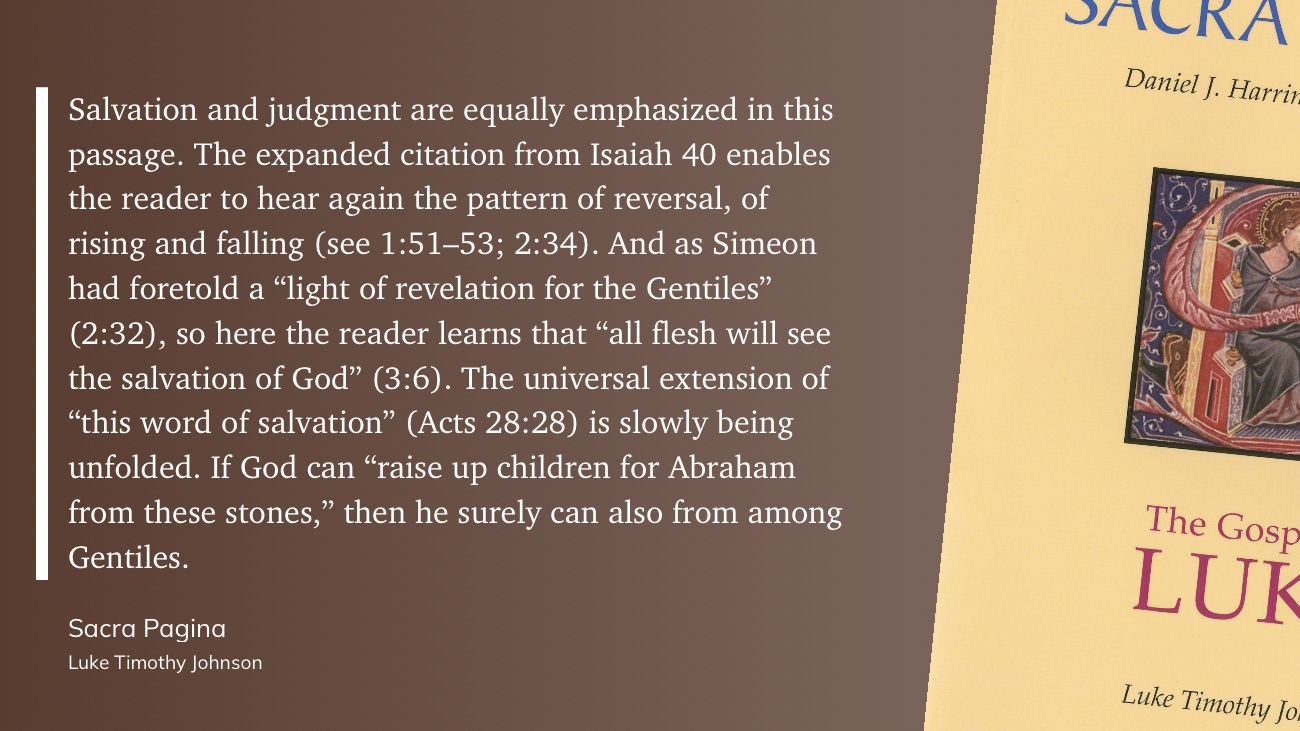
⬇️ Luke Timothy Johnson
Sacra Pagina:
Luke
Johnson, L. T.. Sacra Pagina: The Gospel of Luke. Daniel J. Harrington, S.J., General Editor Liturgical Press, 1991.
3rd Sunday of Advent - YEAR C
Click on slide to view full screen
⬇️ Pablo Gadenz
The Gospel of Luke
Gadenz, Pablo T.. The Gospel of Luke The Catholic Commentary on Sacred Scripture. Grand Rapids, MI: Baker Academic, 2008.
3rd Sunday of Advent - YEAR C

Click on slide to view full screen
⬇️ Richard Rohr
The Good News
According to Luke
Rohr, Richard. The Good News According to Luke. New York: Crossroad, 1997.
3rd Sunday of Advent - YEAR C

Click on slide to view full screen
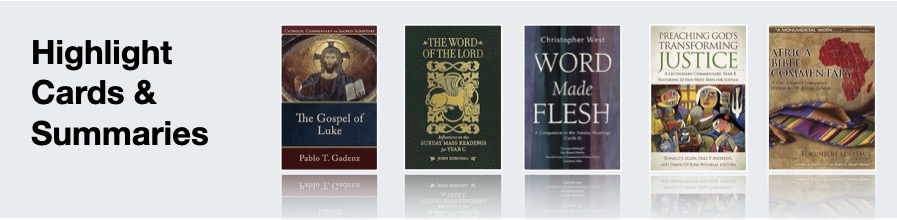
⬇️ John Bergsma
The Word of
the Lord
Bergsma, John. The Word of the Lord: Reflections on the Sunday Mass Readings for Year B. Steubenville, OH: Emmaus Road Publishing, 2020.
3rd Sunday of Advent - YEAR C

Click on slide to view full screen
⬇️ Preaching Justice
John Knox
Press
Allen, Ronald J., Dale P. Andrews, and Dawn Ottoni-Wilhelm, eds. Preaching God’s Transforming Justice: A Lectionary Commentary, Year B. Louisville, KY: Westminster John Knox Press, 2013.
3rd Sunday of Advent - YEAR C

Click on slide to view full screen
⬇️ Christopher West
Word Made Flesh
West, Christopher. Word Made Flesh: A Companion to the Sunday Readings (Cycle B). Pennsburg, PA: Theology of the Body Institute Press, 2021.
3rd Sunday of Advent - YEAR C

Click on slide to view full screen
⬇️ Ignatius Catholic Study Bible
Ignatius Press
Hahn, Scott. The Ignatius Catholic Study Bible New Testament (Ignatius Press), 2010.
3rd Sunday of Advent - YEAR C

Click on slide to view full screen
⬇️ Africa Bible Commentary
Zondervan
Adeyemo, Tokunboh, ed. Africa Bible Commentary. Grand Rapids, MI: Zondervan, 2010.
3rd Sunday of Advent - YEAR C

Click on slide to view full screen
⬇️ Life Recovery Bible
Tyndale House
Publishers
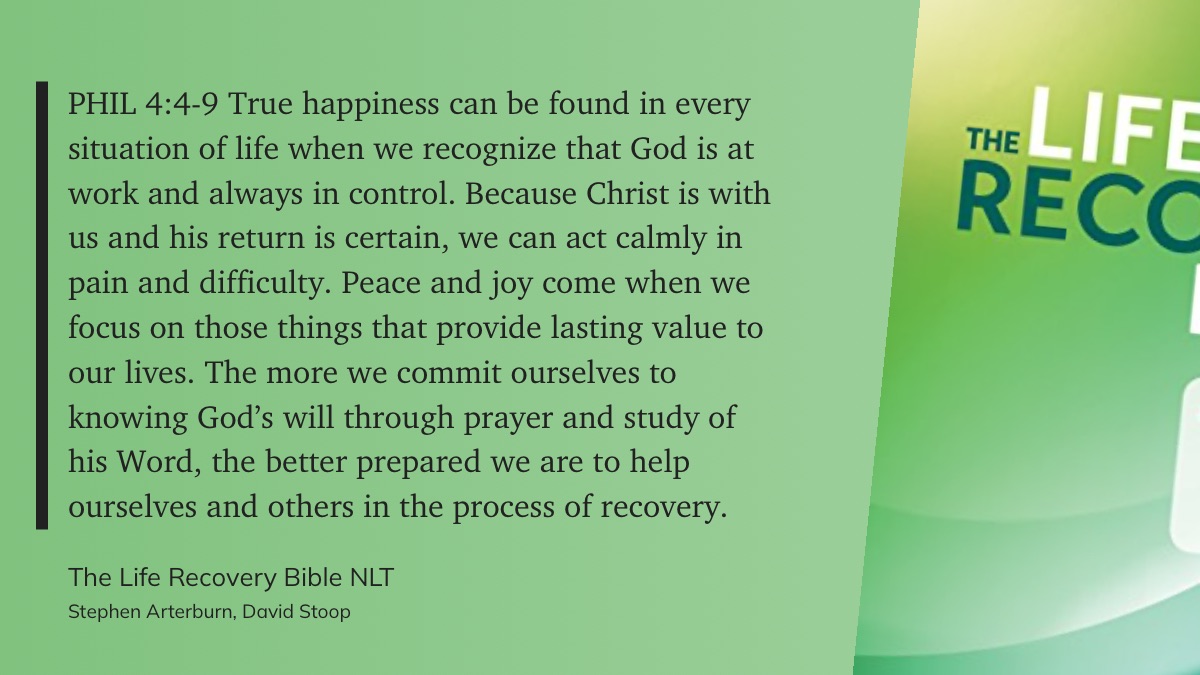
Arterburn, S., & Stoop, D. (Eds.) NLT Life Recovery Bible, Second Edition. Tyndale House Publishers, 2021.
3rd Sunday of Advent - YEAR C
Click on slide to view full screen