MAR 23, 2025


Homilies
Homilies


Sunday Podcast (USCCB)
3rd Sunday of Lent C


Fr. Andrew Ricci
3rd Sunday of Lent C
Study, Pray, Serve (2022)
Fr. Andrew Ricci, ordained in 1997, is a priest for the Diocese of Superior. He is the Rector of the Cathedral of Christ the King.

Christ is Our Master Gardener
While teaching about the need to repent, Jesus offers a parable that challenges us to cultivate a fruitful life. Where do we get the courage to do this? We recognize that Christ is the master gardener who lovingly tends to the care of our souls!
Key Points from the Readings
1st Reading – Exodus 3:1-8a,13-15
- Moses encounters the Lord who speaks from the burning bush.
- God announces the plan to save the people of Israel from their bondage in Egypt and will be called “I AM” when the people ask Moses what is God’s name.
Psalm – 103:1-4,6-8,11
- “The Lord is kind and merciful.”
- God is merciful and gracious, healing, redeeming and pardoning our sins.
2nd Reading – 1st Corinthians 10:1-6,10-12
- St. Paul recounts part of the mistakes of the people of Israel as they fled Egypt.
- We are encouraged to learn from this and seek what is good as we follow Jesus Christ.
Gospel – Luke 13:1-9
- Jesus speaks to the people, encouraging them to repent.
- The Lord then offers a parable about cultivating a fruitful life, and he includes a warning if we neglect our growth.
SOURCE: Study, Pray, Serve


Bulletin Inserts




Carmelite Lectio Divina
Reflections and Prayers
92 page PDF with refections and prayers for each day of the month.
Lectio Divina March 2025 (PDF)
Lectio Divina March 2025 [Mobi]
Lectio Divina March 2025 [ePub]
“Lectio divina is an authentic source of Christian spirituality recommended by our Rule. We therefore practise it every day, so that we may develop a deep and genuine love for it, and so that we may grow in the surpassing knowledge of Christ. In this way we shall put into practice the Apostle Paul’s commandment, which is mentioned in our Rule: “The sword of the Spirit, too, which is the word of God, is to dwell abundantly in your mouth and in your hearts; and whatever things you have to do, let them be done in the word of the Lord.” (Carmelite Constitutions (2019), n. 85.)
Source: Carmelites
Bible Study Notes

- The Jerome Biblical Commentary,
- The New Jerome Biblical Commentary, and
- The Navarre Bible.
SOURCE: St. Charles Borromeo Catholic Church (Picayune, MS)
The Call of Moses

In the first reading, Moses had escaped from the Egyptians and had settled down in the quiet life of a shepherd. Then, Moses saw a strange sight and decided to investigate [Ex 3:2-3]. Moses witnessed the “burning bush” on Mt. Horeb [Ex 3:2], the same mount as Mt. Sinai. According to some traditions, Mt. Sinai meant the”mountain with the burning bush.”
The following dialogue had ritual overtones; God initiated while Moses reacted. As Moses approached, God called out and Moses responded [Ex 3:4]. God gave instruction (do not enter beyond the perimeter, remove shoes as a ritual cleansing, hear the name of the divine) and Moses hid his face (to avoid the terror of experiencing God directly) [Ex 3:5-6]. God witnessed the people’s plight and promised rescue (with Moses as leader in Ex 3:10); Moses questioned his own ability [Ex 3:7-11]. God reassured him with his personal presence while Moses asked for the divine’s name [Ex 3:12-13].
3rd Sunday of Lent C
Call of Moses
Exodus 3:1-8a, 13-15
1ST READING
Key Points

I. The Burning Bush
- Moses encounters a bush that burns but is not consumed (v. 1-2)
- God calls to Moses from the bush, instructing him to approach (v. 3-5)
- Moses hides his face in fear and reverence (v. 6)
II. God’s Self-Revelation
- God identifies Himself as the God of Abraham, Isaac, and Jacob (v. 6)
- God acknowledges the suffering of the Israelites and promises deliverance (v. 7-8a)
III. Moses’ Call to Service
- God instructs Moses to gather the elders of Israel (v. 13)
- God declares Himself as “I AM WHO AM,” providing reassurance (v. 14-15)
IV. God’s Promise and Mission
- God promises to free the Israelites from Egyptian oppression (v. 14-15)
- Moses is to lead the Israelites to worship God on Mount Horeb (v. 12)
Clipart by Fr. Richard Lonsdale; pop-up links direct to Catholic centered content on Google AI search
3rd Sunday of Lent C
1ST READING
Hearers of the Word

Click on slide to watch video by Fr. Kieran J. O’Mahony
3rd Sunday of Lent C
1ST READING
Context
HISTORY
In Exodus 3:1-8a, 13-15, Moses encounters God through a burning bush, marking a turning point in his life and the history of Israel. Set in the context of ancient Egypt, this event is situated within a landscape of political tension and religious revelation.
During this era, Egypt was a powerful nation, and its Pharaohs ruled with an iron fist. The Israelites were enslaved, forced to endure harsh labor under Egyptian oppressors. Moses, a Hebrew by birth, was raised in the Egyptian royal family yet aware of his people’s plight. This passage portrays God intervening to liberate the Israelites, using Moses as His chosen instrument.
God reveals Himself as the God of Abraham, Isaac, and Jacob, establishing a divine lineage that harkens back to Israel’s founding patriarchs. This encounter affirms God’s covenantal faithfulness and His intention to fulfill the promises made to Israel’s ancestors.
The author of Exodus, traditionally attributed to Moses, presents this narrative to emphasize God’s sovereignty and the need for Israel to follow Him faithfully. This passage was likely written for an ancient Israelite audience to bolster their trust in God and to remember their religious heritage. The cultural context underscores the importance of divinely ordained leadership, in this case, Moses, who ultimately guides Israel to freedom and a deeper relationship with their God.
3rd Sunday of Lent C
SOCIETY
Exodus 3:1-8a, 13-15 portrays Moses’ encounter with God, underscoring the sociocultural significance of this divine meeting. Set within the context of ancient Near Eastern cultures, this passage reveals the interplay between religious beliefs, leadership, and identity.
During this era, the concept of divine revelation and appointed leadership was widespread. Ancient societies believed in a connection between the divine realm and human world, often attributing rulers’ authority to heavenly powers. Thus, God’s call for Moses to lead Israel not only highlights the importance of divine intervention but also legitimizes Moses’ role as a leader chosen by God Himself.
In Israelite society, the theme of liberation from oppression resonated deeply. The Israelites, long enslaved by Egypt, yearned for freedom and a homeland. Moses’ encounter at the burning bush introduces God’s solution to this national crisis, promising freedom and a return to the land of their ancestors.
The cultural emphasis on ancestral ties and covenants sheds light on God’s self-revelation as the God of Abraham, Isaac, and Jacob. This connection to Israel’s patriarchs not only establishes continuity with the past but also solidifies God’s covenantal faithfulness to His people.
3rd Sunday of Lent C
THEOLOGY
In Exodus 3:1-8a, 13-15, Moses’ encounter with God offers insights into Catholic theology and provides valuable lessons for contemporary Catholics. This passage emphasizes God’s active presence in history and highlights themes of divine revelation, faithfulness, and salvation.
In Catholic tradition, God’s revelation to Moses serves as a testament to divine communication and personal relationship with humanity. This encounter underscores God’s desire to be known by His people, a desire ultimately fulfilled in the person of Jesus Christ. As such, Moses’ meeting with God prefigures the Incarnation and serves as a reminder of God’s continuous dialogue with His Church.
Moreover, God’s faithfulness to His covenant promises mirrors the Church’s understanding of salvation history. Just as God remained committed to liberating Israel from oppression, He remains faithful to His saving work in the world through Jesus’ death and resurrection. This consistency provides hope and assurance for modern Catholics facing trials and tribulations.
In application, Moses’ encounter challenges contemporary Catholics to recognize and respond to God’s presence in their lives. Like Moses, we are called to trust in God’s faithfulness and cooperate with His saving plan, no matter the circumstances. Through our faith and obedience, we bear witness to God’s enduring love and His desire for a personal relationship with each of us.
3rd Sunday of Lent C
1ST READING
Wikipedia
3rd Sunday of Lent C
1ST READING
Agape Bible Study

Moses’ Encounter with God
EXCERPT: Mt. Horeb is also called Mt. Sinai (31 times in the Pentateuch, beginning in Ex 16:1). Possibly Mt. Horeb was the Midianite name of the mountain where Moses saw the burning bush. Perhaps the name of the holy mountain became known to the Israelites as “Sinai” after the theophany of the burning “bush,” or “tree,” which is sene in Hebrew. The burning bush/tree will become an emblem of the manifestation of Yahweh’s spirit indwelling the desert Tabernacle and later the Holy of Holies in the Jerusalem Temple. In the Book of Genesis, God manifested His visible presence to Abraham in the ratification covenant ritual in Genesis Chapter 15 in the form of fire. In the covenant ratification ceremony in Genesis 15:17, God walked between the bodies of the sacrificed animals in the form of a flaming torch and a burning brazier.
In Moses’s first supernatural encounter with God, there are three parts to the manifestation of the Divine:
- the angel of Yahweh
- the voice of the God of the patriarchs
- the unquenchable fire that does not burn up the bush/tree
Verse 2 is the first time God’s holy covenant name, YHWH/Yahweh, appears in the Book of Exodus. The first person in Scripture to use God’s Divine Name was Eve in Genesis 4:1, and the first Gentile was Rahab, the heroine of Jericho (Josh 2:9). The Biblical text describes an angel of Yahweh as appearing to Moses “in fire flaming out of the bush” (verse 2); however, in verse 6, the voice Moses hears from within the burning bush identifies Himself as the voice of the God of the Patriarchs Abraham, Isaac, and Jacob. The Fathers of the Church, like St. Augustine, wrote that the angel of Yahweh was a manifestation of the pre-Incarnate Christ who was active in the plan of salvation before He became God enfleshed. They also noted that the Most Holy Trinity was present in the manifestation. God the Son was present as the angel of Yahweh, the voice from the bush identified as the God of the Patriarchs was God the Father, and the fire that did not consume the bush was God the Holy Spirit.
The three elements of God’s manifestation in the burning bush linked to the Most Holy Trinity:
Manifestation | Persons of the Most Holy Trinity |
1. The voice of the angel of Yahweh | 1. Pre-Incarnate God the Son |
2. The voice of the God of the patriarchs | 2. God the Father |
3. The unquenchable fire that does not burn up the bush/tree | 3. God the Holy Spirit |
See CCC 202, 205-209, 255, 259, 689, 696 (fire a symbol of the Holy Spirit).
SOURCE: Agape Bible Study Copyright © 2015; revised 2024 (Used with permission.)
Bible Study Notes
- The Jerome Biblical Commentary,
- The New Jerome Biblical Commentary, and
- The Navarre Bible.
SOURCE: St. Charles Borromeo Catholic Church (Picayune, MS)
Blessings and Warnings
1 Cor 10:1-4a Paul interpreted the history of Israel as midrash. This form of interpretation focused on the meanings of individual words and grammatical forms, while it used one verse to interpret another. The lens for interpretation was the rabbinical tradition of teachings. The images of the cloud, the sea, the manna, and the water from the rock could be found in Psalms 78 and 106, Nehemiah 9:9-21.
Paul chose these images in their relation to Christian worship. The cloud was like the incense found in the Temple; it was a sign of divine presence. The sea/water and spiritual food were sacramental images for Baptism and Eucharist.
“but the rock was the Christ” Paul wove two images for “rock” together. The permanence and stability of God were rock-like (Deuteronomy 32:4; 2 Samuel 22:2; Psalms 18:2; 71:3). But Moses gave the Israelites water from a rock (Exodus 17:6); Paul used this as a baptismal image for the Corinthians. Together, Paul implied that the permanence and life-giving qualities of the Christ.
1 Cor 1:6, 11 “(negative) impression” This word in Greek referred to the impression of a stamp made by a
3rd Sunday of Lent C
Israel’s History
1 Corinthians 10:1-6, 10-12
2ND READING
Key Points
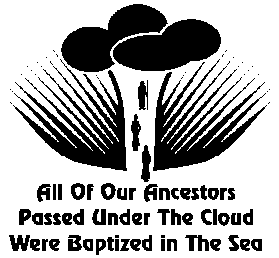
I. Israel’s Journey
- The Israelites’ passage through the sea and their baptism (v. 1-2)
- God’s provision of spiritual food and drink in the wilderness (v. 3-4)
II. God’s Judgement
- God’s displeasure with the majority of the Israelites (v. 5)
- Examples of Israel’s sins and their consequences (v. 6)
III. Warning to the Corinthians
- Paul urges the Corinthians not to idolize or grumble as Israel did (v. 10)
- Reminder that the Old Testament stories serve as warnings (v. 11)
IV. Encouragement for Believers
- Those who stand firm will not fall under God’s judgment (v. 12)
- Temptation is common, but God provides a way out (v. 13)
Clipart by Fr. Richard Lonsdale; pop-up links direct to Catholic centered content on Google AI search
3rd Sunday of Lent C
2ND READING
Hearers of the Word

Click on slide to watch video by Fr. Kieran J. O’Mahony
Theology of the Body

3rd Sunday of Lent C
2ND READING
Context
HISTORY
In 1 Corinthians 10:1-6, 10-12, Paul warns the Corinthian church against the dangers of idolatry and complacency, using Israel’s wilderness experience as a cautionary tale. This passage is situated within the context of the early Christian community, grappling with challenges posed by pagan society and internal divisions.
During this period, Corinth was a bustling trade center known for its cultural diversity and religious plurality. As new converts, the Corinthian Christians faced pressure to conform to Greco-Roman practices, including idol worship and moral permissiveness. Paul, a former Pharisee and Apostle to the Gentiles, aimed to address these issues and guide the church towards unity and holiness.
The political landscape was dominated by the Roman Empire, which tolerated diverse religious practices as long as they did not threaten public order. However, Christians were increasingly viewed with suspicion and faced various forms of persecution. Paul sought to strengthen the Corinthian church in their faith, urging them to learn from Israel’s mistakes and remain committed to Christ.
The intended audience for this letter was the early Christian community in Corinth, struggling to navigate their faith within a pagan society. By drawing parallels between the Israelites’ experience and the Corinthians’ current challenges, Paul emphasizes the importance of spiritual vigilance and fidelity to Christ, ensuring that his message remains relevant and applicable to contemporary readers.
3rd Sunday of Lent C
SOCIETY
In 1 Corinthians 10:1-6, 10-12, Paul addresses the sociocultural challenges faced by the Corinthian church, emphasizing the dangers of idolatry and complacency. Set within a Greco-Roman context, this passage highlights the struggle between Christian values and pagan influences.
The Corinthian society was shaped by the prevailing customs, beliefs, and practices of the Roman Empire, including polytheism and moral permissiveness. As new converts, the Corinthian Christians faced social pressure to participate in idolatrous rituals and conform to the dominant culture.
Paul, aware of these cultural influences, sought to address the tension between Christian identity and societal norms. He aimed to strengthen the Corinthian church’s commitment to Christ, urging them to learn from Israel’s mistakes and remain spiritually vigilant.
The original audience, primarily composed of Gentile converts, grappled with their new identity within a pagan society. Paul’s message of spiritual discipline and unity not only served as a corrective to their practices but also encouraged them to embrace a distinctively Christian lifestyle amidst cultural challenges.
3rd Sunday of Lent C
THEOLOGY
In 1 Corinthians 10:1-6, 10-12, Paul urges the Corinthians to remain vigilant in their faith and avoid the dangers of idolatry, drawing on Israel’s wilderness experience as a cautionary tale. This passage offers valuable theological insights for contemporary Catholics, reinforcing the importance of spiritual discipline, unity, and fidelity to Christ.
Theologically, Paul’s warning underscores the need for Christians to discern and resist influences that undermine their faith. Just as the Corinthians had to navigate the challenges of their Greco-Roman context, modern Catholics must grapple with secular and cultural forces that may compromise their commitment to Christ.
Paul’s message of spiritual vigilance remains relevant today, emphasizing the value of ongoing conversion and fidelity to the Church’s teachings. As Catholics, we are called to examine our lives, discern potential pitfalls, and seek God’s guidance in pursuing a life of holiness.
Moreover, the passage highlights the Eucharistic theme of the Church as the Body of Christ. Paul’s reference to the spiritual food and drink that Israel received in the wilderness draws parallels to the Eucharist, reminding Catholics of their participation in the Body of Christ through this sacrament.
3rd Sunday of Lent C
2ND READING
Wikipedia
3rd Sunday of Lent C
2ND READING
Agape Bible Study
Overconfidence Can Lead to a Failure to Repent
EXCERPT:
St. Paul warns the self-assured and proud Christians of the church at Corinth that they should learn from events in the history of Israel in the Old Testament. He uses the example of the Exodus out of Egypt and the wilderness journey to the Promised Land, recalling the many works of God the Israelites witnessed:
- God leading the Israelites in the form of a Pillar of Cloud (Ex 13:1-22).
- The miraculous crossing of the Red Sea (Ex 14:15-31).
- The supernatural feeding of the Israelites with manna (Ex 16:13-15).
- The quenching of their thirst with water that flowed out from a rock (Ex 17:1-7; Num 20:2-13).
St. Paul interprets the miracle of the Cloud and the Red Sea in verse 1 as symbolizing two aspects of Christian Baptism: the Holy Spirit and the water (Jn 3:3, 5). Paul calls the manna and the water from the rock “supernatural” food and drink because they are symbols of the Eucharist (Jn 6:48-51). Then he makes a shocking announcement when he declares that the “rock” that followed them and gave the water was Christ! In the Old Testament, “rock” was sometimes used as a title for Yahweh (Dt 32:4, 15, 18; 2 Sam 22:32; 23:3; Is 17:10; etc.). As he does in Romans 9:33, 10:11-13, and Ephesians 4:8, St. Paul applies the title “rock” to Jesus Christ, signifying the prerogative of Yahweh to Jesus and pointing to His divinity. By writing that the rock who is Christ “followed them,” Paul claims that the pre-Incarnate Christ was active in the Exodus liberation and redemption that prefigures Christ liberating and redeeming humanity in the exodus out of sin and death that He accomplished in His death and resurrection.
During the journey, God protected the children of Israel and worked miracles on their behalf (verses 1-4), but despite the many examples of God’s loving care, the members of the Exodus generation were rebellious and ungrateful. God judged the covenant failure of the first generation of the Exodus, except for faithful Joshua and Caleb, and they died in the wilderness, never making it to the Promised Land (Num 13:29-30; 26:65).
St. Paul tells the Christians of Corinth that this should serve as a lesson for them. The warning is that being in a covenant relationship with God does not mean we should take our covenant obligations for granted. Being unfaithful to God runs the risk of divine judgment, like the Israelites of the Exodus generation. St. John Chrysostom wrote: “God’s gifts to the Hebrews were figures of the gifts of Baptism and the Eucharist which we were to be given. And the punishments meted out to them are figures of the punishment which our ingratitude will deserve; hence his reminder to be watchful” (Homilies on 1 Corinthians, 23).resurrection, and in the meantime, we must “stand firm” in the Lord!
SOURCE: Agape Bible Study Copyright © 2015; revised 2024 (Used with permission.)
Bible Study Notes
- The Jerome Biblical Commentary,
- The New Jerome Biblical Commentary, and
- The Navarre Bible.
SOURCE: St. Charles Borromeo Catholic Church (Picayune, MS)
The Tough Question
Luke 13:1 “About the same time” is literally “in the same moment” The word for moment, “kairos,” usually means “at the right moment,” and has theological overtones of God’s judgment or metanoia. In this case, however, the word has a general sense of time.
“whose blood Pilate mixed with (the blood of) their sacrifices” This is a Hebraism. On pilgrimage, Jews would come to Jerusalem in order to offer sacrifice at the Temple. Many times they brought their own animals for sacrifice. When Pilate “mixed human blood with the blood of animal sacrifice,” he had Jewish Galileans murdered or executed. Were they revolutionaries on their way to Jerusalem to cause a riot? Or, was this just a phrase to describe fellow Jews? The context does not tell us how literally or figuratively to take this saying. We do know Pilate moved against some from Galilee for an unknown crime or threat.
Luke 13:4 Siloam is a neighborhood in Old Jerusalem, to the south of the Temple in the Lower City.
The regional news referred to a series of executions and an accident. The Galileans were executed most likely for revolutionary activities. The ruthless Pilate made sure they made good on their sacrifices [1-2]. Eighteen citizens of Jerusalem suffered from a building collapse [4].
3rd Sunday of Lent C
Call to Repentance
Luke 13:1-9
GOSPEL READING
Key Points

I. Addressing Tragedies and Self-Assurance
- Jesus responds to news of the Galileans’ death (v. 1-3)
- Warning against self-assurance and not bearing fruit (v. 6-9)
II. The Need for Repentance
- Jesus emphasizes the urgency of repentance to avoid perishing (v. 3, 5)
- The parable of the fig tree illustrates patience and mercy (v. 8-9)
III. God’s Judgment and Mercy
- Jesus highlights God’s judgment on the unrepentant (v. 4-5)
- Emphasis on God’s patience and mercy towards those who need to change (v. 8-9)
IV. Responding to Jesus’ Warnings
- Heeding Jesus’ warnings and call to repentance (v. 3, 5)
- Recognizing the consequences of failing to bear fruit (v. 6-9)
Clipart by Fr. Richard Lonsdale; pop-up links direct to Catholic centered content on Google AI search
3rd Sunday of Lent C
GOSPEL READING
Hearers of the Word

Click on slide to watch video by Fr. Kieran J. O’Mahony
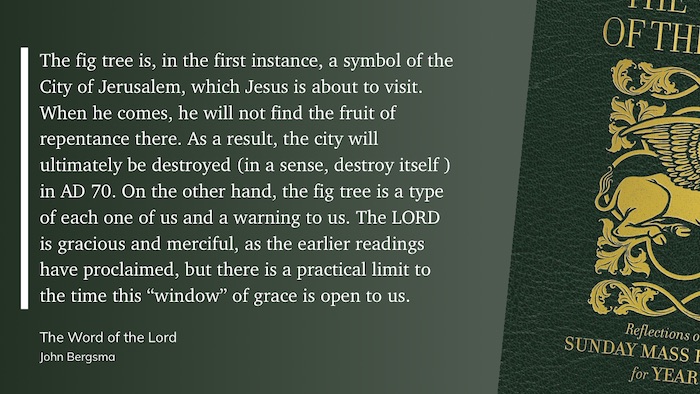
John Bergsma
3rd Sunday of Lent C
GOSPEL READING
Context
HISTORY
Luke 13:1-9 records Jesus’ response to recent tragedies and the call for personal repentance. Set in first-century Judea under Roman rule, this passage reflects the complex political and social landscape of the time, as well as the religious tensions between Jesus and the Jewish leaders.
During this period, Pontius Pilate governed Judea, and instances of injustice and violence were not uncommon. In addressing the tragedies mentioned, Jesus addresses the human search for meaning amidst suffering and the need for spiritual renewal.
Luke, a Gentile physician and companion of Paul, wrote his Gospel to a broader Greco-Roman audience, presenting Jesus’ ministry within the larger historical context. By addressing concerns of sin, repentance, and divine judgment, Luke highlights the relevance of Jesus’ teachings for both Jewish and Gentile believers.
Politically, Jesus’ teachings often clashed with the expectations and interests of the Jewish leaders, who sought to maintain their status and influence. In this passage, Jesus not only addresses the need for repentance but also challenges his audience to consider their relationship with God beyond the confines of strict legalism and ritualism.
3rd Sunday of Lent C
SOCIETY
Luke 13:1-9, set in first-century Judea, reflects the sociocultural context of Jewish society under Roman rule. This passage addresses the concerns of sin, repentance, and divine judgment, touching on prevailing customs and beliefs of the time.
During this period, Jewish religious life revolved around the Law and Temple practices. The concepts of sin, divine judgment, and repentance were deeply ingrained in Jewish society, shaping their understanding of the world and their relationship with God.
Jesus’ teachings in this passage challenge the prevailing notion of sin and divine judgment. He rejects the simplistic idea of attributing suffering to individual sin and emphasizes the urgency of repentance for all, not just those who have experienced tragedy or hardship.
For the original audience, primarily composed of Jewish and Gentile converts, Jesus’ message underscored the need for personal spiritual renewal and transformation. By addressing their cultural assumptions about sin and judgment, Jesus invites his followers to embrace a deeper understanding of God’s mercy and justice.
3rd Sunday of Lent C
THEOLOGY
Luke 13:1-9, which recounts Jesus’ call for repentance and reflection on divine judgment, holds theological significance for contemporary Catholics. The passage highlights themes of sin, repentance, and God’s mercy, emphasizing the importance of spiritual renewal and ongoing conversion.
In Catholic theology, the concepts of sin, repentance, and divine judgment are central to understanding the human condition and our relationship with God. The Sacrament of Reconciliation, for instance, provides an avenue for Catholics to confess their sins, receive absolution, and experience God’s mercy.
Jesus’ teachings in this passage underscore the need for humility and self-examination. Just as the people during Jesus’ time were prone to self-righteousness and judgment, contemporary Catholics must guard against similar temptations. By acknowledging our own shortcomings and embracing the call to repentance, we open ourselves to God’s transforming grace.
The parable of the fig tree serves as a powerful metaphor for God’s patience and mercy. As Catholics, we are called to extend this same patience and mercy towards others, fostering communities of forgiveness and reconciliation.
3rd Sunday of Lent C
GOSPEL READING
Wikipedia
3rd Sunday of Lent C
GOSPEL READING
Agape Bible Study
A Call to Repentance and the Parable of the Barren Fig Tree
EXCERPT: TheThe “Pilate” mentioned in verse 1 is Pontus Pilate, the Roman governor of Samaria and Judea (AD 26-36). That Pilate was the cause of a massacre suggests the Galileans had come to Jerusalem to offer their sacrifices at the Temple and were perhaps involved in some protest against Roman rule. The second tragedy also took place in Jerusalem at a tower near the ritual purification pool of Siloam. However, Jesus’s teaching is that the personal sins of the victims were not the immediate cause of either tragedy (also see Jesus’s teaching in John 9:3). Instead, Jesus asked the crowd to view such tragedies as providential invitations for continual conversion by examining one’s own life and relationship to God and responding with humble repentance for one’s sins. One never knows when a similar tragedy could claim one’s life. In the case of a sudden tragedy, there is no longer the opportunity to repent and make one’s life right with God before one must face God’s divine judgment and make a final accounting for one’s sins.
Jesus continued His message on the importance of repentance in verses 1-5 with a story about God’s patience with those who have not yet given evidence of repentance (verses 3 and 8). He also added a warning about the inevitability of divine judgment in His Parable of the Barren Fig Tree.The vine or fig tree was one of the recurring symbolic images of the prophets that represented God’s covenant relationship with Israel. In the symbolic images of the Old Testament prophets, a fruitful fig tree represented Israel in covenant unity and fidelity with God. However, an unfruitful fig tree indicated Israel’s covenant failure in her mission to God’s holy people when they failed to produce the “good fruit” of service (see Jer 8:13; 24:1-10 and the charts on the symbolic images of the prophets).
The fig tree is the only fruit-bearing tree named in Eden (Gen 3:7). The fruitful fig tree was a sign of the good things God promised the covenant people in the Promised Land (Dt 8:8). Proverbs 27:18 advises that God will bless the person who produces good “fruit” in his life: He who tends a fig tree eats its fruit, and he who is attentive to his master will be enriched. And the prophet Jeremiah compared an Israel under the curse of divine judgment to a fruitless fig tree: I shall put an end to them, Yahweh declares, no more grapes on the vine, no more figs on the fig tree only withered leaves (Jer 8:13 NJB).
In Jesus’s parable, the owner of an orchard complains to his gardener that the fig tree has failed to produce fruit for three years and tells the gardener to cut it down. The gardener urges the owner to leave it for just a little longer so he can fertilize it in the hope that it will begin producing fruit. However, if it still fails to bear fruit, he will cut it down (Lk 13:6-9). A parable is a symbolic story that presents a lesson using familiar events or circumstances. Symbolically,God is the owner of the orchard, the fruitful land He gave His covenant people. It can be compared to the garden in Eden that God gave Adam and Eve, which was also an orchard (Gen 2:8-9). The fig tree is Israel/the covenant people, and Jesus is the gardener who asks for a little longer to bring the tree to bear “fruit.” The children of Israel were not owners but only tenants on God’s land (Lev 25:23). Therefore, they could be dispossessed of the land if they were disobedient to His covenant and followed the ways of their pagan neighbors (Dt 8:18-20).
The fig tree | God’s old covenant people—the Jews |
The orchard | The holy land of Israel |
The owner of the orchard | God |
The gardener | Jesus |
The reference to the three years the gardener worked with the tree may refer to “three” as a number symbolizing importance, usually signifying a future event in God’s divine plan for humanity’s salvation. It may also refer to Jesus’s mission that spanned three Passovers. During that time, He was “pruning” the false teachings that led to a rigid misinterpretation of the Law that lacked compassion (Lk 6:1-5, 9-11; 11:37-52; 13:10-16), His call for the covenant people to bear the good fruit of repentance, and to recognize Him as the promised Messiah. They failed to produce “good fruit,” but, as in the parable, Jesus (the gardener) asked God (the owner of the orchard and fig tree) for a little more time.
SOURCE: Agape Bible Study Copyright © 2015; revised 2024 (Used with permission.)

SCRIPTURE
SEARCH
FIRST READING (149)
SECOND READING (177)
GOSPEL (30)
This tool created by Jeff Pinyan uses the CCEL Early Church Fathers digital edition of the Philip Schaff collection.
3rd Sunday of Lent C

Just Jr., A., Oden, T. C., Carson, D. A., & Oden, E. (Eds.). (2003). Ancient Christian Commentary on Scripture: New Testament III, Luke (Vol. 3). IVP Academic.
Catena Aurea
Luke 13: The Catena Aurea, which means “Golden Chain” in Latin, is a comprehensive biblical commentary comb is a 13th-century biblical commentary compiled by St. Thomas Aquinas. This anthology features insights from over eighty Church Fathers on the four Gospels.