MAR 16, 2025

SOURCE: Hearers of the Word by Fr. Keiran O'Mahony


Homilies
Homilies


Sunday Podcast (USCCB)
2nd Sunday of Lent C
Fr. Andrew Ricci
2nd Sunday of Lent C
Study, Pray, Serve (2022)
Fr. Andrew Ricci, ordained in 1997, is a priest for the Diocese of Superior. He is the Rector of the Cathedral of Christ the King.

The Transfiguration reveals the glory of Jesus while on his journey to the Cross in Jerusalem. This glimpse of the Lord’s majesty provides hope, offering grace and strength to all who strive to carry their Crosses through this life.
SOURCE: Study, Pray, Serve




Bulletin Inserts




Carmelite Lectio Divina
Reflections and Prayers
92 page PDF with refections and prayers for each day of the month.
Lectio Divina March 2025 (PDF)
Lectio Divina March 2025 [Mobi]
Lectio Divina March 2025 [ePub]
“Lectio divina is an authentic source of Christian spirituality recommended by our Rule. We therefore practise it every day, so that we may develop a deep and genuine love for it, and so that we may grow in the surpassing knowledge of Christ. In this way we shall put into practice the Apostle Paul’s commandment, which is mentioned in our Rule: “The sword of the Spirit, too, which is the word of God, is to dwell abundantly in your mouth and in your hearts; and whatever things you have to do, let them be done in the word of the Lord.” (Carmelite Constitutions (2019), n. 85.)
Source: Carmelites
Bible Study Notes

- The Jerome Biblical Commentary,
- The New Jerome Biblical Commentary, and
- The Navarre Bible.
SOURCE: St. Charles Borromeo Catholic Church (Picayune, MS)
Abraham’s Grand Vision

Abraham had a grand vision, but the way it changed him was found in God’s gift: descendants and land [5 and 18]. As a wandering tribe leader, Abraham was a rich merchant (an “import-export” trader) and herdsman. Descendants were important to him in order to increase his wealth with cheap family help, and in order to give him “immortality” through the memory of his sons. Unfortunately, Abraham’s wife was childless.
While land as area was necessary to raise Abraham’s sheep and cattle, a land with secure borders was not as important to Abraham as it might be to his descendants in order to farm.
Who was this God promising Abraham descendants and land? Abraham’s God was most likely his clan’s deity, the God closest to him. In a world with many gods, there was a deity for every city, every family, and every purpose.
2nd Sunday of Lent C
Abrahamic Covenant
Genesis 15:5-12, 17-18
1ST READING
Key Points

I. Introduction
- God takes Abram outside to count the stars
II. God’s Promise
- God promises Abram numerous descendants
- Abram’s faith is credited as righteousness
III. Animal Sacrifice
- Abram prepares animal sacrifice as instructed
IV. Divine Presence
- God’s presence, represented by a smoking fire pot, passes between the sacrifice
V. Covenant
- God makes an everlasting covenant with Abram
- Land from the Nile to Euphrates promised to Abram’s descendants
Clipart by Fr. Richard Lonsdale; pop-up links direct to Catholic centered content on Google AI search
2nd Sunday of Lent C
1ST READING
Hearers of the Word

Click on slide to watch video by Fr. Kieran J. O’Mahony
2nd Sunday of Lent C
1ST READING
Context
HISTORY
Genesis 15:5-12, 17-18 takes place within a historical and political context characterized by God’s covenant with Abram and the promise of a prosperous future for his descendants. This passage is part of the larger narrative in the Book of Genesis, which details the origins of the Israelite people and their relationship with God.
The author of Genesis, traditionally believed to be Moses, sought to communicate God’s faithfulness and His plan for the Israelites to the ancient Hebrew audience. In this patriarchal society, the promise of numerous descendants held immense significance for the preservation of one’s lineage and the security of the community.
Within the broader Ancient Near Eastern context, covenant-making was a common practice among different rulers and people groups. The covenant between God and Abram in Genesis 15 demonstrates a unique relationship between the divine and human realms, solidifying Abram’s role as the father of the Israelite nation.
2nd Sunday of Lent C
SOCIETY
Genesis 15:5-12, 17-18 is deeply embedded in the sociocultural context of ancient Israelite society, with its emphasis on covenant, descendants, and divine promises. Understanding this context illuminates the passage’s meaning and relevance for its original audience.
In ancient Israel, covenants played a crucial role in shaping social and religious life. A covenant was a sacred agreement that bound parties together and established mutual obligations. In this passage, the covenant between God and Abram signifies the special bond between the divine and human realms, assuring Abram’s descendants of God’s providence and protection.
The importance of offspring in Genesis 15 highlights the sociocultural emphasis on descendants in ancient Israelite society. Children were considered a blessing from God and were essential for maintaining the family lineage. The promise of numerous descendants ensured Abram’s status as the father of a great nation, echoing the Israelites’ understanding of their identity and purpose.
Moreover, the divine promise of land reflects the sociocultural importance of territorial inheritance and security. The land of Canaan, which God promised to Abram’s descendants, held immense significance as the future homeland of the Israelites. This promise provided the original audience with a sense of identity and hope for their future as a nation.
2nd Sunday of Lent C
THEOLOGY
The theological context of Genesis 15:5-12, 17-18 within Roman Catholic tradition highlights the significance of God’s covenant with Abram and its implications for contemporary Catholics. This passage reveals essential aspects of God’s relationship with His chosen people and underscores the importance of faith and obedience in the life of believers.
Catholic theology recognizes the enduring nature of God’s covenant with Abram as a foundation for the covenant established through Jesus Christ. The New Testament affirms that those who have faith in Christ become children of Abraham and inherit the promises of God (Galatians 3:6-9). This perspective invites contemporary Catholics to embrace their spiritual lineage and to live as faithful heirs of God’s covenant.
The divine promise of descendants and land to Abram in Genesis 15 points to the Catholic belief in the Communion of Saints, which encompasses the faithful on earth, in heaven, and in purgatory. This unity in Christ transcends earthly limitations, ensuring that believers are part of a spiritual family that extends beyond biological lineage.
Moreover, the covenant between God and Abram exemplifies the importance of trust and obedience in the life of faith. Catholic tradition upholds the value of personal commitment and submission to God’s will, encouraging believers to follow Abram’s example of faithfulness.
2nd Sunday of Lent C
1ST READING
Wikipedia
2nd Sunday of Lent C
1ST READING
Agape Bible Study

God’s Covenant Promises to Abraham
EXCERPT: In this ritual of covenant formation, God passed between the parts of the sacrificed animals, binding Himself by oath to the covenant with Abram. Yahweh manifested His presence in the smoking brazier (fire-pot) and the flaming torch passing between the animal pieces is in essence Yahweh Himself swearing an oath of fidelity to the covenant. The word in Hebrew for “brazier” is tannur, which is an archaic term in Hebrew for “oven.” It is an oven in the sense of a brazier used for burning incense for the liturgical services of the Sinai Covenant and in a Catholic Mass. The smoking brazier and flaming torch represented Yahweh’s presence in the same way the burning bush revealed God’s presence to Moses (Ex 3:2), the pillar cloud and pillar of fire revealed God’s presence to the children of Israel in the Exodus experience (Ex 13:21), and in the cloud on the summit of Mt. Sinai (Ex 19:16; 24:15-16) that was a manifestation of the Glory Cloud, in Hebrew the Shekinah (Ex 16:10; 19:9; 34:5; 40:34-38; Lev 16:2; Num 19:15-22; etc.). The purpose of the cutting of the animals becomes clear in the wording, the LORD made [cut] a covenant with Abram(Genesis 15:18). The Hebrew verb krt, usually translated as “made” or “concluded,” and in Hebrew means “to cut;” Yahweh cut (krt) a covenant with Abram. A covenant with Abram was literally and symbolically “cut” and sealed in blood by which the covenant participants bound themselves by oath to suffer the same death as the animals if either party did not fulfill the promises of the covenant (Jer 34:18). Only God binds Himself as responsible for keeping this perpetual covenant. It is an act that only makes sense in the context of Christ’s sacrifice on the altar of the Cross.
In this bizarre scene, the smoking brazier and the flaming torch become the legs of God, walking the valley of death between the split bodies of the dead animals and taking the covenant curse upon Himself to keep the covenant with Abraham and his descendants. God’s action prefigures the journey of Christ, bearing the covenant curse upon Himself, as He walked through “the valley of the shadow of death” (Ps 23:4) to offer Himself in sacrifice on the altar of the Cross. He took the curse-judgments of past covenant failures upon Himself (Dt 21:22-23) as He offered Himself as the sacrifice that would establish the new and everlasting Covenant with Abraham’s descendants and all humanity.
SOURCE: Agape Bible Study Copyright © 2015; revised 2024 (Used with permission.)
Bible Study Notes
- The Jerome Biblical Commentary,
- The New Jerome Biblical Commentary, and
- The Navarre Bible.
SOURCE: St. Charles Borromeo Catholic Church (Picayune, MS)
Above the Daily Routine
3:17-18 In the context of 3:2, the “enemies of the cross” were Judaizers, Jewish Christians who insisted that Gentiles convert to the mother religion before they could follow Christ. Paul objected to such conversions because, as conduits to life in the chosen assembly, they became more important than the sacrifice of Christ on the cross itself.
In this light, the phrase “(their) god is the belly” was not a reference to a gluttonous life, but to an insistence upon the kosher laws. The phrase “(those) perceiving (only) the earthly (things)” referred to adherence to the duties of the Law. Paul held their insistence upon regulation on diet and focus on the Law would lead to the shame and destruction of the Judaizers.
2nd Sunday of Lent C
Heavenly Citizenship
Philippians 3:17-4:1
2ND READING
Key Points

I. Introduction
- Exhortation to join in imitating Paul
II. Enemies of the Cross
- Warnings against worldly-minded individuals
- Their focus on earthly desires
III. Citizens of Heaven
- Believers’ true home in heaven
- Eagerly awaiting Christ’s return
IV. Call to Stand Firm
- Encouragement to remain steadfast in faith
- Following the examples of godly models
Clipart by Fr. Richard Lonsdale; pop-up links direct to Catholic centered content on Google AI search
2nd Sunday of Lent C
2ND READING
Hearers of the Word

Click on slide to watch video by Fr. Kieran J. O’Mahony
Theology of the Body

2nd Sunday of Lent C
2ND READING
Context
HISTORY
In Philippians 3:17-4:1, Paul addresses the Christian community in Philippi, a Roman colony in Macedonia, around the mid-1st century AD. The historical and political context of this passage reflects the challenges faced by early Christians amidst Roman rule and the influence of various religious practices.
The Philippian church consisted primarily of Gentile converts who navigated social and political pressures to conform to Roman imperial ideology, including emperor worship. Paul’s emphasis on heavenly citizenship (Philippians 3:20) counters the Roman claim that citizens must pledge allegiance to the emperor as a divine figure.
Paul, a former persecutor of Christians who experienced a dramatic conversion, wrote this letter during his imprisonment in Rome. His personal transformation lends credibility to his message of spiritual growth through suffering and sacrifice (Philippians 3:17-18).
As the author, Paul emphasizes the importance of unity in Christ, regardless of social or ethnic background (Philippians 3:18). This message was significant for the Philippian Christians, who needed guidance amidst potential divisions arising from external pressures and varying spiritual practices (Philippians 3:19).
Paul’s warning against “enemies of the cross” (Philippians 3:18) reflects the challenges early Christians encountered from those who rejected the message of the Gospel. The contrast between the cross and worldly desires is a reminder of Christ’s ultimate sacrifice and its impact on believers’ lives.
2nd Sunday of Lent C
SOCIETY
Philippians 3:17-4:1 presents a sociocultural context where early Christians navigated various social pressures and cultural influences while striving for spiritual growth and unity. In this passage, Paul addresses the challenges faced by the Philippian community, urging them to follow the example of Christ and reject worldly practices.
The reference to “enemies of the cross” (Philippians 3:18) alludes to those who perpetuated cultural practices contrary to Christian values. This sociocultural tension emphasized the need for discernment and adherence to the teachings of Christ in an environment that promoted earthly desires and idolatry.
Paul’s emphasis on “heavenly citizenship” (Philippians 3:20) underscores the contrast between the Christian identity and Roman social norms. This distinction provided the original audience with a renewed sense of purpose and belonging in Christ, fostering unity amidst diversity.
Furthermore, the call to imitate Paul and other godly examples (Philippians 3:17, 4:1) highlights the importance of role models in the sociocultural context. By emulating those who lived out their faith authentically, early Christians could better navigate the challenges of their time and maintain a focus on spiritual growth.
2nd Sunday of Lent C
THEOLOGY
Philippians 3:17-4:1 is theologically significant within the Roman Catholic tradition, as it emphasizes the importance of spiritual transformation, the imitation of Christ, and the unity found in heavenly citizenship. These themes continue to hold relevance for contemporary Catholics as they navigate modern-day challenges and strive for holiness.
Catholic theology highlights the ongoing process of conversion and transformation in the life of a believer. Paul’s emphasis on following his example (Philippians 3:17) and pursuing righteousness (Philippians 3:18) aligns with the Catholic understanding of spiritual growth through imitating Christ and the saints.
The concept of heavenly citizenship (Philippians 3:20) resonates with the Catholic belief in the Kingdom of God, emphasizing that Christians ultimately belong to a spiritual realm beyond earthly concerns. This perspective encourages contemporary Catholics to prioritize their relationship with God and live out their faith in daily life.
Paul’s call to “stand firm in the Lord” (Philippians 4:1) reminds contemporary Catholics of their shared mission to proclaim the Gospel amidst challenges and divisions. By fostering unity within the Body of Christ, believers can support one another in their spiritual journeys and bear witness to God’s love in a world that often prioritizes individualism and self-interest.
2nd Sunday of Lent C
2ND READING
Wikipedia
2nd Sunday of Lent C
2ND READING
Agape Bible Study
Citizenship in Heaven
EXCERPT: St. Paul uses the example of his own life and others in their service to the Gospel to encourage the Christians of Philippi to persist in moral conduct and to pursue a spiritual life (verse 17). In contrast, he points to the bad example of those who teach false doctrines or abuse their Christian freedom to lead lives immersed in sins of the flesh, becoming “enemies of the cross of Christ.” Moreover, those people “glory in their shame” by taking pride in their sinful behavior, and the result will be that they doom themselves to destruction (verses 18-19).
In verses 20-21, St. Paul reminds the faithful that their destiny is to become “citizens of Heaven.” Their life on earth, living amid sin, is only temporary. Concerning these verses, St. Augustine wrote: “It is nature flawed by sin that begets all the citizens of the earthly city, whereas it is grace alone which frees nature from sin, which begets citizens of the heavenly city” (The City of God, 15.2). Paul’s message is that Christians are citizens of Heaven because that is the glorious destiny God has planned for them. It is appropriate for them, as the children of God who are awaiting the return of Christ in glory, to live in righteousness. Therefore, says Paul in 4:1, we have every reason for joy because of the knowledge that Christ’s Resurrection is the cause of our future resurrection, and in the meantime, we must “stand firm” in the Lord!
SOURCE: Agape Bible Study Copyright © 2015; revised 2024 (Used with permission.)
Bible Study Notes
- The Jerome Biblical Commentary,
- The New Jerome Biblical Commentary, and
- The Navarre Bible.
SOURCE: St. Charles Borromeo Catholic Church (Picayune, MS)
Looking to the Future in a Rearview Mirror
9:29 “his face changed” is literally “his face became (as) other”
9:31 “his departure” is literally “his exodus” This phrase refers to the death of Jesus.
9:33 “(but) not knowing what he said” This phrase referred back to the subject, Peter. In Luke, like the other evangelists, Peter was seen as blurting out the first thing that came to his mind. He did not understand the gravity of the scene or its meaning.
9:36 “When the sound happened, Jesus was found (to be) alone.” The implication Jesus was found to be alone immediately after the voice from heaven, not during.
9:36 “They were silent and told to no one . . . anything” is literally “They were silent and told no one . . . nothing” The two verbs of silence and the double negative in the second clause made the reaction of the disciples emphatic.
2nd Sunday of Lent C
Transfiguration
Luke 9:28-36
GOSPEL READING
Key Points

I. Jesus’ Appearance
- Jesus takes Peter, John, and James up a mountain to pray
- Jesus’ face and clothes change, radiating glory
II. Heavenly Visitors
- Moses and Elijah appear, discussing Jesus’ departure
- Peter’s suggestion to build tents for them
III. God’s Proclamation
- A cloud overshadows the scene
- God’s voice affirms Jesus as His Son and commands the disciples to listen
IV. Aftermath
- Jesus is found alone after the event
- Disciples keep silent about the experience
Clipart by Fr. Richard Lonsdale; pop-up links direct to Catholic centered content on Google AI search
2nd Sunday of Lent C
GOSPEL READING
Hearers of the Word

Click on slide to watch video by Fr. Kieran J. O’Mahony
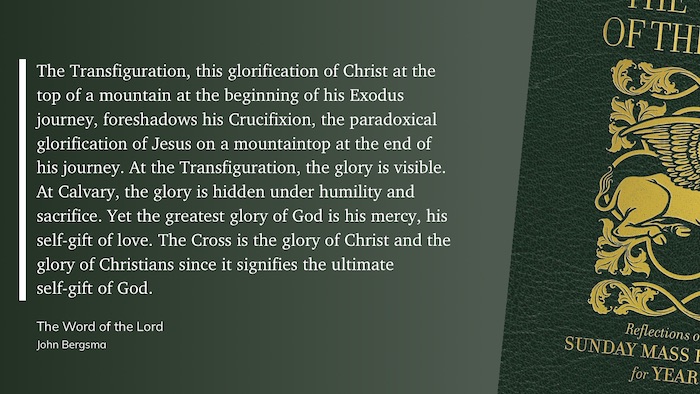
John Bergsma
2nd Sunday of Lent C
GOSPEL READING
Context
HISTORY
The Gospel of Luke, written by the physician and companion of St. Paul, presents Jesus as the savior for all people, with a specific focus on the marginalized and outcasts. In Luke 9:28-36, we encounter the Transfiguration, an event where Jesus’ divine nature is revealed to his disciples. This event gains significance when examined through its historical and political context.
During the time of Jesus, the Israelites were under Roman rule and faced significant political oppression. The Transfiguration’s occurrence on a mountain draws parallels to the story of Moses, who received the Ten Commandments from God on Mount Sinai. Moses’ appearance alongside Elijah during the Transfiguration connects Jesus to significant figures in Jewish history and presents him as the fulfillment of God’s promises to His people.
Moreover, the voice from heaven declaring Jesus as God’s Son and commanding the disciples to listen (Luke 9:35) alludes to the political tension of the time. By asserting Jesus’ authority as God’s chosen one, the Gospel challenges the earthly authority of the Roman Empire and other political powers.
Luke addresses his Gospel primarily to Gentile converts, emphasizing Jesus’ mission as a universal one. The Transfiguration story serves as a reminder to these early Christians that Jesus’ message transcends political boundaries and earthly rulers.
2nd Sunday of Lent C
SOCIETY
Luke’s account of the Transfiguration in Luke 9:28-36 takes place within a rich sociocultural context that influenced its meaning and interpretation for the original audience. The event occurs on a mountain, a significant location that draws parallels to the Jewish tradition of divine revelation, as seen in the stories of Moses and Elijah.
The presence of Moses and Elijah, representing the Law and the Prophets, further emphasizes the connection to Jewish traditions. Their conversation about Jesus’ impending departure in Jerusalem (Luke 9:31) signifies the fulfillment of Jewish prophecies and emphasizes Jesus’ mission as the Messiah.
The heavenly voice that proclaims Jesus as God’s Son (Luke 9:35) addresses a significant sociocultural concern for the original audience: the identity of Jesus as the Messiah. This declaration asserts Jesus’ divine identity and authority, a central belief in early Christian communities.
Moreover, the Transfiguration occurs within the context of Jewish expectations for a messianic figure who would deliver them from Roman oppression. By presenting Jesus as a divine figure with authority over earthly powers, Luke offers hope to the marginalized and oppressed members of society.
2nd Sunday of Lent C
THEOLOGY
Luke 4:1-13 The Transfiguration in Luke 9:28-36 holds profound theological significance within the Roman Catholic tradition, emphasizing Jesus’ divinity and his role as the fulfillment of Old Testament prophecies. The appearance of Moses and Elijah signifies the continuity between the Law, the Prophets, and Jesus’ ministry, while God’s proclamation affirms Jesus’ divine Sonship.
Theologically, the Transfiguration reveals the mystery of Christ’s dual nature as both fully human and fully divine. This event illuminates the Catholic belief in the hypostatic union, which teaches that Jesus’ human and divine natures are united in one person.
For contemporary Catholics, the Transfiguration offers guidance for their spiritual journey. The disciples’ confusion and fear during the event mirror the struggles believers face when confronted with the divine. Just as Jesus comforted his disciples, Catholics today can find solace in Christ’s presence amidst their uncertainties and trials.
The Transfiguration also reminds Catholics of their ultimate goal: eternal life with Christ in heaven. As Jesus’ glory is temporarily unveiled on Mount Tabor, this event foreshadows the future resurrection and the hope of participating in God’s divine life.
Moreover, the Transfiguration challenges Catholics to reflect on their response to Jesus’ divine identity. Like the disciples, they are called to “listen to him” (Luke 9:35) and follow his teachings in their daily lives. By embracing Jesus’ message of love, justice, and mercy, contemporary Catholics can work towards personal transformation and contribute to the betterment of society.
2nd Sunday of Lent C
GOSPEL READING
Wikipedia
2nd Sunday of Lent C
GOSPEL READING
Agape Bible Study
The Transfiguration of the Christ
EXCERPT: The voice is the same voice that was heard at Jesus’s baptism by St. John the Baptist (Lk 3:22). Notice how the Most Holy Trinity is manifested in this event as He was at Jesus’ baptism:
- God the Father’s voice was heard from heaven.
- God the Son was present in His glory (and in His humanity at the baptism).
- God the Holy Spirit was represented by the overshadowing cloud (and by a dove at Jesus baptism).
The presence of God the Holy Spirit manifested in a cloud is in both the Old and New Testaments:
- A pillar of cloud led the children of Israel on the Exodus journey (Ex 13:21-22).
- An overshadowing cloud took possession of the desert Tabernacle and the Ark of the Covenant (Ex 40:34).
- A cloud filled the newly dedicated Temple of the Lord in Jerusalem (1 Kng 8:10-14; 2 Chr 5:13-14).
- A cloud overshadowed the Virgin Mary in the Incarnation of Christ (Lk 1:35).
- An overshadowing cloud appeared at the Transfiguration (Lk 9:34).
The Greek word for the shadow of the cloud cast over them is episkiazo. It is the same word found in the account of the Holy Spirit overshadowing the Virgin Mary in the Incarnation (Lk 1:35), and it is the same word used in the Greek translation of Exodus when God’s Spirit overshadowed the Tabernacle and the Ark of the Covenant (Ex 40:34). A cloud is a frequent vehicle for the manifestation of God’s presence in Scripture (for some additional examples see Ex 16:10; 19:9; 24:15-16; 33:9, 34:5; 2 Mac 2:8; Acts 1:9; Rev 11:12; 14:14).
Do not miss that this significant event of Jesus’s Transfiguration is tied both in time and meaning to the event of Peter’s confession of Christ as the Messiah and the prediction of His coming Passion. The pronouncement of the Divine Voice, “this is my beloved Son” (Lk 9:35a) is confirmation of Peter’s confession of Jesus as Messiah and “listen to Him” is a warning to listen to Jesus’ announcement of His coming Passion and to cooperate in His mission (Lk 9:35b). The command of the Divine Voice of God from heaven, “Listen to Him,” is also a confirmation that Jesus is the prophet like Moses that God promised the people in Deuteronomy 18:15-19. That prophecy ends with a promise and a command: I will raise up for them a prophet like you from among their kinsmen, and will put my words into his mouth; he shall tell them all that I command. If any man will not listen to my words which he speaks in my name, I myself will make him answer for it (Dt 18:18-19 NJB).
SOURCE: Agape Bible Study Copyright © 2015; revised 2024 (Used with permission.)

SCRIPTURE
SEARCH
FIRST READING (45)
SECOND READING (133)
GOSPEL (26)
This tool created by Jeff Pinyan uses the CCEL Early Church Fathers digital edition of the Philip Schaff collection.
2nd Sunday of Lent C

Just Jr., A., Oden, T. C., Carson, D. A., & Oden, E. (Eds.). (2003). Ancient Christian Commentary on Scripture: New Testament III, Luke (Vol. 3). IVP Academic.
Catena Aurea
Luke 9: The Catena Aurea, which means “Golden Chain” in Latin, is a comprehensive biblical commentary comb is a 13th-century biblical commentary compiled by St. Thomas Aquinas. This anthology features insights from over eighty Church Fathers on the four Gospels.