DEC 22, 2024
When Pregnancy Met Pregnancy
✨ FULTON SHEEN: One of the most beautiful moments in history was that when pregnancy met pregnancy, when child-bearers became the first heralds of the King of Kings. All pagan religions begin with the teachings of adults, but Christianity begins with the birth of a Child. From that day to this, Christians have ever been the defenders of the family and the love of generation.
If we ever sat down to write out what we would expect the Infinite God to do, certainly the last thing we would expect would be to see Him imprisoned in a carnal ciborium for nine months; and the next to last thing we would expect is that the “greatest man ever born of woman” while yet in his mother’s womb, would salute the yet imprisoned God-man. But this is precisely what took place in the Visitation.
SCROLL TO READ MORE

BEHOLD 2000 (4:57)—This video has the voice of Fulton Sheen inviting you to give your yes to God, just how Mary did. 'When God became man, or when he willed it from the very creation of the world, he had a dream about a mother ... She was the dream come true, the world's first love.t love.'


Sunday Readings Commentary
Sunday Readings Commentary
- HERMENEUTICAL SCHOLARS
- NOTES / SLIDES
- CHURCH FATHERS
- CATECHISM

⬇️ A Walk in the Word
Hector
Molina
Lending prominence to Mary’s journey to Elizabeth, the fourth Sunday of Advent accentuates the prophetic links to the Messiah’s arrival in Bethlehem, concurrently delving into the profound themes of faith, motherhood, and hope permeating the narrative of salvation history.
4th Sunday of Advent - YEAR C

⬇️ Encountering the Word
Jeff
Cavins
Exalting Mary as the new Ark of the Covenant, the Advent season underscores her role as a vessel of God’s presence and divine pledges, ultimately preparing the way for the arrival of Jesus Christ in the world.
4th Sunday of Advent - YEAR C

⬇️ Hearers of the Word
Kieren J.
O’Mahony
Advent’s fourth Sunday spotlights the visitation story’s importance, accentuating the integral roles of women, faith, and Jesus’ divine-human duality while emphasizing obedience to God’s will within the overarching context of salvation history.
4th Sunday of Advent - YEAR C

⬇️ Bishop Robert Barron
Bishop Robert
Barron
Purposefully engaging in our God-given roles instills a sense of solidarity and shared aspirations, empowering us to transcend the limitations of ego-driven disputes and the apathy perpetuated by contemporary cultural influences.
4th Sunday of Advent - YEAR C

⬇️ Catholic Sunday Scriptures in Context
Fr. Paul
Galetto, OSA
Instances throughout history demonstrate that God frequently selects humble individuals to carry out His divine plans, as exemplified by Mary and Jesus, whose lives embodied faith and sacrifice, ultimately leading to the establishment of a new covenant through Christ.
4th Sunday of Advent - YEAR C


⬇️ Mass Readings Explained
Brant
Pitre
Noticeably, God esteems a heart that’s obedient and primed to receive His word over customary animal sacrifices. This truth finds its ultimate expression in Jesus’ fulfillment of the Psalms and His sacrificial obedience on the Cross, an event that brought about the transformative shift from the Old Covenant to the New.
4th Sunday of Advent - YEAR C

⬇️ The Word Proclaimed
Fr. Francis
Martin
Gracefully illustrated through the encounter of Mary and Elizabeth, the visitation underscores the profound impact of divine presence and the centrality of nurturing relationships, while simultaneously accentuating the jubilation and monumental nature of Christ’s incarnation via the Holy Spirit.
4th Sunday of Advent - YEAR C

To further explore the ideas presented in the excerpts and encourage personal application, discussion questions for small groups are provided. They are not directly connected to the commentary but aim to delve deeper into the concepts presented in order to promote personal reflection. With over 100 questions presented, group leaders are provided with an invaluable resource to shape group discussions as per their preferences.
⬇️ Scott Hahn
Catholic Bible Dictionary
Hahn, Scott. Catholic Bible Dictionary. New York: Doubleday, 2009.
4th Sunday of Advent - YEAR C

Click on slide to view full screen
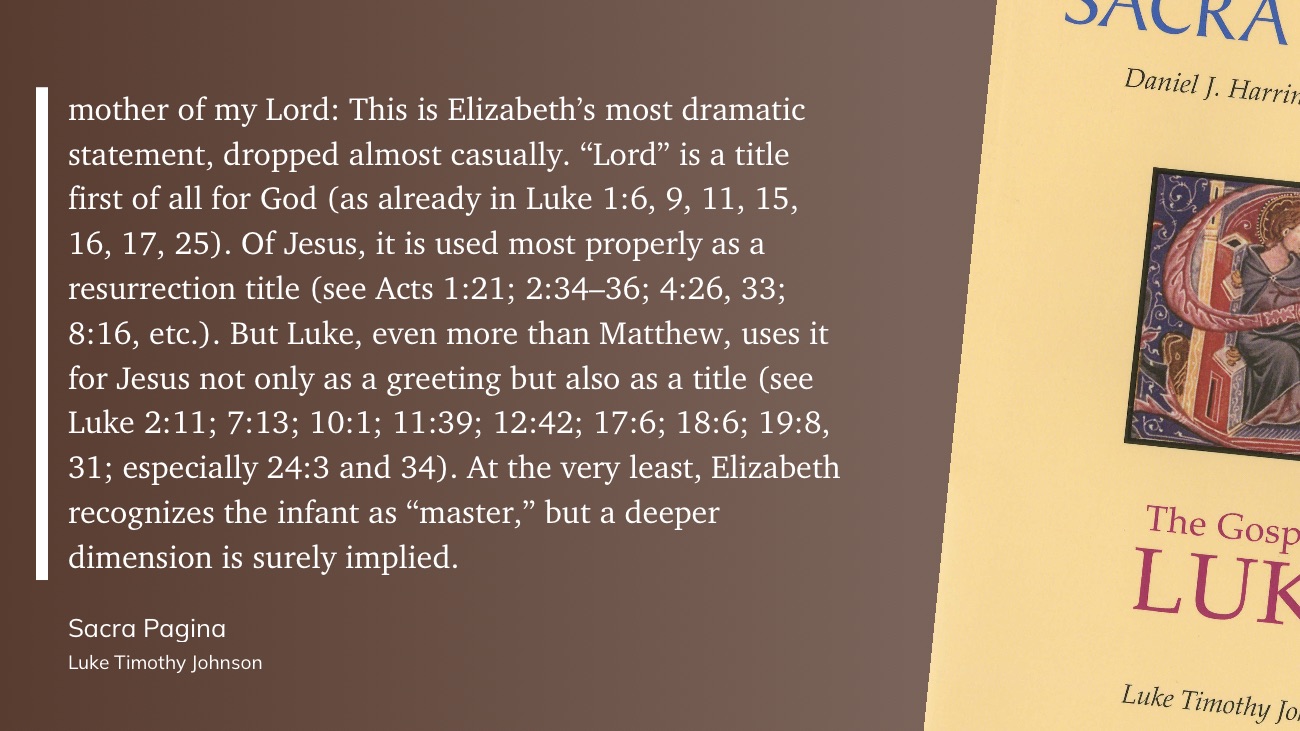
⬇️ Luke Timothy Johnson
Sacra Pagina:
Luke
Johnson, L. T.. Sacra Pagina: The Gospel of Luke. Daniel J. Harrington, S.J., General Editor Liturgical Press, 1991.
4th Sunday of Advent - YEAR C
Click on slide to view full screen
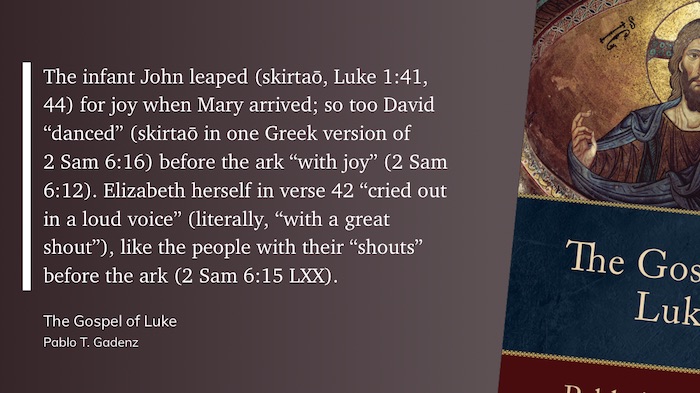
⬇️ Pablo Gadenz
The Gospel of Luke
Gadenz, Pablo T.. The Gospel of Luke The Catholic Commentary on Sacred Scripture. Grand Rapids, MI: Baker Academic, 2008.
4th Sunday of Advent - YEAR C
Click on slide to view full screen
⬇️ Richard Rohr
The Good News
According to Luke
Rohr, Richard. The Good News According to Luke. New York: Crossroad, 1997.
4th Sunday of Advent - YEAR C

Click on slide to view full screen
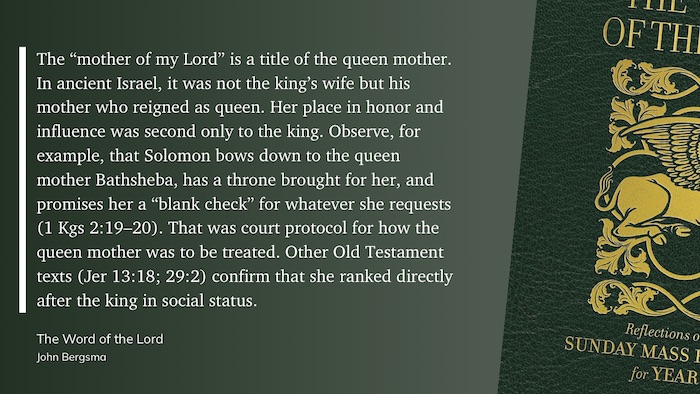
⬇️ John Bergsma
The Word of
the Lord
Bergsma, John. The Word of the Lord: Reflections on the Sunday Mass Readings for Year B. Steubenville, OH: Emmaus Road Publishing, 2020.
4th Sunday of Advent - YEAR C
Click on slide to view full screen
⬇️ Preaching Justice
John Knox
Press
Allen, Ronald J., Dale P. Andrews, and Dawn Ottoni-Wilhelm, eds. Preaching God’s Transforming Justice: A Lectionary Commentary, Year B. Louisville, KY: Westminster John Knox Press, 2013.
4th Sunday of Advent - YEAR C

Click on slide to view full screen
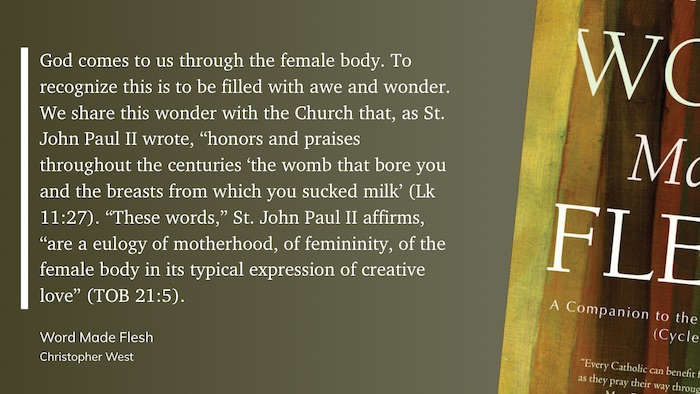
⬇️ Christopher West
Word Made Flesh
West, Christopher. Word Made Flesh: A Companion to the Sunday Readings (Cycle B). Pennsburg, PA: Theology of the Body Institute Press, 2021.
4th Sunday of Advent - YEAR C
Click on slide to view full screen
⬇️ Ignatius Catholic Study Bible
Ignatius Press
Hahn, Scott. The Ignatius Catholic Study Bible New Testament (Ignatius Press), 2010.
4th Sunday of Advent - YEAR C

Click on slide to view full screen
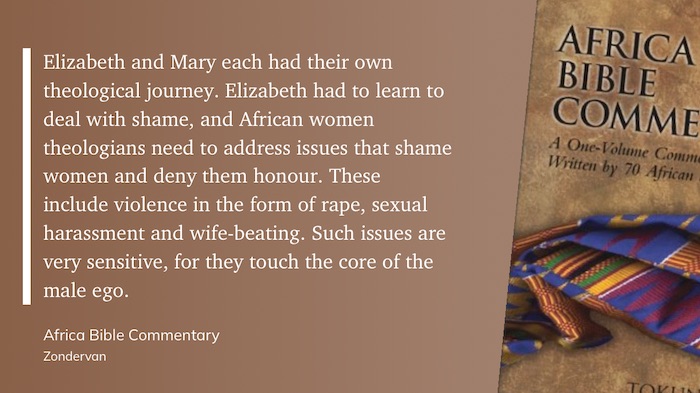
⬇️ Africa Bible Commentary
Zondervan
Adeyemo, Tokunboh, ed. Africa Bible Commentary. Grand Rapids, MI: Zondervan, 2010.
4th Sunday of Advent - YEAR C
Click on slide to view full screen
⬇️ Life Recovery Bible
Tyndale House
Publishers
Arterburn, S., & Stoop, D. (Eds.) NLT Life Recovery Bible, Second Edition. Tyndale House Publishers, 2021.
4th Sunday of Advent - YEAR C

Click on slide to view full screen

SCRIPTURE
SEARCH
FIRST READING (25)
SECOND READING (10)
GOSPEL (41)
This tool created by Jeff Pinyan uses the CCEL Early Church Fathers digital edition of the Philip Schaff collection.
4th Sunday of Advent - YEAR C
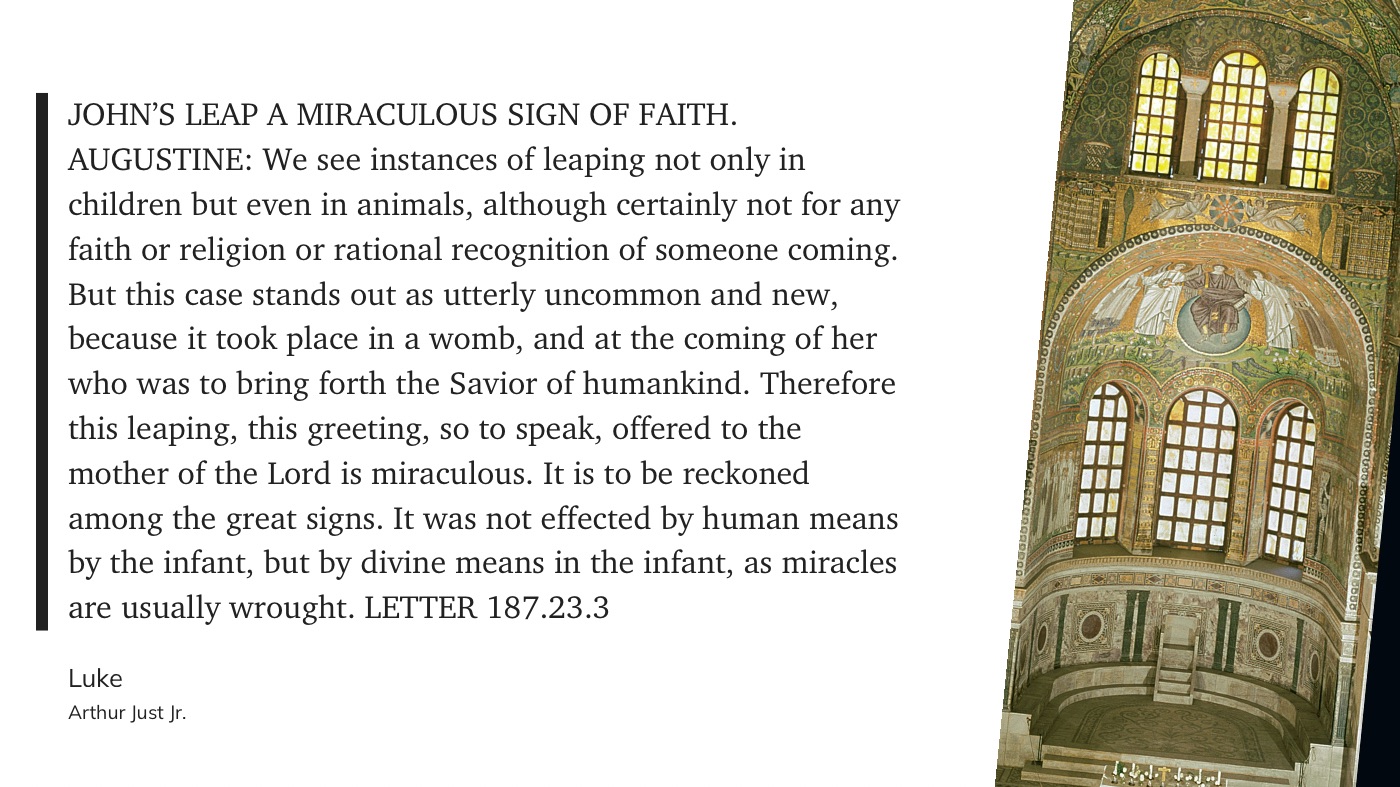
Just Jr., A., Oden, T. C., Carson, D. A., & Oden, E. (Eds.). (2003). Ancient Christian Commentary on Scripture: New Testament III, Luke (Vol. 3). IVP Academic.
IN BRIEF
I. The Strengthening of Mary’s Faith: Mary’s faith is strengthened by the Angel’s revelation, and she serves as an example for others to avoid idleness and gossip, embracing the Holy Spirit’s grace.
II. Mary’s Haste and Humility: Mary’s eagerness to visit Elisabeth demonstrates her humility and commitment to her kinswomen, providing a model for others to follow.
III. Mary’s Initial Secrecy and Confiding in Elisabeth: Despite her initial fears, Mary confides in Elisabeth, showcasing the importance of their close bond and familial relationship.
IV. The Fruits of Mary’s Visit: The divine presence becomes evident during Mary’s visit, as John’s prophetic recognition of Christ leads to a miraculous connection between the two mothers. Elisabeth acknowledges Mary’s blessedness, and Mary’s role as the sole parent of the Divine offspring is emphasized.
V. The Blessing of Mary and the Divine Nature of Christ’s Conception: Mary is revered by both humans and angels, with her divine conception distinguishing Christ’s birth from others.
VI. The Sinless Nature of Christ and Refuting Heresies: The sinless nature of Christ, stemming from Mary’s substance, serves to refute heretical views about Christ’s nature and conception.
VII. Elisabeth’s Humble Response and Strengthening Faith This section emphasizes the humility of Elisabeth in response to Mary’s visit. Elisabeth acknowledges that it is through divine grace that she, the mother of a prophet, is greeted by Mary, the mother of the Lord. Her humble inquiry, “Why am I so honored?” demonstrates her recognition of the divine intervention in their encounter. This event serves to strengthen and grow Elisabeth’s faith. Moreover, Mary’s visit to Elisabeth leads to John’s recognition of Christ, establishing his role as the forerunner and prophet. The divine orchestration of this connection highlights the significance of Mary and Elisabeth’s encounter, reinforcing the idea that their meeting serves a greater purpose in God’s divine plan.
VIII. The Miraculous Joy and Divine Power The joy experienced by the unborn child, John, is attributed to divine power rather than human capability. Augustine argues that even if the child had the capacity for reason and faith, the event should still be considered a miracle. This miraculous joy highlights the divine presence and power throughout the narrative. Additionally, Theophylact discusses the impact of Elisabeth’s words on Mary’s faith. By praising Mary’s faith and affirming the divine promises given to her, Elisabeth becomes the first to experience the fruit of salvation. This exchange between the two women underscores the importance of faith in the biblical story.
IX. The Impact of Faith and Embracing the Word of God
Ambrose commends Mary’s faith and emphasizes its importance for believers. Through faith, believers can conceive and bear the Word of God, recognizing His works. This demonstrates the connection between faith and a deeper understanding of God’s plan. Furthermore, Bede discusses the transformative power of embracing the Word of God. By embracing God’s Word, individuals can climb the heights of virtue, engage in prayer and praise, and ultimately perfect their faith, hope, and love. This highlights the central role of faith in the spiritual journey.
X. Elisabeth’s Prophetic Gift and God’s Divine Plan This section explores the divine gift of prophecy bestowed upon Elisabeth by the Holy Spirit. This gift allows her to perceive the truth of Mary’s pregnancy, her role as the mother of the Redeemer, and the future unfolding of God’s divine plan. Elisabeth’s prophetic insight emphasizes the divine intervention in the story and further demonstrates the interconnectedness of Mary and Elisabeth’s encounters with God’s plan.
A Modern Adaptation of
Catena Aurea
The Catena Aurea, which means “Golden Chain” in Latin, is a comprehensive biblical commentary comb is a 13th-century biblical commentary compiled by St. Thomas Aquinas. This anthology features insights from over eighty Church Fathers on the four Gospels.
THE WORD THIS WEEK has used AI generative technology to create this modern translation, outline and study notes, enhancing accessibility and comprehension of the text for contemporary audiences.
Luke 1:39-45
I. The Strengthening of Mary’s Faith
AMBROSE: When the Angel revealed the hidden mysteries to the Virgin, he shared the story of a barren woman’s conception to strengthen her faith. Mary, filled with God’s grace, eagerly traveled to the hill country, not doubting the message or the messenger. Learn from her, virgins, to avoid idleness and gossip, for the Holy Spirit’s grace doesn’t work slowly.
II. Mary’s Haste and Humility
ORIGEN: Mary’s haste was due to Jesus’ eagerness to sanctify John while both were still in their mothers’ wombs. This led to her quick arrival.
AMBROSE: Virgins, learn from Mary’s example of humility, attentiveness, and dedication to her kinswomen. Despite her modesty and seclusion, Mary didn’t let her pregnancy hinder her from performing her duties or traveling to her cousin Elisabeth.
THEOPHYLACT: Mary serves as a model of piety and humility, as she humbled herself by visiting her elder kinswoman and offering salutations despite being the younger one. Let this be a lesson for all virgins to embrace humility alongside their chastity.
III. Mary’s Initial Secrecy and Confiding in Elisabeth
CHRYSOSTOM: Initially, Mary kept the events to herself, fearing that sharing her story would lead to disbelief or accusations of guilt.
GREEK EXPOSITOR: However, Mary eventually confided in Elisabeth due to their close bond and familial relationship.
IV. The Fruits of Mary’s Visit
AMBROSE: The fruits of Mary’s visit and our Lord’s presence soon became evident when Elisabeth heard Mary’s salutation, causing the babe in her womb to leap. Observe the precise language used: Elisabeth heard first, but John experienced the grace first. Elisabeth’s response was natural, while John’s was due to the divine mystery at play.
GREEK EXPOSITOR: John, being a prophet, recognized and reacted to the presence of Christ more intensely than his mother. Filled with the Holy Spirit, John’s joy was expressed through his leaping, causing Elisabeth to be filled with the Spirit as well. This event demonstrates the miraculous nature of divine grace.
AMBROSE: Elisabeth, once ashamed of her pregnancy, now rejoices in carrying a prophet and acknowledges Mary’s blessedness for her role in the holy birth. She exclaims with a loud voice to signify the importance of the Lord’s arrival. Mary is blessed among women because she is the sole parent of the Divine offspring.
V. The Blessing of Mary and the Divine Nature of Christ’s Conception
BEDE: Both Elisabeth and Gabriel bless Mary with the same words, emphasizing her reverence by both humans and angels.
THEOPHYLACT: Elisabeth specifies the blessing as the fruit of Mary’s womb to distinguish this birth from others, since even holy women have given birth to sinful offspring. This interpretation connects to the use of “and” in place of “because” in the Holy Scriptures.
TITUS BOSTRENSIS: Christ is appropriately called the fruit of Mary’s womb, as He came only from her and not from a human father. This emphasizes the divine nature of His conception.
VI. The Sinless Nature of Christ and Refuting Heresies
GREEK EXPOSITOR: The fruit is considered blessed due to its sinless nature, stemming from the virgin’s substance. This passage also serves to refute certain heretical views about Christ’s nature and conception.
BEDE: The prophecy about the fruit of David’s body being placed on the throne is fulfilled in Christ, the fruit of Mary’s womb.
GREEK EXPOSITOR: Elisabeth’s words and her Spirit-filled state challenge those who deny the true child-bearing role of the Mother of God and attempt to diminish the nature of Christ’s flesh. The fruit’s direct connection to the tree’s substance further disproves these ideas.
VII. Elisabeth’s Humble Response and Strengthening Faith
AMBROSE: Recognizing that it was not by her own merit but by divine grace that the mother of the prophet should be greeted by the mother of the Lord, Elisabeth humbly asks, “Why am I so honored?” This event serves to strengthen and grow her own faith.
ORIGEN: Mary’s visit to Elisabeth led to John’s recognition of Christ, establishing his role as the forerunner and prophet. This miraculous connection between the two mothers was divinely orchestrated.
VIII. The Miraculous Joy and Divine Power
AUGUSTINE: The joy experienced by the unborn child is a miracle, as it is beyond the understanding of a little child. Even if the child had the capacity for reason and faith, this event should still be attributed to divine power rather than human capability.
THEOPHYLACT: The words of Elisabeth praise Mary’s faith and affirm the divine promises given to her. Her belief in these promises makes her the first to experience the fruit of salvation.
IX. The Impact of Faith and Embracing the Word of God
AMBROSE: Mary’s faith is commendable, and it is through faith that believers can also conceive and bear the Word of God, recognizing His works.
BEDE: Those who embrace the Word of God are led to climb the heights of virtue and enter the realm of prayer and praise, ultimately perfecting their faith, hope, and love.
X. Elisabeth’s Prophetic Gift and God’s Divine Plan
GREGORY: The Holy Spirit granted Elisabeth the gift of prophecy, allowing her to perceive the truth of Mary’s pregnancy, her role as the mother of the Redeemer, and the future unfolding of God’s divine plan.

IN BRIEF
Several Catholic doctrines can be connected to the themes found in Luke 1:39-45:
1. Marian Dogmas: The passage highlights Mary’s role as the Mother of God (Theotokos) and her perpetual virginity. Her unique role in salvation history is acknowledged by Elisabeth’s recognition of her blessedness among women (CCC 495, 721).
2. Christ’s Divine and Human Nature: Elisabeth’s reference to Mary as “the mother of my Lord” acknowledges Christ’s divine nature, while the mention of Mary’s womb emphasizes His human nature. This aligns with the Catholic doctrine of the hypostatic union, which states that Christ is both fully divine and fully human (CCC 464-469).
3. The Immaculate Conception and Mary’s Sinless Nature: The recognition of Mary’s blessedness and the fruit of her womb can be connected to the Catholic doctrine of the Immaculate Conception, which states that Mary, from the moment of her conception, was preserved from original sin and filled with divine grace (CCC 490-492).
4. The Sanctification of John the Baptist: The miraculous connection between Mary’s greeting and John’s reaction in Elisabeth’s womb can be seen as a sign of John’s sanctification and his prophetic role in recognizing Christ. This event foreshadows John’s later ministry as the forerunner of Jesus (CCC 523, 719).
5. The Action of the Holy Spirit: The narrative emphasizes the role of the Holy Spirit in the events that unfold, from Mary’s conception of Christ to Elisabeth’s inspired exclamation. This highlights the Catholic doctrine of the Holy Spirit’s active presence and guidance in the lives of believers (CCC 717, 727).
6. The Fulfillment of Divine Promises: The passage emphasizes the fulfillment of divine promises, as Elisabeth blesses Mary for her faith in God’s word. This theme reflects the Catholic belief in the divine revelation and the importance of trusting in God’s providence (CCC 142-143, 146).
4th Sunday of Advent - YEAR C
READING 1 | READING 2 | GOSPEL | COMMENTARY
Lk 3:10-18

Verse 39: "During those days Mary set out and traveled to the hill country in haste to a town of Judah,"
Commentary: Mary's prompt response to the Angel's revelation demonstrates her deep faith and trust in God's divine plan. She serves as a model of obedience and humility, immediately embarking on a journey to visit her cousin Elisabeth. (CCC 148, 494)
Verse 40: "where she entered the house of Zechariah and greeted Elizabeth."
Commentary: Mary's action of greeting Elisabeth showcases her attentiveness and dedication to her kinswomen. This encounter between the two mothers becomes a pivotal moment, as it allows the divine connection between their unborn children to unfold. (CCC 148, 717)
Verse 41: "When Elizabeth heard Mary's greeting, the infant leaped in her womb, and Elizabeth, filled with the Holy Spirit,"
Commentary: The divine power at play is revealed through the unborn child's reaction to Mary's greeting. John, being a prophet, recognizes and reacts to the presence of Christ more intensely than his mother, Elisabeth. This event showcases the miraculous nature of divine grace. (CCC 717, 720)
Verse 42: "cried out in a loud voice and said, “Most blessed are you among women, and blessed is the fruit of your womb."
Commentary: Elisabeth's proclamation highlights Mary's unique role as the Mother of God, carrying the divine offspring. The recognition of Mary's blessedness among women emphasizes the importance of her role in God's divine plan of salvation. (CCC 722, 726)
Verse 43: "And how does this happen to me, that the mother of my Lord should come to me?"
Commentary: Elisabeth's humble inquiry displays her understanding of the divine grace that has brought Mary, the mother of the Lord, to her. This interaction between Mary and Elisabeth serves to strengthen their faith and emphasizes the divine intervention guiding their encounter. (CCC 495, 723)
Verse 44: "For at the moment the sound of your greeting reached my ears, the infant in my womb leaped for joy."
Commentary: This verse reiterates the miraculous connection between Mary's greeting and John's reaction in Elisabeth's womb. The divine power at work becomes evident as the unborn child experiences joy upon recognizing the presence of Christ. (CCC 720)
Verse 45: "Blessed are you who believed that what was spoken to you by the Lord would be fulfilled.”
Commentary: Elisabeth's blessing upon Mary acknowledges her unwavering faith in the divine promises given to her. Mary's belief in these promises serves as an example for all believers, demonstrating the power of faith in God's divine plan. (CCC 148, 724)