Commentary Intro to Mass Readings for Sunday
CommentaryIntro to Mass Readings for Sunday
March 15, 2026
March 22, 2026
5th Sunday of Lent (A)


Content produced, written, and narrated by Larry Broding. Copyright 2017. Titles and infographics created by TWTW, 2026. Permission given for personal use or for use in any non-profit ministry. Content may not be sold or used for personal financial gain.
When God Delays

by Larry Broding
As a young man nearly four decades ago, I learned a hard spiritual lesson. God works at the last moment, but always, always at the right time. In my case, a broken heart led so ever slowly to a deep, abiding love I share with my wife, Andrea.
When I first met her, I was on the rebound, licking my emotional wounds. I soon discovered I had a crush on Andrea, but so many things got in the way that it took nearly 18 months to realize the fulfillment of that aspiration. I fretted about it, I got angry about it, and I prayed about it.
I was even ready to give up on my feelings for her, but one magic night that all changed, and my life has never been the same. And God dragged out my deep desire almost to my breaking point, then answered my prayer perfectly.
God seemed to act at the last minute, but always at the right moment. That’s the moral of one of the most dramatic narratives of the Bible, the resurrection of Lazarus.
DISCUSSION QUESTIONS
TRY IT OUT: Copy and paste a question into the Catholic Assistant (bottom right corner) to receive an AI-generated response.
- Can you share an experience where a perceived delay in your own life ultimately led to a better outcome?
- How do you typically handle the “waiting period” when praying for something deeply important to you, and how can we support each other during those times?
The Revelation of “I Am”
When Jesus heard that a close friend had died, he hesitated to return. Despite his followers’ misgivings about the delay of Jesus, the Master insisted that his eventual journey to the family and the grave of Lazarus would give glory to God.
Jesus would act at the last minute, but it would be the right moment. Why did Jesus hesitate to see his friend? The answer can be summed up in one word, revelation. When Jesus arrived, he discussed the situation with Martha, but in the context of faith. He told her that Lazarus would rise again. She responded with the generally held view in the final resurrection.
Then Jesus made a remarkable statement,
I am the resurrection and the life.
In these few words, Jesus revealed his divinity to Martha. The phrase, I am, was a code John the Evangelist used in his gospel that echoed the title God gave to Moses, “I am who am.”
Jesus also connected his divinity to his mission. In him, people would be raised from the dead and would live with God in his kingdom. He was God, and he was the conduit to eternal life. That was the message Jesus presented to Martha, and she responded in faith.
DISCUSSION QUESTIONS
- How does knowing that God sometimes uses delays to reveal more of Himself change your perspective on unanswered prayers?
- How does viewing Jesus not just as a teacher or healer, but as God Himself, change the way you approach Him in moments of grief or crisis?
The Miracle That Reinforced Faith
When Jesus visited the tomb, he ordered the stone removed. Martha objected because of the stench, but Jesus insisted. In doing so, he set up the second moment of revelation. He declared this would give glory to God, and he prayed so that the witnesses would believe in him. Then he spoke the command, Lazarus, come out here. The appearance of Lazarus revealed the power of Jesus and caused faith among the mourners.
If we connect the statement of Jesus, “I am the resurrection and the life,” with the raising of Lazarus, we can see that the word of revelation produced a result that reinforced faith in the revelation.
In other words, when Lazarus rose from the dead, his appearance added proof and context to faith in Jesus as God and as the way to the kingdom at the end of time. By the command of Jesus, Lazarus was raised.
DISCUSSION QUESTIONS
- What “practical” fears, doubts, or worldly logic sometimes prevent us from fully trusting and obeying God’s commands?
- Can you think of a time when a tangible action, event, or answered prayer helped cement a spiritual truth for you?
The Promise of the Spirit
By the command of Jesus, we will be raised and will live with him forever. The revelation of Jesus gave hope to those who mourn the loss of Lazarus, and it gives us hope.
The promise God made through the prophet Ezekiel echoed through the activity of the Christ.
My people, I will open your graves and bring you back to my land. Then you will know I am Yahweh. I will pour out my life-giving spirit into you. Then you will know I am Yahweh.
That’s what Jesus did. He revealed himself by bringing Lazarus back from the dead.
He does the same for us when he gives us the Spirit, for in the Spirit we are able to turn away from spiritual death and toward eternal life, just as St. Paul wrote the church at Rome. When the Spirit dwells in us, we know that Ezekiel’s words were meant for us.
Now, yes, Jesus hasn’t returned on over two millennia, and yes, the skeptics used that fact to deride our faith, but you know, really, that shouldn’t deter us. God acts at the last minute, but always, always at the right moment.
DISCUSSION QUESTIONS
- In what ways do we experience “spiritual death” in our daily lives, and how does the Holy Spirit offer resurrection right now?
- How does the central theme—”God acts at the last minute, but always at the right moment”—help anchor your faith when faced with doubt or skepticism?


Larry Broding
Word-Sunday
Ezekiel 37:12-14
Spirit-Renewed Life
How do you find hope in the midst of gloom?
As a preacher, connecting the profound despair of the ancient Israelites with the modern struggles of your congregation can be challenging. In his insightful commentary on Ezekiel 37, Larry Broding explores the stark reality of the prophet Ezekiel—a Temple priest swept into Babylonian exile around 597 B.C. Broding highlights how Ezekiel, despite proclaiming a message of extreme doom from his resettlement in modern-day Iraq, ultimately pointed to an almost unreal, miraculous hope in God’s restorative power.

Non-profits have permission to use TWTW clip art.

Why this commentary matters for your homily:

- Contextualizes Deep Spiritual Despair: It grounds the famous “Valley of Dry Bones” vision in the very real, historical hopelessness of the exiled Jews, making the emotional stakes clear and relatable for an audience facing their own seasons of exile.
- Highlights the Contrast of Divine Power: Broding emphasizes the core message of grace: what humanity cannot do for itself, God accomplishes effortlessly. He vividly contrasts the finality of death with the life-giving command of the Lord to reconstitute flesh and breathe life back into dust.
- Provides a Clear Christological Bridge: The commentary seamlessly connects Ezekiel’s ancient prophecy of a spiritual resurrection to its fullest, ultimate context in the person of Jesus Christ, offering you a clear path to preach Gospel hope.
- Inspires Tangible, Forward-Looking Hope: It reminds us that God’s work is ongoing—He continues to breathe His Spirit into His people today, promising them a renewed purpose, a new place in His land, and a final divine revival.
Read Larry Broding’s full commentary to help your congregation move from a place of spiritual exhaustion into the revitalizing breath of God’s Spirit, anchoring their hope in the resurrection promises of Jesus Christ.

THE WORD THIS WEEK infographics on this page were created using using GOOGLE’S AI Gemini 3 Pro. You are free to use the them in any non-profit ministry. Proper attribution, however, must be given to Larry Broding at Word-Sunday.com.
Larry Broding
Word-Sunday
Romans 8:8-11
The Ultimate Life Insurance Policy
Are you comfortable with your present life insurance coverage?
How do you explain the promise of the Resurrection and the ongoing work of the Holy Spirit to a modern congregation? In this thought-provoking reflection, Larry Broding uses the clever, everyday analogy of a “life insurance policy” to unpack the profound theological truth of eternal life. By comparing our worldly bets against death with God’s ultimate guarantee of life through the Spirit, Broding offers a highly relatable framework for understanding grace, human freedom, and the necessity of daily spiritual renewal.

Non-profits have permission to use TWTW clip art.

Why this commentary matters for your homily:
- Provides a Highly Relatable Hook: The life insurance analogy immediately grabs attention, taking an abstract theological concept—eternal life and the resurrection of the dead—and making it accessible and understandable for the average person in your pews.
- Emphasizes the Power of the Spirit: It reminds listeners that our eternal security isn’t just a corporate guarantee, but is backed by the very Spirit that created the universe and raised Christ from the dead.
- Frames Free Will as an “Escape Clause”: Broding eloquently addresses our human tendency to live for the world. Instead of heavy-handed condemnation, he frames sin and worldliness as a voluntary opting-out of God’s life-giving policy, respecting human agency.
- Offers Profound Pastoral Reassurance: The commentary provides a comforting reminder for those struggling with sin: the simple fact that they are trying to seek Christ is evidence that the Holy Spirit is already actively working within them as a gift of grace.
- Issues a Clear Call to Daily Action: It shifts the focus of salvation from a distant, future event to a present reality. It challenges the congregation to “renew the policy” daily through active prayer and spiritual practice.
Read Larry Broding’s full commentary to help your congregation understand the incredible security they have in God’s eternal promise and to inspire them to actively renew their commitment to the Spirit every single day.

THE WORD THIS WEEK infographics on this page were created using using GOOGLE’S AI Gemini 3 Pro. You are free to use the them in any non-profit ministry. Proper attribution, however, must be given to Larry Broding at Word-Sunday.com.
John 11:1-45
Hope in a
Time of Loss
How many of you have been really tired, too tired to even have fun?
In spite of all our human efforts, death remains our shared, inescapable reality—but how we face it profoundly shapes our spiritual lives. In his compelling commentary on the raising of Lazarus in John 11, Larry Broding challenges preachers to look beyond the literal tragedy of the grave to see the profound hope embedded in Christ’s actions. Broding meticulously unpacks the journey of Mary, Martha, and the disciples as they struggle to elevate their understanding of Jesus from a mere physical healer to the divine “I AM.”

Non-profits have permission to use TWTW clip art.
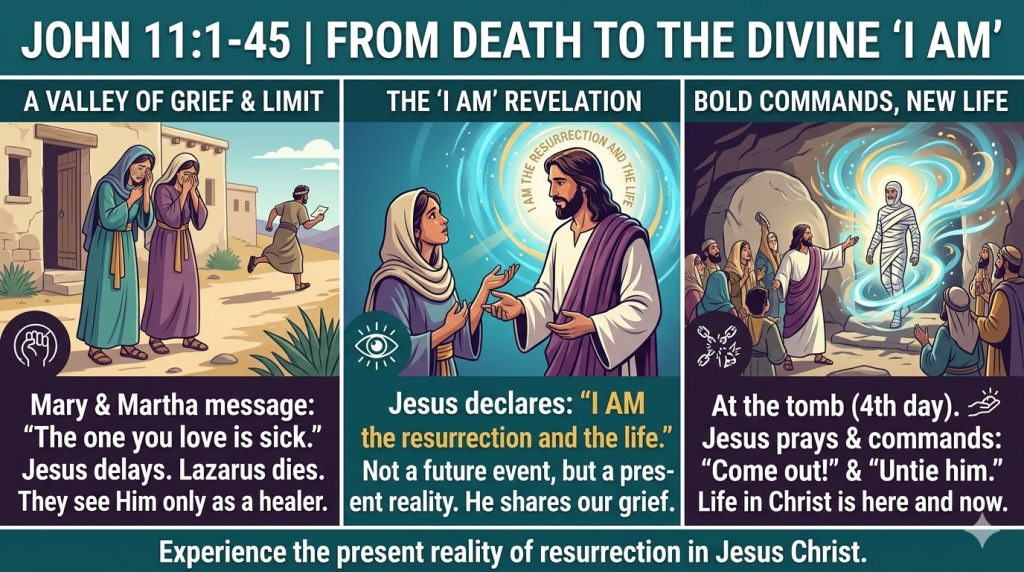
Why this commentary matters for your homily:
- Explores the Spectrum of Faith: Broding highlights the raw, limited faith of the sisters who believed Jesus could have healed their brother before he died, contrasting it with Christ’s invitation to trust in Him as the present reality of resurrection and life.
- Unpacks Rich Johannine Metaphors: The commentary decodes Jesus’s use of mixed metaphors—light versus dark, and death as slumber—giving you fresh ways to explain spiritual blindness and the restorative power of Christ to your listeners.
- Leverages First-Century Cultural Context: By explaining the contemporary Jewish belief that a soul hovered near the body for only three days, Broding raises the stakes of Jesus arriving on the fourth day. It transforms a simple delay into a definitive demonstration of God’s absolute power over true, irreversible death.
- Humanizes the Divine: It examines the complex emotions of Jesus, noting both his genuine sorrow for a lost friend and his indignation at the crowd’s immature faith. This provides a deeply relatable touchpoint for grieving parishioners who are struggling to understand God’s timing.
- Shifts Focus from Future to Present: Broding masterfully flips the theological script, emphasizing that eternal life isn’t just a future resurrection on the day of judgment, but a present reality for those who entrust themselves to Christ today.
Read Larry Broding’s full commentary to help your congregation face the reality of mortality not with despair, but with the triumphant, present hope of Jesus Christ, who calls us out of the tomb and into eternal life.
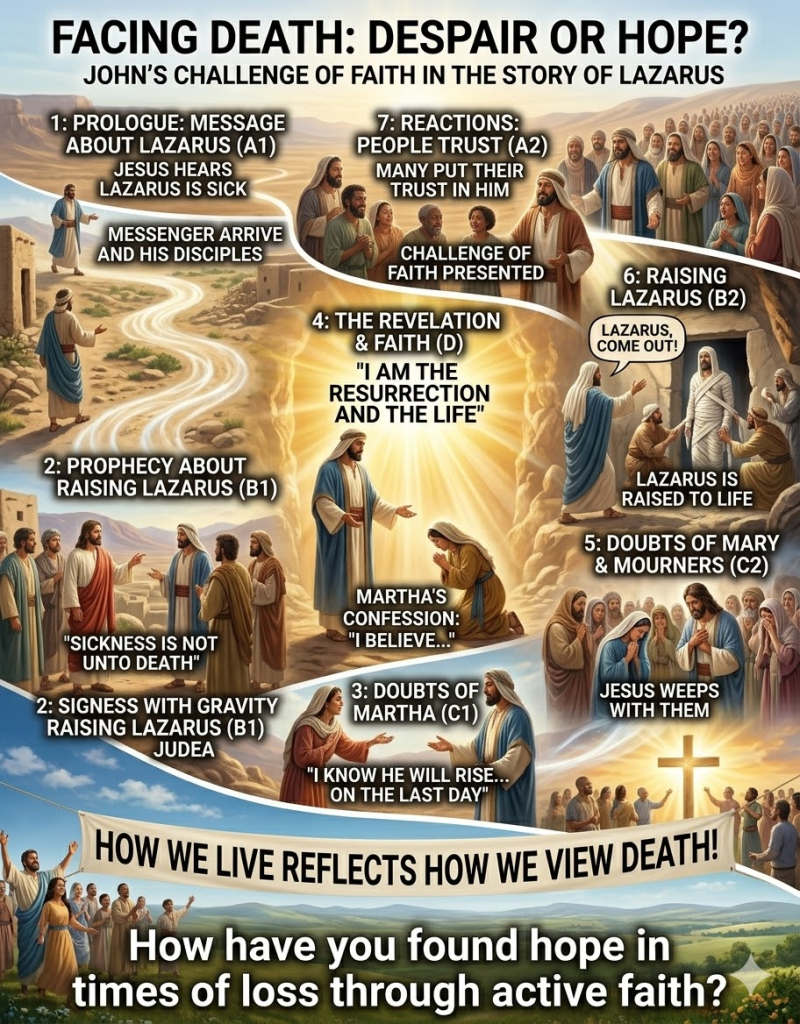
THE WORD THIS WEEK infographics on this page were created using using GOOGLE’S AI Gemini 3 Pro. You are free to use the them in any non-profit ministry. Proper attribution, however, must be given to Larry Broding at Word-Sunday.com.