APR 20, 2025


Homilies
Homilies


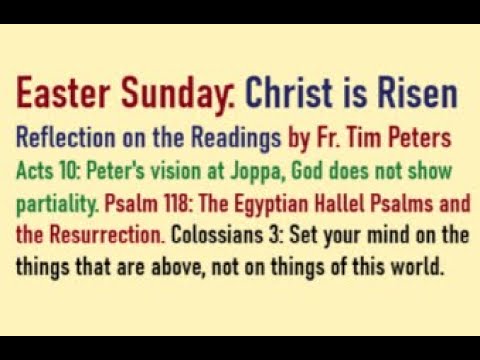


Catholic Women Preach
The Resurrection of the Lord

2025

2022
Visit the website for details on preachers, readings, and texts of preaching.


Commentaries

- Kieren O’Mahony OSA
- Fr. Conley Bertrand
- Fr. George Corrigan OFM
- Fr. Thibodeau
- St. Charles Borromeo
- Edriann Ezell
- Vince Contreras
- Bp. John P. Dolan
- Fr. Eamon Tobin
- Carmelite Lectio Divina
The Conversion of Cornelius

This passage is an early summation of the Gospel. Notice what is included and what is missing. Peter began with the reputation of Jesus after John’s ministry [37]; the author of Acts assumes John’s life was common knowledge.
The Resurrection of the Lord
Peter’s Proclamation
Acts 10:34a, 37-43
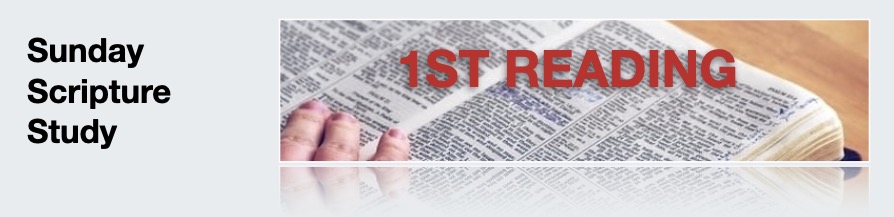
1ST READING
Key Points

I. Peter’s Speech (Acts 10:34a)
- Peter begins to speak, acknowledging that God shows no partiality.
II. The Life and Ministry of Jesus (Acts 10:37-39)
- Peter describes Jesus’ baptism by John the Baptist.
- Jesus’ anointing with the Holy Spirit and his public ministry.
- His crucifixion, death, and burial are recounted.
III. The Resurrection and Witnesses (Acts 10:40-41)
- Peter testifies to Jesus’ resurrection and appearances to chosen witnesses.
- The apostles are commanded to preach and testify to the people.
IV. The Message of Salvation (Acts 10:42-43)
- Peter proclaims Jesus as the judge of the living and the dead.
- Belief in Jesus leads to forgiveness of sins through his name.
Clipart by Fr. Richard Lonsdale; pop-up links direct to Catholic centered content on Google AI search
The Resurrection of the Lord
1ST READING
Context
HISTORY
Acts 10:34a, 37-43 recounts part of Peter’s speech during the conversion of Cornelius, a Roman centurion, which marked a crucial turning point in the spread of Christianity among Gentiles. The political and historical context of this passage is vital for understanding its significance.
During this period (around 40-60 AD), the Roman Empire was in power, and its vast territory encompassed diverse cultures and religions. Cornelius, as a Roman centurion, represented the ruling elite and the Empire’s might. However, his status as a God-fearing Gentile demonstrates the openness of some individuals to religious ideas beyond the Roman pantheon.
In this context, Peter’s speech emphasizes Jesus’ universal message and affirms the divine impartiality that extends salvation to all. This event symbolizes the breaking of religious and cultural barriers, allowing for the inclusion of Gentiles in the Christian community.
The author, traditionally believed to be Luke, was a Greek-speaking physician and companion of Paul. As part of the early Christian movement, Luke’s account was written with a focus on the spread of Christianity and the formation of the Church. The intended audience was likely fellow Christians and converts interested in the history and development of their faith.
Overall, Acts 10:34a, 37-43 represents a pivotal moment in the early Christian movement. It illustrates the intersection of religious, political, and cultural elements, revealing the transformative power of the Gospel and its impact on diverse societies.
The Resurrection of the Lord
SOCIETY
Acts 10:34a, 37-43 records Peter’s speech during a significant encounter between early Christians and Gentiles, revealing sociological and cultural insights into the growth of Christianity. The passage challenges prevailing customs, beliefs, and practices while establishing new interpretations and standards for the expanding faith.
In the 1st century, Jewish society had strict rules and traditions that separated Jews from Gentiles. Stereotypes and prejudices were prevalent, with many Jews viewing Gentiles as unclean or sinful. However, the speech emphasizes God’s impartiality, breaking down barriers and extending salvation to all who believe in Jesus. This message confronts traditional social structures, demanding acceptance, unity, and love among different people groups.
Peter’s speech also highlights the importance of witnessing and testifying about Jesus’ life, death, and resurrection. This act of sharing personal experiences and beliefs was instrumental in attracting new converts and shaping the identity of the early Christian community.
For the original audience, the passage affirmed their faith while challenging them to reach out to others, embracing a broader mission to spread the Gospel beyond traditional cultural and social boundaries. It emphasized the role of individual testimonies and the significance of preaching, establishing these practices as essential elements of Christian culture and identity.
In conclusion, the sociological and cultural context of Acts 10:34a, 37-43 reveals a pivotal moment in the development of the early Christian movement. The passage reflects the challenges and opportunities presented by religious and cultural diversity while encouraging believers to adopt a more inclusive perspective and share their faith with others.
The Resurrection of the Lord
THEOLOGY
Acts 10:34a, 37-43 highlights the importance of God’s impartiality, the salvation through Jesus Christ, and the need for witness and testimony, which form the basis of Roman Catholic theology and have significant implications for contemporary Catholics.
A central theme in the passage is the universality of God’s love and salvation, which aligns with the Catholic belief that the Church is a “universal sacrament of salvation” (Lumen Gentium, 48). The Church embraces its mission to preach the Gospel to all nations, welcoming people of all backgrounds.
Peter’s speech in this passage also emphasizes the resurrection of Jesus, which remains a cornerstone of Catholic theology. The resurrection affirms Jesus’ divinity and his power to conquer death. This message is particularly meaningful during the Easter season, as Catholics celebrate and reflect on the salvific events of Christ’s passion, death, and resurrection.
Moreover, the passage illustrates the importance of bearing witness to the Gospel through words and deeds—a task incumbent upon all Catholics. As St. Francis of Assisi said, “Preach the Gospel at all times; if necessary, use words.” This dual emphasis on proclamation and action is crucial for contemporary Catholics, who are called to share their faith while demonstrating love, compassion, and justice in their daily lives.
In conclusion, Acts 10:34a, 37-43 underscores essential aspects of Roman Catholic theology, including salvation, universality, and the importance of witness and testimony. These theological themes remain relevant today, guiding contemporary Catholics to share their faith and follow Christ’s example of love and service to others.
The Resurrection of the Lord
1ST READING
Wikipedia
The Resurrection of the Lord
Agape Bible Study
Commentaries
- Kieren O’Mahony OSA
- Fr. Conley Bertrand
- Fr. George Corrigan OFM
- Fr. Thibodeau
- St. Charles Borromeo
- Edriann Ezell
- Vince Contreras
- Bp. John P. Dolan
- Fr. Eamon Tobin
- Carmelite Lectio Divina
Clean Out the Old Yeast!
Using the analogy of the Passover meal, Paul urged repentance in the community. Repentance was, of course, a turning away from sin. And a turning toward God. The turning away implied a change of heart and mind.
The Resurrection of the Lord
Celebration
1 Corinthians 5:6b-8
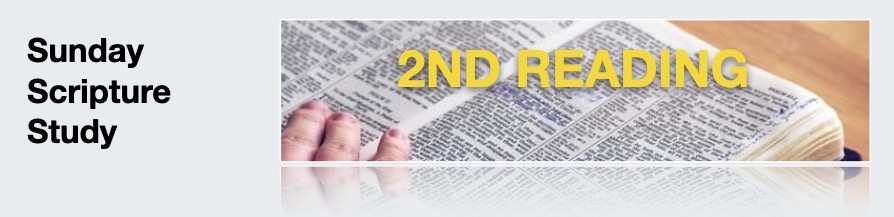
2ND READING
Key Points

I. Removal of Leaven (1 Corinthians 5:6b-7)
- Paul draws a comparison between leaven (yeast) and sin, warning the Corinthians to remove the “old yeast” of immorality and wickedness from their community.
- He emphasizes the necessity of maintaining a pure and holy body of believers, as a little leaven can corrupt the whole batch of dough.
- Paul’s exhortation is a call for repentance, transformation, and renewal, urging the Corinthians to become a new, unleavened batch of dough, free from the influences of sin and worldliness.
II. Commemoration of Passover (1 Corinthians 5:8)
- Reminds the Corinthians to celebrate the Passover feast, which commemorates Israel’s liberation from slavery in Egypt and foreshadows the redemption achieved by Jesus Christ.
- In celebrating with the new unleavened bread, Paul emphasizes the importance of living a life of sincerity and truth, as Jesus Christ, the true Paschal Lamb, has been sacrificed for the salvation of humanity.
- The passage highlights the Eucharistic significance of the feast, as the unleavened bread represents the body of Christ, offered for the forgiveness of sins and the restoration of communion with God.
- By participating in the Passover celebration and embracing the life-giving presence of Christ, the Corinthians are called to leave behind the bondage of sin and enter into a new life of freedom, holiness, and communion with God and one another.
Clipart by Fr. Richard Lonsdale; pop-up links direct to Catholic centered content on Google AI search
The Resurrection of the Lord
2ND READING
Context
HISTORY
1 Corinthians 5:6b-8 discusses the celebration of Passover within the context of the early Christian community in Corinth, highlighting the historical and political backdrop of the time. The passage demonstrates how Paul navigated cultural and religious practices while fostering unity among the diverse members of the Church.
During the 1st century, the Roman Empire controlled much of the Mediterranean region, including Corinth. This multicultural environment brought together individuals from various religious backgrounds, creating a complex landscape of beliefs and practices. Paul, a well-educated Jewish Roman citizen, recognized the need to contextualize Christian teaching within this diverse setting.
The primary audience for Paul’s letter was the Christian community in Corinth, which faced internal divisions and confusion about how to integrate their faith with existing cultural practices.
The Resurrection of the Lord
SOCIETY
1 Corinthians 5:6b-8 addresses the early Christian community in Corinth, offering insights into its social and cultural context. The passage encourages the removal of old yeast (sin) and the celebration of the Passover feast with new unleavened bread, highlighting the need to forsake immorality and embrace a Christ-centered lifestyle.
During this time, the Corinthian society was characterized by pagan practices, immorality, and divisions. The community struggled to maintain a distinct Christian identity and faced challenges in upholding moral standards. Paul’s emphasis on removing sin, as represented by old yeast, reflects his concern for the spiritual well-being of the Corinthians.
The celebration of Passover was a significant practice for early Christians, symbolizing their identity as God’s chosen people and the sacrifice of Jesus Christ. Paul’s instruction to celebrate with unleavened bread (representing sincerity and truth) underscores the need for genuine faith and a commitment to holy living.
For the original audience, the passage urged them to address the moral issues within their community and strengthen their Christian identity in a challenging socio-cultural context. By embracing the message of renewal, holiness, and unity, they could better navigate the influences of the surrounding society and become a shining example of the transformative power of the Gospel.
In conclusion, 1 Corinthians 5:6b-8 reveals significant sociological and cultural aspects of the early Corinthian Christian community, emphasizing the need for moral integrity, spiritual renewal, and communal unity in the face of various challenges and influences.
The Resurrection of the Lord
THEOLOGY
1 Corinthians 5:6b-8 offers valuable theological insights and practical applications for contemporary Catholics. The passage emphasizes the importance of spiritual renewal, the celebration of the Eucharist, and the pursuit of holiness in the lives of believers.
Catholic theology recognizes the need for ongoing conversion and spiritual growth. The call to remove “old yeast” (sin) and embrace a new life in Christ reflects the sacrament of reconciliation, where Catholics confess their sins, receive absolution, and commit to a life of holiness. This process is essential for maintaining communion with God and the Church.
The passage also highlights the Eucharist’s centrality in Catholic worship, where unleavened bread represents the body of Christ. As St. Thomas Aquinas noted, “The Eucharist is the sacrament of love; it signifies love, it produces love” (Summa Theologica, III, q. 79, a. 1). For contemporary Catholics, participating in the Eucharistic celebration nurtures their faith, strengthens their unity, and empowers them for mission.
The pursuit of holiness and moral integrity remains a vital aspect of Catholic life. The Catechism of the Catholic Church teaches, “The way of perfection passes by way of the Cross” (CCC 2015). By embracing the message of renewal and holiness in 1 Corinthians 5:6b-8, Catholics today can navigate contemporary challenges, grow in their faith, and serve as living witnesses to the transformative power of the Gospel.
The Resurrection of the Lord
2ND READING
Wikipedia
The Resurrection of the Lord
Agape Bible Study
Commentaries
- Kieren O’Mahony OSA
- Fr. Conley Bertrand
- Fr. George Corrigan OFM
- Fr. Thibodeau
- St. Charles Borromeo
- Edriann Ezell
- Vince Contreras
- Bp. John P. Dolan
- Fr. Eamon Tobin
- Carmelite Lectio Divina
The Empty Tomb
This resurrection scene from John’s gospel emphasized the empty tomb as a cause for faith, not the appearance of Jesus. Later, the vision of the risen Lord would cause others to believe (Mary Magdalene in John 20:14-18 and Thomas 20:26-28).
The time frame and the initial audience for the encounter with the tomb was different in John. In the Synoptic gospels, a group of women (including the Magdalene) reached the tomb just at or after sunrise. But, in John, Mary Magdalene arrived alone before dawn. Unlike the other scenes, Mary ran to Peter and the other disciple (18:15) whom Jesus loved (13:23 and 19:26). They returned and inspected the tomb before Mary saw the angels (20:11-13). John placed the arrival of Peter and the other disciple to heighten the importance of the empty tomb. For John, this took precedent over the vision of angelic messengers.
Why was the empty tomb so important? Part of the answer could have been polemical. The audience of John had been ejected from the synagogues throughout the empire and had endured prejudice by the Jewish population. One of the attacks on John’s audience could have been a challenge to veracity. “Did your Jesus really rise from the dead?” Jewish critics could have exclaimed. “Prove it!”
Witnesses to the empty tomb during burial rites would have supported Christian claims for their Lord. Especially within a tradition that prized the service of those who cared for the dead, despite the fact that such care made one “unclean.” Preparing the body for burial was a cultural privilege and duty that ranked with care for the widows and orphans. Caring for the dead elevated one’s reputation. The discovery of the empty tomb took place in the context of a charitable act. This alone cast the scepter of shame on those who publicly criticized Christians.
But John added another twist. There were two male witnesses to the event (which, in an ancient Jewish court of law, verified the fact of the case). With two male witnesses to the empty tomb, the onus was back upon the critic. The Christian could claim, “We know the body from a sealed tomb was missing.” It would have been only a small leap of faith to conclude the Lord had truly risen! The vision of the angels to a woman and the appearance of a dead man to his followers could not be so easily dismissed as the signs of lunacy or a mass hallucination.
Yet, only the disciple whom the Lord loved believed (i.e., made the connection between the empty tomb and the Lord’s resurrection). After all, Mary Magdalene saw grave robbers as the most likely suspects for the missing body (yet, why would anyone rob the grave of a poor, traveling preacher?) The key to understanding the other disciple’s faith is the phrase “the one Jesus loved.” In John’s gospel, Jesus revealed himself to those he loved. After the resurrection, the “other disciple” (unwavering in faith at the foot of the cross) was the first to understand, then Mary Magdalene (20:14-17), next the other disciples and Thomas (20:19-29), and finally, Peter by name (21:1-23). Those who fully believed in the time of testing were those who said “yes’ to the Lord and who understood the full impact of the empty tomb. Those who abandoned the Lord in his hour were the last to come to faith. The Lord loved all who followed him completely. But who received that love and acted upon it? The one who grasped the import of the tomb without a body.
The Resurrection of the Lord
Empty Tomb
John 20:1-9
GOSPEL READING
Key Points

I. Discovery of the Empty Tomb (John 20:1-2)
- Mary Magdalene finds the stone removed from Jesus’ tomb.
- She informs Simon Peter and the beloved disciple.
II. Investigation of the Tomb (John 20:3-7)
- Peter and the beloved disciple run to the tomb.
- The beloved disciple arrives first but does not enter.
- Peter enters and observes the burial cloths.
- The beloved disciple sees and believes in Jesus’ resurrection.
III. Confusion and Understanding (John 20:8-9)
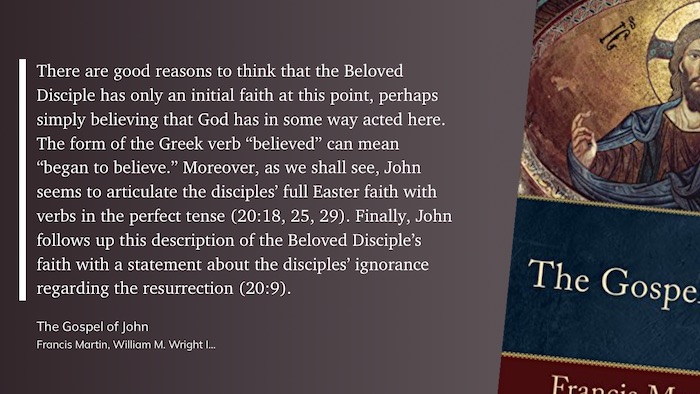
- The disciples do not yet fully comprehend the resurrection.
- They return home, pondering the event and awaiting further understanding.
Clipart by Fr. Richard Lonsdale; pop-up links direct to Catholic centered content on Google AI search
Fr. Francis Martin
The Resurrection of the Lord
Scott Hahn
The Resurrection of the Lord

New Collegeville
The Resurrection of the Lord

Sermon Writer
The Resurrection of the Lord
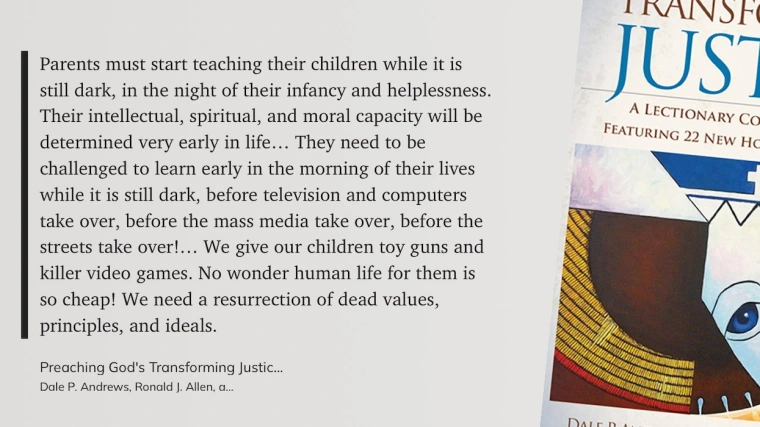
SERMON WRITER – Mark’s Gospel places this visit “very early on the first day of the week, when the sun had risen,” John’s Gospel tells us that it is still dark… John’s Gospel has used the words “dark” and “darkness” several times, usually to speak of spiritual darkness (1:5; 3:9; 8:12; 12:35, 46). Perhaps John’s use of the word “dark” in verse 1 reflects the darkness of Mary’s understanding at this point. Jesus will switch on the light for her in verse 16, but for the moment her world is as dark as it can be.
CATHOLIC RESOURCES: Light and Darkness Symbols in John’s Gospel
Preaching Justice
The Resurrection of the Lord
The Resurrection of the Lord
GOSPEL READING
Context
HISTORY
John 20:1-9, a passage from the Gospel of John, narrates the discovery of the empty tomb by Mary Magdalene and the subsequent investigation by Peter and the beloved disciple. This event took place within the context of 1st-century Palestine, under Roman occupation, and amidst the tensions between Jewish religious authorities and the early Christian community.
The author of the Gospel, traditionally believed to be John the Apostle, was a member of Jesus’ inner circle and a key figure in the early Church. Writing primarily for a Jewish Christian audience, John aimed to demonstrate Jesus’ divine nature, highlight the significance of his resurrection, and strengthen the faith of the community amidst various challenges.
The political environment during this time was marked by Roman rule and its impact on Jewish society. The Roman authorities and Jewish religious leaders feared the growth of the Christian movement, perceiving it as a threat to their power and stability. The empty tomb’s discovery and the resurrection account in John 20:1-9 directly confronted these concerns, asserting the triumph of Jesus Christ over death and the ultimate victory of God’s redemptive plan.
In conclusion, John 20:1-9 is situated within a specific historical and political context that shaped the Gospel’s content and purpose. The passage emphasizes the centrality of Jesus’ resurrection and its implications for the early Christian community, offering a powerful message of hope, faith, and eternal life in Christ.
The Resurrection of the Lord
SOCIETY
John 20:1-9 recounts the discovery of the empty tomb and the initial reactions of Mary Magdalene, Peter, and the beloved disciple, shedding light on the social and cultural context of the early Christian community.
In the 1st-century Palestinian society, women were generally considered less reliable witnesses. However, the Gospel of John emphasizes Mary Magdalene’s role in discovering and reporting the empty tomb, challenging traditional gender norms and highlighting her importance within the community.
The cultural context was marked by Jewish burial customs, which involved wrapping the deceased in linen cloths and placing them in a tomb. The passage describes the burial cloths left behind in the empty tomb, offering evidence of Jesus’ resurrection and challenging the skepticism of the Jewish authorities.
For the original audience, the passage affirmed their faith in Jesus as the Messiah and the Son of God, who conquered death and offered eternal life. In a context where early Christians faced opposition and doubt, the account of the empty tomb provided a compelling testimony to the transformative power of Christ and the hope of resurrection.
In conclusion, John 20:1-9 reflects the sociological and cultural context of the early Christian community, emphasizing the centrality of faith in Jesus, the importance of witnesses, and the challenge to prevailing norms and expectations. The passage’s message remains relevant today, inviting readers to embrace the life-changing power of the resurrection and to bear witness to the Gospel amidst various challenges.
The Resurrection of the Lord
THEOLOGY
John 20:1-9, which narrates the discovery of the empty tomb, is a key passage in Roman Catholic theology, highlighting the significance of Jesus’ resurrection and its implications for the life of faith.
Catholic theology affirms the resurrection as the cornerstone of Christian belief, as stated in the Catechism of the Catholic Church: “The Resurrection of Jesus is the crowning truth of our faith in Christ” (CCC 638). The passage affirms this central truth and provides evidence of Jesus’ triumph over death.
Moreover, the passage emphasizes the role of witnesses in testifying to the resurrection, reflecting the Church’s mission to proclaim the Good News to the world. Pope Francis has highlighted the importance of bearing witness to the Gospel, saying, “The Church is called to come out of herself and to go to the peripheries, not only geographically but also existentially, to reach those who live in a state of abandonment and neglect.”
For contemporary Catholics, John 20:1-9 invites them to embrace the hope and joy of the resurrection in their daily lives. The passage challenges them to bear witness to their faith, confront skepticism, and contribute to building a more just and compassionate society inspired by the Gospel.
In conclusion, John 20:1-9 offers rich theological insights and practical applications for contemporary Catholics. By embracing the transformative power of the resurrection, they can live as witnesses to God’s love and mercy, bringing hope and healing to a world in need of redemption.
The Resurrection of the Lord