Commentary Intro to Mass Readings for Sunday
CommentaryIntro to Mass Readings for Sunday
December 28 2025
December 28, 2025
Holy Family (A)



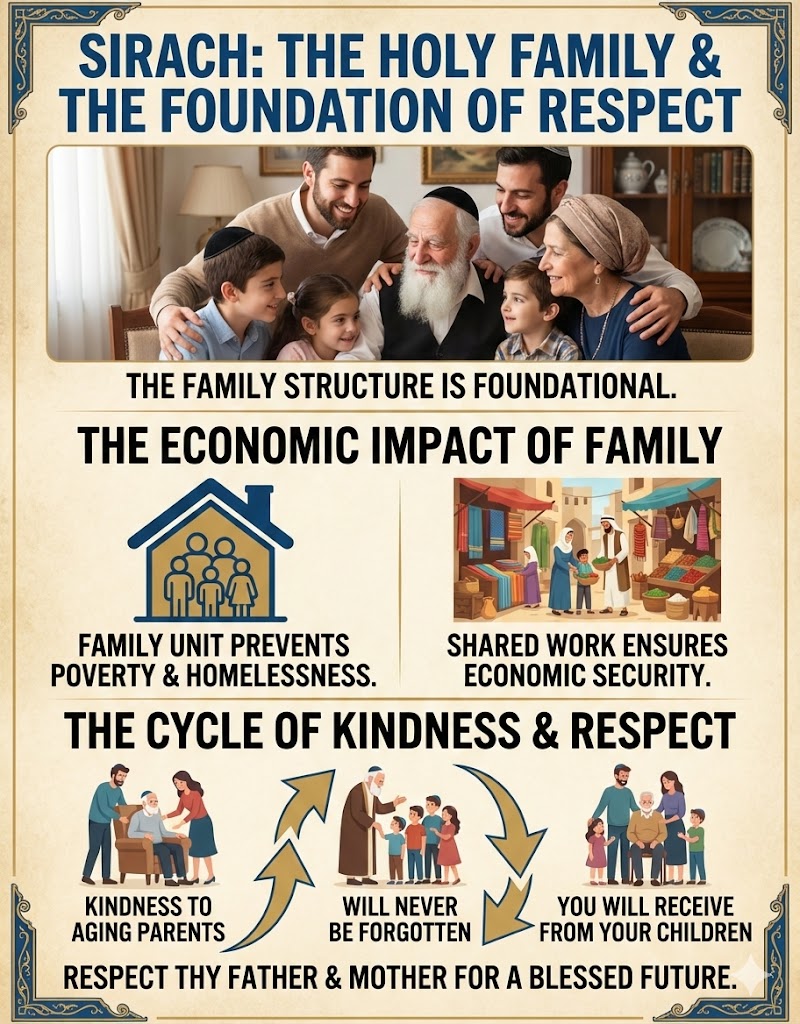
Fr. Galetto contextualizes this passage from Wisdom literature by explaining the critical nature of family structure in the Middle East, both in the time of Jesus and today. He notes that the family unit was an economic necessity that prevented homelessness and poverty, particularly through the tradition of wives joining their husbands’ households to work for the family business. The core message of the reading is the commandment to respect one’s father and mother. Fr. Galetto highlights that this respect must endure even as parents age or face senility, promising that the kindness shown to parents will be returned to you by your own children in the future.

Larry Broding
WORD-SUNDAY.COM
Respect for Parents
by Larry Broding
The fourth commandment is based upon a deeper command from God: love others as self. Love assumes and builds up respect. How have you shown love and respect to your family members? How have you expected such treatment in return?
In a society that idolizes youth and independence, the care of aging parents is often viewed as a burden rather than a blessing. Larry Broding’s commentary on Sirach (Ecclesiasticus) challenges this modern mindset by taking us back to 180 B.C. Jerusalem.
Broding unpacks why Ben Sira placed “honoring father and mother” above even murder and theft in the hierarchy of human duties. This commentary is essential for preachers who want to confront the “optional” nature of family care in America today. Discover how this ancient “textbook for bureaucrats” offers a radical promise: that caring for the elderly isn’t just a duty—it is a spiritual act that atones for sin and guarantees God’s compassion.
Why this commentary will sharpen your homily:
1. It Elevates Family Duty to Spiritual Atonement
The most startling theological claim in this text is often missed by casual readers: that honoring one’s father “forgives sin” (Sirach 3:3). Broding highlights this critical point.
- The Preaching Hook: This allows the preacher to shift the conversation from “moral obligation” to “spiritual redemption.” It presents caregiving not just as a burden, but as a sacramental act that draws God’s compassion.
2. It Contextualizes the “Fourth Commandment”
Broding points out that in Sirach’s hierarchy, honoring parents is the single most important commandment regarding human affairs—ranking higher than the prohibitions against murder, theft, or adultery.
- The Perspective: This insight gives the homilist the ammunition to argue that the breakdown of society isn’t just about crime or violence, but begins with the neglect of the elderly. It reframes the “family values” debate around the treatment of the vulnerable old rather than just the young.
3. It Confronts Modern Culture Head-On
Broding explicitly contrasts the “elderly-centered” culture of Judea with the “youth-centered” culture of modern America.
- The Application: This helps the preacher address the “elephant in the room”: that in our current culture, caring for aging parents is often seen as optional or an inconvenience. Broding argues that what we view as optional, the Bible views as the “pillar of society.”

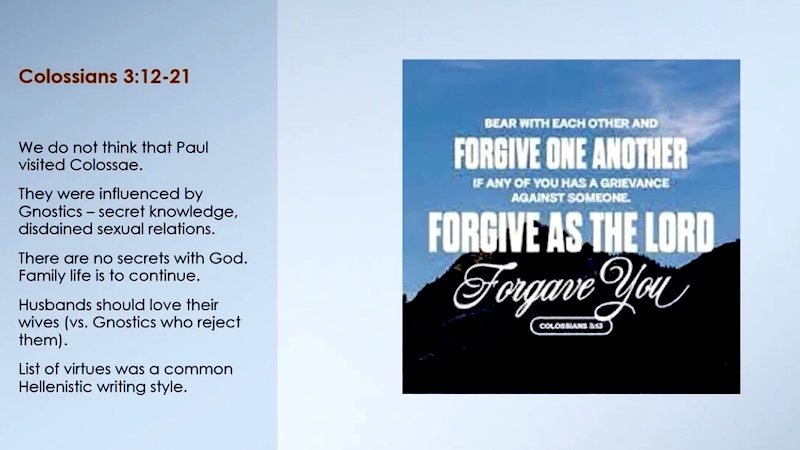
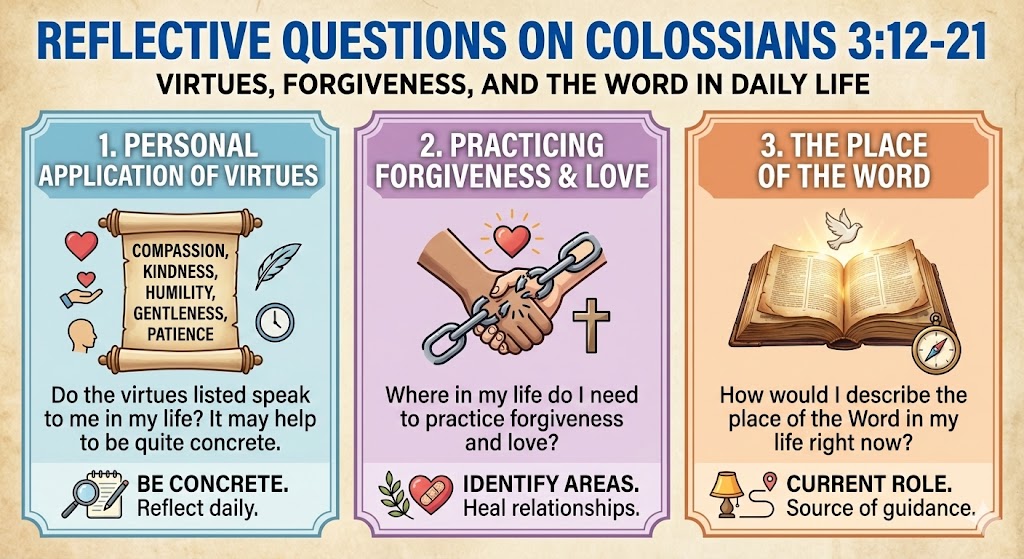
Fr. Galetto explains that St. Paul likely wrote this letter from prison to a community he had never visited to combat the influence of Gnosticism. The Gnostics believed in a “secret knowledge” accessible only to a paying elite and viewed the physical body and sexual relations as evil. This often led men to disdain their wives as sources of temptation. Paul counters this by asserting that there are no secrets in Christ and by providing a “list of virtues” (a common Hellenistic writing style). He urges the Colossians to reject Gnostic elitism and instead focus on forgiveness, love, and the sanctity of the family unit.

Larry Broding
WORD-SUNDAY.COM
What We Bring To the Lord’s Table
by Larry Broding
What do you bring to Mass on Sunday? Baggage and a fighting spirit? Or a thankful heart? Honestly reflect on the quality of your worship. Ask God to heal the hurt. Place all burdens in his hands. And thank him for his grace.
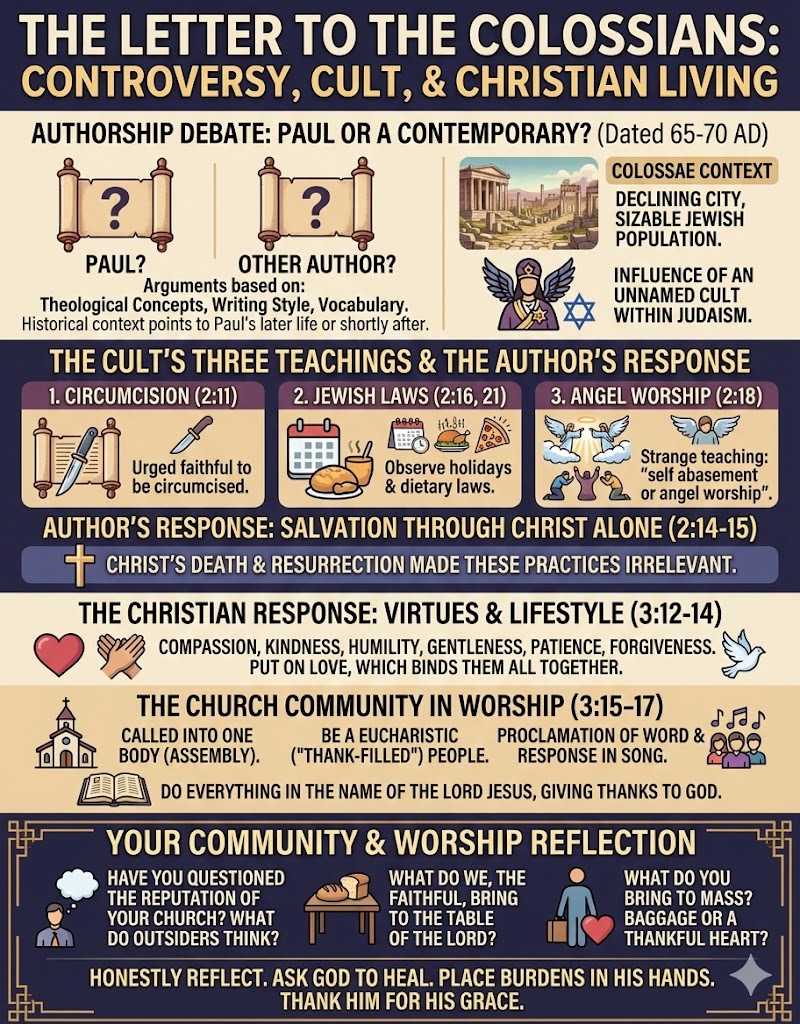
Colossae was a “once glorious, but declining city”—a description that might feel all too familiar to many modern congregations. How does a church maintain its witness when its cultural influence is waning?
Larry Broding’s commentary focuses on the author’s solution: Reputation. By unpacking the communal virtues of compassion, forgiveness, and love found in Colossians 3, Broding challenges preachers to ask the hard questions: What do outsiders think of our community? Do we look like the Body of Christ, or just another social club? Use this commentary to move your parish from individual piety to a powerful corporate witness.
Why this commentary will sharpen your homily:
1. It Decodes the “Colossian Heresy” (The Angel Worship Problem)
Colossians can be a difficult book to preach because Paul (or the author) is arguing against a specific, unnamed group. This commentary clarifies exactly what was at stake.
- The Insight: It explains that the community wasn’t just struggling with standard Jewish laws (circumcision/diet), but a strange “hybrid” cult that involved the “worship of angels” and Gnostic-like secret wisdom.
- The Preaching Point: This allows the homilist to explain why the author is emphasizing Christ’s supremacy so heavily. Christ isn’t just a good teacher here; He is the antidote to a hierarchy of spiritual powers. It helps the preacher ask: What “secret wisdom” or “spiritual forces” are your people relying on instead of Jesus?
2. It Connects Scripture Directly to the Sunday Liturgy
Preachers often struggle to bridge the gap between a letter written in 65 AD and the service happening on Sunday morning. This commentary creates that bridge effortlessly.
- The Link: It explicitly maps the text of Colossians 3 to the structure of the Mass/Service. It identifies the “Assembly” (Body), the “Word and Homily” (3:16a-b), the “Song” (3:16c), and the “Eucharist” (giving thanks in 3:15/17).
- The Application: It transforms the reading from a historical document into a commentary on what the congregation is doing right now. It validates the act of worship as the primary Christian response to God.
3. It Shifts the Focus from Individual to Corporate Virtue
It is easy to preach a list of virtues (compassion, kindness, humility) as a self-help checklist for individuals. This commentary corrects that view.
- The Challenge: It forces the preacher to ask the congregation not just “Are you kind?” but “Is our church known for kindness?” This shifts the sermon from private morality to communal witness.
- The Correction: It emphasizes that the author addresses the community as a whole. These aren’t just personal habits; they are the “brand reputation” of the Church.

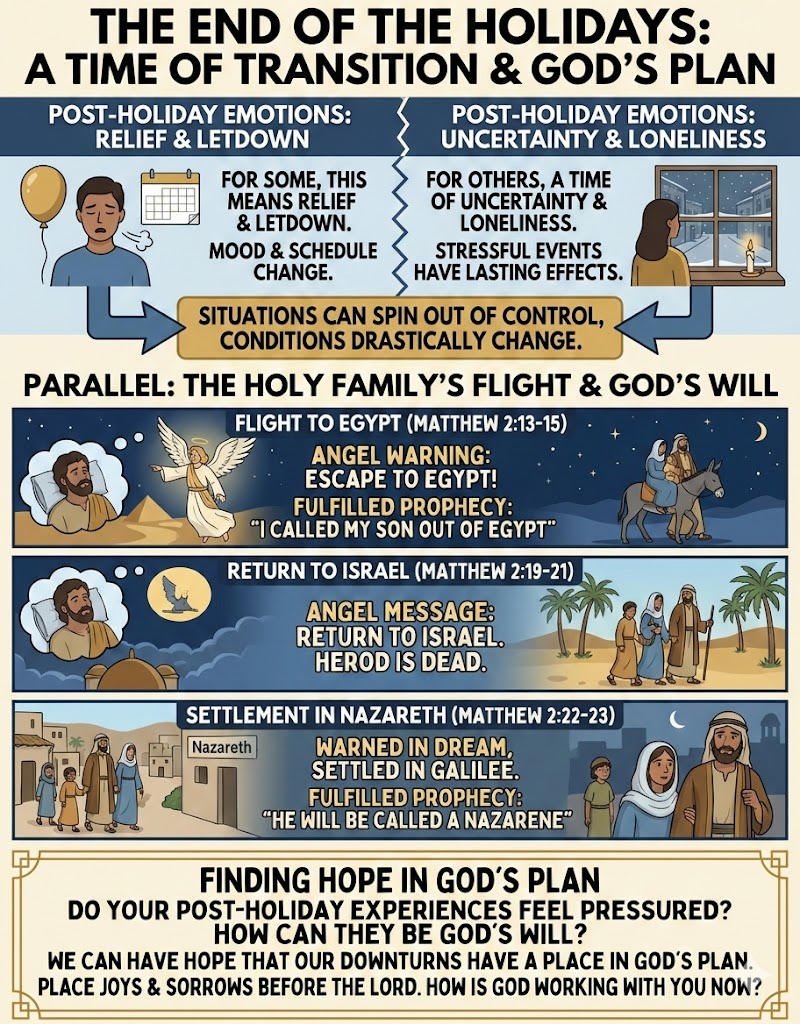
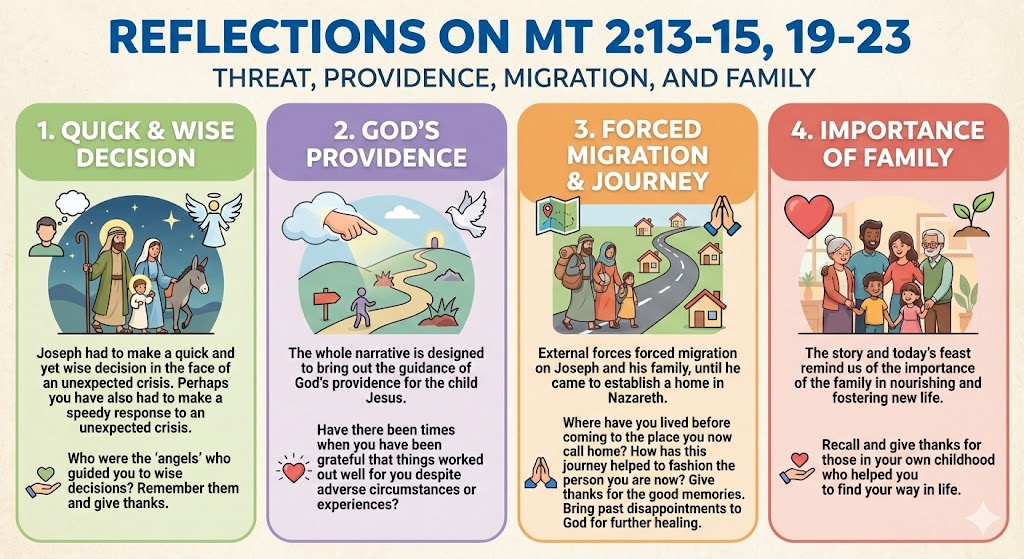
Fr. Galetto emphasizes that Matthew’s primary goal in the infancy narratives is to demonstrate that Jesus is the fulfillment of Old Testament prophecy. He draws a parallel between Jesus and Moses: just as Joseph (OT) and the Israelites found refuge in Egypt, God directs Joseph (NT) through dreams to flee to Egypt to protect the child. Fr. Galetto points out the specific prophetic fulfillment of the line, “Out of Egypt I have called my son.” Finally, he explains that the Holy Family settled in Galilee (the north) rather than Judea due to the fear of Herod’s son, Archelaus. This move to Nazareth was by divine design, fulfilling the prophecy that the Messiah would be known as a Nazorean.

Larry Broding
WORD-SUNDAY.COM
Change After the Holidays
by Larry Broding
Review the holidays. Place the joys and sorrows of the holidays before the Lord. How do you see God working with you this past season? How is he working with you now?
Why did Matthew devote so much space to the Holy Family’s movements between Bethlehem, Egypt, and Nazareth? Larry Broding argues that for the Evangelist, these weren’t just geographic relocations—they were theological revelations.
In this insightful commentary, Broding unpacks the rich typology hidden in Matthew 2:13-23. Discover how the “New Joseph” mirrors the Patriarch of Genesis—dreaming, going down to Egypt, and rising to save his people. Explore the linguistic puzzle of the “Nazarene” prophecy and its possible connection to the Hebrew nazir (“consecrated one”). If you want to show your congregation how Jesus’s childhood journey recapitulates the history of Israel and foreshadows the Cross, this resource is your roadmap.
Why this commentary is essential for your homily prep:
1. It Addresses the “Elephant in the Room”: The Post-Holiday Slump
Most commentaries focus strictly on the historical context. Broding distinguishes himself by starting with the emotional context of the congregation.
- The Problem: He acknowledges that for many, the weeks after Christmas are marked by relief, letdown, loneliness, and a return to the grind.
- The Bridge: He connects this modern “downturn” to the immediate pressure the Holy Family faced after the joy of the Magi. It gives the preacher a perfect opening hook: Just as the Holy Family moved from celebration to survival mode, so do we.
2. It Solves the “Nazarene” Puzzle (Matthew 2:23)
One of the hardest verses for a preacher to explain is Matthew’s claim that “He will be called a Nazarene,” because no such verse exists in the Old Testament.
- The Solution: Broding saves the preacher hours of research by providing a clear, preachable explanation: it is likely a wordplay on the Hebrew “nazir” (consecrated to God). This transforms a confusing footnote into a powerful sermon point about Jesus being consecrated from birth, like Samuel.
3. It Reframes “Geography” as “Theology”
A common trap in preaching this text is getting bogged down in the map (Bethlehem to Egypt to Nazareth). Broding shifts the focus. He argues that Matthew wasn’t concerned with the travel log, but the theological log.
- The Takeaway: Every move Jesus made was about identity, not just location. This helps the preacher explain that our own “moves”—changes in health, job, or family status—are not just random events, but locations where we can discover our own theological identity in Christ.
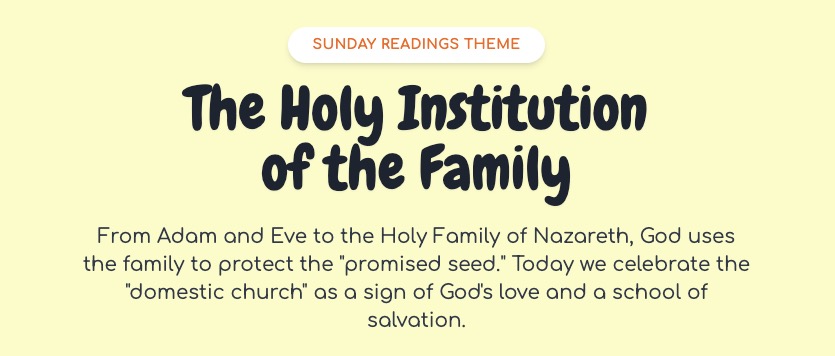


Infographics were created using Nano Banana Pro with Gemini 3.0. They draw inspiration from the commentary above from Agape Bible Study, but are not officially associated with or endorsed by Michal Elizabeth Hunt. They may be copied for personal use or for use in any non-profit ministry. All works on the Agape Bible Study were licensed under a Creative Commons Attribution 3.0 Unported License.
Fr. Corrigan, OFM
friarmusings.com
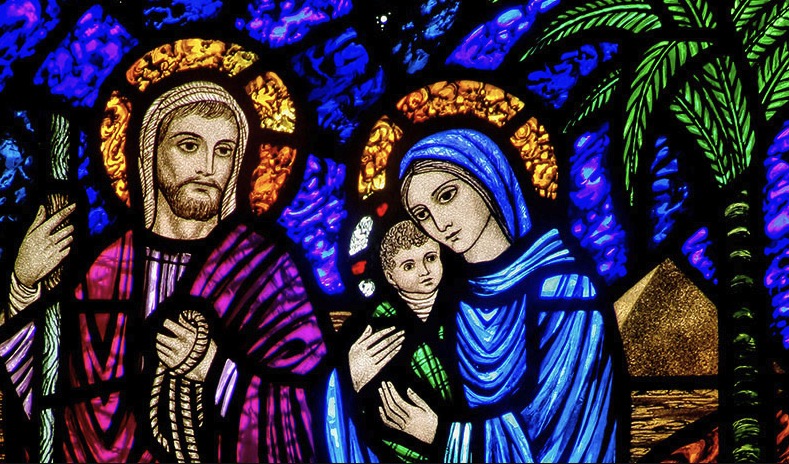


Feast of the Holy Family (A)
Emmanuel,
God with Us
Historical Context: The Prophecy of Isaiah
The homily begins by contextualizing the First Reading from the Book of Isaiah. Scholars generally divide this book into three distinct parts:
- First Isaiah (Chapters 1–39): Written by Isaiah, son of Amoz, in the 8th century BC (approx. 740–710 BC).
- Second Isaiah (Chapters 40–55): Written by an anonymous prophet during the Babylonian Exile (6th century BC).
- Third Isaiah (Chapters 56–66): Written after the return from exile and the rebuilding of the Temple.
The reading for this Sunday comes from First Isaiah, set during the reign of King Ahaz of Judah (735–715 BC). Ahaz faced a political crisis: the expanding Assyrian Empire threatened Judah.
Instead of trusting God, Ahaz sought an alliance with Assyria. When Isaiah offered him a sign from God to prove divine protection, Ahaz refused under the guise of piety (“I will not put the Lord to the test”), masking his unbelief. Despite this, God provided a sign: “The virgin is with child and will give birth to a son whom she will call Immanuel.” In its immediate historical context, this signified God’s protection of Judah against its enemies, but Matthew utilizes this prophecy to illuminate the birth of Jesus.
The Gospel of Matthew: A Focus on Joseph
While Luke’s Gospel focuses on Mary and includes joyful canticles, Matthew’s account is concise (1,800 words vs. Luke’s 4,000) and centers entirely on Joseph. Matthew’s narrative is darker, featuring the threat of Herod, but emphasizes that Jesus is the fulfillment of God’s plan.
The homily highlights the specific legal situation of Mary and Joseph through the lens of Second Temple Jewish marriage customs, which had two stages:
- Betrothal (Erusin): A legally binding contract. The couple were considered husband and wife, but did not yet live together. Infidelity during this stage was considered adultery.
- Home-taking (Nisuin): The wife moves into the husband’s home, marking the beginning of cohabitation and sexual union.
Mary was in the stage of Erusin (likely aged 12–14) when she was found to be with child. Joseph, a righteous man, intended to divorce her quietly to avoid public shame until an angel intervened in a dream.
The Typology of the Two Josephs
The homily draws a parallel between St. Joseph and the Old Testament Joseph (son of Jacob in Genesis):
- Dreams: Both receive divine messages through dreams.
- Egypt: Both go to Egypt to save their families.
- Salvation: The first Joseph saved his family from famine; the second Joseph protects the Savior who saves his people from sin.
The Significance of the Names
The angel commands Joseph to name the child Jesus.
- Etymology: The name comes from the Hebrew Yehoshua (Joshua), meaning “Yahweh saves.” It connects Jesus to the Exodus motif—just as Joshua led the people into the Promised Land, Jesus leads humanity out of the bondage of sin.
- Emmanuel: Matthew also cites Isaiah’s title, Emmanuel (“God with us”).
These names are complementary, not contradictory. “Jesus” describes his mission (to save), while “Emmanuel” describes his identity (God’s presence).
Theological Conclusion: “God With Us”
Matthew uses the concept of Emmanuel as “bookends” for his Gospel:
- Chapter 1: The promise that God is with us in the birth of Jesus.
- The Great Commission: The risen Jesus promises, “I am with you always till the end of time.”
The homily concludes by contrasting King Ahaz with St. Joseph. Where Ahaz refused to ask for a sign and relied on political scheming, Joseph accepted the mystery in silence and obedience, trusting in God’s plan over his own understanding.
Pointers for Prayer
Non-profits are welcome to utilize the provided graphics in their materials and presentations. Please acknowledge Fr. Kieran O’Mahony, OSA, and his website, taurus.ie., as the source. The graphics were designed by TheWordThisWeek.net using Gemini Pro 3 and Nano Banana. Proper attribution is appreciated.

SUNDAY COMMENTARY (PDF)





Hector Molina – Catholic Evangelist
Feast of the Holy Family (A)
The Probing Prophet: John the Baptist
John the Baptist’s inquiry about Jesus’ identity as the Messiah and Jesus’ response highlights the importance of understanding and trusting in God’s plan, and serves as a call to Christians to remain steadfast in hope, persevere, and prepare for the coming of Jesus Christ.
Refer to timestamp links to immediately go to that section of video.
00:00 John the Baptist, imprisoned for denouncing Herod’s sin, sends disciples to Jesus to confirm if he’s the Messiah, while Jesus praises John as a prophet preparing the way for him.
- Jesus tells John’s disciples that he is the one who brings fulfillment to prophecy, as evidenced by his miracles and preaching to the poor, and then praises John as a prophet and messenger preparing the way for him.
- John the Baptist, the herald of the new Exodus and precursor to Christ, is in prison, having been arrested for condemning Herod Antipas’s adulterous relationship with his brother’s wife, Herodias.
- John the Baptist, as a prophet, denounced public sinners, including Herod Antipas and his adulterous relationship with his sister-in-law Herodius, for their grave sin, which led to scandal and ultimately cost him.
- John, imprisoned for denouncing the king and queen’s sinful ways, sends his disciples to Jesus to ask if he is the expected Messiah or if they should look for another.
- John the Baptist, like Elijah, denounced wicked rulers, specifically Herod Antipas and his wife Herodius, and ultimately paid the price with his life, mirroring Elijah’s persecution by King Ahab and Queen Jezebel.
- John the Baptist, having heard about Jesus’ miracles, sends a delegation to ask Jesus if he is the Messiah or if they should look for another.
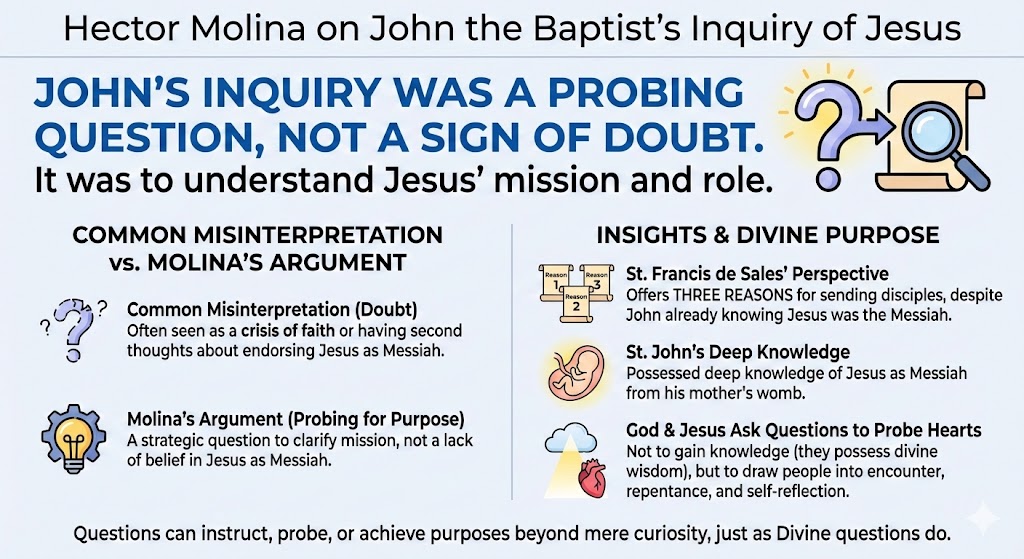
07:45 John the Baptist’s inquiry about Jesus’ identity as the Messiah was not a sign of doubt, but rather a probing question to understand Jesus’ mission and role.
- John’s inquiry about Jesus’ identity as the Christ may seem to indicate doubt, but it questions whether he is actually having second thoughts about endorsing Jesus as the Messiah.
- The speaker argues that John the Baptist did not have a crisis of faith or doubt Jesus’ identity as Messiah, contrary to a common interpretation.
- St. Francis de Sales gives three reasons why John the Baptist sent his disciples to ask Jesus if He was the Messiah, despite knowing Jesus was the Messiah.
- St. John the Baptist, who had a deep knowledge of Jesus as the Messiah from his mother’s womb, sends his disciples to ask Jesus if he is the one to come, despite knowing him to be the Messiah.
12:15 God asks questions not to gain knowledge, but to probe hearts and draw people into an encounter with Him, leading to repentance and self-reflection.
- We ask questions not only to gain knowledge, but also to instruct, probe, or achieve other purposes beyond mere curiosity or ignorance.
- God, and Jesus as the divine majesty, ask questions not out of ignorance, but to probe the hearts of people, as they already possess divine wisdom and knowledge of all things.
- God asks questions in the scriptures, not out of ignorance, but to draw people into an encounter with Him, repentance, and self-reflection, for their benefit, not His.
- St. John the Baptist sent his disciples to Jesus not to verify if He was the Messiah, but to make Him known to the world and to redirect his own disciples to learn from Jesus personally.

16:57 John the Baptist sends his disciples to Jesus to confirm his identity as Messiah and strengthen their faith, citing fulfilled Old Testament prophecies and miracles.
- John the Baptist sends his disciples to Jesus to encounter Him for themselves, not out of doubt, but to strengthen their faith and recognition of Jesus as the Messiah.
- St. John sent his disciples to Jesus to detach them from himself and prevent them from esteeming him more than the Savior.
- St. John sent his disciples to question Jesus not because he doubted Jesus was the Messiah, but to help them see Jesus’ divine majesty and detach from him.
- John the Baptist’s questioning of Jesus was not a reflection of a crisis of faith, but rather an opportunity for his disciples to hear Jesus’ answer and confirm his identity as Messiah.
- Jesus tells John’s disciples to report what they see and hear, citing Old Testament prophecies fulfilled through his miracles, such as the blind receiving sight and the lame walking.
- Jesus quotes Isaiah 61:1, proclaiming good news to the poor, and tells John’s disciples that prophecies of healings and miracles, such as the blind receiving sight and the lame walking, are being fulfilled in him.
25:57 Jesus fulfills Old Testament prophecies as the Messiah, citing miracles as evidence, and calls believers to remain steadfast in hope and persevere.
- Jesus quotes Old Testament scriptures, exceeding prophecies of the Messiah by mentioning lepers being cleansed and the dead being raised to prove he is the Messiah.
- The desert will blossom and the redeemed of Zion will return with joy, obtaining everlasting happiness as sorrow and sighing flee away.
- Jesus tells John’s disciples that he is the fulfillment of Old Testament prophecies about the Messiah, citing his miracles as evidence.
- The Psalm 146 and Isaiah 35 prophecies foretell the Messiah’s deeds, including setting prisoners free, opening the eyes of the blind, and upholding the righteous, all fulfilled in Jesus.
- No matter the circumstances, believers are called to remain steadfast in hope and persevere, trusting that God’s promises will be fulfilled.
31:46 Jesus contrasts John the Baptist’s unwavering commitment and simple lifestyle with the world’s values, highlighting that despite being the greatest man born, the least in the kingdom of heaven is greater due to God’s grace.
- Jesus asks the crowds what they expected to see when they went out to John in the wilderness, identifying John as more than a prophet, a messenger preparing the way for Jesus.
- John the Baptist is contrasted with Herod Antipas, as an immovable and steadfast figure, unlike a reed blown by the wind, symbolizing his unwavering commitment to his message despite public opinion.
- Jesus compares and contrasts John the Baptist’s simple, austere lifestyle with that of King Herod Antipas, highlighting their vastly different approaches to life and leadership.
- Jesus asserts that John the Baptist is the greatest man born among women, yet surprisingly claims that even the least person in the kingdom of heaven is greater than him.
- Jesus contrasts John’s greatness in this world with the even greater status of the least in the kingdom of God, which surpasses John’s greatness due to the mercy and riches of God’s grace made possible through Jesus’ pascal mystery.
- The least in the kingdom of heaven, perfected in righteousness and sanctified by God’s grace, is greater than John the Baptist, who was great prior to the inauguration of the kingdom of God.