APR 13, 2025


Homilies
Homilies


Catholic Women Preach
Palm Sunday C
Visit the website for details on preachers, readings, and texts of preaching.

2025

2022


Bulletin Inserts
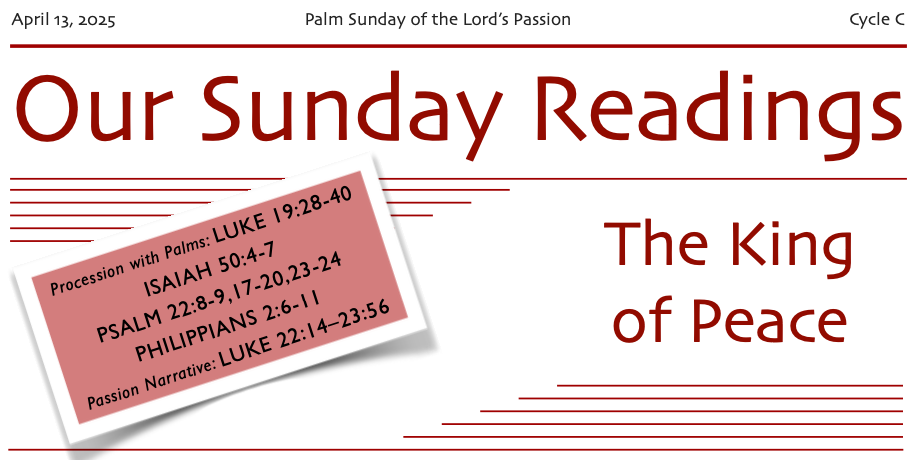



Carmelite Lectio Divina
Reflections and Prayers
92 page PDF with refections and prayers for each day of the month.
Lectio Divina APRIL 2025 (PDF)
Lectio Divina APRIL 2025 [Mobi]
Lectio Divina APRIL 2025 [ePub]
“Lectio divina is an authentic source of Christian spirituality recommended by our Rule. We therefore practise it every day, so that we may develop a deep and genuine love for it, and so that we may grow in the surpassing knowledge of Christ. In this way we shall put into practice the Apostle Paul’s commandment, which is mentioned in our Rule: “The sword of the Spirit, too, which is the word of God, is to dwell abundantly in your mouth and in your hearts; and whatever things you have to do, let them be done in the word of the Lord.” (Carmelite Constitutions (2019), n. 85.)
Source: Carmelites

Bible Study Notes

- The Jerome Biblical Commentary,
- The New Jerome Biblical Commentary, and
- The Navarre Bible.
SOURCE: St. Charles Borromeo Catholic Church (Picayune, MS)
The Risk of
Leadership

These verses were part of the so-called “Suffering Servant” Songs. Scholars have identified Isaiah 50:4-9 as a sliver of the Songs from this chapter. It described the call of the Servant to preach, despite opposition.
In the context of the times, Second Isaiah used these verses to address his critics among the exiles in Babylon. A general pessimism had descended upon Jewish populace in the city. When Second Isaiah saw promise in the coming reign of Cyrus, the Persian conqueror. Cyrus respected local religions and customs. Second Isaiah pinned his ambitions upon the Persian. Whether the prophet wrote before or after the conquest of Babylon in 539 B.C. has been an open question. No matter. Second Isaiah wrote to raise the hopes of the exiles and presented the possibility of return. Isaiah 50:4-7 spoke to the resistance the prophet may have felt. God called him to proclaim an unpopular message and the prophet would remain true to his call [50:4-5]. His critics would try to shame him. Indeed, the prophet would allow his opposition to shame him. But God would vindicate him [50:6-7]….
Palm Sunday C

The Catholic AI assistant (specifically trained for this website), located at the bottom right-hand corner, offers further insights into the Sunday’s Readings. Simply copy & paste any text on this page into it for a more in depth analysis. OR simply ask your own questions.
Perseverance
Isaiah 50:4-7
1ST READING
Key Points

I. Perseverance (Isaiah 50:4-7)
- The Lord’s servant experiences humiliation (50:4-6)
- The Lord provides protection and support (50:7)
II. Text Analysis
- The Lord’s servant has the ability to withstand the shame and insults (50:4)
- God empowers the servant with words and guidance (50:5)
- The servant endures persecution (50:6)
- The Lord is a protector for those who trust in Him (50:7)
III. Conclusion
- The passage illustrates the importance of obedience and trust in God amidst adversity.
- The Lord’s servants are given the strength to persevere through difficult circumstances and remain faithful.
Clipart by Fr. Richard Lonsdale; pop-up links direct to Catholic centered content on Google AI search
Palm Sunday C
1ST READING
Hearers of the Word

Click on slide to watch video by Fr. Kieran J. O’Mahony
Palm Sunday C
1ST READING
Context
HISTORY
Isaiah 50:4-7 is a passage from the Book of Isaiah, a prophetic work within the Old Testament. Authored by the prophet Isaiah, the book spans the 8th century BCE, during a period marked by significant political turmoil and religious challenges in the ancient kingdom of Judah.
The prophet Isaiah emerged during the reigns of Judean kings Uzziah, Jotham, Ahaz, and Hezekiah. During this time, the Assyrian Empire was expanding aggressively, posing a significant threat to Judah. Politically, the nation faced pressure to form alliances with neighboring kingdoms like Egypt, but Isaiah urged the people to rely on God for protection instead. Religiously, idolatry was rampant, and Isaiah’s prophetic message emphasized the importance of repentance, divine sovereignty, and social justice.
Isaiah 50:4-7 specifically focuses on the “suffering servant” motif, a figure who suffers unjustly yet remains obedient to God. Within this context, the passage serves as a call to endure humiliation and persecution without fear, relying on the Lord’s guidance and protection. This message would have resonated with the people of Judah, who faced the looming threat of invasion and exile.
Isaiah’s intended audience was the nation of Judah, and his message aimed to challenge the political and religious status quo. He urged the people to reject the pursuit of foreign alliances, promoting unwavering faith in God in the face of adversity. Isaiah’s words continue to serve as a reminder of the value of trust and perseverance in the midst of hardship.
Palm Sunday C
SOCIETY
Isaiah 50:4-7 reflects the sociocultural context of the ancient kingdom of Judah, which was marked by political instability, religious syncretism, and a growing divide between the wealthy elite and the marginalized poor. In this setting, the passage’s message of perseverance amidst adversity speaks to the struggles faced by the original audience.
During Isaiah’s time, the people of Judah were influenced by the religious practices of neighboring nations, with many incorporating elements of idol worship into their beliefs. This syncretism was particularly prevalent among the upper echelons of society, while the marginalized were more inclined towards maintaining traditional beliefs. Isaiah’s emphasis on faithfulness to God and the role of the suffering servant can be seen as a response to the social and religious divisions within Judah, urging unity and unwavering faith in the face of persecution.
Additionally, the growing social inequality within Judah contributed to the message of Isaiah 50:4-7. The wealthy and powerful often oppressed the poor and vulnerable, leading to an atmosphere of injustice. Isaiah’s focus on the importance of trust in God served as a source of hope for the marginalized, who found themselves at the mercy of unjust power structures.
In conclusion, Isaiah 50:4-7 speaks directly to the sociocultural context of ancient Judah, addressing the pressing issues of religious division, idolatry, and social inequality. The passage’s enduring message of perseverance and faith in the face of adversity remains relevant, offering guidance and hope to readers throughout history.
Palm Sunday C
THEOLOGY
In the Roman Catholic tradition, Isaiah 50:4-7 is often seen as a foreshadowing of Christ’s passion and a call for Christians to embrace self-sacrifice in the face of adversity. The “suffering servant” depicted in the passage is frequently interpreted as a prefiguration of Jesus, who suffered unjustly to bring salvation to humanity.
Within this theological context, Isaiah 50:4-7 highlights the importance of imitating Christ by accepting hardships and persecution with faith and resilience. This idea is central to Catholic teaching, which emphasizes the value of redemptive suffering and unity with Christ in His passion. The passage serves as a reminder of the ultimate purpose behind enduring adversity, fostering hope and a deeper connection with the divine.
For contemporary Catholics, Isaiah 50:4-7 offers guidance on navigating modern-day challenges. In a world plagued by injustice, discrimination, and hardship, the passage encourages believers to persevere in their faith and work towards the greater good. By following the example of Christ and the “suffering servant,” Catholics can strive to bring hope and light to a world in need, demonstrating the transformative power of faith and self-sacrifice.
In conclusion, Isaiah 50:4-7 holds a significant place within Roman Catholic theology, providing insight into the role of redemptive suffering and the importance of imitating Christ in the face of adversity. Through a deeper understanding of this passage, contemporary Catholics can draw inspiration and guidance in their efforts to live out their faith and positively impact the world around them.
Palm Sunday C
1ST READING
Wikipedia
Palm Sunday C
Agape Bible Study

Bible Study Notes
- The Jerome Biblical Commentary,
- The New Jerome Biblical Commentary, and
- The Navarre Bible.
SOURCE: St. Charles Borromeo Catholic Church (Picayune, MS)
Empty Himself
For over the past 60 years, most biblical scholars have seen this passage as a hymn sung in early Christian communities. Paul adopted (even adapted) the song for his letter to the Philippians. The original form is hotly debated; some group the verses into two stanzas (6-8 & 9-11); others group the verses into three stanzas (6-7a, 7b-8, & 9-11). Whether Paul made additions or subtractions to the hymn is unknown. The author, influences, and background are speculative. But, the verses do reflect the early Christian belief that identified the Christ as Isaiah’s Suffering Servant.
Notice hymn began with the divine (2:6) and returned to the divine (2:9-11). But, the focus was on Jesus. He existed in God and did not “seize” Godhood. Instead, Jesus descended to the level of humanity. 2:7b-8 used two phrases built around the verb “becoming.” In 2:7c, “becoming in the likeness of men” referred back to Jesus emptying himself into the form of a servant (2:7b). In 2:8b, “becoming obedient until death” referred back to the humiliation of Jesus (2:8a). The core of the hymn used “emptying” for the Incarnation and “humbling” for the Passion, the two pillars of our faith in Christ. God responded with the resurrection (2:9a) and glorification (2:9b) of Christ. The response of the follower is worship (2:10) and profession of faith (2:11).)…
Palm Sunday C
The Catholic AI assistant (specifically trained for this website), located at the bottom right-hand corner, offers further insights into the Sunday’s Readings. Simply copy & paste any text on this page into it for a more in depth analysis. OR simply ask your own questions.
Humbling of Christ
Philippians 2:6-11
2ND READING
Key Points

I. Humility (Philippians 2:6-11)
- Christ’s self-emptying and humility (2:6-8)
- God’s exaltation of Christ (2:9-11)
II. Text Analysis
- Christ, though divine, became human in obedience to God (2:6-7)
- Christ’s humility leads to His death on the cross (2:8)
- God responds by exalting Christ and granting Him authority (2:9-10)
- Confession of Jesus as Lord (2:11)
III. Conclusion
- The passage emphasizes the significance of humility and obedience in Christ’s sacrifice.
- Christ’s divine nature and human obedience result in His glorification by God.
- Jesus’ exaltation serves as a reminder of His ultimate authority and divine identity.
Clipart by Fr. Richard Lonsdale; pop-up links direct to Catholic centered content on Google AI search
Palm Sunday C
2ND READING
Hearers of the Word
Click on slide to watch video by Fr. Kieran J. O’Mahony

Palm Sunday C
2ND READING
Context
HISTORY
Philippians 2:6-11 is a portion of a letter written by the Apostle Paul to the Christian community in Philippi during the 1st century AD. The passage focuses on the humility and obedience of Christ, emphasizing His divine nature and the redemptive significance of His sacrifice.
At the time of Paul’s writing, the Roman Empire was experiencing significant political and social unrest. Early Christians faced persecution under the rule of emperors like Nero, who viewed Christianity as a threat to Roman authority and stability. Additionally, various philosophical and religious ideologies were widespread, contributing to a diverse intellectual climate.
Paul’s intended audience was the Christian community in Philippi, a Roman colony located in present-day Greece. These early believers, living amidst a backdrop of persecution and competing worldviews, needed encouragement to remain steadfast in their faith. By highlighting Christ’s humility and obedience, Paul sought to inspire unity and perseverance among the Philippian Christians, urging them to imitate Christ’s example amidst adversity.
Given the political climate and intellectual diversity of the era, Philippians 2:6-11 carries a powerful message that transcends cultural and historical boundaries. The passage remains relevant today as a testament to the transformative power of humility and obedience, offering guidance and inspiration to believers worldwide.
Palm Sunday C
SOCIETY
Philippians 2:6-11 addresses the early Christian community in Philippi, which was embedded within a culturally diverse and stratified society. The social context of the passage is characterized by Roman rule, Greek philosophical thought, and a variety of religious practices, providing a rich tapestry against which Paul’s message unfolds.
During this time, humility and obedience were not considered virtues in the conventional sense. Roman society valued power, status, and dominance, while Greek philosophy often emphasized the pursuit of wisdom and self-realization. Amidst these cultural influences, early Christians were called to embrace a radically different set of values centered on Christ’s humility and self-sacrifice.
Paul’s message in Philippians 2:6-11 challenged the prevailing social norms, offering a new model of ethical conduct rooted in Christ’s example. By highlighting the divine nature of Christ and His willingness to humble Himself, Paul sought to inspire unity and a shared sense of purpose among the diverse Christian community in Philippi.
The passage’s emphasis on humility and obedience remains significant today, as contemporary Christians continue to grapple with issues of social inequality and the pursuit of power. Philippians 2:6-11 serves as a reminder of the transformative potential of self-sacrifice, guiding believers towards a more Christ-like approach to navigating the complexities of modern society.
Palm Sunday C
THEOLOGY
In Roman Catholic theology, Philippians 2:6-11 is a pivotal passage that highlights the divine nature of Christ and His redemptive role in human salvation. The passage emphasizes Christ’s humility and obedience, offering a powerful example for Christians to follow.
Theologically, Philippians 2:6-11 underlines the central doctrine of the Incarnation, affirming Christ’s divine and human natures. The passage also highlights the significance of Christ’s obedience and self-sacrifice, which serves as a model for Christian living and a foundation for the sacramental life of the Church.
For contemporary Catholics, Philippians 2:6-11 offers valuable guidance on navigating the complexities of modern life. In a world where individualism and self-promotion are often celebrated, the passage reminds believers of the importance of humility, service, and self-giving love. This message is particularly relevant in areas such as social justice, environmental stewardship, and interfaith dialogue, where a spirit of collaboration and shared responsibility is essential.
Moreover, the passage’s emphasis on obedience and unity in Christ serves as a powerful reminder of the need for harmony within the Church and the broader Christian community. By embracing the virtues espoused in Philippians 2:6-11, contemporary Catholics can strive to build a more just, compassionate, and Christ-centered world.
Palm Sunday C
2ND READING
Wikipedia
Palm Sunday C
Agape Bible Study
Bible Study Notes
- The Jerome Biblical Commentary,
- The New Jerome Biblical Commentary, and
- The Navarre Bible.
SOURCE: St. Charles Borromeo Catholic Church (Picayune, MS)
Prepare to Say Goodbye
Jesus instructed his disciples to prepare for a journey, but not on an apostolic mission. Instead he ordered them to take a money bag , provisions satchel and swords. Either he told them to pack like others who would travel in caravans, with money, food and weapons for self-defense. Or he readied them to make a quick exit, like a band of criminals. Either way, he intended his statements as commands for a final exit. It was enough.
In short order, Luke presented Jesus as the servant who would suffer. He gave himself as an example of leadership for his followers, through his self-giving in the Eucharist. Those who remained faithful had the promise of the Kingdom, but rough times lay ahead. Simon Peter would deny his Master. They would pack as those leaving town and symbolically leaving Jesus. Thus, the scene was set for the arrest of the Lord, for his goodbye.
Palm Sunday C
The Catholic AI assistant (specifically trained for this website), located at the bottom right-hand corner, offers further insights into the Sunday’s Readings. Simply copy & paste any text on this page into it for a more in depth analysis. OR simply ask your own questions.
First Gospel
Luke 19:28-40
GOSPEL READING
Key Points

I. Triumphant Entry (Luke 19:28-40)
- Jesus’ journey to Jerusalem (19:28)
- The disciples fetch a colt for Jesus (19:29-34)
- The triumphant entry into Jerusalem (19:35-38)
- The Pharisees’ request and Jesus’ response (19:39-40)
II. Text Analysis
- Jesus’ determination to enter Jerusalem (19:28)
- The preparation for Jesus’ entry (19:29-34)
- The crowd’s reaction to Jesus’ arrival (19:35-38)
- Confrontation with the Pharisees and Jesus’ assertion of His divine purpose (19:39-40)
III. Conclusion
- The passage details Jesus’ entry into Jerusalem as a king, fulfilling Old Testament prophecy.
- The event showcases the growing tension between Jesus and the religious authorities.
- Jesus’ response to the Pharisees emphasizes the unstoppable nature of His mission and identity.
Clipart by Fr. Richard Lonsdale; pop-up links direct to Catholic centered content on Google AI search
Palm Sunday C
GOSPEL READING
Hearers of the Word
Click on slide to watch video by Fr. Kieran J. O’Mahony
Fr. Geoffrey Plant
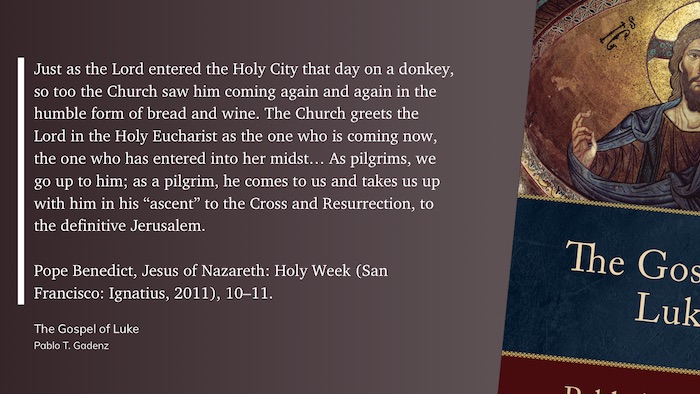
Pablo T. Godenz
Palm Sunday C
GOSPEL READING
Context
HISTORY
Luke 19:28-40 recounts Jesus’ triumphal entry into Jerusalem, marking a pivotal moment in His ministry and the events leading up to His crucifixion. Set against the backdrop of 1st-century Palestine, the passage reflects the social, political, and religious tensions of the era.
During this time, the Jewish people were living under Roman occupation, longing for a messianic figure who would deliver them from oppression. Jesus’ entry into Jerusalem, with its accompanying messianic overtones, stirred the hopes of many while simultaneously provoking the ire of Jewish leaders and Roman authorities.
Luke, a Gentile physician and companion of Paul, wrote his Gospel account with the intention of presenting a comprehensive narrative of Jesus’ life and ministry. Addressing a primarily Gentile audience, Luke sought to emphasize the universal implications of Jesus’ mission, highlighting the significance of His death and resurrection for all people.
Within this context, Luke 19:28-40 serves as a dramatic turning point in Jesus’ earthly ministry, setting the stage for the climactic events of His passion, death, and resurrection. By portraying Jesus as a humble yet triumphant figure, Luke invites his readers to recognize the transformative power of Christ’s mission and its enduring relevance for all who seek salvation.
Palm Sunday C
SOCIETY
Luke 19:28-40, detailing Jesus’ triumphal entry into Jerusalem, reflects the diverse social and cultural landscape of 1st-century Palestine. This event occurs amidst a mix of Jewish and Hellenistic influences, shaping the narrative’s meaning and relevance for its original audience.
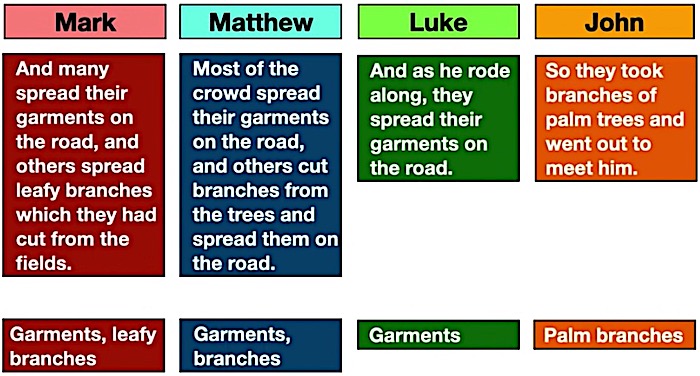
In Jewish tradition, the arrival of a king or messiah was often marked by a procession, with people spreading their cloaks and branches before him. Jesus’ entry into Jerusalem echoes these customs, highlighting His messianic identity while also challenging popular expectations of a political deliverer.
Furthermore, the passage takes place during Passover, a significant Jewish festival commemorating Israel’s liberation from Egyptian bondage. This context underscores the redemptive nature of Jesus’ mission, as He comes to offer spiritual freedom and salvation for all people.
Luke’s primarily Gentile audience would have recognized the symbolic significance of Jesus’ entry into Jerusalem, particularly its connection to Old Testament prophecies and Jewish messianic expectations. By emphasizing the humble and peaceful nature of Jesus’ arrival, Luke highlights the inclusive and redemptive dimensions of Christ’s mission, challenging prevailing ideas of power and authority.
In summary, the sociocultural context of Luke 19:28-40 deepens our understanding of Jesus’ identity and mission, providing valuable insights into the dynamics of faith, politics, and culture in the early Christian era. The passage continues to resonate with contemporary readers, offering a model of humble leadership and self-sacrifice amidst a world often defined by conflict and division.
Palm Sunday C
THEOLOGY
From a Roman Catholic theological perspective, Luke 19:28-40 underscores the significance of Jesus’ messianic identity and His redemptive mission. The passage, which details Jesus’ triumphal entry into Jerusalem, highlights Christ’s humility, obedience, and ultimate purpose as the Savior of humanity.
Catholic theology emphasizes the unity of Jesus’ divine and human natures, a truth illustrated by His humble entry into Jerusalem. Despite being the Son of God, Jesus chooses to ride a donkey, symbolizing peace and humility, rather than asserting His divine power and authority.
Moreover, Jesus’ arrival in Jerusalem is linked to the fulfillment of Old Testament prophecies, reaffirming His role as the long-awaited Messiah. This connection underscores the continuity between the Hebrew Scriptures and the New Testament, an essential aspect of Catholic teaching.
For contemporary Catholics, Luke 19:28-40 serves as a powerful reminder of the values of humility, service, and self-sacrifice that define Christ’s mission and should characterize the lives of His followers. By embracing these virtues, Catholics can strive to imitate Jesus’ example in their daily lives, serving as agents of peace, justice, and reconciliation in a world marked by division and conflict.
In conclusion, Luke 19:28-40 provides valuable insights into the theological significance of Jesus’ messianic identity and mission, offering guidance and inspiration for Catholics seeking to live out their faith amidst the challenges of the modern world.
Palm Sunday C