APR 6, 2025


Homilies
Homilies


Catholic Women Preach
5th Sunday of Lent C

2025

2022
Visit the website for details on preachers, readings, and texts of preaching.


Bulletin Inserts



Carmelite Lectio Divina
Reflections and Prayers
92 page PDF with refections and prayers for each day of the month.
Lectio Divina APRIL 2025 (PDF)
Lectio Divina APRIL 2025 [Mobi]
Lectio Divina APRIL 2025 [ePub]
“Lectio divina is an authentic source of Christian spirituality recommended by our Rule. We therefore practise it every day, so that we may develop a deep and genuine love for it, and so that we may grow in the surpassing knowledge of Christ. In this way we shall put into practice the Apostle Paul’s commandment, which is mentioned in our Rule: “The sword of the Spirit, too, which is the word of God, is to dwell abundantly in your mouth and in your hearts; and whatever things you have to do, let them be done in the word of the Lord.” (Carmelite Constitutions (2019), n. 85.)
Source: Carmelites


Bible Study Notes

- The Jerome Biblical Commentary,
- The New Jerome Biblical Commentary, and
- The Navarre Bible.
SOURCE: St. Charles Borromeo Catholic Church (Picayune, MS)
Look to the Future

Tradition is important. It proclaims our past and defines our roots. But tradition for tradition’s sake is as problematic as change for change’s sake. Faith demands that we cling to the wisdom of tradition, while being open to possibilities change brings.
To a people that defined itself by the events of the Exodus [16-17], God called Israel to a new openness. “Forget the past,” God chided the people. “Look what I am about to do.”
Why did the savior of the Exodus tell the people to forget about the past and look to the future? Through the prophecy of Second Isaiah, God spoke to the exiles in Babylon, the descendants of those who were taken before the destruction of Jerusalem…
5th Sunday of Lent C

The Catholic AI assistant (specifically trained for this website), located at the bottom right-hand corner, offers further insights into the Sunday’s Readings. Simply copy & paste any text on this page into it for a more in depth analysis. OR simply ask your own questions.
Restoration
Isaiah 43:16-21
1ST READING
Key Points

I. Past Redemption: God’s Mighty Acts
- Opening a way in the sea (v. 16)
- Path in mighty waters (v. 16)
- Leading out chariots and horsemen (v. 17)
- Extinguishing the enemy (v. 17)
II. Present Renewal: God’s Promises
- Forgetting past events (v. 18)
- New acts by God (v. 19)
- Water in the desert (v. 20)
- Rivers in the wasteland (v. 20)
III. Covenantal Blessing: Chosen People
- People formed for God’s praise (v. 21)
Clipart by Fr. Richard Lonsdale; pop-up links direct to Catholic centered content on Google AI search
5th Sunday of Lent C
1ST READING
Hearers of the Word

Click on slide to watch video by Fr. Kieran J. O’Mahony
5th Sunday of Lent C
1ST READING
Context
HISTORY
The passage from Isaiah 43:16-21 offers a message of hope to the Israelites during a turbulent period of exile in Babylon. The prophet Isaiah sought to encourage and comfort his people by reminding them of God’s past redemptive acts and the promise of a renewed future.
During the 8th century BCE, Israel faced numerous challenges, including the rising Assyrian Empire and conflicts with neighboring nations. Isaiah’s role as a prophet involved guiding the Israelites and interpreting God’s will amidst these challenges. With his words, Isaiah aimed to reassure the people that God had not abandoned them.
In this passage, Isaiah alludes to the Exodus event (Isaiah 43:16-17), emphasizing God’s ability to overcome powerful enemies and obstacles, symbolized by the parting of the sea and the defeat of the Egyptian army. By reminding his audience of this pivotal moment in their history, Isaiah encourages them to remain steadfast in their faith and trust in God’s plan.
Moreover, Isaiah addresses the despair and discouragement felt by the Israelites in exile, promising that God will provide for them in their current wasteland (Isaiah 43:20). He urges his audience to look forward to the transformation God will bring, ensuring the Israelites’ future is marked by hope and renewal.
Isaiah’s background as a prophet and advisor to kings, combined with his unwavering faith in God’s plan, enabled him to provide comfort and assurance to his people. This passage reflects Isaiah’s ability to convey hope amidst adversity, addressing the challenges faced by the Israelites and promising God’s continued care and provision.
5th Sunday of Lent C
SOCIETY
The sociocultural context of Isaiah 43:16-21 is deeply rooted in the Israelites’ beliefs, customs, and practices during the Babylonian exile. As a prophet, Isaiah sought to address the concerns and challenges of his people while upholding their faith in God’s providence.
The Babylonian exile in the 6th century BCE marked a period of immense upheaval for the Israelites. Exiled from their homeland, they faced uncertainty and doubt about their future, questioning their identity and relationship with God. Isaiah’s message of hope and renewal provided much-needed reassurance to this displaced community.
The Israelites held a strong belief in their covenant with God and looked to past events, such as the Exodus, as evidence of His providence and protection. By referencing this historical event (Isaiah 43:16-17), Isaiah tapped into the collective memory of his people, emphasizing God’s enduring love and power.
Additionally, the motif of water in a barren landscape (Isaiah 43:20) held significant meaning for the Israelites, as water symbolized life, purification, and God’s provision. By invoking this imagery, Isaiah emphasized the transformative power of God and His ability to provide for His people even in the most desolate circumstances.
In summary, the sociocultural context of Isaiah 43:16-21 demonstrates the relevance and impact of the prophet’s message on his original audience. Isaiah’s references to the Israelites’ shared history, beliefs, and symbols provided hope and reassurance, inspiring the exiled community to persevere and trust in God’s redemptive plan.
5th Sunday of Lent C
THEOLOGY
The passage from Isaiah 43:16-21 holds significant theological meaning within the Roman Catholic tradition, as it emphasizes God’s redemptive love and the importance of hope during challenging times. The passage’s message of comfort and renewal resonates with contemporary Catholics, guiding them through personal struggles and societal upheaval.
Isaiah’s reminder of God’s past acts of salvation (Isaiah 43:16-17) highlights the Catholic belief in divine providence and the importance of trusting in God’s plan. This message encourages modern-day Catholics to persevere through personal hardships, knowing that God has not abandoned them.
Furthermore, the imagery of water in a barren wasteland (Isaiah 43:20) connects to the Catholic sacrament of Baptism, symbolizing spiritual rebirth and the cleansing of sin. This metaphor reinforces the importance of the sacraments in the lives of contemporary Catholics and reminds them of God’s transformative power.
In today’s turbulent world, the message of hope and resilience in Isaiah 43:16-21 resonates strongly. Catholics can draw inspiration from the Israelites’ journey, applying the passage’s teachings to their own lives by remaining steadfast in faith during times of uncertainty and change.
In conclusion, the Roman Catholic theological context of Isaiah 43:16-21 emphasizes the enduring relevance of the passage’s message for contemporary Catholics. By internalizing its themes of divine providence, hope, and transformation, modern-day believers can navigate personal and societal challenges with unwavering trust in God’s love and guidance.
5th Sunday of Lent C
1ST READING
Wikipedia
5th Sunday of Lent C
Agape Bible Study

Bible Study Notes
- The Jerome Biblical Commentary,
- The New Jerome Biblical Commentary, and
- The Navarre Bible.
SOURCE: St. Charles Borromeo Catholic Church (Picayune, MS)
A Question of Comfort Levels
How do we define preaching the gospel? A cynical, but popular definition is “to comfort the afflicted and to afflict the comfortable.” If you were ever at the end of your rope and needed Good News, you know the definition is true. If you were ever comfortable in your lifestyle and the words of the preacher made you uncomfortable, even angry, you know the definition is true.
Paul certainly knew the phrase was true. In fact, he lived discomfort as he preached. Discomfort put his life in perspective. His present circumstances were nothing compared with his commitment to the Lord. The benefits of faith so outdistanced the benefits of momentary pleasures. In these verses, he listed three benefits: feeling justified before God, a personal relationship (i.e., knowledge) of the Risen Lord, and an experience of the power that raised him from the dead (the Spirit)…
5th Sunday of Lent C
The Catholic AI assistant (specifically trained for this website), located at the bottom right-hand corner, offers further insights into the Sunday’s Readings. Simply copy & paste any text on this page into it for a more in depth analysis. OR simply ask your own questions.
Refocus
Philippians 3:8-14
2ND READING
Key Points

I. Reevaluating Priorities
- Considering everything as loss compared to knowing Christ (v. 8)
- Accepting the loss for the sake of Christ (v. 8)
II. Seeking Righteousness
- Not having righteousness based on the law (v. 9)
- Seeking righteousness through faith in Christ (v. 9)
III. Embracing Transformation
- Knowing Christ and the power of his resurrection (v. 10)
- Sharing in Christ’s sufferings (v. 10)
- Becoming like Christ in his death (v. 10)
IV. Striving for the Goal
- Pursuing the prize of God’s upward calling (v. 14)
- Forgetting the past and straining forward to the future (v. 13)
Clipart by Fr. Richard Lonsdale; pop-up links direct to Catholic centered content on Google AI search
5th Sunday of Lent C
2ND READING
Hearers of the Word

Click on slide to watch video by Fr. Kieran J. O’Mahony

5th Sunday of Lent C
2ND READING
Context
HISTORY
Philippians 3:8-14 offers insight into the historical and political context of early Christianity, highlighting the apostle Paul’s teachings on faith and righteousness. Written during the 1st century AD, this passage addresses the challenges faced by the early Christian community in Philippi, a Roman colony.
Paul, a former persecutor of Christians turned ardent apostle, writes to the Philippians while imprisoned for his faith. His background as a zealous Pharisee informs his perspective on righteousness, which he now sees as attainable only through faith in Christ (Philippians 3:9).
The Christian community in Philippi faced various challenges, including persecution, social ostracism, and pressures to conform to Roman customs. Paul’s emphasis on the value of knowing Christ (Philippians 3:8) and striving toward the goal of eternal life (Philippians 3:14) provided spiritual guidance and encouragement to these early believers.
Additionally, Paul’s rejection of his past accomplishments (Philippians 3:7) serves as a countercultural message, challenging the Roman emphasis on status, power, and achievement. Instead, he highlights the transformative nature of faith in Christ, urging his audience to embrace a new identity centered on spiritual growth and communion with God.
In summary, the historical and political context of Philippians 3:8-14 reveals the significance of Paul’s teachings on faith and righteousness for the early Christian community in Philippi. Amidst persecution and societal pressures, his message offered hope and guidance, inspiring believers to persevere in their faith and strive for spiritual maturity.
5th Sunday of Lent C
SOCIETY
Philippians 3:8-14 reflects the sociocultural context of the early Christian community in Philippi, which was influenced by Roman, Greek, and Jewish cultures. The passage’s emphasis on faith and spiritual transformation speaks to the challenges faced by this diverse community, providing guidance on navigating societal pressures and fostering unity in Christ.
In ancient Rome, social status and achievement were highly valued, with many striving for wealth and power. Paul’s assertion that he considers his previous accomplishments as “loss” (Philippians 3:7) challenges this cultural norm, emphasizing the importance of humility and spiritual growth.
Additionally, the Philippian church consisted of both Jewish and Gentile converts, which created tension regarding circumcision and adherence to Mosaic Law. Paul addresses this division by asserting that righteousness comes through faith in Christ, not by following the law (Philippians 3:9). This teaching encourages unity among believers, transcending cultural and religious differences.
Furthermore, the passage’s emphasis on transformation and renewal reflects the early Christians’ need to negotiate their identity within a society that often viewed them with suspicion and hostility. Paul’s teachings on embracing the power of Christ’s resurrection (Philippians 3:10) and striving for the goal of eternal life (Philippians 3:14) provided inspiration and hope to this fledgling community.
In conclusion, the sociocultural context of Philippians 3:8-14 reveals the relevance of Paul’s message to the early Christian community in Philippi. By addressing prevalent cultural values and the challenges faced by believers, Paul’s teachings on faith, humility, and spiritual transformation offered guidance and encouragement to a diverse and often marginalized group.
5th Sunday of Lent C
THEOLOGY
Philippians 3:8-14 holds significant theological relevance within the Roman Catholic tradition, as it highlights key aspects of Christian faith and spiritual growth. The passage’s emphasis on knowing Christ, embracing humility, and striving for spiritual maturity aligns with Catholic teachings on faith and discipleship, offering valuable insights for contemporary Catholics.
Catholic theology affirms the importance of personal conversion and transformation, which Paul embodies in his dramatic shift from persecuting Christians to preaching the Gospel (Philippians 3:7). This example serves as a powerful reminder of the power of grace and the call to ongoing spiritual growth.
Additionally, the Catholic Church upholds the belief that salvation is attained through faith in Christ, in line with Paul’s assertion in Philippians 3:9. This teaching emphasizes the centrality of faith in the lives of contemporary Catholics, guiding them to seek righteousness through a relationship with Christ.
Furthermore, the passage’s emphasis on the pursuit of spiritual maturity (Philippians 3:12-14) aligns with the Catholic understanding of discipleship as a lifelong journey. By striving for holiness and fostering a deeper relationship with God, modern-day Catholics can draw inspiration from Paul’s example and teaching.
In conclusion, the Roman Catholic theological context of Philippians 3:8-14 highlights the ongoing relevance of the passage for contemporary Catholics. By embracing its message of faith, humility, and spiritual growth, believers can navigate their spiritual journey with greater intentionality and purpose, inspired by the teachings and example of St. Paul.
5th Sunday of Lent C
2ND READING
Wikipedia
5th Sunday of Lent C
Agape Bible Study

Bible Study Notes
- The Jerome Biblical Commentary,
- The New Jerome Biblical Commentary, and
- The Navarre Bible.
SOURCE: St. Charles Borromeo Catholic Church (Picayune, MS)
Sinless in the Eyes of God
In this beautiful story, the Pharisees challenged Jesus with a moral dilemma. The Jewish leaders pitted the fulfillment of God’s Law (tradition) against compassion (present need). If Jesus chose fulfillment of the Law, he would be seen as cold-hearted in the eyes of those he ministered to: the sinners. But, if he chose compassion, he would be seen as one who disrespected the Law and was “soft on” immorality; the general populace would renounce him and the leaders would have sufficient grounds to prosecute him. This was a tight “open and shut” case for the Pharisees and a losing situation for Jesus.
But Jesus chose an unexpected middle route; he acted apathetic by doodling on the ground and turned the question back on them. The doodling may refer to a Greek text of Jeremiah 17:13: “…may those who turn away from the Lord be written on the earth…” The names of the saved, as the ancients believed, would be written in heaven. [6]
By giving the sinless permission to carry out the Law, Jesus caught the Pharisees at their own game. To throw a stone at this point would be the sin of pride. The persecutors would have the audacity to act in God’s place; this would be blasphemous in the eyes of the people, since no one was without sin. No wonder the elders left first in shame! [7-9]
Possibly the greatest irony of the story could be found in the adulterous woman. The woman, caught in the act, stood before Jesus un-judged; that would be the way Jesus would leave the woman. Without judgment, the charge of sin could not be leveled against her, she was truly “sinless” in the eyes of the Lord. Jesus simply told her not to sin again. [10-11]
(This story has been controversial, not in content, but in place. Remove these passages, and John 7:14-8:57 flows smoothly….
5th Sunday of Lent C
The Catholic AI assistant (specifically trained for this website), located at the bottom right-hand corner, offers further insights into the Sunday’s Readings. Simply copy & paste any text on this page into it for a more in depth analysis. OR simply ask your own questions.
Compassion
John 8:1-11
GOSPEL READING
Key Points
I. The Woman Caught in Adultery
- Woman brought before Jesus by the Scribes and Pharisees (v. 3)
- Accusation and questioning by the Scribes and Pharisees (v. 5)
II. Jesus’ Response
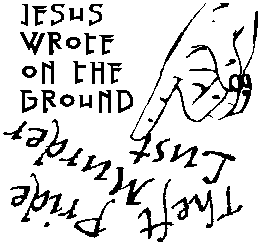
- Ignoring the question and writing on the ground (v. 6)
- Challenging those without sin to cast the first stone (v. 7)
III. Forgiveness and Mercy
- Woman’s accusers leaving, starting from the eldest (v. 9)
- Jesus forgiving the woman and urging her to sin no more (v. 11)
Clipart by Fr. Richard Lonsdale; pop-up links direct to Catholic centered content on Google AI search
5th Sunday of Lent C
GOSPEL READING
Hearers of the Word

Click on slide to watch video by Fr. Kieran J. O’Mahony
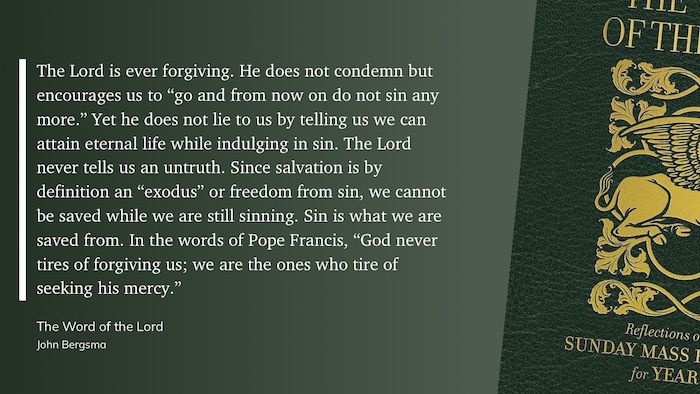
John Bergsma
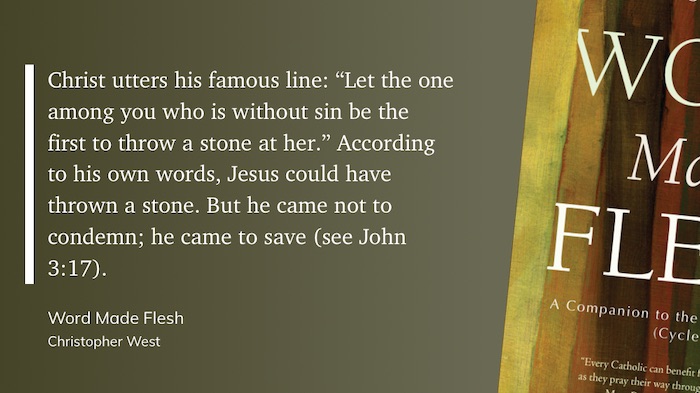
Christopher West
5th Sunday of Lent C
GOSPEL READING
Context
HISTORY
John 8:1-11 recounts the story of the woman caught in adultery, offering insight into the historical and political context of Jesus’ ministry in 1st century Palestine. This passage highlights the tensions between Jesus and the religious authorities of the time and emphasizes his message of forgiveness and compassion.
During this period, the Roman Empire governed Palestine, and Jewish society was largely patriarchal, with women occupying a lower social status than men. The Pharisees and scribes sought to maintain social order and religious purity, often enforcing strict interpretations of Mosaic Law.
Jesus, as a Jewish teacher and healer, attracted a following that threatened the religious authorities’ power. The Pharisees and scribes attempted to trap Jesus by presenting the woman caught in adultery (John 8:3-5), expecting him to either uphold Mosaic Law and condemn her or defy the law and lose credibility.
Instead, Jesus’ response confounded his opponents while offering mercy and forgiveness to the woman (John 8:7-11). This event illustrates the tension between Jesus’ teachings of compassion and the religious establishment’s desire to maintain control.
The story also highlights Jesus’ innovative approach to sin and repentance, focusing on forgiveness and restoration rather than punishment. This message remains relevant for contemporary readers, illustrating the boundless love and mercy offered by Christ to all who seek redemption.
In summary, John 8:1-11 reflects the historical and political context of Jesus’ ministry, emphasizing the challenges he faced from religious authorities while offering a powerful message of forgiveness and compassion that continues to resonate with readers today.
5th Sunday of Lent C
SOCIETY
John 8:1-11 provides valuable insight into the sociocultural context of the early Christian community, particularly regarding attitudes toward women and sin in 1st century Palestine. This passage, which recounts the story of the woman caught in adultery, underscores Jesus’ compassionate and countercultural approach to gender and morality.
During this period, women in Jewish society faced significant social constraints and were often viewed as inferior to men. In the case of adultery, women were more likely to face harsh punishment, while men were often given more lenient treatment. By challenging the Pharisees’ and scribes’ punitive approach, Jesus defied the prevailing social norms and emphasized the inherent worth of each individual, regardless of gender or social status.
Additionally, this passage highlights the tension between Jesus’ message of forgiveness and the rigid interpretation of Mosaic Law held by religious authorities. By refusing to condemn the woman and instead calling for repentance and forgiveness (John 8:10-11), Jesus offers a radical alternative to the legalistic approach to sin and punishment.
The story’s original audience, comprising early Christians navigating the challenges of following Christ within a patriarchal and legalistic society, would have found hope and encouragement in Jesus’ compassionate treatment of the woman. His example illustrates that love, forgiveness, and transformation are available to all who seek it, regardless of societal expectations.
In conclusion, John 8:1-11 challenges the sociocultural norms of 1st century Palestine, emphasizing the transformative power of Christ’s love and forgiveness. By defying the prevailing attitudes toward gender and sin, this passage provides a powerful reminder of the boundless compassion offered by Christ to all those who seek redemption.
5th Sunday of Lent C
THEOLOGY
John 8:1-11 has profound theological implications within the Roman Catholic tradition, highlighting key aspects of Christ’s teachings on forgiveness, compassion, and the importance of individual transformation. By examining the context and relevance of this passage, contemporary Catholics can apply its teachings to their own spiritual journey.
Catholic theology emphasizes the boundless love and mercy of God, with reconciliation and forgiveness as central themes. Jesus’ response to the woman caught in adultery exemplifies this concept, as he refuses to condemn her and instead offers a message of redemption and renewal (John 8:10-11). This divine mercy serves as a model for contemporary Catholics, who are called to extend forgiveness and compassion to others, just as Christ has shown mercy to them.
Additionally, the passage underscores the importance of personal transformation and growth in the life of faith. Jesus’ call for the woman to “sin no more” (John 8:11) highlights the necessity of turning away from harmful actions and embracing a new way of life in accordance with God’s will. This message challenges modern Catholics to engage in ongoing self-reflection and growth, striving for greater alignment with the teachings of Christ.
In conclusion, John 8:1-11 provides valuable insights into the Roman Catholic theological context, emphasizing the significance of forgiveness, compassion, and personal transformation in the life of faith. By reflecting on these teachings and applying them to contemporary challenges, Catholics can deepen their relationship with Christ and become more effective instruments of His love in the world.
5th Sunday of Lent C