APR 27, 2025


Homilies
Homilies
- Bishop Barron
- MORE
- 1-MINUTE HOMILY
- 2-Minute Homily
- MSGR. Peter Hahn
- Fr. Jude Langeh
- FR. RUTTIG
- FR. MCCARTHY, OSA
BISHOP
BARRON
Divine Mercy Sunday

For Easter Season (2022), Bishop Barron preached each Sunday on the Second Reading from the Book of Revelation.

Divine Mercy Sunday


ONE MINUTE
HOMILY

Divine Mercy Sunday


TWO MINUTE
HOMILY

Divine Mercy Sunday


MSGR. PETER
HAHN
Divine Mercy Sunday


FR. JUDE
LANGEH, CMF


FR. KEVIN
RUTTIG

Divine Mercy Sunday


FR. TOM
McCARTHY, OSA

Divine Mercy Sunday


Deacon Peter McCulloch
Deacon of the
Diocese of Broken Bay, Australia
Now Featuring Google Notebook LM Podcasts
With each edition THE WORD THIS WEEK will provide conversations between two AI hosts for selected homilies, simulating a podcast-style discussion.
Each NotebookLM discussion is based on the provided homilies. The AI hosts summarize the material, and make connections between topics.
Divine Mercy Sunday

2015 DOCUMENTARY TRAILER (4:21) – The fascinating story surrounding the original work of art commissioned by St Faustina and painted in Vilnius, Lithuania, by an uncelebrated artist

On the Secrets of Divine Mercy
Click below to show/hide questions.
This discussion guide has been generated by the WORD THIS WEEK'S Catholic AI Assistant based on Deacon Peter's homily.
1. Understanding Peace
- What does Jesus mean by "peace be with you" in the context of the Gospel?
- How does the peace offered by Jesus differ from the general understanding of peace?
- Can you recall a personal experience where you've felt this deeper peace? What contributed to that feeling?
2. Transformation Through Love
- How did the Apostles' understanding of Jesus' message transform their lives?
- Why is God’s love likened to the embrace of a loving father rather than just a pardon from a judge?
- Discuss how a life filled with God’s love can be liberating and transformative.
3. Historical Context
- Who are some of the saints that emphasized the importance of God’s love and mercy? Discuss the impact of St Gertrude, St Mechtilde, and St Margaret Mary Alacoque.
- How did these saints contribute to the understanding of the Sacred Heart of Jesus?
4. The Message of Divine Mercy
- Analyze the significance of Jesus’ revelations to Sr Maria Faustina Kowalska.
- What symbolism is suggested by the image of the Divine Mercy that Jesus described?
- How does this message of Divine Mercy challenge our understanding of forgiveness and love?
5. The Role of Divine Mercy Sunday
- Why do you think Jesus emphasized establishing the Feast of Divine Mercy?
- Discuss the importance of Pope St John Paul II's role in canonizing Sr Faustina and establishing the feast.
- How can the observance of Divine Mercy Sunday bring us closer to a personal relationship with Jesus?
Reflection and Prayer
- Take a moment to reflect on why Jesus desires a personal relationship with each of us.
- Consider areas in your life where you might be honoring God only with words, rather than heartfelt action.
- Pray for the peace that comes from loving and trusting in God's merciful heart.
- Conclude with a group prayer for deeper understanding and acceptance of divine mercy in your lives.
Homily Excerpt

We all want peace, don’t we? Sadly, there’s more fear, mistrust and tension around us than peace. What can we do about it?
In today’s Gospel, Jesus enters the locked room where his disciples are hiding and says, ‘peace be with you’. He also says something similar in our second reading to St John, who’s exiled on the island of Patmos. Jesus says, ‘Do not be afraid’.
Jesus often speaks of peace, but the peace he refers to isn’t just restful calm or a beach holiday. It’s much deeper than that. Jesus’ peace comes from a life of love and joy that’s only available from God.
So many saints have shown us that a life filled with God’s love is not only liberating and transforming and dynamic, but it’s also peaceful. Consider the Apostles after Jesus’ resurrection. They’re totally transformed as they finally start understanding Jesus’ message about God’s love…

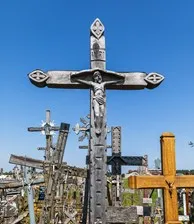
GREAT BIG STORY (1:22) – Hundreds of thousands of crosses sit on a hill in northern Lithuania. Although this place of pilgrimage now represents both Christian devotion and the Lithuanian identity, the tradition of leaving crosses dates back to 1831..
The Hill of Crosses
Click below to show/hide questions.
This discussion guide has been generated by the WORD THIS WEEK'S Catholic AI Assistant based on Deacon Peter's homily.
Opening Remarks:
Reflect on the statement "Christ is risen! Alleluia!" Why is this proclamation central to the celebration of Easter?
Introduction to the Hill of Crosses:
Discuss the significance of the Hill of Crosses in Lithuania and its role as a symbol for the Lithuanian people's faith and independence.
- Why do you think the Hill of Crosses has been a powerful symbol for so many generations?
- How does this place inspire people of faith around the world?
Freedom of Faith:
Consider the contrast between the freedom to worship in some countries and the restrictions in others. Reflect on the situation in Soviet Russia and the current scenario in Ukraine.
- How do limitations on religious freedoms affect individuals and communities?
- What are the potential effects on a culture or society when religious expression is suppressed?
Malcolm Muggeridge's Experience:
Explore the narrative of Malcolm Muggeridge visiting a church in Kyiv and his transformation from atheism to faith.
- What aspects of the Ukrainian congregation's faith moved Muggeridge so deeply?
- How does Muggeridge's story illustrate the power of faith under persecution?
Symbols of Hope and Transformation:
Analyze how the cross, once a symbol of Roman tyranny, became a symbol of hope through Jesus' crucifixion.
- In what ways do symbols, such as the cross or the Hill of Crosses, empower individuals facing adversity?
- How can faith transform fear and oppression into hope and liberation?
Modern-Day Spiritual Warfare:
Discuss the broader implications of the ongoing spiritual battles described in the sermon, such as those between truth and lies, light and darkness.
- Identify examples of this spiritual warfare in contemporary society.
- How can individuals cultivate their faith and resilience in the face of these challenges?
Personal Reflection:
Encourage personal reflection on the message of the sermon.
- How can the message of Easter and the Hill of Crosses inspire your own faith journey?
- What actions can you take to support religious freedom and human dignity in your community and around the world?
Closing Thoughts:
Invite group members to share any final insights or commitments they have from the discussion. Christ is risen! Alleluia! Encourage everyone to carry the hope and joy of Easter into their daily lives.
Homily Excerpt
Today as we celebrate the joy of Easter, we are reminded that millions of people around the world cannot express their religious faith freely. They cannot do what we’re now doing: celebrating Jesus’ Resurrection and promise of eternal life.
In Northern Lithuania, two and a half hours’ drive from Vilnius, the capital, there’s a place called the Hill of Crosses. It’s a small hill in the middle of green farmland, densely covered with countless thousands of crosses of all shapes and sizes.
For hundreds of years, this hill has symbolised the deep Christian faith and independent spirit of the Lithuanian people. Every day, people go there to pray and reflect, and to add new crosses.
Among these crosses, there’s a statue of Jesus sitting under a roof, praying quietly. His sad face represents the millions of Christians who for years could only worship in secret under Soviet Russia.
The Soviets hated this hill; they bulldozed it and burnt the crosses many times. But despite the risks, the people kept returning. In 1973, after again bulldozing it, soldiers started guarding this hill, but still the locals returned late at night to plant new crosses.ings, crowning with thorns, and nails through his wrists and feet.

Josefa Menéndez—
Mystic of Mercy
This discussion guide has been generated by the WORD THIS WEEK'S Catholic AI Assistant based on Deacon Peter's homily.
Discussion Guide for Divine Mercy Sunday: Embracing God's Love and Forgiveness
1. Introduction to Divine Mercy Sunday:
- Reflect on the significance of Pope St. John Paul II proclaiming the second Sunday of Easter as Divine Mercy Sunday.
- Discuss St. Faustina Kowalska’s role in spreading the message of Divine Mercy.
- How does the vision of Jesus as the ‘King of Divine Mercy’ symbolize his message?
2. Understanding Mercy through St. Faustina and Sr. Josefa:
- Explore Jesus' messages to St. Faustina about his mercy, especially towards sinners.
- Why does Jesus emphasize that "the greater the sinner, the greater the right they have to my mercy"?
- Introduce Josefa Menéndez’s life and her mystical experiences with Jesus.
- Discuss Jesus’ desire for the world to know about his mercy through Sr. Josefa.
3. Humility and Love in Action:
- Contemplate Jesus’ teachings to Sr. Josefa about humility, obedience, and love in everyday actions.
- How can we practice love in both work and rest, joy and sorrow?
- Discuss the importance of acting with love, as highlighted in Jesus’ words to Sr. Josefa.
4. Jesus’ Passion and Reparation:
- Reflect on Jesus’ request for reparation and love at every Eucharist, as shared with Sr. Josefa.
- How can we relate to Jesus’ feelings of ingratitude and the desire for souls’ love?
- Consider the invitation to link personal suffering with Jesus’ for the salvation of souls.
5. Complete Surrender to Divine Will:
- Analyze the significance of Jesus asking for Sr. Josefa’s complete abandonment to his will.
- What does it mean to surrender to God? How can this be applied in our lives?
6. Consistency of Jesus' Messages:
- Explore how the messages given to Sr. Josefa align with those received by St. Faustina, St. Margaret Mary Alacoque, and St. Therese of Lisieux.
- How do these messages support the essence of the Gospel?
7. Divine Invitation:
- Reflect on Jesus’ invitation to the world: “Let them come to me! Let them throw themselves into my arms!”
- How can we individually and collectively accept this invitation and encourage others to do the same?
8. Personal Reflection and Application:
- Encourage participants to share personal experiences related to mercy, love, and forgiveness.
- Discuss actionable steps to embody the message of Divine Mercy in daily life.
9. Conclusion and Prayer:
- Close with a prayer focusing on openness to Jesus' love, mercy, and forgiveness.
- Encourage ongoing reflection and commitment to embracing and spreading the message of Divine Mercy.
Homily Excerpt

25 years ago, in April 2000, Pope St John Paul II canonised Faustina Kowalska and established the second Sunday of Easter as Divine Mercy Sunday. This is what we celebrate today.
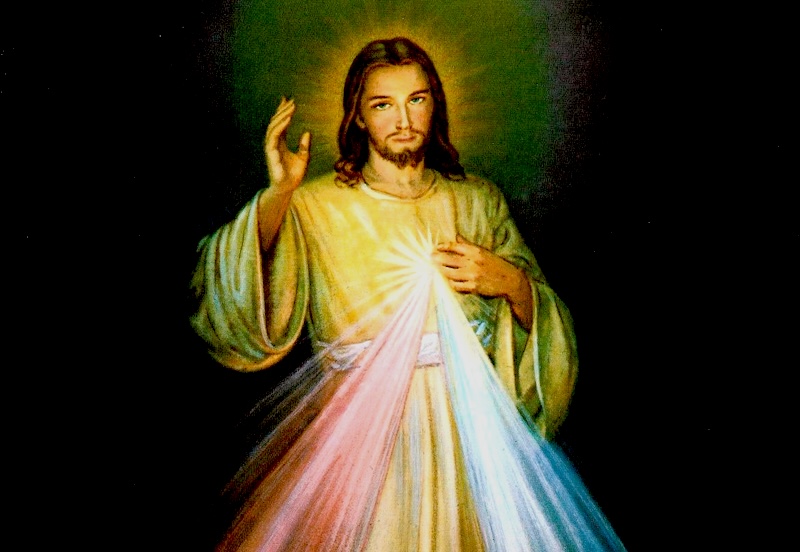
St Faustina (1905-38) is the humble Polish nun who most people associate with Divine Mercy Sunday. Jesus appeared to her many times and gave her a vision of himself as the ‘King of Divine Mercy’ wearing white, with rays of white and red light shining from his heart.
Jesus told her that the world won’t find peace until it starts trusting in his mercy. ‘My Heart overflows with great mercy for souls, especially for poor sinners,’ he said. ‘If only they could understand that I am the best of Fathers to them and that it’s for them that the blood and water flowed from my heart…’ (Diary 367).
He also said, ‘The greater the sinner, the greater the right they have to my mercy… Whoever trusts in my mercy will not perish, for all his affairs are mine and his enemies will be shattered at the base of my footstool.’ (Diary 723)

THE WORD THIS WEEK invites you to check out the Catholic AI assistant (located at the bottom right-hand corner), a homily preparation resource you can use to clarify or develop the insights and themes of Deacon Peter’s homilies.
Fr. Austin Fleming
Divine Mercy Sunday

2015 HOMILY – Sometimes we might think and act as if God’s forgiveness is kept in a big “mercy bank” in heaven and that when you or I tell God, “I’m sorry for such and such…” God goes to the mercy bank, withdraws a sufficient amount of forgiveness and deposits it in our salvation savings account.
WRONG!
God is mercy! God is a river, an infinite ocean of mercy. The heart of Jesus is an eternal fountain of forgiveness that never stops pumping, flowing, gushing forth with mercy, mercy that has no end. The font of Jesus’ mercy is never turned OFF by the vagaries of our repentance – or lack of it.
This discussion guide has been generated by the WORD THIS WEEK’S Catholic AI Assistant based on Father Austin’s homily. NEED HELP? Copy and paste a question into the chat bot in the lower right corner of the screen and have our Catholic Assistant help you.
Understanding God’s Mercy
– Explore the concept of God’s mercy as described in the sermon. How does the analogy of a “mercy bank” differ from the reality of God’s infinite mercy?
– Contemplate on the imagery used (like Niagara Falls and a fire hydrant) to describe God’s mercy. How does this imagery help understand the nature of divine mercy?
The Challenge of Forgiveness
– Discuss: Why might it be challenging for us to forgive others as Jesus forgives us?
– Reflect on the statement: “God’s mercy precedes our sins.” How does this perspective change our understanding of repentance and forgiveness?
Personal Reflection
– Encourage group members to share personal experiences where they found forgiving others challenging, and how they sought or could seek God’s help in the process.
– Reflect on the idea that God’s mercy is ready for us even before we sin. How does this understanding affect our view of confession and reconciliation?
Pope Francis and the Year of Mercy
– Review Pope Francis’s emphasis on mercy as a central theme of his papacy. Discuss why this focus might be particularly relevant today.
– Analyze the quote from “Misericordiae Vultus.” What does it mean to not judge or condemn? How can this be applied in day-to-day life?
Application to Communion
– Discuss the relevance of the Last Supper mentioned in the sermon. How does the act of communion embody the themes of mercy and forgiveness?
– Encourage participants to reflect on approaching the Lord’s table with an open heart to receive and extend mercy.
Actionable Steps
– Identify practical steps that group members can take to embody God’s mercy and forgiveness in their personal lives.
– Discuss ways to incorporate the message of mercy in community practices and outreach within the church or group settings.
Closing Reflection
– Invite participants to consider who in their lives they may need to forgive and how they can entrust both themselves and others to God’s mercy.
– Encourage a moment of silent prayer or meditation, focusing on the abundant mercy available through Christ.
THE WORD THIS WEEK invites you to check out the Catholic AI assistant (located at the bottom right-hand corner), a homily preparation resource you can use to clarify or further develop the insights and themes of Fr. Fleming’s homily.
Dominican Blackfriars

Divine Mercy Sunday

Photograph by Fr Lawrence Lew OP of the choir screen in Notre Dame Cathedral, Paris.
Click below to show/hide questions.
This discussion guide has been generated by the WORD THIS WEEK'S Catholic AI Assistant based on the Dominican Blackfriars' homily for this week. NEED HELP? Copy and paste a question into the chat bot in the lower right corner of the screen and have our Catholic Assistant help you.
Introduction and Initial Reactions
—Reflect on the statement: "When someone we love dies, it is like we have been betrayed." How do you relate to this concept? What emotions does it evoke in you?
—Discuss the idea of feeling betrayed by the deceased rather than God. Why might this be a common sentiment in grief?
Sharing Love and the Impact of Loss
—Share personal experiences of continuing life without someone you deeply loved. How do daily reminders and memories impact your healing process?
—In what ways do shared joys and experiences become painful reminders after a loss?
Thomas's Doubt and the Reality of Resurrection
—Discuss the significance of Thomas’s doubt and how it represents a common struggle in reconciling faith with grief.
—Reflect on the type of resurrection Thomas hoped for and how it relates to his understanding of healing and hope.
—Share your thoughts on the apostles’ gathering in fear and how community plays a role in navigating sorrow and fear.
Encounter with the Risen Christ
—Examine Christ’s interaction with Thomas, particularly the significance of touching His wounds. What does this suggest about dealing with pain and sorrow?
—Discuss Blaise Pascal’s remark: "The Risen Christ does not want to be touched, except in His wounds.” How does this fit with your understanding of healing and salvation?
—How do the sacraments symbolize the life-giving nature of Christ's wounds today?
Hope and Healing in the Resurrection
—Explore how the resurrection of Christ offers a promise of healing for our own grief and losses. What does it mean for our own lives and the people we mourn?
—Reflect on how the sermon portrays the transformation of sorrow into something glorious through faith. How does this offer hope in your spiritual journey?
—Discuss the assertion that we are not orphans because Christ lives in the Church. How does this impact your sense of community and belonging?
Application in Daily Life
—Consider practical ways to feel connected to the living Christ in everyday life, especially through touching His wounds in the sacraments.
—How can this sermon inspire us to support others who are grieving? In what ways can we offer comfort and hope?
Homily Excerpt
Second Sunday of Easter (Low Sunday). fr Leon Pereira tells us how through his wounds Christ heals all our sorrows and transforms them to glory.

The same Risen Jesus who told Mary Magdalene not to cling to Him forces Thomas to touch His wounds. Noting this difference, the philosopher and mathematician Blaise Pascal remarked, ‘The Risen Christ does not want to be touched, except in His wounds.’ Why? Because it is from His wounds that His saving powers – the seven holy sacraments of the Church – stream forth upon us. And His wounds show us the truth that there is a healing for all sorrows, one which does not pretend they never happened, but a healing which draws us through and beyond all sorrows, which glorifies us and makes us live again in our bodies, unable to suffer or die, and forever able to love and to rejoice.
Because Jesus is risen, we are not left alone. Because Christ has overcome death, our own grief at death will be broken. Because Jesus has come back from the dead, the pain of our loss will be healed. We are not left as orphans because Christ is alive in His Church. Just as Thomas touched Christ’s wounds, so we touch the same life-giving wounds of Christ in the sacraments, above all in the Eucharist. From the altar we too receive our Lord and our God, the Living One whom Thomas touched, the One who took flesh for our sake, to heal us.
Photograph by Fr Lawrence Lew OP of the choir screen in Notre Dame Cathedral, Paris.
Click below to show/hide questions.
This discussion guide has been generated by the WORD THIS WEEK'S Catholic AI Assistant based on the Dominican Blackfriars' homily for this week. NEED HELP? Copy and paste a question into the chat bot in the lower right corner of the screen and have our Catholic Assistant help you.
Introduction
- Begin by sharing the anecdote about Bertrand Russell's hypothetical encounter with God during judgment. Discuss the implications of his response: "Not enough evidence."
- Relate this to the challenges some face in accepting the resurrection of Jesus, contrasting stubborn unbelief with genuine struggles.
Exploring St. Thomas's Doubt
- Reflect on St. Thomas's initial disbelief in Jesus' resurrection. Discuss the nature of his doubts and how they resonate with our struggles.
- Consider the significance of the resurrection in Christian faith. What makes it an "astonishing" event in history as stated in the sermon?
- Discuss how the resurrection's transformative power extends to believers, offering eternal life in Jesus' name.
The Transformation of Doubt
- Examine how Jesus' interaction with St. Thomas transforms his doubt into a profound confession of faith: "My Lord and my God."
- Discuss the role of faith as a gift rather than a conclusion drawn strictly from empirical evidence.
- Explore why St. Thomas is revered not for his doubt, but for his eventual act of faith.
Doubt and Faith in Contemporary Context
- Discuss contemporary views on doubt as a virtue and skepticism in modern society. How does this contrast with the spiritual perspective offered?
- Reflect on the importance of balancing doubt with faith, especially in relational contexts where trust is essential.
- Consider the evidence available to believers in support of the resurrection: the Gospels, martyr witnesses, and Church tradition.
The Role of Humility and Acceptance
- Analyze the virtue of knowing when to set aside doubt in favor of faith and trust.
- Discuss humility as essential in accepting truths that go beyond human understanding and reason.
- Reflect on the human struggle to believe in divine truths and how faith compensates for our natural limitations.
Application and Reflection
- How can the story of St. Thomas inspire us in our moments of doubt and struggle?
- In what ways can believers nurture their faith to embrace the transformative reality of the resurrection?
- Encourage sharing of personal experiences of doubt and how faith has played a role in overcoming these challenges.
Homily Excerpt
Second Sunday of Easter (C) | Fr Robert Verrill considers the usefulness of doubt, and the virtue of knowing when to put doubts aside.
There’s a story about the atheist philosopher Bertrand Russell being asked what he would say if he found himself standing before God on the day of judgment and God asked him “Why didn’t you believe in Me?” Russell replied “I would say, ‘Not enough evidence, God! Not enough evidence!”
For some people, no amount of evidence would ever convince them to believe in God and in Jesus’ resurrection, but in today’s Gospel, we don’t hear of the obstinate disbelief of a cynical atheist, but of someone who is struggling. The disbelief of the apostle St Thomas reflects the doubts of someone who would very much like to believe in Jesus’ resurrection, but he just finds it too astonishing to accept.
Now St. Thomas’ struggle to believe in Jesus’ resurrection is an opportunity for us to reflect on our own struggles as well. If only we realized just how astonishing the resurrection is, we might spend more time thinking about it…
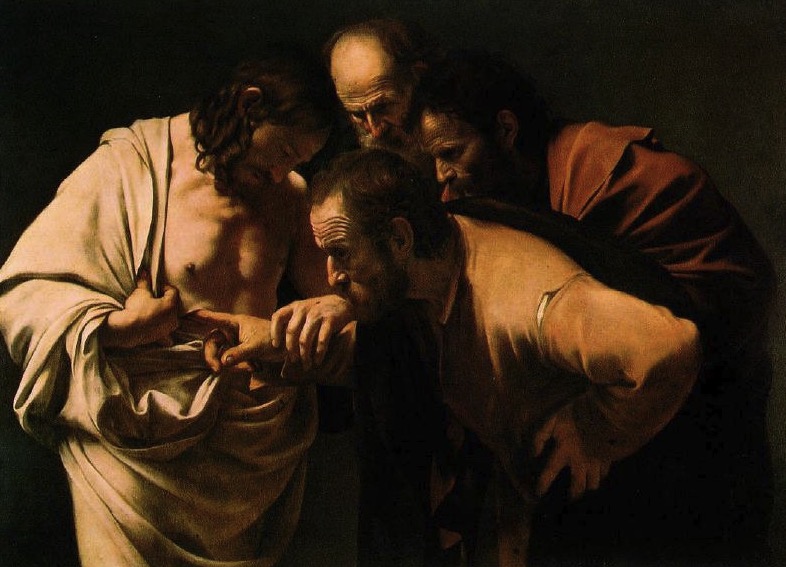
Image: Incredulita di San Tommaso (1602), Potsdam, Sanssouci, Bildergalerie, photographed by Rodney
Click below to show/hide questions.
This discussion guide has been generated by the WORD THIS WEEK'S Catholic AI Assistant based on the Dominican Blackfriars' homily for this week. NEED HELP? Copy and paste a question into the chat bot in the lower right corner of the screen and have our Catholic Assistant help you.
1. The Significance of Thomas' Doubt:
- How does Thomas’ need to see and touch the scars of Jesus influence our understanding of faith and belief?
- In what ways can skepticism and doubt play a positive role in deepening one's faith journey?
2. The Role of Sacraments:
- Discuss how sacraments serve as tangible expressions of Christ’s presence in the contemporary Church.
- How could engaging in sacraments help individuals in their personal faith journey?
3. Community and Commission:
- Analyze how the risen Jesus transforms the disciples into a community with a mission to show mercy and justice.
- Why is community important in the context of faith, and how can modern believers build and sustain faith communities?
4. Reflections from Acts:
- What similarities do you find between the early Christian community described in Acts and today’s Church?
- How can the Church today maintain its relevance and retain its charismatic roots in a seemingly routine or prosaic environment?
5. Belief Without Sight:
- Discuss the concept of being blessed for believing without seeing. How might this apply to everyday believers who don't witness miraculous events?
- How can believers find assurance and encouragement in the ordinary moments of life?
6. Everyday Miracles:
- Consider the statement about the miracle of "God-with-us" being an everyday occurrence. How do routine religious practices help deepen one's faith despite their perceived mundanity?
- In what ways might routine and consistency in worship be beneficial to believers?
7. The Imperfection of the Church:
- How does the story of Ananias and Sapphira highlight the enduring imperfections within the Church?
- Why is it important to acknowledge the Church’s imperfections while celebrating its role in divine grace?
8. The Glorified Christ:
- Explore how Revelation portrays the risen Christ as both mysterious and intimately present.
- How does the concept of a glorified Christ beyond our comprehension shape our understanding of divine mystery and hope?
9. Reflection and Application:
- Think about a time when doubt challenged your faith. How did you reconcile it, and what role did community or sacraments play in that reconciliation?
- Share an experience where you felt the presence of God in a mundane routine or everyday miracle. How did this experience impact your faith journey?
- Discuss ways your group can act as a community of faith, showing mercy and justice to those around you. What practical steps can you take together?
Homily Excerpt
Second Sunday of Easter (Low Sunday). Fr Colin Carr preaches on how Christ touches our lives, dramatically or otherwise.
It was very important to Thomas that his excited fellow disciples had not just seen a phantasm, but the same Christ they had known and followed in Galilee and Jerusalem. The risen Christ was present to people by sight, though sometimes it took them a little time to realise who they were seeing. But sight can be deceptive, as we suggest when we say of someone that they’re ‘seeing things’. Touch is a more solid way of being present to each other, and Thomas wanted to be able to see and touch not just any bit of Jesus but the scars – the holes which were absences of flesh showing the the presence of the flesh of the crucified and risen one. We who have not seen yet have believed can experience the intimate closeness of the risen One – a genuine touch – in many ways, but particularly through the sacraments which are tangible expressions of his presence with us.
But this is not just a private, individual experience enjoyed by those who are mystically inclined. The risen Jesus breathes on his disciples (in other words inspires them) and transforms them into a community which is sent out to show his mercy and his justice. The intimately, visibly, tangibly present Christ creates a community which will become a world-wide Church in which he is always present.
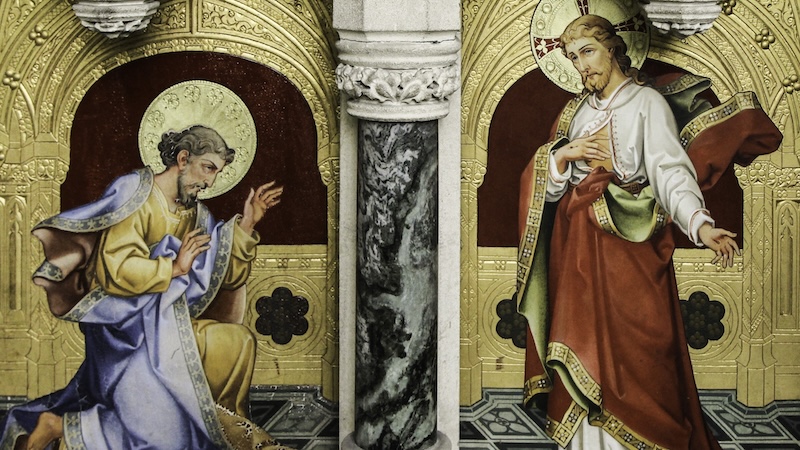
Image: detail from a side-altar frontal by Bentley in St Cuthbert’s Seminary, Ushaw, photographed by Fr Lawrence Lew OP
Click below to show/hide questions.
This discussion guide has been generated by the WORD THIS WEEK'S Catholic AI Assistant based on the Dominican Blackfriars' homily for this week.
Introduction
Begin by setting the context of the sermon, focusing on the faith journey of the Apostle Thomas as a case study in believing in the Risen Christ. Highlight the primary themes: surprise and planning in resurrection appearances, the personal journey of faith, and the importance of testimony.
Section 1: The Surprise of the Resurrection Appearances
1. Questions for Reflection:
- What is the significance of the unexpected reactions of those who witnessed the Resurrection appearances?
- How does the element of surprise contribute to the credibility of the Resurrection accounts in the Gospel?
2. Discussion Points:
- Explore the contrast between the disciples' surprise and the possibility of Jesus’s careful planning.
- Discuss the impact of Jesus’s planned appearances on the formation of early Christian faith.
Section 2: Thomas, The Absent Apostle
1. Questions for Reflection:
- Why might Thomas have been absent during Jesus’s first appearance to the apostles?
- How does Thomas’s past behavior (as described in John 11:16 and John 14:1-7) inform our understanding of his absence?
2. Discussion Points:
- Consider the potential reasons for and implications of Thomas’s absence.
- Discuss the tension between fear and bravery in Thomas’s character and actions.
Section 3: Thomas’s Transformation and Confession
1. Questions for Reflection:
- What factors contributed to Thomas’s radical change in belief?
- How does Thomas’s confession ("My Lord and My God") relate to his previous hesitation?
2. Discussion Points:
- Analyze Jesus’s response to Thomas’s disbelief and its significance.
- Discuss the broader implications of Thomas’s transformation for other believers and for the nature of faith.
Section 4: Faith Beyond Seeing
1. Questions for Reflection:
- What does Jesus’ blessing for those who believe without seeing tell us about the nature of faith?
- How might Thomas’s experience serve future believers, even those who do not see Jesus physically?
2. Discussion Points:
- Explore the importance of apostolic testimony and its role in spreading the Christian faith.
- Discuss how faith today is supported by Scripture, tradition, and personal encounters with the divine.
Section 5: Our Role as Modern-Day Witnesses
1. Questions for Reflection:
- How are we, as modern believers, similar to Thomas in our journey of faith?
- In what ways can personal testimony influence others’ beliefs?
2. Discussion Points:
- Discuss personal experiences where faith was challenged or strengthened without direct evidence.
- Reflect on the role of community and shared stories in deepening and spreading faith.
Conclusion
Summarize the paths to faith discussed, emphasizing the ongoing relationship with the Living Lord. Encourage participants to share their own experiences and consider how they can walk in Jesus’ way, becoming witnesses to His continuing presence in the world. Discuss the implications for personal and communal faith journeys in the modern world.
Homily Excerpt
Second Sunday of Easter. Fr Andrew Brookes considers the faith journey of the Apostle Thomas.
Jesus always knew he would only visibly appear to a few witnesses, chosen beforehand, and after that people would be invited to believe on the word of their testimony. But the word of their testimony is not just words looking back to a past memory but expressing an ongoing relationship with a Living Lord, who reigns from Heaven, and who lives and reigns in their hearts. After that first generation, people would be invited to rely on the written words of the Gospel and the ongoing faith of each generation of disciples.
This pattern of believing continues. We are asked to believe on the basis of the apostles’ testimony recorded in the Scriptures, on the testimony of other believers over the centuries and those around us now, especially those who speak to us of their faith, and also because the invisible Risen Lord and his Holy Spirit work at least small signs for us, and make their presence felt and seen and known to us, and who stir up faith, hope and love in us, prompting us to exclaim to Jesus ‘My Lord and My God’. In turn we become witnesses, sharing our testimony, walking in the way of the Lord for us, telling of the Living Lord Jesus to others, and inviting them to confess him, to believe, know and love him, and so to receive eternal life, to follow Jesus and to walk in his Way, like Thomas.
THE WORD THIS WEEK invites you to check out the Catholic AI assistant (located at the bottom right-hand corner), a homily preparation resource you can use to clarify or further develop the insights and themes of the homilies above.
Fr. Charles E. Irvin
Divine Mercy Sunday
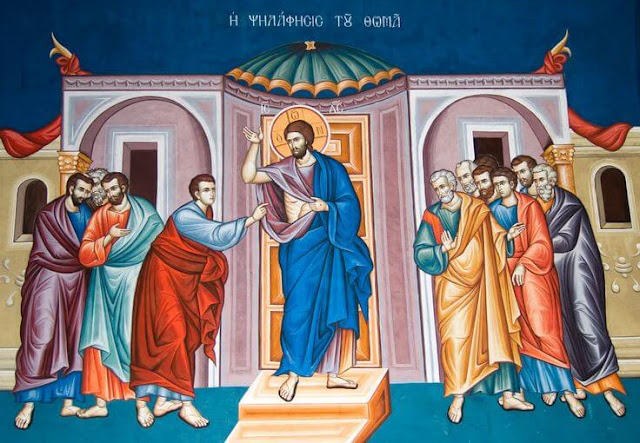

What happened on Easter Sunday morning and thereafter? We could take doubters to the tomb and they would find it to be empty. But what would that prove? Nothing — except that the tomb was empty. They would not see and encounter the risen Christ.
What do non-Christian historians tell us about Jesus of Nazareth? Nothing much beyond the fact that He was from Nazareth, that He was a descendent of David, and that He was crucified in Jerusalem. Historians cannot, however, bring us to encounter the risen Christ.
The answer to the question “What happened?” is found in the lives of all who, down through the centuries, have encountered Christ as He has come to us in others who share our humanity.
What was “seen” is not as significant as what is known to be ultimately true. The reality of Christ resurrected from the dead is found in the lives of those who, touched by the Holy Spirit, have encountered Christ in His presence to them, in His power given to them, and in His love shared with them. Because of them I know what happened after Jesus Christ rose from the dead. Because of them I know that the tomb is empty and that Jesus Christ is out and about working elsewhere.
This discussion guide has been generated by the WORD THIS WEEK’S Catholic AI Assistant based on Fr. Irvin’s homily. NEED HELP? Copy and paste a question into the chat bot in the lower right corner of the screen and have our Catholic Assistant help you.
1. Introduction to Skepticism
– Discuss the prevalence of skepticism in today’s society. What are some examples of current issues that provoke skepticism?
– How does skepticism differ from questioning and doubt? Can you identify where each might exist in your personal life or society?
2. Faith and Daily Acts
– Explore the notion that skeptics and doubters engage in acts of faith daily. How do these acts manifest in everyday activities, like traveling or relationships?
– Debate whether faith can be considered a reasonable and evidence-based act. How does this perspective align or clash with personal experiences or beliefs?
3. The Role of Historical Testimonies
– Evaluate the sermon’s claim that the testimonies of eyewitnesses to Jesus, like those of the apostles, are credible. How do personal beliefs or cultural backgrounds influence this evaluation?
– Discuss the distinction between historical evidence and personal belief. What role should each play in forming faith convictions?
4. Encountering Doubt Through Thomas the Apostle
– Reflect on the experiences of doubting figures like Thomas the Apostle. How can his story resonate with personal experiences of faith and doubt?
– What is the significance of Thomas’s declaration, “My Lord and my God,” in the broader context of resolving doubt?
5. The Nature of Seeing and Believing
– Analyze how the apostles’ experience of “seeing” Christ is depicted as involving more than physical sight. In what ways can this concept be applied to modern faith experiences?
– Discuss the challenges in conveying spiritual encounters or revelations to others. How important is personal experience in affirming religious belief?
6. Implications of the Resurrection
– Consider the ways in which the resurrection of Jesus is believed to have impacted the apostles and early Christians. How does this transformation support or challenge current beliefs?
– Explore the role of the Holy Spirit in transforming individuals and in witnessing the reality of the resurrection over centuries.
7. The Role of the Church and Community
– Discuss the sermon’s view of the Church as a gift and a source of faith. How does this perspective align with or challenge personal views on organized religion?
– Reflect on the importance of community in sustaining faith. Share experiences where communal support has strengthened personal beliefs or practices.
8. Personal Reflections and Applications
– How does this sermon inspire personal faith journeys or understanding of skepticism and belief?
– In what ways can individuals navigate their doubts and faith questions within a supportive community?
THE WORD THIS WEEK invites you to check out the Catholic AI assistant (located at the bottom right-hand corner), a homily preparation resource you can use to clarify or further develop the insights and themes of Fr. Irvin’s homily.
Fr. George Smiga
- Seeing the Change in Us - 2004
- NO HOMILY - 2007
- Christ's Risen Body - 2010
- A New Kind of Joy - 2013
- No Homily - 2016
- No Homily - 2019
- No Homily - 2022
Seeing the Change in Us

We should hesitate before we criticize Thomas. Thomas, of course, is the disciple who has been remembered as the one who doubted. Therefore, it is easy to look down on Thomas and criticize him because at first he did not believe in Jesus’ resurrection. But before we begin that critique, it would be good for us to recognize that Thomas is the disciple who is most like us. You see, the other disciples all believed because they saw the Lord. They saw his risen glory. But Thomas was asked to believe, not because he saw, but only because he heard the testimony of the other disciples. “We have seen the Lord,” they said to him. That is our situation. We have not seen the risen Lord. Our faith is founded on the witness of others, the testimony that comes from others who also believe. So since we are, as it were, standing in the shoes of Thomas, perhaps we be more sympathetic and ask: What was the problem? Why did he fail to believe?
Yes, it is true that Thomas did not at first see the risen Lord. He did, however, have the testimony of the other disciples. Why was their word not enough? Why was their testimony insufficient? Thomas doubted because the word of the other apostles did not ring true. They told him what happened. They told him, “We have seen the Lord. He came and breathed the Holy Spirit on us. He sent us out into the world to forgive sin and to heal the brokenness of others.” They told him all of those things, but their words were not enough and Thomas began to doubt. He doubted because if Jesus had been raised up, if the apostles had been sent out to the world, what were they still doing huddled in that upper room? If Jesus had been raised up, if the apostles had been given a mission to the world, if the Spirit had descended upon them in power, then what were they still doing here? Why hadn’t they left? Why wasn’t there a greater change in their lives?
This discussion guide has been generated by the WORD THIS WEEK’S Catholic AI Assistant based on Fr. Smiga’s homily.
Context and Introduction
– Discuss the significance of Thomas in Christian theology, focusing on his label as ‘Doubting Thomas’.
– Explore the emotional and spiritual challenges of believing in the resurrection without physical evidence.
Thomas and Us: A Shared Experience
1. Comparison with Thomas:
– How do we relate to Thomas’s initial disbelief given our reliance on second-hand testimony about Jesus’ resurrection?
– What can Thomas teach us about the nature of faith in the absence of direct evidence?
2. The Role of Testimony:
– Why might testimony alone be insufficient to foster belief?
– Discuss how personal experiences and changes in others can impact belief more powerfully than words alone.
Examine the Disciples’ Influence
1. The Gap Between Word and Action:
– Analyze the supposed disconnect between the disciples’ words and their actions.
– Discuss the impact of this disconnect on Thomas’s faith and our faith today.
2. Reflection Questions:
– How can we ensure our actions align with our words, particularly in expressing love and pride?
– How do inconsistencies between spoken beliefs and visible actions affect our ability to evangelize or witness effectively?
Applying the Message to Personal Relationships
1. Living Out Love:
– How can we better demonstrate our love to those around us?
– What specific steps can we take to ensure our words of love are matched by our actions?
2. Active Participation in Children’s Lives:
– Reflect on practical ways to be present and engaged in the lives of children or young ones you influence.
Living the Resurrection Today
1. Manifesting Belief in Daily Life:
– Discuss practical ways to live out a belief in the resurrection through joy, generosity, and gratitude.
– Reflect on how your life reflects the truth of the resurrection to others.
2. Group Reflection:
– How can your small group or community better support each other in aligning words with actions?
– In what ways can your collective actions serve as testimony to the truth of the resurrection?
Conclusion: Embracing the Call to Witness
– Discuss the individual and communal responsibility to live in a way that makes the resurrection evident to others.
– Brainstorm actionable steps that can be taken as a group to live more authentically and evidence the change that belief in the resurrected Christ demands.
THE WORD THIS WEEK invites you to check out the Catholic AI assistant (located at the bottom right-hand corner), a homily preparation resource you can use to further clarify or further develop the insights and themes of Fr. Smiga’s homilies.
Pro-Life Homily Resources
Divine Mercy Sunday

Divine Mercy Sunday
“Whose sins you forgive are forgiven, and whose sins you retain are retained.” In this Gospel passage of the Second Sunday of Easter, which is Divine Mercy Sunday, we see Jesus proclaiming the gift that flows from his death and resurrection – the forgiveness of our sins. Isaiah had proclaimed that by his wounds we are healed. Now Jesus shows those wounds and imparts the healing. His cross and his resurrection reveal the mercy of God.
We are familiar with the image of Divine Mercy. Rays of light are coming from Jesus’ wounds. Under the Old Covenant, on the Day of Atonement, the high priest went into the most sacred part of the Temple, asked God’s mercy for the sins of the people, and then came out declaring that they had God’s forgiveness. The Divine Mercy image is Jesus, the new and eternal high priest, having offered his own blood and entered the sanctuary of heaven itself, now coming to us and proclaiming that our sins are forgiven.
THE WORD THIS WEEK invites you to check out the Catholic AI assistant (located at the bottom right-hand corner), a homily preparation resource you can use to clarify or develop the insights and themes of Frank Pavone’s homily notes for preachers.
Msgr. Joseph Pellegrino
Divine Mercy Sunday

The Power to Conquer Doubts

The gospel reading reminds us that faith is trusting in God, not finding physical proofs. If you notice, those in the gospel who are gifted with the appearance of the Resurrected Savior are those who already, to some degree or other, have faith in Jesus. He doesn’t appear to strangers. Perhaps the best symbol of the Resurrection is the empty tomb. Those who have faith in Jesus are called now to believe that he has been raised from the dead as he said. The very Empty Tomb is not a proof of faith but a call to faith. It is a sign that reality has been transformed. This is the ideal for which we strive. However, we happen to be human. We are not just spiritual, we are physical. Most of our knowledge comes from the physical side of our nature. We see, hear, touch, etc then we evaluate. Faith does not provide this. Faith demands that we subordinate our physical, scientific capabilities to our spiritual side. Our belief in the Word of God that Jesus has transformed reality takes primacy over whether we can see, feel, heal or touch any sort of change in reality.
This discussion guide has been generated by the WORD THIS WEEK’S Catholic AI Assistant based on Fr. Pellegrino’s homily.
Part 1: The Role of the Lent to Pentecost Cycle
Discussion Points:
– Lent is traditionally a time for catechumens to learn the basics of Christianity, such as the Creed and Our Father.
– During the Easter season, neophytes are encouraged to incorporate their faith into every aspect of life, a journey known as mystagogia.
Questions:
– How does revisiting the fundamentals of faith benefit even long-standing members of the Church?
– What does the term “mystagogia” mean to you, and how have you personally experienced this process in your life?
Part 2: Faith and Doubt
Discussion Points:
– The Gospel reading highlights doubts in faith, emphasizing that faith is about trusting in God, not about seeking physical proof.
– The empty tomb serves as a symbol of transformed reality and a call to faith.
Questions:
– What are some doubts you have faced regarding your faith, and how have you addressed them?
– How do you interpret the symbolism of the empty tomb in your personal faith journey?
Part 3: Balancing the Physical and Spiritual
Discussion Points:
– Humans tend to rely on physical proofs; however, faith requires prioritizing spiritual understanding over sensory evidence.
– Doubting is natural, and it is common for pre-teens, teens, and even adults to question their faith, especially following tragedies.
Questions:
– How do you find a balance between needing physical proof and nurturing your spiritual faith?
– In what ways can periods of doubt contribute to strengthening one’s faith over time?
Part 4: The Role of the Holy Spirit
Discussion Points:
– Jesus gave us the Holy Spirit to help us trust Him and find strength in faith.
– The Holy Spirit aids in transforming doubts into opportunities for growth.
Questions:
– How do you perceive the role of the Holy Spirit in your daily life?
– When facing doubts, how can you actively seek the Holy Spirit’s assistance in strengthening your faith?
Part 5: Divine Mercy and Forgiveness
Discussion Points:
– This sermon highlights Divine Mercy Sunday, underscoring God’s compassion and willingness to understand our struggles with faith.
– St. Paul emphasizes the necessity of the Holy Spirit in declaring faith in God.
Questions:
– How does the concept of Divine Mercy provide comfort in times of doubt?
– What steps can you take in your community to support others experiencing struggles with their faith?
THE WORD THIS WEEK invites you to check out the Catholic AI assistant (located at the bottom right-hand corner), a homily preparation resource you can use to clarify or develop the insights and themes of Msgr. Pelligrino’s homily.
Msgr. Charles Pope
Divine Mercy Sunday
God’s Perfect Mercy
Mercy does not mean there is no judgment; mercy exists because there is a day of judgment. Mercy does not mean there is no Hell; mercy exists because Hell does. Somebody say, “Lord, have mercy!” Without mercy we are lost. With it we stand a chance, but only if we accept our need for it. Mercy, Lord, have mercy!
Oh, thanks be to God for mercy! So let’s consider the glory and the gift of mercy on this Sunday of divine mercy. The Gospel for today’s Mass speaks both to the need for mercy and the glory of it. Let’s look at four teachings on mercy, God’s perfect mercy.
I. The Prelude to Mercy
II. The Peace of Mercy
III. The Priesthood of Mercy
IV. The Prerequisite of Mercy

THE WORD THIS WEEK invites you to check out the Catholic AI assistant (located at the bottom right-hand corner), a homily preparation resource you can use to clarify or develop the insights and themes of Msgr. Pope’s homily.
Fr. Jude Siciliano, OP

Divine Mercy Sunday
Thank God for Thomas!
EXCERPT: IAll I can say is, “Thank God for Thomas!” Poor Thomas, he gets the brunt of today’s gospel. Easter was just one week ago and today we have a story about one of Jesus’ closest disciples doubting the resurrection. We even have a common term for someone who will not accept a truth, we call them a “Doubting Thomas.” Some even call today, “Doubting Thomas Sunday.” Poor Thomas.
But do you understand Thomas’ situation? Can you identify with him because, like Thomas, we were not in the room when Jesus first appeared to his disciples who were locked in fear and disappointment. We are also a long way in time from today’s story, which took place a mere seven days after the resurrection.
Thomas does have the advantage over us, doesn’t he? At least, eventually, he did meet the risen Lord. But I’m so glad he initially doubted what the others were telling him, “We have seen the Lord!” There are enthusiastic Christians in our world all around us, good for them! Some seem to make faith easy. They seem to be able to float over the stuff of daily life: not just its joys and successes, but also its failures and disappointments. That is why I can say, “Thank God for Thomas.”
He speaks for me when life’s problems rise to my neck and I don’t see any way out ; when I am weighed down and need help and don’t feel the proximity of the Lord.
THE WORD THIS WEEK invites you to check out the Catholic AI assistant (located at the bottom right-hand corner), a homily preparation resource you can use to clarify or develop the insights and themes of Fr. Jude’s homily notes.
Fr. Tom Casey

Divine Mercy Sunday

“My Lord and My God”
EXCERPT – John tells us that the apostle, Thomas, was not with the group of disciples when Jesus first appeared, but he doesn’t tell us why. Perhaps socially distancing himself from the rest of the apostles was his way of dealing with his grief at what had happened his master. However, Thomas is with them the following Sunday when Jesus again appears to his disciples, openly manifesting in his Risen body the scars of his traumatic recent history. It is surely significant that Jesus does not hide his wounds but invites the ‘doubting’ Thomas to touch them and to ‘doubt no longer but believe’ (Jn 20:27). The wounds in Jesus’ risen body are not old wounds, but wounds so raw that Thomas can place his finger inside them. And it is this intensely physical contact with the wounds of Jesus’ risen body that elicits from Thomas the greatest act of faith in the Bible: ‘My Lord and my God’ (Jn 20: 28).
Bishop John Kobina Louis
Divine Mercy Sunday
Sunday Homilies

Bishop John Kobina Louis, PhD, is an auxiliary bishop of the Archdiocese of Accra, Ghana. He was ordained as an auxiliary bishop on 19th April 2023.
Fr. Michael Chua
Divine Mercy Sunday

Homily Excerpt
I dislike wearing short khakis. To be honest, I find it embarrassing, not because I’m prudish but because I have ugly scars from a previous motorcycle accident stretching the entire length of the shin on both legs. I guess we all have scars, from the unstitched nicks of childhood to crooked or misshapen noses, to long gouges left on our chests from bypass surgery. Then there are the countless inner wounds; the grief that never quite heals, wrongs done to us or by us that can never be righted, memories that cannot be erased, hurtful words or betrayals that seem to have a direct line to our tear ducts or the recurrent knot in our stomach. Some scars are readily visible; others remain hidden, whether from embarrassment or reticence. A friend once told me that his “tears roll on the inside.” You can’t get through life without scars, inside or outside.
But where do our deepest hurts come from. The popular spiritual author, Henri Nouwen speaks of them emanating from our primary relationships, those persons we love most and who love us most; they too are the ones who hurt us most. Nouwen writes, “that is where we are most loved and most wounded… where our greatest joy and our greatest pain touch each other.”

Homily Excerpt
Today, our Lord declares once again to all: “Peace be with you.” With these words, our Lord is reminding us that there is no room for fear, distress, or self-pity for a community of believers in the Resurrection. Our Churches are reopened and our doors unlocked. It is now time for you to reopen the doors of your heart and believe once again, in the power of the Risen Lord. The dangers and risks of this virus has not magically disappeared, although with vaccinations and therapeutics, things have become more manageable. But again, life is fraught with dangers and risks. Faith is not throwing caution to the wind but helps us resist throwing in the towel to our fears. If you are willing to take this challenge, you would soon discover the wonders which the Resurrection can reveal to you. The Resurrection unmasks evil, heals broken hearts, vanquishes fear, and ignites a contagious hope that fills human hearts in the midst of adversities, sufferings, natural disasters, and pandemics. It bestows a strength that is far beyond the contingencies and consequences of any war, pestilence, tsunami, or any other natural or biological threat to the human family. Believe in His promise: “Happy are those who have not seen and yet believe.”

Homily Excerpt
It can be a real challenge to wrap your head around the fact that this Sunday goes by many names. Some would argue – way too many. Today is the Second Sunday of Easter but it is also known as the Sunday within the Octave of Easter. In the extraordinary form and in the pre-1969 calendar, it was also called Low Sunday (in relation to last Sunday, Easter). And since the pontificate of St John Paul II, it has received this eponymous title – Divine Mercy Sunday. As we continue to pray for Pope Francis of happy memory, we too remember how mercy had been one of the major lietmotifs of his pontificate.
But my favourite name for this Sunday is derived from the incipit of the entrance antiphon for this Sunday. Quasimodo Sunday. It is taken from 1 Peter 2:2 and in Latin, it begins with these words: “quasi modo geniti infantes” or in English, “like newborn infants.” This is the full text of the antiphon: “As newborn babes, desire the rational milk without guile, that thereby you may grow unto salvation: If so, be you have tasted that the Lord is sweet.”
THE WORD THIS WEEK invites you to check out the Catholic AI assistant (located at the bottom right-hand corner), a homily preparation resource you can use to clarify or develop the insights and themes of Fr. Chua’s homilies.
Fr. Vincent Hawkswell
Divine Mercy Sunday

Homily Excerpt
2022 HOMILY – We all need God’s mercy. “If we say, ‘We are free of the guilt of sin,’ we deceive ourselves,” St. John said.
Aren’t guilt feelings psychologically unhealthy?
No; not if we have really done wrong.
Isn’t it enough to give to charity and avoid stealing, murdering, committing adultery, etc.?
No, says St. John Henry Newman. Such people “walk by their own light, not by the true Light.” They settle for a standard they can easily keep: what satisfies the world rather than God.
Doesn’t God love us just as we are?
Yes, but too much to leave us there; he wants to make us perfect.
THE WORD THIS WEEK invites you to check out the Catholic AI assistant (located at the bottom right-hand corner), a homily preparation resource you can use to clarify or develop the insights and themes of Fr. Hawkswell’s homily.
Fr. Denis J. Hanly
Divine Mercy Sunday

Homily Excerpt

The joy of the disciple is knowing that God is with him all through these days, whether they bring great joy or great sorrow, He is with them to be with them and He is with them to suffer with them, He is with them to be joyful with them and it is His tears that we cry when we cry for our own disappointments, for God is inseparable from His people.
And this is what he wants us to bring to each other, not just a nice feeling of being forgiven on Wednesday and entering the old world on Thursday, but the feeling that the forgiveness of God is a given and it is given to us whenever we fall for one reason or another, or slip and go another way for a little while.
It is there waiting for us and with us and never to be taken from us. It’s a simple turn around and saying, “I am sorry,” and once again we experience the presence of Jesus our Lord, the man of sorrows.
THE WORD THIS WEEK invites you to check out the Catholic AI assistant (located at the bottom right-hand corner), a homily preparation resource you can use to clarify or develop the insights and themes of Fr. Hanly’s homily.
Fr. Tommy Lane
Divine Mercy Sunday
- Jesus always waiting for us 2023
- Trust in Jesus’ Mercy and Love 2022
- Christ invites us to his Sacred Heart 2013
- Jesus’ Resurrection and the New Covenant 2008
- The joy of faith in Jesus 2006
- Why confess sins to a priest? 2006 (excerpt of above homily)
- Trust, Surrender, Believe, Receive
- Blessed are those who have not seen and yet believe
- Related Homilies: Jesus Did Rise on Easter Sunday! 2021
- Divine Mercy 2008
- Homilies on God’s mercy
- stories about faith
Fr. John Kavanaugh, S.J.
Divine Mercy Sunday

Everywhere the apostles went after the resurrection, they seem to have carried the message, “Peace be with you.” Despite resistance to their proclamation of the Messiah, they found new power to work signs and wonders. The sick were cured, the troubled were healed.
The events of Christ’s Passion, death, and Resurrection were the sign of his undying ascendancy over every threat of worldly dominion. Revelation’s rhapsody played through their zeal.
“Do not be afraid. I am the first and the last, the one who lives. Once I was dead, but now I am alive forever and ever.”
We are led by the Gospels’ resurrection accounts to think that such confidence was not there from the start. The followers of Jesus, despite the reports of his rising, were locked in a hidden enclave, struck with fear.
This discussion guide has been generated by the WORD THIS WEEK’S Catholic AI Assistant based on Fr. Kavanaugh’s homily. NEED HELP? Copy and paste a question into the chat bot in the lower right corner of the screen and have our Catholic Assistant help you.
1. Introduction to the Message of Peace
Discuss the significance of the message “Peace be with you” that the apostles carried with them after the resurrection. How did it empower them to perform signs and wonders despite the resistance they faced?
Reflect on the role of Jesus’ resurrection in asserting his ascendancy over worldly threats. How did this inspire confidence in the apostles?
2. The Role of Forgiveness
Explore how forgiveness is highlighted as a central theme in Jesus’ mission. What are the implications of Jesus offering forgiveness as his final gift?
Analyze Jesus’ teachings on forgiveness, especially the call to forgive “seventy times seven times” and the corresponding parables. Why is forgiveness so critical to our lives?
3. The Unforgiving Heart
Discuss the consequences of an unforgiving heart and the inability to receive forgiveness. How does refusal to forgive impact one’s spiritual well-being?
Consider the irony of receiving the Eucharist while harboring resentment. How might unresolved grudges diminish the power of the Eucharist within us?
4. Personal Reflections on Forgiveness
Share personal experiences of holding onto anger or being unforgiven. How has it affected your life?
Reflect on moments of forgiveness you have offered or received. How did this experience change your perspective or circumstances?
5. The Peace and Lightness of Forgiveness
Discuss how forgiveness brings lightness and suppleness to life. What metaphorical or real experiences can you share that align with this sentiment?
Reflect on the idea that forgiveness allows us to create something new out of nothingness. How does this align with your understanding of spiritual rebirth?
6. Receiving and Giving Peace
Explore how peace must be received with open hands, similar to forgiveness. How can one prepare to receive these gifts?
Discuss the concept of God’s love and forgiveness as a gift we cannot earn. How can accepting this gift transform our interactions with others?
7. Apostolic Witness and Community
Examine how the apostles’ acceptance of forgiveness empowered them to spread the message of Jesus. What can modern believers learn from their example?
Reflect on the statement “See how they love one another.” How does this relate to community building and living out the teachings of Jesus today?
THE WORD THIS WEEK invites you to check out the Catholic AI assistant (located at the bottom right-hand corner), a homily preparation resource you can use to clarify or develop the insights and themes of Fr. Kavanaugh’s homily.
Bishop Frank Schuster
Divine Mercy Sunday
Homily Excerpt
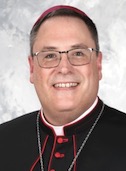
My friends, what are your wounds? Think about it for a moment, what are your wounds? Now can you trust your wounds to Jesus? Ask yourself that, can you trust your wounds to Jesus? In the Gospel today, Jesus showed his wounds to Thomas. Now Thomas is an apostle and saint that many of us can relate with. Thomas was the one who said,
“Unless I see the mark of the nails in his hands and put my finger into the nail marks and put my hand into his side, I will not believe.”
And we can all relate with that. At times, we have all had our doubts. Perhaps, more than a few people here this weekend come with hurts and doubts. Thomas is your patron saint today.
Now notice that Jesus waited a week before appearing before Thomas. For a wounded, hurting soul, a week can be a long time. In the Spirit Life, God does take his time. He waits for the perfect moment. He made the Hebrews wait 40 years, made them wander in the desert. Thomas needed a week. Thomas and the other disciples were in the upper room with the doors locked and Jesus appeared before them and said
“Peace be with you”.
He then showed Thomas his wounds. Jesus invited Thomas to touch his 2 wounds. Now Thomas was a wounded, doubting soul. What was Jesus’ remedy for Thomas’ infirm soul? Jesus gave Thomas his w
THE WORD THIS WEEK invites you to check out the Catholic AI assistant (located at the bottom right-hand corner), a homily preparation resource you can use to clarify or develop the insights and themes of Bishop’s Schuster’s homily.

Divine Mercy Sunday

Seeing with Eyes of Faith
Christ kept His humanity: do we in turn see Him in the humanity around us? C.S. Lewis, the author, once wrote that next to the Blessed Sacrament itself, your neighbor is the holiest object presented to your senses for in your neighbor, Christ’s glory, Himself, is truly hidden. In the Eucharist you do not actually see the risen Christ. Glorified wounds and all, but you do recognize Him for He has opened the eyes not of your flesh, built of your faith. In the power of that faith you can exclaim with the Apostle, my Lord, my God.
In your own journeying you will meet thousands of women and men, people of all kinds. The Christian question is now, what will you see with the eyes of your flesh? The Christian question is, what will you recognize with the eyes of your faith? Will you be able to see divinity in humanity, or will seeing keep you from recognizing? Will the grime and the grit blind you? With the cancer or the Alzheimer’s, the ugly and the spiteful, all those very human things that make for difference and indifference, for hostility and hatred, will they prevent you from recognizing your risen Lord? Not only in the broken bread, but in the breaking heart? The broken body? The broken mind?
THE WORD THIS WEEK invites you to check out the Catholic AI assistant (located at the bottom right-hand corner), a homily preparation resource you can use to clarify or develop the insights and themes of Fr. Warren’s homily.
Fr. Jagodensky, SDS
Divine Mercy Sunday
Homily Excerpt
Easter’s joy may be cloudily looming by so many, many of our accumulating years. Young ears heard about eternal judgment, again and again, and inculcated during those so very important and formative growing years. All about the practices (whether doing or missing them), memorizing them, honoring religious rites, and that oh so very, very important kneeling and standing at the correct times. And now, here we all are in the third chapter of our faith life’s journey.
Our faith formation time youth, in body, mind, and spirit, engendered into a rather beautiful and powerful gift of faith, was often based on that eternal, all awaiting, that unknown sometime but soon-to-come, judgment. Believing was secondary to the doing or as say, “practicing” our faith. Grace was considered a reward instead of strengthening us. Indulgences were a bonus, if practiced correctly – the right time and said correctly. Please notice that I said, “said” and not “prayed.”
Please note that the provided video clips serve as additional resources to complement the homily. They may not have a direct correlation with the contributor’s original content. They aim to inspire preachers to enrich their own homilies, drawing ideas and insights from both the written material and the visual content explored.