September 21, 2025
September 21, 2025
Advent | Christmas | Lent | Easter | Solemnities | Ordinary Time | Luke's Gospel
Homily Connections
Homily Connections


Current Events – September 2025

ROME REPORTS (01:37) – Pope Leo has called the parish of the Holy Family, the only Catholic parish in Gaza, where around 500 refugees live together within the parish complex.

25th Sunday of Year C
Amos 8:4-7 — Economic Justice in an Unstable World
- In the U.S.: Debates over economic data and policy are highlighting the gap between statistical reports and the lived reality of the poor. As economists debate job numbers (with major downward revisions announced September 9, 2025) and tariff impacts, Amos reminds us that God’s measure of an economy is not its stock market high, but how the most vulnerable are treated. Do our economic systems "trample on the needy"?
- In the World: The global food and displacement crisis, particularly in places like Sudan and Gaza, is a modern echo of the injustice Amos condemned. As of early September 2025, famine and suffering caused by conflict and economic collapse are the result of choices made by the powerful. Amos declares that God never forgets the cry of the poor and holds nations accountable.
- In the Church: The upcoming canonization of saints like Pier Giorgio Frassati, with his feast day established in September 2025, challenges the Church to be a prophetic voice against injustice. As Pope Leo XIV and African bishops call for climate and economic solutions rooted in community (September 10, 2025), they are channeling the spirit of Amos, demanding justice, not just charity.

25th Sunday of Year C
1 Timothy 2:1-8 — Prayer Amidst Global & Political Tension
- In the U.S.: A deeply polarized political climate, with initiatives like the 'America Prays' program announced September 9, 2025, on one side and fierce debate on the other, makes St. Paul's call to pray "without anger or argument" for our leaders more urgent than ever. This is a call to rise above political division and bring God’s peace into a fractured civic space.
- In the World: Escalating violence in the Middle East, including the Israeli strike in Doha, Qatar on September 9, 2025, tests our commitment to pray for all, even our perceived enemies. St. Paul’s instruction is a spiritual strategy for peace, asking us to intercede for leaders on all sides, that they might be guided by a wisdom greater than their own.
- In the Church: The ongoing Synod on Synodality, which concluded its Marian Congress in early September 2025, emphasizes listening and dialogue as the path forward. This reflects the spirit of 1 Timothy, which calls for a prayerful, non-adversarial posture. As the Church seeks to "walk together," it models for the world a way of engaging with others that is rooted in prayerful respect rather than hostile debate.
25th Sunday of Year C
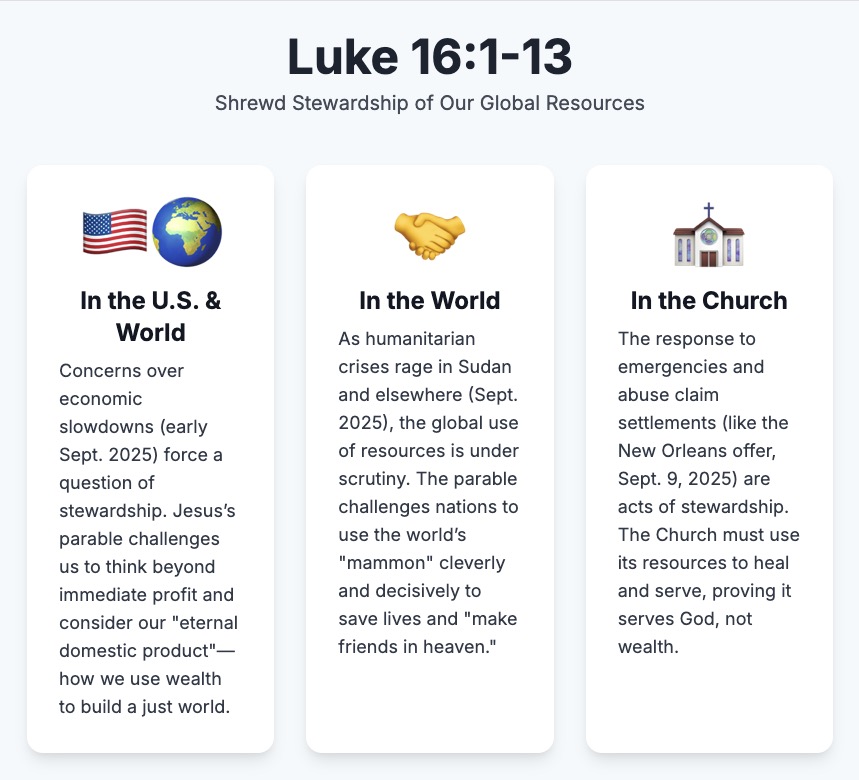
Luke 16:1-13 — Shrewd Stewardship of Our Global Resources
- In the U.S. & World: Concerns over a potential economic slowdown and job market weakness, heightened by government reports in early September 2025, force a question of stewardship. Are we, as individuals and as a society, using our resources shrewdly for the long term? Jesus’s parable challenges us to think beyond immediate profit and consider our "eternal domestic product"—how we are using our wealth to build a just and compassionate world that will last.
- In the World: As humanitarian crises rage in Sudan, Afghanistan, and elsewhere in September 2025, the global community’s use of resources is under scrutiny. The parable of the shrewd steward is a direct challenge to nations and NGOs: Are we using the world’s "mammon" cleverly and decisively to save lives and "make friends in heaven"?
- In the Church: The response to humanitarian emergencies and the ongoing settlement of abuse claims (such as the new $230 m guaranteed offer from the Archdiocese of New Orleans on September 9, 2025) are both acts of stewardship. The Church is called to use its material resources shrewdly and justly to bring healing and aid. This means managing its "mammon" not for its own preservation, but to restore justice and serve those in desperate need, proving it serves God, not wealth.
────── ⋆⋅☆⋅⋆ ──────
Family, Theology of the Body & Pro-Life

FOCOLARE MEDIA (01:14) – Pope Francis challenged us to resist throwaway culture, explained Camosy, “and build up a culture of encounter and hospitality.” Pope Francis showed us how to “meet the vulnerable and marginalized personally by disrupting our routines and going to the peripheries of our familiar communities.”
25th Sunday of Year C
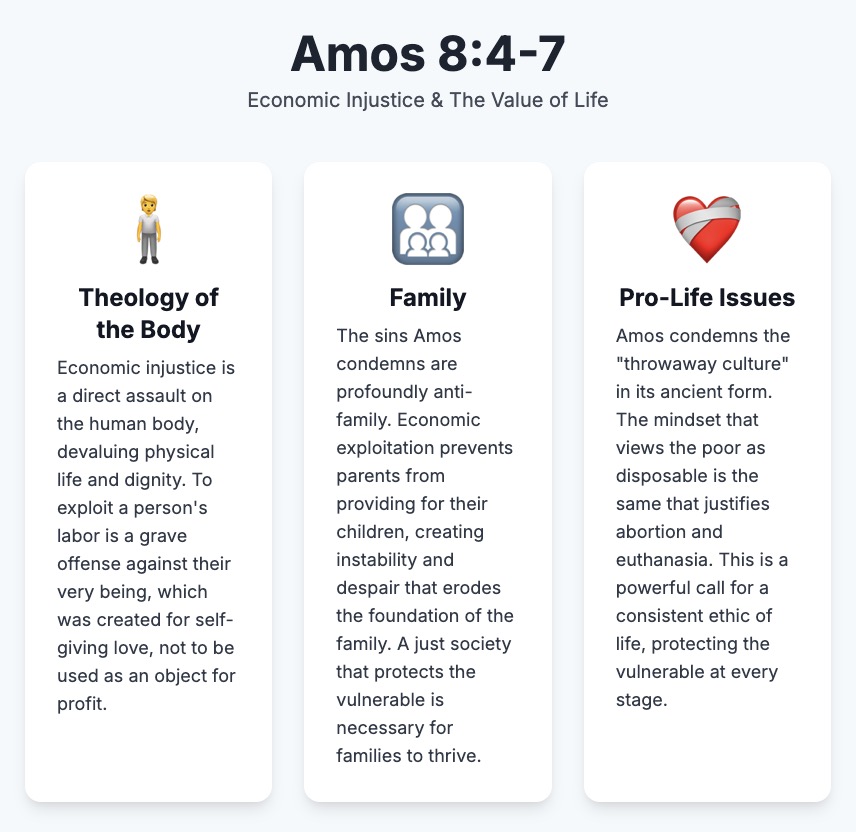
Amos 8:4-7 — Economic Injustice & The Value of Life
- Theology of the Body: Economic injustice is a direct assault on the human body. To cheat the poor out of their wages is to devalue their physical lives and dignity. Theology of the Body teaches that the body reveals the person; therefore, to exploit a person's labor is to commit a grave offense against their very being, which was created for self-giving love, not to be used as an object for profit.
- Family: The sins Amos condemns are profoundly anti-family. Economic exploitation prevents parents from providing for their children, creating the instability and despair that erodes the foundation of the family. A just society that protects the vulnerable is necessary for families to thrive.
- Pro-Life Issues: Amos condemns the "throwaway culture" in its ancient form. The mindset that seeks to "trample on the needy" and views the poor as disposable commodities is the same mindset that justifies abortion, euthanasia, and the death penalty. This passage is a powerful call for a consistent ethic of life, demanding that we protect the dignity of the vulnerable, whether they are in the womb, in poverty, or on death row.
25th Sunday of Year C
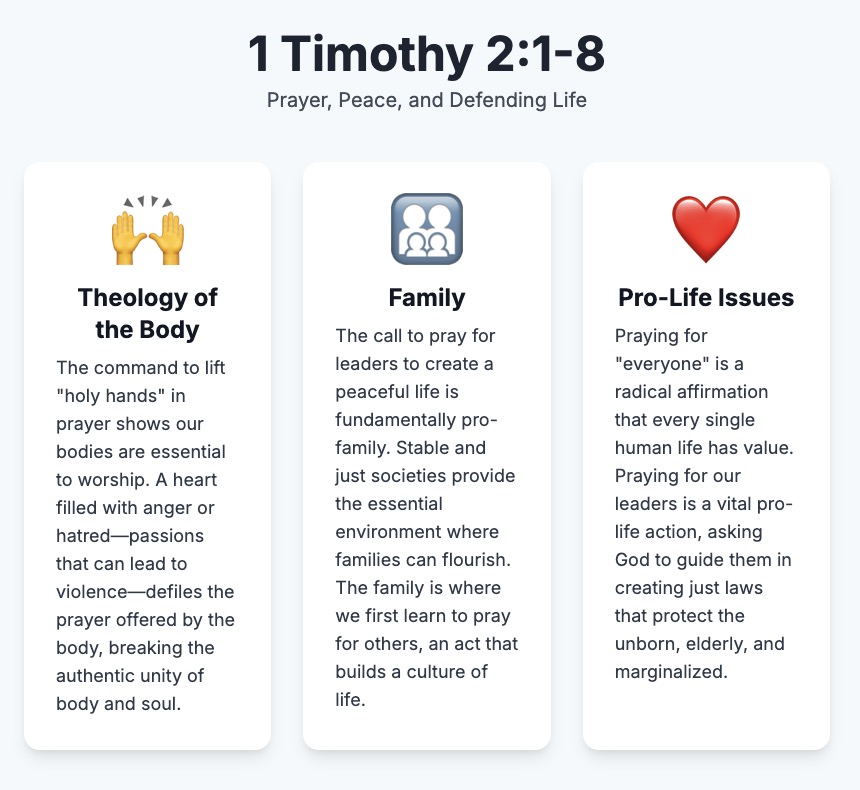
1 Timothy 2:1-8 — Prayer, Peace, and Defending Life
- Theology of the Body: The command to lift "holy hands" in prayer shows that our bodies are essential to worship. Our physical posture should reflect an interior disposition of peace and love. A heart filled with anger or hatred—passions that can lead to violence against life—defiles the prayer offered by the body, breaking the authentic unity of body and soul.
- Family: The call to pray for leaders to create a peaceful and quiet life is fundamentally pro-family. Stable, just, and peaceful societies provide the essential environment where families can flourish and be protected from harm. The family is where we first learn to pray for others, an act that builds a culture of life.
- Pro-Life Issues: The command to pray for "everyone" is a radical affirmation of the pro-life message that every single human life has value. Praying for our leaders is a vital pro-life action, asking God to guide them in creating just laws that protect the unborn, the elderly, and the marginalized. It is a spiritual tool to counter the anger and division that fuel violence in all its forms.
25th Sunday of Year C
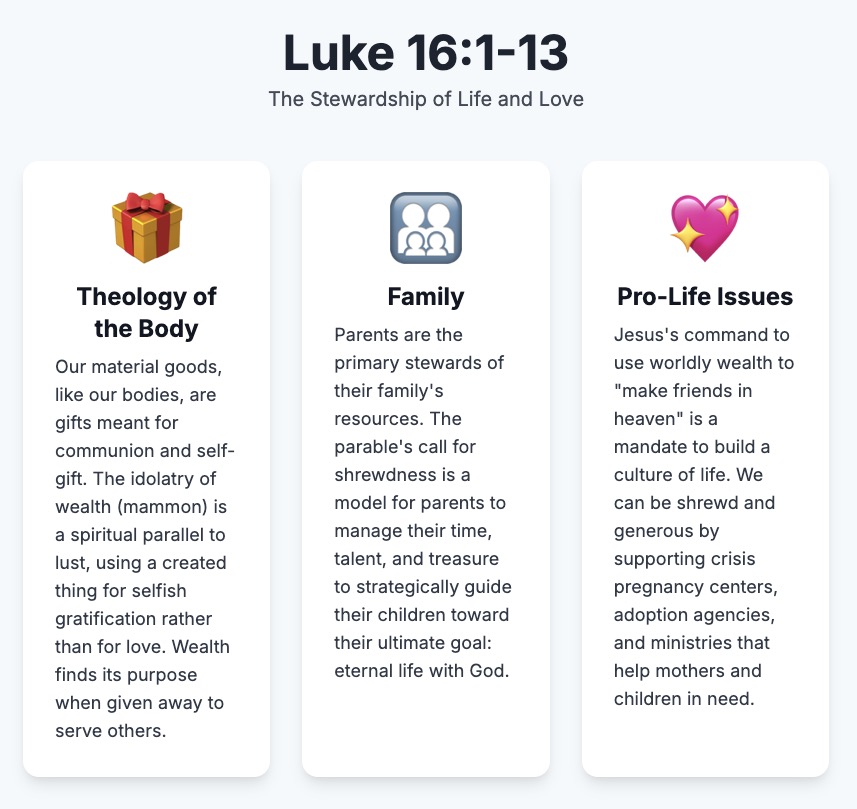
Luke 16:1-13 — The Stewardship of Life and Love
- Theology of the Body: Our material goods, like our bodies, are gifts from God meant for communion and self-gift, not selfish use. The idolatry of wealth (mammon) is a spiritual parallel to lust and pornography, where a created thing is used for selfish gratification rather than for love. Just as the body finds its meaning in self-gift, wealth finds its true purpose when given away to build relationships and serve others.
- Family: Parents are the primary stewards of their family's resources. The parable's call for shrewdness is a model for parents to manage their time, talent, and treasure not merely for worldly comfort, but to strategically guide their children toward their ultimate goal: eternal life with God.
- Pro-Life Issues: Jesus's command to use worldly wealth to "make friends in heaven" is a direct mandate to use our resources to build a culture of life. A practical pro-life application is to be shrewd and generous in supporting crisis pregnancy centers, adoption agencies, and ministries that help mothers and children in need. This is how we use the "mammon" of this world to invest in eternal lives.
────── ⋆⋅☆⋅⋆ ──────
Lives of the Saints

ASCENSION PRESENTS (11:37) – Remembering the faithfulness of St. Oscar Romero, Archbishop of San Salvador, and how he spoke out against injustices of the poor.
25th Sunday of Year C
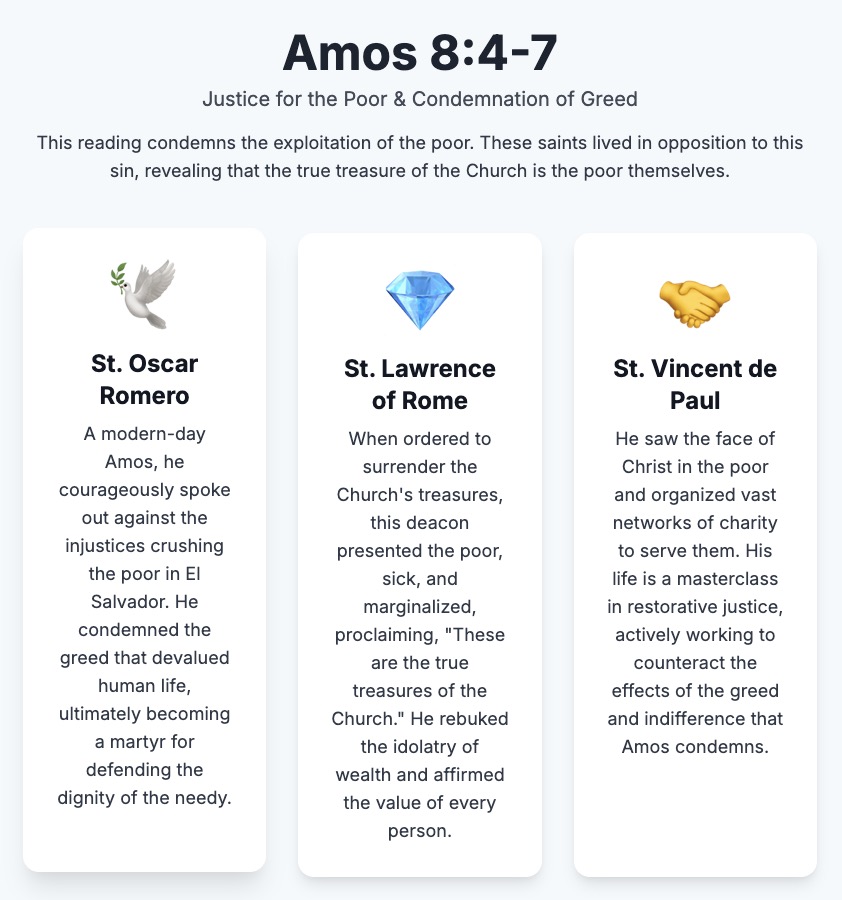
Amos 8:4-7 — Justice for the Poor & Condemnation of Greed
- St. Oscar Romero: A modern-day Amos, Archbishop Romero courageously spoke out against the economic and social injustices crushing the poor in El Salvador. He condemned the greed that devalued human life, ultimately becoming a martyr for defending the dignity of the needy against the powerful.
- St. Lawrence of Rome: When the Roman Prefect demanded the treasures of the Church, this deacon shrewdly presented the poor, the sick, and the marginalized, proclaiming, "These are the true treasures of the Church." He directly rebuked the idolatry of material wealth and affirmed the supreme value of the human person.
- St. Vincent de Paul: He saw the face of Christ in the poor and organized vast networks of charity to serve them. His life is a masterclass in restorative justice, actively working to counteract the effects of the greed and indifference that Amos condemns.
25th Sunday of Year C
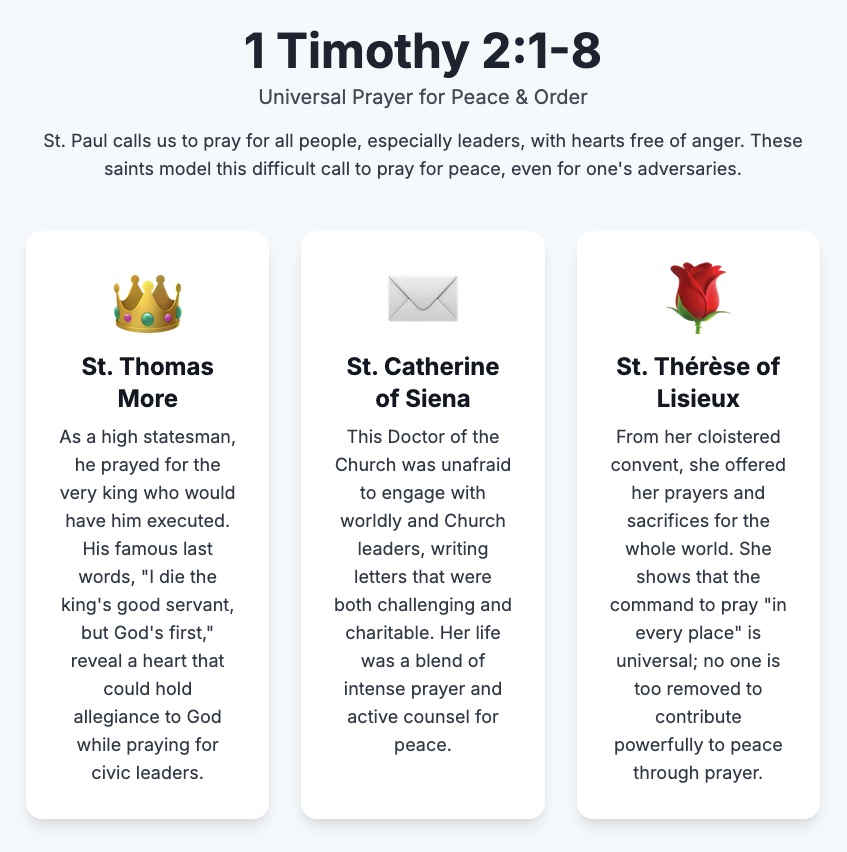
1 Timothy 2:1-8 — Universal Prayer for Peace & Order
- St. Thomas More: As a high statesman, he prayed for the very king who would have him executed. His famous last words, "I die the king's good servant, but God's first," reveal a heart that could hold allegiance to God while praying for civic leaders, exemplifying the call to seek peace even amid persecution.
- St. Catherine of Siena: This Doctor of the Church was unafraid to engage with worldly and Church leaders, writing letters that were both challenging and charitable. Her life was a blend of intense prayer and active counsel, showing that praying for leaders is a vital work for the peace and health of society.
- St. Thérèse of Lisieux: From her cloistered convent, St. Thérèse offered her prayers and sacrifices for priests, missionaries, and the whole world. She shows that the command to pray "in every place" is universal; no one is too removed from worldly affairs to contribute powerfully to peace through prayer.
25th Sunday of Year C
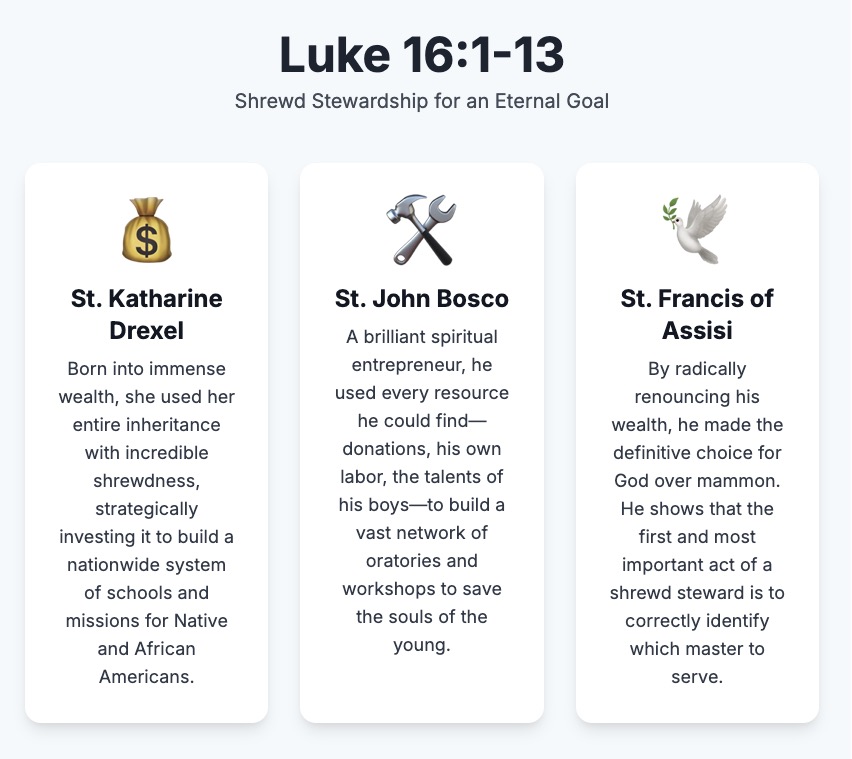
Luke 16:1-13 — Shrewd Stewardship for an Eternal Goal
- St. Katharine Drexel: Born into one of America's wealthiest families, she used her entire inheritance with incredible shrewdness. She didn't just give it away; she strategically invested it to build a nationwide system of schools and missions for Native and African Americans, using her "dishonest wealth" to win countless souls for Christ.
- St. John Bosco: A brilliant spiritual entrepreneur, Don Bosco was a master of using every resource he could find—donations, his own labor, the talents of his boys—to build a vast network of oratories and workshops. He was savvy and practical, managing worldly goods with the single-minded goal of saving the souls of the young.
- St. Francis of Assisi: By radically renouncing his wealth, St. Francis made the definitive choice for God over mammon. His stewardship then shifted to God's creation and the souls of his brothers. He shows that the first and most important act of a shrewd steward is to correctly identify which master to serve.
────── ⋆⋅☆⋅⋆ ──────
Movies, Songs & Modern Culture
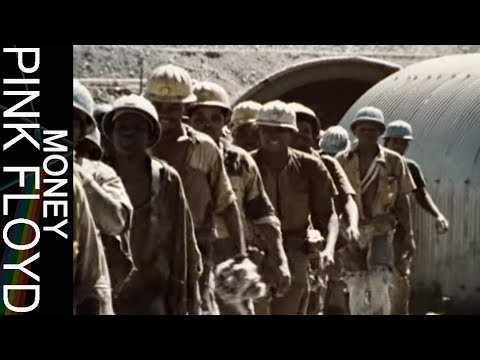
ROME REPORTS (04:43) – The official promo video for ‘Money’ by Pink Floyd, taken from the album ‘The Dark Side Of The Moon’.

25th Sunday of Year C
Amos 8:4-7 — The Greed That Dehumanizes
- Popular Movie: The Wolf of Wall Street (2013) This film is a modern-day parable of the sins Amos condemns. It portrays a world where profit is the only god, and people—the "poor" who are swindled—are treated as disposable objects to be exploited. It is a raw look at the spiritual sickness that comes from serving mammon.
- Popular Song: "Money" by Pink Floyd The lyrics, "Money, it's a crime / Share it fairly but don't take a slice of my pie," capture the mindset Amos decries. The song critiques how the pursuit of wealth can become an all-consuming obsession that corrupts the human heart and leads to the very injustice and indifference to the needy that God condemns.
- Modern Culture: "Hustle Culture" & Fast Fashion The cultural pressure to be constantly working and accumulating wealth, often at the expense of rest, relationships, and ethics, mirrors the merchants' impatience for the Sabbath to end. Likewise, the global fast fashion industry often relies on "diminishing the ephah" by paying impossibly low wages to workers in poor countries to satisfy our desire for cheap goods.

25th Sunday of Year C
1 Timothy 2:1-8 — The Call for Prayer Over Polarization
- Popular Movie: Lincoln (2012) The film depicts a leader navigating a deeply fractured nation filled with anger and division. The command to pray for our leaders finds context here; such prayer is not a political endorsement but a spiritual act to bring God’s wisdom and peace into a world torn apart by human argument.
- Popular Song: "Where Is the Love?" by The Black Eyed Peas This song is a lament for a world suffering from terrorism, racism, and division, asking why love and peace are so absent. St. Paul provides the Christian answer: we must actively bring God's love into the world through universal prayer, lifting up "holy hands without anger or argument."
- Modern Culture: Cancel Culture vs. Civil Discourse In a culture that often resorts to public shaming and political tribalism, St. Paul's call is radically counter-cultural. He asks us to engage not with outrage, but with prayer. Praying for our leaders and those we disagree with is a spiritual strategy to break the cycle of anger and create space for peace.

25th Sunday of Year C
Luke 16:1-13 — The Shrewd Steward
- Popular Movie: Schindler's List (1993) Oskar Schindler is a perfect model of the shrewd steward. He uses his "dishonest wealth"—money and influence gained through worldly, self-serving means—with incredible shrewdness to achieve an eternal goal: saving lives. He proves that the tools of this world can be used to "make friends for yourselves in heaven."
- Popular Song: "The Gambler" by Kenny Rogers The song's wisdom—"You've got to know when to hold 'em, know when to fold 'em"—is about strategy and foresight. Jesus calls us to have the same forward-thinking mindset. We must be spiritual gamblers who know that our time and resources on earth are the chips we must play wisely for an eternal jackpot.
- Modern Culture: Ethical & Impact Investing This is a real-world application of the parable's lesson. Impact investors use their capital (mammon) not just for a financial return, but to strategically create positive social or environmental outcomes. It is a modern way of using worldly wealth shrewdly for a purpose beyond mere self-enrichment, aligning one's portfolio with eternal values.
Text and Infographics on this page were created by THE WORD THIS WEEK using AI generative tools (i.e. Chart.js and Tailwind CSS). They may be copied for personal use or for any non-profit ministry.