September 14, 2025

Homily connections for each Sunday reading focused on Current Events, Family, Theology of the Body, Pro-life Issues, Saints, Popular Movies, Popular Songs, Modern Culture. Great tool for preachers.

September 14, 2025

Exaltation of the Holy Cross

Homily Connections

Homily Connections

Homily Connections

⬅️ ➡️

Charlie Kirk Tragedy – September 11, 2025

Give key bulletin points interpreting the following Scripture passages xxxxxxxxxxxxx  (New American Bible) through the Catholic lenses of current news events 2025 happening in the U.S.,the World, and the church. Be sure to give specific dates or time frames for the current events mentioned. create a three column infographic with extra large icons based on xxxxxxxxx create a three column infographic with extra large icons based on xxxxxxxxx
YouTube player
SHOW/HIDE INFOGRAPHIC - A PATH THROUGH TRAGEDY
1st READING2nd READINGTHE GOSPEL

Click to enlarge

SHOW/HIDE TEXT ✨

Exaltation of the Holy Cross

The Antidote to Poisonous Politics

"...the people grew impatient on the way; they spoke against God and against Moses... Then the LORD sent venomous snakes among them..."

The Israelites' sin stemmed from impatience and rebellion. Their angry words were a political poison that corrupted their community, leading to death. Political assassination is born from a similar spiritual poison: an extreme impatience with dialogue and due process, and a rebellious desire to seize control. It is a venomous strike that promises a quick solution but delivers only death and chaos.

God's response was not to meet violence with more violence. Instead, He commanded Moses to lift up a symbol of the very thing that was killing them. The cure required the people to turn away from their immediate circumstances and look in faith to a source of healing provided by God. This teaches us that the antidote to the poison of political hatred is not a more effective poison, but a radical act of looking up in faith to the one who can truly heal our divisions.

Click to enlarge

SHOW/HIDE TEXT ✨

Exaltation of the Holy Cross

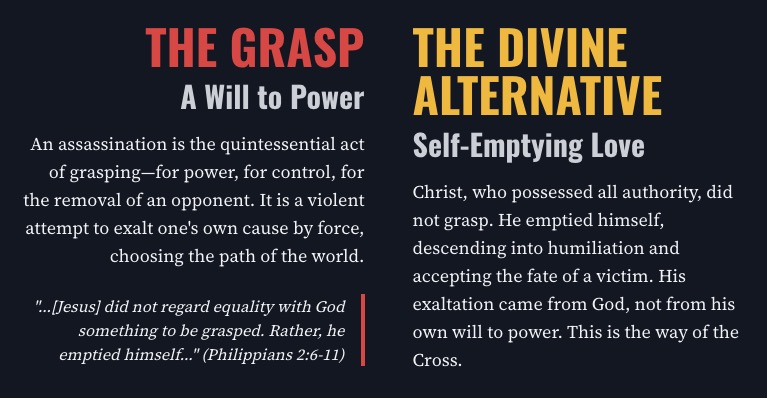
The Rejection of Power Grasping

"[Jesus], though he was in the form of God, did not regard equality with God something to be grasped. Rather, he emptied himself..."

This hymn presents the ultimate refutation of the mindset behind political violence. An assassination is the quintessential act of grasping—for power, for control, for the removal of an opponent. It is a violent attempt to exalt one's own cause by force.

Christ provides the divine alternative. He, who possessed all authority, did not grasp. He emptied himself, descending into humiliation and accepting the fate of a victim of political violence—death on a cross. His exaltation came not from his own will to power, but from God as a reward for his humble obedience. To resort to assassination is to choose the path of grasping, the path of the world. The way of the Cross is the path of self-emptying love, trusting that only God has the authority to truly exalt.

Click to enlarge

SHOW/HIDE TEXT ✨

Exaltation of the Holy Cross

The Motive of Saving Love

"For God so loved the world that he gave his only Son... For God did not send his Son into the world to condemn the world, but that the world might be saved through him."

This passage reveals the fundamental motive of God, which stands in stark opposition to the motive of an assassin. An assassination is an act of ultimate condemnation. It is a judgment that a person is beyond redemption and must be eliminated. Its motive is hatred, fear, or a lust for power.

The Cross, which was the instrument of a political execution, is revealed here as the instrument of divine love. God's response to a broken and rebellious world was not to condemn it but to save it through an act of supreme sacrifice. To engage in political assassination is to usurp the role of judge and to act as an agent of condemnation. The Christian calling, however, is to be an agent of God's saving love, a love that was willing to suffer violence rather than inflict it.

RECOMMENDED VIDEOS

Charlie Kirk: Courage to Speak the Truth

ALL SAINTS PARISH (11:24) – In the wake of Charlie Kirk’s tragic death, Fr. Meyer reflects on his witness to truth and courage in a world filled with confusion and violence. Like John the Baptist and the martyrs before him, Charlie spoke boldly about life, marriage, and the dignity of every human person — and he paid the ultimate price.

My Response to the Charlie Kirk Assassination

THE COUNSEL OF TRENT (21:29) – In this episode Trent Horn (Catholic Answers) reflects on the work of conservative activist Charlie Kirk and where the conservative Christian movement goes after his death.

Vatican, Bishops reacts to Charlie Kirk Tragedy

EWTN (4:31) – While honoring and remembering those who died at the Pentagon on 9-11, President Donald Trump also paid tribute to Charlie Kirk, who was assassinated in Utah on Wednesday. White House Correspondent, Owen Jensen reports.

────── ⋆⋅☆⋅⋆ ──────

Family, Theology of the Body & Pro-Life

Give key bulletin points interpreting the following Scripture passages XXXXXXXXX  (New American Bible) through the Catholic lenses of Family, Theology of the Body and Pro-life Issues (abortion, death penalty and pornography. create a three column infographic with extra large icons based on xxxxxxxxx
YouTube player

TIMELESS KINGDOM PRUBLICATION (01:14) – In his latest appearance with Joe Rogan Podcast, Jordan Peterson stunned the agnostic Joe Rogan with an incredible explanation of the cross.

1ST READING2ND READINGTHE GOSPEL
SHOW/HIDE TEXT ✨

Exaltation of the Holy Cross

Numbers 21:4b-9 — Healing by Looking to the Sign

  • Theology of the Body: The serpent's bite is a physical affliction stemming from a spiritual sickness (grumbling, lack of faith). The body suffers the consequences of sin. Healing comes through a physical act—looking at the bronze serpent—which engages the body in the act of faith and trust, showing that our bodies are the arena where salvation is experienced.
  • Family: Sin, like the serpent's venom, can poison a family through impatience, ingratitude, and blame. This reading is a model for family healing: when afflicted by sin, the family is called to look together to the ultimate sign of healing and mercy—the Crucifix—to be healed and restored.
  • Pro-Life Issues: The "fiery serpents" are a symbol of the culture of death (abortion, euthanasia, pornography) that poisons society. The bronze serpent, prefiguring the Cross, is the ultimate pro-life symbol. To "look upon it" is to choose Christ, the source of all life, and to reject the venom of a culture that devalues the human person.
SHOW/HIDE TEXT ✨

Exaltation of the Holy Cross

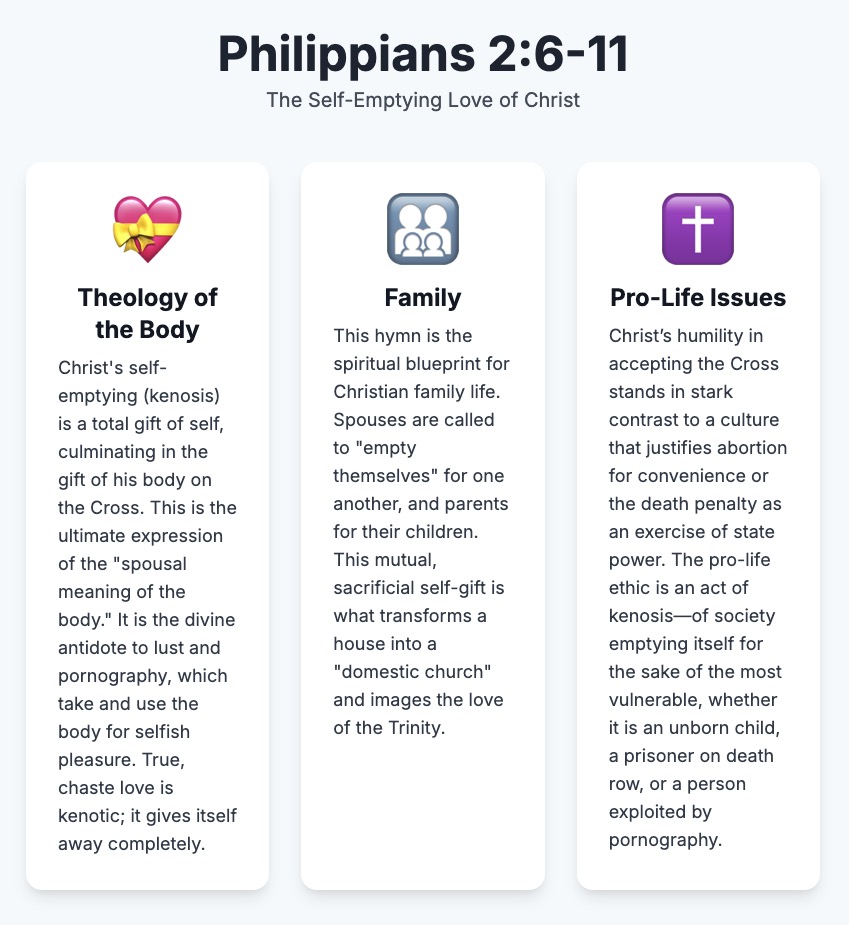
Philippians 2:6-11 — The Self-Emptying Love of Christ

  • Theology of the Body: Christ's self-emptying (kenosis) is a total gift of self, culminating in the gift of his body on the Cross. This is the ultimate expression of the "spousal meaning of the body." It is the divine antidote to lust and pornography, which take and use the body for selfish pleasure. True, chaste love is kenotic; it gives itself away completely.
  • Family: This hymn is the spiritual blueprint for Christian family life. Spouses are called to "empty themselves" for one another, and parents for their children. This mutual, sacrificial self-gift is what transforms a house into a "domestic church" and images the love of the Trinity.
  • Pro-Life Issues: Christ’s humility in accepting the Cross stands in stark contrast to a culture that justifies abortion for convenience or the death penalty as an exercise of state power. The pro-life ethic is an act of kenosis—of society emptying itself for the sake of the most vulnerable, whether it is an unborn child, a prisoner on death row, or a person exploited by pornography.
SHOW/HIDE TEXT ✨

Exaltation of the Holy Cross

John 3:13-17 — The Un-Condemning Love of the Father

  • Theology of the Body: "God so loved the world that he gave his only Son." God's love is not an abstract idea; it becomes flesh and blood in the person of Jesus. This sanctifies the body as the vehicle of divine love. This love is total, faithful, and fruitful (life-giving for the world), which is the standard by which all human expressions of love, especially marital love, are measured.
  • Family: The family is meant to be the first school of love, where a child experiences the profound truth of this Gospel: that they are loved unconditionally by God. It is in the family that we learn to love without condemning and to offer mercy, reflecting the Father's love for the world.
  • Pro-Life Issues: John 3:16 is a foundational pro-life verse. God's love is for "the world"—for every single person, without exception, from conception to natural death. The declaration that God came "not to condemn... but to save" is the basis for offering mercy to post-abortive parents and for opposing the death penalty, always choosing the path of salvation over condemnation.

────── ⋆⋅☆⋅⋆ ──────

Lives of the Saints

Give key bulletin points interpreting the following Scripture passages XXXXXXXXX  (New American Bible) through the Catholic lenses of the saints. Pick three saints each exempliflying on of the themes of each reading. create a three column infographic with extra large icons based on xxxxxxxxx
YouTube player

EXPLORE DOCUMENTARY FILMS (8:40) – Unravel the painful history of Molokai through Father Damien, who dedicated his life to helping the people who were exiled and sent to the isolated peninsula of Kalaupapa.or.

1ST READING2ND READINGTHE GOSPEL
SHOW/HIDE TEXT ✨

Exaltation of the Holy Cross

Numbers 21:4b-9 — Looking to the Cross for Healing

This reading shows the Israelites finding healing from the serpent's venom only by looking in faith at the bronze serpent lifted by Moses. These saints show us how to find healing from the poison of sin and despair by fixing our eyes on the Cross.

  • St. Charles Borromeo: When the plague—a real-life "fiery serpent"—devastated Milan, St. Charles did not flee. He walked barefoot in the streets, leading processions with a large crucifix, literally calling his suffering people to "look upon" the sign of their ultimate healing and hope in the midst of death.
  • St. Damien of Molokai: Voluntarily entering the living death of the leper colony on Molokai, St. Damien was surrounded by people physically "bitten" by a terrible disease. He brought them spiritual and physical healing not through his own power, but by constantly directing their gaze to the Crucifix and the Eucharist, the sources of true life.
  • St. Ignatius of Loyola: After his leg was shattered in battle, Ignatius experienced the "venom" of despair and temptation. His conversion began by looking at illustrations of the life of Christ and the saints. He teaches us to combat the spiritual poison of desolation by resolutely turning our gaze back to Christ crucified, the only true source of our consolation.
SHOW/HIDE TEXT ✨

Exaltation of the Holy Cross

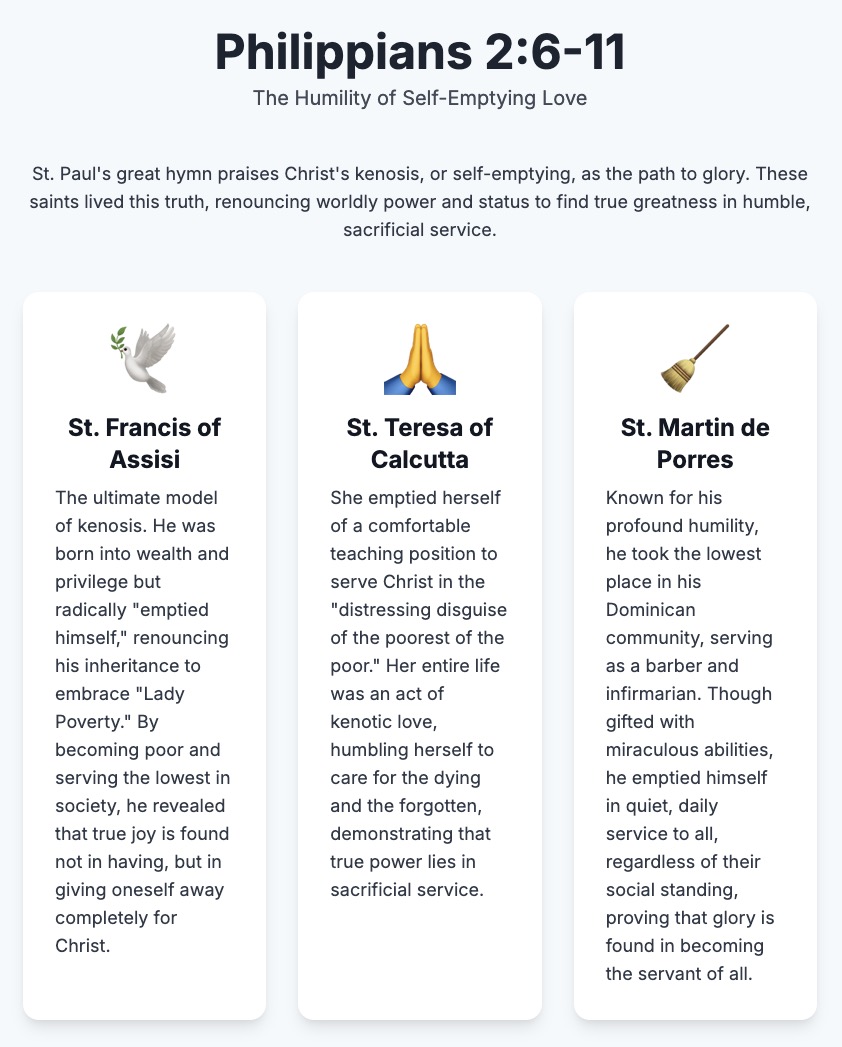
Philippians 2:6-11 — The Humility of Self-Emptying Love

St. Paul's great hymn praises Christ's kenosis, or self-emptying, as the path to glory. These saints lived this truth, renouncing worldly power and status to find true greatness in humble, sacrificial service.

  • St. Francis of Assisi: The ultimate model of kenosis. He was born into wealth and privilege but radically "emptied himself," renouncing his inheritance to embrace "Lady Poverty." By becoming poor and serving the lowest in society, he revealed that true joy is found not in having, but in giving oneself away completely for Christ.
  • St. Teresa of Calcutta (Mother Teresa): She emptied herself of a comfortable teaching position to serve Christ in the "distressing disguise of the poorest of the poor." Her entire life was an act of kenotic love, humbling herself to care for the dying and the forgotten, demonstrating that true power lies in sacrificial service.
  • St. Martin de Porres: Known for his profound humility, he took the lowest place in his Dominican community, serving as a barber and infirmarian. Though gifted with miraculous abilities, he emptied himself in quiet, daily service to all, regardless of their social standing, proving that glory is found in becoming the servant of all.
SHOW/HIDE TEXT ✨

Exaltation of the Holy Cross

John 3:13-17 — Proclaiming God’s Un-Condemning Love

"For God so loved the world that he gave his only Son... not to condemn the world, but that the world might be saved." These saints were on fire with this message, becoming powerful witnesses to God's merciful, saving love.

  • St. Faustina Kowalska: As the Apostle of Divine Mercy, her entire mission was to proclaim the message of John 3:16. She reminded the world that God's love and mercy are an infinite ocean, greater than our greatest sins, and that He desires not to condemn us but to draw us into His merciful heart.
  • St. John Vianney (The Curé of Ars): He was a living channel of God's un-condemning love, spending up to 18 hours a day in the confessional. He met hardened sinners not with harsh judgment, but with tears and prayers, revealing the merciful heart of the Father who waits to save, not to condemn.
  • St. Thérèse of Lisieux: Her "Little Way" is a path of radical trust in God's merciful love. She understood that holiness was not about her own great efforts, but about receiving the Father's love like a child. She is a Doctor of the Church because she lived the profound truth that God is a loving Father whose primary desire is to save.

────── ⋆⋅☆⋅⋆ ──────

Movies, Songs & Modern Culture
Give key bulletin points interpreting the following Scripture passages XXXXXXXXX  (New American Bible) through the Catholic lenses by looking at popular movies, popular songs, and modern culture. create a three column infographic with extra large icons based on xxxxxxxxx
YouTube player

JOHNNY CASH (03:48) – Official Music Video for Hurt performed by Johnny Cash.
1ST READING2ND READINGTHE GOSPEL
SHOW/HIDE TEXT ✨

Exaltation of the Holy Cross

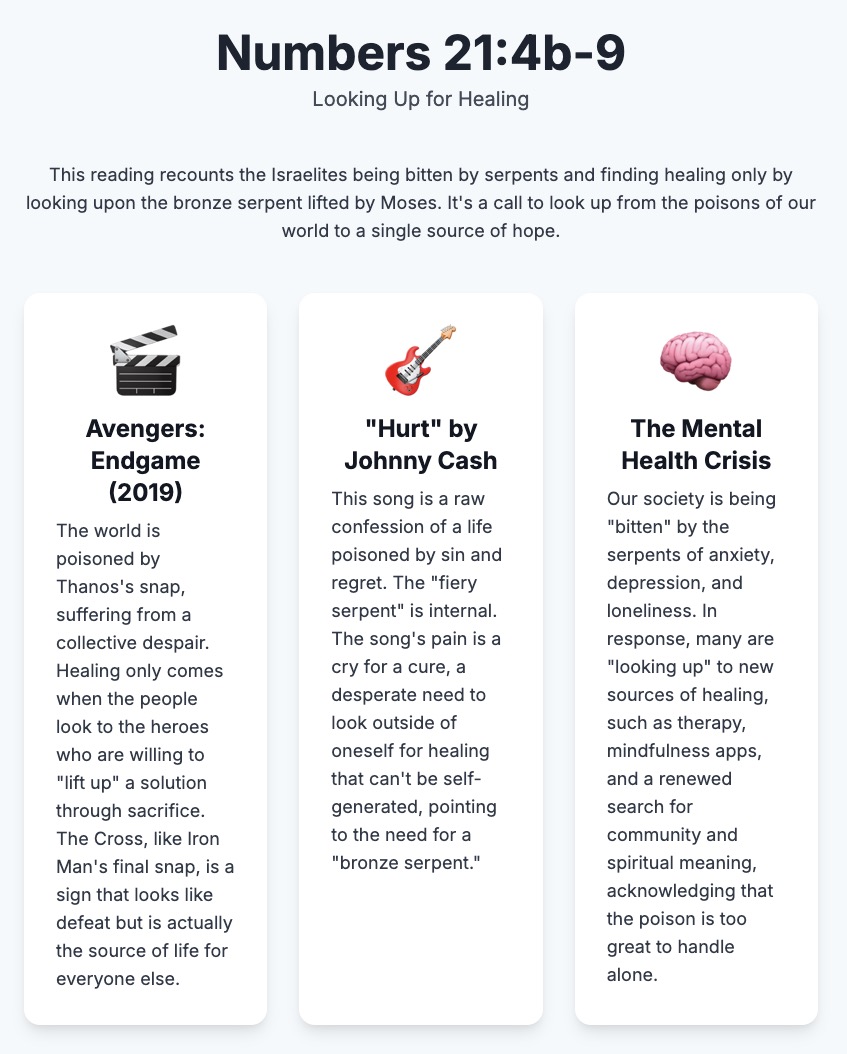
Numbers 21:4b-9 — Looking Up for Healing

This reading recounts the Israelites being bitten by serpents and finding healing only by looking upon the bronze serpent lifted by Moses. It's a call to look up from the poisons of our world to a single source of hope.

  • Popular Movie: Avengers: Endgame (2019) The world is poisoned by Thanos's snap, suffering from a collective despair. Healing only comes when the people look to the heroes who are willing to "lift up" a solution through sacrifice. The Cross, like Iron Man's final snap, is a sign that looks like defeat but is actually the source of life for everyone else.
  • Popular Song: "Hurt" by Johnny Cash This song is a raw confession of a life poisoned by sin and regret. The "fiery serpent" is internal. The song's pain is a cry for a cure, a desperate need to look outside of oneself for healing that can't be self-generated, pointing to the need for a "bronze serpent."
  • Modern Culture: The Mental Health Crisis Our society is being "bitten" by the serpents of anxiety, depression, and loneliness. In response, many are "looking up" to new sources of healing, such as therapy, mindfulness apps, and a renewed search for community and spiritual meaning, acknowledging that the poison is too great to handle alone.
SHOW/HIDE TEXT ✨

Exaltation of the Holy Cross

Philippians 2:6-11 — The Humility of the Cross

This is the great hymn of Christ’s kenosis, or self-emptying. It teaches that true greatness comes not from power and status, but from humble, sacrificial service.

  • Popular Movie: The Lord of the Rings: The Return of the King (2003) Aragorn’s journey is a model of kenosis. He empties himself of his identity as a lone ranger to embrace his destiny as king, a role that demands complete self-sacrifice for his people. He shows that true authority is found not in claiming power, but in humbly serving others.
  • Popular Song: "Bridge Over Troubled Water" by Simon & Garfunkel The lyrics are a perfect description of self-emptying love: "I will lay me down." The singer becomes a humble bridge for another person to cross over their suffering. It's a promise to sacrifice one's own comfort and strength for the good of another, reflecting Christ's love on the Cross.
  • Modern Culture: Celebrity & Influencer Culture This passage is radically counter-cultural to an age that idolizes self-promotion, personal branding, and the accumulation of followers. The kenosis of Christ challenges this, proposing that a life of quiet, humble service—often unseen—has more lasting value than a life spent seeking public glory.
SHOW/HIDE TEXT ✨

Exaltation of the Holy Cross

John 3:13-17 — God’s Un-Condemning Love

Jesus explains that He must be lifted up, "for God so loved the world that he gave his only Son... not to condemn the world, but that the world might be saved."

  • Popular Movie: Les Misérables (2012) The Bishop’s act of mercy towards Jean Valjean is a perfect image of John 3:17. Instead of condemning Valjean for stealing, he saves him, giving him the chance at a new life. This un-condemning love becomes the force that transforms Valjean’s entire existence.
  • Popular Song: "Amazing Grace" This is the quintessential song of John 3:16. It is the testimony of a "wretch" who expected condemnation but received saving grace instead. It captures the wonder of being loved and saved by a God who chooses mercy over judgment.
  • Modern Culture: "Cancel Culture" In a social climate where people are often swiftly and permanently condemned for their mistakes, the Gospel's message is a radical alternative. It declares that God’s response to failure is not to "cancel" us, but to offer a path to redemption and salvation through the Cross.

Text and Infographics on this page were created by THE WORD THIS WEEK using AI generative tools (i.e. Chart.js and Tailwind CSS). They may be copied for personal use or for any non-profit ministry.