September 14, 2025
September 14, 2025
Sacraments
Sacraments Baptism Eucharist Confirmation Confession Anointing of the Sick Marriage Holy Orders


Living the Word through Sacramental Grace
- BAPTISM
- EUCHARIST
- CONFIRMATION
- CONFESSION
- ANOINTING OF SICK
- MATRIMONY
- HOLY ORDERS
- DEEP DIVE
Numbers 21:4b-9
BAPTISM
The Serpent and the Soul
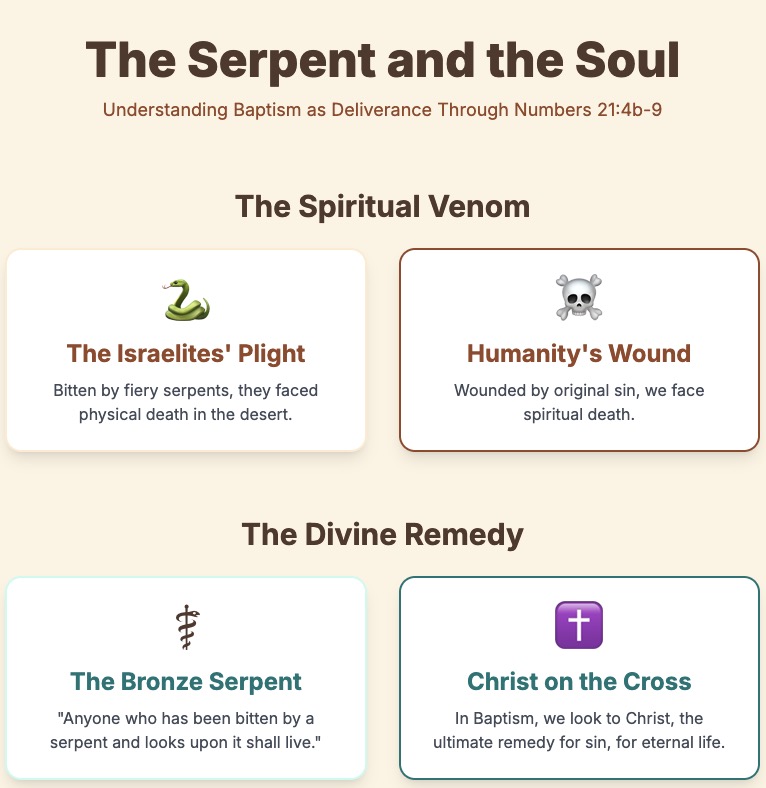
Based on Numbers 21:4b-9, Baptism is our deliverance from the spiritual venom of original sin. Just as the Israelites were bitten by serpents and died, humanity is wounded by sin. Their remedy was to gaze upon the bronze serpent, a symbol of God’s healing power. The verse, “anyone who has been bitten by a serpent and looks upon it shall live,” prefigures our own salvation.
In Baptism, we look to Christ on the cross, the ultimate remedy for sin. The daily grace received is the strength to recognize the “serpents” of temptation in our lives—pride, anger, selfishness—and immediately turn our gaze back to Christ.
A practical life application is to consciously recall our baptismal promises when we feel the “bite” of sin, choosing to look upon the cross for our healing and life rather than succumbing to the poison. This act reaffirms our identity as those saved and healed by God’s mercy.
Exaltation of the Holy Cross

Numbers 21:4b-9
Part 1: The Wound and the Remedy
The essay states, “Just as the Israelites were bitten by serpents and died, humanity is wounded by sin. Their remedy was to gaze upon the bronze serpent, a symbol of God’s healing power.”
- The Israelites’ suffering was immediate and physical. How is the “wound” of original sin both similar and different from their experience?
- The remedy for the Israelites required an act of trust—looking at something that didn’t seem like a logical cure. How does this prefigure the faith required to believe in the power of Baptism?
- The essay says we must “look to Christ on the cross, the ultimate remedy for sin.” What does it mean to “look to Christ on the cross” in a practical, daily sense?
Part 2: The Daily Grace of Recognition
The essay identifies the daily grace as “the strength to recognize the ‘serpents’ of temptation in our lives—pride, anger, selfishness—and immediately turn our gaze back to Christ.”
- Why is simply recognizing temptation the first crucial step toward overcoming it? What happens when we are blind to our own “serpents”?
- How does the grace of our Baptism specifically help us to have the strength for this recognition and turning back?
- Besides pride, anger, and selfishness, what are some other modern-day “serpents” that we face?
Part 3: Life Application: Recalling Our Identity
The essay suggests a life application is “to consciously recall our baptismal promises when we feel the ‘bite’ of sin, choosing to look upon the cross for our healing and life.”
- What are our baptismal promises? Why would recalling them be a powerful antidote to temptation?
- What does it look like in a moment of temptation to “choose to look upon the cross” instead of “succumbing to the poison”?
- How does this conscious choice reaffirm our identity as “those saved and healed by God’s mercy”? How does it change our self-perception?
Philippians 2:6-11
BAPTISM
The Emptying and the Exalting
Philippians 2:6-11 reveals Baptism as the sacrament where we participate in Christ’s own self-emptying, or kenosis. Saint Paul writes that Jesus “emptied himself…he humbled himself, becoming obedient to death, even death on a cross.”
In the waters of Baptism, we die with Christ; we are emptied of our old selves, our pride, and our sin. In this profound act of humility, we are then raised with him, for “because of this, God greatly exalted him.”
The enduring grace of this sacrament is the grace of humility. It empowers us daily to empty ourselves for others, to serve without recognition, and to prioritize God’s will over our own. We live this out by performing acts of service with a joyful heart, by forgiving freely, and by seeking to uplift others, trusting that it is in dying to self that we are truly exalted in Christ.
Exaltation of the Holy Cross

Philippians 2:6-11
Part 1: The Act of Self-Emptying (Kenosis)
The essay states, “In the waters of Baptism, we die with Christ; we are emptied of our old selves, our pride, and our sin. In this profound act of humility, we are then raised with him.”
- What does it practically mean to be “emptied of our old selves”? What parts of the “old self” (e.g., specific attitudes, habits, desires) does Baptism challenge us to let go of?
- The essay calls this a “profound act of humility.” Why is it humble to admit that we need to “die” to our old way of living in order to be “raised” to a new one?
- How does the physical act of being immersed in or having water poured on us in Baptism symbolize this spiritual reality of dying and rising?
Part 2: The Enduring Grace of Humility
The essay identifies the enduring grace as “the grace of humility. It empowers us daily to empty ourselves for others, to serve without recognition, and to prioritize God’s will over our own.”
- How is the grace of humility received in Baptism different from just trying to be a humble person on our own? What does “empowerment” from a sacrament mean in this context?
- What is the difference between serving someone and serving “without recognition”? Why is the latter a deeper form of humility?
- How can the grace of Baptism help when our will conflicts with God’s will? How does humility make it easier to surrender?
Part 3: Life Application: Living the Grace
The essay suggests, “We live this out by performing acts of service with a joyful heart, by forgiving freely, and by seeking to uplift others.”
- Why is serving with a “joyful heart” a key part of living out our Baptism? What does joy have to do with humility?
- How does our own experience of being “emptied” of sin in Baptism help us to “forgive freely” when others wrong us?
- What are some practical ways we can “seek to uplift others” in our daily lives, putting their needs and well-being before our own recognition?
John 3:13-17
BAPTISM
Born from Above
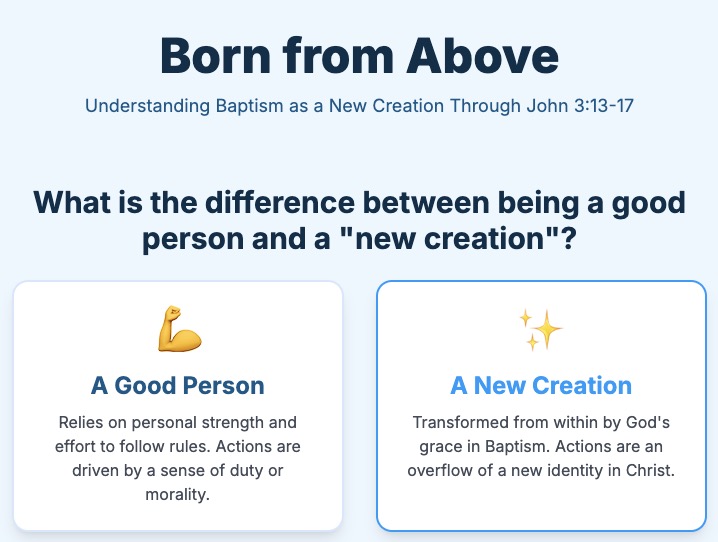
The discourse in John 3:13-17 illuminates Baptism as a true spiritual rebirth into God’s family. Jesus insists that one must be “born from above” to see the kingdom of God. This is not merely a symbolic act, but a profound transformation that makes us new creations.
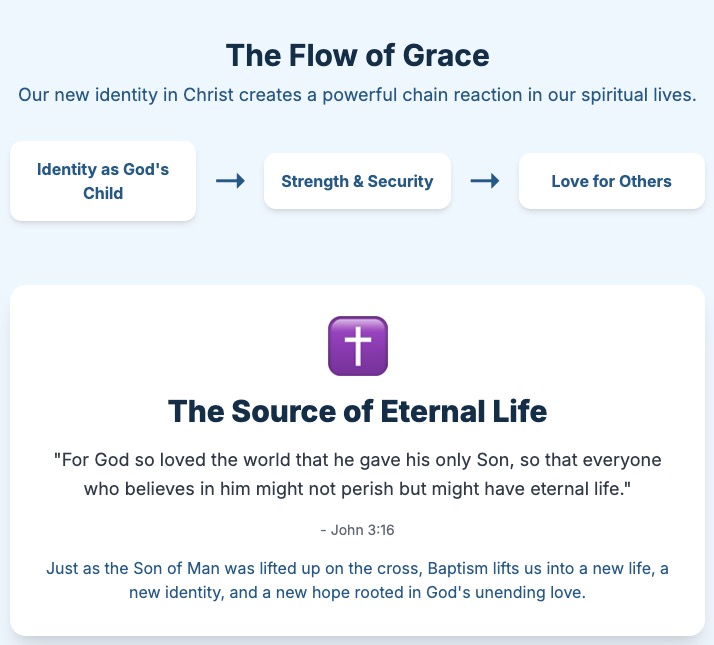
The Gospel connects this rebirth to the cross, stating, “so must the Son of Man be lifted up, so that everyone who believes in him may have eternal life.” Baptism is the moment we are grafted onto Christ and given this eternal life.
The daily grace we draw from this is the grace of divine filiation—the constant, lived awareness that we are beloved children of God. When we face trials, we can live out this grace by confidently remembering our true identity. This security frees us to love others with the same selfless love “God so loved the world” with.
Exaltation of the Holy Cross
John 3:13-17
Part 1: The Act of Spiritual Rebirth
The essay states, “Jesus insists that one must be ‘born from above’ to see the kingdom of God. This is not merely a symbolic act, but a profound transformation… Baptism is the moment we are grafted onto Christ and given this eternal life.”
- The essay contrasts a “symbolic act” with a “profound transformation.” What’s the difference? Why is it important that Baptism is a real transformation and not just a symbol?
- How does connecting this spiritual rebirth to Christ being “lifted up” on the cross give Baptism its power?
- The text uses the image of being “grafted onto Christ.” What does this agricultural image suggest about our new life and our intimate relationship with Him?
Part 2: The Grace of Divine Filiation
The essay identifies the daily grace as “the grace of divine filiation—the constant, lived awareness that we are beloved children of God.”
- What is the difference between intellectually knowing you are a child of God and having a “constant, lived awareness” of it? What might this awareness look and feel like day-to-day?
- How can truly remembering our identity as a “beloved child of God” give us security and confidence when we face trials, failures, or rejection?
- In what ways can this security free us from the need for worldly approval or the fear of what others think?
Part 3: Life Application: Loving Selflessly
The essay suggests, “This security frees us to love others with the same selfless love ‘God so loved the world’ with.”
- Why does feeling secure in God’s love make it easier to love other people without expecting anything in return? How does it remove fear from our acts of love?
- What are some practical ways we can “live out” our identity as a beloved child in our interactions with family, friends, or even strangers this week?
- The essay references how “God so loved the world.” How can our love for others, rooted in our Baptismal identity, be a small reflection of that same kind of universal, sacrificial love?
Numbers 21:4b-9
EUCHARIST
Gaze Upon Him and Live
The story in Numbers 21:4b-9, where the Israelites are healed by looking at a bronze serpent, beautifully prefigures the healing power of the Eucharist. Just as the Israelites were poisoned, we are wounded daily by the venom of sin and despair. Their antidote required an act of faith: to gaze upon the symbol God provided.
Our remedy is infinitely greater. In the Eucharist, we don’t just look upon a symbol; we receive Christ Himself, “lifted up” for our salvation. The grace we receive is profound spiritual healing. Each time we approach the altar, we turn from the “serpents” of our faults and weaknesses. As the Israelites who looked upon the serpent “shall live,” we who receive the Eucharist in faith are healed from within, receiving the true medicine of immortality and the strength to continue our journey toward the promised land of Heaven.
Exaltation of the Holy Cross

Numbers 21:4b-9
Part 1: The Wound and the Antidote
The essay states, “Just as the Israelites were poisoned, we are wounded daily by the venom of sin and despair. Their antidote required an act of faith: to gaze upon the symbol God provided.”
- In what ways can sin and despair feel like a “venom”? How do they affect our spiritual vitality?
- The Israelites’ healing required a physical action (looking up) tied to an act of faith. How is our approach to the Eucharist similar? What interior act of faith is required of us?
- Why do you think God chose such a strange remedy for the Israelites? What does this teach us about God’s methods and the necessity of trust?
Part 2: An Infinitely Greater Remedy
The essay emphasizes, “Our remedy is infinitely greater. In the Eucharist, we don’t just look upon a symbol; we receive Christ Himself, ‘lifted up’ for our salvation.”
- What is the fundamental difference between gazing at a symbol for healing and receiving the source of healing Himself?
- How does receiving the Eucharist as the true Body and Blood of Christ change its power in our lives, compared to if it were only a symbol?
- In what ways is Christ “lifted up” for us in the Mass?
Part 3: The Grace of Spiritual Healing
The essay describes the grace received as “profound spiritual healing” and the “true medicine of immortality.”
- Beyond the forgiveness of venial sins, what kind of “profound spiritual healing” do you think the Eucharist offers? (e.g., healing of memories, disordered attachments, spiritual lukewarmness).
- What does the phrase “medicine of immortality” mean to you? How does receiving the Eucharist give us the strength to continue our journey to Heaven?
- How can we better prepare our hearts to receive this healing grace when we approach the altar?
Philippians 2:6-11
EUCHARIST
The Humble Feast of Exaltation
Philippians 2:6-11 describes Christ’s ultimate act of self-emptying, or kenosis, which is made perpetually present to us in the Eucharist. In this sacrament, Jesus continues to “empty himself,” humbling his divine glory to become our spiritual food under the simple appearances of bread and wine. This is the ultimate act of love and service.
The daily grace we draw from the Eucharist is the strength to practice this same humility. When we receive the Body of Christ, given for us, we are empowered to empty ourselves for others. This grace transforms our perspective, turning our focus from our own needs to the needs of those around us.
A life application is to consciously perform an act of humble service after receiving Communion, whether at home or work, allowing the self-giving love of Christ we just received to flow through us into the world.
Exaltation of the Holy Cross

Philippians 2:6-11
Part 1: The Ultimate Act of Love
The essay states, “In this sacrament, Jesus continues to ‘empty himself,’ humbling his divine glory to become our spiritual food under the simple appearances of bread and wine. This is the ultimate act of love and service.”
- In what ways is the Eucharist an act of kenosis or “self-emptying”? How does the reality of Jesus becoming our food challenge our ideas of power and glory?
- The essay calls this the “ultimate act of love and service.” Why is this humble form of presence so profound?
- How does receiving a God who makes Himself so small and vulnerable for us change our relationship with Him?
Part 2: The Grace to Practice Humility
The essay identifies the daily grace as “the strength to practice this same humility… When we receive the Body of Christ, given for us, we are empowered to empty ourselves for others.”
- What is the connection between receiving Jesus in the Eucharist and being empowered to “empty ourselves for others”? How does one lead to the other?
- The essay says this grace “transforms our perspective.” How can receiving Communion help practically shift our focus from our own needs to the needs of those around us?
- Can you think of a time when receiving the Eucharist gave you the strength to be more patient, loving, or selfless than you might have been on your own?
Part 3: Life Application: Letting Love Flow
The essay suggests “to consciously perform an act of humble service after receiving Communion… allowing the self-giving love of Christ we just received to flow through us into the world.”
- Why is it important to connect the spiritual act of receiving Communion with a concrete, physical act of service?
- What are some specific and practical “acts of humble service” we could perform immediately after Mass or during the following week?
- What does the image of Christ’s love “flowing through us” suggest about our role in the world as people who receive the Eucharist?
John 3:13-17
EUCHARIST
The Gift of Eternal Life
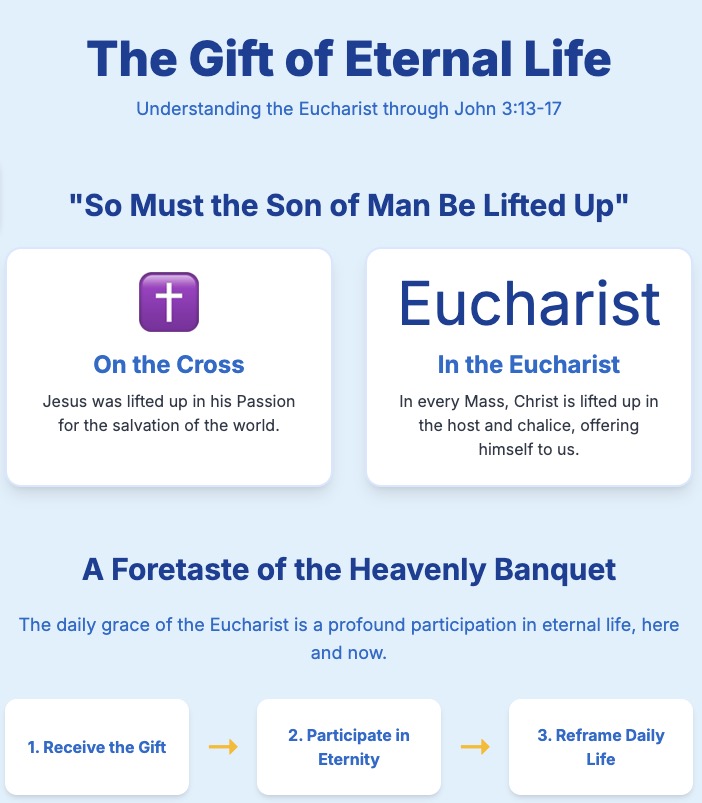
In John 3:13-17, Jesus connects being “lifted up” with the gift of eternal life. This finds its ultimate fulfillment not only on the cross but in the Holy Eucharist.
In every Mass, Christ is “lifted up” before our eyes in the host and chalice, a direct fulfillment of his words: “so that everyone who believes in him may have eternal life.” The Eucharist is the tangible gift of God’s love, the very Body and Blood of the Son He gave for us. The daily grace we receive is a profound participation in this eternal life, here and now. It is a foretaste of the heavenly banquet.
As a life application, we can approach Communion with the conscious intention of receiving this gift of eternity, allowing it to reframe our daily struggles and anxieties in the light of the unending life and love that God promises and provides.
Exaltation of the Holy Cross
John 3:13-17
Part 1: The Gift of Being “Lifted Up”
The essay states, “In every Mass, Christ is ‘lifted up’ before our eyes in the host and chalice, a direct fulfillment of his words: ‘so that everyone who believes in him may have eternal life.'”
- The essay connects Christ being “lifted up” on the cross with being “lifted up” in the Eucharist. How are these two events one single reality for us during the Mass?
- The essay calls the Eucharist the “tangible gift of God’s love.” Why is it important for us as human beings to have a tangible sign of this promise of eternal life?
- How does understanding that the Eucharist is the very Body and Blood of the Son He “gave for us” deepen the meaning of Communion?
Part 2: The Grace of an Eternal Perspective
The essay identifies the daily grace as “a profound participation in this eternal life, here and now. It is a foretaste of the heavenly banquet.”
- What does the phrase “foretaste of the heavenly banquet” evoke for you? What do you imagine that banquet is like?
- What does it mean to “participate in eternal life, here and now”? If we have a taste of it now, how should that affect the way we live and interact with others?
- How does receiving this grace help us to see beyond the immediate struggles and anxieties of our daily lives?
Part 3: Life Application: Reframing Our Reality
The essay suggests “to approach Communion with the conscious intention of receiving this gift of eternity, allowing it to reframe our daily struggles and anxieties.”
- What is a practical way you can set a “conscious intention” before receiving Communion at Mass?
- How specifically can viewing a daily problem (like a stressful project at work or a family disagreement) through the “light of the unending life” change your reaction to it?
- What is one specific anxiety or struggle in your life right now that could be “reframed” by this eternal perspective?
Numbers 21:4b-9
CONFIRMATION
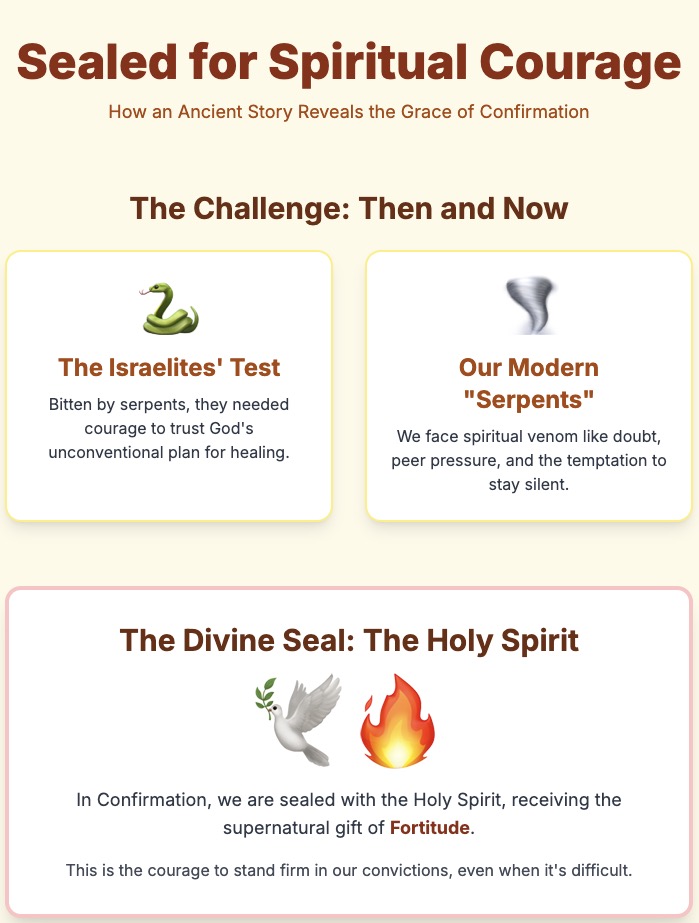
Sealed for Spiritual Courage
The account in Numbers 21:4b-9 serves as a powerful allegory for the grace of Confirmation. The Israelites, bitten by serpents, needed courage to look upon the bronze serpent and trust in God’s unconventional plan for their healing.
In Confirmation, we are sealed with the Holy Spirit, receiving the gift of Fortitude to face the spiritual “serpents” of our time: doubt, peer pressure, and temptation. The daily grace of this sacrament is the supernatural courage to stand firm in our convictions. When we are tempted to remain silent or compromise our faith, the Spirit empowers us to “look upon” the Cross and act with conviction. This isn’t just about avoiding sin, but about courageously living as witnesses.
A practical application is to consciously pray for the Spirit’s fortitude before entering a challenging social or professional environment, trusting Him to be our strength and our shield.
Exaltation of the Holy Cross
Numbers 21:4b-9
- Opening Question: The essay uses the image of “spiritual serpents” (doubt, peer pressure, temptation). What does a modern-day “serpent” look like in your own life (at school, work, or in social situations)?
- The Gift of Fortitude: How is the courage given in Confirmation different from natural bravery? Can you think of a time when you felt you needed a strength that was beyond your own to stand up for your faith?
- A Conscious Act: The essay suggests praying for fortitude before entering a challenging environment. What makes this act of prayer a “practical application” of the sacrament? How does it activate the grace we’ve already received?
- Beyond Avoidance: The text says Confirmation is “not just about avoiding sin, but about courageously living as witnesses.” What is the difference between these two things? How can we move from simply avoiding wrong to actively doing right in a public way?
Philippians 2:6-11
CONFIRMATION
Empowered for Public Witness
Philippians 2:6-11, which proclaims that Christ’s humility led to His exaltation where “every tongue confess that Jesus Christ is Lord,” illuminates Confirmation as the sacrament of public witness. While Baptism brings us into God’s family, Confirmation commissions us to go out and proclaim His name.
The Holy Spirit anoints us, not for our own glory, but to empower our personal “kenosis,” or self-emptying, so that Christ may be glorified through our lives and words. The daily grace is the boldness to share our faith. This transforms us from passive believers into active apostles.
A life application is to actively look for opportunities to witness to Christ’s love through our actions—serving a neighbor, encouraging a coworker, or defending the dignity of another—allowing our lives to become a clear confession of faith that points entirely to Him.
Exaltation of the Holy Cross

Philippians 2:6-11
- Opening Question: The essay contrasts being a “passive believer” with an “active apostle.” What do you think are the key characteristics of each? Where do you see yourself on that spectrum right now?
- Connecting Humility and Witness: How does Christ’s “kenosis” (self-emptying) relate to our call to be public witnesses? Why is humility essential for authentic evangelization?
- Commissioned to Proclaim: Confirmation is described as a “commissioning.” What does that word imply? How does it change our understanding of our role in the Church and in the world?
- Practical Witness: The essay lists serving a neighbor, encouraging a coworker, or defending someone’s dignity as acts of witness. Can you brainstorm other specific, everyday actions that would allow your life to “become a clear confession of faith”?
John 3:13-17
CONFIRMATION
The Spirit of Mature Understanding
In John 3:13-17, Jesus speaks of being “born from above” by the Spirit and of being “lifted up” for eternal life. Confirmation perfects our baptismal grace, elevating our faith from its infancy to maturity. The Holy Spirit bestows the gifts of Wisdom and Understanding, allowing us to grasp the profound mystery of Christ “lifted up” on the cross and in the Eucharist. This grace moves us beyond a mere intellectual knowledge of God to a deep, personal relationship.
The daily grace is the ability to see the world through the lens of faith, discerning God’s will in our lives. A practical application is to approach Scripture or Church teaching not as a textbook, but as a conversation, asking the Holy Spirit who was promised to guide us to all truth, to illuminate our minds and hearts with divine understanding.
Exaltation of the Holy Cross

John 3:13-17
- Opening Question: What does it mean for a faith to be “mature”? How is a mature understanding of God different from the faith of a child?
- Wisdom and Understanding: The essay highlights the gifts of Wisdom and Understanding. How are these two gifts different? How do they work together to help us grasp the “profound mystery of Christ”?
- Lens of Faith: What does it mean to “see the world through the lens of faith”? How might this perspective change how you view current events, personal struggles, or your career path?
- Faith as Conversation: The practical application suggests approaching Scripture and Church teaching as a “conversation” with the Holy Spirit. What does this look like in practice? How can this approach prevent our faith from becoming dry or purely academic?
Numbers 21:4b-9
CONFESSION & PENANCE
The Healing Gaze
The story of the bronze serpent in Numbers 21:4b-9 is a powerful image of the Sacrament of Reconciliation. The Israelites were dying from the venom of serpents; we are spiritually wounded by the poison of sin. Their healing required a conscious act of turning and looking upon the remedy God provided.
In Confession, we do the same. We must have the courage to “look upon” our sins by naming them, and in doing so, we turn our gaze to Christ, our true healing. The daily grace received is the strength to be honest with ourselves and with God. It breaks the paralysis of shame and empowers us to immediately turn to God when we feel the “bite” of temptation.
A practical application is to make a brief examination of conscience each night, acknowledging our faults not in despair, but with the hopeful confidence that God provides the antidote.
Exaltation of the Holy Cross

Numbers 21:4b-9
Part 1: The Poison and the Paralysis
The essay states, “we are spiritually wounded by the poison of sin” and that this can lead to a “paralysis of shame.”
- In what ways can unconfessed sin act like a “poison” in our spiritual lives? How does it affect our relationship with God and others?
- The Israelites were physically dying. What parts of us “die” spiritually when we are separated from God by sin?
- Have you ever experienced the “paralysis of shame”? How does it prevent us from seeking the healing we need?
Part 2: The Courage to Look
The essay says, “We must have the courage to ‘look upon’ our sins by naming them, and in doing so, we turn our gaze to Christ, our true healing.”
- Why does it take courage to “look upon” and name our sins? What are we often afraid of seeing?
- How is the act of looking at the bronze serpent similar to the act of confessing our sins to a priest? What role does faith play in both actions?
- How does the act of naming our sins help us turn our gaze away from the sin itself and toward Christ, the healer?
Part 3: The Grace of Honesty
The essay identifies the daily grace of the sacrament as “the strength to be honest with ourselves and with God.”
- How does the regular practice of Confession make it easier to be honest with ourselves on a daily basis?
- How does this grace empower us to “immediately turn to God when we feel the ‘bite’ of temptation,” rather than hiding in shame?
- In what other areas of your life could the grace of radical honesty bring healing and freedom?
Part 4: Life Application: The Daily Antidote
The essay suggests a “brief examination of conscience each night, acknowledging our faults not in despair, but with the hopeful confidence that God provides the antidote.”
- What is the difference between acknowledging a fault in despair versus acknowledging it with hopeful confidence?
- How can a simple, nightly examination of conscience act as a “daily antidote” to the poison of sin?
- What is one practical step you can take to incorporate this spiritual practice into your nightly routine?
Philippians 2:6-11
CONFESSION & PENANCE
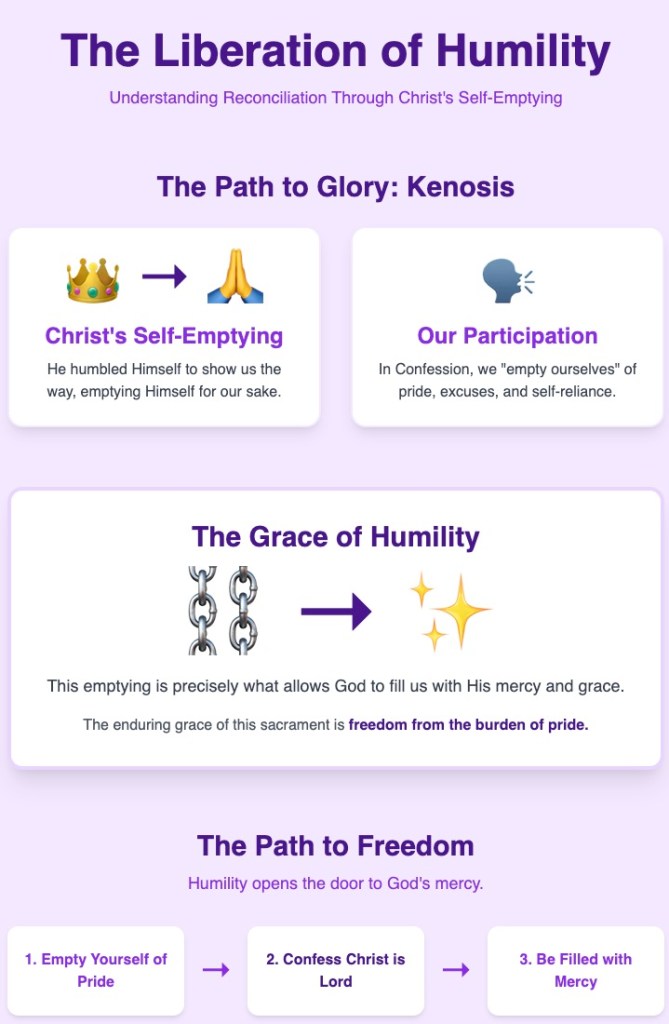
The Liberation of Humility
Philippians 2:6-11 reveals Christ’s kenosis, or self-emptying, as the path to glory. Reconciliation is our participation in this act. To enter the confessional is to “empty ourselves” of pride, excuses, and self-reliance. As we “confess that Jesus Christ is Lord” over our sins and weaknesses, we perform a profound act of humility. This emptying is precisely what allows God to fill us with His mercy and grace.
The enduring grace of this sacrament is freedom from the burden of pride. It softens our hearts, making it easier to admit fault and seek forgiveness in our daily relationships.
A life application is to consciously choose a small act of humility after Confession—such as asking for help with a task or admitting a mistake to a family member—allowing the sacrament’s grace to reshape our patterns of behavior.
Exaltation of the Holy Cross
Philippians 2:6-11
Part 1: The Act of Self-Emptying (Kenosis)
The essay states, “Reconciliation is our participation in this act. To enter the confessional is to ‘empty ourselves’… As we ‘confess that Jesus Christ is Lord’ over our sins and weaknesses, we perform a profound act of humility.”
- What does it mean to “confess that Jesus Christ is Lord” not just with our lips, but specifically over our sins and weaknesses?
- How is the act of confessing our sins an act of humility? In what ways does it challenge our self-reliance?
- The essay says this “emptying is precisely what allows God to fill us with His mercy and grace.” Why must we be “empty” before we can be “filled”?
Part 2: The Grace of Freedom
The essay identifies the enduring grace of the sacrament as “freedom from the burden of pride” and that it “softens our hearts.”
- In what ways can pride feel like a “burden”? Can you share an example from your own life where pride was a heavy weight?
- What does a “soft heart” look like in daily life, as opposed to a “hard heart”?
- How does receiving God’s mercy make it easier to admit fault and seek forgiveness in our human relationships?
Part 3: Life Application: Reshaping Our Patterns
The essay suggests “to consciously choose a small act of humility after Confession…allowing the sacrament’s grace to reshape our patterns of behavior.”
- Why is it important to follow up the spiritual act of Confession with a practical, physical act of humility?
- What are some examples of “small acts of humility” we could practice in our daily lives (e.g., at home, work, or school)?
- How can these small, conscious choices help to “reshape our patterns of behavior” over time? What patterns might they change?
John 3:13-17
CONFESSION & PENANCE
The Judgment of Mercy
Many fear Confession as a place of judgment, but John 3:13-17 reveals its true nature. Jesus declares, “God did not send his Son into the world to condemn the world, but that the world might be saved through him.”
The confessional is not a tribunal of condemnation; it is a tribunal of mercy. It is the sacred space where Christ, “lifted up,” fulfills His mission to save, not to condemn. The daily grace we receive from this encounter is a profound and lasting peace. It silences the voice of the accuser and replaces anxiety and guilt with the quiet confidence of being a beloved, forgiven child.
A practical application is, when tempted to despair over a sin, to repeat Christ’s words as a prayer, reaffirming that God’s primary desire for you is not condemnation, but healing and salvation.
Exaltation of the Holy Cross

John 3:13-17
Part 1: The Act of Self-Emptying (Kenosis)
The essay states, “Reconciliation is our participation in this act. To enter the confessional is to ‘empty ourselves’… As we ‘confess that Jesus Christ is Lord’ over our sins and weaknesses, we perform a profound act of humility.”
- What does it mean to “confess that Jesus Christ is Lord” not just with our lips, but specifically over our sins and weaknesses?
- How is the act of confessing our sins an act of humility? In what ways does it challenge our self-reliance?
- The essay says this “emptying is precisely what allows God to fill us with His mercy and grace.” Why must we be “empty” before we can be “filled”?
Part 2: The Grace of Freedom
The essay identifies the enduring grace of the sacrament as “freedom from the burden of pride” and that it “softens our hearts.”
- In what ways can pride feel like a “burden”? Can you share an example from your own life where pride was a heavy weight?
- What does a “soft heart” look like in daily life, as opposed to a “hard heart”?
- How does receiving God’s mercy make it easier to admit fault and seek forgiveness in our human relationships?
Part 3: Life Application: Reshaping Our Patterns
The essay suggests “to consciously choose a small act of humility after Confession…allowing the sacrament’s grace to reshape our patterns of behavior.”
- Why is it important to follow up the spiritual act of Confession with a practical, physical act of humility?
- What are some examples of “small acts of humility” we could practice in our daily lives (e.g., at home, work, or school)?
- How can these small, conscious choices help to “reshape our patterns of behavior” over time? What patterns might they change?
Numbers 21:4b-9
ANOINTING OF THE SICK
Union in Affliction
The story in Numbers 21:4b-9, where Israelites were healed by looking at a bronze serpent, reveals Anointing of the Sick as the sacrament that gives meaning to our suffering. Illness can feel like a serpent’s venom, isolating and draining us of life.
The Anointing is God’s tangible remedy, a sacred sign that, when received in faith, brings profound spiritual healing. It does not promise a magical cure for the body, but it unites our personal suffering with the redemptive suffering of Christ on the cross. The daily grace received is perseverance in hope. It transforms our pain from a meaningless affliction into a powerful prayer, offered in union with Him.
A life application is to consciously offer up our physical or emotional pains for a specific intention, allowing the Spirit to turn our sickbed into an altar of love, just as the cross transformed suffering into salvation.
Exaltation of the Holy Cross

Numbers 21:4b-9
Part 1: The Venom of Suffering
The essay compares illness to a “serpent’s venom” that is “isolating and draining.”
- In what ways have you experienced physical or emotional suffering that felt like a “poison” in your life? Did it feel isolating?
- The Israelites in the desert were complaining and losing hope. How does serious illness or chronic pain challenge our own hope and trust in God?
- Besides physical illness, what other modern-day “serpents” (e.g., despair, anxiety, loneliness) can drain us of spiritual life?
Part 2: God’s Tangible Remedy
The essay contrasts a “magical cure” with “profound spiritual healing” and emphasizes uniting our suffering with Christ’s.
- What is the difference between hoping for a cure and hoping for healing? Why is this distinction important when discussing this sacrament?
- The Anointing is described as a “tangible remedy.” Why do you think God gives us physical, tangible signs (like oil, water, bread) in the sacraments?
- What does it practically mean to “unite our personal suffering with the redemptive suffering of Christ on the cross”? How can this idea change our perspective on our own pain?
Part 3: The Grace of Perseverance
The essay identifies the daily grace of this sacrament as “perseverance in hope,” which transforms pain into prayer.
- How can the sacrament provide “perseverance” even if the physical condition does not improve? Where does this strength come from?
- Have you ever experienced a situation where suffering, in time, felt less like a “meaningless affliction” and more like an opportunity for prayer or growth?
- How does the sacrament help shift our focus from “Why is this happening to me?” to “How can I offer this to God?”
Part 4: Life Application: The Sickbed as an Altar
The essay suggests consciously offering up our pains for a specific intention, turning a “sickbed into an altar of love.”
- What does the image of a “sickbed as an altar” mean to you? How does it change the perception of a place of suffering?
- What is a specific intention you could “offer up” your current struggles for—whether for a person, a cause, or for the Church?
- How can this practice of offering our suffering help not only the person who is sick but also those around them?
Philippians 2:6-11
ANOINTING OF THE SICK
The Dignity of Weakness
Philippians 2:6-11 describes Christ’s kenosis—His radical self-emptying. Serious illness is our own profound experience of kenosis, emptying us of strength, independence, and control.
The Anointing of the Sick is the sacrament that meets us precisely in this state of vulnerability. As Christ humbled himself, the anointing with sacred oil affirms our profound dignity even in our weakness. It declares that our worth is not in our ability, but in our identity as beloved children of God. The daily grace received is the strength to surrender, to accept our dependence on God and others with peace rather than despair.
A life application for those who are healthy is to serve the sick and elderly, recognizing in their vulnerability the humble Christ. For the sick, it is to allow others to serve them, transforming their need into an opportunity for grace.
Exaltation of the Holy Cross

Philippians 2:6-11
Part 1: The Experience of Kenosis
The essay connects Christ’s “radical self-emptying” with the experience of serious illness, which empties us of “strength, independence, and control.”
- What does the idea of Christ “emptying himself” mean to you? Why is this act so central to our faith?
- In what ways can illness or vulnerability feel like a form of “self-emptying”? Have you ever felt emptied of strength or control in a challenging situation?
- Why is it often so difficult for us to accept a loss of independence or control in our lives?
Part 2: The Affirmation of Dignity
The essay states that the anointing “affirms our profound dignity even in our weakness” and that our worth is based on our identity, not our ability.
- What does the phrase “the dignity of weakness” mean to you? How does this contrast with the world’s view of where dignity comes from?
- How can the physical act of being anointed with oil serve as a powerful affirmation of one’s identity as a “beloved child of God”?
- Discuss a time when you realized your own worth (or someone else’s) had nothing to do with physical ability or accomplishments.
Part 3: The Grace of Surrender
The essay identifies the daily grace of this sacrament as “the strength to surrender, to accept our dependence on God and others with peace rather than despair.”
- What is the difference between “giving up” in despair and “surrendering” in peace? Why is one a grace and the other a temptation?
- How does accepting our dependence on God and others challenge our sense of pride?
- In what ways can the grace of surrender bring peace to a situation filled with anxiety or fear?
Part 4: Life Application: A Two-Fold Call
The essay presents a life application for both the healthy and the sick: to serve and to be served.
- For the healthy: What are some practical ways we can “recognize in their vulnerability the humble Christ” when we encounter the sick or elderly?
- For the sick: Why can it sometimes be harder to receive help than to give it? How can allowing others to serve you become “an opportunity for grace” for both you and the caregiver?
- How does this mutual exchange of service build a stronger, more compassionate community?
John 3:13-17
ANOINTING OF THE SICK
Preparation for Eternal Glory
In John 3:13-17, Jesus speaks of being “lifted up” to grant eternal life. Anointing of the Sick is the Church’s ultimate prayer that a person will be “lifted up” from their suffering into the glory of Heaven.
This sacrament prepares the soul for its final journey, strengthening it against the final temptations of fear and despair. It is a final seal of God’s merciful love, a confirmation of the promise that He “did not send his Son into the world to condemn the world, but that the world might be saved.” The enduring grace is a profound peace and a fortified hope in the resurrection.
A practical life application for all of us is to live each day with an eternal perspective, fostering reconciliation and love, so that when our final hour comes, we are prepared to be lifted up with Christ into everlasting life.
Exaltation of the Holy Cross

John 3:13-17
Part 1: The Promise of Being “Lifted Up”
The essay connects Christ being “lifted up” to grant eternal life with the Church’s prayer that a person will be “lifted up” from suffering into glory.
- What does the phrase “lifted up” mean to you in the context of both Jesus on the cross and a soul’s journey to Heaven?
- The sacrament is described as the “Church’s ultimate prayer” for a person. Why is it significant that this prayer is offered by the entire Church, not just the individual or priest?
- How does viewing Anointing of the Sick as a preparation for glory change its perception from being a sacrament only for the dying?
Part 2: Strengthened for the Final Journey
The essay highlights that the sacrament strengthens the soul against the final temptations of fear and despair and is a “final seal of God’s merciful love.”
- Why might fear and despair be particularly strong temptations when facing serious illness or the end of life?
- The sacrament is a confirmation that God’s mission is to “save, not to condemn.” How can this truth directly combat feelings of unworthiness or fear of judgment?
- What does it mean to be “sealed” with God’s love? How does this sacrament act as a final, powerful reminder of our Baptismal seal?
Part 3: The Grace of Peace and Hope
The essay identifies the enduring grace as “a profound peace and a fortified hope in the resurrection.”
- Where does the “profound peace” that comes from this sacrament originate, especially when physical circumstances may not be peaceful at all?
- What is the difference between ordinary hope and a “fortified hope in the resurrection”?
- Have you ever witnessed someone face a serious illness with a sense of peace that seemed to defy the situation? How did it impact you?
Part 4: Life Application: An Eternal Perspective
The essay proposes that we should all “live each day with an eternal perspective, fostering reconciliation and love.”
- What are some practical, everyday things you can do to live with more of an “eternal perspective”?
- How does actively “fostering reconciliation and love” in our daily relationships prepare us for our final hour?
- Why is it important to think about these things now, rather than waiting until we are seriously ill?
Numbers 21:4b-9
MATRIMONY
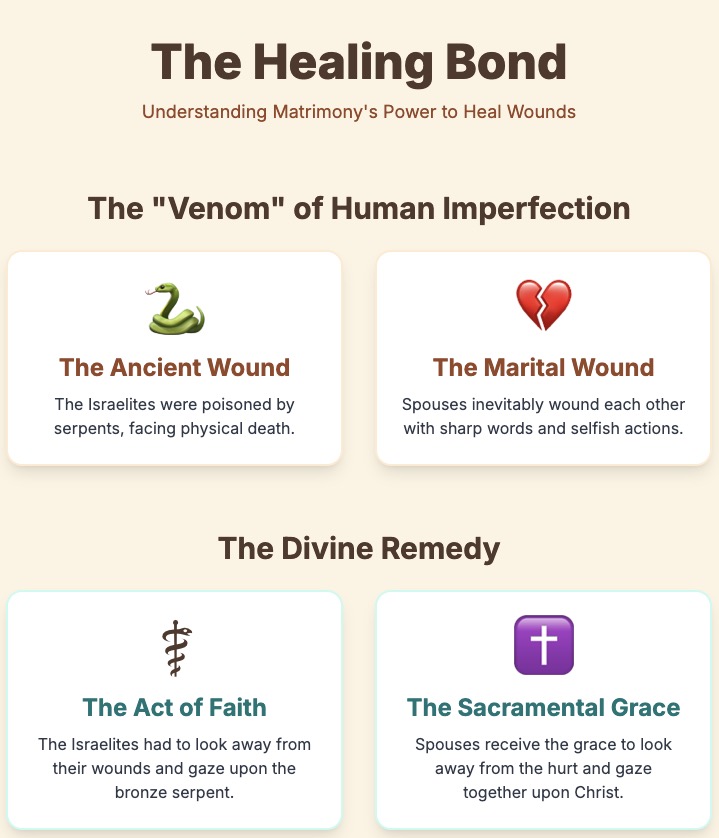
The Healing Bond
The story in Numbers 21:4b-9, where Israelites looked upon a bronze serpent to be healed, provides a powerful model for Matrimony.
In marriage, spouses will inevitably wound each other with sharp words or selfish actions—the “venom” of human imperfection. The Sacrament of Matrimony provides the remedy: the grace to look away from the immediate hurt and gaze together upon Christ, who was “lifted up” for them. The daily grace received is the power of mutual forgiveness and healing. It is the strength to see past the sting of a particular fault and recognize the greater reality of their sacramental bond in Christ.
A life application is, after a disagreement, for the couple to consciously pray before a crucifix, asking Christ to heal the wound between them, trusting that looking to Him together is the antidote to the poison of resentment.
Exaltation of the Holy Cross
Numbers 21:4b-9
Part 1: The “Venom” of Human Imperfection
The essay states, “In marriage, spouses will inevitably wound each other with sharp words or selfish actions—the ‘venom’ of human imperfection.”
- What do you think of the analogy of hurtful actions or words being like “venom”? In what ways does this metaphor accurately describe the effect of sin within a relationship?
- The essay says these wounds are “inevitable.” Why is it important to accept this reality rather than expecting a conflict-free marriage?
- What happens when the “poison” of resentment is left untreated in a marriage? How can it affect a couple’s bond over time?
Part 2: The Sacramental Remedy
The essay identifies the remedy as “the grace to look away from the immediate hurt and gaze together upon Christ, who was ‘lifted up’ for them.”
- In the middle of a disagreement, what makes it so difficult to “look away from the immediate hurt”?
- What does it mean for a couple to “gaze together upon Christ”? What are some practical ways a couple can do this?
- The daily grace is described as the “strength to see past the sting of a particular fault and recognize the greater reality of their sacramental bond.” How does remembering your sacramental bond change your perspective on a specific argument or hurt?
Part 3: Life Application: The Healing Gaze
The essay suggests, “after a disagreement, for the couple to consciously pray before a crucifix, asking Christ to heal the wound between them, trusting that looking to Him together is the antidote to the poison of resentment.”
- Why is the crucifix a particularly powerful focal point for prayer after a conflict? What does Christ’s sacrifice on the cross teach us about forgiveness and healing?
- What are some of the internal and external obstacles that might prevent a couple from praying together right after an argument? How can they overcome these?
- How can this conscious act of prayer serve as a powerful “antidote to the poison of resentment”? What does this practice teach a couple about the source of their healing?
Philippians 2:6-11
MATRIMONY
The Self-Giving Union
Philippians 2:6-11 illuminates Matrimony as a school of kenosis, or mutual self-emptying. Christ “emptied himself,” becoming a servant out of love. In marriage, spouses are called to this same radical gift of self.
The sacrament provides the daily grace to live this out, empowering a husband and wife to prioritize the other’s good, to serve without keeping score, and to humble themselves for the sake of unity. This grace transforms marriage from a contract of convenience into a covenant of self-giving love.
A practical life application is to find small, daily opportunities for kenosis: taking on a chore your spouse dislikes, listening with your full attention when you are tired, or yielding your preference for the sake of peace. These acts of emptying oneself allow Christ’s perfect love to fill and define the marriage.
Exaltation of the Holy Cross

Philippians 2:6-11
Part 1: The Call to Kenosis
The essay states, “Christ ‘emptied himself,’ becoming a servant out of love. In marriage, spouses are called to this same radical gift of self.”
- What does it practically mean to “empty yourself” for your spouse? How is this different from simply compromising or “meeting halfway”?
- The essay calls this a “radical gift of self.” What makes this kind of self-giving “radical” in today’s culture?
- How does Christ’s example of becoming a servant challenge the common idea of marriage as a 50/50 partnership where each person’s needs must be equally met?
Part 2: The Grace of Self-Giving
The essay explains, “The sacrament provides the daily grace… to prioritize the other’s good, to serve without keeping score, and to humble themselves for the sake of unity. This grace transforms marriage from a contract of convenience into a covenant of self-giving love.”
- Why is it so easy for couples to begin “keeping score” of who does what? What are the dangers of this mindset for a marriage?
- What is the difference between a “contract of convenience” and a “covenant of self-giving love”? How would a couple living out each of these view their relationship and commitments differently?
- When might a spouse need to be humble for the sake of unity, even if they believe they are “right” in a particular situation?
Part 3: Life Application: Daily Acts of Love
The essay suggests, “A practical life application is to find small, daily opportunities for kenosis: taking on a chore your spouse dislikes, listening with your full attention when you are tired, or yielding your preference for the sake of peace.”
- Why are these “small, daily opportunities” for self-gift so important in a marriage, perhaps even more so than grand, occasional gestures?
- Can you share an example of a time your spouse (or someone in a close relationship) performed a “small act of kenosis” for you? How did it make you feel and how did it affect the relationship?
- The essay says these acts “allow Christ’s perfect love to fill and define the marriage.” How does a simple, humble act like taking out the trash or listening patiently become a channel for divine love?
John 3:13-17
MATRIMONY
A Love Lifted High
In John 3:13-17, Jesus speaks of being “lifted up” so that the world might be saved through Him. The Sacrament of Matrimony is meant to be a visible love “lifted high” for the world to see.
A marriage lived in Christ becomes a tangible sign of how “God so loved the world”—a love that is total, faithful, fruitful, and sacrificial. The daily grace of this sacrament is the ability to love each other in a way that points beyond themselves to God. It empowers a couple to make their shared life a source of grace for their family and community.
A practical life application is for a couple to ask, “How can our love be a witness today?” This could be through offering hospitality, mentoring another couple, or serving a parish ministry together, making their union a beacon of God’s life-giving love.
Exaltation of the Holy Cross

John 3:13-17
Part 1: A Visible Sign of God’s Love
The essay states, “A marriage lived in Christ becomes a tangible sign of how ‘God so loved the world’—a love that is total, faithful, fruitful, and sacrificial.”
- What does it mean for a marriage to be a “tangible sign”? How can an ordinary human relationship point to the extraordinary reality of God’s love?
- Let’s break down the four characteristics mentioned. What do each of these look like in the day-to-day life of a married couple?
- Total: (giving your whole self)
- Faithful: (remaining committed in heart, mind, and body)
- Fruitful: (openness to life, both physically and spiritually)
- Sacrificial: (putting the other’s needs first)
- How does the sacrament provide the grace for a couple to live out this high calling, especially when human weakness makes it difficult?
Part 2: The Grace to Point Beyond Yourselves
The essay identifies the daily grace as “the ability to love each other in a way that points beyond themselves to God. It empowers a couple to make their shared life a source of grace for their family and community.”
- How can a couple’s love for each other “point beyond themselves”? Can you think of a married couple whose relationship has pointed you toward God? What was it about them?
- What are some ways a marriage can become a “source of grace” for others?
- How does receiving this daily grace help a couple avoid becoming too inwardly focused on their own relationship, and instead look outward to the needs of their family and community?
Part 3: Life Application: A Beacon of Love
The essay suggests a practical application: “for a couple to ask, ‘How can our love be a witness today?’ This could be through offering hospitality, mentoring another couple, or serving a parish ministry together…”
- What is the value in a couple intentionally asking this question together? How might it change the way they approach their day?
- Besides the examples given, what are some other simple, practical ways a couple can make their union a “beacon of God’s life-giving love” in their neighborhood, workplace, or parish?
- How does serving together as a couple strengthen the marital bond itself, in addition to being a witness to others?
Numbers 21:4b-9
HOLY ORDERS
The Raised Sign of Mercy
The story in Numbers 21:4b-9, where Moses lifts up a bronze serpent to heal the Israelites, illuminates the role of the priest as an instrument of God’s mercy. The people, wounded by sin and despair, look to their priest, not for his own power, but because he is ordained to make Christ’s healing present. Like Moses, the priest is called to lift up Christ—in the Eucharist, in the words of absolution, and in his very life.
The daily grace a cleric receives is the strength to be a steadfast sign of hope, to continually point people to Christ even when they are complaining or have lost their way.
A practical life application for a priest or deacon is, when feeling overwhelmed by the pastoral needs of his flock, to spend time before the Blessed Sacrament, consciously placing the people’s wounds before the “lifted up” Christ, the true source of all healing.
Exaltation of the Holy Cross

Numbers 21:4b-9
Theme 1: The Sign in the Desert, The Savior on the Cross
The Old Testament event provides a physical symbol for a spiritual reality fulfilled in Christ.
- Question 1: The Israelites’ journey was marked by impatience and complaining against God. In what ways do we mirror this behavior in our own spiritual journeys when we encounter difficulties?
- Question 2: God’s remedy was for the people to look upon a bronze serpent. Why do you think God chose this specific sign? How does this act of looking in faith relate to our own path to healing?
- Question 3: Jesus directly references this event in John 3:14-15. How does understanding the story of the bronze serpent deepen our understanding of what happened on the cross?
Theme 2: The Priest: Making Christ’s Healing Present
Like Moses, the priest stands between the people and God, not as a barrier, but as a bridge for God’s mercy.
- Question 1: The guide says the priest is called to “lift up Christ.” What does this look like practically in the celebration of the Eucharist, in the Sacrament of Reconciliation, and in a priest’s daily life and preaching?
- Question 2: The “daily grace” a cleric receives is the strength to be a “steadfast sign of hope,” even when people are complaining or have lost their way. Why is this grace so essential for an effective ministry?
- Question 3: The people were healed by looking at the sign Moses made, not at Moses himself. How does this distinction help us understand the proper role of a priest as an instrument who points away from himself and toward Christ?
Theme 3: Bringing Our Wounds to the Healer
The ultimate source of healing is not the instrument, but Christ Himself.
- Question 1: The guide suggests a priest should “consciously place the people’s wounds before the ‘lifted up’ Christ” in prayer. How can this act of intercession protect a priest from burnout and despair when faced with overwhelming pastoral needs?
- Question 2: As laypeople, what are some of the “serpent bites” (wounds from sin, despair, bitterness) we carry? What sometimes prevents us from bringing them to the sources of healing Christ has given us in the Church?
- Question 3: How can we better cultivate the habit of “looking upon” the lifted-up Christ in our daily lives, especially when we feel the effects of sin and suffering?
4. Reflection & Action
- For Clergy: This week, when you feel the weight of your pastoral duties, take five minutes before the Blessed Sacrament. Intentionally name the people and situations that are burdening you, and place them before Christ, the true healer.
- For Laity: Identify a specific wound or sin in your life. This week, make a conscious act of “looking upon the serpent” by bringing that wound to Christ, either through the Sacrament of Reconciliation, a Holy Hour, or heartfelt prayer before a crucifix.
Philippians 2:6-11
HOLY ORDERS
A Life Poured Out
Philippians 2:6-11 provides the ultimate model for Holy Orders: the kenosis of Christ, who “emptied himself, taking the form of a slave.” A man is ordained not for power or privilege, but to be configured to Christ the Servant. His life becomes a radical act of self-emptying for the sake of the Church.
The daily grace of Holy Orders is pastoral charity—the supernatural strength to pour oneself out in service without counting the cost. It is the grace that fuels late-night hospital visits, long hours in the confessional, and the patient counseling of a soul in turmoil.
A life application for clergy is to intentionally seek out the hidden, thankless tasks of ministry, seeing in them a direct opportunity to live out Christ’s own humble service and to find joy not in recognition, but in a life poured out for others.
Exaltation of the Holy Cross

Philippians 2:6-11
Theme 1: The Kenosis of Christ: The Ultimate Model
The foundation of priestly service is Christ’s own act of “emptying himself.”
- Question 1: What does it mean that Christ, “though he was in the form of God, did not regard equality with God something to be grasped”? How does this challenge our own ambitions?
- Question 2: Jesus took the “form of a slave.” What specific examples from the Gospels show Jesus living out this role as a humble servant to his disciples and others?
- Question 3: The world often defines leadership by power, influence, and recognition. How does Christ’s model of kenosis completely redefine what it means to be a true leader?
Theme 2: Pastoral Charity: The Grace to Serve
This supernatural strength allows a priest to live a life of self-gift.
- Question 1: The guide defines pastoral charity as the “supernatural strength to pour oneself out in service without counting the cost.” Why is this strength described as “supernatural”? What happens when a person tries to serve endlessly using only their own human strength?
- Question 2: The text lists examples like late-night hospital visits and long hours in the confessional. In what other, perhaps less visible ways, do priests exercise this pastoral charity today?
- Question 3: How is pastoral charity more than just being kind or generous? How does its focus on the eternal salvation of the person being served elevate the act?
Theme 3: Finding Joy in Humble Service
The application of kenosis is to find purpose not in recognition, but in the act of service itself.
- Question 1: The guide suggests clergy should “intentionally seek out the hidden, thankless tasks of ministry.” Why is there a unique spiritual value in doing good that no one else sees?
- Question 2: How can a person shift their mindset from seeking affirmation to finding genuine joy in “a life poured out for others”? What practical steps could one take to cultivate this attitude?
- Question 3 (For Laity): The call to empty ourselves is a universal Christian call. In what specific ways can we live out Christ’s kenosis in our roles as spouses, parents, employees, or friends?
4. Reflection & Action
- For Clergy: Identify one “hidden, thankless task” in your ministry this week. Offer it to God intentionally as an act of humble service, seeking no recognition for it.
- For Laity: Find an opportunity to serve someone in your life this week in a way that requires you to “empty yourself” of your time, comfort, or pride. Do it joyfully and without expecting anything in return.
John 3:13-17
HOLY ORDERS
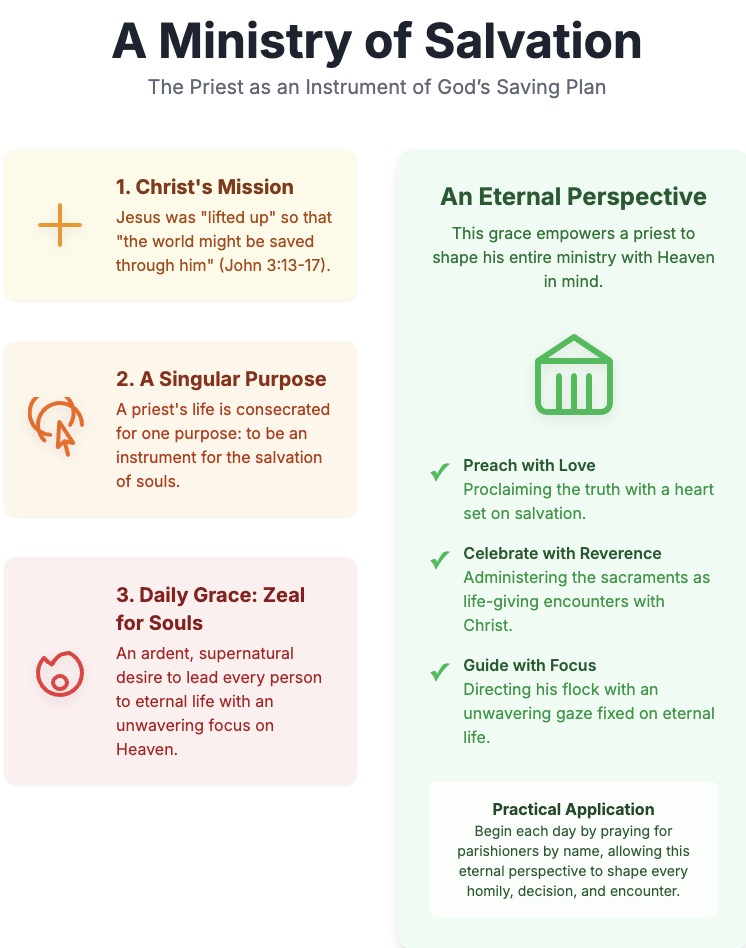
A Ministry of Salvation
In John 3:13-17, Jesus reveals His mission: He was “lifted up” so “that the world might be saved through him.” This is the very heart of the priesthood. A priest is ordained for the salvation of souls. His life is set apart and consecrated for this singular purpose: to be an instrument of God’s saving plan.
The daily grace he receives is a profound zeal for souls—an ardent, supernatural desire to lead every person he encounters to eternal life. This grace empowers him to preach the truth with love, celebrate the sacraments with reverence, and guide his flock with unwavering focus on Heaven.
A practical life application is for a priest to begin each day by praying for the salvation of his parishioners by name, allowing this eternal perspective to shape every homily, decision, and pastoral encounter
Exaltation of the Holy Cross
John 3:13-17
Theme 1: Jesus’ Mission: “Lifted Up” for Salvation
The foundation of the priesthood is Christ’s own redemptive work. He is the model for every priest.
- Question 1: In John 3:14, Jesus compares being “lifted up” to the serpent in the desert. This refers to both His crucifixion and His glorification. How does this dual meaning help us understand the nature of salvation?
- Question 2: The text says the goal is “that the world might be saved through him.” What does salvation mean to you personally? How is it more than just “getting into Heaven”?
- Question 3: How does knowing that God’s primary desire is to save, not to condemn (John 3:17), change the way we view God’s laws and our own sins?
Theme 2: The Priest: An Instrument of God’s Saving Plan
A priest’s life is set apart to participate directly in Christ’s mission. His identity is tied to the salvation of others.
- Question 1: What does it mean for a person to be an “instrument” of God? In what ways is a priest a unique instrument for salvation?
- Question 2: The text states a priest’s life is “consecrated for this singular purpose.” How does this singular focus challenge the modern idea of having a career, personal ambitions, or a private life?
- Question 3: How do the sacraments, particularly the Eucharist and Reconciliation, serve as the primary means through which a priest carries out this mission of saving souls?
Theme 3: A Zeal for Souls: The Grace of the Priesthood
This supernatural desire for the salvation of others is the engine of a priest’s ministry. It is a grace that must be nurtured.
- Question 1: The guide mentions a priest receives a “profound zeal for souls.” How would you describe this “ardent, supernatural desire”? How is it different from just wanting to be a nice or helpful person?
- Question 2: The practical application suggested is for a priest to begin each day praying for his parishioners by name. How might this simple act transform his perspective and shape his “homilies, decisions, and pastoral encounters”?
- Question 3 (For Laity): Recognizing that our priests are dedicated to our salvation, what is our role? How can we actively support our priests in their mission and show them that we, too, have a “zeal for souls”?
4. Reflection & Action
For Laity: Take a moment this week to pray specifically for your priest(s) by name. Ask God to strengthen their zeal for souls and to protect them in their ministry. Consider sending a note of encouragement, letting them know you are praying for them.
For Clergy: Consider implementing the practice of praying for a few parishioners by name each morning this week. Notice how it shapes your intentions and interactions throughout the day.
INTRODUCTION: The sacraments are important for Catholics to grow in their relationship with God. They are not just one-time events but ongoing experiences. THE WORD THIS WEEK connects each sacrament to the Sunday readings in its LIVING THE WORD section. You can also find a DEEP DIVE into one sacrament to learn more. Priests and deacons might find this useful when preparing their homilies. If the essay doesn’t connect with you right now, feel free to explore the reflection questions and infographics on the other pages of this section.
EUCHARIST
The Lifted-Up, Emptied, and Saving Presence
Numbers 21:4b-9
Philippians 2:6-11
John 3:13-17

The Holy Eucharist stands as the “source and summit of the Christian life” (CCC 1324), a mystery in which the whole spiritual good of the Church is contained: Christ himself. Catholic dogmatic theology understands this sacrament not as a mere symbol, but as the real, true, and substantial presence of the Lord, offered for the salvation of the world.
By examining key scriptural passages through the lens of Tradition, one can see how the Eucharist is the fulfillment of Old Testament prefigurements and the ultimate expression of Christ’s self-emptying love. Specifically, the narratives of the bronze serpent in Numbers 21:4b-9, the kenotic hymn of Philippians 2:6-11, and the discourse with Nicodemus in John 3:13-17 reveal the Eucharist as the lifted-up sign of healing, the embodiment of divine humility, and the very instrument of our salvation.

The Lifted-Up Sign of Healing
The episode of the bronze serpent in the Book of Numbers provides a profound prefigurement of the Eucharist as the definitive remedy for the venom of sin. The Israelites, suffering from their faithlessness, were healed not by their own merits, but by looking in faith upon a sign God provided: “Moses made a bronze serpent and mounted it on a pole, and whenever anyone who had been bitten by a serpent looked at the bronze serpent, he lived” (Numbers 21:9). Jesus himself makes this typology explicit in his dialogue with Nicodemus, stating, “Just as Moses lifted up the serpent in the desert, so must the Son of Man be lifted up, so that everyone who believes in him may have eternal life” (John 3:14-15).
The Eucharist is the perpetual memorial of this “lifting up” on the cross, a truth continually illuminated by the Magisterium. The Catechism teaches that in the Eucharist, the sacrifice of Christ “is made present” (CCC 1366). St. John Paul II, in his encyclical Ecclesia de Eucharistia, powerfully reaffirmed this, explaining that the Mass is not a mere repetition but a sacramental re-presentation of the one sacrifice of Calvary. He writes, “The sacrifice of Christ and the sacrifice of the Eucharist are one single sacrifice… In this divine sacrifice which is celebrated in the Mass, the same Christ who offered himself once in a bloody manner on the altar of the cross is contained and is offered in an unbloody manner” (EE, 12). Therefore, when the priest, acting in persona Christi, elevates the consecrated host, we are invited to look upon our Savior with the same life-giving faith as the Israelites looked upon the serpent.
In this gaze, we find healing. St. Thomas Aquinas affirms this, teaching that the Eucharist is a “remedy whereby we are freed from daily faults and preserved from mortal sins.” This theme of the Eucharist as divine medicine resonates deeply in the teachings of Pope Francis, who often describes the Eucharist not as a prize for the perfect, but as “powerful medicine and nourishment for the weak” (Evangelii Gaudium, 47). It is the antidote to our spiritual poisons—pride, despair, and selfishness. By receiving the Eucharist, we do more than look upon a sign; we consume the very source of our healing, allowing Christ’s grace to counteract the poison of sin in our souls and conform us ever more closely to Him.

The Embodiment of Divine Humility

Furthermore, the Eucharist is the ultimate expression and continuation of Christ’s kenosis, or self-emptying, described by St. Paul in Philippians 2. Christ, “though he was in the form of God, did not regard equality with God something to be grasped. Rather, he emptied himself, taking the form of a slave” (Philippians 2:6-7). This emptying, which reached its apex in his death on the cross, is made sacramentally present in the Eucharist. Here, Christ’s humility is magnified; He who is infinite God conceals His glory under the humble appearances of bread and wine. The great dogmatic theologian St. Thomas Aquinas saw this as a profound act of divine condescension, arguing that it was fitting for Christ to come to us under these species so that our merit of faith might be increased (Summa Theologiae III, q. 75, a. 1).
St. John Paul II described the Eucharist as a “school of love,” teaching that in this sacrament, Jesus “makes himself our food and communicates to us his very life” (Mane Nobiscum Domine, 15). This profound reality led St. Augustine to exclaim, “If you, therefore, are Christ’s body and members, it is your own mystery that is placed on the Lord’s table… Be what you see, and receive what you are” (Sermon 272). We receive the humble, self-emptied Christ in order to become, in turn, a humble and serving Body of Christ for the world. Pope Francis echoes this theme powerfully, reminding us that the Eucharist is not a reward for the perfect, but “an antidote by which we are freed from our daily faults and preserved from mortal sin” (Homily, Corpus Christi 2018). It is the grace that transforms us from spectators into active participants in Christ’s own mission of service.
Pope Benedict XVI, in his apostolic exhortation Sacramentum Caritatis, further explains that in the Eucharist, “Jesus shows us the truth about love… It is the love that implies a true self-giving” (no. 2). The doctrine of transubstantiation, the “change of the whole substance of the bread into the substance of the body of Christ our Lord and of the whole substance of the wine into the substance of his blood” (CCC 1376), is the theological articulation of this profound act of sacramental humility. Christ does not just take the form of a slave; He takes the form of food, pouring Himself out to become our spiritual nourishment. In this, the Eucharist becomes the preeminent school of humble service, inviting those who receive it to imitate Christ’s self-emptying love in their own lives.
The Instrument of Our Salvation
Finally, these threads converge on the central truth that the Eucharist is the primary instrument of the salvation that Christ won for humanity. God’s mission is one of rescue, not condemnation: “For God did not send his Son into the world to condemn the world, but that the world might be saved through him” (John 3:17). The Eucharist is the means by which the graces of this saving mission are applied to the faithful throughout history. It is the “sacrament of our salvation, accomplished by Christ on the cross, [which] is also a sacrifice of praise in thanksgiving for the work of creation” (CCC 1359). Theologian Henri de Lubac emphasized that the Eucharist makes the Church, and it is through the Church, Christ’s Mystical Body, that this salvation is communicated to the world. Each reception of the Eucharist deepens our union with Christ, incorporates us more profoundly into His Body, and strengthens us for our pilgrimage toward eternal life. It is not merely a preparation for salvation, but a true participation in it, a foretaste of the heavenly banquet.
In conclusion, the Holy Eucharist synthesizes the great mysteries of our faith. It is the fulfillment of the bronze serpent, the lifted-up sign upon which we gaze in faith to be healed from sin. It is the ultimate act of Christ’s kenotic love, where He empties Himself to become our food. And it is the enduring sacrament of the salvation He won for us on the cross. In this single mystery, we encounter the Lord who was lifted up, who humbled himself, and who gave his life so that we might be saved.
Text and Infographics on this page were created by THE WORD THIS WEEK using AI generative tools (i.e. Chart.js and Tailwind CSS). They may be copied for personal use or for any non-profit ministry.