September 14, 2025
September 14, 2025


Catholic Essays
Catholic Essays


The Bronze Serpent: A Catholic Perspective on Healing and Hope
The story of the bronze serpent in the Book of Numbers 21:4b-9 is far more than a peculiar historical account; for the Catholic tradition, it stands as one of the most powerful prefigurements of Christ’s saving work. The narrative is straightforward: the Israelites, weary and impatient, sin by complaining against God and Moses. As a consequence, God sends venomous serpents, and many die. Upon their repentance, God provides a surprising remedy—a bronze serpent mounted on a pole, which grants life to all who gaze upon it in faith. This event illuminates the timeless dynamics of sin, repentance, and God’s specific, covenantal mercy.
From a Catholic theological perspective, this passage is a masterclass in typology, a key way the Church reads the Old Testament in light of the New. Jesus himself confirms this interpretation in the Gospel of John 3:14, stating, “just as Moses lifted up the serpent in the desert, so must the Son of Man be lifted up.” The Church Fathers saw the bronze serpent as a clear prefigurement of the Cross. The serpent, a symbol of the very evil that caused death, became the instrument of healing when lifted up by God’s command. Likewise, Christ, who took upon himself the sin of the world, was lifted up on the Cross—an instrument of shame and death—to become the definitive source of spiritual healing and eternal life for all who look to him in faith.
The modern application for the contemporary Catholic is tangible and deeply personal. We too are often “bitten” by the venom of sin. This spiritual poison manifests as despair, habitual vice, broken relationships, and a sense of separation from God. The story of the bronze serpent teaches us that the remedy is not found in our own strength but in turning our gaze to the source of healing God has provided: the crucified Christ. For example, when a Catholic feels overwhelmed by a particular temptation or personal failure, the act of praying before a crucifix is not mere sentimentality; it is a conscious act of “looking upon the serpent,” placing one’s weakness before the power of Christ’s victory.
This principle finds its most profound expression in the Sacrament of Reconciliation. In the confessional, we do not simply list our failings; we present the “serpent bites” of our sins to Christ, who, through the ministry of the priest, heals us. Therefore, the ancient story from Numbers remains a vital lesson for Catholics today. It reminds us that in moments of spiritual crisis, the path to life is not to look inward at our own despair, but to look upward in faith to the Cross, the ultimate sign of God’s triumphant and healing love.
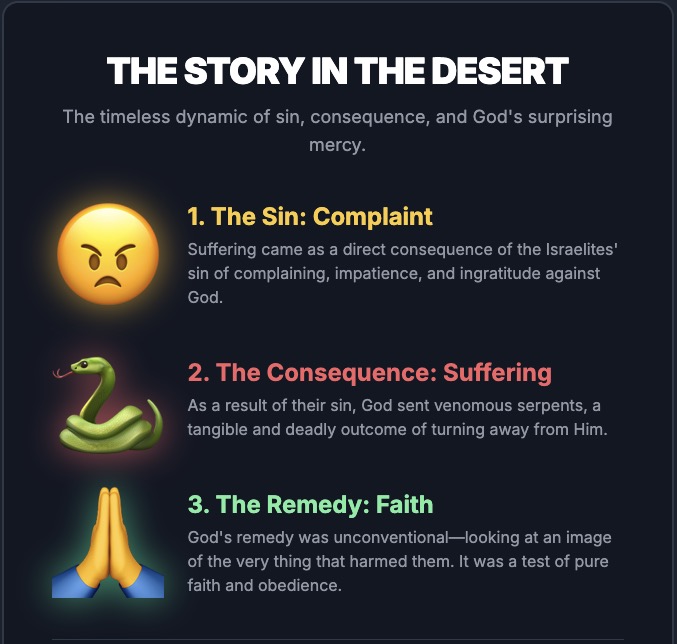
Part 1: The Story in the Desert
The essay begins by outlining the “timeless dynamics of sin, repentance, and God’s specific, covenantal mercy.” Let’s start with the original event.
- The Israelites’ suffering came as a direct consequence of their sin of complaining against God. In our own lives, how do we see a connection between sin (like impatience, ingratitude, or lack of trust) and spiritual suffering?
- God’s remedy was for the people to look upon an image of the very thing that was harming them. What does this strange and specific instruction teach us about the nature of faith and obedience? Why not a more conventional remedy?
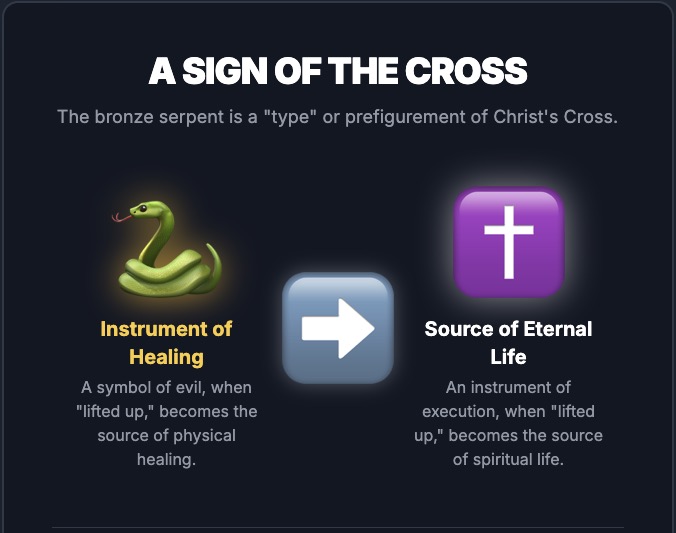
Part 2: A Sign of the Cross (Typology)
The essay’s central point is that the bronze serpent is a “type” or prefigurement of Christ’s Cross. Let’s explore this connection.
- The essay states the serpent, a symbol of evil, became an “instrument of healing.” How does this paradox help us understand the much greater paradox of the Cross, an instrument of execution, becoming our source of eternal life?
- Jesus says the Son of Man must be “lifted up” just as the serpent was. What does this phrase “lifted up” mean in the context of both the Crucifixion and the Resurrection/Ascension?
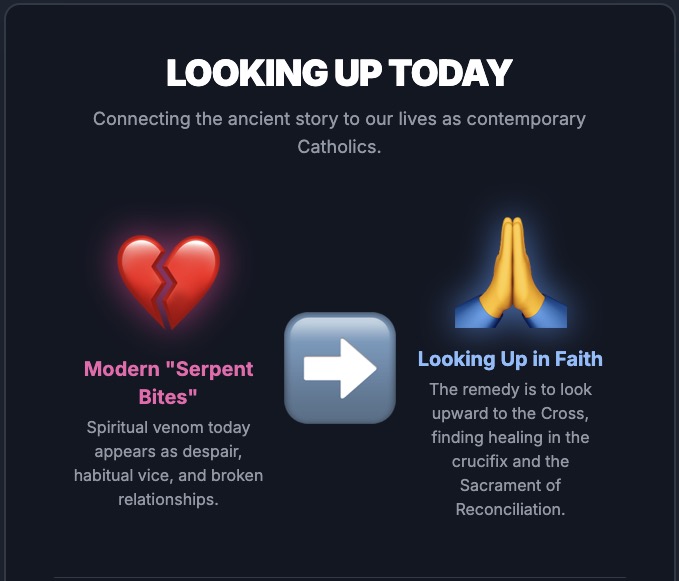
Part 3: Looking Up Today (Modern Application)
The final part of the essay connects this ancient story to our lives as contemporary Catholics. Let’s make it personal.
- The essay identifies despair, habitual vice, and broken relationships as modern “serpent bites.” What is a spiritual “venom” you see affecting people in today’s world?
- What is the practical difference between “looking inward at our own despair” and “looking upward in faith to the Cross”? Share an example of what “looking to the Cross” might look like during a difficult day.
- The essay highlights two key places where Catholics “look upon” the crucified Christ today: praying before a crucifix and the Sacrament of Reconciliation. How can this understanding change your approach to these two powerful spiritual practices?
This week, when you face a moment of temptation, frustration, or personal failure (a “serpent bite”), make a conscious effort to perform a simple act of “looking up.” This could be by praying before a crucifix, making the Sign of the Cross with intention, or simply calling to mind the image of Christ on the Cross.
The Kenotic Christ: A Catholic Model for Humility
The Christological hymn found in the Letter to the Philippians 2:6-11 is one of the most sublime and theologically dense passages in the New Testament. For the Catholic tradition, it is not merely a piece of early Christian poetry but a profound dogmatic statement on the identity and mission of Jesus Christ. This hymn, which charts the course from Christ’s divine pre-existence to his exaltation as Lord of all, provides the ultimate model for Christian living. By examining its theological concept of kenosis, or self-emptying, we can uncover its vital application for the contemporary Catholic seeking to live a life of authentic faith and service.
From a Catholic theological perspective, this passage is foundational to our understanding of the Incarnation and the Paschal Mystery. The hymn describes Christ’s kenosis, asserting that although he “was in the form of God,” he “did not regard equality with God something to be grasped. Rather, he emptied himself, taking the form of a slave” (Philippians 2:6-7). Catholic teaching clarifies that this “emptying” was not an abandonment of his divinity, but rather a voluntary concealment of his divine glory to fully embrace our human condition. This act reveals the very nature of the Triune God: a life of perfect, self-giving love. Christ’s humility, therefore, is not a diminishing of his Godhood, but the ultimate expression of it. This kenotic love reached its apex in his Passion, as he “humbled himself, becoming obedient to death, even death on a cross” (Philippians 2:8).
The hymn’s second movement reveals the divine response to this radical act of love. Because of Christ’s perfect obedience, “God greatly exalted him and bestowed on him the name that is above every name” (Philippians 2:9). This demonstrates a core tenet of Catholic soteriology: the Cross is inseparable from the Resurrection. Christ’s humiliation is the very path to his glorification. The passage culminates in a vision of cosmic liturgy, where “every knee should bend, of those in heaven and on earth and under the earth, and every tongue confess that Jesus Christ is Lord” (Philippians 2:10-11). This is the definitive victory over sin and death, a victory achieved not through overwhelming power, but through self-emptying love.
The modern application of this profound theology is a direct call to imitate Christ’s kenotic humility in our daily lives. In a world that often prizes self-promotion, status, and power, the Philippians hymn challenges the contemporary Catholic to embrace a different path—one of service, humility, and self-gift. This does not mean self-deprecation, but rather a rightly ordered sense of self that places God first and serves others without counting the cost. For example, a professional who uses their skills not only for personal gain but also to mentor a junior colleague or volunteer for a non-profit embodies this spirit. It is the act of putting another’s needs before one’s own convenience and ambition.
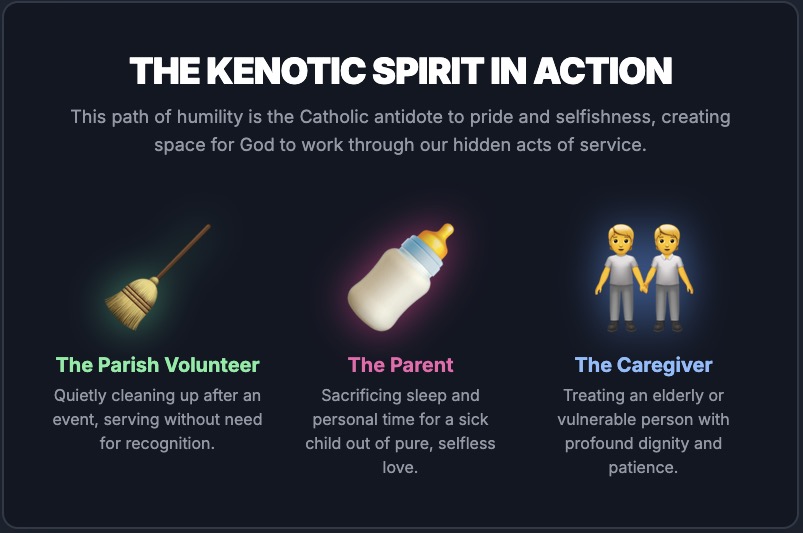
This kenotic spirit finds tangible expression in the life of the Church and in our personal vocations. It is the parish volunteer who quietly cleans up after an event, the parent who sacrifices sleep and personal time for a sick child, or the caregiver who treats an elderly person with profound dignity and patience. In these hidden acts of service, we take on the “form of a slave” that Christ first modeled for us. This path of humility is the Catholic antidote to the pride and selfishness that so often wound our world. By emptying ourselves in loving service, we not only imitate Christ but also create space for God to work through us, making his love present to others. The hymn reminds us that this is the true path to a meaningful life—one that finds
Part 1: The Mystery of Kenosis (Self-Emptying)
The essay explains that Christ’s “emptying” was not an abandonment of his divinity, but a “voluntary concealment of his divine glory.”
- What was your initial understanding of the phrase “he emptied himself”? How does the essay’s explanation change or deepen that understanding?
- The essay says Christ’s humility is the “ultimate expression” of his Godhood. How does this challenge the world’s view of what power, greatness, and divinity look like?
- Why is it significant that Christ took the form of a “slave” specifically, rather than just a human? What does this reveal about his mission?

Part 2: The Path to Glory
The hymn shows a clear movement: because of Christ’s humility and obedience, God exalted him. The essay notes, “Christ’s humiliation is the very path to his glorification.”
- How does the connection between the Cross and the Resurrection shape our Catholic understanding of suffering? Can you think of a time when a personal sacrifice or a difficult situation eventually led to an unexpected grace or good?
- The passage ends with a vision of all creation worshiping Jesus as Lord. How does knowing this final victory change how we view the struggles and apparent “defeats” in our own lives and in the world?

Part 3: The Call to Imitation (Modern Application)
The essay challenges us to apply this “kenotic spirit” to our daily lives in a world that often prizes self-promotion.
- The essay gives examples of a professional mentoring someone, a parish volunteer cleaning up, and a parent sacrificing sleep. What is another tangible, everyday example of someone living out this “kenotic spirit” that you have witnessed?
- What do you find to be the biggest obstacle to practicing humility and self-gift in today’s culture? How can the example of Christ in this hymn help us overcome that obstacle?
- The essay says that by “emptying ourselves in loving service, we not only imitate Christ but also create space for God to work through us.” Share about a time you felt God working through you when you put the needs of another person before your own.

The Lifted-Up Savior: A Catholic Reflection on John 3:13-17
The dialogue between Jesus and Nicodemus in the Gospel of John provides one of the most concise and profound summaries of the Christian faith. In John 3:13-17, Jesus reveals the very heart of his saving mission, grounding it in the rich theological soil of the Old Testament and blossoming into a universal offer of divine love. For the Catholic, this passage is not merely a historical account but a living reality encountered daily in the Church’s liturgy and moral life. It explains the “why” behind the Cross, transforming it from an instrument of execution into the ultimate symbol of healing and hope.
From a Catholic theological perspective, this passage is a masterclass in typology. Jesus’s reference, “just as Moses lifted up the serpent in the desert, so must the Son of Man be lifted up” (John 3:14), directly connects his future crucifixion with the event in the Book of Numbers 21:4-9. The Israelites, bitten by serpents as a result of their sin, were saved by gazing in faith upon a bronze serpent on a pole. The Church Fathers saw this as a clear prefigurement of the Cross. Where the Israelites found physical healing, humanity finds spiritual healing from the venom of original sin by gazing in faith upon the crucified Christ. The act of “lifting up” signifies not only the shame of the cross but also the glory of the Resurrection and Ascension, a single, salvific event.
This act of being lifted up is motivated by an almost incomprehensible love, as explained in John 3:16: “For God so loved the world that he gave his only Son.” Catholic teaching emphasizes that God’s love is the initiating force of our salvation. It is not a passive emotion but a self-giving, sacrificial act. Furthermore, the passage clarifies God’s intent: “For God did not send his Son into the world to condemn the world, but that the world might be saved through him” (John 3:17). This counters any perception of God as a vindictive judge, revealing Him instead as a merciful Father who actively seeks our redemption.
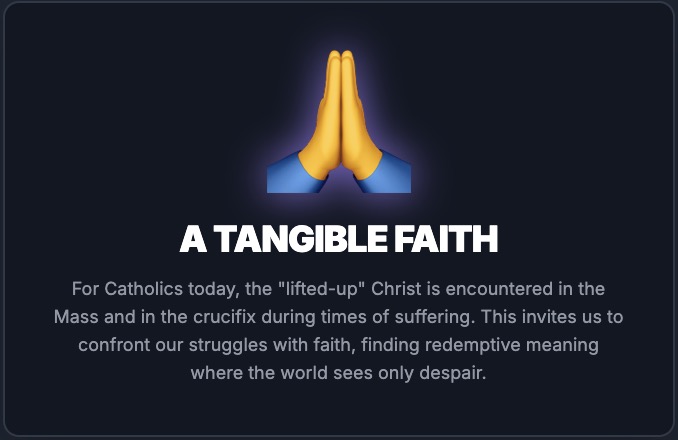
For the contemporary Catholic, the application of this passage is tangible and immediate. Each time we participate in the Mass, the priest elevates the consecrated Host—Christ “lifted up” and made present for us. We are invited, like the Israelites, to gaze upon Him with faith and find spiritual nourishment and healing. Similarly, a Catholic facing personal suffering—be it illness, loss, or personal failure—is called to “look upon” the crucifix. Instead of despairing, they can unite their own cross with Christ’s, finding redemptive meaning in their struggles. In a world that often flees from suffering, this passage invites us to confront it with faith, seeing in the lifted-up Christ the definitive victory over sin and death.

The Cross as a Living Reality
The essay begins by framing the Cross not as a mere historical symbol, but as a “living reality encountered daily” in the Church’s liturgy and moral life.
- Question 1: The essay argues that the Cross is more than a historical artifact; it’s a “living reality.” In your own life, how do you experience the Cross as something present and active, rather than just a symbol of a past event? Where do you see it in the liturgy or in the moral choices you face?
Healing Through a Faith-Filled Gaze
The second paragraph explores the connection between the bronze serpent in the Book of Numbers and Christ’s crucifixion, highlighting the importance of “gazing in faith” for healing.
- Question 1: The essay explains that the bronze serpent is a “prefigurement” of the Cross. Why is understanding these connections between the Old and New Testaments important for our Catholic faith?
- Question 2: For the Israelites, salvation came from looking at the serpent. For us, it comes from “gazing in faith upon the crucified Christ.” What does this “gaze of faith” look like in your daily prayer life?
A Mission of Love, Not Condemnation
The third paragraph focuses on the motivation behind the Cross: God’s active, self-giving love, which seeks to save rather than condemn.
- Question 1: John 3:16 is perhaps the most famous verse in the Bible. How does the essay’s emphasis on God’s love as an “initiating force” and a “sacrificial act” deepen your understanding of this verse?
- Question 2: If God’s mission is to save and not condemn, how does that challenge us to act with greater mercy and less judgment towards others in our community, workplace, and families?
Finding Christ in the Mass and in Suffering
The final paragraph brings the theology into the present moment, identifying the “lifted-up” Christ in the elevation of the Eucharist and in the crucifix we turn to during times of personal suffering.
- Question 1: The essay connects the priest elevating the Host at Mass with Christ being “lifted up.” How might this insight change or deepen your focus during the Liturgy of the Eucharist?
- Question 2: The text suggests that uniting our suffering with the Cross helps us find “redemptive meaning.” Can you think of a time when turning to the Cross in a moment of pain or failure brought you comfort or a new perspective?
- Question 3: In a world that often encourages us to avoid suffering at all costs, how does the Catholic invitation to “confront it with faith” offer a different and potentially more hopeful path?
- BAPTISM
- EUCHARIST
- CONFIRMATION
- CONFESSION
- ANOINTING OF SICK
- MATRIMONY
- HOLY ORDERS
- DEEP DIVE
Numbers 21:4b-9
BAPTISM
The Serpent and the Soul
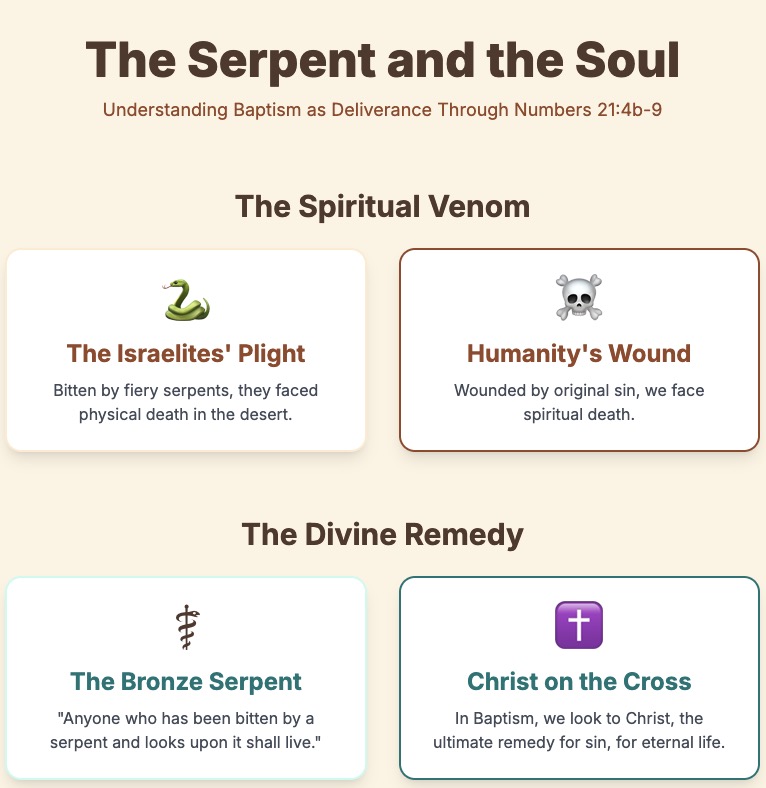
Based on Numbers 21:4b-9, Baptism is our deliverance from the spiritual venom of original sin. Just as the Israelites were bitten by serpents and died, humanity is wounded by sin. Their remedy was to gaze upon the bronze serpent, a symbol of God’s healing power. The verse, “anyone who has been bitten by a serpent and looks upon it shall live,” prefigures our own salvation.
In Baptism, we look to Christ on the cross, the ultimate remedy for sin. The daily grace received is the strength to recognize the “serpents” of temptation in our lives—pride, anger, selfishness—and immediately turn our gaze back to Christ.
A practical life application is to consciously recall our baptismal promises when we feel the “bite” of sin, choosing to look upon the cross for our healing and life rather than succumbing to the poison. This act reaffirms our identity as those saved and healed by God’s mercy.
Exaltation of the Holy Cross

Philippians 2:6-11
BAPTISM
The Emptying and the Exalting
Philippians 2:6-11 reveals Baptism as the sacrament where we participate in Christ’s own self-emptying, or kenosis. Saint Paul writes that Jesus “emptied himself…he humbled himself, becoming obedient to death, even death on a cross.”
In the waters of Baptism, we die with Christ; we are emptied of our old selves, our pride, and our sin. In this profound act of humility, we are then raised with him, for “because of this, God greatly exalted him.”
The enduring grace of this sacrament is the grace of humility. It empowers us daily to empty ourselves for others, to serve without recognition, and to prioritize God’s will over our own. We live this out by performing acts of service with a joyful heart, by forgiving freely, and by seeking to uplift others, trusting that it is in dying to self that we are truly exalted in Christ.
Exaltation of the Holy Cross

John 3:13-17
BAPTISM
Born from Above
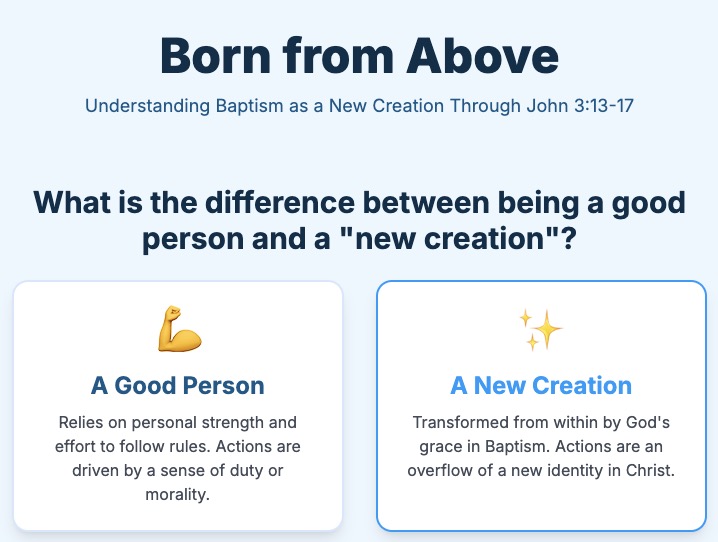
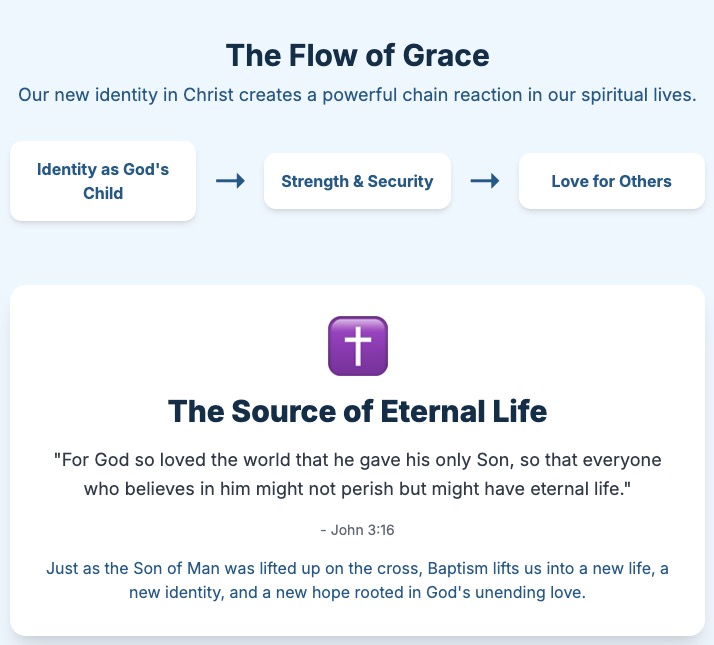
The discourse in John 3:13-17 illuminates Baptism as a true spiritual rebirth into God’s family. Jesus insists that one must be “born from above” to see the kingdom of God. This is not merely a symbolic act, but a profound transformation that makes us new creations.
The Gospel connects this rebirth to the cross, stating, “so must the Son of Man be lifted up, so that everyone who believes in him may have eternal life.” Baptism is the moment we are grafted onto Christ and given this eternal life.
The daily grace we draw from this is the grace of divine filiation—the constant, lived awareness that we are beloved children of God. When we face trials, we can live out this grace by confidently remembering our true identity. This security frees us to love others with the same selfless love “God so loved the world” with.
Exaltation of the Holy Cross
Numbers 21:4b-9
EUCHARIST
Gaze Upon Him
and Live
The story in Numbers 21:4b-9, where the Israelites are healed by looking at a bronze serpent, beautifully prefigures the healing power of the Eucharist. Just as the Israelites were poisoned, we are wounded daily by the venom of sin and despair. Their antidote required an act of faith: to gaze upon the symbol God provided.
Our remedy is infinitely greater. In the Eucharist, we don’t just look upon a symbol; we receive Christ Himself, “lifted up” for our salvation. The grace we receive is profound spiritual healing. Each time we approach the altar, we turn from the “serpents” of our faults and weaknesses. As the Israelites who looked upon the serpent “shall live,” we who receive the Eucharist in faith are healed from within, receiving the true medicine of immortality and the strength to continue our journey toward the promised land of Heaven.
Exaltation of the Holy Cross

Philippians 2:6-11
EUCHARIST
The Humble Feast of Exaltation
Philippians 2:6-11 describes Christ’s ultimate act of self-emptying, or kenosis, which is made perpetually present to us in the Eucharist. In this sacrament, Jesus continues to “empty himself,” humbling his divine glory to become our spiritual food under the simple appearances of bread and wine. This is the ultimate act of love and service.
The daily grace we draw from the Eucharist is the strength to practice this same humility. When we receive the Body of Christ, given for us, we are empowered to empty ourselves for others. This grace transforms our perspective, turning our focus from our own needs to the needs of those around us.
A life application is to consciously perform an act of humble service after receiving Communion, whether at home or work, allowing the self-giving love of Christ we just received to flow through us into the world.
Exaltation of the Holy Cross

John 3:13-17
EUCHARIST
The Gift of Eternal Life
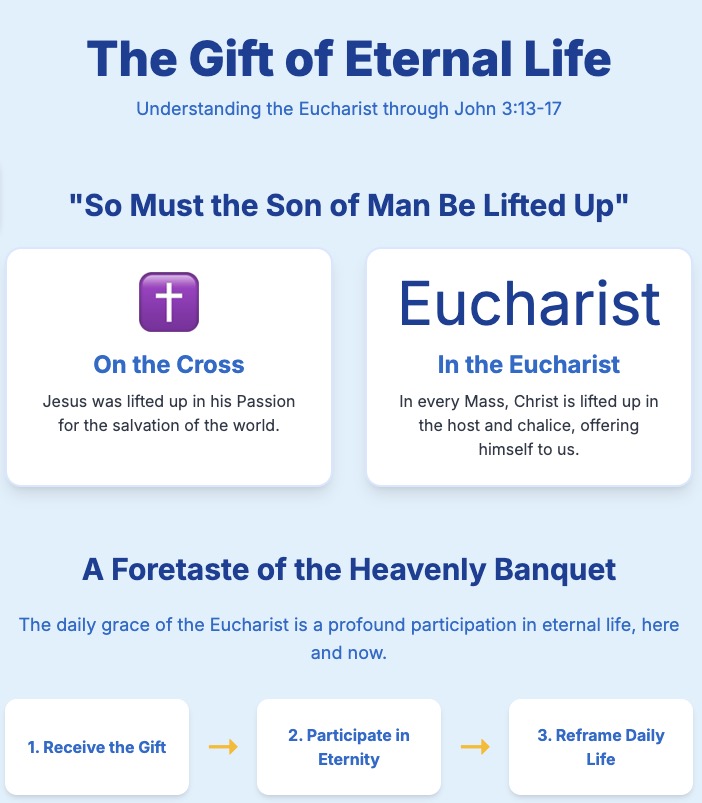
In John 3:13-17, Jesus connects being “lifted up” with the gift of eternal life. This finds its ultimate fulfillment not only on the cross but in the Holy Eucharist.
In every Mass, Christ is “lifted up” before our eyes in the host and chalice, a direct fulfillment of his words: “so that everyone who believes in him may have eternal life.” The Eucharist is the tangible gift of God’s love, the very Body and Blood of the Son He gave for us. The daily grace we receive is a profound participation in this eternal life, here and now. It is a foretaste of the heavenly banquet.
As a life application, we can approach Communion with the conscious intention of receiving this gift of eternity, allowing it to reframe our daily struggles and anxieties in the light of the unending life and love that God promises and provides.
Exaltation of the Holy Cross
Numbers 21:4b-9
CONFIRMATION
Sealed for Spiritual Courage
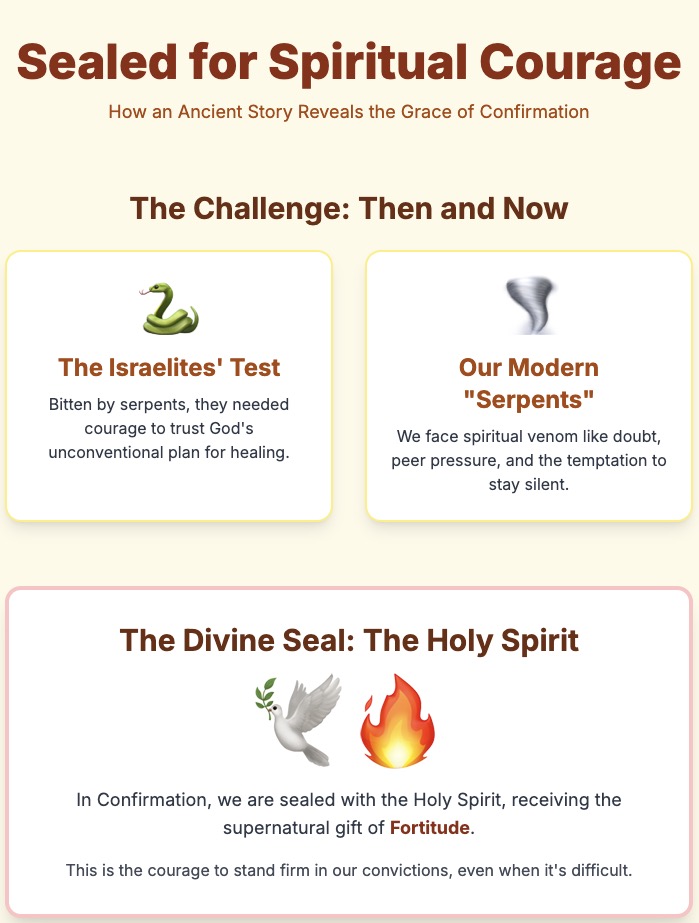
The account in Numbers 21:4b-9 serves as a powerful allegory for the grace of Confirmation. The Israelites, bitten by serpents, needed courage to look upon the bronze serpent and trust in God’s unconventional plan for their healing.
In Confirmation, we are sealed with the Holy Spirit, receiving the gift of Fortitude to face the spiritual “serpents” of our time: doubt, peer pressure, and temptation. The daily grace of this sacrament is the supernatural courage to stand firm in our convictions. When we are tempted to remain silent or compromise our faith, the Spirit empowers us to “look upon” the Cross and act with conviction. This isn’t just about avoiding sin, but about courageously living as witnesses.
A practical application is to consciously pray for the Spirit’s fortitude before entering a challenging social or professional environment, trusting Him to be our strength and our shield.
Exaltation of the Holy Cross
Philippians 2:6-11
CONFIRMATION
Empowered for Public Witness
Philippians 2:6-11, which proclaims that Christ’s humility led to His exaltation where “every tongue confess that Jesus Christ is Lord,” illuminates Confirmation as the sacrament of public witness. While Baptism brings us into God’s family, Confirmation commissions us to go out and proclaim His name.
The Holy Spirit anoints us, not for our own glory, but to empower our personal “kenosis,” or self-emptying, so that Christ may be glorified through our lives and words. The daily grace is the boldness to share our faith. This transforms us from passive believers into active apostles.
A life application is to actively look for opportunities to witness to Christ’s love through our actions—serving a neighbor, encouraging a coworker, or defending the dignity of another—allowing our lives to become a clear confession of faith that points entirely to Him.
Exaltation of the Holy Cross

John 3:13-17
CONFIRMATION
The Spirit of Mature Understanding
In John 3:13-17, Jesus speaks of being “born from above” by the Spirit and of being “lifted up” for eternal life. Confirmation perfects our baptismal grace, elevating our faith from its infancy to maturity. The Holy Spirit bestows the gifts of Wisdom and Understanding, allowing us to grasp the profound mystery of Christ “lifted up” on the cross and in the Eucharist. This grace moves us beyond a mere intellectual knowledge of God to a deep, personal relationship.
The daily grace is the ability to see the world through the lens of faith, discerning God’s will in our lives. A practical application is to approach Scripture or Church teaching not as a textbook, but as a conversation, asking the Holy Spirit who was promised to guide us to all truth, to illuminate our minds and hearts with divine understanding.
Exaltation of the Holy Cross

Numbers 21:4b-9
CONFESSION & PENANCE
The Healing Gaze
The story of the bronze serpent in Numbers 21:4b-9 is a powerful image of the Sacrament of Reconciliation. The Israelites were dying from the venom of serpents; we are spiritually wounded by the poison of sin. Their healing required a conscious act of turning and looking upon the remedy God provided.
In Confession, we do the same. We must have the courage to “look upon” our sins by naming them, and in doing so, we turn our gaze to Christ, our true healing. The daily grace received is the strength to be honest with ourselves and with God. It breaks the paralysis of shame and empowers us to immediately turn to God when we feel the “bite” of temptation.
A practical application is to make a brief examination of conscience each night, acknowledging our faults not in despair, but with the hopeful confidence that God provides the antidote.
Exaltation of the Holy Cross

Philippians 2:6-11
CONFESSION & PENANCE
The Liberation of Humility
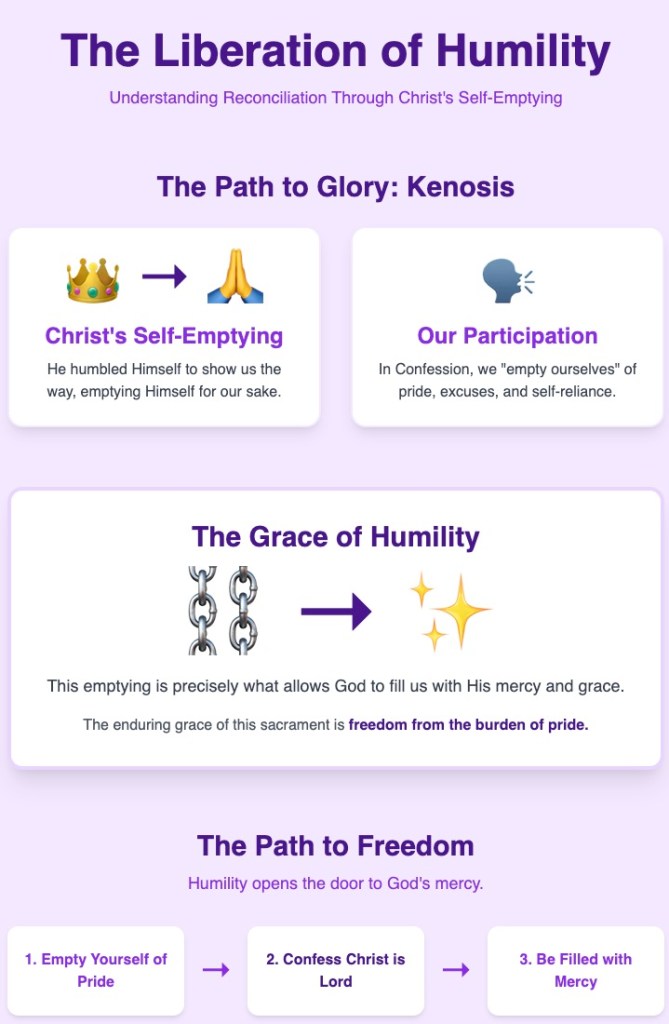
Philippians 2:6-11 reveals Christ’s kenosis, or self-emptying, as the path to glory. Reconciliation is our participation in this act. To enter the confessional is to “empty ourselves” of pride, excuses, and self-reliance. As we “confess that Jesus Christ is Lord” over our sins and weaknesses, we perform a profound act of humility. This emptying is precisely what allows God to fill us with His mercy and grace.
The enduring grace of this sacrament is freedom from the burden of pride. It softens our hearts, making it easier to admit fault and seek forgiveness in our daily relationships.
A life application is to consciously choose a small act of humility after Confession—such as asking for help with a task or admitting a mistake to a family member—allowing the sacrament’s grace to reshape our patterns of behavior.
Exaltation of the Holy Cross
John 3:13-17
CONFESSION & PENANCE
The Judgment of Mercy
Many fear Confession as a place of judgment, but John 3:13-17 reveals its true nature. Jesus declares, “God did not send his Son into the world to condemn the world, but that the world might be saved through him.”
The confessional is not a tribunal of condemnation; it is a tribunal of mercy. It is the sacred space where Christ, “lifted up,” fulfills His mission to save, not to condemn. The daily grace we receive from this encounter is a profound and lasting peace. It silences the voice of the accuser and replaces anxiety and guilt with the quiet confidence of being a beloved, forgiven child.
A practical application is, when tempted to despair over a sin, to repeat Christ’s words as a prayer, reaffirming that God’s primary desire for you is not condemnation, but healing and salvation.
Exaltation of the Holy Cross

Numbers 21:4b-9
ANOINTING OF
THE SICK
Union in Affliction
The story in Numbers 21:4b-9, where Israelites were healed by looking at a bronze serpent, reveals Anointing of the Sick as the sacrament that gives meaning to our suffering. Illness can feel like a serpent’s venom, isolating and draining us of life.
The Anointing is God’s tangible remedy, a sacred sign that, when received in faith, brings profound spiritual healing. It does not promise a magical cure for the body, but it unites our personal suffering with the redemptive suffering of Christ on the cross. The daily grace received is perseverance in hope. It transforms our pain from a meaningless affliction into a powerful prayer, offered in union with Him.
A life application is to consciously offer up our physical or emotional pains for a specific intention, allowing the Spirit to turn our sickbed into an altar of love, just as the cross transformed suffering into salvation.
Exaltation of the Holy Cross

Philippians 2:6-11
ANOINTING OF
THE SICK
The Dignity of Weakness
Philippians 2:6-11 describes Christ’s kenosis—His radical self-emptying. Serious illness is our own profound experience of kenosis, emptying us of strength, independence, and control.
The Anointing of the Sick is the sacrament that meets us precisely in this state of vulnerability. As Christ humbled himself, the anointing with sacred oil affirms our profound dignity even in our weakness. It declares that our worth is not in our ability, but in our identity as beloved children of God. The daily grace received is the strength to surrender, to accept our dependence on God and others with peace rather than despair.
A life application for those who are healthy is to serve the sick and elderly, recognizing in their vulnerability the humble Christ. For the sick, it is to allow others to serve them, transforming their need into an opportunity for grace.
Exaltation of the Holy Cross

John 3:13-17
ANOINTING OF
THE SICK
Preparation for Eternal Glory
In John 3:13-17, Jesus speaks of being “lifted up” to grant eternal life. Anointing of the Sick is the Church’s ultimate prayer that a person will be “lifted up” from their suffering into the glory of Heaven.
This sacrament prepares the soul for its final journey, strengthening it against the final temptations of fear and despair. It is a final seal of God’s merciful love, a confirmation of the promise that He “did not send his Son into the world to condemn the world, but that the world might be saved.” The enduring grace is a profound peace and a fortified hope in the resurrection.
A practical life application for all of us is to live each day with an eternal perspective, fostering reconciliation and love, so that when our final hour comes, we are prepared to be lifted up with Christ into everlasting life.
Exaltation of the Holy Cross

Numbers 21:4b-9
MATRIMONY
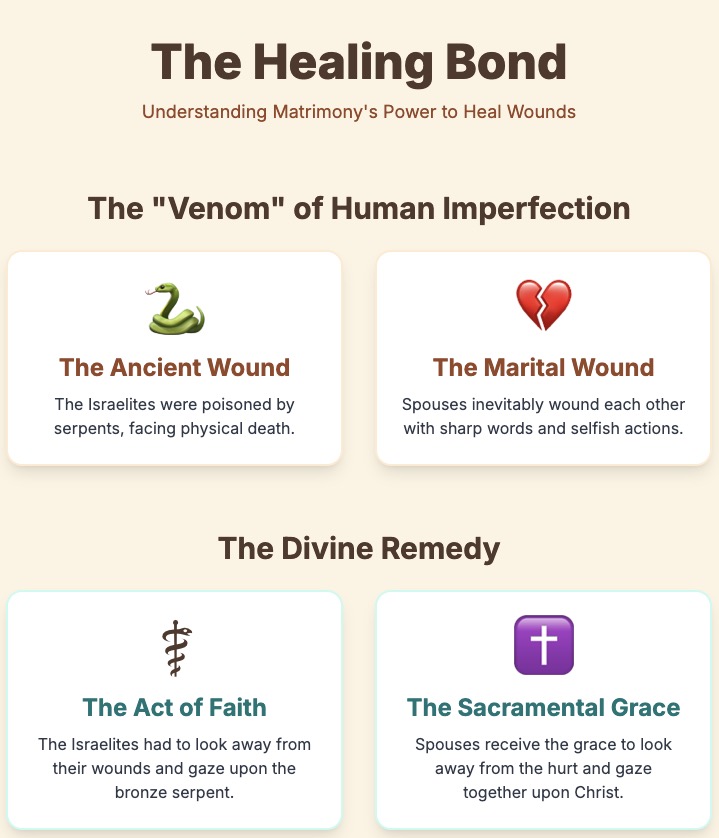
The Healing Bond
The story in Numbers 21:4b-9, where Israelites looked upon a bronze serpent to be healed, provides a powerful model for Matrimony.
In marriage, spouses will inevitably wound each other with sharp words or selfish actions—the “venom” of human imperfection. The Sacrament of Matrimony provides the remedy: the grace to look away from the immediate hurt and gaze together upon Christ, who was “lifted up” for them. The daily grace received is the power of mutual forgiveness and healing. It is the strength to see past the sting of a particular fault and recognize the greater reality of their sacramental bond in Christ.
A life application is, after a disagreement, for the couple to consciously pray before a crucifix, asking Christ to heal the wound between them, trusting that looking to Him together is the antidote to the poison of resentment.
Exaltation of the Holy Cross
Philippians 2:6-11
MATRIMONY
The Self-Giving Union
Philippians 2:6-11 illuminates Matrimony as a school of kenosis, or mutual self-emptying. Christ “emptied himself,” becoming a servant out of love. In marriage, spouses are called to this same radical gift of self.
The sacrament provides the daily grace to live this out, empowering a husband and wife to prioritize the other’s good, to serve without keeping score, and to humble themselves for the sake of unity. This grace transforms marriage from a contract of convenience into a covenant of self-giving love.
A practical life application is to find small, daily opportunities for kenosis: taking on a chore your spouse dislikes, listening with your full attention when you are tired, or yielding your preference for the sake of peace. These acts of emptying oneself allow Christ’s perfect love to fill and define the marriage.
Exaltation of the Holy Cross

John 3:13-17
MATRIMONY
A Love Lifted High
In John 3:13-17, Jesus speaks of being “lifted up” so that the world might be saved through Him. The Sacrament of Matrimony is meant to be a visible love “lifted high” for the world to see.
A marriage lived in Christ becomes a tangible sign of how “God so loved the world”—a love that is total, faithful, fruitful, and sacrificial. The daily grace of this sacrament is the ability to love each other in a way that points beyond themselves to God. It empowers a couple to make their shared life a source of grace for their family and community.
A practical life application is for a couple to ask, “How can our love be a witness today?” This could be through offering hospitality, mentoring another couple, or serving a parish ministry together, making their union a beacon of God’s life-giving love.
Exaltation of the Holy Cross

Numbers 21:4b-9
HOLY ORDERS
The Raised Sign of Mercy
The story in Numbers 21:4b-9, where Moses lifts up a bronze serpent to heal the Israelites, illuminates the role of the priest as an instrument of God’s mercy. The people, wounded by sin and despair, look to their priest, not for his own power, but because he is ordained to make Christ’s healing present. Like Moses, the priest is called to lift up Christ—in the Eucharist, in the words of absolution, and in his very life.
The daily grace a cleric receives is the strength to be a steadfast sign of hope, to continually point people to Christ even when they are complaining or have lost their way.
A practical life application for a priest or deacon is, when feeling overwhelmed by the pastoral needs of his flock, to spend time before the Blessed Sacrament, consciously placing the people’s wounds before the “lifted up” Christ, the true source of all healing.
Exaltation of the Holy Cross

Philippians 2:6-11
HOLY ORDERS
A Life Poured Out
Philippians 2:6-11 provides the ultimate model for Holy Orders: the kenosis of Christ, who “emptied himself, taking the form of a slave.” A man is ordained not for power or privilege, but to be configured to Christ the Servant. His life becomes a radical act of self-emptying for the sake of the Church.
The daily grace of Holy Orders is pastoral charity—the supernatural strength to pour oneself out in service without counting the cost. It is the grace that fuels late-night hospital visits, long hours in the confessional, and the patient counseling of a soul in turmoil.
A life application for clergy is to intentionally seek out the hidden, thankless tasks of ministry, seeing in them a direct opportunity to live out Christ’s own humble service and to find joy not in recognition, but in a life poured out for others.
Exaltation of the Holy Cross

John 3:13-17
HOLY ORDERS
A Ministry of Salvation
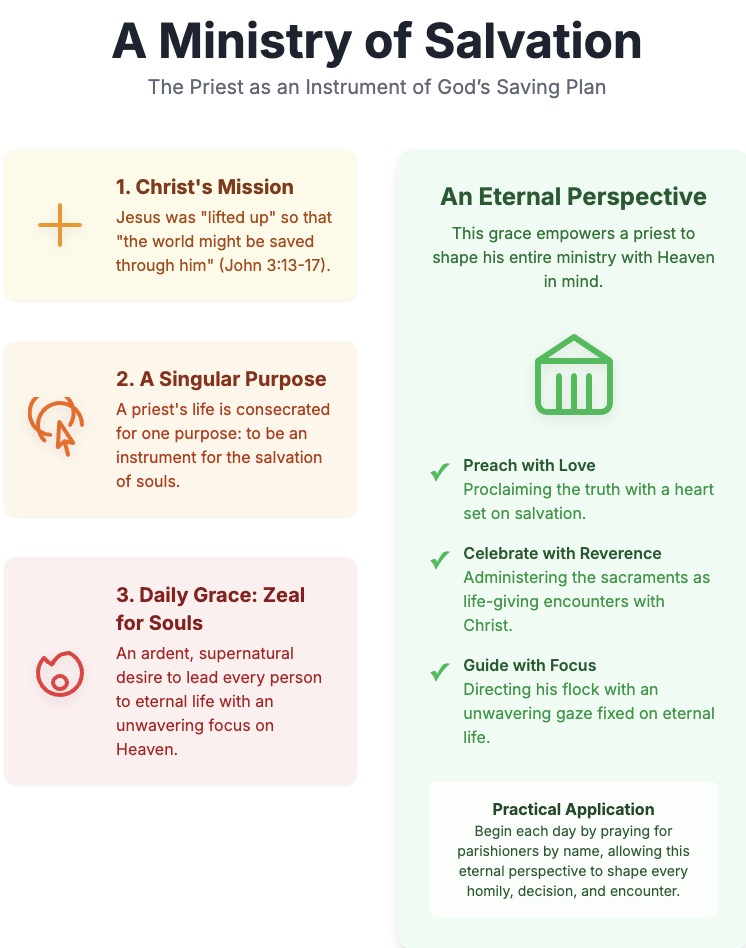
In John 3:13-17, Jesus reveals His mission: He was “lifted up” so “that the world might be saved through him.” This is the very heart of the priesthood. A priest is ordained for the salvation of souls. His life is set apart and consecrated for this singular purpose: to be an instrument of God’s saving plan.
The daily grace he receives is a profound zeal for souls—an ardent, supernatural desire to lead every person he encounters to eternal life. This grace empowers him to preach the truth with love, celebrate the sacraments with reverence, and guide his flock with unwavering focus on Heaven.
A practical life application is for a priest to begin each day by praying for the salvation of his parishioners by name, allowing this eternal perspective to shape every homily, decision, and pastoral encounter
Exaltation of the Holy Cross
The Holy Eucharist
The Holy Eucharist stands as the “source and summit of the Christian life” (CCC 1324), a mystery in which the whole spiritual good of the Church is contained: Christ himself. Catholic dogmatic theology understands this sacrament not as a mere symbol, but as the real, true, and substantial presence of the Lord, offered for the salvation of the world.
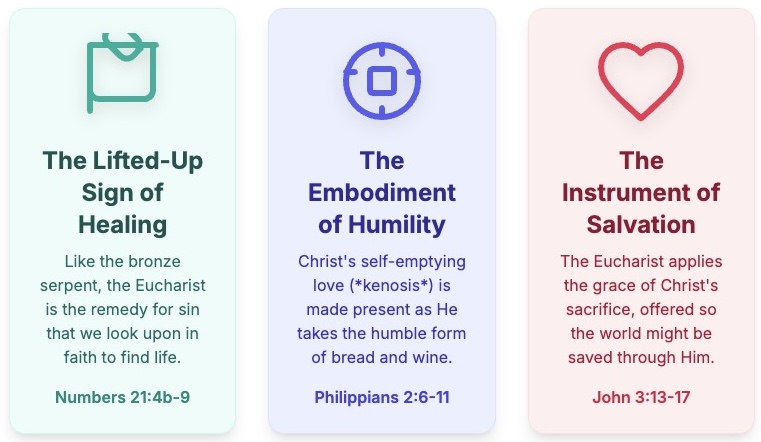
By examining key scriptural passages through the lens of Tradition, one can see how the Eucharist is the fulfillment of Old Testament prefigurements and the ultimate expression of Christ’s self-emptying love. Specifically, the narratives of the bronze serpent in Numbers 21:4b-9, the kenotic hymn of Philippians 2:6-11, and the discourse with Nicodemus in John 3:13-17 reveal the Eucharist as the lifted-up sign of healing, the embodiment of divine humility, and the very instrument of our salvation.

The Lifted-Up Sign of Healing
The episode of the bronze serpent in the Book of Numbers provides a profound prefigurement of the Eucharist as the definitive remedy for the venom of sin. The Israelites, suffering from their faithlessness, were healed not by their own merits, but by looking in faith upon a sign God provided: “Moses made a bronze serpent and mounted it on a pole, and whenever anyone who had been bitten by a serpent looked at the bronze serpent, he lived” (Numbers 21:9). Jesus himself makes this typology explicit in his dialogue with Nicodemus, stating, “Just as Moses lifted up the serpent in the desert, so must the Son of Man be lifted up, so that everyone who believes in him may have eternal life” (John 3:14-15).
The Eucharist is the perpetual memorial of this “lifting up” on the cross, a truth continually illuminated by the Magisterium. The Catechism teaches that in the Eucharist, the sacrifice of Christ “is made present” (CCC 1366). St. John Paul II, in his encyclical Ecclesia de Eucharistia, powerfully reaffirmed this, explaining that the Mass is not a mere repetition but a sacramental re-presentation of the one sacrifice of Calvary. He writes, “The sacrifice of Christ and the sacrifice of the Eucharist are one single sacrifice… In this divine sacrifice which is celebrated in the Mass, the same Christ who offered himself once in a bloody manner on the altar of the cross is contained and is offered in an unbloody manner” (EE, 12). Therefore, when the priest, acting in persona Christi, elevates the consecrated host, we are invited to look upon our Savior with the same life-giving faith as the Israelites looked upon the serpent.
In this gaze, we find healing. St. Thomas Aquinas affirms this, teaching that the Eucharist is a “remedy whereby we are freed from daily faults and preserved from mortal sins.” This theme of the Eucharist as divine medicine resonates deeply in the teachings of Pope Francis, who often describes the Eucharist not as a prize for the perfect, but as “powerful medicine and nourishment for the weak” (Evangelii Gaudium, 47). It is the antidote to our spiritual poisons—pride, despair, and selfishness. By receiving the Eucharist, we do more than look upon a sign; we consume the very source of our healing, allowing Christ’s grace to counteract the poison of sin in our souls and conform us ever more closely to Him.

The Embodiment of Divine Humility

Furthermore, the Eucharist is the ultimate expression and continuation of Christ’s kenosis, or self-emptying, described by St. Paul in Philippians 2. Christ, “though he was in the form of God, did not regard equality with God something to be grasped. Rather, he emptied himself, taking the form of a slave” (Philippians 2:6-7). This emptying, which reached its apex in his death on the cross, is made sacramentally present in the Eucharist. Here, Christ’s humility is magnified; He who is infinite God conceals His glory under the humble appearances of bread and wine. The great dogmatic theologian St. Thomas Aquinas saw this as a profound act of divine condescension, arguing that it was fitting for Christ to come to us under these species so that our merit of faith might be increased (Summa Theologiae III, q. 75, a. 1).
St. John Paul II described the Eucharist as a “school of love,” teaching that in this sacrament, Jesus “makes himself our food and communicates to us his very life” (Mane Nobiscum Domine, 15). This profound reality led St. Augustine to exclaim, “If you, therefore, are Christ’s body and members, it is your own mystery that is placed on the Lord’s table… Be what you see, and receive what you are” (Sermon 272). We receive the humble, self-emptied Christ in order to become, in turn, a humble and serving Body of Christ for the world. Pope Francis echoes this theme powerfully, reminding us that the Eucharist is not a reward for the perfect, but “an antidote by which we are freed from our daily faults and preserved from mortal sin” (Homily, Corpus Christi 2018). It is the grace that transforms us from spectators into active participants in Christ’s own mission of service.
Pope Benedict XVI, in his apostolic exhortation Sacramentum Caritatis, further explains that in the Eucharist, “Jesus shows us the truth about love… It is the love that implies a true self-giving” (no. 2). The doctrine of transubstantiation, the “change of the whole substance of the bread into the substance of the body of Christ our Lord and of the whole substance of the wine into the substance of his blood” (CCC 1376), is the theological articulation of this profound act of sacramental humility. Christ does not just take the form of a slave; He takes the form of food, pouring Himself out to become our spiritual nourishment. In this, the Eucharist becomes the preeminent school of humble service, inviting those who receive it to imitate Christ’s self-emptying love in their own lives.
The Instrument of Our Salvation
Finally, these threads converge on the central truth that the Eucharist is the primary instrument of the salvation that Christ won for humanity. God’s mission is one of rescue, not condemnation: “For God did not send his Son into the world to condemn the world, but that the world might be saved through him” (John 3:17). The Eucharist is the means by which the graces of this saving mission are applied to the faithful throughout history. It is the “sacrament of our salvation, accomplished by Christ on the cross, [which] is also a sacrifice of praise in thanksgiving for the work of creation” (CCC 1359). Theologian Henri de Lubac emphasized that the Eucharist makes the Church, and it is through the Church, Christ’s Mystical Body, that this salvation is communicated to the world. Each reception of the Eucharist deepens our union with Christ, incorporates us more profoundly into His Body, and strengthens us for our pilgrimage toward eternal life. It is not merely a preparation for salvation, but a true participation in it, a foretaste of the heavenly banquet.
In conclusion, the Holy Eucharist synthesizes the great mysteries of our faith. It is the fulfillment of the bronze serpent, the lifted-up sign upon which we gaze in faith to be healed from sin. It is the ultimate act of Christ’s kenotic love, where He empties Himself to become our food. And it is the enduring sacrament of the salvation He won for us on the cross. In this single mystery, we encounter the Lord who was lifted up, who humbled himself, and who gave his life so that we might be saved.