October 12, 2025
October 12, 2025


Homily Videos Bishop Barron
Homily Videos Bishop Barron
Bishop Robert Barron

28th Sunday of Year C

Where You Stumble
Dig for Treasure
Bishop Robert Barron focuses on humility in the face of personal struggles, as exemplified by Naaman the Syrian, can lead to spiritual growth, healing, and a deeper connection with God.
TWTW Visual Summary and Discussion Questions
Click to enlarge
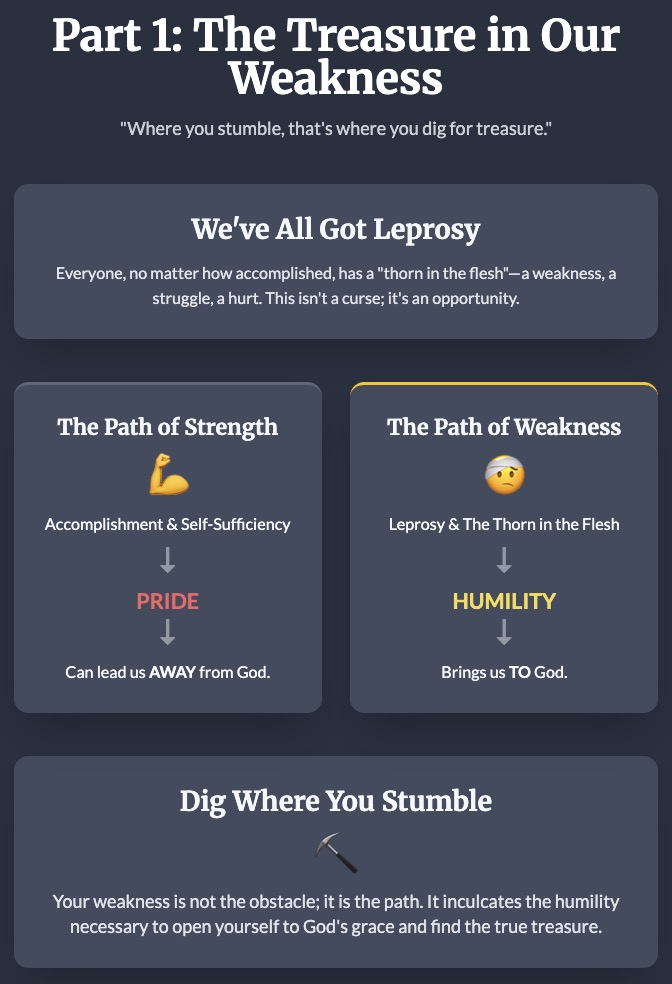
Part 1: HE TREASURE IN OUR WEAKNESS
"Very often, everybody, it's precisely the thorn in the flesh. It's precisely the leprosy, precisely our weakness that will bring us to God… Where you stumble, that's where you dig for treasure."
- Bishop Barron states, "we've all got leprosy." What is a "thorn in the flesh" or personal weakness in your life that you often wish would just go away?
- How can personal strengths and accomplishments sometimes become a spiritual weakness that leads us away from God? Can you think of a time when self-sufficiency made you feel less need for God?
- Reflect on the idea that "where you stumble, that's where you dig for treasure." Has a personal struggle or vulnerability ever unexpectedly opened a door to humility or brought you closer to God?

Click to enlarge
Part 2: THE PATH OF HUMILIATION
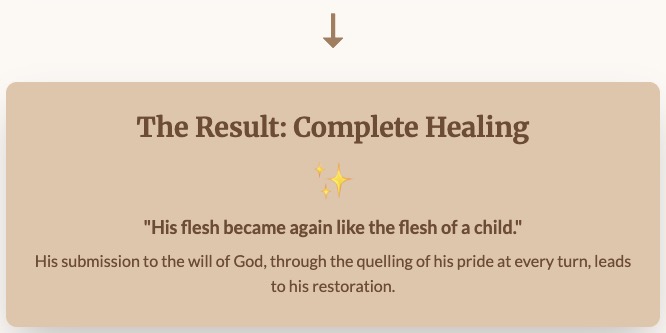
Core Idea: "So watch this now in the story of Naaman the Syrian. At every step, he's going to be humbled. And it's his very weakness that leads him along this path, the path of salvation."
- Naaman faced a series of humiliations: listening to a slave, being rebuffed by a king, and receiving strange instructions from a prophet's messenger. Which of these steps would have been most difficult for your own pride to accept?
- Bishop Barron notes that Naaman could have stormed off in anger at several points but chose humility instead. When have you felt the urge to react with pride to an embarrassing situation? What helps you choose a humbler path?
- The instructions for Naaman's healing were simple and strange, not grand and impressive. Why do we often expect God's interventions to be dramatic rather than working through simple, everyday means?

Click to enlarge
Part 3: THE GOAL OF HEALING
"The healing was not the end in itself… what was the real goal here? Was to move to the praise of God… What's Thanksgiving, everybody, but still another expression of humility."
- After being healed, Naaman's focus shifted from his cure to worshipping God. When your prayers are answered, how can you ensure your response moves beyond simple relief and toward deeper, more intentional praise?
- The homily connects the Samaritan leper's gratitude with Naaman's response. Why is giving thanks a "further stance of humility"? How does a lack of gratitude reveal a hidden pride or sense of entitlement?
- Bishop Barron concludes by asking us to name our "leprosy" and dig there. What is one concrete step you can take this week to approach your personal weakness with humility, seeing it as a potential path to spiritual healing?

The Gospel is Jesus Christ
Friends, in our second reading this Sunday, Paul writes to Timothy, “Remember Jesus Christ, raised from the dead, a descendant of David: such is my gospel.” The Gospel is not the ethical teachings of Jesus or the doctrinal teachings of Saint Paul; the Gospel is Jesus himself. And Christianity is not a noble spiritual path or a set of ideas; it’s a relationship to Jesus. All those other things are great and follow from him—but it’s about him!
TWTW Visual Summary and Discussion Questions
Father Geoffrey Plant
28th Sunday of Year C

Ten Lepers
Ten lepers call out to Jesus for mercy. Jesus responds by telling them to go and show themselves to a priest. They set out, in faith, and on the way they are cured. Only one of the ten, a Samaritan, returns to give thanks.
TWTW Visual Summary and Discussion Questions

Click to enlarge
PRIDE, HUMILITY & HEALING
Discussion Questions:
- Fr. Plant explains that biblical “leprosy” (tzara’at) was primarily about being declared “unclean” and excluded from the community. How does understanding this social and religious isolation change your perception of the ten lepers’ desperation?
- Naaman was furious because the prophet Elisha didn’t treat him with the respect he felt his status deserved. When have you felt that God wasn’t answering your prayers in the way you expected or thought you deserved? What can Naaman’s story teach us about surrendering our pride?
- The people of Nazareth were enraged that Jesus highlighted God’s mercy to Naaman, a foreigner. Where do we see this kind of "insider vs. outsider" prejudice in our world, or even our Church, today?
Click to enlarge
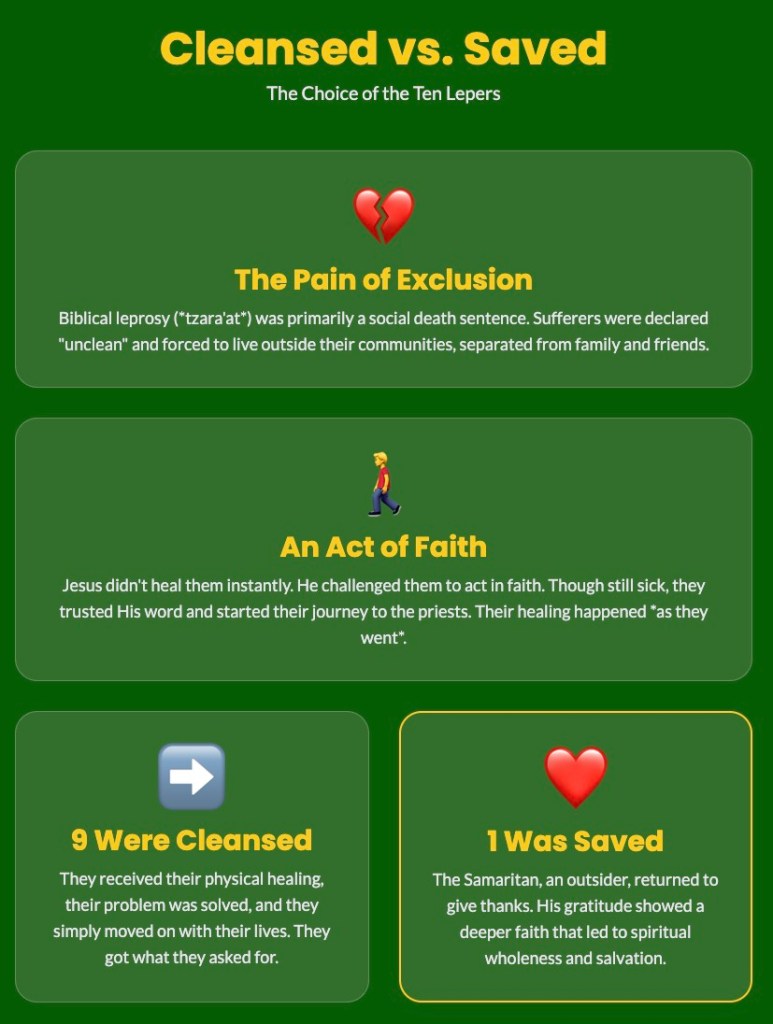
CLEANSED VS. SAVED: THE CHOICE OF GRATITUDE
Discussion Questions:
- The other nine lepers were simply obeying Jesus’ command to go to the priests. Were their actions wrong, or just incomplete? What is the difference between simple obedience and the faith that leads to true salvation?
- The homily draws a sharp distinction between being “cleansed” (having a problem fixed) and being “saved” (being made spiritually whole). Can you think of a time in your life when you prayed only to be cleansed of a problem? What would it have looked like to "return" and seek salvation in that moment?
- Both Naaman and the Samaritan were foreigners who received a gift they knew they had no right to expect. How did their status as “outsiders” give them a clearer perspective on God’s grace than the nine who were “insiders”?
Click to enlarge
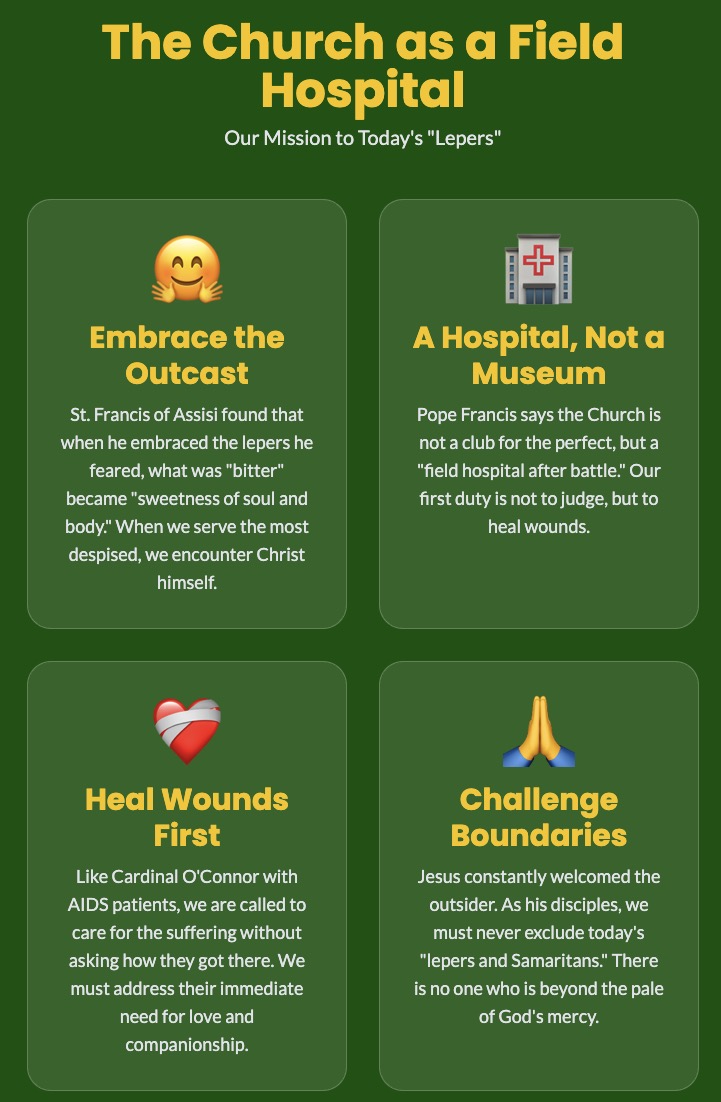
THE CHURCH AS A FIELD HOSPITAL
Discussion Questions:
- Fr. Plant shares the story of St. Francis of Assisi, for whom the "bitter" experience of seeing lepers was changed into "sweetness of soul and body." Who are the modern "lepers" in our society that we might feel a natural aversion or bitterness towards?
- What does it mean for us, as a parish community, to be a “field hospital”? What practical steps could we take to prioritize healing the most immediate wounds of those who come to us?
- Cardinal O’Connor was not interested in how the AIDS patients he served contracted their disease, only that they needed care. How can we better practice this form of unconditional mercy, looking past the "why" of someone's suffering to address the "what" of their immediate need?
Father Kevin Rettig

28th Sunday of Year C

Triumph of the Small Mind
The 150th anniversary of the Ku Klux Klan serves as a stark reminder of the enduring dangers of intolerance and hate in society, highlighting the need for compassion and acceptance of diversity to combat such ideologies. Small-minded individuals sought to purify American society through violence and intimidation against new immigrants who threatened their narrow worldview.
TWTW Visual Summary and Discussion Questions

Click to enlarge
"Like every other movement based on fear and hate, the clan arose out of a world view of exclusion a view of US versus them...they set about to purify American society with a Bible in one hand and the torch in the other."
Discussion Questions:
- The homily describes the KKK's motivation as a desire to return to an "imaginary past." In what ways does society today sometimes idealize or imagine a past that was not as "pure" as some claim?
- Fr. Rettig notes that the Klan targeted immigrants who were "different" (Irish, German, Chinese, Italian, etc.). How does the fear of new immigrants and their cultural differences manifest in public conversations today?
- The Klan claimed to defend "Christian morality." How can religious language and symbols, like the Bible and the cross, be twisted to justify hatred and violence?

Click to enlarge
"Why is it that people are so uncomfortable with what is unlike themselves why do otherwise decent. Human beings fill their hearts with fear and loathing when confronted with the different the foreign. The other?"
Discussion Questions:
- The homily states that the KKK's mentality of fear and bigotry has "existed in every nation and in every age." Besides the examples given, where else in history or current events do you see this "smallness of mind" at work?
- Social media is mentioned as a tool that can feed hate. In your experience, how does online interaction either encourage the "monster" of hate or help to defeat it?
- Fr. Rettig asks why "otherwise decent human beings" can fill their hearts with fear. What societal pressures or personal insecurities do you think make people vulnerable to this kind of thinking?
Click to enlarge
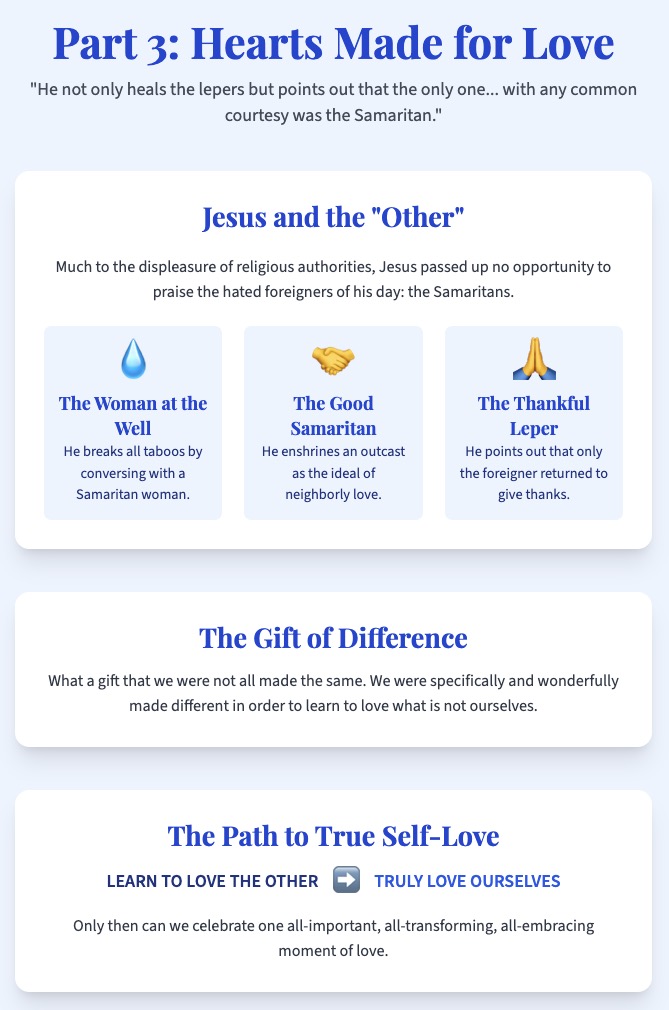
"He not only heals the lepers but points out that the only one among the whole lot of them with any common courtesy was. The Samaritan has none but this Foreigner come back to say thank you."
Discussion Questions:
- Jesus consistently praised the Samaritans, the "hated dirty foreigners" of his day. Who are the "Samaritans" in our society today—the groups that are often despised or viewed with suspicion?
- How do Jesus's actions (speaking to the woman at the well, the parable of the Good Samaritan) provide a direct challenge to a worldview of "us vs. them"?
- The homily concludes that we were "wonderfully made different in order to learn to love what is not ourselves." What is one practical step you can take to better understand and embrace someone who is different from you?

Lepers
During the Nazi occupation of Poland, Józef and Victoria Ulma, a devout farming couple, courageously sheltered eight Jewish people in their attic, seeing them as children of God despite the immense risk. In March 1944, police discovered the hidden families and executed them all. The police then murdered Józef, a pregnant Victoria, and their six children. This ultimate sacrifice, born of a deep faith symbolized by the word “Samaritan” in their family Bible, led Pope Francis to beatify the entire Ulma family as martyrs. Their heroic story serves as a powerful call for love and respect for every human being.
TWTW Visual Summary and Discussion Questions


Monsignor Peter Hahn
28th Sunday of Year C

The Gift of Awareness
Awareness of God’s presence and gratitude for His healing power are essential for personal transformation and deepening our relationships with Him and others.
TWTW Visual Summary and Discussion Questions
Click to enlarge
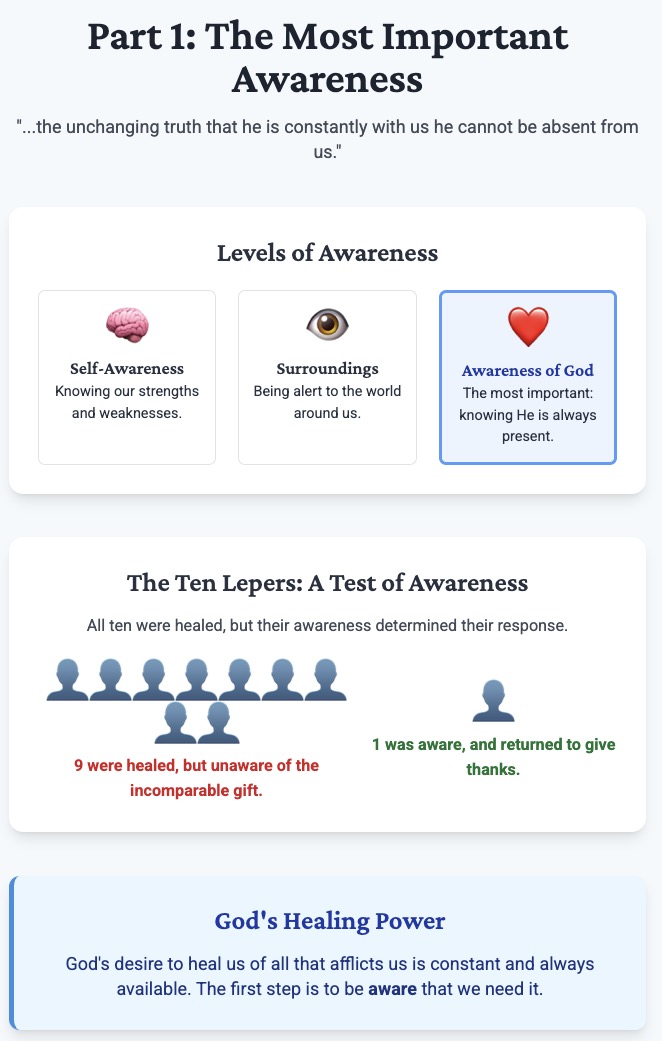
THE MOST IMPORTANT AWARENESS
"The most important awareness we need is that of God to know and to always remember the unchanging truth that he is constantly with us he cannot be absent from us."sures us that He will provide everything we need to sustain us in hope.
Discussion Questions:
- The homily contrasts self-awareness with awareness of God. In your daily life, which type of awareness do you focus on more? What gets in the way of remembering God's constant presence?
- Nine of the ten lepers were healed but seemed unaware of the "incomparable gift" they had received. Why do you think it's so easy to receive blessings from God without being fully aware of their source?
- The priest says God "wants to heal us of all that afflicts us." What personal afflictions (spiritual, emotional, etc.) might you be less aware of needing God's healing for?

Click to enlarge
AWARENESS IN THE EUCHARIST
"It's easy to lose the fullness of the awareness of what happens here who he is here to touch us and to heal us the Son of God."
Discussion Questions:
- The homily mentions that coming to Mass can feel "ordinary or routine." Have you ever felt this way? What helps you reawaken a sense of awe and awareness during the Eucharist?
- How does the idea that God wants to "transform us" in communion change your perspective on receiving the Eucharist? Is it just a ritual, or is it an active moment of change?
- The priest emphasizes being "united to Christ" in the Eucharist. What does this union mean to you personally, and how can awareness of it affect your life outside of Mass?

Click to enlarge
AWARENESS, GRATITUDE, AND SALVATION
"iI is this awareness that will then prompt in us an overwhelming sense of joy and gratitude."
Discussion Questions:
- How are awareness and gratitude linked in your own spiritual life? Can you have one without the other?
- St. Paul says, "if we persevere we shall also reign with him." How does this promise of salvation and eternal glory—the ultimate gift—put our daily struggles and blessings into perspective?
- The homily encourages us to "always with great joy thank and praise God." What is one specific thing you can do this week to cultivate a greater awareness of God's gifts, leading to more joyful gratitude?

Our Faith is Meant to Afflict the Comfortable
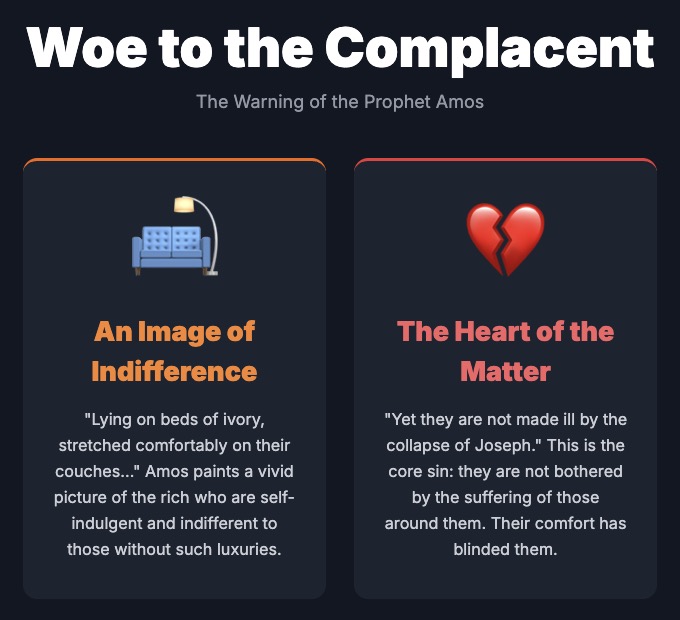
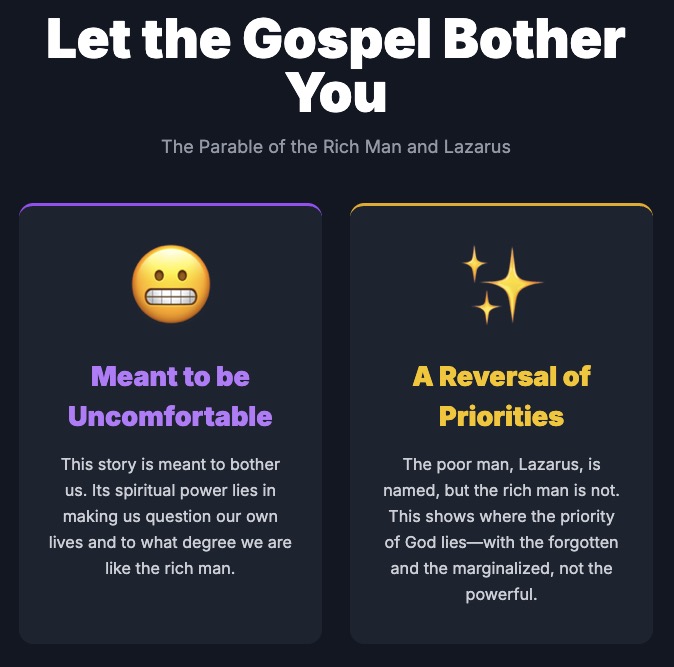
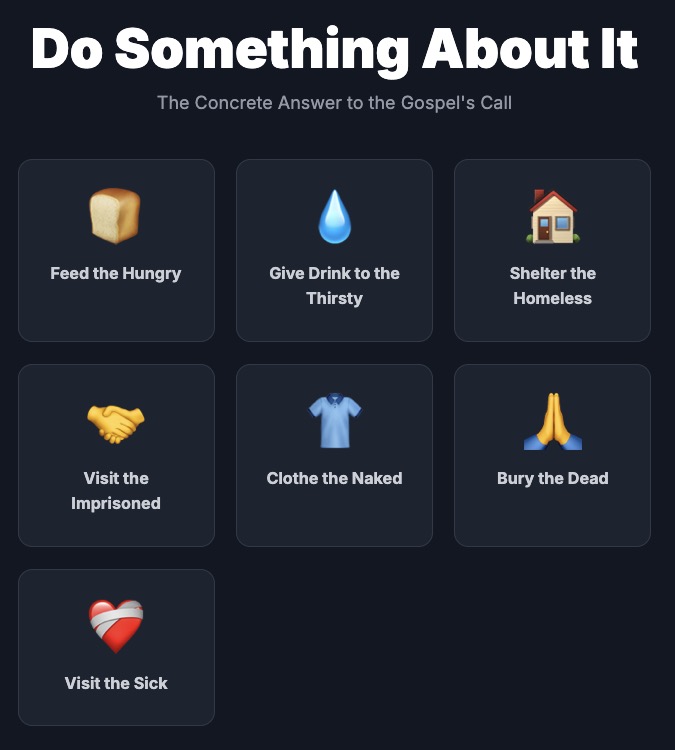
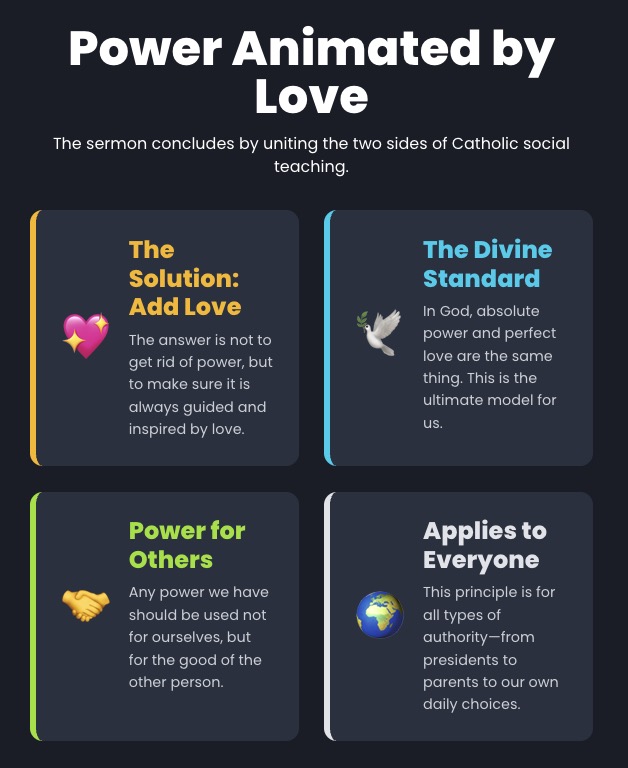
Faith challenges complacency and calls for personal reform and stewardship of God’s gifts, emphasizing the importance of caring for others and adhering to the Church’s teachings to avoid societal and spiritual downfall.
TWTW Visual Summary and Discussion Questions

Click to enlarge
Part 1: The Warning Against Worldly Comfort
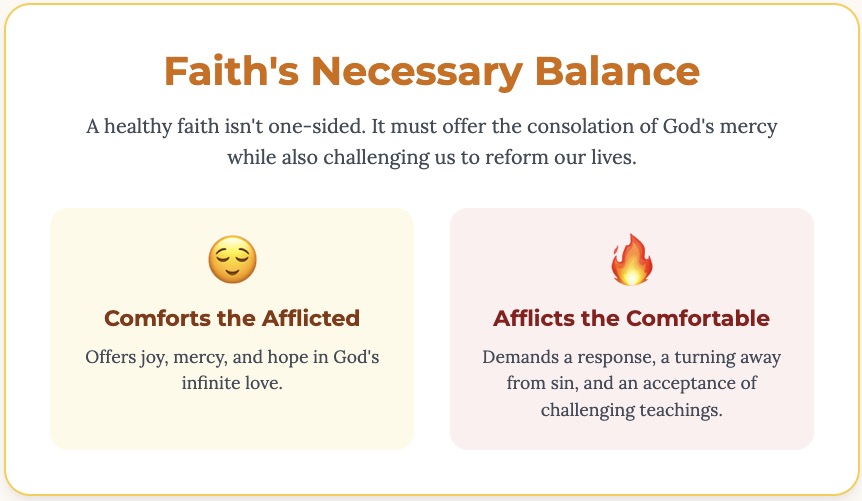
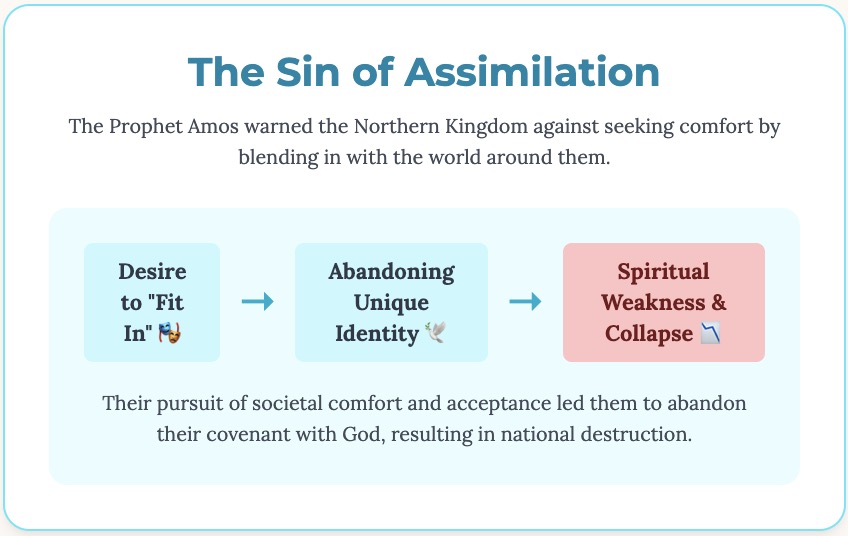
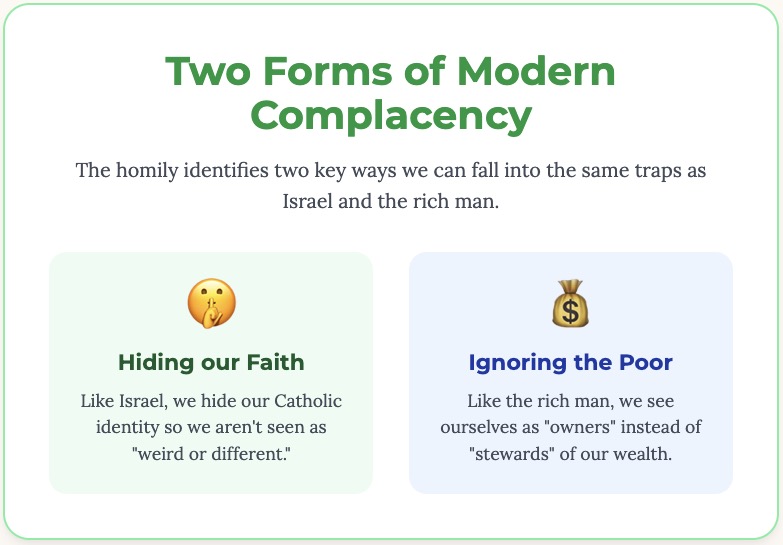
Focus: This section explores the homily's opening theme: that faith must both comfort and challenge us. It examines the historical example of the Prophet Amos warning Israel against the spiritual danger of seeking comfort through cultural assimilation.
Discussion Questions:
- Msgr. Hahn begins with the saying that faith is meant to "comfort the afflicted, but sometimes to afflict the comfortable." Can you recall a time when your faith was a great comfort? Can you recall a time when a teaching or scripture reading made you feel "afflicted" or challenged in your comfort? Why is this balance important?
- The people of the Northern Kingdom wanted to be "assimilated" and not seem different from the cultures around them. In what specific ways do we, as modern Catholics, feel pressure to "blend in" with secular society?
- Amos warned that this desire for comfort would lead to weakness and collapse. Where do you see this principle at work today? How does abandoning our unique Catholic identity in favor of societal acceptance make our faith weaker?

Click to enlarge
Part 2: The Individual Face of Complacency
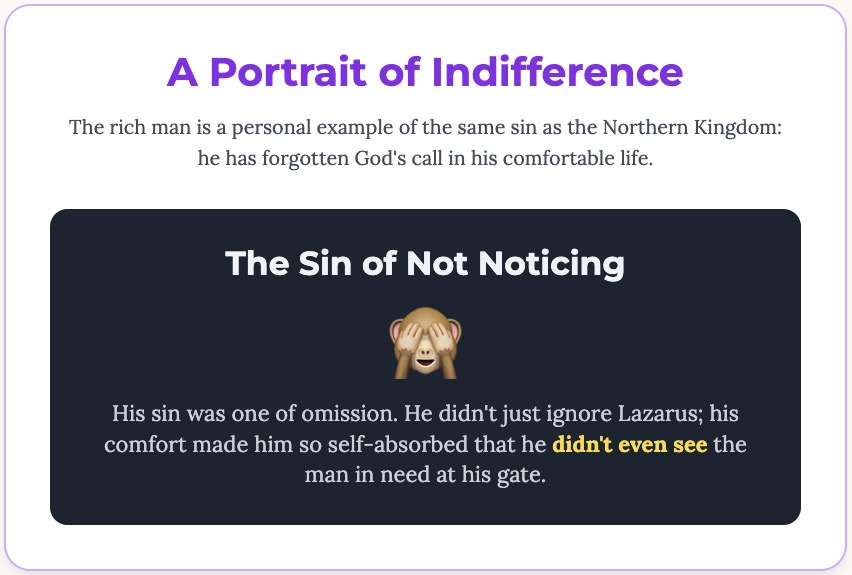
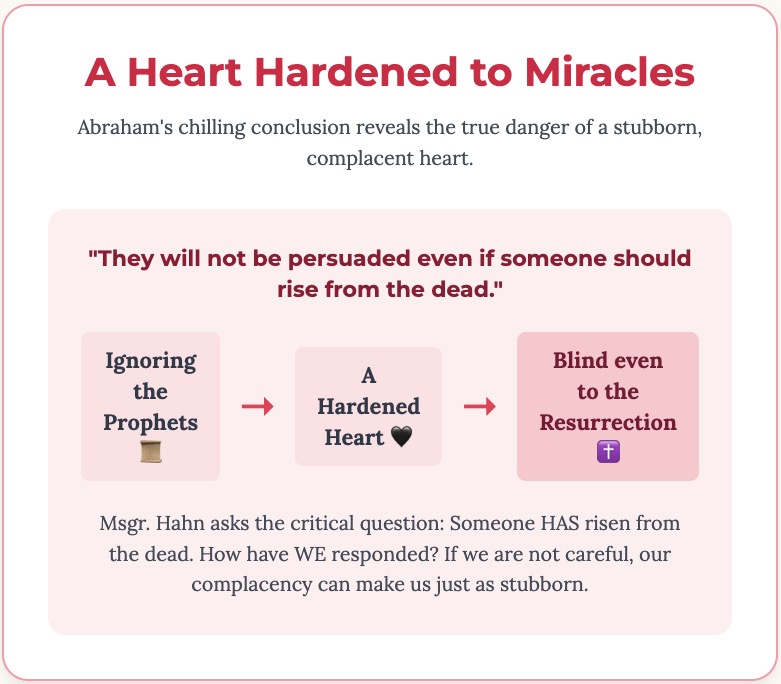
Focus: This section analyzes the Gospel parable of the rich man and Lazarus as a powerful, individual example of the destructive nature of self-centered indifference and the hardness of a complacent heart.
Discussion Questions:
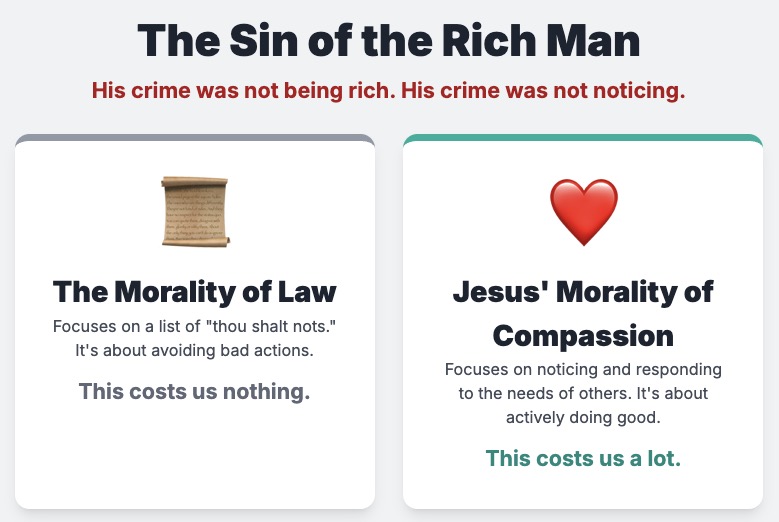
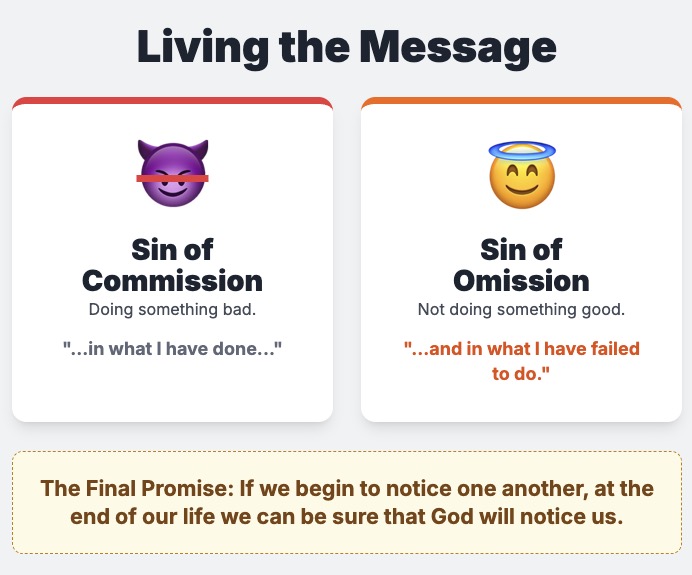
- The homily emphasizes that the rich man's sin was a failure to notice. Why is this type of indifference, born from being overly comfortable, so spiritually dangerous? Who is the "Lazarus" at the gate of our society (or our own lives) that we might fail to notice?
- Abraham says the brothers have "the benefits of all the law and the prophets." What are the "prophetic voices" God gives us today to warn us against complacency (e.g., Scripture, Church teaching, the words of the Pope, our conscience)?
- Msgr. Hahn connects Abraham’s final words directly to us: "Someone has risen from the dead... and yet how do we respond?" If the Resurrection is the ultimate sign, why do we still fall into the trap of complacency? What does this say about the stubbornness of the human heart?


Click to enlarge
Part 3: The Urgent Call to Stewardship and Holiness
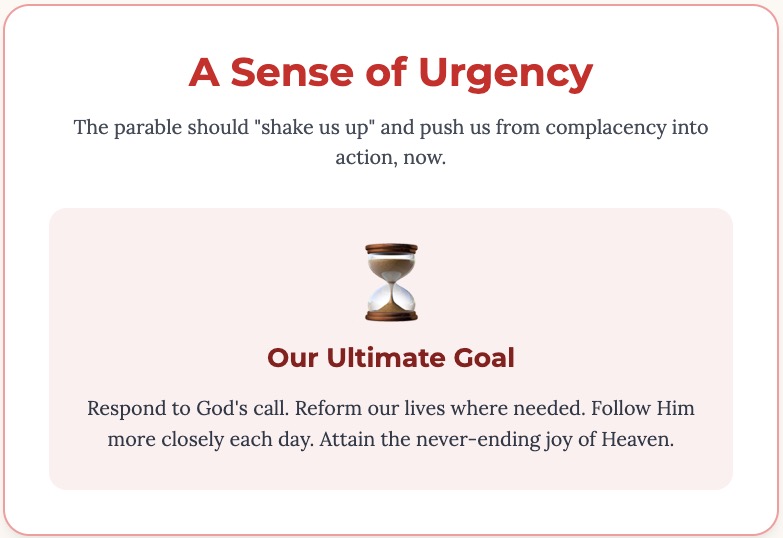
Focus: This final section applies the warnings to our modern lives, identifying contemporary forms of complacency and issuing an urgent call to reform our lives by embracing our role as stewards and actively pursuing holiness.
Discussion Questions:
- The homily presents two modern forms of complacency: hiding our faith to fit in, and failing to share our resources. Which of these two temptations do you find more challenging in your own life? Why?
- Discuss the concept of being "stewards" rather than "owners" of God's gifts. How does this shift in perspective change your view of your time, talents, and money?
- The readings are meant to give us a "sense of urgency." What is one practical area of your life (e.g., prayer, a specific sin, a relationship, an act of charity) where you feel God is calling you to move from complacency to urgent action?
- The homily concludes by calling us to "follow him more closely each day." What is one concrete step you can take this week to respond to that call and break out of a comfortable spiritual routine?
Frank Pavone
28th Sunday of Year C
Erasing False Distinctions
This video by Frank Pavone argues that Christ’s consistent outreach to the ostracized, like the lepers, establishes a pro-life ethic that erases false distinctions and demands protection for the unborn, today’s most neglected outcasts.
TWTW Visual Summary and Discussion Questions

Click to enlarge
ANGER AT THE SYSTEM
"If Jesus was moved by anger, his anger would not have been at the leper, but rather at the system that excluded certain people."
Discussion Questions:
- The reflection contrasts Jesus feeling "pity" versus feeling "anger." How does thinking of Jesus's anger at injustice, rather than just pity for the suffering, change your perception of his ministry?
- Lepers were considered "unclean" and cast off from the community. What systems or attitudes in our society today cast certain groups of people out or treat them as less than human?
- The act of touching a leper was "radical." What would be a modern equivalent of a "radical act" that defies a cultural system of exclusion?
Click to enlarge
ERASING DISTINCTIONS
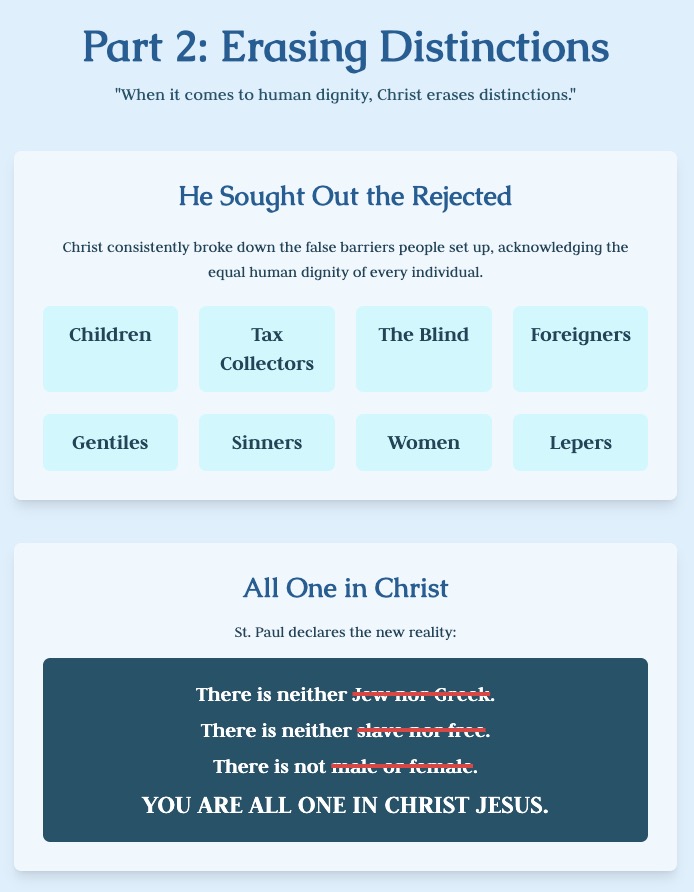
"When it comes to human dignity, Christ erases distinctions. St. Paul declares, 'There is neither Jew nor Greek... slave nor free... not male or female. You are all one in Christ Jesus.'"
Discussion Questions:
- The reflection lists several groups Jesus sought out (tax collectors, children, foreigners, etc.). Why do you think he so consistently went against the social norms of his time to engage with these people?
- St. Paul's declaration was revolutionary. In what areas of life do we still struggle to live up to this ideal of being "all one in Christ Jesus," creating our own distinctions?
- How does the concept of "equal human dignity" challenge the way we interact with people who have different beliefs, backgrounds, or social statuses than our own?
Click to enlarge
THE MOST NEGLECTED
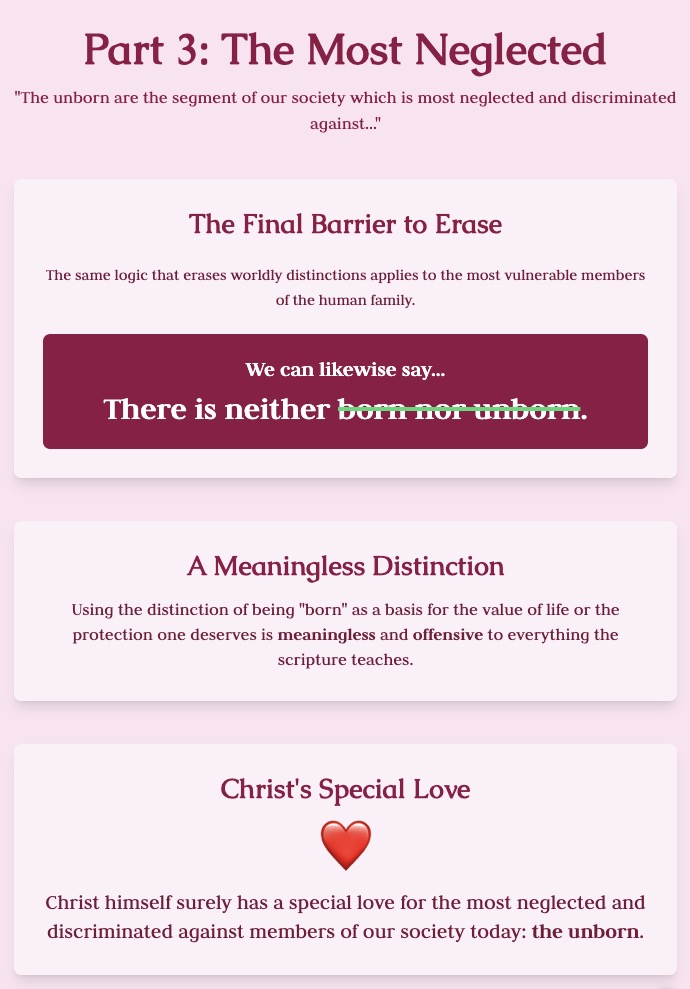
"The unborn are the segment of our society which is most neglected and discriminated against and Christ himself surely has a special love for them."
Discussion Questions:
- The reflection applies St. Paul's words to the unborn, saying "There is neither born nor unborn." How does this parallel the other distinctions (Jew/Greek, slave/free) that Christ and the apostles erased?
- In what ways can the unborn be considered "ostracized" or treated as outcasts by our modern culture and laws?
- If Christ consistently sought out the rejected and oppressed, how does this principle guide a Christian response to the issue of abortion today?
Non-profit ministries have permission to copy/paste any infographics on this website into bulletins, presentations, or class/home school worksheets. A link and/or shoutout to THE WORD THIS WEEK and respective contributors would be greatly appreciated.