October 12, 2025
October 12, 2025


Commentary Intro to Mass Readings for Sunday
CommentaryIntro to Mass Readings for Sunday

28th Sunday of Year C
2 Kings 5:14-17
2 Kings 5:14-17
POP-UP Video | NAB w/ Notes | LECTIONARY
Click graphic above to view intro to reading
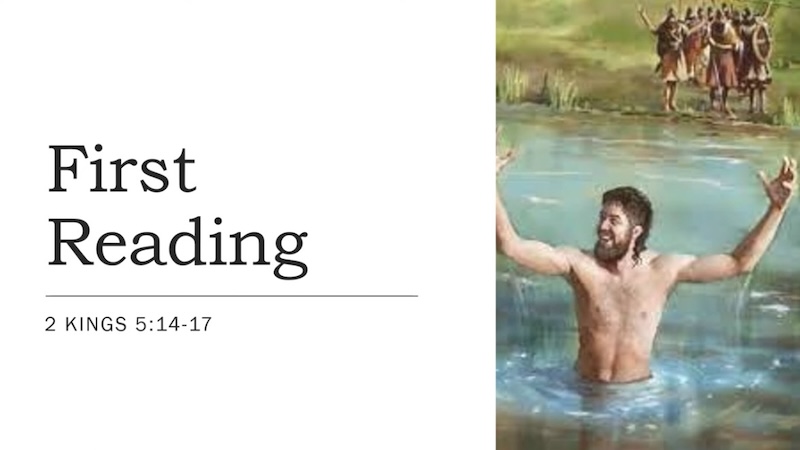
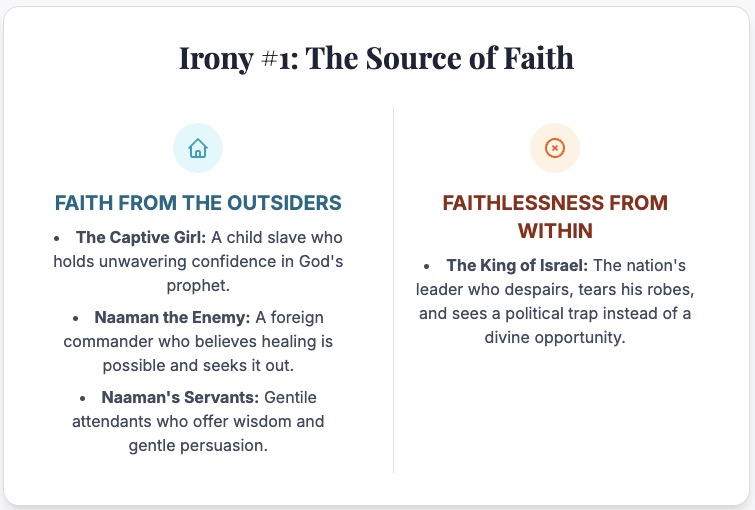
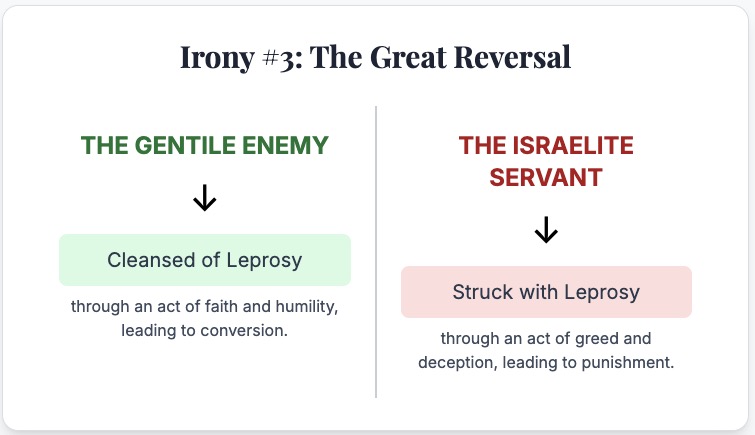
Father Paul explains that the reading from 2 Kings tells the story of Naaman, a Syrian general and an enemy of Israel, who is suffering from a skin disease. He learns about the prophet Elisha from a Hebrew slave girl in his household, who tells him the prophet may be able to cure him.

A central point Father Paul highlights is Naaman's request for "two mule-loads of earth" after he is healed. This is because, in the 8th century BC when the story takes place, deities were believed to be tied to specific geographical regions. For Naaman to worship the God of Israel back in his homeland, he felt he needed to take some of Israel's land with him.
Finally, the story demonstrates immense gratitude. Naaman's desire to give Elisha a gift was a sign of his thankfulness, but Elisha refused it to make it clear that he was not the one who performed the healing—it was God.
Clipart by Fr. Richard Lonsdale


Change of Skin,
Change of Heart
by Larry Broding

How does God’s power turn a proud skeptic into a grateful believer?
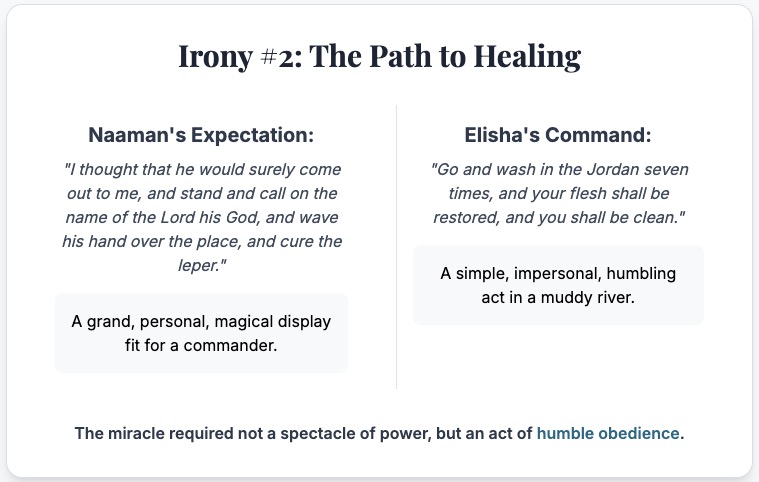
The story of Naaman’s healing in 2 Kings 5:14-17 is a staple of miraculous storytelling, but in his commentary, Larry Broding invites us to look past the cleansed skin and see the far more profound transformation happening within. This isn’t just a story about a physical cure; it’s a powerful drama about a proud heart made humble and a life completely reoriented by an encounter with the one true God.
Broding skillfully points out that the true miracle wasn’t just the washing away of a skin disease in a muddy river, but the washing away of arrogance and misplaced allegiance. For preachers preparing a homily, this commentary provides a rich foundation to explore themes of humility, conversion, and our own blindness to the miracles in our daily lives.
Dive into Broding’s full analysis to discover how the journey of a skeptical soldier can challenge your congregation. This commentary will help you craft a message that asks the vital questions: Do we see God’s miracles in our own lives? And more importantly, do we allow them to truly change us?




Fr. Tim Peters teaches at Saint John’s Seminary in Camarillo



28th Sunday of Year C
2 Timothy 2:8-13
2 Timothy 2:8-13
POP-UP Video | NAB w/ Notes | LECTIONARY
Click graphic above to view intro to reading

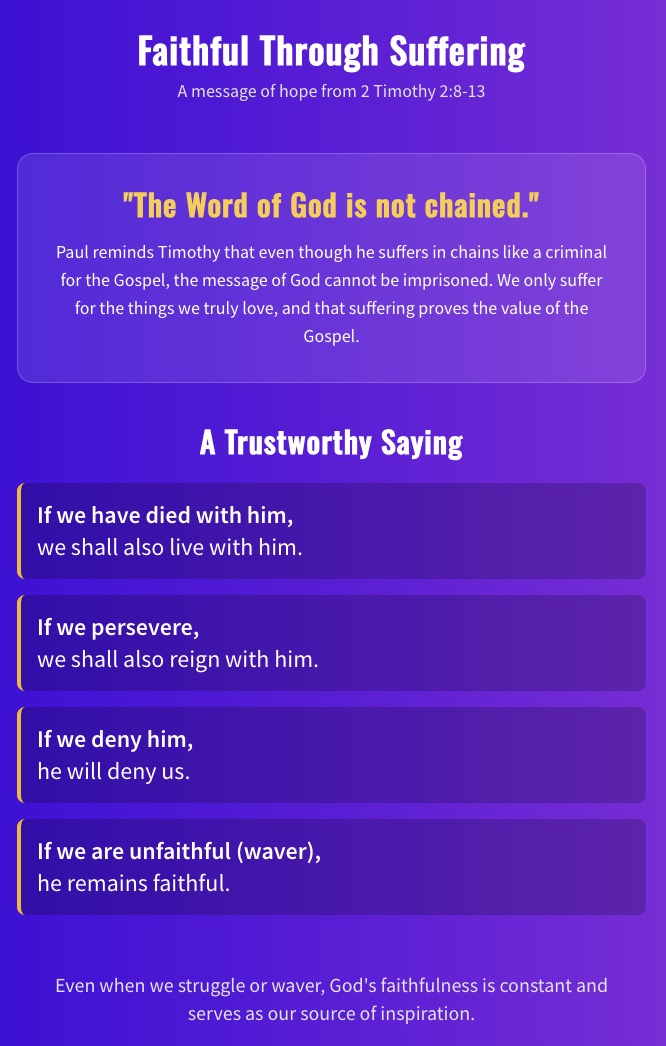
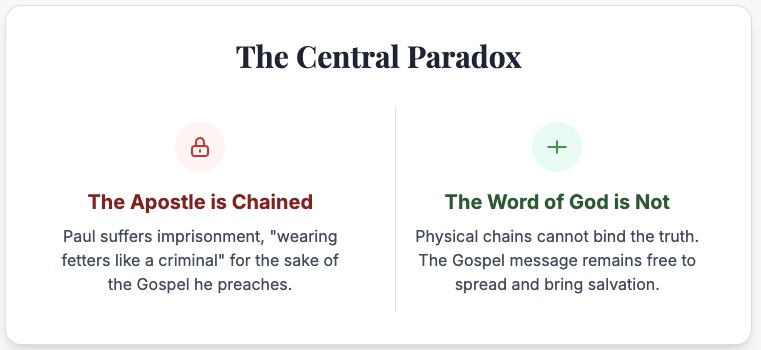
Father Paul explains that the author of the letter, likely Paul himself, is encouraging Timothy by reminding him that ministry involves suffering. Using his own experience of being treated like a criminal, the author shows that suffering for the Gospel demonstrates its value, as we only suffer for what we truly love. He warns Timothy that he too will suffer for his dedication to the word of God.

Father Paul also notes that the "trustworthy saying" at the end of the reading is likely part of an early liturgical hymn. He clarifies that the word "unfaithful" in this context is better translated as "to waver in the faith," emphasizing that even when we waver, God remains constant and serves as a source of inspiration.
Clipart by Fr. Richard Lonsdale
Remembering Jesus
by Larry Broding
What drives someone to evangelize? Why would anyone endure suffering, imprisonment, or even death just to share their faith?
In his insightful commentary on 2 Timothy 2:8-13, Larry Broding unpacks the profound motivation behind the Christian witness. He moves beyond a simple reading of the text to explore the powerful, active command at its heart: “Remember Jesus Christ.”
Broding reveals that this is not a call for mere historical recollection, but an invitation to live constantly in the divine presence and to be Christ for others. It is this shared experience of a living Lord that builds the Church. Broding explains that this act of remembrance is fundamentally communal.
For preachers preparing a homily, this commentary offers a key to unlock the passage’s central truth: we evangelize not to share a set of rules, but to invite others into the life-changing presence of Christ. Click on the title above to read Broding’s full commentary to explore how this powerful dynamic can shape our understanding of faith, community, and the unchained Word of God.


Fr. Tim Peters teaches at Saint John’s Seminary in Camarillo


28th Sunday of Year C
Luke 17:11-19
Luke 17:11-19
POP-UP Video | NAB w/ Notes | LECTIONARY
Click graphic above to view intro to reading
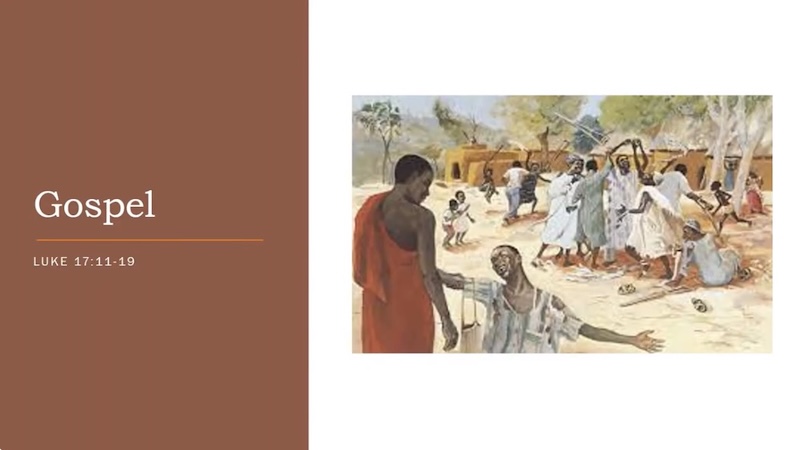
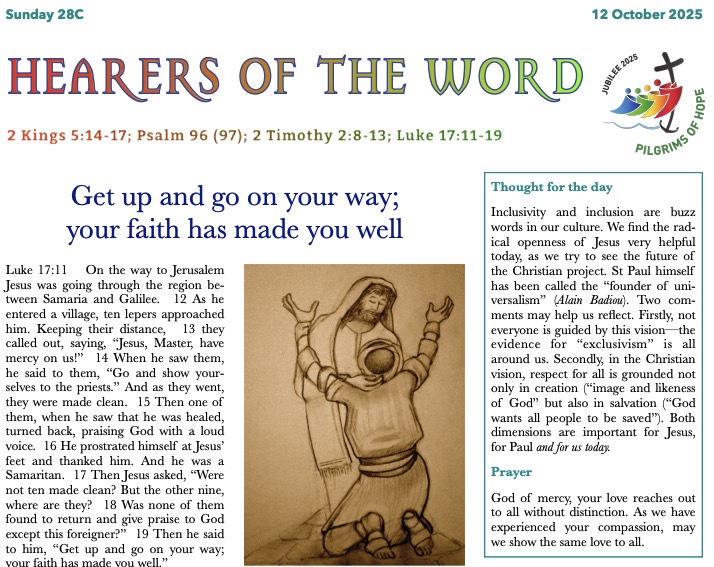
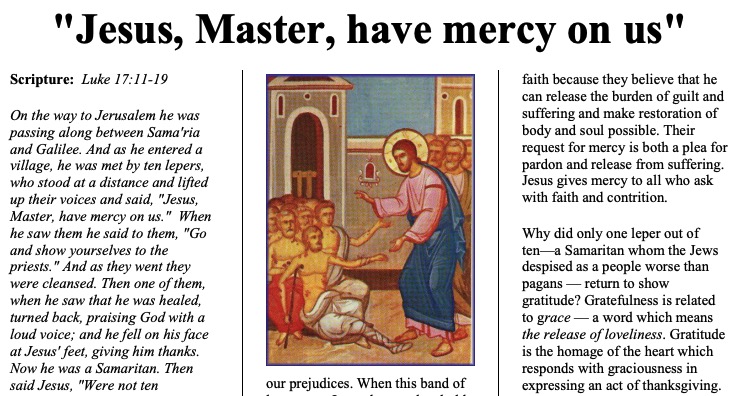
Father Paul explains that the Gospel today tells the story of Jesus healing ten lepers as He journeys through Samaria and Galilee. He highlights that the lepers stood at a distance, as required by law due to the belief that leprosy was highly infectious.

He points out that this is an unusual story because it features a "delayed healing," which is rare in Jesus' miracles. The core message, Father Paul notes, is that "faith counts, not race" , as both Jews and Samaritans—who were typically enemies—were healed. This emphasizes that in illness, all people are equal, and Jesus treats everyone with love.
Jesus tested their faith by simply commanding them to "go show yourselves to the priest," without any physical contact or immediate prayer. Father Paul concludes by calling the grateful Samaritan a "new Good Samaritan," underscoring that faith must be coupled with gratitude, recognizing God as the source of the saving act. He also differentiates between healing and salvation, stating that faith brings salvation, which is the greater good the Samaritan leper received.
Clipart by Fr. Richard Lonsdale

The Faith of the Outcast
by Larry Broding
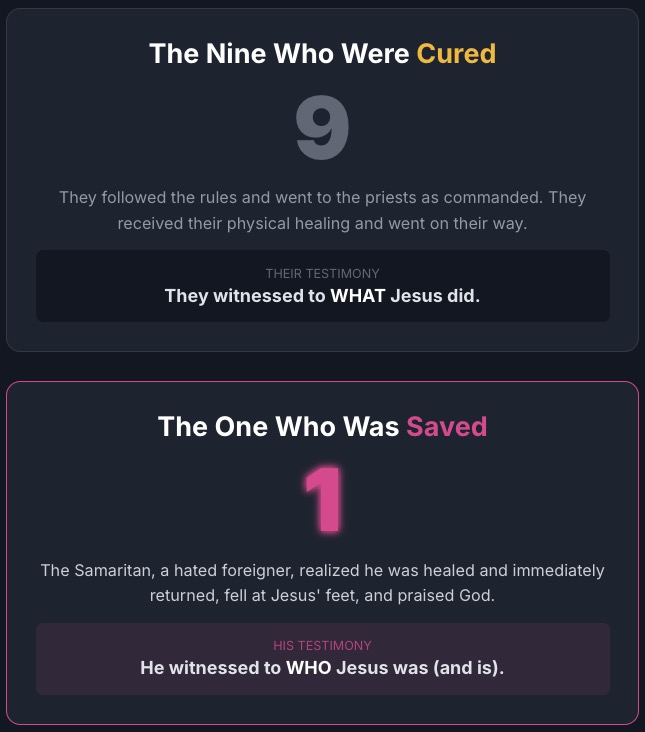
What is the difference between being cured and being saved?
In his insightful commentary on Luke 17:11-19, Larry Broding challenges us to look beyond the simple lesson of gratitude in the healing of the ten lepers. He reveals a deeper, more profound truth: the story of an outcast who, from his position of isolation, saw the heart of the miracle far more clearly than the nine who simply followed the rules.
This isn’t just a story about thankfulness; it’s about a transformative encounter. Broding masterfully unpacks the irony that while ten men were physically healed, only one—the hated Samaritan—returned to worship the healer. For preachers preparing a homily, this commentary provides a rich foundation to explore the nature of a faith that doesn’t just receive a gift, but recognizes the Giver.
Dive into Broding’s full analysis to move beyond a surface-level message. This commentary will equip you to guide your congregation in asking the vital questions: Are we merely content with God’s blessings, or are we, like the Samaritan, so moved by the encounter that we are compelled to return and fall at the feet of Jesus in worship?


Boundaries, Faith and Gratitude
The narrative of the Journey to Jerusalem (begun in Luke 9:51) returns; new characters are introduced – ten lepers – the disciples play no role in this story. For a brief moment the on-going theme of forming discipleship seemingly takes a backseat, as the accent is upon God’s mercy and salvation. Several commentators hold that this account marks a new turn in Luke’s telling of the gospel moving from an accent on discipleship to the larger theme of “Responding to the Kingdom” as the cleansing of lepers is takes as a sign of the in-breaking of the Kingdom.
PDF COMMENTARY
(Luke 17:11-19)
Fr. Tim Peters teaches at Saint John’s Seminary in Camarillo







Diocese of Phoenix
28th Sunday of Year C

Christ in Our Neighborhood
Bishop John Dolan
This program aims to foster deeper relationships with Christ through weekly Scripture study and prayer in small faith communities. It was introduced in December 2022

More Discussion Guides
Fr. Thibodeau
Bible Study Notes
Bp. John P. Dolan
Fr. Tobin

Fr. Conley Bertrand
28th Sunday of Year C
Cycle C (PDFs)
📖 Old Testament (43 pp.)
📖 Epistles (87 pp.)
📖 Gospels (182 pp.)
📖 Daily Gospels (208 pp.)
SOURCE: Come, Lord Jesus
Carmelite Reflections and Prayers
Lectio Divina

78-page PDF with reflections and prayers for each day of the month
Lectio Divina OCTOBER 2025 (PDF)
Lectio Divina OCTOBER 2025 [Mobi]
Lectio Divina OCTOBER 2025 [ePub]
______________
“Lectio divina is an authentic source of Christian spirituality recommended by our Rule. We therefore practise it every day, so that we may develop a deep and genuine love for it, and so that we may grow in the surpassing knowledge of Christ. In this way we shall put into practice the Apostle Paul’s commandment, which is mentioned in our Rule: “The sword of the Spirit, too, which is the word of God, is to dwell abundantly in your mouth and in your hearts; and whatever things you have to do, let them be done in the word of the Lord.” (Carmelite Constitutions (2019), n. 85.)
Source: Carmelites

Luke 17:5–6
11 On the way to Jerusalem he was passing along between Samaria and Galilee.
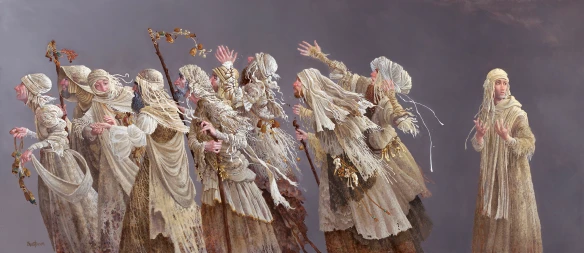
12 And as he entered a village, he was met by ten lepers, who stood at a distance
13 and lifted up their voices, saying, “Jesus, Master, have mercy on us.”
14 When he saw them he said to them, “Go and show yourselves to the priests.” And as they went they were cleansed.
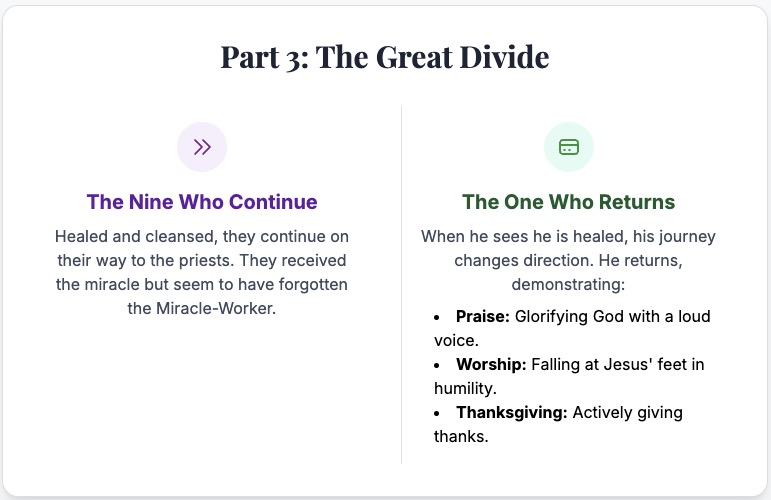
15 Then one of them, when he saw that he was healed, turned back, praising God with a loud voice;
16 and he fell on his face at Jesus’ feet, giving him thanks. Now he was a Samaritan.
17 Then Jesus answered, “Were not ten cleansed? Where are the nine?
18 Was no one found to return and give glory to God except this foreigner?”
19 And he said to him, “Rise and go your way; your faith has made you well.”
SOURCE: English Standard Version (ESV).
Infographics


Calling Out Ingratitude
AMBROSE. After telling the previous parable, our Lord now turns his attention to calling out ingratitude.
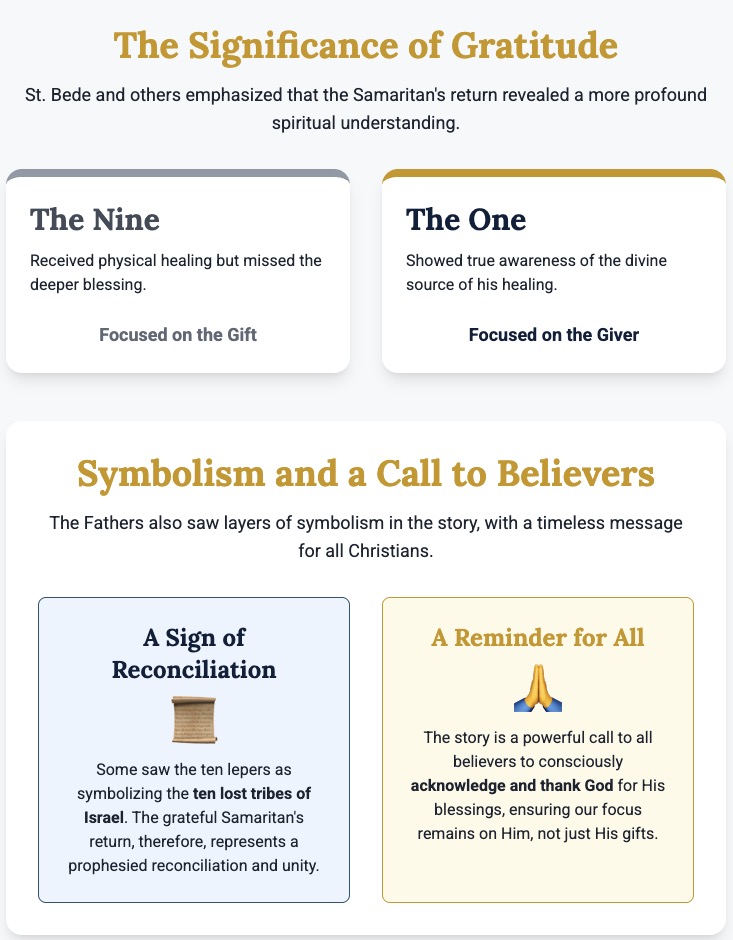
It’s easy to get so focused on asking for the next thing that we forget to be thankful for the last one. Ambrose points out that Jesus is intentionally shifting gears here. He’s teaching us that receiving a miracle is only half the story; responding to it with gratitude is what makes the story complete.
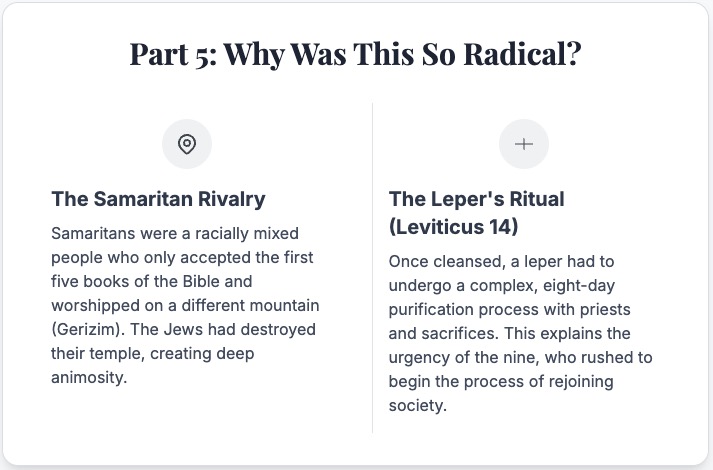
TITUS BOSTRENSIS. Titus notes that this story immediately shows that the Samaritans were more receptive to God’s mercy than the Jews were. There was deep-seated hostility between these groups, and by traveling through their shared borderlands, Jesus was on a mission to break down those walls and build “one new man” out of the two.
Ten Lepers
CYRIL OF ALEXANDRIA. Cyril points out that Jesus is revealing His divine power to the people of Israel. He highlights that these ten men were lepers, a condition that made them social and religious outcasts, banished from cities and towns under the Law of Moses.
TITUS BOSTRENSIS. Titus observes that their shared suffering created an unlikely community. They had to keep their distance, as the Law of Moses focused on outward, physical cleanliness. In contrast, the Gospel is concerned with the “leprosy” of the heart—our inner corruption.
Pain has a way of erasing the lines we draw between each other. These men—Jews and Samaritans who would normally despise one another—were united by a shared agony. It’s a powerful picture of how our deepest wounds can become the very place where community is born. Their physical leprosy is a mirror for our spiritual condition. The world tells us to hide our brokenness, but the Gospel says that’s precisely where healing begins.
A Request of True Value
THEOPHYLACT. Theophylact sees a beautiful paradox here. They stand far away physically, ashamed and expecting Christ to be disgusted by them like everyone else. But their prayers instantly closed that distance, because, as the Psalm says, “The LORD is near to all who call on him in truth” (Psalm 145:18).
TITUS BOSTRENSIS. By calling on the name “Jesus”—which literally means “Savior”—they were tapping into the reality of who He is. They weren’t asking for money; they knew His power and were asking for the one thing that truly mattered: the complete restoration of their bodies.

THEOPHYLACT & CYRIL OF ALEXANDRIA. Theophylact notes that they don’t just beg; they call him “Master” or “Lord,” showing a reverence that bordered on recognizing His divinity. Jesus’s command to “Go, show yourselves to the priests” was an act of faith in itself. Under the Law, this was the final step after being healed. So by telling them to go, Jesus was essentially saying, “Start walking, because by the time you get there, you’ll be healed.” Cyril adds that this also served as an undeniable witness to the religious authorities in Jerusalem. The very priests who were jealous of Jesus would have to officially verify a miracle that only He could perform.
Where are the Nine?
THEOPHYLACT & TITUS BOSTRENSIS. And the miracle happened just as He said. But here’s the turn: out of the ten, the nine Israelites, the “insiders,” never looked back. They were ungrateful. It was the Samaritan, the stranger, who came back, shouting praises to God. Titus notes that his healing gave him the boldness to approach, and his posture—falling on his face at Jesus’s feet—showed both his profound faith and his overwhelming gratitude. And the text makes a point to say: he was a Samaritan. From this, we learn that our background or heritage doesn’t stop us from pleasing God; what matters is the posture of our heart. And for those born into the “right” family or community, don’t get arrogant—the nine insiders here were the ones who were ungrateful. Jesus’s question hangs in the air: “Were not ten cleansed?”
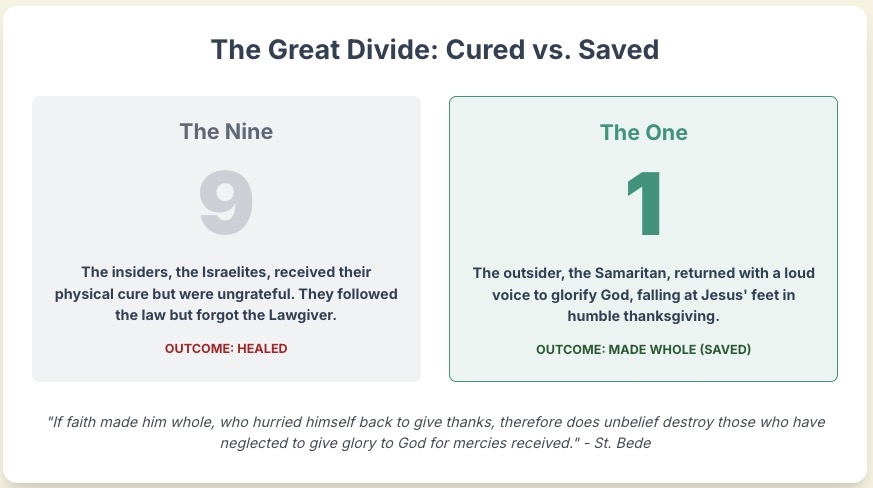
Shockingly, it’s easy to treat God like a divine vending machine. We put in our prayer, get our blessing, and walk away. The nine got what they wanted: a physical cure. They were restored to society. But they missed out on what was truly on offer: a relationship with the Healer. The Samaritan, the one everyone looked down on, understood that the gift was nothing compared to the Giver. He didn’t just want his old life back; he wanted the One who could give him a new one.
The Deeper Meaning of the Miracle
AUGUSTINE. Augustine offers a mystical reading. He sees the lepers as people who are trapped in false teachings. They don’t hide their ignorance; they broadcast it proudly, mixing bits of truth with error, creating a “leprosy” of the soul that disfigures the beauty of the truth. He finds it significant that only lepers were sent to the priests, seeing this as a symbol of the Church’s role. While Jesus heals our inner vices directly, the Church is given the task of teaching and administering the sacraments—the outward signs of that inner healing. Those who receive the Church’s teaching but fail to return to God with a humble, grateful heart are like the nine. They remain imperfect, stuck in the number nine, which needs the “one” of unity to become a complete ten. But the Samaritan, whose name can be interpreted as “guardian,” represents the true Church. By giving thanks, he “guards” the gift he received, preserving the unity of faith with humble devotion.

The Posture of Grace
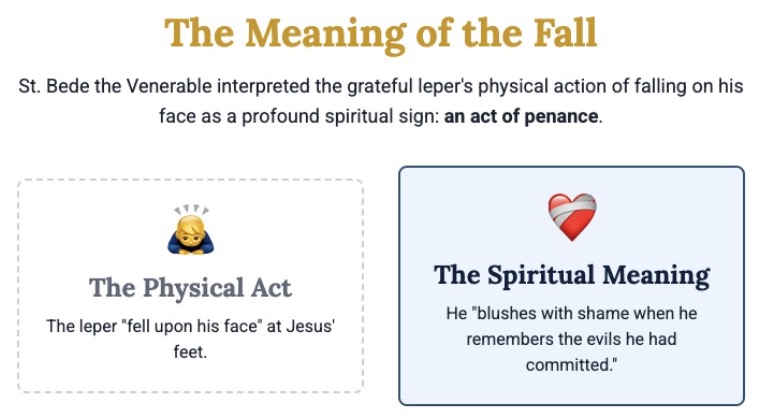
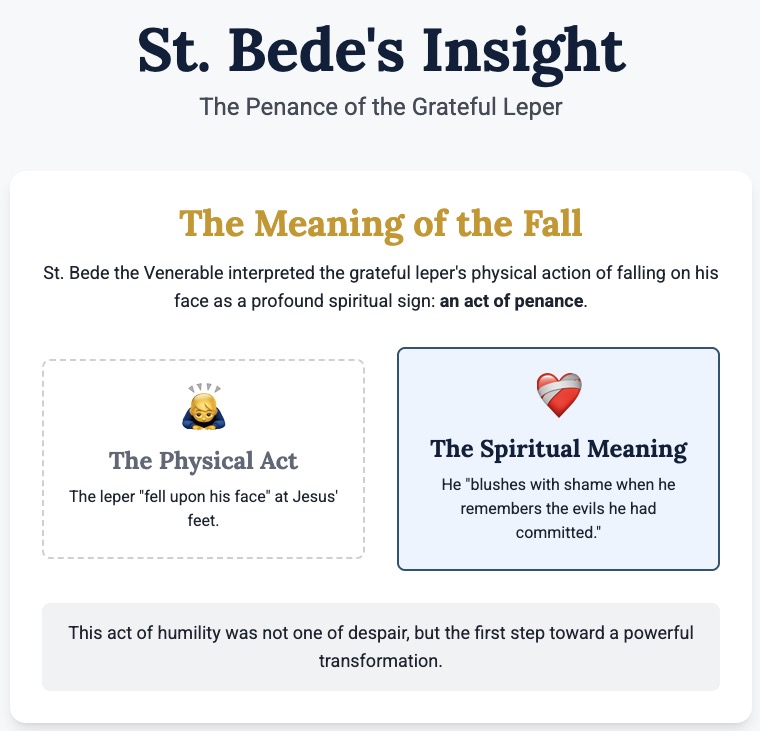
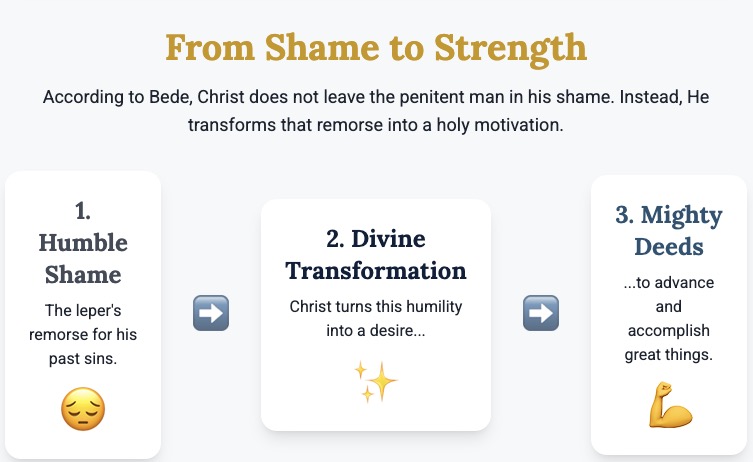
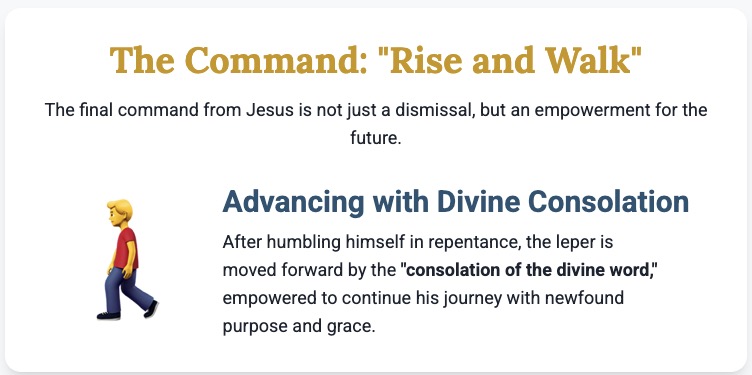
BEDE. Bede connects the man’s posture to his spiritual state. He falls on his face in shame, remembering his past brokenness. He is then commanded to “rise and walk,” because when we acknowledge our weakness, God’s word lifts us up to do great things. Bede concludes that if the faith of the thankful man made him whole, then the unbelief of the ungrateful ones ultimately destroys them.
The man’s physical posture—falling on his face—is a perfect picture of his inner reality. It’s that raw, honest moment when you’re so overwhelmed by grace that you feel like you could just collapse. He isn’t just being polite; he’s “blushing with shame,” painfully aware of his broken past in the presence of pure goodness. He knows he didn’t earn this miracle.
But God never leaves us there on the floor. The command to “rise and walk” is God hitting the reset button. It’s a powerful way of saying, “Your past doesn’t define you anymore. Acknowledging your weakness isn’t the end—it’s the starting line for what I’m going to do through you.” Humility is the launchpad for greatness.
This is where Bede’s insight gets really sharp. He says the man’s faith “made him whole” precisely because he came back to say thank you. Gratitude wasn’t just good manners; it was the tangible evidence of his faith.
In contrast, the unbelief of the other nine wasn’t that they didn’t think Jesus could heal them—their unbelief was revealed in their ingratitude. By not returning, they treated a life-altering gift like a simple transaction, effectively “ghosting” God. That spiritual neglect, Bede argues, is what ultimately keeps us broken.
So, for us today, Bede’s message is clear: True faith grows from humility, and the ultimate proof of that faith isn’t what we ask for, but how gratefully we respond once we’ve received it.