October 19, 2025
October 19, 2025


Commentary Intro to Mass Readings for Sunday
CommentaryIntro to Mass Readings for Sunday


Click graphic above to view intro to readin
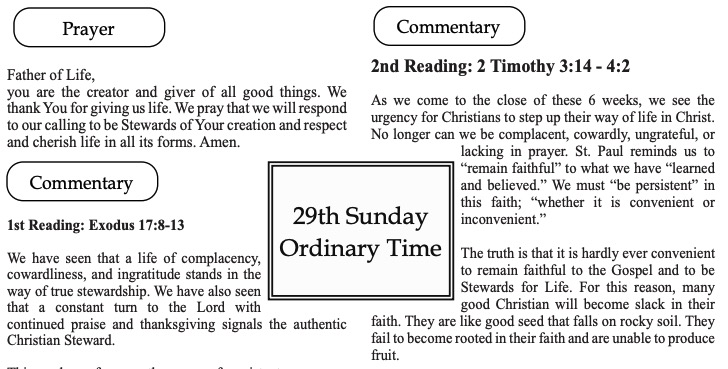
29th Sunday of Year C
In his introduction to the reading from Exodus, Fr. Paul provides historical and theological context. He explains that the battle between the Israelites and the nomadic Amalekites, occurring around 1200 BC in the Sinai desert, was likely a conflict over resources like water.
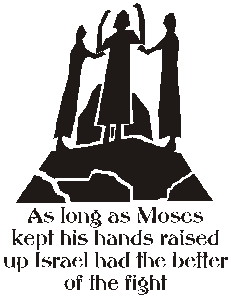
He interprets Moses's act of holding up his hands not just as a historical event but as a "prophetic action" symbolizing prayer and God's power. Fr. Paul suggests the author used artistic license to convey a deeper truth: God protects His people through human cooperation, as seen when Aaron and Hur support Moses. The ultimate message is that Israel's success is not rooted in its military power, but in its reliance on God and the power of prayer.
Clipart by Fr. Richard Lonsdale

Moses’ Persistent Prayer
by Larry Broding

Have you ever felt your arms grow heavy in prayer, weighed down by weariness or doubt?
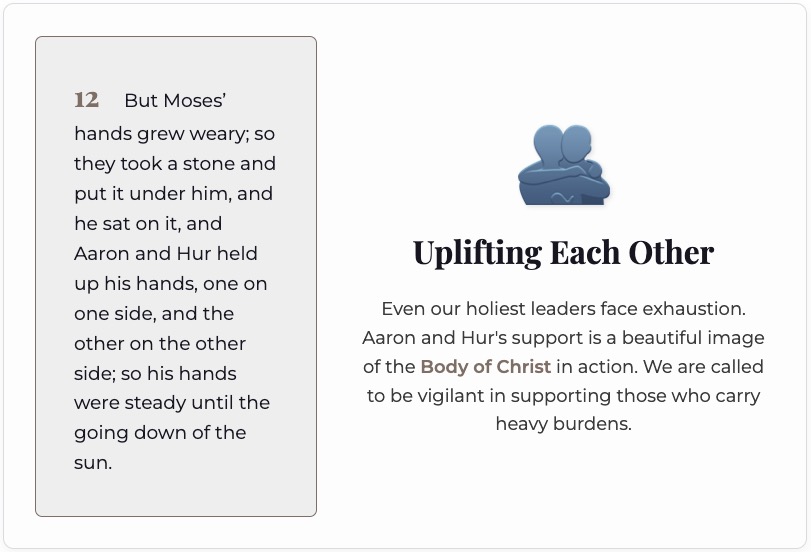
Broding reveals that the story’s focus isn’t the battle, but the physical and spiritual act of intercession. He highlights that Israel’s victory was not secured by one man’s stamina, but by the strength of a community. When Moses grew tired, his friends were there to literally hold him up. This commentary transforms a familiar story into a powerful message about spiritual fatigue and our absolute need for each other.




29th Sunday of Year C
2 Timothy 3:14-4:2
2 Timothy 3:14-4:2
POP-UP Video | NAB w/ Notes | LECTIONARY
Click graphic above to view intro to reading

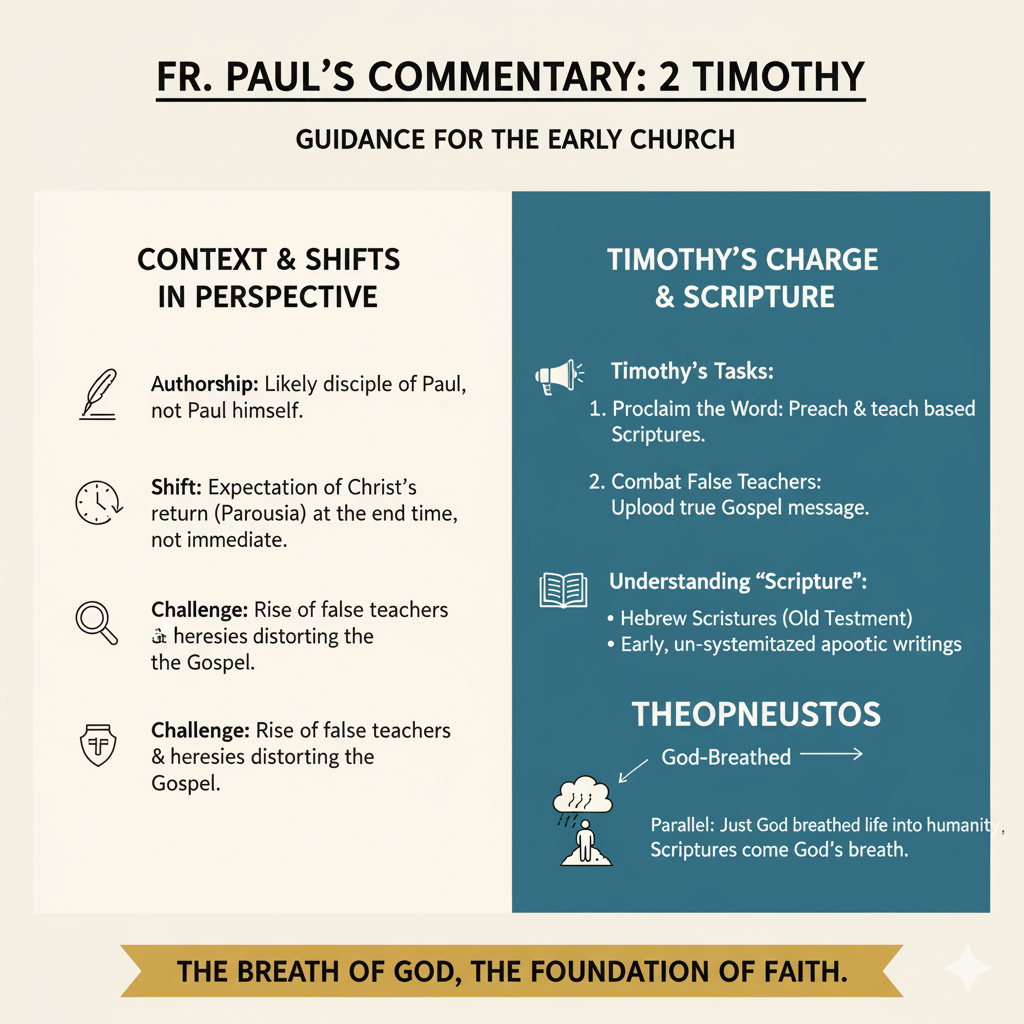
Fr. Paul suggests that this letter was likely written by a disciple of Paul, rather than Paul himself. The letter reflects a shift in the early Church's perspective; they are no longer expecting the immediate return of Christ but are now focused on his eventual coming at the end of time, known as the Parousia.
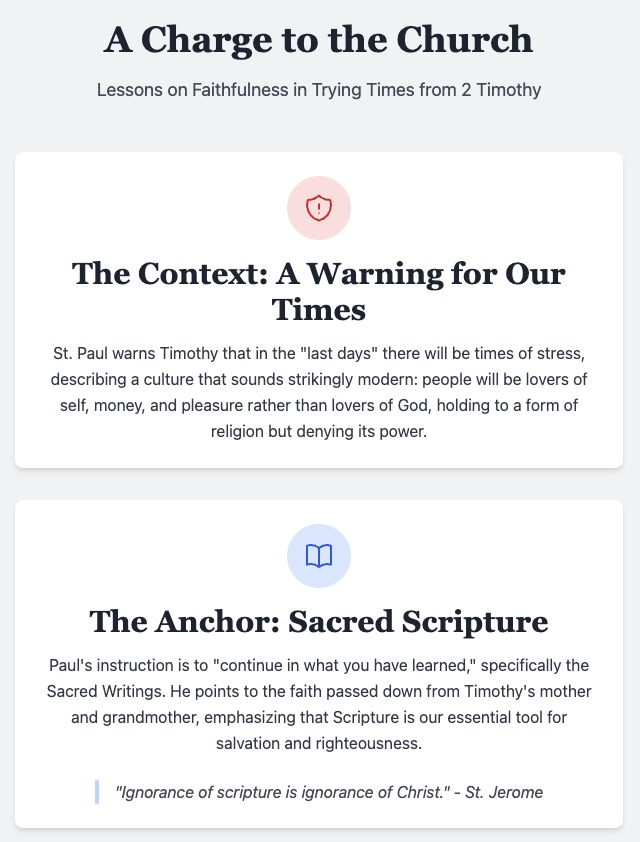
In this context, Timothy is charged with two main tasks:
- Proclaim the Word: He is to preach and teach, using the Scriptures as his foundation.
- Combat False Teachers: A primary challenge for the church at this time was the rise of heresies and individuals who were distorting the Gospel message for their own purposes.
Fr. Paul clarifies that when the letter refers to "Scripture," it means the Hebrew Scriptures (the Old Testament) and possibly some early, un-systematized writings of the apostles. He highlights the Greek word for "inspired by God," Theopneustos, which literally means "God-breathed." He draws a parallel to the creation story, explaining that just as God breathed life into humanity, the Scriptures also come directly from the very breath of God.
Clipart by Fr. Richard Lonsdale
Click to enlarge
The Good Teacher
by Larry Broding
What does it take to be a teacher of the faith in a challenging world?
In his commentary on 2 Timothy, Larry Broding transports us from the safety of the pulpit to the chaos of the first-century marketplace, where evangelism was a daily spiritual battle.
Broding paints a vivid picture of the early evangelist, who had to be ready for anything. He shows that for the early Church, sharing the Gospel wasn’t a gentle exercise but a fierce defense of the faith in the face of hostility. As he sets the scene:
“The evangelist was frequently faced with a hostile audience… Many times, the scene turned into a battle of apologetics.”
Against this intense backdrop, Broding unpacks the author’s charge to Timothy, revealing a timeless blueprint for anyone called to teach or lead. He highlights the essential qualities needed then and now: a deep knowledge of Scripture, personal integrity grounded in faith, and above all, patient endurance.
This commentary is a powerful resource for preachers looking to craft a homily on the courage and character required for modern discipleship. It connects the ancient charge to Timothy with the call every believer feels today: to stand firm, proclaim the Word, and teach with unwavering patience and passion.

Fr. Tim Peters teaches at Saint John’s Seminary in Camarillo


29th Sunday of Year C
Luke 18:1-8
Luke 18:1-8
POP-UP Video | NAB w/ Notes | LECTIONARY
Click graphic above to view intro to reading

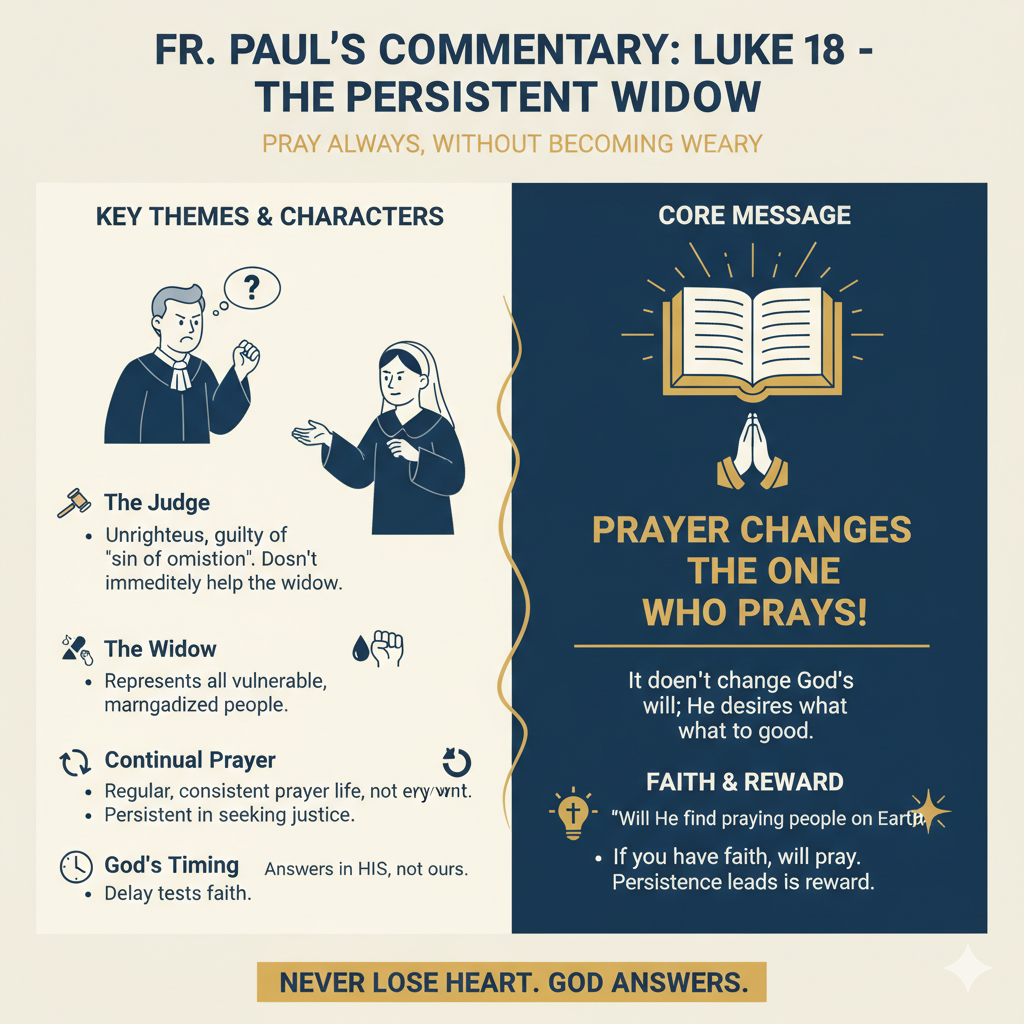
Fr. Paul explains that this Gospel reading contains the parable of the persistent widow. The central message is about the necessity of praying always and without becoming weary. He makes a distinction between continuous prayer (praying every single moment) and continual prayer (maintaining a regular and consistent prayer life), noting the parable encourages the latter. To stop praying is a sign of losing faith.
Key points on the characters and themes include:
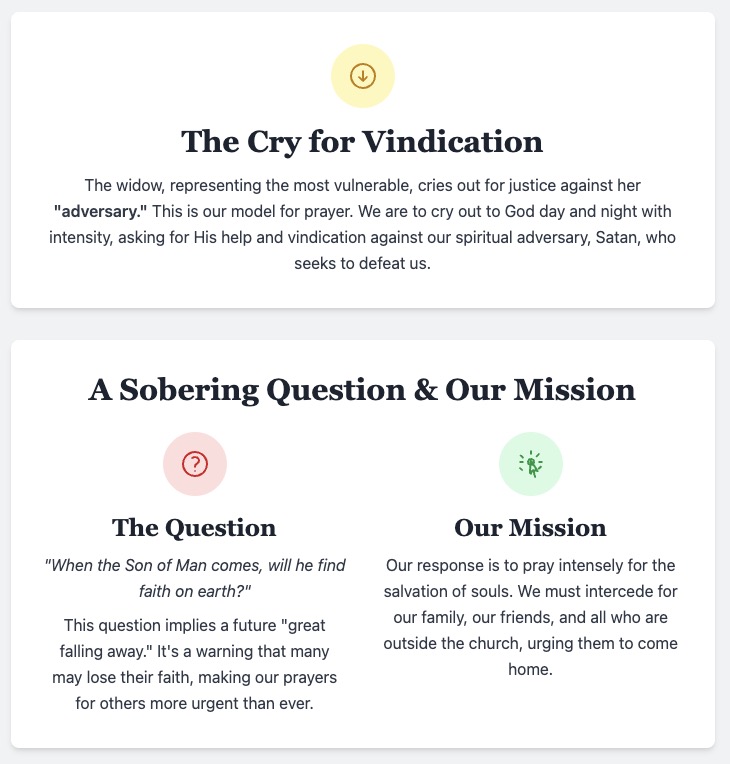
- Faith and Prayer: The final verse, "when the son of man comes, will he find faith on Earth," is directly tied to prayer. Fr. Paul interprets this to mean, "Will he find praying people on Earth?" The parable concludes that if you have faith, you will pray, and you will be rewarded for that persistence.
- The Judge: It is better to understand the judge not as "dishonest" but as "unrighteous." He is guilty of a sin of omission by failing in his duty to advocate for the widow right away.
- The Widow: She represents all poor and vulnerable people. In that society, widows were the most marginalized as they had no husband to defend them and no legal standing in court. However, this widow is persistent and actively seeks justice for herself.
- The Nature of Prayer: Fr. Paul offers a significant insight: prayer changes the person who prays, it does not change God. God already knows and desires what is good for us. Our persistence in prayer transforms our own hearts and deepens our faith.
- God's Timing: The delay in Christ's return (the Parousia) is presented as a test of faith. God will answer our prayers, but it will be in His time, not necessarily ours.
Clipart by Fr. Richard Lonsdale
Click to enlarge
Patient Waiting
by Larry Broding
Have you ever felt like your prayer life is stuck in a divine waiting room?
We plead for God’s immediate intervention, only to be told, “Wait.” In his insightful commentary on Luke’s parable of the persistent widow, Larry Broding explores this profound tension between our urgent cries and God’s eternal timing.
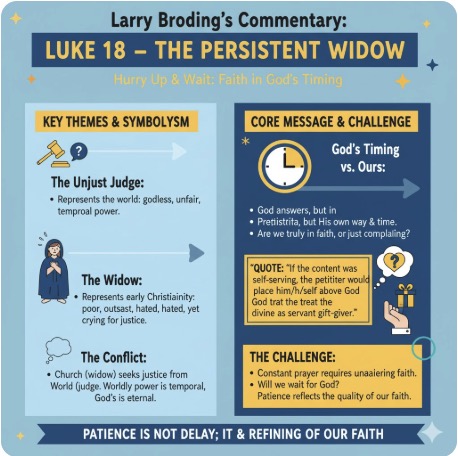
Broding moves beyond a simple lesson on persistence, offering a powerful symbolic reading of the parable. He paints a vivid picture of the unjust judge as the godless, unfair world, and the relentless widow as the early Church itself—poor, outcast, and hated, yet crying out for justice. This perspective transforms the story from a personal lesson into a dramatic depiction of the Church’s faith in a hostile world.
This commentary challenges us to look deeper at our own prayers. When we object to God’s timing, is it a request made in faith, or is it just complaining? Broding asks a piercing question about the nature of our petitions:
“If the content was self-serving, the petitioner would place him/herself above God and treat the divine as a servant gift-giver.”
For any preacher preparing to speak on the topics of prayer, patience, or what it means to have faith when deliverance seems far off, Broding’s commentary is an essential resource. It provides the depth and challenge needed to craft a homily that speaks directly to the heart of a waiting congregation.

Fr. Tim Peters teaches at Saint John’s Seminary in Camarillo
Fr. Tim Peters


Fr. Francis Martin

Hector Molina

Matt Zemanek

Fr. Bryan Kujawa



Diocese of Phoenix
29th Sunday of Year C

Christ in Our Neighborhood
Bishop John Dolan
This program aims to foster deeper relationships with Christ through weekly Scripture study and prayer in small faith communities. It was introduced in December 2022

More Discussion Guides
Fr. Thibodeau
Bible Study Notes
Bp. John P. Dolan
Fr. Tobin
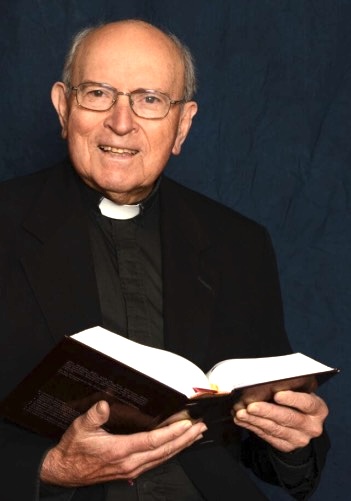
Fr. Conley Bertrand
29th Sunday of Year C
Cycle C (PDFs)
📖 Old Testament (43 pp.)
📖 Epistles (87 pp.)
📖 Gospels (182 pp.)
📖 Daily Gospels (208 pp.)
SOURCE: Come, Lord Jesus
Carmelite Reflections and Prayers
Lectio Divina
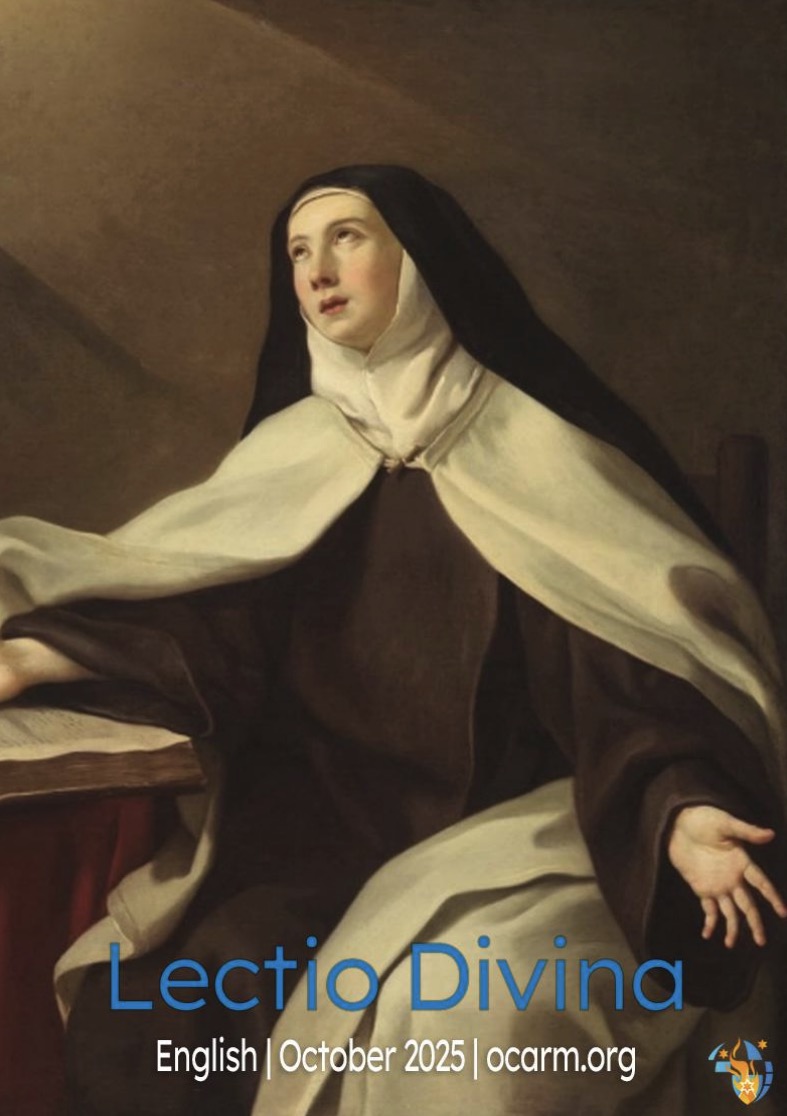
78-page PDF with reflections and prayers for each day of the month
Lectio Divina OCTOBER 2025 (PDF)
Lectio Divina OCTOBER 2025 [Mobi]
Lectio Divina OCTOBER 2025 [ePub]
______________
“Lectio divina is an authentic source of Christian spirituality recommended by our Rule. We therefore practise it every day, so that we may develop a deep and genuine love for it, and so that we may grow in the surpassing knowledge of Christ. In this way we shall put into practice the Apostle Paul’s commandment, which is mentioned in our Rule: “The sword of the Spirit, too, which is the word of God, is to dwell abundantly in your mouth and in your hearts; and whatever things you have to do, let them be done in the word of the Lord.” (Carmelite Constitutions (2019), n. 85.)
Source: Carmelites
Luke 18:1–8
1 And he told them a parable to the effect that they ought always to pray and not lose heart.
2 He said, “In a certain city there was a judge who neither feared God nor respected man.
3 And there was a widow in that city who kept coming to him and saying, ‘Give me justice against my adversary.’
4 For a while he refused, but afterward he said to himself, ‘Though I neither fear God nor respect man,
5 yet because this widow keeps bothering me, I will give her justice, so that she will not beat me down by her continual coming.’”
6 And the Lord said, “Hear what the unrighteous judge says.
7 And will not God give justice to his elect, who cry to him day and night? Will he delay long over them?
8 I tell you, he will give justice to them speedily. Nevertheless, when the Son of Man comes, will he find faith on earth?”
SOURCE: English Standard Version (ESV).
The Why Behind Prayer
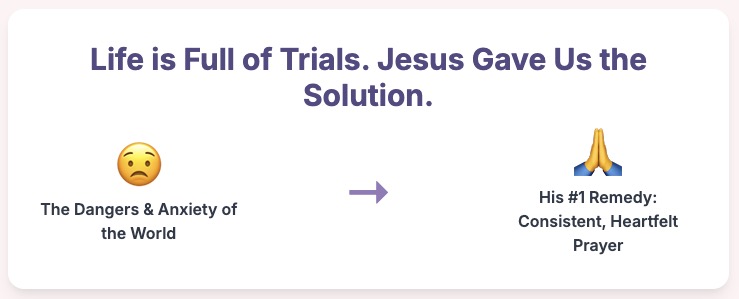
THEOPHYLACT After Jesus warned about the coming trials and dangers, he immediately gave the solution: consistent and heartfelt prayer.
CHRYSOSTOM The one who saved you has also shown you what he wants you to do. He wants you to be relentless in prayer, to really think about the blessings you’re asking for, and to ask so you can receive the good things He is eager to give you. He never denies His blessings to those who pray; instead, His mercy encourages people to not give up on praying. Joyfully accept the Lord’s encouragement. Be eager to do what He commands and avoid what He forbids. Finally, think about what an amazing gift you’ve been given: the ability to talk to God in your prayers and tell Him everything you need. And even though He doesn’t speak back in words, He answers you through His mercy. He never scoffs at your requests, and He never gets tired of listening; He only waits for you to speak.
BEDE We could say that a person who “prays always and not losing heart” is someone who never misses the designated times for prayer. Alternatively, everything a righteous person does and says with God in mind can be considered a form of prayer.
We often treat God like a cosmic vending machine. We put in a prayer, press the button, and get frustrated when the blessing we want doesn’t immediately drop into the tray. Jesus is telling us to see prayer as a relationship. It’s the ongoing conversation that deepens our trust, not a transaction to get what we want.

Unlocking the Parable

AUGUSTINE Jesus tells his parables for one of two reasons: either to draw a direct comparison or to teach by way of contrast, leading to a “how much more” conclusion. For example, “If God dresses the wildflowers that are here today and gone tomorrow, how much more will he take care of you?” He uses that same “how much more” logic here with the story of the unjust judge.
THEOPHYLACT It’s worth noting that showing disrespect to other people is a sign of deep-seated wickedness. There are many who don’t fear God but are kept in check by what others might think of them; they are less sinful. But when someone stops caring about the opinions of other people, their sinfulness becomes much worse.
AUGUSTINE You can think of the widow as a symbol for the Church, which often seems alone and abandoned while waiting for the Lord’s return, even though He is secretly watching over her.

A Cry for Justice, Not Revenge
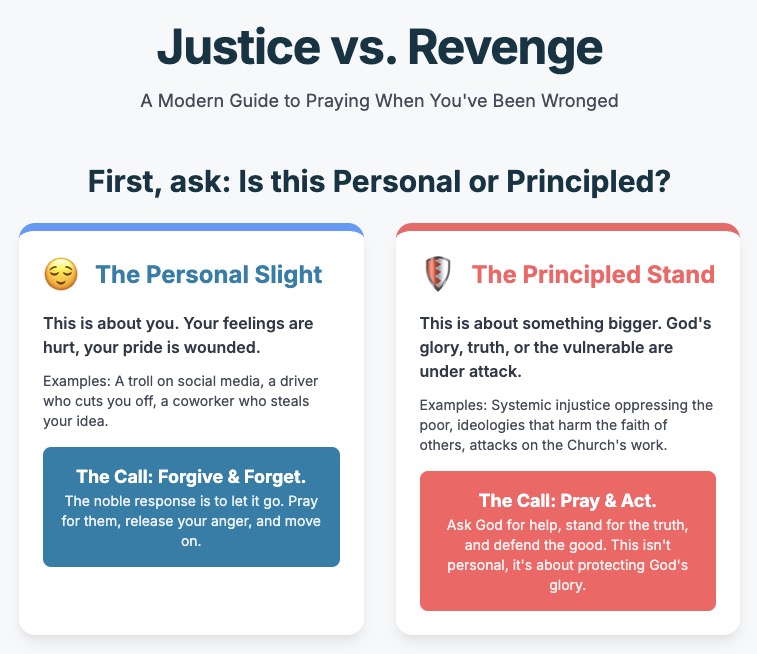
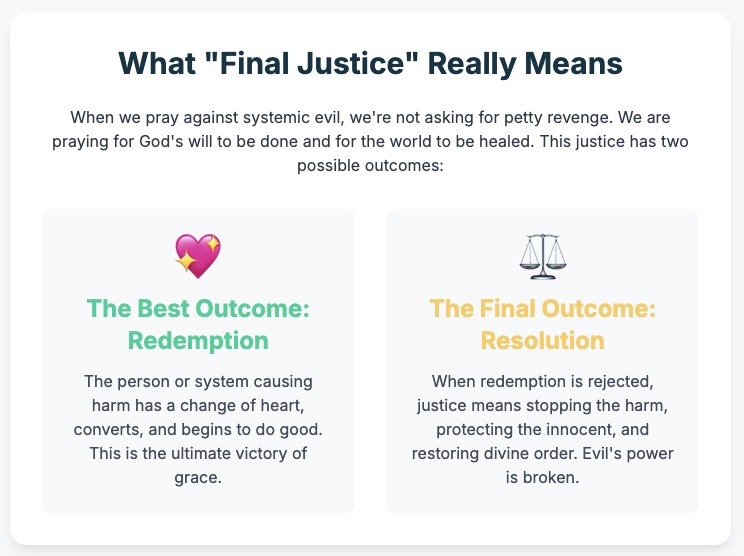
AUGUSTINE When the widow says, “Grant me justice against my adversary,” it explains why God’s chosen people pray for justice. This “justice” for the righteous should be understood as the end of wickedness, which happens in one of two ways: either the wicked convert and become righteous, or they are punished after rejecting their chance to change. Even if every person turned to God, the devil would still need to be condemned at the end of time. Since righteous people are eagerly waiting for this final justice, it’s not wrong for them to be described as wanting “vengeance.”
CYRIL OF ALEXANDRIA Here’s another way to look at it: When people personally harm us, the noble response is to forgive and forget. But when they attack God’s glory by attacking His servants or His Church, then we should go to God for help and boldly call out those who are dishonoring Him.
The Unfailing Logic of God’s Goodness
AUGUSTINE So, if the persistent pleading of the widow eventually won over even a completely corrupt judge, how much more confident should we be when we pray without stopping to God, who is the very source of all justice and mercy?
THEOPHYLACT It’s as if Jesus is saying, “If persistence can break down a judge who is stained by every kind of sin, how much more will our prayers move God, the Father of all mercy, to be merciful to us!”
Let’s take this a step deeper. Think of your soul as the widow. You have shed the “old man,” your sinful nature. Your “adversary” is the devil, who constantly accuses and attacks you. When you approach God, the truly righteous Judge, you are pleading your case against this adversary. Your persistence in prayer doesn’t change God’s mind, but it softens and changes your heart, opening it to receive the grace and mercy He is already pouring out for your deliverance.
The Haunting Final Question
THEOPHYLACT After teaching us that we need to turn to prayer to face the dangers of the last days, Jesus then adds, “Nevertheless, when the Son of Man comes, will he find faith on earth?”
AUGUSTINE Jesus is talking here about a perfect, complete faith, which is rarely found on earth. Look at how full the Church is—if there were no faith at all, no one would be here. But if there were perfect faith, wouldn’t we be moving mountains?
BEDE Jesus speaks this as if He’s unsure, not because He actually doubts, but to challenge us. It’s like when we ask a rhetorical question we already know the answer to, such as when correcting someone by saying, “Do I not provide for you?”
AUGUSTINE Jesus adds this to show that when faith disappears, prayer stops. Therefore, to pray, you must have faith. And to keep your faith from failing, you must pray. Faith is the source from which prayer flows, and the act of pouring out your heart in prayer is what makes your faith strong and steady.
Jesus asks this question not because He is in doubt, but to challenge us. It’s as if He’s saying, “After everything I’ve done for you, after promising you a direct line to the Father, will you really give up on me? Will you let your faith die out?” He’s showing us that when faith weakens, prayer is the first thing to go. And that brings us full circle. Faith is the engine of prayer. And prayer is the fuel that keeps our faith from failing. They are inseparable. So let us be found faithful. Let us be found praying.

