Papal Homilies
December 14, 2025
December 14, 2025
3rd Sunday of Advent (A)



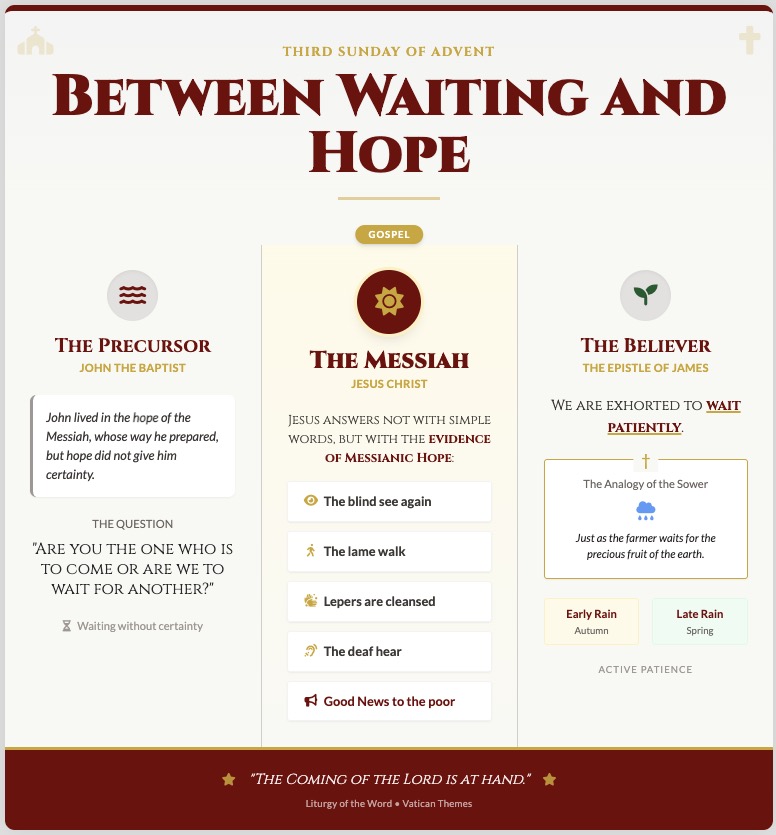
Infographic was created using Nano Banana Pro with Gemini 3.0. It draws inspiration from the commentary from the 2004-05 Dicastery for the Clergy Notes (YEAR A | B | C cf. text above), but is not officially associated with or endorsed by the Holy See. It may be copied for personal use or for use in any non-profit ministry.
Doctrinal Messages

Infographic was created using Nano Banana Pro with Gemini 3.0. It draws inspiration from the commentary from the 2004-05 Dicastery for the Clergy Notes (YEAR A | B | C cf. text above), but is not officially associated with or endorsed by the Holy See. It may be copied for personal use or for use in any non-profit ministry.
Pastoral Suggestions
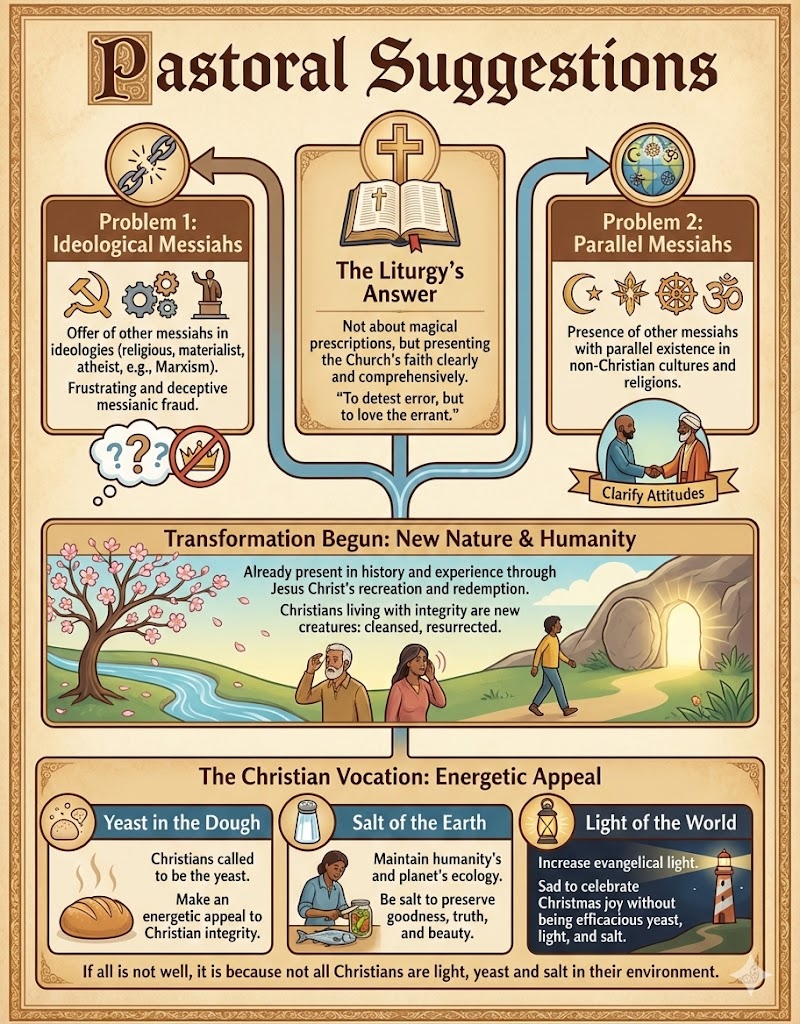
Infographic was designed using Nano Banana Pro with Gemini 3.0. It draws inspiration from the commentary from the 2004-05 Dicastery for the Clergy Notes (YEAR A | B | C cf. text above), but is not officially associated with or endorsed by the Holy See. It may be copied for personal use or for use in any non-profit ministry.
Featured Videos

Vatican Media Livestream allows viewers to witness the Pope's addresses during Papal Audiences, as well as other Vatican events and news. It is part of the Holy See's efforts to share the latest updates on Pope Leo XIV, the Holy See, and the Church worldwide with a global audience.

Pope Leo’s apostolic trip to Turkey and Lebanon was a significant ecumenical and interfaith mission that emphasized unity, hope, and peace, as he met with various religious leaders and delivered powerful messages to promote resilience and a better future amidst regional uncertainty.
- 00:00 Pope Leo’s first apostolic trip to Turkey and Lebanon is marked by a muted reception in Turkey, with few crowds and mixed responses from locals, despite an official welcome with a guard of honor and red carpet.
- 00:51 Pope Leo emphasizes the importance of honoring the dignity and freedom of all people in Turkey, where religion plays a significant role in society.
- 01:48 Pope Leo encourages Catholics in Turkey to find strength in their small numbers, promotes unity among Christians, and meets with Ecumenical Patriarch Bartholomew during his apostolic trip.
- 03:31 Pope Leo’s first apostolic trip to Turkey and Lebanon involved significant ecumenical and interfaith encounters, including a visit to the Blue Mosque and the Armenian Apostolic Cathedral, where he acknowledged the Armenian people’s suffering.
- 05:24 Pope Leo receives a warm welcome in Lebanon, a country with a dwindling Christian population, and delivers a speech praising the resilience of the Lebanese people amidst regional uncertainty and crisis.
- 06:49 Pope Leo’s apostolic trip to Turkey and Lebanon features emotional moments, including a golden rose presentation at Our Lady of Lebanon shrine and a joyful meeting with 15,000 young people at the Maronite Patriarchate.
- 08:06 Pope Leo delivers a powerful message to young people in Turkey and Lebanon, urging them to hold onto hope and work towards a better, more peaceful future.
- 09:32 Pope Leo concluded his six-day peace mission to Turkey and Lebanon, delivering a powerful appeal to a crowd of 150,000 in Beirut and paying respects to victims of the 2020 port blast.

DRM News (11:30)
Pope Leo emphasizes the importance of unity, peace, and living a life of goodness and faith, urging Christians to cultivate their spirituality and work towards global harmony and reconciliation, both within and outside the church.
- FULL: “Beat Swords Into Plowshares!” Pope Leo Delivers Fiery Speech in Historic Istanbul Mass | AC1G
- Pope Leo emphasizes the importance of unity, peace, and living a life of goodness and faith, urging Christians to cultivate their spirituality and work towards global harmony and reconciliation, both within and outside the church.
- 00:00 Pope Leo delivers a mass in Istanbul, reflecting on the significance of being part of the church and the importance of sharing God’s gifts with everyone, inspired by a passage from the prophet Isaiah.
- 02:25 The joy of goodness is contagious and can inspire others to faith, as seen in the lives of saints who were led to Christ through the witness of others.
- 03:26 Pope Leo urges Christians to cultivate their faith through prayer, sacraments, and charity, and to live a life of goodness, ready to welcome the Lord who comes every day.
- 04:38 Pope Leo calls for urgent global peace, unity, and reconciliation, citing Isaiah’s vision of a world where nations no longer war, and instead turn instruments of war into tools for growth and harmony.
- 05:29 Pope Leo emphasizes building bridges of unity on three levels: within the community, in ecumenical relations with other Christian denominations, and in encounters with people of other religions.
- 06:39 Pope Leo emphasizes the importance of unity within the church, highlighting that while it’s a gift from God, it also requires effort and maintenance to remain strong and be a credible sign of God’s love.
- 08:12 Pope Leo emphasizes the importance of unity among Christians and with non-Christian communities, citing ecumenism and shared faith in Jesus as key bonds of unity.
- 09:37 Pope Leo urges people to walk together, breaking down walls of prejudice and promoting mutual knowledge and esteem to become peacemakers, uniting in love for God and each other.

Pope Leo XIV visits Turkey to participate in an ecumenical Divine Liturgy with Orthodox leaders, specifically the Ecumenical Patriarch of Constantinople, in a symbolic gesture of Christian unity and shared faith.
- 00:00 Pope Leo XIV visits Turkey, attending a Divine Liturgy with the Ecumenical Patriarch of Constantinople, marking a significant ecumenical event.
- 13:03 Pope Leo XIV conducts Divine Liturgy and Ecumenical Blessing ceremony in Turkey, promoting unity and reverence.
- 26:15 Pope Leo XIV leads ecumenical divine liturgy in Turkey with Orthodox leaders, promoting faith and unity.
- 54:06 Pope Leo XIV leads Divine Liturgy in Turkey, praying for mercy, forgiveness, and peace, and professing faith in the Holy Trinity and the Church.
- 01:05:04 Pope Leo XIV leads Divine Liturgy and offers ecumenical blessing in Turkey, praying for unity and blessings among Orthodox leaders and churches.
- 01:23:35 Pope Leo XIV leads ecumenical Divine Liturgy in Turkey with Orthodox Patriarch, marking a significant moment in Christian unity.
- 01:55:11 Pope Leo XIV leads ecumenical blessing in Turkey, emphasizing Christian unity and shared faith amidst global conflict.
- 02:15:11 Pope Leo XIV visits Turkey, attending a divine liturgy with Ecumenical Patriarch Bartholomew I, highlighting unity among baptized Christians and 1700 years of shared faith.

The Gospel of this third Sunday of Advent speaks to us about John the Baptist who, while in prison, sends his disciples to ask Jesus: “Are you he who is to come, or shall we look for another?” (Mt 11:4). Indeed, John, hearing of Jesus’ works, is seized with doubt as to whether He is really the Messiah or not. In fact, he imagined a stern Messiah who would come and do justice with power by chastising sinners. Now, on the contrary, Jesus has words and gestures of compassion towards all; at the centre of His action is the mercy that forgives, whereby “the blind receive their sight and the lame walk, lepers are cleansed and the deaf hear, and the dead are raised up, and the poor have good news preached to them” (v. 6). It does us good, however, to look more closely at this crisis of John the Baptist, as it can tell us something important too.
The text emphasizes that John is in prison, and this, as well as being a physical place, makes us think of the inner situation he is experiencing: in prison there is darkness, there is no possibility of seeing clearly and seeing beyond it. In effect, the Baptist is no longer able to recognize Jesus as the awaited Messiah. He is assailed by doubt, and he sends the disciples to check: “Go and see if he is the Messiah or not”. It surprises us that this should happen to John, the one who had baptized Jesus in the Jordan and had indicated him to his disciples as the Lamb of God (cf. Jn 1:29). But this means that even the greatest believer goes through the tunnel of doubt. And this is not a bad thing; on the contrary, sometimes it is essential for spiritual growth: it helps us understand that God is always greater than we imagine Him to be. His works are surprising compared to our calculations; His actions are different, always, they exceed our needs and expectations; and therefore, we must never stop seeking Him and converting to His true face. A great theologian used to say that God “needs to be rediscovered in stages… sometimes believing that we are losing Him” (H. DE LUBAC, Sur les chemins de Dieu). This is what the Baptist does: in doubt, he still seeks Him, questions Him, “argues” with Him and finally rediscovers Him. John, defined by Jesus as the greatest among those born of women (cf. Mt 11:11), teaches us, in short, not to close God within our own mindsets. This is always the danger, the temptation: to make ourselves a God to our measure, a God to use. And God is something else.
Brothers and sisters, we too at times find ourselves in his situation, in an inner jail, unable to recognize the newness of the Lord, whom we perhaps hold captive in the presumption that we already know everything about Him. Dear brothers and sisters, one never knows everything about God, never! Perhaps we have in mind a powerful God who does what He wants, instead of the God of humble meekness, the God of mercy and love, who always intervenes respecting our freedom and our choices. Perhaps we even find ourselves saying to Him: “Are you really you, so humble, the God who is coming to save us?”. And something similar can happen to us with our brothers and sisters too: we have our ideas, our prejudices and we attach rigid labels to others, especially those we feel are different to us. Advent, then is a time for overturning our perspectives, for letting ourselves be surprised by God’s mercy. Astonishment: God always astonishes. We saw, not long ago, in the television programme “A Sua Immagine”, they were talking about wonder. God is always the One who stirs wonder in you. A time – Advent – in which, preparing the Nativity display for the Infant Jesus, we learn again who our Lord is; a time to leave behind certain preconceptions and prejudices about God and our brothers and sisters. Advent is a time in which, instead of thinking about gifts for ourselves, we can give words and gestures of consolation to those who are wounded, as Jesus did with the blind, the deaf and the lame.
May Our Lady take us by the hand, like a mother, may she take us by the hand in these days of preparation for Christmas, and help us recognize in the smallness of the Infant the greatness of God who is coming.


On this Third Sunday of Advent, the Liturgy presents to us a passage from the Letter of St James, which opens with this exhortation: “Be patient, therefore, brethren, until the coming of the Lord” (Jas 5:7). It seems to me especially important, in our day, to underline the value of constancy and persistence, virtues which belonged to the normal baggage of our ancestors but today are less popular, in a world which exalts, rather, the change and capacity to adapt oneself to ever new and diverse situations.
Taking nothing from these features, which are also human qualities, Advent calls us to develop inner tenacity, resistance of the spirit, which enables us not to despair while waiting for a good that is slow in coming, but on the contrary to prepare for its coming with active trust.
“Behold,” James writes, “the farmer waits for the precious fruit of the earth, being patient over it until it receives the early and the late rain. You also be patient. Establish your hearts, for the coming of the Lord is at hand” (Jas 5:7-8).
The comparison drawn with the farmer is very expressive, he has sown the field and has before him several months of patient and constant waiting, but he knows that in the meantime the seed completes its cycle, thanks to the autumn and spring rains. The farmer is not a fatalist but the model of a mentality which unites faith and reason in a balanced way. For on the one hand he knows the laws of nature and does his work well, and on the other, he trusts in Providence, because certain fundamental things are not in his hands but in the hands of God. Patience and constancy are truly a synthesis between human commitment and confidence in God.
“Establish your hearts”, Scripture says. How can we do this? How can we strengthen our hearts, already somewhat frail in themselves and rendered even more unstable by the culture in which we are immersed. Help is not lacking; it is the Word of God. In fact, while everything else passes and changes, the Word of the Lord is not transient. If the events of life make us feel bewildered and every certainty seems to crumble, we have a compass to guide us, we have an anchor to prevent us from drifting away.
Here the model offered to us is that of the prophets, namely those people whom God called so that they might speak in his name. The prophet finds his joy and strength in the word of God and while humans often search for happiness in ways that prove erroneous, he announces true hope, which does not disappoint because it is founded on the fidelity of God.
Every Christian, by virtue of Baptism, has received prophetic dignity. May each one rediscover and nourish it, by listening assiduously to the divine Word. May the Virgin Mary, whom the Gospel calls blessed because she believed in the fulfilment of the words of the Lord, obtain this for us (Lk 1:45).
3rd Sunday of Advent (A)
28 November 2010 | St Peter’s Square
