September 21, 2025
September 21, 2025
Advent | Christmas | Lent | Easter | Solemnities | Ordinary Time | Luke's Gospel


Homily Notes
Papal Homilies
Papal Homilies
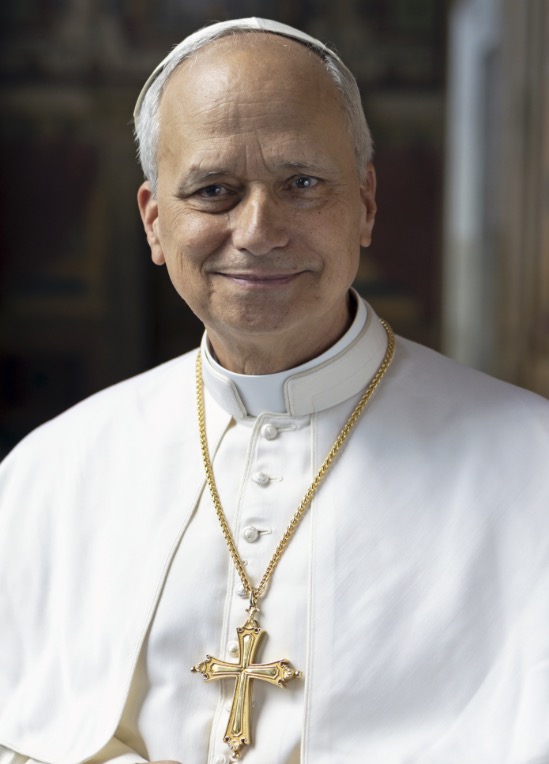


True Riches

This Sunday’s liturgical texts essentially ask the question of where true riches lie. The first reading answers this question by stating that true riches cannot live side by side with ambition and avarice to the detriment of the poor and needy. Nor does it lie in the ability to make friends with other people’s riches. The children of light understand that true riches are stored in Heaven (Gospel). This way of seeing things doesn’t come to us naturally; we can only achieve it through prayer (Second Reading).
© 2000 Dicastery for the Clergy A | B | C
DOCTRINAL MESSAGE
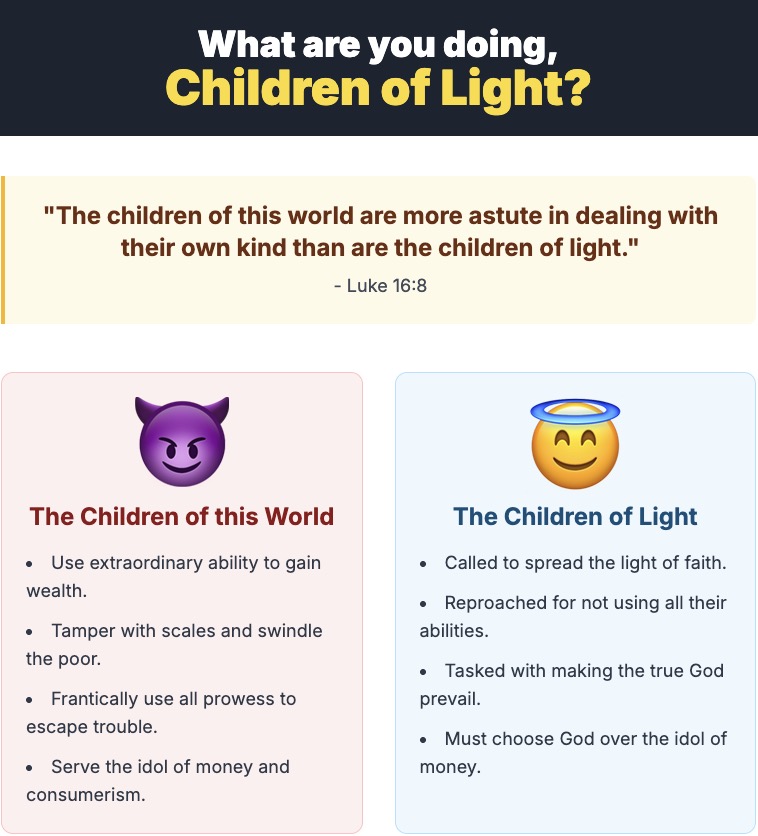
What are you doing, children of light? The expression "children of light" seems to refer to the early Christians, who had been enlightened by the risen and glorious Christ by means of baptism. In contrast with this expression, we have the expression "children of this world," which refers to all those whose life is governed by a worldly and "economic" attitude rather than a religious attitude.
The Gospel’s verdict is striking, it even gives us the goose bumps, "For the children of this world are more astute in dealing with their own kind than are the children of light." Why does this judgment seem as important today as it was 20 centuries ago? What is going on with the children of light?
- The children of this world know how to make extraordinary use of their abilities, and use their ambition to tamper with the scales unfairly and to openly swindle the poor, and even reduce other men to slavery because they themselves have gone bankrupt (First Reading).
- In adverse circumstances, the children of this world franticly use all their prowess to get out of the awkward situation they find themselves in (Gospel).
Jesus reproaches the children of light for not resorting to all lawful means in order to spread the light of faith. He also reproaches their failure to use all their abilities to find ways to overcome adversity and bring the light to many other people. One cannot love the God of Jesus Christ and the "god of money."
The God of Jesus Christ has every right to prevail over the "god of money," who is nothing more than an idol. The children of light have been entrusted with the mission of making the true God, the Supreme Good and true treasure of man, prevail over the idol of money. In society, the idol of money and consumerism has an increasing number of worshippers; shouldn’t we ask ourselves what the children of light are doing about it?
Prayer, the place of true understanding of the self. We find the light and strength to work for our true wealth through prayer. The Christian prays for all people, for kings and queens, and for all those who hold power. The very act of praying for all these people shows we place above them the God who is the true treasure - a treasure that never be destroyed and that will never exhaust itself. In prayer, we understand that God will judge the arrogance of the rich, whose abuse cries out to the God of Justice (First Reading). In prayer, it is easier to understand that man’s riches consist in the richness of his faith. It is indeed in the oven of prayer that we bake the daily bread of faith and of fraternal solidarity. The praying person who raises his pure hands to Heaven, devoid of all anger or rivalry, discovers the richness of salvation and grace, which are given to us by Jesus Christ the Mediator, and he will be able to more easily give a proportioned importance to any other riches of this world. He is enlightened so that he may understand that all earthly goods come from God, that man is only their administrator, and that he must administer them well. Could the prayerful man ever swindle God, the Giver of all riches; could he be arrogant with those who lack goods and riches? In the school of prayer we come to realize that earthly riches and goods are only a means to better serve others; a means that will allow us to be welcomed in the eternal dwelling once we leave the administration of this world and present ourselves before God’s judgment.
PASTORAL SUGGESTIONS
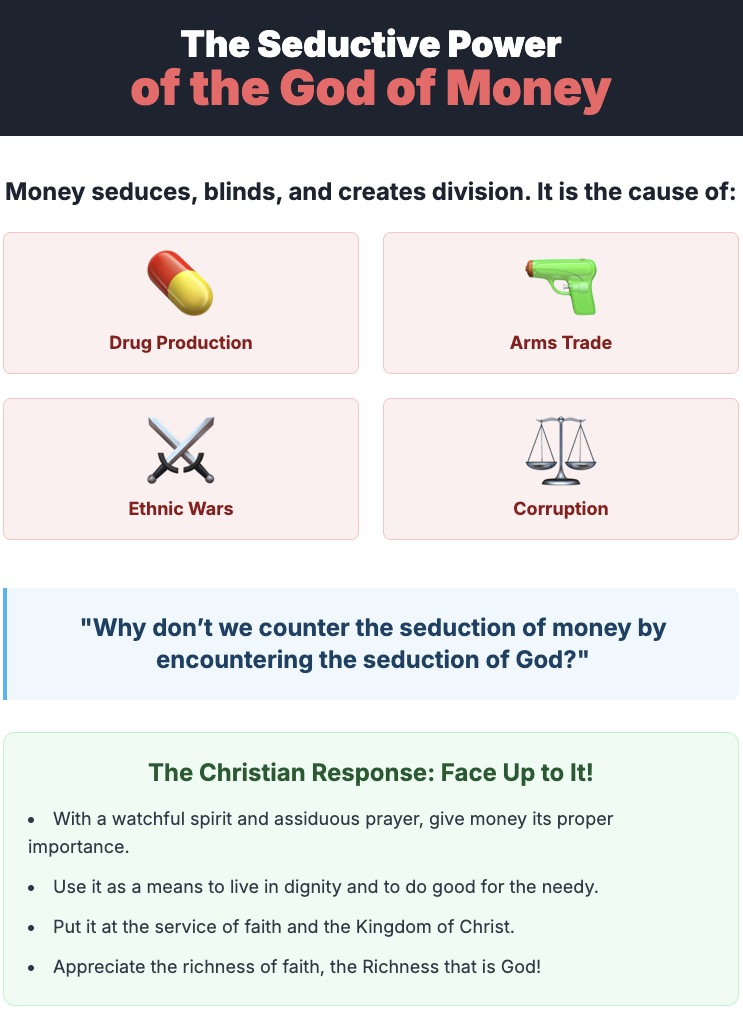
The seductive power of the god of money. In a largely consumerist and materialistic society such as our own, the god of money can hypnotize even the best of Christians. If we get to the very heart of things, isn’t the worship of the god of money the main cause for the production of drugs? Isn’t our insatiable desire for money the greatest driving force behind the production and sale of armaments to governments that should be using such funds to create infrastructures for the social and cultural development of their countries? Isn’t the god of money the most powerful incentive fueling the ethnic wars in several African countries? How do we explain the corruption of many leaders if not on the grounds that they have erected an altar to this god? Money seduces, blinds, and creates fraternal divisions. It awakens the instinct of ambition, it makes even the most inviolable and noble principles succumb, it hardens the heart, dehumanizes and even makes one forget God. As believers, we must keep our eyes open to this reality and temptation, which is difficult to overcome. With a watchful spirit and assiduous prayer, we must practice to give the proper importance to money, to put it in the place that it was meant to occupy in God’s plans, to use it as a means to live in dignity, to do good unto the needy, to put it at the service of faith and of the Kingdom of Christ. Let us not be afraid of its seductive power. Let us face up to it. Let us live our daily life in the effort to appreciate more and more the richness of faith, the Richness that is God. Why don’t we counter the seduction of money by encountering the seduction of God? The living and personal God is the best antidote against all the idols that may come knocking on the door of our heart.
A Prayer for the rich. Faith is a treasure that God grants to all who ask for it. The Church is a community of believers, in which there is room for all. It is true that the Church makes a preferential option for the poor, and this is more than justified. However, the Church belongs to all and is for all. This is why I urge you to recite a prayer for the rich.
Visual Summary of Dicastery Notes


Reflection Questions and Infographics were generated using Google Gemini 2.5 AI tools (w/ Chart.js and Tailwind CSS). Feel free to use them in any non-profit ministry. A Link or shoutout to THE WORD THIS WEEK would be greatly appreciated.
The Dishonest Steward
18 September 2022- Saint Peter’s Square

For each part, click on the chevron banners following each infographic to access discussion guides for parishes and schools, or use the questions for your preaching preparation.
Click on infographics to enlarge

The Manager's Reaction to Crisis
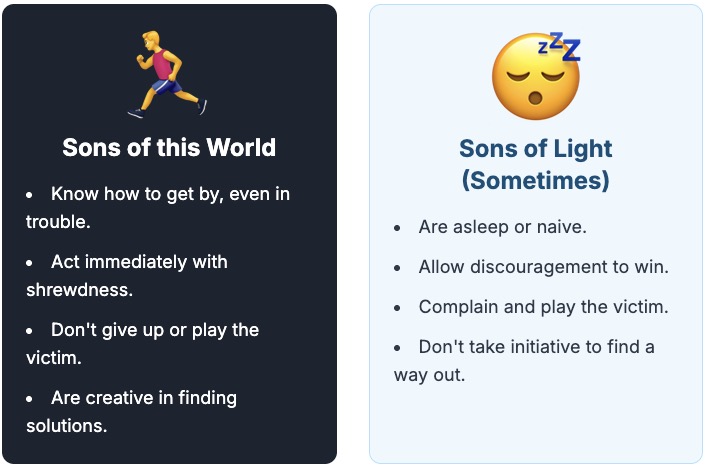
Pope Francis says: "[The manager] does not give up, he does not resign himself to his fate and does not play the victim. On the contrary, he acts immediately with shrewdness, he looks for a solution and is creative."
Discussion Questions:
- What strikes you most about the manager's reaction when he learns he will be fired? Why do you think Pope Francis emphasizes that he "does not play the victim"?
- Think of a time you faced a personal, professional, or spiritual crisis. Was your first instinct to act creatively to find a solution, or was it to feel discouraged, overwhelmed, or to complain?
- In what ways can "playing the victim" be a spiritual trap that prevents us from acting?
Reflection Questions and Infographics were generated using Google Gemini 2.5 AI tools (w/ Chart.js and Tailwind CSS). Feel free to use them in any non-profit ministry. A Link or shoutout to https://thewordthisweek.net/ would be appreciated.
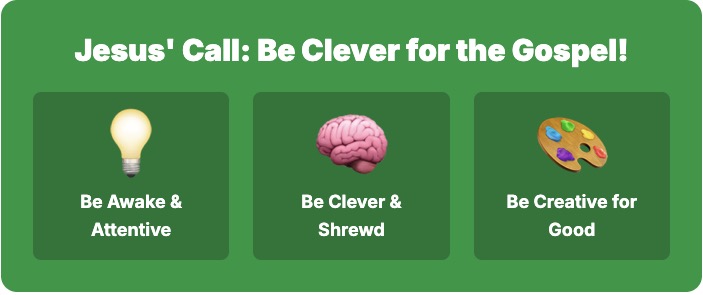
The Steward's Strategic Shift
Jesus says: “The sons of this world are more shrewd in dealing with their own generation than the sons of light” (Lk 16:8).
Pope Francis says: "...those who move in darkness, by certain worldly standards, know how to get by even when in trouble, they know how to be more shrewd than others. Instead, Jesus’ disciples, namely ourselves, sometimes are asleep or naive, not knowing how to take the initiative..."
Discussion Questions:
- In what specific ways do you see the "sons of this world" being shrewd, creative, and proactive today (in business, marketing, politics, technology, etc.)?
- Why do you think we as Christians are sometimes "asleep or naive"? What holds us back from taking more initiative for the sake of the Gospel? Is it fear, comfort, lack of creativity, or something else?
- Can you think of an example where the Church or a Christian group was truly shrewd and creative in spreading the Gospel or serving others? What made it so effective?
Pope Francis says: "Before, he was accumulating wealth for himself, but now he uses it... to make friends who can help him in the future. Jesus, thus, gives us a teaching on how we use material goods: 'Make friends for yourselves by means of unrighteous mammon...'"
Discussion Questions:
- What is the fundamental change in the manager's strategy? How does he shift from thinking about things to thinking about relationships?
- Jesus tells us to use "unrighteous mammon" (worldly wealth) to make friends. What does this "mammon" look like in your own life (e.g., your money, your home, your time, your talents)?
- Pope Francis says that to inherit eternal life, "what matters is the love we will have expressed in our fraternal relations." How does this challenge the way our culture typically measures a "successful" life?
Reflection Questions and Infographics were generated using Google Gemini 2.5 AI tools (w/ Chart.js and Tailwind CSS). Feel free to use them in any non-profit ministry. A Link or shoutout to https://thewordthisweek.net/ would be appreciated.

Jesus' Invitation to Generosity
Pope Francis says: "...do not use the goods of this world only for yourselves and for your selfishness, but use them to create friendships, to create good relationships, to act with charity, to promote fraternity and to show care for the weakest."
Discussion Questions:
- Pope Francis gives a very practical list for how to use our goods. Which of these actions—creating friendships, acting with charity, promoting fraternity, caring for the weakest—do you find most natural? Which is the most challenging for you?
- Think of a time when sharing a material good or your time helped you build a stronger relationship with someone. What happened?
- In what ways can a selfish or fearful attitude toward our possessions actually isolate us from others and prevent the friendships God wants for us?
Reflection Questions and Infographics were generated using Google Gemini 2.5 AI tools (w/ Chart.js and Tailwind CSS). Feel free to use them in any non-profit ministry. A Link or shoutout to https://thewordthisweek.net/ would be appreciated.

Our Creative Response in a Flawed World
Pope Francis says: "But we Christians are not allowed to become discouraged, or worse, to let go of things, remaining indifferent. On the contrary, we are called to be creative in doing good... using the goods of this world... not to enrich ourselves, but to generate fraternal love and social fellowship."
Discussion Questions:
- The Pope acknowledges our world has "dishonest conduct, unfair policies," and other "murky situations." Why is being "creative in doing good" a more powerful response than simply becoming discouraged or complaining?
- What does the phrase "social friendship" mean to you? How can using our material goods generously help build not just individual relationships, but a healthier and more connected community?
- Brainstorm one creative, practical way your family or this group could use a shared resource (money, time, a space) this month to "generate fraternal love and social fellowship" in your wider community.
Reflection Questions and Infographics were generated using Google Gemini 2.5 AI tools (w/ Chart.js and Tailwind CSS). Feel free to use them in any non-profit ministry. A Link or shoutout to https://thewordthisweek.net/ would be appreciated.
The Dishonest Steward
23 September 2007 | St Clement’s Square
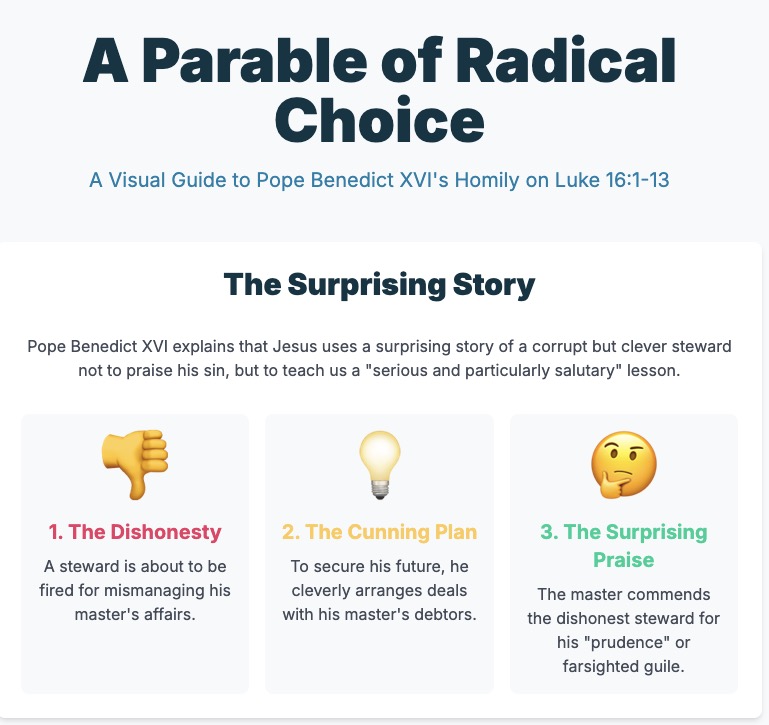
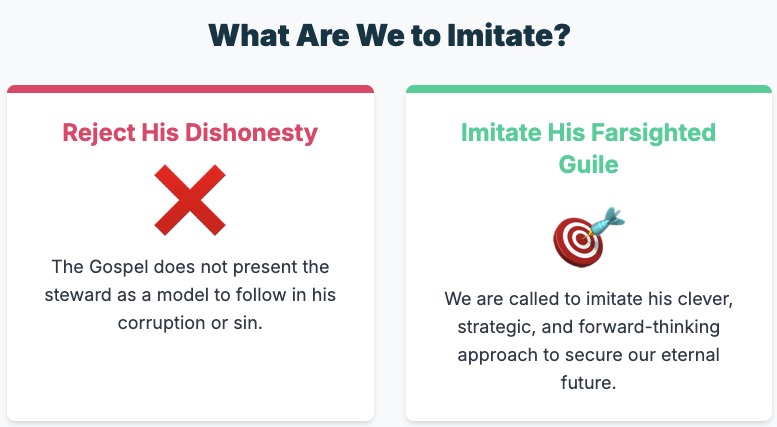
Imitating Guile, Not Dishonesty
Pope Benedict XVI says: "The Gospel does not present him to us as a model to follow in his dishonesty, but rather as an example to be imitated for his farsighted guile... how much more concerned we Christians must be to provide for our eternal happiness with the goods of this earth."
Discussion Questions:
- What is the difference between the steward's dishonesty (which we should reject) and his farsighted guile (which we should imitate)?
- Pope Benedict says worldly people are often prepared to be dishonest for an "unpredictable material well-being." In what areas of our own lives are we tempted to be lazy or passive about our "eternal happiness"?
- What would it look like to apply the steward's level of strategic, farsighted thinking to your spiritual life or to the mission of the Church?
Reflection Questions and Infographics were generated using Google Gemini 2.5 AI tools (w/ Chart.js and Tailwind CSS). Feel free to use them in any non-profit ministry. A Link or shoutout to https://thewordthisweek.net/ would be appreciated.

The Fundamental Choice – God or Mammon?
Pope Benedict XVI says: "Life is truly always a choice: between honesty and dishonesty... between selfishness and altruism... Ultimately, Jesus says, 'You cannot serve God and mammon'... it is necessary to make a fundamental decision between God and mammon."
Discussion Questions:
- Pope Benedict defines "mammon" as making "economic success a person's true god." What are some modern idols in our culture that compete with God for our ultimate allegiance?
- The Pope contrasts the "logic of profit" with the "logic of sharing and solidarity." What are some practical examples of these two logics at work in our society? In our own lives?
- Pope Benedict frames this as a choice between "God and Satan." Why do you think he uses such strong, ultimate terms for this decision?
Reflection Questions and Infographics were generated using Google Gemini 2.5 AI tools (w/ Chart.js and Tailwind CSS). Feel free to use them in any non-profit ministry. A Link or shoutout to https://thewordthisweek.net/ would be appreciated.

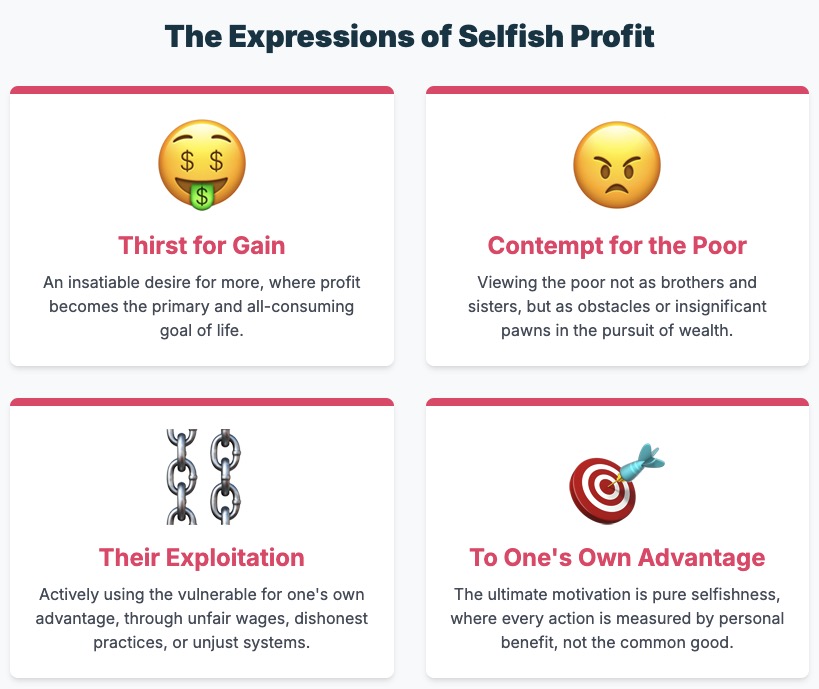
Good Stewards of God's Gifts
Pope Benedict XVI says: "The only way of bringing our personal talents and abilities and the riches we possess to fruition for eternity is to share them with our brethren, thereby showing that we are good stewards of what God entrusts to us."
Discussion Questions:
- This teaching calls us to see our possessions, talents, and abilities not as our own, but as things "God entrusts to us." How does this shift in perspective change your relationship with your own resources?
- The Prophet Amos, as mentioned by the Pope, condemns contempt for the poor and their exploitation. How can we, as "good stewards," actively work against this in our daily lives and economic choices?
- Jesus says, "He who is faithful in a very little is faithful also in much." What is a "very little" thing you are being called to be faithful in right now?
Reflection Questions and Infographics were generated using Google Gemini 2.5 AI tools (w/ Chart.js and Tailwind CSS). Feel free to use them in any non-profit ministry. A Link or shoutout to https://thewordthisweek.net/ would be appreciated.
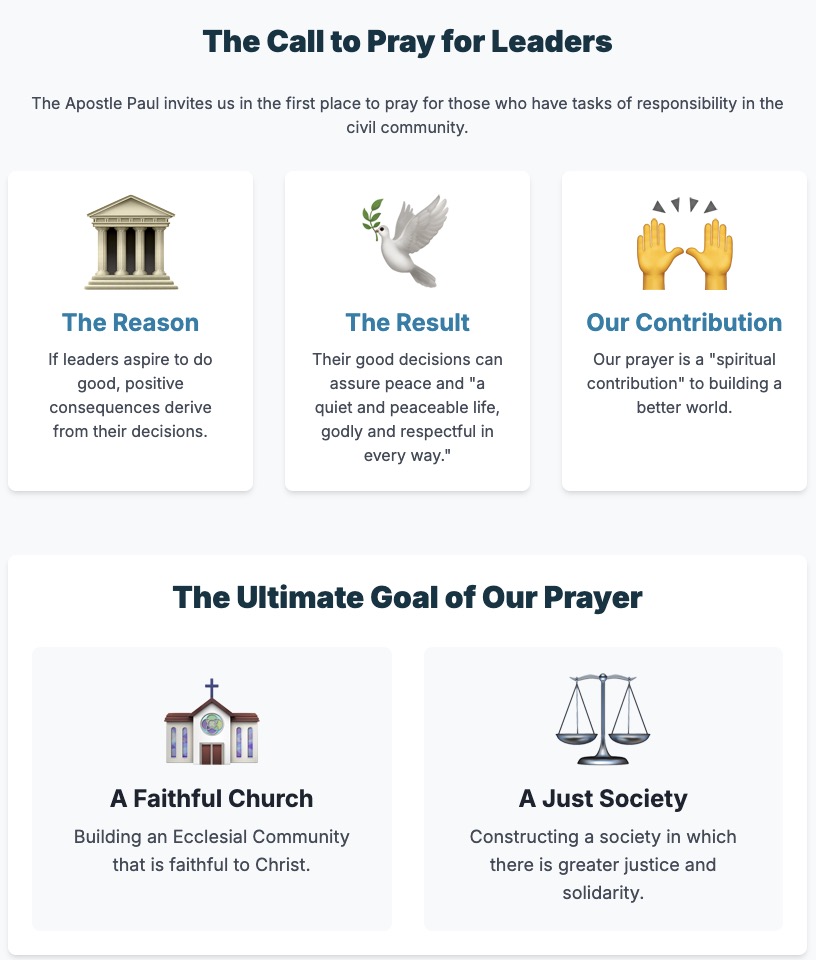
Prayer as the Foundation for a Just Society
Pope Benedict XVI says: "Praying for others is a great act of charity... may our prayer never be lacking, a spiritual contribution to building an Ecclesial Community that is faithful to Christ and to the construction of a society in which there is greater justice and solidarity."
Discussion Questions:
- The Pope, referencing St. Paul, notes that praying for civic leaders helps assure peace and a quiet life. How can praying for leaders, especially those you may disagree with, help you to choose the "logic of solidarity" over the "logic of profit" or division?
- How does prayer help us reject the selfishness condemned by Amos and open our hearts to "authentic generosity"?
- In what way is prayer a "spiritual contribution" to building a more just society?
Reflection Questions and Infographics were generated using Google Gemini 2.5 AI tools (w/ Chart.js and Tailwind CSS). Feel free to use them in any non-profit ministry. A Link or shoutout to https://thewordthisweek.net/ would be appreciated.
 Highlight text or double-click a paragraph anywhere on the site to ADD TO NOTES. You can also click ASK AI to copy your selection to the clipboard with a command prompt, ready for you to paste manually into the chat above.