Papal Homilies, Leo XIV, Pope Francis, Benedict XVI, Sunday Readings

Papal Homilies Leo XIV, Pope Francis, Benedict XVI, Sunday Readings

Papal Homilies Leo XIV, Pope Francis, Benedict XVI, Sunday Readings

Papal Homilies Leo XIV, Pope Francis, Benedict XVI, Sunday Readings

October 19, 2025

October 19, 2025

DICASTERY NOTES 2000POPE FRANCISPOPE BENEDICT XVI
create an engaging colorful vatican church oriented infographic with title “Faith to Obedience” in three column format based on

Everything is a gift for those who live by faith. We are not entitled to it, but must humbly ask for it in our prayer. Thus the widow in the parable does not grow tired of begging the judge for justice, until she receives an answer (Gospel). Moses, in turn, accompanied by Aaron and Hur, do not cease to raise their hands and heart to Yahweh so that they Israelites may have an advantage over the Amalekites (First Reading). Through the study of and meditation on the scripture, “This is how someone who is dedicated to God becomes fully equipped and ready for any good work” (Second Reading).

© 2000 Dicastery for the Clergy A | B | C

Click infographics to enlarge


Doctrinal Messages

SHOW/HIDE DICASTERY NOTES

To pray in order to receive. In the spiritual life everything is a gift; nothing may be received without a humble and constant prayer to God. With such prayer, we open the door to God’s heart in an invisible yet real and effective way. "Without me you can do nothing." "Anything is possible for he who believes," for he who prays with faith. God is so good that even without praying we receive many things from him. What is absolutely certain is that if we ask God for the things that Jesus teaches us to ask him for, and in the way which he teaches us to do so, God will grant them to us. The widow in the parable suffers from the injustice of men. Only the judge can do her justice, which is why she pursues him day after day until she obtains it. If we translate the parable into real terms, God will certainly judge human injustice. If we elevate our supplication to God, he will listen to us and will answer our petition. If Moses, Aaron, and Hur had not begged God for the Israelites to have an advantage over the Amalekites, would they have achieved what they wanted? Their prayer, more than the sword, was what made their victory possible. The prayerful Christian has been equipped by God, as Timothy was, to perform his tasks appropriately: knowledge of the scriptures, faithfulness to the inherited tradition, the proclamation of the Gospel. This Sunday’s liturgical texts give an extraordinary value to prayer, as a constitutive element of orthopraxis and as a foundation of spiritual progress and of all victories in the daily battles of faith. One must pray to receive, but also to give according to the gift one has received. God’s gift will be accompanied by the action of man, which will in turn be based on the gift itself. Victory belongs to God, but man must apply the means in order for God’s action to be effective. Without Joshua’s sword, there would have been no victory, but the sword alone, without God’s intervention would have led to defeat. Without Timothy’s effort to be primarily a good Jew and then a good disciple of Paul’s, God would not have been able to prepare him to carry out his mission as leader of the Ephesus community. As in Jesus the human and the divine merge inseparably but without becoming confused, so in the spiritual life of the Christian the divine and the human converge, maintaining their identity, to yield a single result. Eliminating one of the two terms would inflict a deadly mutilation upon man, unless God intervenes extraordinarily.

INFOGRAPHIC

Click infographics to enlarge

Click on banners to show/hide content


SHOW/HIDE DICASTERY NOTES

Characteristics of the praying person. 1) The prevailing feature in the texts is perseverance in prayer. Without such perseverance the widow would not have obtained justice, nor would the people of Israel have defeated the Amalekites. A perseverance that according to our human way of thinking may even seem inopportune, but that pleases and moves God. A perseverance that may be demanding, even harsh, and require a great effort, as in the case of Moses, but that God blesses.

2) The praying person begs the Lord because he is very much aware of his need and of his powerlessness to meet that need on his own. Only God can bridge the gap between the pusillanimity of the praying person and the need that compels him. The people of Israel felt the urgent need to defeat the Amalekites, without which they would not be able to reach the promised land. However, at the same time they realized their smallness before the magnitude of such an enterprise. They turned to Yahweh to obtain from him the victory that they longed for.

3) The praying person must have a deep belief. If one does not have faith in the One we are asking, what is prayer for? Wouldn’t that turn prayer into a pantomime? One either prays with faith, or forgets about prayer once and for all. The decrease or increase in prayer is proportional to the decrease or increase in one’s faith life.

INFOGRAPHIC

Click to enlarge

Click on banners to show/hide content


Pastoral Suggestions

SHOW/HIDE NOTES

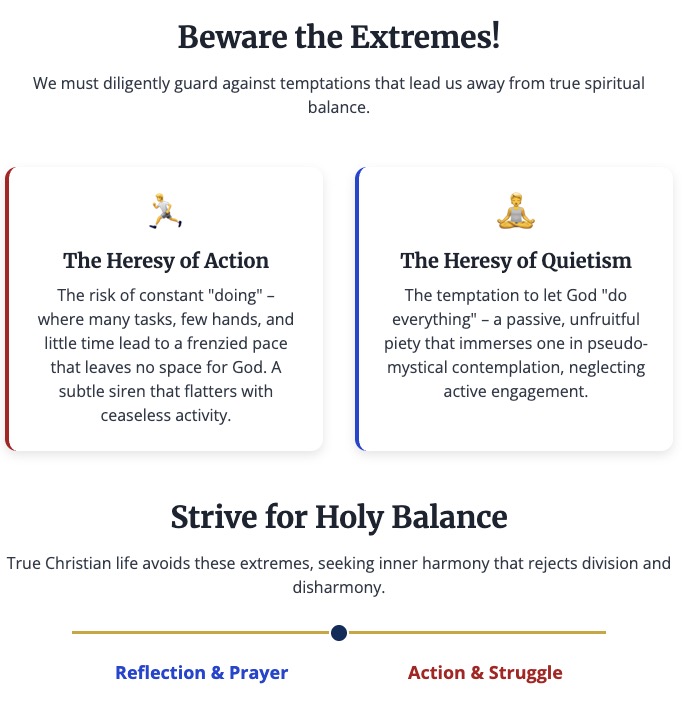
Prayer and action, reflection and struggle. Saint Benedict used to teach his monks, "Ora et labora." "Do not pray without working or work without praying." From then on, it has been clear that we are not talking about prayer and action as two separate paths. In the Church we pray, but actively, placing in our prayer our tasks and concerns of the day. At the office, in the field, in the factory, at home we work, but making God part of our work, because God is among the pots and pans, as Saint Theresa of Avila rightly said. Therefore, man does not compartmentalize his daily life or his Sunday in hours of work, on the one hand, and moments of prayer on the other. To put it in a better way, when he prays he is working but in a different way, and when he works, he is praying but according to a different approach. The Christian thus experiences and preserves great inner harmony, leaving aside all forms of unnatural division, rejecting with determination any form of rupture and disharmony. Indeed, today there is the risk of falling prey to the heresy of action, because there are many tasks and few men and little time to carry them out. Aren’t there parish priests who perhaps are tempted by this subtle heresy, by this siren which flatters their ears with the music of febrile action that leaves no space or time for God? Today, albeit less frequently, Christians may be tempted by the heresy of quietism, letting God do everything by immersing themselves in a pseudo-mystical, passive and unfruitful piety. Neither one nor the other are attitudes proper of a true Christian. Let us make an effort to keep the scale balanced between reflection and struggle, between action and prayer.

INFOGRAPHIC

Click to enlarge


SHOW/HIDE NOTES

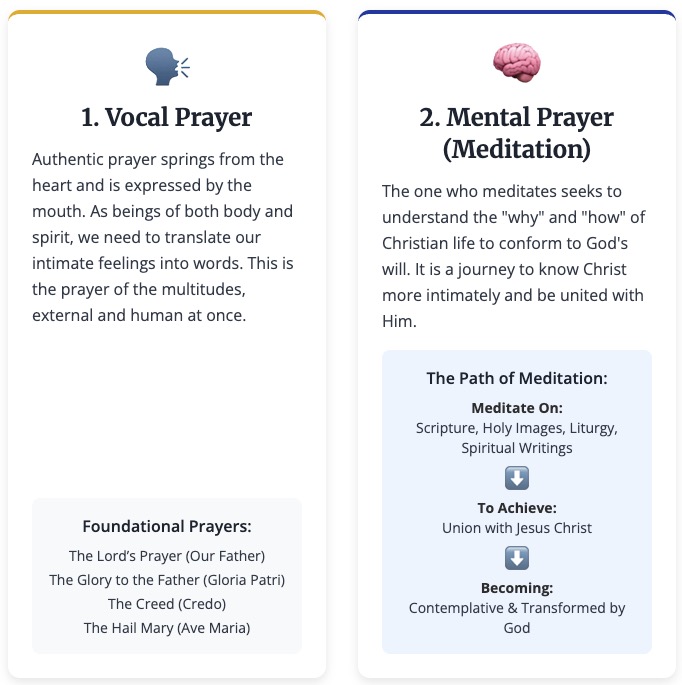
Different ways of praying. The Church teaches us that there are different ways of praying.

1) Vocal prayer. In order for prayer to be authentic, it must spring from the heart but be expressed by our mouth. This is why the most beautiful Christian prayer is a vocal prayer, taught by Jesus himself: the Lord’s Prayer. The Gospels, on different occasions, narrate that Jesus prayed, and some of these accounts provide us with Jesus’ vocal prayers, for example during his agony in the Gethsemane. Vocal prayer is like a need of our human nature. We are body and spirit, and we experience the need to translate into words our most intimate feelings. Vocal prayer is the prayer of the multitudes par excellence, for it is external and human at once. In the Church there are some very beautiful vocal prayers, which children learn in catechesis and that nourish our faith life throughout our entire life. In addition to the Lord’s Prayer, we have the Glory to the Father, the Creed, the Hail Mary. They are prayers that nourish the piety of Christians from the beginning of life until its natural end.

2) Mental prayer or meditation. He who meditates seeks to understand the why and how of Christian life in order to conform to God’s will. This is why one meditates on the Sacred Scriptures, on holy images, on the texts of the liturgy, on the writings of the spiritual fathers, etc. Christian prayer especially lends itself to meditation on "the mysteries of Christ" in order to know them better, and especially in order to be united with him. When this union with Jesus Christ is achieved, prayer then becomes contemplative and the entire being of the praying person feels transformed by the spiritual and profound experience of the living God.

INFOGRAPHIC

Click to enlarge

Click on banners to show/hide content

Non-profit ministries have permission to copy/paste any infographics on this website into bulletins, presentations, or class/home school worksheets. A link and/or shoutout to THE WORD THIS WEEK and respective contributors would be greatly appreciated.

The Gospel parable which we have just heard (cf. Lk 18:1-8) contains an important teaching: we “ought always to pray and not lose heart” (v. 1). This means, then, pray constantly, not just when I feel like it. No, Jesus says that we ought “always to pray and not lose heart”. And he offers the example of the widow and the judge.
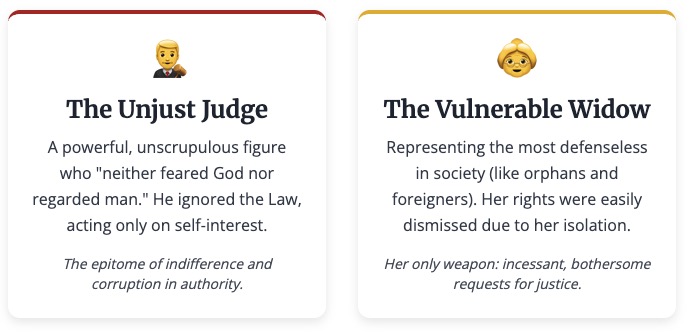
The judge is a powerful person, called to issue judgment on the basis of the Law of Moses. That is why the biblical tradition recommended that judges be people who fear God, who are worthy of faith, impartial and incorruptible (cf. Ex 18:21). However, this judge “neither feared God nor regarded man” (Lk 18:2). As a judge, he was unfair, unscrupulous, who did not take the Law into account but did whatever he wanted, according to his own interests. It was to him that a widow turned for justice. Widows, along with orphans and foreigners, were the most vulnerable groups of society. The rights afforded them by the Law could be easily disregarded because, being isolated and defenceless, they could hardly be assertive. A poor widow, there, alone, with no one to defend her, might be ignored, might even be denied justice. Just as the orphan, just as the foreigner, the migrant: in that time this was a very serious problem. Faced with the judge’s indifference, the widow has recourse to her only weapon: to bother him incessantly with her request for justice. And because of her insistence, she achieves her end. At a certain point, the judge grants her request, not because he is moved by mercy or because his conscience has been working on him; he simply admits: “because this widow bothers me, I will vindicate her, or she will wear me out by her continual coming” (v. 5).

From this parable Jesus draws two conclusions: if the widow could manage to bend the dishonest judge with her incessant requests, how much more will God, who is the good and just Father, “vindicate his elect, who cry to him day and night”; moreover, will not “delay long over them”, but will act “speedily” (vv. 7-8).

That is why Jesus urges us to pray and “not to lose heart”. We all go through times of tiredness and discouragement, especially when our prayers seem ineffective. But Jesus assures us: unlike the dishonest judge, God promptly answers his children, even though this doesn’t mean he will necessarily do it when and how we would like.
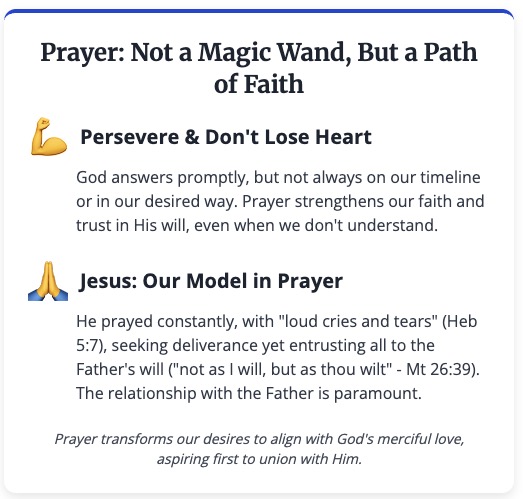
Prayer does not work like a magic wand! It helps us keep faith in God, and to entrust ourselves to him even when we do not understand his will. In this, Jesus himself — who prayed constantly! — is our model. The Letter to the Hebrews reminds us that “In the days of his flesh, Jesus offered up prayers and supplications, with loud cries and tears, to him [God] who was able to save him from death, and he was heard for his godly fear” (5:7). At first glance this statement seems far-fetched, because Jesus died on the Cross. Yet, the Letter to the Hebrews makes no mistake: God has indeed saved Jesus from death by giving him complete victory over it, but the path to that [victory] is through death itself! The supplication that God has answered referred to Jesus’ prayer in Gethsemane. Assailed by looming anguish, Jesus prays to the Father to deliver him of this bitter cup of the Passion, but his prayer is pervaded by trust in the Father and he entrusts himself entirely to his will: “not as I will,” Jesus says, “but as thou wilt” (Mt 26:39). The object of prayer is of secondary importance; what matters above all is his relationship with the Father. This is what prayer does: it transforms the desire and models it according to the will of God, whatever that may be, because the one who prays aspires first of all to union with God, who is merciful Love.

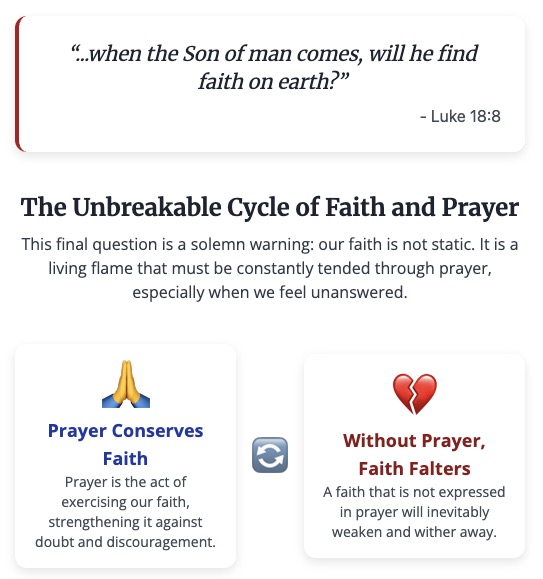
The parable ends with a question: “when the Son of man comes, will he find faith on earth?” (v. 8). And with this question we are all warned: we must not cease to pray, even if left unanswered. It is prayer that conserves the faith, with out it faith falters! Let us ask the Lord for a faith that is incessant prayer, persevering, like that of the widow in the parable, a faith that nourishes our desire for his coming. And in prayer let us experience that compassion of God, who like a Father comes to encounter his children, full of merciful love.
Click on infographics to enlarge

Click on infographics to enlarge

This Sunday’s Gospel presents Jesus healing 10 lepers, of whom only one, a Samaritan and therefore a foreigner, returned to thank him (cf. Lk 17: 11-19). The Lord said to him: “Rise and go your way; your faith has made you well” (Lk 17: 19).

This Gospel passage invites us to a twofold reflection. It first evokes two levels of healing: one, more superficial, concerns the body. The other deeper level touches the innermost depths of the person, what the Bible calls “the heart”, and from there spreads to the whole of a person’s life. Complete and radical healing is “salvation”. By making a distinction between “health” and “salvation”, even ordinary language helps us to understand that salvation is far more than health: indeed, it is new, full and definitive life.

Furthermore, Jesus here, as in other circumstances, says the words: “Your faith has made you whole”. It is faith that saves human beings, re-establishing them in their profound relationship with God, themselves and others; and faith is expressed in gratitude. Those who, like the healed Samaritan, know how to say “thank you”, show that they do not consider everything as their due but as a gift that comes ultimately from God, even when it arrives through men and women or through nature. Faith thus entails the opening of the person to the Lord’s grace; it means recognizing that everything is a gift, everything is grace. What a treasure is hidden in two small words: “thank you”!