Commentary Intro to Mass Readings Sunday Readings
CommentaryIntro to Mass Readings Sunday Readings
July 5, 2026
⭐⭐⭐ Hearers of the Word—PDF | VIDEO


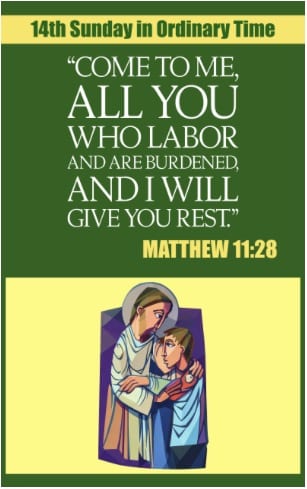
Our Sunday Readings *
Edrianne Ezell
Scripture Study for Catholics *
Vince Contreras
Hearers of the Word *
Fr. O’Mahony OSA
Friar Musings, OFM *
Fr. George Corrigan, OFM
Echoing God’s Word *
Fr. Clement Thibodeau


Fr. Francis Martin

Brant Pitre

Kevin Aldrich

14th Sunday of Year A
Zechariah 9:9-10
XXXXXXXXXXXXXXXXXXXXXXX list ten questions divided into sections, with each section having a
title, based on the following that a preacher could ask an AI Catholic assistant for help with as the preacher prepares his homily. Do not use phrases such as “The text notes refer to” “The commentary suggests”. Instead use “xxxxxxx refers” and “xxxxxxx suggests” . Whenever possible though it is best to cite a specific verse or verses of the reading when writing the question. Do not place questions in quotation marks.
Create a verse by verse (NAB) commentary relating xxxxxxxxxxxxx TO CATHOLIC doctrine and practice. Give real life applications when appropriate
Verse 9 "Rejoice heartily, O daughter Zion, shout for joy, O daughter Jerusalem! See, your king shall come to you; a just savior is he, meek, and riding on an ass, on a colt, the foal of an ass."
Commentary:
The prophet opens with an explosive command to rejoice and shout for joy. This is not merely emotional sentiment but the proper response of the People of God to the coming of their King. The "daughter Zion" personifies Jerusalem and, by extension, the whole covenant people awaiting their Messiah.
The phrase "your king shall come to you" is intensely messianic. The Church recognizes here a direct prophecy of Christ. The Evangelists explicitly cite this verse at the Triumphal Entry on Palm Sunday—Matthew 21:5 and John 12:15 both quote Zechariah to identify Jesus as this prophesied King. This is a foundational point of Catholic Christology: Jesus is the fulfillment of the Old Testament hope, the long-awaited Davidic King.
Notice the threefold description of this King:
- "A just savior" — He comes bearing righteousness and salvation. The Hebrew here conveys that He is vindicated/saved by God and brings salvation to His people. Catholic doctrine sees Christ as both the one who is justified by the Father (vindicated in the Resurrection) and the source of our justification (cf. CCC 1992, Christ won our justification through His Passion).
- "Meek" — The King comes in humility, not in worldly pomp. This anticipates the Beatitude, "Blessed are the meek" (Matthew 5:5), and reveals the paradox at the heart of Christ's kingship: He reigns from the Cross. The Catechism teaches that Christ's kingship is exercised through humble service (CCC 786).
- "Riding on an ass... the foal of an ass" — The donkey is a beast of peace and humility, in stark contrast to the war-horse of conquering kings. Solomon rode a mule to his coronation (1 Kings 1:38-40), so the image is royal, yet deliberately lowly. Jesus deliberately fulfilled this prophecy, choosing the donkey to declare the nature of His reign.
A note on the Hebrew parallelism: The "ass" and the "colt, the foal of an ass" refer to a single animal described in poetic parallelism, not two separate animals. Matthew's account (which mentions both the donkey and the colt) reflects his careful attention to the exact wording of the prophecy rather than a misreading.
Real-Life Application:
Christ still comes to us "meek"—in the humble appearance of bread in the Eucharist, in the ordinary person who needs our help, in the quiet of prayer. We often look for God in dramatic, powerful ways, while He comes riding the donkey of the ordinary. For your parishioners: where might Christ be entering their lives humbly, while they await Him in spectacle? This verse also calls each of us to imitate the King's meekness—in our families, in disagreements at work, in the patience we show toward difficult people.
Verse 10 "He shall banish the chariot from Ephraim, and the horse from Jerusalem; the warrior's bow shall be banished, and he shall proclaim peace to the nations. His dominion shall be from sea to sea, and from the River to the ends of the earth."
Commentary:
If verse 9 reveals the humility of the King, verse 10 reveals the universality and peace of His reign.
"He shall banish the chariot... the horse... the warrior's bow" — These are the instruments of war. The Messiah's Kingdom is not established by violence or military might but by peace. This dismantling of weapons echoes Isaiah's vision of swords beaten into plowshares (Isaiah 2:4) and Micah 4:3. Christ's Kingdom is the Kingdom of Peace—pax Christi. The Catechism affirms that Christ is "our peace" (Ephesians 2:14) who reconciles all things in Himself.
"He shall proclaim peace to the nations" — The Hebrew word here is shalom, far richer than mere absence of conflict. It means wholeness, well-being, right relationship with God and neighbor. Crucially, this peace extends to "the nations" (Hebrew goyim, the Gentiles). This is the universal scope of salvation—the Messiah comes not only for Israel but for all peoples. This grounds the Church's missionary mandate (CCC 849-856): the Gospel is for every nation.
"His dominion shall be from sea to sea... to the ends of the earth" — This echoes Psalm 72:8, a royal psalm of the Davidic King. The reach of the Messiah's reign is catholic in the truest sense—universal. This is fulfilled in the Catholic Church spread throughout the world and in the eschatological hope of Christ the King, whose reign we celebrate on the Solemnity of Our Lord Jesus Christ, King of the Universe.
A doctrinal point: The Church teaches that Christ's Kingdom is "already, but not yet." It was inaugurated in His first coming (the Triumphal Entry, the Cross, the Resurrection) but will only be fully realized at His second coming. We live in this tension, praying "Thy Kingdom come" while building up the Kingdom now.
Real-Life Application:
In a world torn by war, division, and political hostility, this verse is profoundly relevant. Christ "banishes the chariot"—He calls His followers to be peacemakers. For parishioners, this means:
- Being agents of reconciliation in fractured families and communities
- Resisting the temptation to "win" through aggression, gossip, or domination
- Supporting the Church's consistent witness for peace and the dignity of every human life
The universality of His dominion ("to the ends of the earth") reminds us that no one is outside the reach of God's mercy. There is no person, no nation, no situation beyond Christ's redeeming peace.
Algorithmically generated text
This is one of the most theologically rich images in the prophetic literature, and it rewards careful attention. The choice of the donkey is not incidental—it is a deliberate, layered symbol that the Gospel writers recognized as a precise prophecy of Christ. Let me address both the significance of the mount itself and the way Matthew and John connect it to Jesus.
The Significance of the Donkey
1. A Beast of Peace, Not of War
The most important contrast is between the donkey and the war-horse. In the ancient Near East, a king riding a horse—especially with chariots—came as a conqueror, a warlord arriving for battle or triumphal procession after victory. The horse was the supreme instrument of military power.
The donkey, by contrast, was a humble animal of peace, burden, and ordinary labor. By choosing the donkey, the prophet declares that this King comes not to wage war but to establish peace. This connects directly to the very next verse, where the King "shall banish the chariot... the horse... the warrior's bow" and "proclaim peace to the nations" (Zechariah 9:10). The mount and the message are one: a King of peace.
2. A Royal—Yet Humble—Tradition
Crucially, the donkey was not only a symbol of lowliness. In Israel's history, it also carried royal associations. When Solomon was made king, he rode on King David's own mule to his anointing at Gihon (1 Kings 1:38-40). Judges and noble figures in Israel rode donkeys (Judges 5:10, 10:4).
So the image holds a beautiful paradox: the donkey is genuinely royal and genuinely humble. This King is no pretender—He is the true Davidic heir—yet His kingship is exercised in meekness, not domination. He is, as the verse says, both a King and "meek."
3. Continuity with Ancient Prophecy
The image also reaches back to the patriarch Jacob's blessing of Judah: "He tethers his donkey to the vine, his purebred ass to the choicest stem" (Genesis 49:11), part of the prophecy that "the scepter shall never depart from Judah" (Genesis 49:10). The Messiah from the tribe of Judah is thus associated with the donkey from the earliest messianic prophecies.
4. The Hebrew Parallelism
A point worth noting for your own clarity: the phrase "on an ass, on a colt, the foal of an ass" employs classic Hebrew poetic parallelism. It describes a single young animal in two complementary phrases—"an ass" and then more specifically "a colt, the foal of an ass." It is one donkey, poetically described, not two animals. This becomes important when we look at Matthew's account below.
How the Gospels Connect This to Jesus
Both Matthew and John explicitly cite Zechariah 9:9 when narrating Jesus's triumphal entry into Jerusalem on Palm Sunday, identifying Him unmistakably as the prophesied King.
Matthew's Account (Matthew 21:1-11)
Matthew quotes the prophecy directly, blending Zechariah 9:9 with a phrase from Isaiah 62:11. He writes that this took place to fulfill what was spoken through the prophet: "Say to daughter Zion, 'Behold, your king comes to you, meek and riding on an ass, and on a colt, the foal of a beast of burden'" (Matthew 21:4-5).
A note on Matthew's "two animals": Matthew uniquely mentions that the disciples brought both an ass and a colt (Matthew 21:2, 7). Some have mistakenly read this as Matthew misunderstanding the Hebrew parallelism. The better interpretation is that Matthew, writing for a Jewish audience deeply familiar with the Scriptures, was being scrupulously faithful to the exact wording of the prophecy—he records that both animals were present (the colt and its mother, which would naturally accompany an unbroken young colt), precisely to show the prophecy's literal fulfillment. Jesus, of course, rode the colt. Matthew's attention to detail reflects his concern to demonstrate that every word of the prophets was fulfilled in Christ.
John's Account (John 12:12-16)
John also cites the prophecy, in a slightly abbreviated form: "Fear no more, O daughter Zion; see, your king comes, seated upon an ass's colt" (John 12:15).
John adds a profoundly important detail about the disciples' understanding: his disciples did not understand this at first, but when Jesus had been glorified they remembered that these things had been written about him and done to him (John 12:16). This is a key insight—the full meaning of the prophecy and the triumphal entry was only grasped after the Resurrection, in light of Christ's glorification. The Holy Spirit illuminated for the disciples what they had witnessed but not comprehended in the moment.
The Theological Heart of the Matter
What unites both Gospel accounts is the recognition that Jesus deliberately and consciously fulfilled this prophecy. He did not enter Jerusalem on a donkey by accident. By sending His disciples to procure the colt and riding it into the Holy City, Jesus was making a public, prophetic, royal declaration: I am the King Zechariah foretold—the meek King of peace, the Son of David.
Yet He chose the mount that revealed the nature of His kingship. He came not to seize Jerusalem by force, not to lead a military revolt against Rome (which is what many in the crowd hoped for), but to ascend the throne of the Cross and reign through self-emptying love. The donkey proclaimed in advance that this King's victory would come not through conquest but through humility, suffering, and peace.
This is why the crowds' cries of "Hosanna to the Son of David!" were both true and incomplete—they hailed Him as King, but they expected a conquering Messiah. The donkey already announced a different kind of triumph, one they would only understand after Calvary and the empty tomb.
For Your Preaching
The pastoral richness here is considerable:
- The deliberate humility of God — Christ chose the lowly mount, revealing that true kingship is exercised in humility and service, not domination.
- The danger of misreading the King — The crowds wanted a worldly conqueror and were disappointed; we, too, can want a God who delivers us on our terms, by power and spectacle, rather than the humble King who saves through the Cross.
- Understanding comes after glorification (John 12:16) — Like the disciples, we often understand God's work in our lives only in hindsight, illuminated by grace. This is a great consolation for those in the midst of confusion or suffering.
A powerful homiletic thread: the King we welcome on Palm Sunday with palm branches is the same King we follow to the Cross by Friday. The donkey of peace leads to the throne of the Cross—and that is precisely how He conquers.
Algorithmically generated text
This is a beautiful pastoral instinct—and it lies at the very heart of what makes Zechariah 9:9 so spiritually fertile. The prophet's image of the King who comes "meek, and riding on an ass" is not merely a historical detail about Palm Sunday; it reveals the permanent pattern of how God chooses to come to us. He comes low, hidden, and unassuming. Helping your parishioners recognize this pattern can transform how they encounter Christ in their daily lives.
Let me offer a framework, drawing out the three modes you named, with concrete homiletic and pastoral approaches.
The Foundational Insight: God's "Preference for the Lowly"
Begin by establishing the pattern that runs through all of salvation history. The God of the Bible consistently chooses the small, the hidden, and the humble over the powerful and the spectacular:
- He comes to Elijah not in the wind, earthquake, or fire, but in "a light silent sound"—a tiny whispering sound (1 Kings 19:11-13).
- He chooses the youngest son, David, the overlooked shepherd boy (1 Samuel 16).
- The eternal Word enters the world not in a palace but in a manger, wrapped in swaddling clothes (Luke 2).
- The Messiah rides not a war-horse but a donkey (Zechariah 9:9).
- He saves the world not from a throne but from a Cross.
The key homiletic point: God's humility is not an exception to His majesty—it is the very expression of it. The same God who is "Lord of heaven and earth" comes to us riding on an ass. If we are always scanning the horizon for God in power and spectacle, we will miss Him, because He comes humbly. The challenge for our people is to retrain their eyes to recognize Him where He actually appears.
1. Christ Comes Humbly in the Eucharist
This is the supreme continuation of Zechariah's prophecy. The King who hid His majesty under the lowliness of a donkey now hides His glory under the appearance of bread and wine.
The connection to make: Just as the crowds on Palm Sunday could have walked right past a man on a donkey, so today a person can walk right past the Tabernacle without recognizing the King of the Universe present there. The Eucharist is the ultimate "meek and humble" coming of Christ—true God and true man, veiled under the humblest of forms.
- St. Thomas Aquinas captured this in Adoro te devote: the Godhead lies hidden, and what looks like mere bread requires the eyes of faith to perceive.
- This is why Eucharistic Adoration is so powerful—it is learning to see the King who comes humbly, to recognize Him under the appearance of bread as the Palm Sunday crowds recognized Him under the appearance of an ordinary traveler.
Pastoral application: Invite your people to approach the Eucharist with the eyes of faith. The same reverence and joy that greeted Christ entering Jerusalem should mark how they receive Holy Communion and how they genuflect before the Tabernacle. Encourage a visit to the Blessed Sacrament during the week—a quiet, unspectacular encounter with the humble King.
2. Christ Comes Humbly in the Poor
Here the connection deepens powerfully. Christ identified Himself directly with the lowly: "Whatever you did for one of these least brothers of mine, you did for me" (Matthew 25:40). The King who came riding humbly continues to come to us in the face of the poor, the suffering, the marginalized, and the forgotten.
The connection to make: The donkey-riding King has a "preferential love" for the lowly because He Himself came low. To encounter the poor is to encounter Christ in a privileged way—the Church teaches that the poor are a "sacrament" of Christ's presence (cf. CCC 2449, on the Church's love for the poor).
- St. Teresa of Calcutta spoke of serving Christ in His "distressing disguise" among the poorest of the poor.
- St. Vincent de Paul, St. Martin of Tours (who clothed the beggar and saw Christ), and countless saints recognized the humble Christ in the needy.
Pastoral application: Challenge your parishioners to ask, "Where is the King coming to me this week disguised as someone in need?"—the lonely neighbor, the difficult family member, the person at work everyone ignores, the homeless person they would rather not see. The temptation is to look for God in the impressive and to overlook Him in the inconvenient. Yet that is precisely where He comes.
3. Christ Comes Humbly in Ordinary Life
This is perhaps the most overlooked mode and the most transformative for daily Christian living. The humble King does not reserve His comings for dramatic moments. He comes in the ordinary, the routine, the small duties of daily life.
The connection to make: Just as Christ's entry looked unremarkable to the casual observer, so His presence in the ordinary fabric of life often goes unnoticed. The spiritual life is largely the art of recognizing Him there.
- This is the heart of the "little way" of St. Thérèse of Lisieux—finding holiness and the presence of God in small, hidden, ordinary acts done with great love.
- It is the spirituality of the "sacrament of the present moment" (Jean-Pierre de Caussade)—God comes to us in the duties and encounters of each ordinary moment.
- It echoes the hidden life of the Holy Family at Nazareth, where God lived thirty hidden years in utter ordinariness.
Pastoral application: Help your people see that they do not need to wait for a mountaintop experience to meet Christ. He comes in the morning offering, the patient caregiving of a sick spouse, the faithful labor of work, the meal shared with family, the small sacrifice made in love. The "spectacle" we crave is rarely where God is; the donkey-path of the ordinary is His chosen road.e negotiated for ourselves—even when that life comes in forms we did not expect.
Algorithmically generated text
This is a profound question that opens directly onto one of the richest veins in Catholic social and spiritual teaching. Let's address both dimensions—the doctrinal foundation of Christ as our peace, and the Church's prophetic witness for peace in a divided world.
The Prophetic Image: Disarmament as the Mark of the Messiah
When Zechariah declares that the Messiah "shall banish the chariot from Ephraim, and the horse from Jerusalem; the warrior's bow shall be banished" (9:10), he is making a stunning theological statement. The chariot, the horse, and the bow were the supreme instruments of ancient warfare—the "tanks and artillery" of their day. Their removal signals that the Messianic Kingdom will not be established by military conquest or coercive power.
This is the deliberate counterpoint to verse 9. The King comes "meek, and riding on an ass"—a beast of peace and burden, not the war-horse of a conquering general. The mount and the disarmament together proclaim a single truth: the Messiah's reign is a reign of peace. He does not merely win wars; He abolishes the very means of war.
Importantly, the text says the King Himself banishes these weapons. This is not the disarmament imposed by a defeated enemy, but the peace established by the victorious King through entirely different means—through the Cross.
Christ Our Peace: The Doctrinal Foundation
The Catholic understanding of this prophecy centers on St. Paul's declaration in Ephesians: "He is our peace" (Ephesians 2:14). Note that Paul does not say Christ merely brings peace or teaches peace—Christ is our peace in His very person.
Several layers of Catholic doctrine flow from this:
1. Peace as Reconciliation with God. The deepest division is not between nations but between humanity and God, caused by sin. Christ's Passion reconciles us to the Father. As St. Paul writes, "making peace by the blood of his cross" (Colossians 1:20). The Catechism teaches that Christ destroyed the enmity in His own flesh, reconciling both Jew and Gentile to God in one body through the Cross (cf. Ephesians 2:14-16). The disarmament of Zechariah is fulfilled most deeply when Christ disarms the powers of sin and death.
2. Peace as a Gift, Not a Worldly Achievement. Christ says, "Peace I leave with you; my peace I give to you. Not as the world gives do I give it to you" (John 14:27). The pax Christi is qualitatively different from the pax Romana—the false peace imposed by force. The world's peace is the silence after conquest; Christ's peace is the shalom of right relationship, wholeness, and communion.
3. Peace as the Fruit of the Holy Spirit. Peace is listed among the fruits of the Spirit (Galatians 5:22) and is a sign of the Kingdom of God, which St. Paul describes as "righteousness, peace, and joy in the Holy Spirit" (Romans 14:17). True peace is interior before it is exterior—it begins in the soul reconciled to God.
4. Peace and the Tranquility of Order. The Catholic tradition, following St. Augustine, defines peace as tranquillitas ordinis—"the tranquility of order." Peace is not merely the absence of conflict but the presence of right order: justice, charity, and the proper relationship of all things to God. This is why the Church insists that there can be no peace without justice (Opus iustitiae pax—"peace is the work of justice," Isaiah 32:17).
The Church's Witness for Peace in a Divided World
The prophecy's vision of disarmament is not merely a description of Christ's first coming—it is a mandate that the Church carries forward. The Catholic Church has developed one of the most robust bodies of teaching on peace of any institution in the world.
The Beatitude of the Peacemakers. Christ declares, "Blessed are the peacemakers, for they shall be called children of God" (Matthew 5:9). Note: not the peace-keepers or the peace-lovers, but the peace-makers—those who actively labor to build peace. This is the vocation of every Christian.
The Modern Magisterium. The Church's social teaching has spoken with remarkable consistency on peace:
- St. John XXIII's encyclical Pacem in Terris (1963) grounded peace in the four pillars of truth, justice, charity, and freedom, and addressed it to "all people of good will."
- St. Paul VI famously declared before the United Nations, "No more war, war never again!" and instituted the World Day of Peace (January 1st), observed annually since 1968.
- St. John Paul II tirelessly opposed the arms race and the logic of nuclear deterrence, and gathered religious leaders at Assisi to pray for peace.
- The Catechism devotes a substantial section to peace and the avoidance of war (CCC 2302-2317), teaching that peace is not merely the absence of war and is threatened by injustice, hatred, and the unequal distribution of resources.
The "Banishing of the Bow" Today. The prophet's image of banished weapons finds direct echo in the Church's call for disarmament. Echoing Isaiah and Micah, the vision of beating swords into plowshares (Isaiah 2:4) inspires the Church's persistent advocacy for an end to the arms race, the reduction of weapons, and care for the victims of war.
Preaching This in a Divided World
For your homily, the pastoral power of this text lies in its application to the divisions our people actually live in. The "chariots and horses" of our day are not only literal weapons but the instruments of division we wield daily:
- The weapons of the tongue — gossip, contempt, the harsh word, the social-media attack
- The chariots of political tribalism — the hostility that fractures families, parishes, and communities along partisan lines
- The bow of unforgiveness — the grudges and resentments we refuse to lay down
Christ comes to "banish" these weapons from our hearts. Just as He disarmed the means of war in the prophecy, He invites each believer to a personal disarmament—to lay down our defenses, our need to "win," our score-keeping, and to receive His peace.
A practical homiletic movement might be:
- Christ disarms — He establishes peace through the Cross, not the sword.
- Christ disarms us — He calls us to surrender the weapons we carry in our own hearts.
- Christ sends us as peacemakers — Having received His peace, we become agents of reconciliation in our homes, parishes, and a fractured society.
You might close by reminding your congregation that the Sign of Peace at Mass is not a mere social greeting but a profound act: we extend the peace of Christ Himself, the peace that "banishes the bow," to the person beside us—and are then sent forth to extend it to a divided world. Ite, missa est—we are sent.
Algorithmically generated text


When was the last time you felt life was precarious? When have you questioned your faith in God or in others?
After the Babylonian exile, Jews returned to rebuild Jerusalem. In the following years, the inhabitants enjoyed some level of autonomy. But Judah remained a province of Persia to the distant east and a buffer zone with Egypt to the south. So far from the center of power, yet so close to the enemy, Judah was in precarious position.
Indeed, the inhabitants began to question their identity and faith. Was the God of a defeated nation a false god? Wasn’t loyalty to such a deity hard to defend? Was it worth the cost to remain Jewish? Out of these questions came an new answer, the promise of a Messiah, a son of David. Through the promised One, God would be vindicated. And the glory of the nation would be restored. The hymn in Zechariah 9:9-10 represented the vision of the Messiah. Like many other prophecies, the Lord declared the event as if it were occurring as he spoke. The king would triumphantly enter the city to rule a vast empire in peace.
Like the Jews in the time of the prophecy, we might be tempted to wallow in a funk that drains our faith. The world is too dangerous. Our lives are chaotic and precarious. This is the time to focus on God. He will save us, despite our troubles. This is the promise Zechariah presented to the people. And the promise God gives to us now.
How has God helped you through the doubtful times?
Create a simple, modern infographic illustrating [INSERT BIBLE PASSAGE OR TOPIC]. Use a [SPLIT-SCREEN / 3-PANEL] layout. The style should be clean, high-quality digital art or vector illustration.
Visuals:
Panel 1: Show [DESCRIBE SCENE 1 – e.g., a stormy sea].
Panel 2: Show [DESCRIBE SCENE 2 – e.g., Jesus calming the waves].
Text & Typography:
Font: Use EXTRA LARGE, BOLD, SANS-SERIF FONT (like Arial). Ensure high contrast so text is easily readable.
Header: Write “[INSERT MAIN TITLE]” at the top.
Captions: Include short, punchy text summaries in the panels: “[TEXT FOR PANEL 1]” and “[TEXT FOR PANEL 2]”.
Overall Vibe: Professional, educational, and uncluttered. Avoid small details; focus on big images and big text.
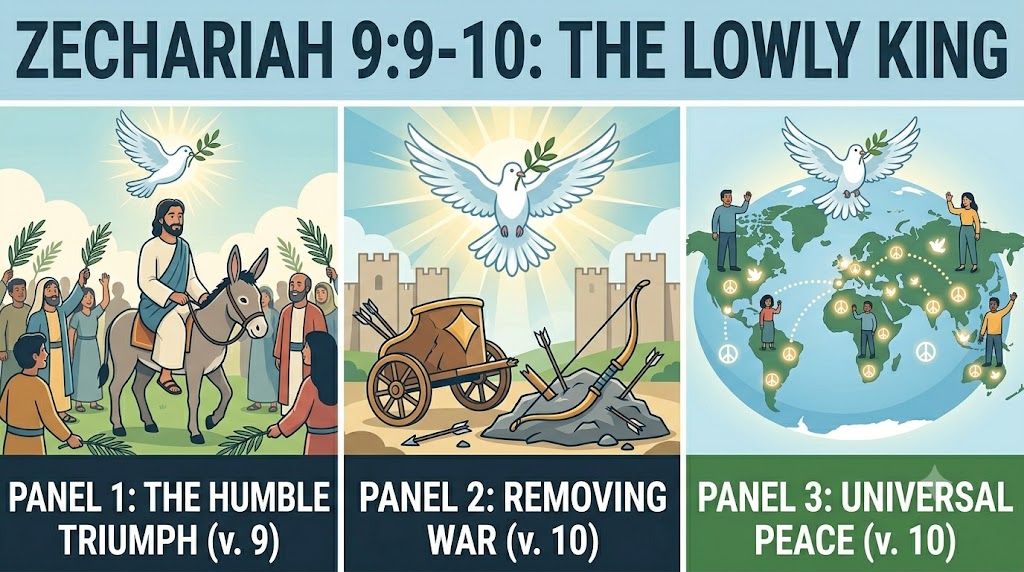
Non-profits have permission to use this infographic in their ministry.

14th Sunday of Year A
Romans 8:9, 11-13
XXXXXXXXXXXXXXXXXXXXXXX list ten questions divided into sections, with each section having a
title, based on the following that a preacher could ask an AI Catholic assistant for help with as the preacher prepares his homily. Do not use phrases such as “The text notes refer to” “The commentary suggests”. Instead use “xxxxxxx refers” and “xxxxxxx suggests” . Whenever possible though it is best to cite a specific verse or verses of the reading when writing the question. Do not place questions in quotation marks.
Verse 9 "But you are not in the flesh; on the contrary, you are in the spirit, if only the Spirit of God dwells in you. Whoever does not have the Spirit of Christ does not belong to him."
Commentary:
Paul addresses Christians directly, declaring a fundamental change of state: "you are not in the flesh... you are in the spirit." In Pauline theology, "flesh" (sarx) does not simply mean the body or physical nature—it means human existence apart from God, fallen and turned in on itself. "Spirit" (pneuma) refers to life animated and governed by the Holy Spirit. This is the language of two modes of existence: the old life of sin and the new life of grace.
The condition is crucial: "if only the Spirit of God dwells in you." This is the doctrine of the indwelling of the Holy Trinity. Through Baptism, the Christian becomes a temple of the Holy Spirit (1 Corinthians 6:19). The Catechism teaches that by grace we are made "partakers of the divine nature" (2 Peter 1:4; CCC 1996-2000), and the gift of sanctifying grace establishes God's very presence within the soul. This is not a metaphor—it is a real, ontological transformation worked by grace.
Notice that Paul uses "the Spirit of God" and "the Spirit of Christ" interchangeably. This subtly affirms a key Trinitarian truth that the Church would later define: the Holy Spirit proceeds from the Father and the Son (the Filioque). The Spirit is fully the Spirit of the Father and fully the Spirit of the Son (CCC 245-248).
The warning is sobering: "Whoever does not have the Spirit of Christ does not belong to him." Belonging to Christ is not a matter of external affiliation but of interior life. To be a Christian is to possess the Spirit. This grounds the Catholic understanding that grace is necessary for salvation—we cannot belong to Christ by our own natural powers alone.
Real-Life Application:
Remind your parishioners of the dignity they carry: the Holy Spirit dwells within the baptized soul in a state of grace. This should transform how we treat our own bodies and souls, and how we regard others. When a person feels worthless, forgotten, or alone, this verse declares the opposite—the very Spirit of God makes His home in them. It also calls us to examine: am I living as a temple of the Spirit, or am I living "according to the flesh"? Frequent recourse to the Sacrament of Reconciliation restores and strengthens this indwelling when sin has weakened or driven it out.
Verse 11 "If the Spirit of the one who raised Jesus from the dead dwells in you, the one who raised Christ from the dead will give life to your mortal bodies also, through his Spirit dwelling in you."
Commentary:
Paul now connects the indwelling Spirit to the Resurrection of the body. The same divine power that raised Jesus from the tomb is the power dwelling within us, and it guarantees that our own "mortal bodies" will share in that resurrection.
This is a key point of Catholic eschatology, professed every Sunday in the Creed: "I look forward to the resurrection of the dead and the life of the world to come." Christianity does not promise merely the immortality of the soul (a notion the Greeks held) but the resurrection of the body. The Catechism affirms that "the Spirit, who is the gift of God... will raise up our mortal bodies" (CCC 990, 997-1001). Our bodies are not disposable shells; they are destined for glory.
Note the Trinitarian and salvific structure of the verse: the Father ("the one who raised Jesus") acts through the Spirit to give life, on account of the Son's Resurrection. The Christian's destiny is bound up entirely in the life of the Trinity.
There is also a profound link to the Eucharist here. Christ promised, "Whoever eats my flesh and drinks my blood has eternal life, and I will raise him on the last day" (John 6:54). The indwelling Spirit and the Eucharist together are the "medicine of immortality" (St. Ignatius of Antioch) that pledges the resurrection of our bodies.
Real-Life Application:
This verse is a wellspring of hope, especially in pastoral situations of grief, terminal illness, and aging. When ministering to the dying or to grieving families, this is the heart of Christian consolation: death does not have the final word. The body laid in the grave will be raised. This also dignifies how we treat the bodies of the dead—hence the Church's reverence in Christian burial and her teaching on the respectful treatment of remains. For the living, it teaches us that what we do in the body matters eternally, since the body itself is destined for resurrection.
Verse 12 "Consequently, brothers, we are not debtors to the flesh, to live according to the flesh."
Commentary:
Paul draws a practical conclusion ("Consequently"). Because we possess the Spirit and the promise of resurrection, we owe the flesh nothing. The fallen self has no claim on us. We are under no obligation to obey the disordered desires of sin.
This addresses the reality of concupiscence—the inclination to sin that remains even after Baptism. The Church teaches that while Baptism removes original sin, concupiscence remains as a "tinder for sin" (fomes peccati), but it has no power to compel us (CCC 1264, 405). Paul is clear: the flesh is a defeated creditor with no rightful debt to collect. We have been set free.
The word "brothers" (in some translations, "brothers and sisters") reminds us that this new life is lived in the communion of the Church, the family of God, not in isolation. The Christian moral life is a shared struggle and a shared inheritance.
Real-Life Application:
This is enormously liberating for anyone caught in habitual sin or addiction. Temptation often whispers, "You owe me; you can't help yourself; this is just who you are." Paul answers: you are not a debtor to the flesh. You are not obligated to obey sinful impulses. Grace makes genuine freedom possible. For those struggling with vice, this verse, combined with the means of grace—prayer, the Sacraments, accountability—offers real hope of victory.
Verse 13 "For if you live according to the flesh, you will die; but if by the Spirit you put to death the deeds of the body, you will live."
Commentary:
Paul presents two paths and two destinies—a classic "two ways" teaching found throughout Scripture (Deuteronomy 30:19; Psalm 1).
"If you live according to the flesh, you will die" — This is spiritual death, eternal separation from God. Paul does not treat the Christian life as automatic or presumptuous; our cooperation with grace is necessary. This refutes any notion of "once saved, always saved." The Catholic Church teaches that we can fall from grace through mortal sin, which is why perseverance is required (CCC 1861, 2016).
"If by the Spirit you put to death the deeds of the body, you will live" — This is the doctrine of mortification and the ongoing work of sanctification. Notice the cooperation: it is "by the Spirit" (grace) that "you" (human free will) put sin to death. This is the Catholic synthesis of grace and free will against both Pelagianism (which over-credits human effort) and the denial of free will. We truly act, but only by the power of the Spirit (CCC 2008-2010).
This "putting to death" is the foundation of the Church's spiritual tradition of asceticism—penance, fasting, self-denial, and the daily carrying of the Cross (Luke 9:23). It is not hatred of the body but the disciplining of disordered desires so that the whole person may live.
Real-Life Application:
The Christian life is not passive. Lent, fasting on Fridays, almsgiving, and the daily small sacrifices are concrete ways we "put to death the deeds of the body." Encourage your parishioners that these practices are not mere rules but life-giving cooperation with the Spirit. Practical mortifications—turning off a screen to pray, resisting an unkind word, getting up to serve when tired—are the daily means by which we choose life. The goal is always life, never grim self-punishment: we deny ourselves lesser things to gain the greater life of the Spirit.es the newness without ever revoking the original gift.e; God responds by filling the barren places of our lives with life itself. The one who prepares a table for the Lord receives more than she ever set on it—a truth fulfilled every time we approach the altar.
Algorithmically generated text
This verse contains one of St. Paul's most sobering and clarifying statements: "Whoever does not have the Spirit of Christ does not belong to him" (Romans 8:9). It draws a sharp line—belonging to Christ is not a matter of external affiliation, ancestry, or even good intentions, but of the interior possession of the Holy Spirit. Let me unfold both the doctrine of grace's necessity and the beautiful way the Sacrament of Reconciliation restores this indwelling.
What It Means to "Belong to Christ"
Paul's logic is precise. To be a Christian is not merely to be a member of a group, to hold certain beliefs, or to be baptized on paper. To belong to Christ is to possess His Spirit—to be interiorly animated, indwelt, and transformed by the Holy Spirit. The Spirit is the very "seal" and pledge of our belonging (cf. Ephesians 1:13-14, 2 Corinthians 1:22).
This is profoundly relational. The same Spirit who unites the Father and the Son in eternal love is poured into our hearts (Romans 5:5), making us adopted children of God and members of Christ's Body. Without that Spirit dwelling within, the external markers of Christianity remain hollow. As Paul says elsewhere, one could have great knowledge and even perform mighty works, but without the love that the Spirit pours forth, it profits nothing (1 Corinthians 13).
The Necessity of Grace
This brings us to the heart of Catholic teaching on grace. The Church teaches that we cannot belong to Christ, cannot be justified, cannot attain salvation by our own natural powers alone. Grace is absolutely necessary.
1. Grace as God's Free Gift. Grace is "favor, the free and undeserved help that God gives us to respond to his call to become children of God" (CCC 1996). We do not earn the Spirit; He is given. This is the gratuity of salvation—it begins entirely with God's initiative.
2. Sanctifying Grace and the Indwelling. The Church distinguishes sanctifying grace—the habitual, stable, supernatural gift that makes the soul holy and pleasing to God—from actual graces, which are God's interventions in particular moments. Sanctifying grace is precisely what establishes the indwelling of the Holy Trinity in the soul. The Catechism teaches that through this grace we are made "partakers of the divine nature" (2 Peter 1:4; CCC 1996-2000). This is the supernatural life of the soul.
3. The Necessity of Grace for Salvation. Against the Pelagian heresy (which held that we could achieve salvation by our own efforts), the Church definitively teaches that we need grace to do anything meritorious for eternal life. We can no more save ourselves than a branch can bear fruit cut off from the vine: "Without me you can do nothing" (John 15:5). To "have the Spirit of Christ" is therefore to live in the state of grace.
4. The Loss of Grace Through Mortal Sin. This is the crucial pastoral point. Sanctifying grace can be lost. The Church teaches that mortal sin—a grave violation of God's law committed with full knowledge and deliberate consent—destroys charity in the heart and deprives the soul of sanctifying grace (CCC 1855, 1861). When a person commits mortal sin, they drive out the indwelling presence; in the stark terms of Paul's verse, they cease, in that state, to "have the Spirit of Christ." This is why the Church takes sin so seriously—not out of legalism, but because sin ruptures our living communion with God.
How Reconciliation Restores the Indwelling
Here is the consoling heart of the matter. The God who freely gives the Spirit has also provided the means to restore His indwelling when it has been lost or weakened through sin. That means is the Sacrament of Reconciliation (Penance, Confession).
1. The Sacrament Christ Instituted. On Easter evening, the Risen Christ breathed on the apostles—a deliberate echo of God breathing life into Adam—and said, "Receive the Holy Spirit. Whose sins you forgive are forgiven them, and whose sins you retain are retained" (John 20:22-23). Note the profound connection: the gift of forgiveness is bound up with the gift of the Spirit. Christ gave the Church the authority and the sacramental means to restore the Spirit's life in repentant sinners.
2. Reconciliation as a "Second Baptism." The Fathers of the Church called Penance a "laborious kind of baptism" (CCC 1446)—a second plank of salvation after the shipwreck of sin. Just as Baptism first poured the Spirit into the soul and made us temples of God, Reconciliation restores that indwelling when mortal sin has driven it out. The Catechism teaches that the sacrament reconciles us with God, and the penitent "recovers grace" and is reconciled (CCC 1468).
3. What the Sacrament Accomplishes. Through sacramental absolution, the penitent:
- Has mortal sins forgiven and the eternal punishment due to them remitted
- Is restored to the state of sanctifying grace, with the indwelling Trinity returning to the soul
- Is reconciled with the Church, whose communion is wounded by sin
- Receives an increase of spiritual strength for the Christian battle (CCC 1496)
The Catechism beautifully describes the effect as a "true 'spiritual resurrection,' restoration of the dignity and blessings of the life of the children of God" (CCC 1468). The soul that had ceased to "have the Spirit of Christ" is brought back to life.
4. Frequent Confession Even for Venial Sin. Even when one has not committed mortal sin, the Church warmly recommends frequent confession. Venial sin does not destroy the indwelling but weakens charity and dims the Spirit's life within us. Regular confession strengthens the indwelling, deepens our belonging to Christ, and forms us in holiness (CCC 1458).
Preaching This to Your Parishioners
This verse and its doctrine offer a powerful and hopeful pastoral message. A few approaches:
Reframe Confession as Restoration, Not Punishment. Many of your people may experience the confessional as a place of dread or shame. Help them see it as Paul's verse illuminated: it is where the Spirit of Christ is restored to the soul, where one who had lost their belonging is welcomed home and brought back to life. It is a spiritual resurrection, not a courtroom.
The Dignity at Stake. Emphasize what is truly at stake in sin—not the breaking of arbitrary rules, but the loss of the most precious gift: the indwelling presence of God Himself. When we understand that we are temples of the Holy Spirit, we understand both the tragedy of sin and the joy of restoration.
An Image for the Homily. You might use the image of a hearth fire. Sanctifying grace is the fire of God's presence in the soul. Venial sin lets the fire dim and grow cold; mortal sin extinguishes it entirely. Confession is where Christ relights the fire—where the Spirit is breathed back into us, as on that first Easter evening.
A Concrete Invitation. Don't end with abstraction. Invite your people specifically: "If it has been a long time, come home. The Spirit of Christ is waiting to be restored to your soul. Our confession times are..." Make the path to restoration concrete and accessible.
Algorithmically generated text
This is one of the most pastorally urgent applications of the entire passage, and St. Paul's words in Romans 8:12 are extraordinarily liberating when rightly understood. "We are not debtors to the flesh, to live according to the flesh." For the person trapped in habitual sin or addiction—who often feels enslaved, hopeless, and defined by their failures—this single verse can be a doorway to genuine hope. Let me unfold how you might use it.
The Lie That Addiction and Habitual Sin Tell
Begin by naming the experience your struggling parishioners actually know. Habitual sin and addiction speak with a relentless voice that says: "You owe me. You can't help yourself. This is just who you are. You'll never be free. Resistance is pointless." The person comes to believe they are a debtor to the flesh—obligated, bound, owned by the compulsion.
This is precisely the lie St. Paul demolishes. He declares that the flesh has no rightful claim on us. We are not debtors to it. The fallen self is a defeated creditor presenting a fraudulent bill. The Christian owes the flesh nothing—no obedience, no allegiance, no submission to its demands.
The homiletic key: Paul does not say the struggle disappears or that temptation will never knock. He says the obligation is gone. You no longer have to answer the door. The chains have been struck off in Baptism, even if the prisoner has grown so used to them that he still feels their weight.
The Doctrinal Foundation: Why We Owe Nothing
This hope is not mere positive thinking—it rests on solid Catholic doctrine. Three truths ground it:
1. Baptism has truly set us free. Through Baptism, we died with Christ to sin and rose to new life (Romans 6). Original sin is washed away, and the Holy Spirit comes to dwell within us (the very theme of v. 9 and v. 11). The dominion of sin is genuinely broken.
2. Concupiscence remains, but it has no power to compel. Here is the crucial pastoral distinction. The Church teaches that even after Baptism, concupiscence—the inclination toward sin—remains as a "tinder for sin" (fomes peccati). But the Catechism is clear that concupiscence "is left for us to wrestle with" and "cannot harm those who do not consent" (CCC 1264). It can tempt, but it cannot force. The addiction can pull, but it cannot compel consent against a will strengthened by grace.
3. Diminished culpability in genuine addiction. This is enormously consoling and must be preached with care. The Church recognizes that the freedom required for full moral culpability can be diminished by habit, compulsion, psychological factors, and the grip of addiction (CCC 1735, 2352). For the person in the grip of true addiction, their guilt before God may be far less than they fear. God sees the whole reality—the struggle, the weakened will, the genuine desire to be free. This frees the penitent from crushing, paralyzing shame while still calling them forward to healing.
The Cooperation of Grace and Effort (vv. 12-13 Together)
It is vital to read v. 12 alongside v. 13: "if by the Spirit you put to death the deeds of the body, you will live." This is the Catholic synthesis that protects against two opposite errors:
- Against despair/Pelagianism: We do not break free by sheer willpower alone. The person who has tried and failed a hundred times by gritting their teeth needs to hear this. It is "by the Spirit" that we conquer—by grace, not raw effort.
- Against passivity/presumption: Yet Paul also says "you put to death." We must genuinely cooperate. Grace does not bypass our freedom; it empowers it.
The homiletic image: The person struggling is not asked to win the battle alone—that is the very despair that keeps them bound. They are asked to cooperate with a power infinitely greater than the addiction: the same Spirit who raised Christ from the dead (v. 11) now dwells in them. The power that emptied the tomb is available to empty the chains of compulsion.
Concrete Means of Grace to Offer
Hope must be made practical. Point your parishioners to the concrete means by which the Spirit "puts to death" the deeds of the flesh:
1. The Sacrament of Reconciliation—frequently. Even when one falls repeatedly, returning to Confession is not failure; it is faithfulness. Each absolution restores and strengthens the indwelling Spirit. Encourage them never to let shame keep them away—the very repetition of return is itself a form of perseverance.
2. The Eucharist. The Bread of Life sustains the weary soul and strengthens the will against temptation. Frequent Communion (worthily received) is medicine for the struggling.
3. Prayer and reliance on the Spirit. Teach them simple, repeated prayers in moments of temptation—calling on the Holy Spirit, invoking the name of Jesus, turning to Our Lady.
4. The communion of the Church. Recovery is not solitary. Encourage accountability, spiritual direction, support communities (including, where appropriate, recovery programs that recognize a Higher Power), and the prayers of the parish. The "brothers" Paul addresses (v. 12) struggle together, not in isolation.
5. Patience and the long view. Sanctification is usually gradual. Help them see that growth in freedom often comes incrementally, with setbacks along the way, and that each return to grace is genuine progress, not a return to square one.
A Pastoral Tone for Your Preaching
The way you preach this matters as much as the content. A few cautions and encouragements:
- Lead with mercy, never with condemnation. The person in habitual sin already condemns themselves harshly. They need to hear that God is not waiting to punish but longing to free them.
- Distinguish the person from the sin. Their identity is "temple of the Holy Spirit" (v. 9, 11), not "addict" or "failure." Sin is what they do, not who they are in Christ.
- Be realistic about the cross. Don't promise instant deliverance. Promise that they are not alone, that the obligation is broken, and that with grace, freedom is genuinely possible—a journey, not a magic moment.
- Make hope concrete. End not with abstraction but with an invitation: come to Confession, come to the Eucharist, come to me as your priest. The door is open.
A Homiletic Refrain
You might anchor the homily in a single, repeatable line drawn straight from the verse:
"You are not a debtor to the flesh. You owe it nothing. The chains were broken at your Baptism—and the same Spirit who raised Jesus from the dead now lives in you to set you free."
A powerful structure:
- The lie — sin says you are owned, you can't change, this is just who you are.
- The truth — Paul says you owe the flesh nothing; you are free.
- The power — the Spirit who raised Christ (v. 11) lives in you; you do not fight alone.
- The path — concrete means of grace: Confession, Eucharist, prayer, community, perseverance.
- The invitation — come, and begin again today.
Algorithmically generated text
This is an excellent and theologically precise question. Romans 8:13 is one of the verses that most clearly distinguishes the Catholic understanding of salvation from the "once saved, always saved" position, and preaching it well requires both doctrinal clarity and pastoral balance. Let me help you preach it faithfully—neither slipping into presumption on one side nor despair on the other.
The Verse Itself: A Real Warning to Believers
First, notice to whom Paul is speaking. He is not addressing pagans or outsiders. The "you" in "if you live according to the flesh, you will die" (Romans 8:13) refers to baptized Christians—those who already "have the Spirit of Christ" (v. 9) and in whom the Spirit dwells (v. 11).
This is the decisive exegetical point. Paul issues a genuine warning to those who already belong to Christ. He presents two real possibilities with two real outcomes: live according to the flesh and die; or by the Spirit put the deeds of the body to death and live. The conditional "if" is meaningful—the outcome is not predetermined or automatic. The Christian's final salvation remains contingent on his cooperation with grace, perseverance, and continued fidelity.
If salvation were irreversibly secured at the moment of belief, Paul's warning would be empty. But Paul means exactly what he says: even one who possesses the Spirit can, by choosing to "live according to the flesh," forfeit eternal life.
The Catholic Doctrine: Salvation Is a Race to Be Finished
The Church's teaching here is rooted throughout Scripture and consistently held in Tradition:
1. We Can Fallから Grace. The Council of Trent definitively taught (against the Reformers) that the justified can lose the grace of justification through mortal sin—not only through loss of faith. Grace, once received, is not an irrevocable possession; it must be guarded and lived. This directly contradicts "once saved, always saved."
2. Mortal Sin Causes Spiritual Death. This is precisely the "death" Paul warns of. The Catechism teaches that mortal sin "results in the loss of charity and the privation of sanctifying grace," and if not redeemed by repentance and God's forgiveness, "it causes exclusion from Christ's kingdom and the eternal death of hell" (CCC 1861). To "live according to the flesh" in a settled, deliberate way is to choose this death. The three conditions of mortal sin remain essential to teach: grave matter, full knowledge, and deliberate consent (CCC 1857).
3. Scripture Is Full of Warnings to Believers. Paul himself disciplined his body lest, "after having preached to others, I myself should be disqualified" (1 Corinthians 9:27). He tells the Philippians to "work out your salvation with fear and trembling" (Philippians 2:12). Christ warns that "the one who perseveres to the end will be saved" (Matthew 24:13). These warnings assume that falling away is a genuine possibility.
4. The Need for Final Perseverance. The Church teaches that perseverance to the end is itself a great grace for which we must continually pray (CCC 2016, 1821). We have a confident hope of salvation, but not an absolute certainty that presumes upon God. We "hope to die in the grace of God" and to obtain the reward of eternal life as a free gift—but this hope requires that we persevere.
Walking the Narrow Path in Your Preaching
The pastoral challenge is to avoid two opposite errors, both of which Paul's verse guards against:
Error 1: Presumption ("Once Saved, Always Saved")
This is the error of treating salvation as a settled past event that cannot be lost regardless of how one lives. It empties Paul's warning of meaning and can lead to spiritual complacency—a false security that says "I prayed the prayer / I was baptized, so my behavior no longer affects my salvation." Paul's "you will die" directly refutes this.
Error 2: Despair (Anxious Scrupulosity)
The opposite danger is to preach this so severely that your people live in constant terror, never sure of God's love, paralyzed by the fear that any failing damns them. This too is a distortion. The Catholic answer is confident hope, not anxious certainty or anxious despair.
The Catholic Middle: Confident Hope with Vigilance
The faithful path holds both truths: God's grace is sufficient and freely given, AND our cooperation genuinely matters. We can be confident in God's mercy while remaining vigilant against sin. This is the "fear and trembling" of a son who loves his Father and dreads only to wound that love—not the terror of a slave.
The Balancing Truth: This Is a Message of Hope, Not Threat
Crucially, don't preach v. 13 in isolation. Read it with the whole arc of Romans 8, which is fundamentally a chapter of hope and assurance:
- The Spirit dwells in us (v. 9, 11).
- We are not debtors to the flesh (v. 12)—we have real freedom.
- The same Spirit who raised Christ gives life to us (v. 11).
- And just verses later: "If God is for us, who can be against us?" (8:31) and nothing "will be able to separate us from the love of God" (8:39).
The resolution of the apparent tension: Nothing external can separate us from God's love—but we ourselves, by our own free choice to live according to the flesh, can walk away. God never abandons us; the danger is that we abandon Him. This preserves both God's faithfulness and human responsibility.
A Homiletic Structure You Might Use
1. The Warning Is Real (and It's for Us). Paul speaks to the baptized. The Christian life is not "set it and forget it"—it is a race to be run, a fight to be fought, a journey requiring perseverance.
2. What "Death" Means. Explain mortal sin gently but clearly—the deliberate, knowing choice of grave evil that drives out the indwelling Spirit. Not every fault is mortal sin; teach the conditions so people neither presume nor despair.
3. But We Are Not Left Alone. The same Spirit who warns us also empowers us. We "put sin to death" by the Spirit, not by white-knuckled effort. The means of grace—Reconciliation, the Eucharist, prayer—are God's provision for perseverance.
4. Confident Hope. Close on Romans 8's triumphant note: nothing can separate us from God's love except our own refusal. So we run the race with confidence, returning always to His mercy when we stumble, praying daily for the grace of final perseverance.
A Homiletic Refrain
You might anchor it in a line like:
"God will never let go of you. The only question Saint Paul puts before us today is whether we will let go of Him. And the same Spirit who warns us is the same Spirit who holds us—if we will keep walking by the Spirit, we will live."
A helpful analogy for your people: Salvation is like a marriage, not a one-time transaction. The wedding day (Baptism) truly unites us to Christ—but the covenant must be lived faithfully every day. One can, tragically, betray and abandon the marriage. Yet the faithful Spouse always stands ready to receive the repentant back (Reconciliation). This honors both the seriousness of the warning and the boundless mercy of God.ce and the firm purpose of amendment.
Algorithmically generated text
How can you be charitable to the self-centered people in your life?
Certain people in our worlds are so self-centered, they cannot see their actions are only self-directed. As the saying goes, they “want it both ways.” Their relationships are only one way (toward themselves). Their acts of charity are self-serving; their altruism is self-promotion. These are the people that find no problem with pushing rules to the limit (and sometimes over the limit) to serve themselves.
Of course, we all suffer from self-absorption to some degree or another; we all have the temptation to make ourselves “Number One!” When we worship at our own altars, however, we fail to see work of the Greater One in action. We become so steeped in our own little worlds, we cannot see God’s Spirit in life.
In his rabbinical style, Paul wrote to the Roman community in style of stark contrasts. For Paul, the world could be divided into two camps: those in the flesh and those in the Spirit. Those in the flesh lived a life of ignorance to God’s will simply because they had not yet gained faith. But, those in the flesh could be back-sliders or those with knowledge of the Christian life, but still rejected the “Way.” “In the flesh” meant all those who were not truly Christian.
Those in the Spirit, however, lived the Christian lifestyle. They worshiped together, shared fellowship with mutual affection, and reached out to non-believers. Not only did they think differently, they acted differently. Their faith led to charity. Their concern was for others.
Paul may have painted the world in “black and white” terms, but his point is well taken. There is a difference between “it’s all about me” and “it’s all about others.” That difference is the Spirit. When we live in sin, we focus on the self, and we slowly die. When we live in the Spirit, we focus on others (especially THE Other) and live. When we live in sin, we want it both ways. When we live in the Spirit, we only want what God wants.
Have you prayed to the Spirit lately? How has the Spirit helped you to extend yourself for others?
Create a simple, modern infographic illustrating [INSERT BIBLE PASSAGE OR TOPIC]. Use a [SPLIT-SCREEN / 3-PANEL] layout. The style should be clean, high-quality digital art or vector illustration.
Visuals:
Panel 1: Show [DESCRIBE SCENE 1 – e.g., a stormy sea].
Panel 2: Show [DESCRIBE SCENE 2 – e.g., Jesus calming the waves].
Text & Typography:
Font: Use EXTRA LARGE, BOLD, SANS-SERIF FONT (like Arial). Ensure high contrast so text is easily readable.
Header: Write “[INSERT MAIN TITLE]” at the top.
Captions: Include short, punchy text summaries in the panels: “[TEXT FOR PANEL 1]” and “[TEXT FOR PANEL 2]”.
Overall Vibe: Professional, educational, and uncluttered. Avoid small details; focus on big images and big text.
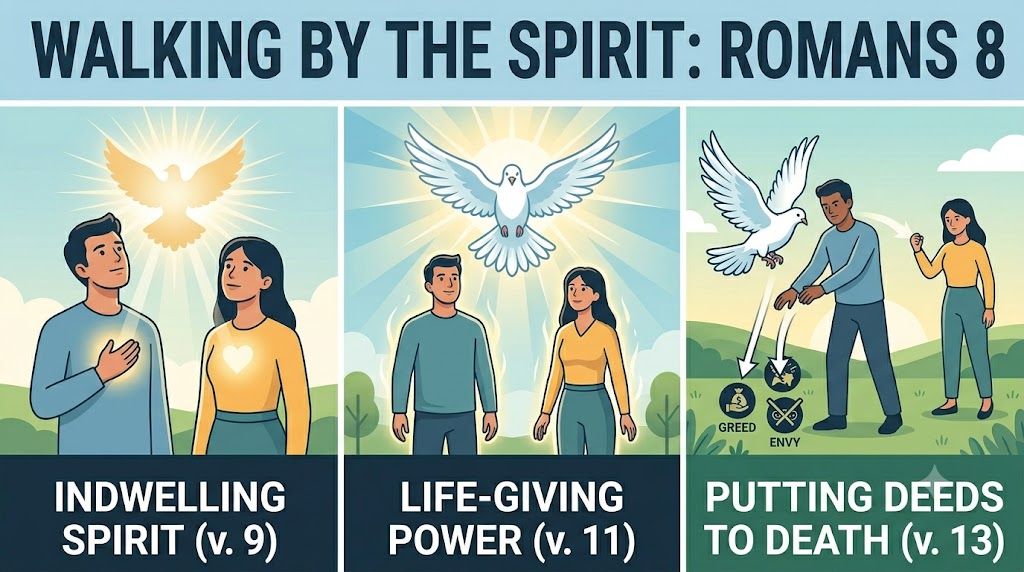
Non-profits have permission to use this infographic in their ministry.

14th Sunday of Year A
Write an engaging description meant to get readers to read Larry Broding’s commentary which can be used to help preachers prepare their own homily. After a brief introduction give bulletin points of why this commentary matters for your homily. conclude with “Read Larry Broding’s full commentary to help your congregation…” Complete sentence. XXXXXXXXXXXXXXXXXXXXXXX
Matthew 11:25-30
XXXXXXXXXXXXXXXXXXXXXXX list ten questions divided into sections, with each section having a
title, based on the following that a preacher could ask an AI Catholic assistant for help with as the preacher prepares his homily. Do not use phrases such as “The text notes refer to” “The commentary suggests”. Instead use “xxxxxxx refers” and “xxxxxxx suggests” . Whenever possible though it is best to cite a specific verse or verses of the reading when writing the question. Do not place questions in quotation marks.
Verse 25 "At that time Jesus said in reply, 'I give praise to you, Father, Lord of heaven and earth, for although you have hidden these things from the wise and the learned you have revealed them to the little ones.'"
Commentary:
Jesus opens with a prayer of praise and thanksgiving to the Father. The phrase "I give praise to you" (or "I bless you," "I thank you") reveals the heart of Jesus's own prayer life—rooted in adoration and gratitude. The Catechism presents Jesus at prayer as the model for all Christian prayer (CCC 2599-2602).
He addresses God as "Father, Lord of heaven and earth." This combines tender intimacy (Abba, Father) with cosmic majesty (Lord of all creation). Catholic prayer holds both truths together—God is both transcendent Creator and loving Father, as we pray in the "Our Father."
The paradox of revelation: "hidden from the wise and the learned... revealed to the little ones." God's saving truth is not earned by intellectual achievement or worldly status but received in humility. This does not condemn learning itself, but rather the pride that closes the heart to God. The "little ones" (nēpioi—infants, the simple, the lowly) are those poor in spirit (Matthew 5:3) who receive the Kingdom as a gift. This is the gratuity of grace: divine truth is a revelation, not a human discovery (CCC 50, 153).
Real-Life Application:
In an age that prizes credentials, expertise, and intelligence, this verse humbles us. The simplest grandmother praying her Rosary may possess a deeper knowledge of God than the most credentialed scholar who approaches faith with a closed, proud heart. Encourage parishioners that holiness and intimacy with God are open to everyone—the child, the uneducated, the struggling—not just the elite. It is also a call to approach our own faith with childlike trust rather than the demand to "figure everything out" before we believe.
Verse 26 "Yes, Father, such has been your gracious will."
Commentary:
Jesus embraces the Father's plan with perfect filial surrender: "such has been your gracious will" (literally, "for such was your good pleasure"). Here we glimpse the perfect harmony between the will of the Son and the will of the Father—a unity that will be expressed supremely in Gethsemane ("not my will but yours be done," Luke 22:42).
This verse models the heart of Christian prayer: conformity to God's will. We pray "thy will be done" not with grudging resignation but with trust that the Father's will is gracious and good. The Catholic spiritual tradition calls this abandonment to Divine Providence.
Real-Life Application:
So much of our anxiety comes from resisting God's will or trying to control outcomes. The peace of the saints flowed from trusting that the Father's "gracious will" is always for our good, even when hidden in suffering or mystery. For parishioners facing uncertainty—a diagnosis, a vocational decision, a family crisis—this verse invites the prayer: "Father, your gracious will be done."
Verse 27 "All things have been handed over to me by my Father. No one knows the Son except the Father, and no one knows the Father except the Son and anyone to whom the Son wishes to reveal him."
Commentary:
This is one of the most exalted Christological statements in the Synoptic Gospels—so lofty it sounds like the Gospel of John. Jesus reveals the unique, mutual, and exclusive knowledge shared between the Father and the Son.
"All things have been handed over to me" — The Son receives everything from the Father: His authority, His mission, His very being as Son. This points to the eternal generation of the Son and His role as the one Mediator (1 Timothy 2:5).
"No one knows the Son except the Father, and no one knows the Father except the Son" — This mutual knowledge is the foundation of the doctrine of the Holy Trinity. The Father and the Son know one another with a perfect, divine knowledge that no creature can attain on its own. The Catechism teaches that no one can know God unless God reveals Himself; Christ alone reveals the Father (CCC 240-242, 473).
"Anyone to whom the Son wishes to reveal him" — Our knowledge of the Father comes entirely through the Son. Jesus is the definitive revelation of God: "Whoever has seen me has seen the Father" (John 14:9). This grounds Catholic teaching that Christ is the fullness of God's self-revelation; there is no other way to the Father (John 14:6; CCC 65-67).
Real-Life Application:
If we want to know God—not just know about Him—we must go to Jesus. We come to know the Son through prayer, the Scriptures, and above all the Eucharist, where He gives Himself to us. Encourage your people that a relationship with the Father is not abstract theology but is offered concretely through friendship with Christ. The desire to "know God" is fulfilled by sitting with Jesus in Adoration, in the Gospels, in the Mass.
Verse 28 "Come to me, all you who labor and are burdened, and I will give you rest."
Commentary:
Here begins the tender invitation. The verb "Come" is a personal, direct call from Christ Himself. It is addressed to "all"—universal in scope—specifically to those who "labor and are burdened." This includes those weighed down by sin, by the heavy burdens of legalistic religion (the Pharisees' "heavy burdens," Matthew 23:4), by suffering, by the toil of life.
The promise is "rest" (anapausis)—the deep rest of the soul, a foretaste of the eternal Sabbath rest of God (Hebrews 4:9-11). This is not mere physical relaxation but the peace that Christ alone gives (John 14:27).
This invitation has profound sacramental resonance. Christ gives rest to the burdened soul especially through:
- Reconciliation, where the burden of sin is lifted
- The Eucharist, the "bread of life" that sustains the weary
- The whole life of grace
Real-Life Application:
This is perhaps the most pastorally rich verse in the passage. We live in a culture of exhaustion—overwork, anxiety, burnout, the crushing weight of guilt and shame. To every burdened person, Christ says, "Come to me." For the parishioner buried under sin, the confessional is where this rest is found. For the one weary from caregiving, grief, or hardship, time before the Blessed Sacrament is where the soul is renewed. As pastors, you yourselves carry heavy burdens—this is Christ's invitation to you as well. Make space to come to Him and rest.
Verse 29 "Take my yoke upon you and learn from me, for I am meek and humble of heart; and you will find rest for yourselves."
Commentary:
Jesus offers not the removal of all yokes but the exchange of a crushing yoke for His own. The "yoke" in Jewish tradition referred to the yoke of the Law and discipleship under a rabbi. Jesus invites us to take His yoke—to become His disciple, to follow His teaching and way of life.
"Learn from me" — Discipleship is a lifelong apprenticeship in the school of Christ. We learn not only doctrine but a way of being.
"For I am meek and humble of heart" — This is the only place in the Gospels where Jesus explicitly describes His own interior disposition. He reveals the Sacred Heart: gentle, humble, approachable. This verse is foundational to Catholic devotion to the Most Sacred Heart of Jesus, a heart that is meek and lowly, burning with love for humanity. Christ's meekness fulfills the prophecy of the humble King (Zechariah 9:9) and models the Beatitude of meekness (Matthew 5:5).
"You will find rest for yourselves" — Paradoxically, taking on Christ's yoke—discipleship, obedience, the imitation of His humility—is itself the path to rest. Submission to Christ is liberation, not bondage.
Real-Life Application:
True peace is found not in casting off all discipline and "doing whatever I want," but in surrendering to Christ's gentle lordship. Encourage devotion to the Sacred Heart—a powerful antidote to a harsh, anxious, performance-driven spirituality. We are invited to imitate Christ's meekness and humility in our daily interactions: responding gently when provoked, choosing humility over the need to be right, serving rather than dominating. The yoke is shared—Christ pulls alongside us; we are never alone in our burdens.
Verse 30 "For my yoke is easy, and my burden light."
Commentary:
The passage concludes with a beautiful paradox. Christ does not promise a life free of all burden—discipleship has its demands, its cross (Matthew 16:24). But His yoke is "easy" (chrēstos—also meaning "kind," "good," "well-fitting") and His burden "light."
How can this be, when Christ asks for everything? Because His yoke is carried with and for love, and sustained by grace. St. Augustine observed that love makes light what would otherwise be heavy; what we do for love is no burden. The commandments and the demands of the Gospel, when embraced in love and empowered by the Holy Spirit, become not a crushing weight but the path of joy.
This reflects the Catholic understanding of the New Law of grace, the law of the Gospel, which the Catechism describes as the grace of the Holy Spirit given through faith in Christ, working through love (CCC 1965-1972). The old burden of trying to save ourselves by our own efforts is replaced by the "light" burden of cooperating with grace.
Real-Life Application:
When the demands of faith feel heavy—forgiving an enemy, remaining faithful in a hard marriage, persevering in prayer—the problem is often that we are trying to carry the yoke alone, by sheer willpower. Christ's promise is that with His grace and in His love, the burden becomes bearable, even joyful. Remind your parishioners (and yourselves): we are not asked to do this on our own strength. The yoke is easy precisely because Christ carries it with us.
Algorithmically generated text
This verse is one of the most beautiful and counterintuitive statements in the Gospels, and it strikes directly at a temptation that is especially strong in our credentialed, achievement-driven age. When Jesus rejoices that the Father has "hidden these things from the wise and the learned" and "revealed them to the little ones" (Matthew 11:25), He is unveiling the fundamental disposition by which God's saving truth is received: not the proud grasp of the intellect, but the open hands of the humble heart. Let me help you preach this faithfully and fruitfully.
First, a Crucial Clarification: This Is Not a Condemnation of Learning
Before anything else, you must guard against a misreading that your more thoughtful parishioners will immediately sense. Jesus is not condemning intelligence, education, or the life of the mind. The Catholic Church is the patroness of universities, the home of the greatest minds in history—St. Augustine, St. Thomas Aquinas, St. Bonaventure, St. John Henry Newman. Faith and reason are, as St. John Paul II wrote in Fides et Ratio, "like two wings on which the human spirit rises to the contemplation of truth."
What Jesus condemns is not learning but pride—the spiritual posture that says, "I will master God by my own intellect; I will accept only what I can fully comprehend and control; I need no one to reveal anything to me." The "wise and learned" He refers to are not the genuinely wise, but those whose self-sufficiency has closed their hearts. Recall: it was precisely the scholarly Pharisees and scribes, confident in their own expertise, who rejected Christ, while the simple fishermen and the lowly received Him.
The homiletic key: The problem is never the intellect itself, but the pride that makes the intellect a barrier rather than a gift. Even the most brilliant scholar must become a "little one" to receive God.
The Doctrine: Revelation Is a Gift, Not an Achievement
This brings us to the heart of Catholic teaching on revelation and grace.
1. God Cannot Be "Figured Out"—He Reveals Himself. The deepest truths of God—the Trinity, the Incarnation, our redemption—are not conclusions that the human mind can deduce on its own. They are mysteries that God freely chooses to reveal. The Catechism teaches that "by natural reason man can know God with certainty" from creation (CCC 50), but the intimate truths of God's inner life and His plan of salvation "exceed entirely the power of human reasoning" and could only be known because God revealed them (CCC 50-53). Revelation is pure gift.
2. Faith Itself Is a Grace. We cannot even believe by our own power. The Catechism teaches that "faith is a gift of God, a supernatural virtue infused by him" (CCC 153). To assent to God's revelation requires "the grace of God and the interior help of the Holy Spirit." This is why the simplest believer who has faith possesses something the proudest skeptic cannot manufacture by intellect alone.
3. The Gratuity of Grace. This connects to the entire Catholic understanding of grace as God's free, unearned gift (CCC 1996-2000). Just as we cannot earn the indwelling of the Spirit, we cannot earn knowledge of God by accumulating credentials. The truth is given to those disposed to receive it—and the disposition required is humility, the empty hands of the "little one."
Who Are the "Little Ones"?
The Greek word, nēpioi, means infants, the simple, the dependent, the lowly. To be a "little one" is to be like a child before God—not childish, but childlike:
- Humble — aware of one's need, not self-sufficient
- Trusting — receiving truth as a gift rather than demanding to control it
- Open — hearts not closed by pride or prior agendas
- Dependent — recognizing that we receive everything from the Father
This connects beautifully to the first Beatitude: "Blessed are the poor in spirit, for theirs is the kingdom of heaven" (Matthew 5:3). Poverty of spirit is precisely this littleness—the recognition that before God we are beggars, and that everything we have of Him is gift. It also recalls Jesus's later teaching: "unless you turn and become like children, you will not enter the kingdom of heaven" (Matthew 18:3).
A powerful witness for your homily: St. Thérèse of Lisieux built her entire spirituality—the "Little Way"—on precisely this truth. She understood that she could not climb to God by great achievements but could only let herself be lifted by His merciful love, like a child carried up a staircase. She is a Doctor of the Church not for her learning but for her littleness. The Father revealed to this young, uneducated Carmelite truths that learned theologians spend lifetimes seeking.
Real-Life Applications for Your Parishioners
This verse speaks powerfully into the lived experience of your people:
1. Comfort for the "Ordinary" Believer. Many in your pews may feel inadequate—they haven't read theology, can't argue with skeptics, feel "simple." Tell them: the grandmother praying her Rosary with a humble, trusting heart may know God more intimately than the most decorated scholar. Holiness and intimacy with God are not reserved for an intellectual elite; they are open to everyone. This is profoundly democratizing and consoling.
2. A Warning Against Spiritual Pride. For the educated and accomplished—and perhaps for clergy and theologians themselves—this is a sobering caution. Knowledge can puff up (1 Corinthians 8:1). We can study God endlessly and still miss Him if we approach Him as an object to master rather than a Person to love. Even great theological learning must be married to humble prayer and childlike trust.
3. The Antidote to Our Cultural Idolatry of Expertise. We live in an age that worships credentials, data, and intellect, and that often treats faith as something for the "unsophisticated." This verse turns the world's hierarchy upside down. The pathway to the deepest Truth is not upward through achievement but downward through humility.
4. A Posture for Approaching Faith's Mysteries. Encourage your people, when they encounter what they cannot fully understand—the Trinity, the Eucharist, suffering, God's providence—not to demand mastery before they believe, but to approach as little ones, trusting the Father who reveals. Faith seeks understanding, but it begins with humble trust.
A Homiletic Structure You Might Use
1. The Surprising Joy of Jesus. Open with Christ rejoicing—why does He praise the Father for hiding truth from some? Set up the paradox.
2. Clear the Misunderstanding. It's not about brains versus simplicity; it's about pride versus humility. Even the brilliant must become little.
3. The Truth Is a Gift. We don't earn or deduce God—He reveals Himself, and faith itself is grace. Empty hands receive what clenched fists cannot grasp.
4. Become a Little One. Hold up St. Thérèse, the praying grandmother, the trusting child. Holiness is open to all who come humbly.
5. The Invitation. This passage flows directly into "Come to me, all you who labor" (v. 28). The little ones who receive the Father's revelation are the very ones invited to find rest in the Son. Humility is the door to both knowledge and rest.
A Homiletic Refrain
You might anchor the homily in a line such as:
"God does not reveal Himself to the clever, but to the childlike—not because He despises the mind, but because He gives Himself only into open, empty, trusting hands."
A vivid image for your people: the truths of God are like water—they flow downward, to the lowest places, to the valleys of humility, never to the proud peaks of self-sufficiency. To receive the living water, we must let ourselves be made low.s or a friendship at the office. But the cup of cold water you give in his name (v. 42)—the integrity, the kindness, the courageous no—will not lose its reward. Christ counts what the corporation never will.
Algorithmically generated text
This is a wonderfully fruitful pastoral connection, and it lies at the very heart of why this verse is so beloved. When Christ says "Come to me, all you who labor and are burdened, and I will give you rest" (Matthew 11:28), He is not offering a vague, sentimental comfort. He is making a concrete promise that the Church makes tangible and accessible precisely through the Sacraments. The "rest" Christ offers is not merely an idea—it is a gift He delivers, and He delivers it most especially at the confessional and the altar. Let me help you draw out this connection.
Understanding the "Rest" Christ Promises
First, establish what this "rest" (Greek anapausis) actually means. It is far deeper than physical relaxation or a vacation from stress. It is the rest of the soul—the peace of being reconciled to God, freed from the crushing weight of sin and guilt, and resting securely in the love of the Father.
Scripture frames this as the true Sabbath rest—the rest God Himself enjoyed after creation (Genesis 2:2-3) and the rest that remains for the People of God (Hebrews 4:9-11). It is the shalom, the wholeness and right-relationship, that the world cannot give. As Christ says elsewhere, "Peace I leave with you; my peace I give to you. Not as the world gives do I give it to you" (John 14:27).
And St. Augustine gave this longing its most famous expression: our hearts are restless until they rest in God. The "labor and burden" Christ names is ultimately the restlessness of the soul made for God and weighed down by sin—and the "rest" is the soul's homecoming to Him.
The homiletic key: "Come to me" is not abstract. Where do we go to come to Christ? He has given us privileged, concrete places of encounter—the Sacraments. The invitation of Matthew 11:28 finds its fulfillment at the confessional and the altar.
The Sacrament of Reconciliation: Rest from the Burden of Sin
Of all the burdens that weigh on the human soul, none is heavier than sin and guilt. The image of sin as a weight, a burden to be lifted, runs all through Scripture: "My iniquities overwhelm me, a burden too heavy for me" (Psalm 38:5). This is precisely the burden Christ promises to lift.
The connection to make: When Christ says "come to me... and I will give you rest," the confessional is one of the most direct fulfillments of that promise. There, the penitent lays down the burden of sin at the feet of Christ—who acts through the priest—and receives absolution, restoration, and peace.
Consider what Reconciliation accomplishes as rest:
- The lifting of the weight of guilt. The penitent walks out lighter, unburdened, the load truly removed—not merely felt to be removed, but actually taken away by Christ's forgiveness.
- The peace of restored friendship with God. The Catechism lists among the sacrament's effects "reconciliation with God by which the penitent recovers grace" and "peace and serenity of conscience with strong spiritual consolation" (CCC 1496). That phrase—peace and serenity of conscience—is precisely the "rest" of Matthew 11:28.
- A spiritual resurrection. The Catechism calls Reconciliation a "true 'spiritual resurrection'" (CCC 1468). The dead weight of sin gives way to new life.
Pastoral framing: Many of your parishioners experience the confessional as a place of dread rather than rest. Reframe it through this verse. It is not Christ's tribunal of condemnation but His armchair of mercy—the very place He fulfills His promise: "Come to me... and I will give you rest." Encourage the burdened to stop carrying alone what Christ is waiting to lift.
The Eucharist: Rest That Nourishes the Weary
If Reconciliation removes the burden, the Eucharist provides the sustenance and abiding peace for the weary soul. Christ does not merely lift our load and send us off empty—He feeds us, strengthens us, and abides with us.
The connection to make: The Eucharist is "the source and summit of the Christian life" (CCC 1324). It is where the weary soul comes to Christ in the most intimate way possible—receiving Him into our very being—and finds rest in communion with Him.
Consider the Eucharist as rest:
- The Bread of Life for the weary. Recall Elijah, exhausted and despairing in the desert, wanting to die—and God sends an angel with bread, saying, "Get up and eat, else the journey will be too long for you" (1 Kings 19:5-8). Strengthened by that food, he walks forty days to the mountain of God. The Eucharist is our food for the journey, the viaticum that sustains weary pilgrims.
- Rest in Christ's abiding presence. "Whoever eats my flesh and drinks my blood remains in me and I in him" (John 6:56). The deepest rest is to abide in Christ—and the Eucharist accomplishes exactly this union.
- A foretaste of the eternal Sabbath rest. Every Eucharist is a pledge of the eternal rest of heaven, the wedding feast of the Lamb. It is rest now, and the promise of rest forever.
Eucharistic Adoration as a "place of rest." Don't overlook this: time before the Blessed Sacrament is one of the most literal ways to fulfill "Come to me." To simply sit in silence before the Lord present in the Tabernacle—bringing our burdens, resting in His gaze—is to take Christ at His word. Encourage your parishioners to make a quiet visit, especially when overwhelmed: to come, and rest.
Weaving the Two Together: A Rhythm of Rest
The two Sacraments work in beautiful harmony, and you can present them as the Church's rhythm for the weary soul:
- Reconciliation unburdens — Christ lifts the weight of sin, restoring grace and peace of conscience.
- The Eucharist nourishes — Christ feeds and strengthens the unburdened soul, drawing it into intimate communion with Himself.
Indeed, the Church wisely teaches that one in mortal sin should be reconciled before receiving the Eucharist (CCC 1385)—so that the soul, unburdened in Confession, may receive the Lord worthily and find true rest in Communion. The path of rest runs from the confessional to the altar.
A Homiletic Structure You Might Use
1. Name the Burdens. Open by naming the real weights your people carry—guilt, grief, anxiety, exhaustion, the heaviness of sin. Christ sees them all and speaks directly: "Come to me."
2. "Come to Me"—But How? Where? Pose the question: when Christ says "come to me," where do we actually go? Answer: He has given us concrete places of encounter—the Sacraments.
3. Rest from the Burden — Reconciliation. The confessional as the place where the heaviest burden, sin, is lifted and peace of conscience restored.
4. Rest in His Presence — The Eucharist. The altar and the Tabernacle as the place where the unburdened soul is fed, united to Christ, and given a foretaste of eternal rest.
5. The Invitation Made Concrete. Close not with abstraction but with a specific, warm invitation: Come this week. Come to Confession. Come to the altar. Come and sit before the Lord in the Tabernacle. He is waiting to give you rest. (Include your parish's confession and Adoration times.)
A Homiletic Refrain
You might anchor the homily in a line such as:
"When Christ says 'Come to me,' He is not pointing to an idea—He is pointing to the confessional, where He lifts our burden, and to the altar, where He feeds our weary souls. The rest He promises has an address: it is wherever He gives Himself to us."
A vivid closing image: St. Augustine's restless heart finds its rest not in a feeling but in a Person—and that Person waits for us, really and truly, in the Sacraments. The weary need not search far. Christ has come close, hidden in the words of absolution and under the appearance of bread, saying still: Come to me, and I will give you rest.
Algorithmically generated text
This is one of the most profound paradoxes in the Gospel, and unpacking it well will give your congregation a key that unlocks the entire Christian moral life. How can Christ—who asks us to love our enemies, take up our cross, forgive seventy-seven times, and be perfect as the heavenly Father is perfect—call His yoke "easy" and His burden "light" (Matthew 11:30)? The answer lies in the heart of Catholic teaching on grace and the New Law. Let me help you preach it.
First, the Paradox: A Yoke That Is Real, Yet Easy
Begin by honestly naming the tension your thoughtful parishioners will feel. Christ does not promise a burden-free life. He explicitly speaks of a "yoke" and a "burden"—discipleship has genuine demands. Just chapters later He says, "Whoever wishes to come after me must deny himself, take up his cross, and follow me" (Matthew 16:24). The Gospel is not cheap; it asks everything.
So how is this yoke "easy"? Note first what the Greek word translated "easy" (chrēstos) actually conveys: it means kindly, good, well-fitting. A yoke fashioned by a master carpenter—and Christ was a carpenter—was custom-shaped to the animal so that it did not chafe but distributed the load gently. Christ's yoke is not no yoke; it is a yoke that fits, made by One who knows us and carries it with us.
The homiletic key: The yoke is easy not because the demands are small, but because of how and with whom it is carried—in love, and empowered by the Holy Spirit. This is the doctrine of the New Law of grace.
The Old Law and the New Law
To explain why the yoke is light, contrast the Old Law with the New Law of the Gospel.
The Old Law (the Law of Moses) was holy, just, and good—a true gift from God (Romans 7:12). But it functioned primarily as an external command. It told people what to do but did not, of itself, give the interior power to do it. As St. Paul laments in Romans 7, he knew the good but found himself unable to accomplish it: "I do not do the good I want, but I do the evil I do not want" (Romans 7:19). The Law, by itself, became a heavy burden—it revealed sin without supplying the strength to overcome it. This is the "heavy burden" the scribes and Pharisees laid on people's shoulders (Matthew 23:4), multiplying external precepts without lifting a finger to help carry them.
The New Law of the Gospel is something radically different. The Catechism gives a beautiful definition: the New Law "is the grace of the Holy Spirit given to the faithful through faith in Christ" (CCC 1966). The decisive point: the New Law is not primarily a set of written rules—it is grace itself, the interior power of the Holy Spirit working through love.
The prophets foretold exactly this. God promised through Jeremiah: "I will place my law within them, and write it upon their hearts" (Jeremiah 31:33). And through Ezekiel: "I will put my spirit within you and make you live by my statutes" (Ezekiel 36:27). The New Law is the law written not on stone tablets but on the heart, by the indwelling Spirit.
The homiletic key: The Old Law commanded from outside; the New Law empowers from within. The yoke becomes light because God Himself, dwelling in us, helps us carry it.
Why the Yoke Becomes Light: Three Reasons
You can give your congregation three concrete reasons the burden is light:
1. It Is Carried by Grace, Not by Willpower Alone
The New Law works "principally through grace itself, interiorly given" (CCC 1966). We are not asked to fulfill the Gospel by gritting our teeth and trying harder. The Holy Spirit, dwelling in us, supplies the strength. As St. Paul says, "I have the strength for everything through him who empowers me" (Philippians 4:13). The branch bears much fruit not by straining but by remaining on the vine (John 15:5). What is impossible by human effort becomes possible—even light—by grace.
2. It Is Carried in Love, Not Mere Obligation
This is St. Augustine's great insight: love makes light what would otherwise be heavy. What we do out of love is no burden. A mother rising at night for her child, a person laboring for someone they love—the effort is real, but love transforms its weight into joy. So too with the Gospel: when the commandments are kept not as cold duty but as the expression of love for God and neighbor, they cease to be a burden. As St. John writes, "the love of God [is] that we keep his commandments. And his commandments are not burdensome" (1 John 5:3). The whole Law, Christ teaches, is fulfilled in love (Matthew 22:37-40). Love is the lightness of the yoke.
3. It Is Carried with Christ, Not Alone
A yoke, by its very design, is often made for two—two oxen pulling together. The deepest meaning of the "easy yoke" is that Christ takes the yoke upon His own shoulders alongside us. We never pull alone. The One who invites us to take His yoke (v. 29) is "meek and humble of heart"—He pulls beside us, bearing the greater part of the weight. This is the rest He promises: not the absence of all labor, but never laboring alone.
A Crucial Balance: Not License, but Liberating Grace
Be careful to guard against a misunderstanding. The "easy yoke" does not mean the Gospel is undemanding or that "anything goes." The New Law actually asks more than the Old—it reaches to the heart, demanding not only that we not murder but that we not even harbor anger; not only that we not commit adultery but that we be pure even in our thoughts (Matthew 5:21-48). The New Law is, in its demands, higher than the Old.
The paradox resolves precisely here: the New Law asks more, yet is lighter—because it supplies the very grace to fulfill what it commands. The Catechism describes the New Law as "a law of love... a law of grace... and a law of freedom" (CCC 1972). It liberates us from the slavery of sin and the impossible project of self-salvation, replacing it with the freedom of the children of God who act, by grace, out of love.
Real-Life Applications for Your Parishioners
Make this concrete for the burdens your people actually carry:
- For the one who finds faith exhausting: If the Christian life feels like a crushing weight of rules, perhaps they are trying to carry it alone, by willpower, like the Old Law. The invitation is to let the Spirit carry it with them—through prayer, the Sacraments, and reliance on grace.
- For the one facing a hard commandment: Forgiving a deep wound, remaining faithful in a difficult marriage, persevering in chastity—these can feel impossible. Remind them: they are not asked to do it on their own strength. The same Spirit who raised Christ supplies the power, and love transforms the labor.
- For the scrupulous or anxious: The Gospel is not a burden of fear but a yoke of love. God is not a harsh taskmaster but a Father who helps His children carry what He asks.
- For everyone: The practical means of keeping the yoke light are the means of grace—the Eucharist (strength for the journey), Reconciliation (unburdening), and daily prayer (staying connected to the Vine).
A Homiletic Structure You Might Use
1. The Paradox. How can Christ, who asks everything, call His yoke easy? Name the tension honestly.
2. The Well-Fitting Yoke. The carpenter's yoke is custom-made, fitted, gentle—and made for two.
3. Old Law vs. New Law. The Law that commands from outside versus the grace that empowers from within—the Spirit writing the law on our hearts.
4. Why It's Light: Grace, Love, and Christ Beside Us. The three reasons the burden becomes light.
5. Not License, but Freedom. The Gospel asks more, yet is lighter—because grace supplies what it commands.
6. The Invitation. Stop carrying it alone. Take His yoke—come to the Eucharist, to Confession, to prayer—and find the burden light.
A Homiletic Refrain
You might anchor the homily in a line such as:
"The yoke is not light because Christ asks little—He asks everything. It is light because He never lets us carry it alone, because grace supplies the strength, and because love makes every burden a joy."
A vivid closing image: picture two oxen yoked together—one strong, one weak. The strong one bears the weight; the weak one need only walk alongside. Christ is the strong ox who has taken the yoke upon Himself; He asks only that we walk beside Him, in step with His Spirit, carried by His love. That is why His burden is light.
Algorithmically generated text
In this passage from Matthew, Jesus addressed knowledge of God and the consequences of that knowledge.
Jesus praised God (literally “acknowledged” God in public) for revealing his Kingdom to the common people (those who knew little) instead of those who thought they understood all (i.e., the scribes and the Pharisees). This is the way God wanted it to happen. [11:25-26]
Knowledge of God requires some explanation. Jesus did not merely speak of dogma (knowledge about God). He addressed a deeper issue: intimate experience of God. An analogy might help us understand this point. We all have had rare experiences of authentic encounter with another human being. A meeting where all our good and bad points, all our strengths and weaknesses are revealed. The other person in the encounter know us for who we truly are. If we apply this experience to God, only the Father and the Son truly know each other. The follower of Christ also knows the Father through the revelation of the Son. This is what the Kingdom is all about. [11:27]
Video courtesy of Larry Broding.
Knowledge of God has consequences, for it demands a response. For those under the Jewish Law, knowledge of YHWH required a duty to his Law. As the teachers of God’s Law, the Pharisees firmly believed that God punished the nation of Judea throughout history because the people ignored his Law. If people strove to keep his Law, they would arrive one day closer to his Kingdom. So, the Pharisees added guidelines, rulings, and regulations that kept the faithful from breaking the Law even by accident. Unfortunately, their rulings tightly controlled everyday life. [11:28]
Jesus countered this notion with the breath of fresh air. God would provide the means to people so they could please him. His Son was that means. Those who came to the Son would please the Father. Rules and regulations were not important. Relationship with Jesus was important.
Has faith become a burden, full of obligations? How can renewing a relationship with Jesus help you?
The yoke of Jesus stood for his Lordship. When someone says “yes” to Jesus, he or she placed Jesus above them. He is the Teacher. The follower became the student. But, because of his gentle compassion and his humility, the Lordship of Jesus had the weight of love, uplifting and empowering. [29-30] How is the yoke of Jesus easy? How does following the Lord help you in life?
Jesus praised God for his revelation and its loving consequences. We, too, should thank and praise God for his Kingdom and the Lordship of his Son.
How can I extend hospitality to other Christians, especially those in need?
Create a simple, modern infographic illustrating [INSERT BIBLE PASSAGE OR TOPIC]. Use a [SPLIT-SCREEN / 3-PANEL] layout. The style should be clean, high-quality digital art or vector illustration.
Visuals:
Panel 1: Show [DESCRIBE SCENE 1 – e.g., a stormy sea].
Panel 2: Show [DESCRIBE SCENE 2 – e.g., Jesus calming the waves].
Text & Typography:
Font: Use EXTRA LARGE, BOLD, SANS-SERIF FONT (like Arial). Ensure high contrast so text is easily readable.
Header: Write “[INSERT MAIN TITLE]” at the top.
Captions: Include short, punchy text summaries in the panels: “[TEXT FOR PANEL 1]” and “[TEXT FOR PANEL 2]”.
Overall Vibe: Professional, educational, and uncluttered. Avoid small details; focus on big images and big text.

Non-profits have permission to use this infographic in their ministry.