
Featured
Videos

SOURCE: Catholic Kids Media

SOURCE: Mary Jo Cole


SOURCE: Heidi Witte – Kids’ Liturgy

SOURCE: Ministry to Children
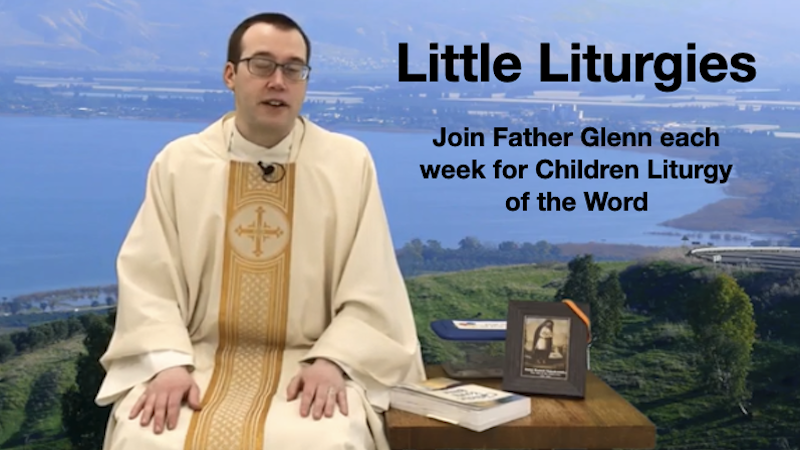

Father Glenn highlights John’s purpose in life, which is to prepare the way for Jesus to come and delivers an important message about our own lives. John takes his calling seriously and lives a simple life in the desert, wearing camel hair and eating locusts and honey. He preaches a message of repentance and reminds people to turn back to God’s law of love.
Father Glenn admires John’s determination, conviction, bravery, and faith in living out the message of the prophet Isaiah. He acknowledges that although John is successful in drawing crowds and leading people to repentance, he does not get to witness the full impact of his work. John’s greatest work is to prepare the path for Jesus, including his crucifixion, death, and resurrection, which ultimately creates the Church and spreads the message of the Gospel.
Father Glenn draws a parallel between John’s life and our own, emphasizing that when we give the gift of love to others, some gifts may flourish and grow in our lifetime, while others may grow in God’s time or long after we are gone. He encourages listeners to have faith when offering their gifts of love, knowing that they will bloom in God’s time, even if we may not see it.


Father Joe shares a conversation with Big Al about his changing career aspirations. Big Al confesses that he no longer wants to become a soccer player, but instead dreams of becoming an airplane pilot. Father Joe acknowledges the excitement of such a career choice but cautions Big Al about the importance of being attentive and following instructions from the control tower and co-pilot to avoid accidents. Father Joe draws a parallel between flying an airplane and navigating life, highlighting the significance of listening to guidance from God and wise and loving people. He explains that steering our lives in the wrong direction can lead to internal crashes, such as selfishness or arrogance. Father Joe urges Big Al to listen to God and ensure he is moving in the right direction in life. He concludes by emphasizing that listening to God is the key to finding true happiness and fulfillment.


Join us on a spiritual journey as we delve into Mark 1:1-8, where the voice of one crying out in the wilderness paves the way for the coming of Jesus Christ. In this detailed analysis, we uncover the significance of John the Baptist’s message and its relevance to our modern lives.
00:00 Introduction to the Gospel of Mark 1:1-8
00:58 What is the meaning of Mark 1:1-8
02:11 Bible Quiz: What was john the Baptist’s diet as mentioned in Mark 1:6?
02:39 Bible Quiz: In Mark 1:4, what did John the baptist Preach?
03:12 Bible Quiz: According to Mark 1:8, what did John say about the one coming after him?
03:43 Transfiguring Discussion Question
52
Sundays

Explore the Gospel
Meet Our Extended Family
Take Time to Chat
Family Fun
Recipe of the Week
Family Prayer
Fun Facts
SOURCE: 52 Sundays


Featured
Video

Children’s
Sermons

Richard Niell Donovan, a retired Disciples of Christ clergyman, published Sermon writer for more than two decades. When Dick died in 2020, his wife, Dale, has graciously kept the website online free of charge.
Children sermons have been written by
Lois Parker Edstrom
Dell Smith Klein
Dr. Carol J Miller
Dr. Dan Wuori
OBJECTS: None
It’s week number two: the second week of Advent and you may have noticed that we’ve lit another candle. Two candles lit and two more to go! Christmas is drawing closer and closer and before you know it we’ll be celebrating Jesus’ birth.
The Gospel reading is a special one, because it’s a prologue. Have you heard that word before––prologue?
A prologue is a part of a story that comes at the very beginning––and it has a special job. Its job it to get you ready––to tell you what you need to know to understand the rest of the story.
And today we hear the prologue to the Gospel of Mark––its very first verses.
In it we meet John the Baptist––who was a very important figure in the Bible.
John was a preacher who helped many people to have their sins forgiven by baptizing them in the River Jordan. Later in his life he would even baptize Jesus.
Click Title for Entire Message
SOURCE: Sermon Writer
OBJECT: Letters, stamps, email
When you want to send someone a message, how do you do it? You can write a letter and send it by mail. Perhaps you are familiar with the computer and send email messages. You can also use the telephone or just use your voice if the person is nearby.
We have lots of ways to send messages now, but earlier it was difficult to get a message to someone. Letters were hand carried or sent by boat and it took months before the letter was delivered.
In America, about one hundred and fifty years ago, mail was carried by the Pony Express. Riders left from Missouri and rode horses, day and night, as fast as they could ride, to California – about two thousand miles away. It was like a relay race where horses were changed every ten miles and riders took turns, each riding a hundred miles or so. The riders were often young, skinny boys, some as young as eleven. It took about ten days for mail carried by Pony Express to arrive. It was a difficult, but exciting journey.
Before Jesus was born, the good news of Jesus Christ, the Son of God, was written about by the prophet, Isaiah. This is what was written: “Behold, I send my messenger… who will prepare your way before you” (1:2).
Click Title for Entire Message
OBJECT: A megaphone. (You can roll up a big piece of poster board and use it to make your announcement.)
(Raise the megaphone. Use a loud voice) I HAVE AN ANNOUNCEMENT. I AM SENDING A MESSENGER. This is a megaphone. In the past, a megaphone was used when someone needed to make a special announcement. Today, we have microphones, so we don’t need the megaphone any more.
They didn’t have microphones or megaphones at the time of the Old Testament, but they did write special messages. Here are the words of one message: “Behold, I send my messenger before your face, who will prepare your way before you; the voice of one crying in the wilderness, ‘Make ready the way of the Lord!’” (Paraphrase of Malachi 3:1; Isaiah 40:3) That Old Testament message was talking about a man by the name of John.
John is better known to us as John the Baptist, or John the Baptizer. He must have been an interesting person. He didn’t live in the city. He lived out in the desert, or wilderness. He didn’t eat hamburgers and French fries; he ate locusts and honey. He didn’t wear a suit, or even jeans and a tea shirt; he wore clothes made out of camel’s skin and he had a leather belt around his waist. John talked to people near a river or stream and he baptized people who came to visit him.
Click Title for Entire Message
SOURCE: Sermon Writer
Sunday
Connection



 Highlight text or double-click a paragraph anywhere on the site to ADD TO NOTES. You can also click ASK AI to copy your selection to the clipboard with a command prompt, ready for you to paste manually into the chat above.