MAR 9, 2025

SOURCE: Hearers of the Word by Fr. Keiran O'Mahony


Homilies
Homilies
1st Sunday of Lent C


Sunday Podcast (USCCB)
1st Sunday of Lent C
Fr. Andrew Ricci
1st Sunday of Lent C

Study, Pray, Serve (2022)
Fr. Andrew Ricci, ordained in 1997, is a priest for the Diocese of Superior. He is the Rector of the Cathedral of Christ the King.



Bulletin Inserts



Carmelite Lectio Divina
Reflections and Prayers
92 page PDF with refections and prayers for each day of the month.
Lectio Divina March 2025 (PDF)
Lectio Divina March 2025 [Mobi]
Lectio Divina March 2025 [ePub]
“Lectio divina is an authentic source of Christian spirituality recommended by our Rule. We therefore practise it every day, so that we may develop a deep and genuine love for it, and so that we may grow in the surpassing knowledge of Christ. In this way we shall put into practice the Apostle Paul’s commandment, which is mentioned in our Rule: “The sword of the Spirit, too, which is the word of God, is to dwell abundantly in your mouth and in your hearts; and whatever things you have to do, let them be done in the word of the Lord.” (Carmelite Constitutions (2019), n. 85.)
Source: Carmelites

Bible Study Notes

- The Jerome Biblical Commentary,
- The New Jerome Biblical Commentary, and
- The Navarre Bible.
SOURCE: St. Charles Borromeo Catholic Church (Picayune, MS)
This passage is part of the harvest liturgy

The Law instructed an Israelite to take various produce at the beginning of the harvest (the “first fruits”) and present the produce to the Lord at his dwelling (i.e., the Temple). After the priest received the produce and placed it on the altar [4], the farmer who offered it would recite the creedal formula of 26:5-10. Then, the priest and the farmer’s family would sit down to feast on the produce.
God took an alien tribe, made them fertile [5], freed them [6-8], and gave them a land “flowing with milk and honey” [9]. At the end of this formula, the farmer reciprocated God’s goodness with his offering [9] and a bow of worship [10]. On the lips of the farmer, the history of the nation and the power of its God were remembered.
1st Sunday of Lent C
Offering of First Fruits
Deuteronomy 26:4-10

I. Historical Background
- Egyptian bondage and oppression
II. God’s Intervention
- Deliverance with a mighty hand
- Witnessing God’s signs and wonders
III. Land Inheritance
- Entry into a bountiful land
- Acknowledgment of divine gift
IV. First Fruits Declaration
- Worship and celebration
- Presentation of offering
- Proclamation of obedience
- Recognition of God’s provision
Clipart by Fr. Richard Lonsdale; pop-up links direct to Catholic centered content on Google AI search
Hearers of the Word

Click on slide to watch video by Fr. Kieran J. O’Mahony

The Creed of the Israelites
EXCERPT: Our First Reading introduces a historical precedent for a publicly professed creed (Dt 26:4-10) on the God-ordained feast of Firstfruits celebrated on the day after the Saturday Sabbath of the holy week of the Feast of Unleavened Bread, on the first day of the week (Lev 23:10-14). The celebration of this feast in AD 30 became Resurrection Sunday (Mt 28:1).
SOURCE: Agape Bible Study Copyright © 2015; revised 2024 (Used with permission.)
Bible Study Notes
- The Jerome Biblical Commentary,
- The New Jerome Biblical Commentary, and
- The Navarre Bible.
SOURCE: St. Charles Borromeo Catholic Church (Picayune, MS)
10:9 ” If you should confess the Lord Jesus in your mouth” When would the believer “confess” Jesus as Lord? In the Roman community, two times come to mind: in worship or evangelization.
10:10 “For, (one) believes in (the) heart into righteousness” Some translate “righteousness” as “justification” in this context. When the preposition “into” was added to “righteousness,” the phrase indicated results. In other words, whoever trusts God (or believes God raised Jesus from the dead; see 10:9) will be made righteous by God. Paul held the faith relationship was key to understanding justification.
10:11 “The (one) believing in him will not be shamed.” This verse was from Isaiah 20:16. It referred to the establishment of Jerusalem by God. As a city housing the Temple, Jerusalem was a cornerstone of religious piety and patriotism. Many of the faithful at the time believed that, as God was eternal, his city would stand the tests of time.
10:13 “For everyone who should call upon the name of the Lord will be saved.” This verse was from Joel 2:32. Like Isaiah 20:16, this referred to the worship of the Lord in Jerusalem.
1st Sunday of Lent C
The Word of Faith
Romans 10:8-13

I. Proclamation
- Confession of faith with the mouth
- Belief in the heart
II. Salvation Assurance
- Justification through belief
- Salvation through confession
III. Scriptural Foundation
IV. Promise of Eternal Life
- Calling upon the Lord’s name
- Assurance of being saved
Clipart by Fr. Richard Lonsdale; pop-up links direct to Catholic centered content on Google AI search
Hearers of the Word
Click on slide to watch video by Fr. Kieran J. O’Mahony
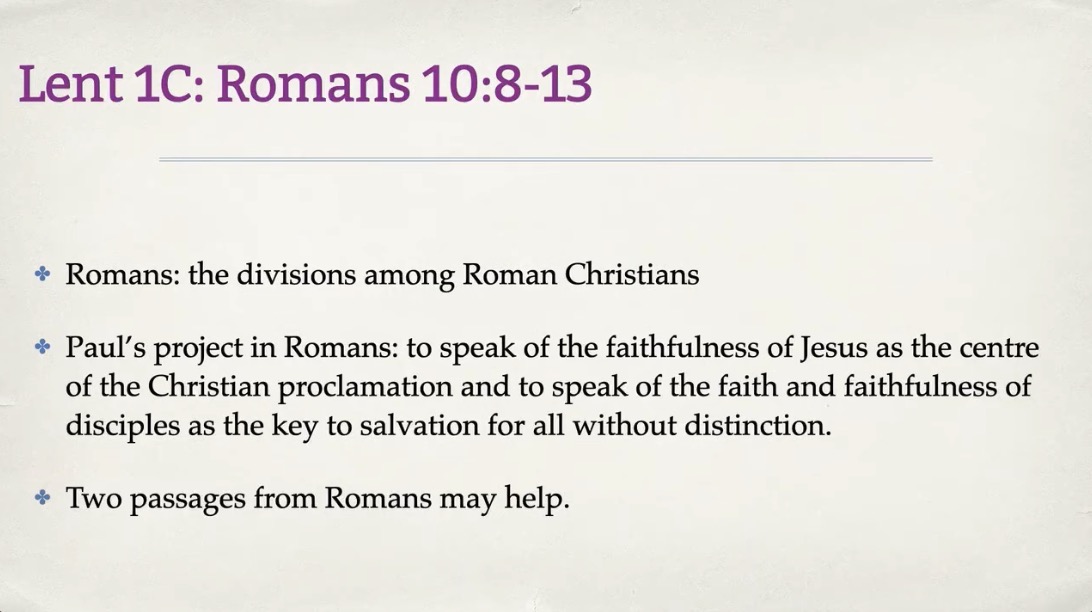
Baptismal Confession of the Early Christians
EXCERPT: In the Second Reading, St. Paul repeats an early Christian baptismal creed in his letter to the Christians in Rome: If you confess with your mouth that Jesus is Lord and believe in your heart that God raised him from the dead, you will be saved. Our baptismal vows are more elaborate today, but the confession is essentially the same. Only the Lord Jesus Christ offers us the gift of eternal salvation, and everyone who calls on the name of the Lord will be saved (Rom 10:13).To believe in the "name" of Jesus is to follow His commandments, exercise obedience to everything He taught, and adhere to the deposit of faith that He entrusted to His Church.
SOURCE: Agape Bible Study Copyright © 2015; revised 2024 (Used with permission.)
Bible Study Notes
- The Jerome Biblical Commentary,
- The New Jerome Biblical Commentary, and
- The Navarre Bible.
SOURCE: St. Charles Borromeo Catholic Church (Picayune, MS)
The Spirit leads Jesus into the desert for the purpose of a test
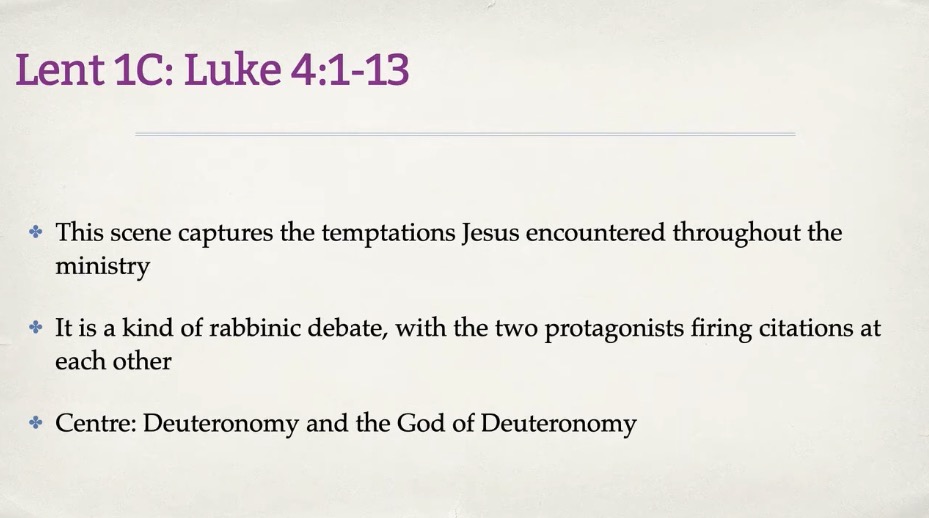
The temptation was to be a “crisis point” for Jesus; in Luke’s gospel. The temptation of bread represented the miracles of Jesus [3-4]. The temptation of temporal power represented his leadership in the Church community [5-7]. And the temptation in Jerusalem represented his growing popularity which had its peak when Jesus entered the capital [9-12]. For Jesus, each temptation represented a choice he had to make, a choice to trust in God or to promote self interest.
4:1 “full of the Holy Spirit” was a permanent condition. Luke used this phrase to point out the Messiah hood of Jesus. Jesus received his anointing as Messiah with the descent of the Spirit in his baptism (3:22). “filled with the Holy Spirit” was a temporary condition of prophetic utterance received by followers.
4:6 “this (ruling) power and their glory . . . because it has been given over to me and to whomever I wish to give it” The devil presumed power in the world, because people, by their sin, had given it to him. Unlike the fatalism of Greek culture or dualism of the Persian culture, Jews in the time of Jesus held the view that people, not God, were the source of evil. Evil came about by the abuse of free will.
1st Sunday of Lent C
Temptation in the Desert
Luke 4:1-13

I. The Spirit’s Guidance
- Jesus led into the desert
- Forty days of fasting
II. First Temptation: Stone to Bread
- Satan’s challenge to prove divinity
- Jesus’ reliance on God’s Word
III. Second Temptation: Authority Over Nations
- Offer of worldly power
- Rejection and quote from Scripture
IV. Third Temptation: Testing God’s Protection
- Suggestion to prove divine favor
- Response with another scriptural quote
V. Satan’s Departure
- End of temptation
- Angels ministering to Jesus
Clipart by Fr. Richard Lonsdale; pop-up links direct to Catholic centered content on Google AI search
Hearers of the Word
Click on slide to watch video by Fr. Kieran J. O’Mahony
The Temptation of Jesus the Second Adam
EXCERPT: In the Gospel Reading, we hear about the three tests of a covenant ordeal to which Satan subjected Jesus after His forty days in the wilderness. In each trial, Satan tried to lure Jesus into the sin of rebellion against God, but each time Jesus affirmed His obedience to the will of God the Father. He refused to test God. Instead, He put His trust and faith in His Father's Divine Plan for His life and the future salvation of humanity.
St. John the Apostle wrote: Do not love the world or the things of the world. If anyone loves the world, the love of the Father is not in him. For all that is in the world, sensual lust, enticement for the eyes, and a pretentious life is not from the Father but is from the world (1 Jn 1:15-16 NJB). St. John has summed up the world's temptations into three categories: sensual lust (desires of the flesh), enticement for the eyes, and a pretentious life (1 Jn 2:15-16).
| The Temptations of the First and Second Adams Contrasted | ||
| Temptations | The first Adam Genesis 3:1-6 | Jesus, the new Adam Luke 4:1-13 |
| The devil's invitation to rebellion | "Did God really tell you not to eat from any of the trees...?" | The devil said to him, "If you are the Son of God, |
| Hunger, a desire of the flesh | The woman saw that the tree was good for food | command this stone to become bread." |
| Enticement for the eyes | pleasing to the eyes, and | Then he took him up and showed Him all the kingdoms of the world ... "All this will be yours if you worship me." |
| The pride of a pretentious life (power) | desirable for gaining wisdom | "If you are the Son of God, throw yourself down from here... He will command his angels concerning you." |
| Michal E Hunt, Copyright © 2012 Agape Bible Study. | ||
His commands concerning the Tree of the Knowledge of Good and Evil and bringing sin into God's perfect world, infecting all humankind (Gen 2:16-17; 3:1-19; 1 Jn 3:8, CCC 394).
SOURCE: Agape Bible Study Copyright © 2015; revised 2024 (Used with permission.)

SCRIPTURE
SEARCH
FIRST READING (1)
SECOND READING (64)
GOSPEL (37)
This tool created by Jeff Pinyan uses the CCEL Early Church Fathers digital edition of the Philip Schaff collection.
1st Sunday of Lent C

Just Jr., A., Oden, T. C., Carson, D. A., & Oden, E. (Eds.). (2003). Ancient Christian Commentary on Scripture: New Testament III, Luke (Vol. 3). IVP Academic.
Catena Aurea
Luke 4: The Catena Aurea, which means “Golden Chain” in Latin, is a comprehensive biblical commentary comb is a 13th-century biblical commentary compiled by St. Thomas Aquinas. This anthology features insights from over eighty Church Fathers on the four Gospels.