MAR 2, 2025

SOURCE: Hearers of the Word by Fr. Keiran J. O'Mahony


Homilies
Homilies
8th Sunday of Year C


Sunday Podcast (USCCB)
8th Sunday of Year C
Fr. Andrew Ricci
8th Sunday of Year C
Study, Pray, Serve (2022)
Fr. Andrew Ricci, ordained in 1997, is a priest for the Diocese of Superior. He is the Rector of the Cathedral of Christ the King.


Bulletin Inserts
8th Sunday of Year C


Christ in our Neighborhood
8th Sunday of Year C

Bishop John P. Dolan / Phoenix
TWO PAGE HANDOUT | MOBILE
MAIN PAGE


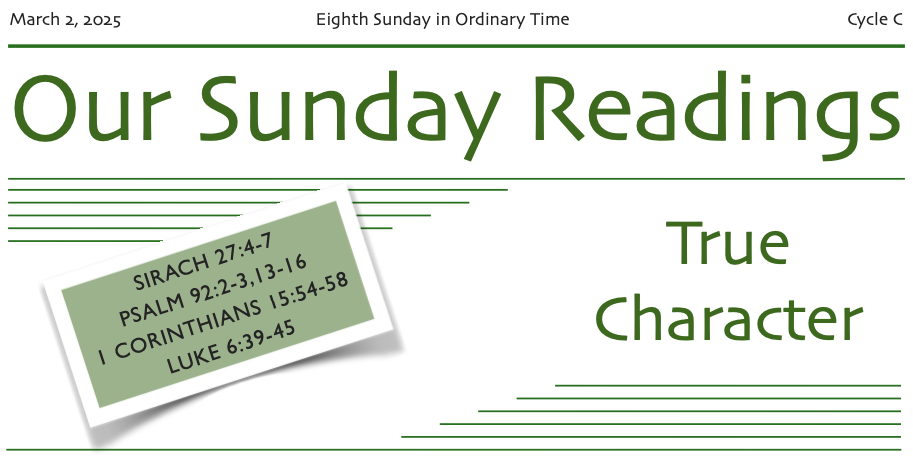
Our Sunday Readings
8th Sunday of Year C
Edrianne Ezell
Commentary, Questions & Prayer
Scripture Study
8th Sunday of Year C

Lectionary Commentary
8th Sunday of Year C
Fr. Tobin
Echoing God’s Word
8th Sunday of Year C
Fr. Thibodeau
Carmelite Lectio Divina
Reflections and Prayers
92 page PDF with refections and prayers for each day of the month.
Lectio Divina March 2025 (PDF)
Lectio Divina March 2025 [Mobi]
Lectio Divina March 2025 [ePub]
“Lectio divina is an authentic source of Christian spirituality recommended by our Rule. We therefore practise it every day, so that we may develop a deep and genuine love for it, and so that we may grow in the surpassing knowledge of Christ. In this way we shall put into practice the Apostle Paul’s commandment, which is mentioned in our Rule: “The sword of the Spirit, too, which is the word of God, is to dwell abundantly in your mouth and in your hearts; and whatever things you have to do, let them be done in the word of the Lord.” (Carmelite Constitutions (2019), n. 85.)
Source: Carmelites


Summary
This passage uses metaphors to emphasize the connection between speech, actions, and character. It highlights that tribulations reveal one’s true nature, just as a sieve separates wheat from chaff. Speech exposes the inclinations of the heart, much like a tree’s fruit shows the care it received.

he book of Sirach (also known as “Ecclesiasticus” from the Latin Vulgate) was written by Jeshua ben Eleazar ben Sira in the early second century BC. Jeshua wrote in Alexandria, Egypt, where a large Jewish population lived. Because the Jewish population was native (second generation and beyond), they had lost Hebrew and adopted Greek as a native language. While the book was originally written in Hebrew, it was quickly translated into Greek and found its way into the Septuagint, a Greek translation of the Old Testament.
The book is a collection of wise sayings useful for teaching ethics to the young. Written in the first person, the book extolled the Hebrew traditions. These factors indicate the writing was possibly used as a text book in religious schools found in the Jewish quarter of Alexandria.
In this passage, Sirach encouraged a small dose of skepticism, akin to “don’t judge a book by its cover.” He counseled his students to see beyond the good looks, the fancy clothes, the smooth flow of speech or the alluring ring of rhetoric; the wise person should peer into the mind and the heart. Only then, Sirach insisted, could you find the person’s true character. The one seeking righteous friends should test them to find out if they were truly worthy.
Sirach was honored in the early Church as a guide to life. It still has that power.
Permission for use. All materials found in word-sunday.com are the property of Larry Broding (Copyright 1999-2025). Viewers may copy any material found in these pages for their personal use or for use in any non-profit ministry.
8th Sunday of Year C
Sifting Character
Sirach 27:4-7

I. The sieve metaphor (27:4):
A shaken sieve reveals what is within; likewise, speech discloses one’s faults and mind.
II. The test of the just (27:5-6):
As a potter’s work is tested in a furnace, tribulations reveal the character of the righteous.
III. The fruit of a tree analogy (27:7):
Just as the care given to a tree is evident in its fruit, so too does one’s speech expose the inclinations of their heart.
Clipart by Fr. Richard Lonsdale
Fr. Paul Galeto, OSA


Click on slide to watch video.
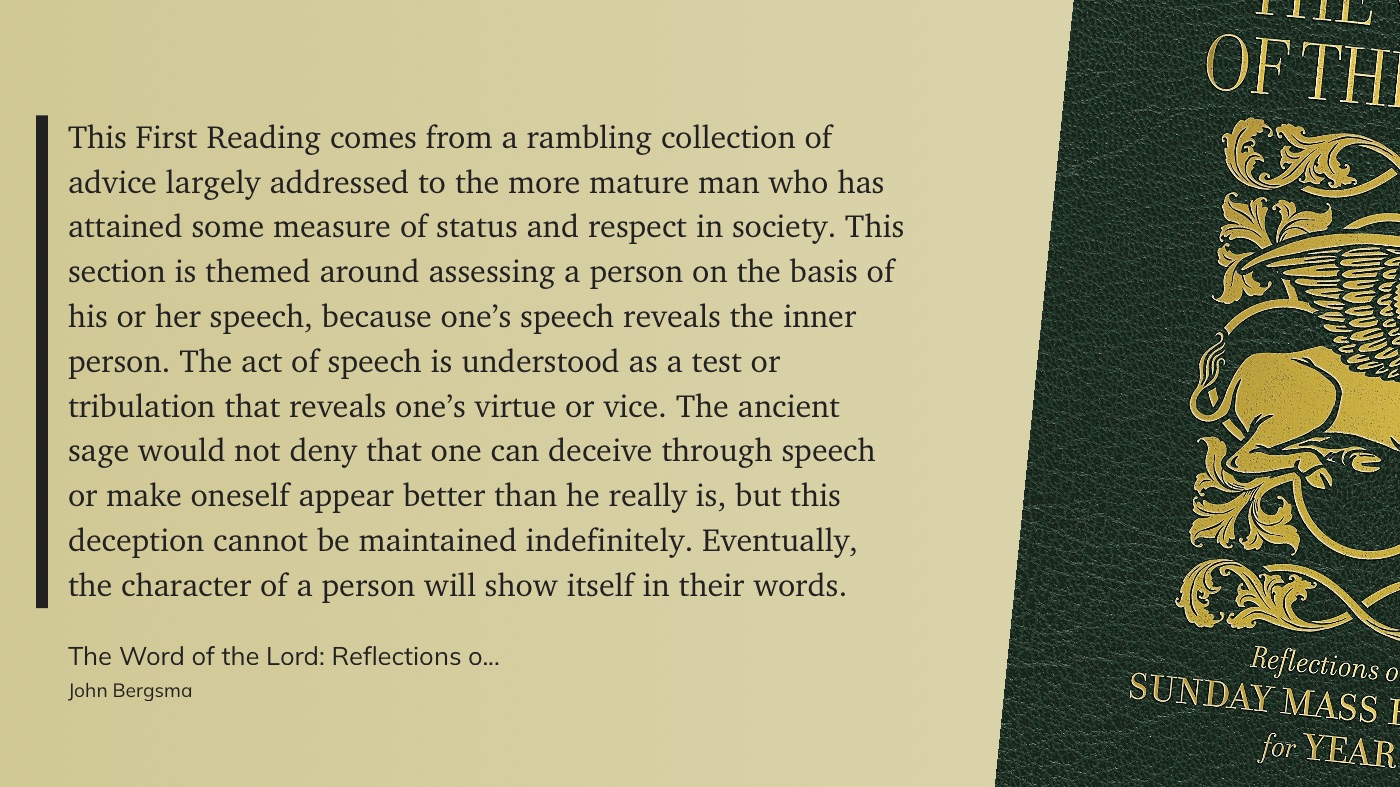
John Bergsma
Click on slide for larger image.
Bible Study Notes (PDF)
PDF Handout

- The Jerome Biblical Commentary,
- The New Jerome Biblical Commentary, and
- The Navarre Bible.
SOURCE: St. Charles Borromeo Catholic Church (Picayune, MS)

The Quality of One's Speech is a Test of One's Character
EXCERPT: Using examples from everyday life, including a sieve used to separate the grain from the husk and a kiln that fires a clay pot, the inspired writer compares tribulation in one's life to a test that reveals the quality of someone's character. The wise person knows when to speak and when to remain silent; he knows it is unnecessary to say everything he thinks. He also knows that thoughts precede actions, and sin is conceived in one's mind before it becomes an evil deed. He compares good deeds to good fruit, which is evidence of the careful cultivation of a fruit tree in the same way that a wise man who controls his thoughts produces the fruit of righteous acts.
SOURCE: Agape Bible Study Copyright © 2015; revised 2024 (Used with permission.)
Summary
This passage celebrates the victory of life over death through faith in Christ. Death loses its power as believers transform from perishable to imperishable beings. Sin, the cause of death’s sting, is overcome through Christ’s victory. The passage encourages steadfast devotion to the Lord’s work, assuring that such labor is not in vain.
15:54 “(that) subject to death will put on immortality” The phrase “(that) subject to death” is an adjective that means “death-like.” “Immortality” was an adjective in Greek that meant “un-dead.”
“Death was swallowed up in (God’s) victory” This verse was a Greek translation of Isaiah 25:8; this translation was unique, since it was not found in the Septuagint.
15:55 Where of you, death, (is) the victory; where of you, death, the sting?” This was a very free rendering of Hosea 13:14b: “O Death, where are your plagues? O Sheol, where is your destruction?” (RSV) Hosea used this phrase in the spirit of despair; he felt his condition was worse than death itself. Paul used the phrase in the light of the Resurrection; for Paul, death had been stripped of its power.
15:56 “The sting of death (is) sin.” Paul equated the term “sting” with snake bite, a clear reference to the role of the devil in the Garden of Eden narrative. The sin of Adam was like the bite of a poisonous snake that stung of venom. The venom would eventually kill. Paul implied that the victory of the resurrection removed the venom, hence the sting, of the devil’s bite.
These verses ended the body of Paul’s first letter to the Corinthians. Here he finished his argument for the resurrection with a reflection on the Second Coming. In a “wink of an eye” (15:52), the dead would be raised and the living would have their bodies changed from the physical to the spiritual. Then the perishable will become imperishable, the mortal will become immortal. Then, Paul (loosely) quoted two verses from the prophets to celebrate the end of death. And, in a domino-falling fashion, Paul worked backwards from the victory over death, to the victory over sin, and, implicitly, to the victory over Satan himself. (The note on the “sting” as a snake bite propped up this connection.) The victor was Christ. So, as a corollary, Paul argued for faithfulness. Any work done for Christ would not be in vain.
Permission for use. All materials found in word-sunday.com are the property of Larry Broding (Copyright 1999-2025). Viewers may copy any material found in these pages for their personal use or for use in any non-profit ministry.
8th Sunday of Year C
Triumph Over Death
1 Corinthians 15:54-58

I. Death is swallowed up in victory (15:54-55)
- The perishable becomes imperishable
- The mortal becomes immortal
II. The power of sin and the law (15:56)
- Sin gives death its sting
- The law empowers sin
III. Triumph through Christ (15:57)
- God gives victory over death
- Victory comes through our Lord Jesus Christ
IV. Call to steadfastness (15:58)
- Encouragement to be firm and devoted in the Lord’s work
- Assurance that labor in the Lord is not in vain
Clipart by Fr. Richard Lonsdale
Fr. Paul Galeto, OSA

Click on slide to watch video.
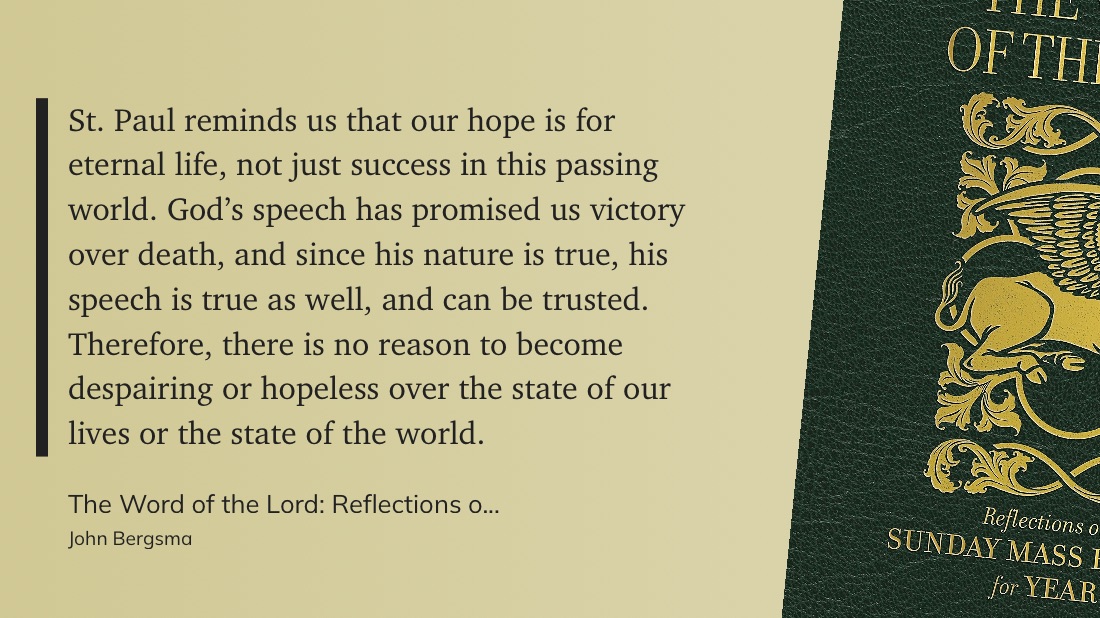
John Bergsma
Click on slide for larger image.
Bible Study Notes (PDF)
PDF Handout
- The Jerome Biblical Commentary,
- The New Jerome Biblical Commentary, and
- The Navarre Bible.
SOURCE: St. Charles Borromeo Catholic Church (Picayune, MS)
A Hymn of Triumph Over Death
EXCERPT: The Greek Christians of Corinth were having difficulty accepting the doctrine of the resurrection of the dead because it was a concept with which the Greeks were utterly unfamiliar. In 1 Corinthians 15:1-58, St. Paul gives a compelling argument supporting the bodily resurrection of Christ from the grave. In verses 54-58, he concludes with a hymn of thanksgiving to God for the tremendous gift to humanity merited by the death and resurrection of Jesus Christ, which comes from His victory over sin, death, and the devil.
Paul writes that physical death has been "swallowed up in victory" as the price of the death of the One who was sinless and able to condemn physical death without a lasting impact on the mortal soul (verses 54-55). Then in verses 56-57, Paul summarizes his teaching on the connection between Mosaic Law, sin, and death. Sin is the "sting" of death because it entered the world through the sin of Adam to harm all his descendants (see Rom 5:12). As humanity increased, sin grew. The Law of the Sinai Covenant (Law of Moses) defined sin, but it was incapable of providing the grace to enable humans to avoid sin. In verse 58, St. Paul urges Christians to continue the fight by being "firm, steadfast, and devoted to the work of the Lord" and by knowing that our good deeds offered in a labor of love for the Lord are not in vain.
SOURCE: Agape Bible Study Copyright © 2015; revised 2024 (Used with permission.)
Summary
This passage emphasizes the importance of integrity in discipleship. The parable of the blind leading the blind highlights that disciples reflect their teachers. It encourages self-examination before judging others, ensuring personal faults are addressed. Finally, it asserts that actions reveal character, just as good trees produce good fruit, and bad trees yield bad fruit.
6:41-42 In these two verses, Jesus invoked the image of two carpenters working side-by-side. When splinters of wood or sawdust flies, some will find their way into the eyes. If one carpenter asks another for help, it’s only natural to help the person in pain.
Tying these verses to 6:37 (“Don’t judge . . . or condemn . . . but acquit”), Jesus implied the person asked (the one who wants to take the speck from the other carpenter’s eye) should not reply with criticism. Negative criticism is neither constructive or requested. In addition, the critic many times chides others to cover over their own personal fault.
6:41 ” . . . speck (of sawdust) . . . the beam (of lumber) . . . ” The word “speck” can also be translated “splinter.” Jesus used extreme images (common in Semitic analogies) to make a point. When we judge others, we notice (and criticize) the smallest details. Yet that judgment blinds us to our own faults, some of which can be truly major in scope.
Jesus used an analogy from his own background as a carpenter. He pointed to the temptation in leaders to make negative, and sometimes rash, moral judgments. It was easier to point and condemn, than to take time to reflect, take stock, and reform.
The analogy of the speck and the beam implied a greater issue for Christians: repentance. The critic cannot repent, unless critical focus was pointed inward. Christians, by definition, were reformed sinners following the Lord. As sinners, they were no better than the people they looked upon. As the reformed, they struggled with the moral life and they received God’s grace as a gift; struggle and grace had no place with judgment. As Christians, they followed One Greater than they were; Christians cannot take the place of the Judge they profess to worship. Sharp moral criticism was diametrically opposed to repentance.
43 For a good tree does not produce rotten fruit, nor again does a rotten tree produce good fruit. 44 For each tree is known from (its) own fruit. For, not from thorns do (people) collect figs, nor from thorn bushes do (people) gather bunches of (ripe) grapes. 45 The good man from the good treasure of the heart brings forth good. And the evil (person) from the evil (heart) brings forth evil. For his mouth speaks from the excess of the heart.”
6:43-45 In this section, Jesus used an agricultural analogy. Just as good fruit comes from good trees, people reveal their character through their speech. Jesus seemed to say, “Listen to someone long enough, and you will know where their heart lies.”
Permission for use. All materials found in word-sunday.com are the property of Larry Broding (Copyright 1999-2025). Viewers may copy any material found in these pages for their personal use or for use in any non-profit ministry.
8th Sunday of Year C
True Discipleship
Luke 6:39-45

I. The parable of the blind leading the blind (6:39)
- A student is not above their teacher
- A fully trained disciple becomes like their teacher
II. Removing obstacles before correcting others (6:40-42)
- The importance of self-examination before judging others
- Addressing personal faults to guide others effectively
III. Recognizing good and bad fruit (6:43-45)
- Trees are known by their fruit
- Good people produce good deeds from their good hearts
- Wicked people reveal their evil through their actions
Clipart by Fr. Richard Lonsdale
Fr. Paul Galeto, OSA

Click on slide to watch video.
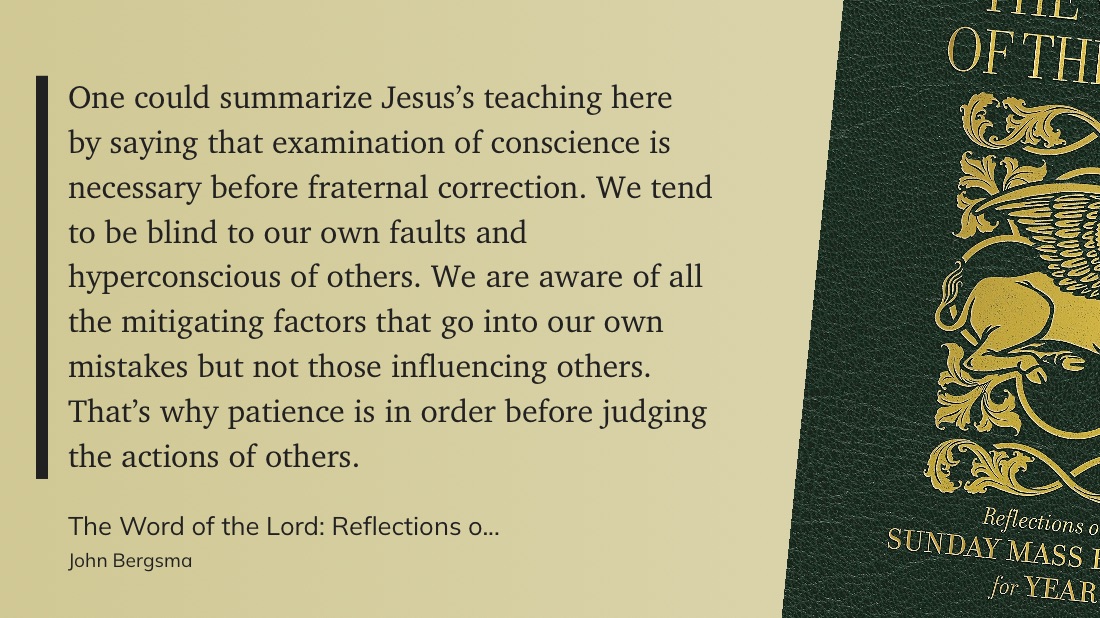
John Bergsma
Click on slide for larger image.
Bible Study Notes (PDF)
PDF Handout
- The Jerome Biblical Commentary,
- The New Jerome Biblical Commentary, and
- The Navarre Bible.
SOURCE: St. Charles Borromeo Catholic Church (Picayune, MS)
Art & Faith

The Blind Leading the Blind, Painted by Pieter Brueghel the Elder (1529-1569), is a literal depiction of the parable of the blind. Each figure has a different eye affliction, just like all of us are blind in so many different ways. The men are holding each other for guidance. But, the leader of the group has already fallen into a ditch and, because they are all linked together, he is dragging everyone else down with him.

The Parable of the Mote and the Beam painting is one of thirteen illustrations of Gospel parables painted by Domenico Fetti in 1619. It illustrates the key point of Jesus’ parable that there is nothing worse than hypocrisy.
A Person is Known by the Quality of His Actions
EXCERPT: In this passage, Jesus uses a saying and two short parables to teach about correct behavior. He began teaching in parables when He encountered the opposition of His audience that included the religious leaders (see Mk 5:36-39). A parable is a story based on a familiar life experience that conveys a particular truth or imparts a lesson. Biblical scholars number the parables in the Gospels as between 35-75. The wide variation in numbering the parables comes from the difficulty in classifying what is defined as a parable, a saying or maxim, a simile or a metaphor, or an allegory. Eight major themes occur regularly in Jesus's parables:
- The assurance of the coming of the Kingdom of God.
- The present arrival of the "new age."
- The mercy of God for sinners.
- The imminence of God's divine judgment.
- The necessity of an immediate personal response to Jesus's message.
- The conditions of discipleship.
- The coming of the Passion.
- The consummation of Jesus's mission in His Resurrection and Ascension.
The Saying of the Blind Guide:
In verse 39, Jesus said, "Can a blind person guide a blind person? Will not both fall into a pit?" He uses what may have been a popular saying to make His point about the importance of correct behavior. A person already immersed in sin cannot lead someone else out of sin and back to the path of righteousness. He is a "blind guide" and a hypocrite because of his sinful condition. The "pit" is probably a reference to the fiery pit of the hell of the damned. Notice that Jesus uses the Greek word "hypocrite" in verse 42. There is no Hebrew or Aramaic equivalent. It is a Greek word that refers to the Greek theater and means "playing a role or part." Jesus's point is that someone guilty of unconfessed sins for which they have not shown repentance is only a hypocrite playing the part of a righteous person when they try to bring to light the sins of another.
The Parable of the Splinter and the Beam
The "teacher" in verse 40 is Christ. No disciple is superior to Christ, but every disciple, when trained in the "Word," can live in the image and likeness of Christ to be an example to others.
Jesus teaches that in fighting sin, we must begin with fighting the failures in ourselves. We are hypocrites if we quickly judge a fault in someone else when we are guilty of the same sin in our life. When we recognize and condemn in someone else what is a sin in our lives without confessing and repenting our transgressions, then our sins will doubly count against us at the accounting of our lives before God at Divine Judgment. We will also have no credibility if we try to help someone else whose life is torn apart by sin if our lives are just as tainted. The answer to living a life of righteousness is to seek God's forgiveness in the Sacrament of Reconciliation. When we experience the grace of God's mercy, we must offer that same forgiveness to others in the human family. To forgive us our trespasses as we forgive those who trespass against us is a petition in the Lord's Prayer (Mt 6:12). We must be committed to forgiving one another as God has forgiven you in Christ (Eph 4:32). St. Augustine wrote, "Whoever confesses his sins ...is already working with God" (In Evangelium Johannis, 12).
The Parable of a Tree and its Fruit:
Jesus used this parable in the Sermon on the Mount to help discern between the true and false prophet (Mt 7:15-20). Someone who claims he speaks in the name of God is someone who claims to be a prophet. Unfortunately, throughout salvation history there have always been false prophets leading the faithful astray. In relating this teaching to the blind guide saying, one can recognize the true child of God who is a guide to others by the quality of his deeds that are the "fruits" of good works that his life produces like compassion, mercy, charity to the poor and a forgiving heart. Notice the reference to "thorn bushes," a reminder of Adam's judgment in Genesis 3:18.
People in Jesus's time understood the heart as the moral essence of a person for good or evil. It was the seat of one's personality. The struggle against sin and evil entails purifying oneself by confessing sin and surrendering to the interior anointing of God the Holy Spirit. Only then can someone genuinely do what is righteous. In Jesus's parable, the good fruit (good works) come from good trees (good people), and the rotten fruit (evil works) come from bad trees (people with evil intentions). The malicious accusations of the scribes and Pharisees reveal the malice and evil in their hearts; it is their rotten fruit/deeds that identify them as evil. They are looking for sin in Jesus when there was an abundance of sin evident in their lives.
In the "tree known by its fruit" parable, Jesus uses one of the covenant images of the Old Testament prophets. There are four reoccurring symbolic images of the prophets that represent a covenant relationship or lack of a covenant relationship with God: (1) marriage, (2) the fruitful vine and tree, (3) domesticated animals, and (4) drinking wine (See the chart "The Symbolic Images of the Prophets"). In this series of teachings, Jesus was calling His disciples in every generation to be guided by a spiritual discernment that is the evidence of the Holy Spirit working in their lives. They must be honest in confessing and repenting their transgressions before calling other sinners to repentance. They must bear the "good fruit" of righteous deeds as evidence of one who bears the image of the resurrected Jesus Christ. The philosopher Goethe repeated the point of Jesus' teaching when he wrote: "Behavior is the mirror of one's true image." Does your behavior mirror the image of the righteous Resurrected Jesus Christ?
SOURCE: Agape Bible Study Copyright © 2015; revised 2024 (Used with permission.)

SCRIPTURE
SEARCH
FIRST READING (36)
SECOND READING (68)
GOSPEL (71)
This tool created by Jeff Pinyan uses the CCEL Early Church Fathers digital edition of the Philip Schaff collection.
8th Sunday of Year C


Just Jr., A., Oden, T. C., Carson, D. A., & Oden, E. (Eds.). (2003). Ancient Christian Commentary on Scripture: New Testament III, Luke (Vol. 3). IVP Academic.
Catena Aurea
The Catena Aurea, which means “Golden Chain” in Latin, is a comprehensive biblical commentary comb is a 13th-century biblical commentary compiled by St. Thomas Aquinas. This anthology features insights from over eighty Church Fathers on the four Gospels.
 Highlight text or double-click a paragraph anywhere on the site to ADD TO NOTES. You can also click ASK AI to copy your selection to the clipboard with a command prompt, ready for you to paste manually into the chat above.