MAR 2, 2025

SOURCE: Catholic Resources by Rev. Felix Just, S.J.


Liturgy Planning
Liturgy Planning
- NOTES
- SPACE
- LECTORS
- MUSIC
Weekday
Masses

MON | TUE | WED
THUR | FRI | SAT
Lent
2025
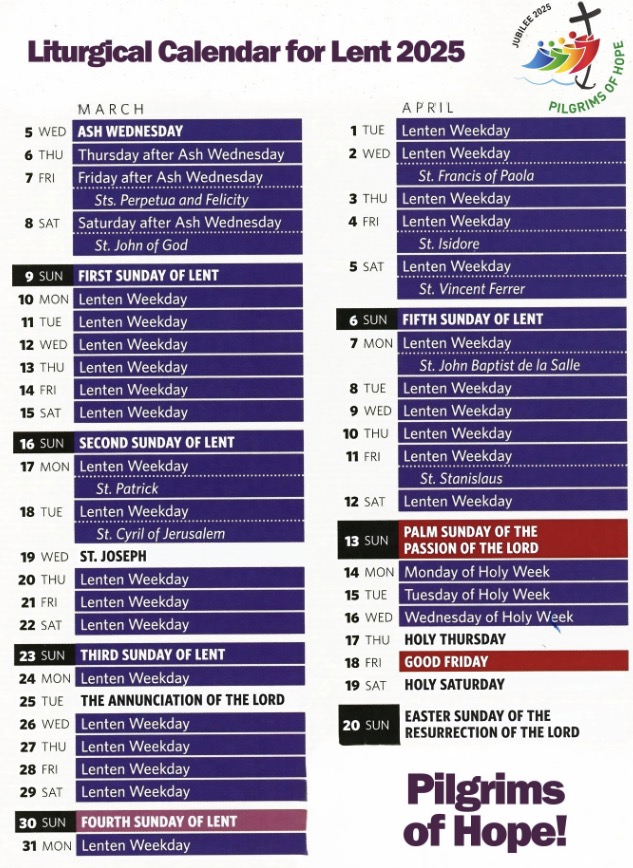
Lent 2025 begins on Ash Wednesday, March 5, 2025. To help you on your Lenten Journey during this Jubilee Year as Pilgrims of Hope, this Lenten eBook contains 67 Ideas and Suggestions for Prayer, Fasting and Almsgiving and a 2025 Lenten Liturg
JUBILEE 2025
The Jubilee Year begins on Christmas Eve in Rome. Here are 16 pages with Resources to help you understand and celebrate the Jubilee and Holy Year of 2025!
8th Sunday of Year C

SOURCE: Basilica of the The National Shrine. Crypt Church (TV Mass)
February 27, 2022
Celebrant & Homilist: Rev. Lee Fangmeyer
Choir: Basilica of the National Shrine of the Immaculate Conception Cantor & Organist, Washington, D.C.
⬇️ Planning Notes
8th Sunday of Year C
Self-Examination
Fr. Lawrence Mick

THE GOSPEL calls us to self-examination. What kind of fruit are we producing in our lives? What changes are needed? This passage also reminds us not to spend our time judging the faults of others but to remove the beam from our own eyes. That is good advice at any time of the year, but it also sets the stage for celebrating the scrutinies with the elect during Lent. We can only hold them up as examples of the need for continued conversion if we admit that we all are in need of such spiritual growth.
These themes provide plenty of material for preachers this weekend, but they also provide ideas for the petitions. The general intercessions are intended to be part of our response to what we have heard in the word of God. The more you can use language and images from the readings in crafting the petitions, the clearer that connection becomes.
Wednesday is Ash Wednesday, which usually draws large numbers of worshipers.
Discuss with the pastor what schedule would best accommodate those who want to start Lent with the Eucharist as well as those who may only come for the distribution of ashes in the context of a Liturgy of the Word. Don’t forget those who are unable to come to church because of illness or age. Can the ashes be taken to them in a similar service of prayer?
SOURCE: CELEBRATION
⬇️ Greeting
8th Sunday of Year C
⬇️ Kyrie
8th Sunday of Year C
- Lord Jesus, your words fill us with spirit and life: Lord, have mercy.
- Christ Jesus, your actions teach us how to love and forgive: Christ, have mercy.
- Lord Jesus, your very life shows us how to live in communion with one another: Lord, have mercy.
SOURCE: CELEBRATION
⬇️ Collect
8th Sunday of Year C

SOURCE: Julie Storr
⬇️ Lectionary Readings

FR. FELIX JUST, S.J (1:26:40)
8th Sunday of Year C
COMMENTARY | HOLY SEE
BULLETIN INSERTS
⬇️ Homily
8th Sunday of Year C
⬇️ Prayers of the Faithful
8th Sunday of Year C
Discover a vast collection of over 100 petitions that are thoughtfully updated each week, ensuring a strong connection to the Sunday Readings. These petitions, designed for the Prayers of the Faithful during Mass, provide a relevant and meaningful way for your parish community to unite in prayer and intercession.
CHURCH | WORLD | SPECIAL NEEDS | COMMUNITY
Presider Let us pray to respond to the needs of others more quickly and generously than we respond to our own.
Minister For those in church leadership who are fearful and resistant to change; for those who have left the church or feel alienated by it, we pray:
- For elected leaders, for truthful dialogue among all representatives of political parties and, for the enactment of just laws that protect the least among us, for transparency in government, we pray:
- For the wisdom to listen compassionately, to judge gently and to endure tribulations faithfully, we pray:
- For those who suffer from the effects of harsh weather, natural disasters and poor living condition, we pray:
- For those marginalized due to race, gender, ethnicity, social status, religious beliefs, political affiliations and all other forms of prejudice; for the grace to see how we marginalize others, we pray:
- For the intercession of St. Katharine Drexel, whom the church remembers on this day as the patron saint of racial justice and philanthropists; for an ability to give our wealth and resources to those in need, we pray:
- For comfort to those who suffer from chronic disease; for those who cannot afford or do not have access to life-saving medical treatment; for all medical professionals who work tirelessly to heal, we pray:
- For all who are in prison; for healing and peace for victims of crime, and for all who have died, especially those who have died violent deaths, we pray:
Presider God of love, hear these prayers and guide us to an ever-deepening awareness of your will. Help us remove the beams in our own eyes so we may better serve others. We ask this in Jesus’ name. Amen.ve according to the gifts you give us for the good of the world. We pray in the name of your Son, who gives us a new commandment. Amen.
SOURCE: CELEBRATION
RESOURCES
General Instruction of the Roman Missal
A Simple Guide to Liturgical Enviornment (DIocese of New Ulm PDF)
Common Questions on Liturgical Norms – by Father Edward McNamara, professor of liturgy at the Regina Apostolorum Pontifical Athenaeum
DIRECTORY OF
POPULAR PIETY
AND THE LITURGY
Directory (Vatican)
Lent (PDF)
Holy Week (PDF)
Eastertide (PDF)
GUIDELINES AND RESOURCES
8th Sunday of Year C

BISHOP ROBERT BARRON (15:06)- Ash Wednesday homily from three years ago given to the students at St. Bonaventure High School in Ventura, CA.
Ash Wednesday
Preparation for Ash Wednesday includes reflecting on repentance and sin, and considering how to create more space for God in your life. The ashes used on Ash Wednesday are a symbol of penance and are made from the previous year’s Palm Sunday palms.
Reflect on repentance
- Consider what has distracted you from growing your relationship with God
- Consider what you might give up or change to create more space for God
- Consider how you can seek God’s mercy during Lent
Prepare your heart
- Consider how you can prepare a clean heart before celebrating Easter
- Consider how you can create simple patterns to help you look forward to Lent
- Consider how you can give thanks to God
Attend Ash Wednesday Mass
- During the Mass, you can receive ashes in the shape of a cross on your forehead
- The ashes symbolize penance and contrition, and that God is merciful to those who repent
Remember the meaning of the ashes
- The ashes are a reminder that you should repent of your sins
- Ashes are a reminder that you are dust and will return to dust
- The ashes are a reminder of Christ’s sacrifice
Gathering Space
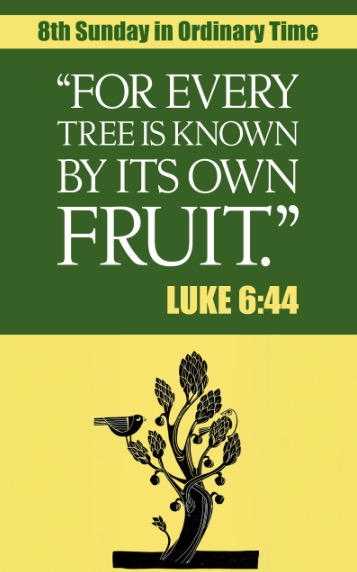
- Display banners or posters with quotes from the readings, such as “Love your enemies, do good to those who hate you” (Luke 6:27)



8th Sunday of Year C
Lector’s Notes
Greg Warnusz’s look at the Sunday readings,
focusing on the lector’s understanding
and proclamation
Lisa M. Bellecci
FIRST
READING

SECOND READING

Lector Series
The following lector videos were produced by the Los Angeles Archdiocese:



8th Sunday of Year C

SOURCE: OCP Liturgy Podcasts
“A good person out of the store of goodness in his heart produces good, but an evil person out of a store of evil produces evil; for from the fullness of the heart the mouth speaks.”
Jesus challenges the world with his call to universal love.
SOURCE: OCP Liturgy Podcasts
“A good person out of the store of goodness in his heart produces good, but an evil person out of a store of evil produces evil; for from the fullness of the heart the mouth speaks.”
SOURCE: OCP Liturgy Podcasts
“A good person out of the store of goodness in his heart produces good, but an evil person out of a store of evil produces evil; for from the fullness of the heart the mouth speaks.”
Jesus offers practical wisdom for living in Christian community.





Alleluia! Sing to Jesus
Traditional; arr. by Josh Blakelsey
8th Sunday of Year C
The House that Love Is Building
Sarah Hart

Lord, It Is Good to Give Thanks to You
Steve Angrisano
8th Sunday of Year C
Lord, It Is Good to Give Thanks to You
Steve Angrisano

Tend the Ground
Curtis Stephan
8th Sunday of Year C
Tend the Ground
Curtis Stephan

By Our Love
Tom Kendzia
8th Sunday of Year C
By Our Love
Tom Kendzia

Alleluia! Alleluia! Let the Holy Anthem Rise
Timothy R. Smith
8th Sunday of Year C
Alleluia! Alleluia! Let the Holy Anthem Rise
Timothy R. Smith
