FEB 23, 2025


Homilies
Homilies
7th Sunday of Year C


Sunday Podcast (USCCB)
7th Sunday of Year C

Fr. Andrew Ricci
7th Sunday of Year C
Study, Pray, Serve (2022)
Fr. Andrew Ricci, ordained in 1997, is a priest for the Diocese of Superior. He is the Rector of the Cathedral of Christ the King.
SOURCE: Study, Pray, Serve




Bulletin Inserts
7th Sunday of Year C


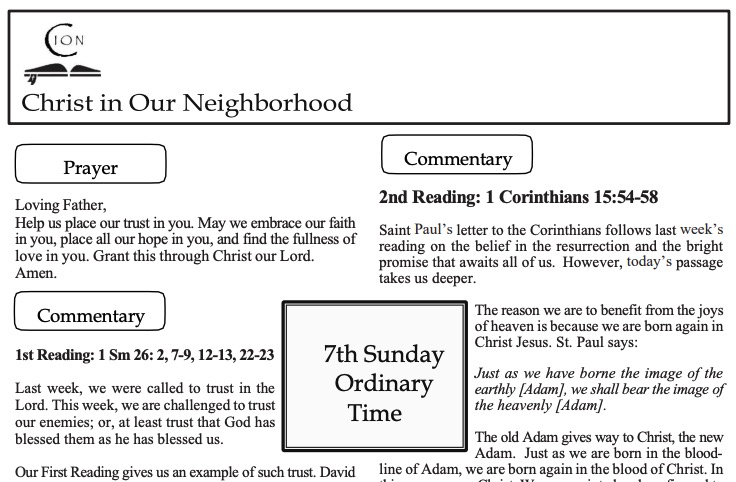
Christ in our Neighborhood
7th Sunday of Year C

Bishop John P. Dolan / Phoenix
TWO PAGE HANDOUT | MOBILE
MAIN PAGE

Our Sunday Readings
7th Sunday of Year C
Edrianne Ezell
Commentary, Questions & Prayer

Scripture Study
7th Sunday of Year C

Lectionary Commentary
7th Sunday of Year C
Fr. Tobin
Echoing God’s Word
7th Sunday of Year C
Fr. Thibodeau
Carmelite Lectio Divina
Reflections and Prayers
77 page PDF with refections and prayers for each day of the month.
Lectio Divina February 2025 (PDF)
Lectio Divina February 2025 [Mobi]
Lectio Divina February 2025 [ePub]
“Lectio divina is an authentic source of Christian spirituality recommended by our Rule. We therefore practise it every day, so that we may develop a deep and genuine love for it, and so that we may grow in the surpassing knowledge of Christ. In this way we shall put into practice the Apostle Paul’s commandment, which is mentioned in our Rule: “The sword of the Spirit, too, which is the word of God, is to dwell abundantly in your mouth and in your hearts; and whatever things you have to do, let them be done in the word of the Lord.” (Carmelite Constitutions (2019), n. 85.)
Source: Carmelites


Social Media /
Bulletin Inserts
“So David and Abishai went among the soldiers by night, and there lay Saul sleeping inside the barricade with his spear thrust into the ground at his head…” – 1 Samuel 26:7
Sometimes, we’re given opportunities to act on our emotions, but wisdom tells us to pause. In moments where you have power over someone, how do you choose grace instead of retaliation?
“But David said to Abishai, ‘Do not harm him, for who can lay hands on the Lord’s anointed and remain unpunished?'” – 1 Samuel 26:9
David showed respect and restraint. He valued life and God’s anointing above his own grudge. When faced with revenge, what steps can you take to choose empathy over your anger?
“Taking the spear and the water jug from Saul’s head, they made off…” – 1 Samuel 26:12
David took what he could and left without harm. This shows us that sometimes, walking away is the strongest choice. What burdens are you carrying that you could walk away from today for your own peace?
“The Lord will reward everyone for their justice and faithfulness.” – 1 Samuel 26:23
Living with integrity and faithfulness in challenging times brings its own rewards. How can you remain faithful and just when the world tempts you to act otherwise?
“Look, here is the king’s spear. Let one of the young men come over and get it.” – 1 Samuel 26:22
David was confident in letting go and demonstrating peace. When you let go of what’s not yours to keep, how does it change your life for the better?

This passage represents the second time David was able to catch King Saul off guard. The first time, David was able to approach the sleeping Saul by accident; David took the hem of Saul’s tunic only to repent of his action.
This time, Saul pursued David [2]. Even though Saul surrounded himself with guards, David calculated his approach. Remembering God’s will in the person of Saul, David resisted the temptation to kill his enemy [7-8]. Instead, David took the symbols of Saul’s survival (water jug) and military power (spear) [12-13].
From an opposite high point, David taunted Saul; he challenged the King to send one of his servants to retrieve the items. This is a rhetorical remark, for David had the high ground to fend off an attack. The real purpose of the taunt was revealed; David could have killed the king but spared Saul’s life at cost of his royal honor. David was the better warrior and the power of this story would galvanize popular support for David. Saul was in decline. From this point on, David did not try to reconcile with Saul. In David’s mind, the inevitable was in God’s hands. [22-23]
No one escapes the wrath of an enemy. But, how do we, as Christians, respond to direct attack or slander? Do we return in kind, or do we trust God with the outcome? This is the true measure of our moral character.
Permission for use. All materials found in word-sunday.com are the property of Larry Broding (Copyright 1999-2025). Viewers may copy any material found in these pages for their personal use or for use in any non-profit ministry.
7th Sunday of Year C
David Spares Saul
1 Samuel 26:2, 7-9, 12-13, 22-23

I. David Pursues Saul (v. 2)
- Saul goes to the hill of Hachilah
- David learns about Saul’s whereabouts
II. David’s Opportunity (vv. 7-9)
- Saul and his army encamp in the valley
- David and Abishai sneak into the camp at night
- Saul and his men are asleep, giving David the chance to kill him
III. David Refuses to Harm Saul (vv. 12-13)
- David takes Saul’s spear and water jug
- David refuses to kill Saul, the Lord’s anointed, despite Abishai’s suggestion
IV. David Rebukes Abishai (v. 22-23)
- David reproaches Abishai for suggesting to harm Saul
- David insists on respecting Saul as God’s anointed king
Clipart by Fr. Richard Lonsdale
Scriptures in Context
Fr. Paul Galeto, OSA


Fr. Paul Galetto, OSA
Catholic Sunday Scriptures in Context
Enemy, an Authority Figure?

Click on slide for larger image.
David’s Refusal

Click on slide for larger image.
Bible Study Notes (PDF)
PDF Handout

- The Jerome Biblical Commentary,
- The New Jerome Biblical Commentary, and
- The Navarre Bible.
SOURCE: St. Charles Borromeo Catholic Church (Picayune, MS)
FR. DAVID LINGWOOD (9:21) – 7th Sunday Ordinary Time (Year C) – King Saul is hunting his rival David with the intention of killing him. He camps for the night. Under the cover darkness, David and his nephew sneak into his camp. Saul is asleep and unprotected. How will the two intruders act? This decision will be critical for David’s future.

David Spares Saul's Life
EXCERPT: David demonstrates his faith in God and obedience to His commandments in two episodes involving David's sworn enemy, King Saul. Some men from Ziph went to Saul and offered to betray David. Their city was in the hill country of southern Judah (Josh 15:55) and gave its name to the Judean wilderness between their territory and the Dead Sea at En-Gedi (1 Sam 23:14-15, 24; 26:2). Saul's remorse for how he had treated David in an episode recounted in 1 Samuel 24:17-22, and his thankfulness for David sparing his life was short-lived. He was soon back to relentlessly hunting down David and his men with an army of three thousand men to David's six hundred. The Hill of Hachilah (1 Sam 23:19; 26:1, 3) is an unknown site located in the wilderness of southern Judah not far from Hebron. David hid from Saul there in 1 Samuel 23:19 and 26:1, and in our reading, the king pitched his camp there. Saul was looking for David, but David had better spies and located the king's camp first. Saul was in the company of his kinsman and army commander, Abner, son of Ner (see 1 Sam 14:50-51 and 26:5).
David and his nephew Abishai made their way into the king's camp in the dark, where they discovered him sleeping soundly. Abishai suggested that God had put Saul into David's hands and offered to kill his uncle's mortal enemy. Abishai's boast that it would only take one blow to "pin him to the ground" with Saul's spear recalls when Saul twice tried to "pin David to the wall" with the same spear (1 Sam 18:11 and 19:10). But David resists the temptation and forbids his nephew to raise his hand against Yahweh's anointed king of Israel.Abishai was shocked by his uncle's refusal, so David felt it necessary to explain that God would judge Saul, and his death was in God's hands. David feared offending God more than what his enemy could do to him or his family, and David, who was also God's anointed (1 Sam 16:1, 12-13), trusted God with his destiny (verse 10).
To offer proof that he could have taken Saul's life, David took Saul's spear and the water jug by the king's head. Perhaps David took the spear because he was fearful that it would be too much of a temptation for the impetuous Abishai to have it in his hands. It was similar to cutting a piece from Saul's cloak in the earlier episode (1 Sam 24:5, 12) when David also resisted the temptation to kill his enemy. No one in the camp awoke because God caused all the soldiers to remain sleeping. The Lord had again intervened directly to aid David.
David retreated to the safety of the other side of a ravine where he shouted from the prominence across the gorge to Saul's camp. David's shouting awakened the men in Saul's camp from not just a sound sleep but a God-induced stupor. David then lifted Saul's spear above his head as proof that he could have killed Saul but that he had shown mercy to the anointed king of God's people. David feared offending God more than he feared his enemy, and he loved God more than killing his enemy to save his own life. For his act of mercy, God would reward David. Saul would die in battle with the Philistines while David became Israel's greatest and most beloved king and the ancestor of the mother of the Redeemer-Messiah and her son, Jesus of Nazareth (Mt 1:1; Lk 1:32-33)!ue to bear the spiritual fruit of righteousness that promises an ever "green" eternal reward from the waters of the "stream" of everlasting life.
SOURCE: Agape Bible Study Copyright © 2015; revised 2024 (Used with permission.)
Social Media /
Bulletin Inserts
“For the earthly man comes first, then the heavenly one.”
Caption: Our journey starts in the physical, but our destination is the spiritual.
Reflection Question: In what ways are you preparing your spirit for its heavenly journey?
“Just as we have borne the image of the earthly one, we shall also bear the image of the heavenly one.”
Caption: Embrace the process of becoming—of moving from the earthly image to the heavenly.
Reflection Question: What steps can you take today to reflect the image of the heavenly?
“The first man is from the earth, earthly; the second man, from heaven.”
Caption: Our origin is earthly, but our calling is heavenly. Strive to live a life that reflects divine love and purpose.
Reflection Question: What actions can you take to shift your focus from earthly concerns to heavenly pursuits?
15:45 “The first man, Adam, became a living being” was a combination of Genesis 1:27a (So God created man in his own image, in the image of God he created him) and 2:7c (man became a living being). The word “Adam” had the generic meaning of “man,” the addition of “Adam” to “man” was actually redundant.
The phrase “become a living being” was actually “become into a living (human) soul.” In other words, the verb “become” had a passive voice, that begged the question, “Who caused this “becoming?'” Of course, the answer was God. In other words, “man” (“Adam”) received life from God.
Paul balanced the first Adam with the second, the one who would give life. That phrase was literally “the last Adam into a life-giving spirit.”
The first Adam received natural life from God’s Spirit; the last would give the gift eternal life through that same Spirit.
15:46 “the natural” was literally the “soul-like.” Paul used the language of the human spirit (“soul”) to differentiate between the human and the divine (“spiritual”).
15:48 This sentence was a comparison between the “earthly” Adam and the “heavenly” Adam. The sons of the earthy Adam shared the same curses as the first one (“As such, the dust (one), so too, (those) dust (ones)”). Those who believe in the heavenly Adam (Christ) would share in the same blessings he does (“and as such (one) of heaven, so too, (those) of heaven”).
Permission for use. All materials found in word-sunday.com are the property of Larry Broding (Copyright 1999-2025). Viewers may copy any material found in these pages for their personal use or for use in any non-profit ministry.
7th Sunday of Year C
The First and Last Adam
1 Corinthians 15:45-49

I. The First Adam and the Last Adam (v. 45)
- Scripture states that the first man, Adam, became a living being
- The last Adam, Christ, became a life-giving spirit
II. The Spiritual and the Natural (v. 46)
- The spiritual comes before the natural
- The spiritual is exemplified by the heavenly man, Christ
III. Mankind’s Origin and Redemption (v. 47-49)
- The first man, Adam, is from the earth, made of dust
- The second man, Christ, is from heaven
- Those who belong to the earth are like the first Adam, made of dust
- Those who belong to heaven are like the heavenly man, made in His image
- Just as the earthly man was made in the image of the first Adam, the heavenly man is made in the image of Christ
Clipart by Fr. Richard Lonsdale
Scriptures in Context
Fr. Paul Galeto, OSA

Fr. Paul Galetto, OSA
Catholic Sunday Scriptures in Context
The Two Adams

Click on slide for larger image.
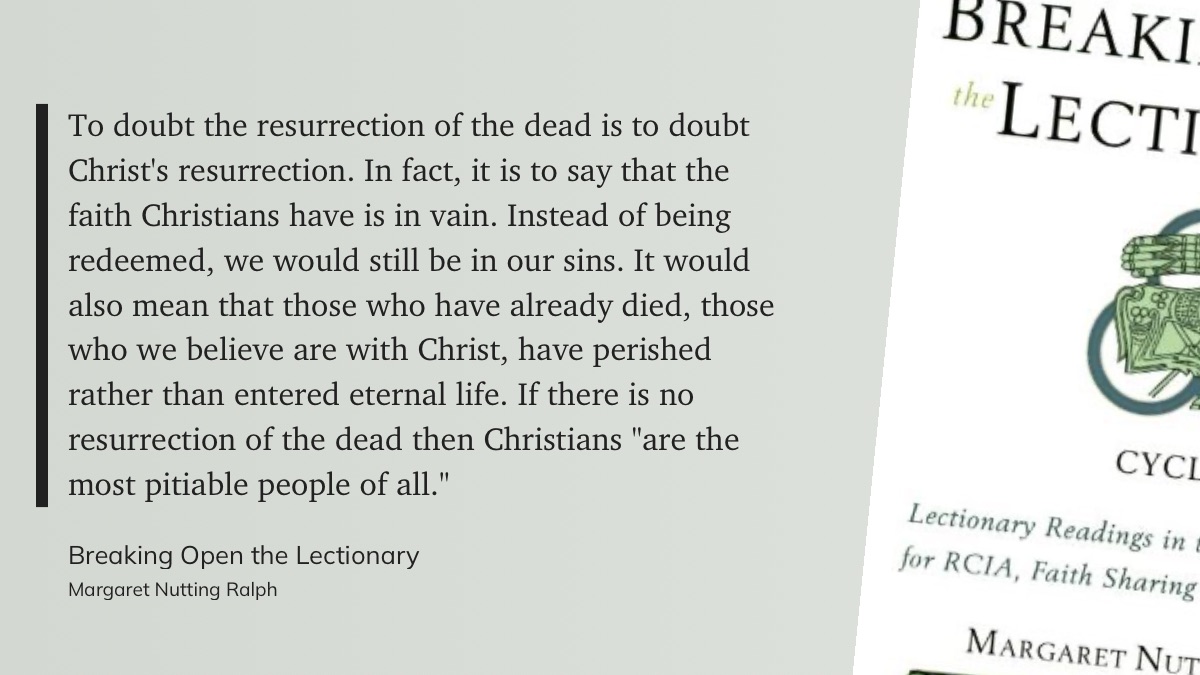
Doubting the Resurrection
Click on slide for larger image.
Bible Study Notes (PDF)
PDF Handout
- The Jerome Biblical Commentary,
- The New Jerome Biblical Commentary, and
- The Navarre Bible.
SOURCE: St. Charles Borromeo Catholic Church (Picayune, MS)
Bearing the Image of Christ
EXCERPT: All the descendants of the "first Adam" inherited his human nature in a body formed from the dust of the earth and destined to perish and return to dust (Gen 2:7). St. Paul wrote that Jesus is the "new Adam." He took on human nature in a weak and vulnerable physical body. However, in His resurrection from the grave, His divinity triumphed over His human nature. When He returns in glory, Jesus Christ will share His bodily resurrection with us in its perfection and immortality.
Commenting on verse 46, St. Augustine wrote: "It is called a spiritual body not because it has become a spirit but because it is in such a way subject to the spirit, to fit it for its heavenly abode that every kind of earthly weakness and imperfection is changed into a heavenly permanence" (De fide et symbol, chapter 6).
In this present life, the Holy Spirit calls Christians to reflect the image of "the heavenly One" by reproducing the life of Christ in our own lives. Having died to sin through the Sacrament of Baptism, the Christian is already raised with Christ to a new life (Col 3:1-4). St. Paul also wrote that Christ was raised from the dead by the glory of the Father so that we too might walk in the newness of life. And since the Resurrected Christ shall never die again, we also must consider ourselves dead to sin so that we might live eternally with Him in glory(cf. Rom 6:4-11 and 1 Thess 5:10).e calls Christ the "Fruitfruits" of the resurrection. Under Mosaic Law, the "Firstfruits" were the portion of the harvest offered in thanksgiving to the Lord that implied the consecration of the entire harvest that would follow (Lev 34:26; Dt 26:1-11). Christ's resurrection is not an end in itself. It is not completed but continues in the harvest of souls in every generation of humankind. At Christ's return, all humanity will arise bodily as the completion of the final human harvest in God's call to the Last Judgment that will end for the just in eternity with Christ in His heavenly Kingdom (1 Thes 4:16; Rev 20:11-15).
SOURCE: Agape Bible Study Copyright © 2015; revised 2024 (Used with permission.)
Social Media /
Bulletin Inserts
“But to you who hear I say, love your enemies, do good to those who hate you…”
Imagine a world where love overcomes hate, where small acts of kindness transform hearts. Embrace this courage today by loving beyond boundaries. How can you show love to someone who challenges your peace?
“…bless those who curse you, pray for those who mistreat you.”
In the silence of your heart, offer prayers for those who misunderstand you. Your blessings might become the turning point for someone’s struggle. Who in your life needs your prayers today?
“Give to everyone who asks of you, and from the one who takes what is yours do not demand it back.”
Generosity knows no bounds. Share your time, wisdom, and resources freely, trusting in the abundance of the universe. What are you willing to give without expecting in return?
“Be merciful, just as your Father is merciful.”
When you choose mercy over judgment, you mirror a divine love that heals. Let compassion guide your actions. Where can you extend mercy today?
“…for the measure with which you measure will in return be measured out to you.”
Your kindness expands the fabric of humanity. It sets the standard for the world you wish to live in. What measure are you using to shape your relationships?
6:27-28 In last week’s study, Jesus condemned the “rich” as he compared them to the “poor.” In the context of 6:22-23, the rich could be identified as Jews from the Pharisee party who controlled many of the synagogues in the region (and in the Roman Empire). The poor could be identified as the Christians who were rejected and persecuted by the Pharisees. How should the Christians respond to the persecution? Treat the antagonists as if they were welcome to the Christian community. Even persecution provided an opportunity for evangelization.
6:29 Here, Jesus addressed another prime audience for evangelization: Roman soldiers. To supplement their meager income, soldiers would beat and steal from the local populace. Such violence reinforced a policy of Roman intimidation over conquered peoples. Passive cooperation could shock the soldiers (who expected resistance) and offer a chance for evangelization.
6:30-31 These two verses summarized the teaching on love of enemy. Give selflessly. Do not seek redress. Treat everyone the same way. Such behavior opens the door to evangelization.
6:32-35 How were Christians different from other Jews and the pagans? Jesus chose three areas: relationships, ethics, and charity. Christians were not to simply extend loyalty, good works, and self-giving to other Christians. Stopping there would not distinguish followers of Jesus from any other group. No, Christians were to treat others the same. For they were to see beyond the present condition. They were to see, not with this world’s eyes, but through heaven’s eyes.
6:37 “judge . . . condemn . . . acquit” These three verbs describe the powers of a magistrate. Jesus used legal terms to remind his followers that these were powers best left to God, the eternal judge. In a more positive vein, Jesus implied when people refrained from these activities, they were, in effect, living in the Kingdom, living as if the Final Judgment had already taken place. Place yourself under the mercy of a just God, Jesus seemed to say, and realize life in the Kingdom here and now.
6:39 “For, in what measure you measure, it will be measured for you.” Many have used this verse to justify a Christian acceptance of “karma,” the Hindu and Buddhist notion that the moral universe has an unbreakable law of retribution. Taken to its logical conclusion, karma maintains that, somehow, rich people deserve their comfortable lifestyle based upon the past moral acts.
In the light of Luke 6:20-26, such a notion cannot be justified. Jesus chided the rich and praised the poor. More importantly, Christian faith presents the notion that everything people have are gifts from God. Gifts cannot be earned or deserved. They are freely given and received. The believer who freely gives is far more likely to realize the material and spiritual wealth they have is gift from God. In other words, the verse should not be read as quantity (“the stuff I give, I will receive in kind”). It should be read as quality (“the open heart that gives freely realizes the great wealth already received and thanks God accordingly”).
Permission for use. All materials found in word-sunday.com are the property of Larry Broding (Copyright 1999-2025). Viewers may copy any material found in these pages for their personal use or for use in any non-profit ministry.
7th Sunday of Year C
Love Your Enemies
Luke 6:27-38

I. Love for Enemies (vv. 27-28)
- Jesus commands His followers to love their enemies
- Bless those who curse you
- Pray for those who mistreat you
II. Hypocrisy and Generosity (vv. 29-30)
- Refrain from retaliating against those who strike you
- Give to those who ask from you, without expecting return
III. The Golden Rule (v. 31)
- Treat others as you wish to be treated
IV. God’s Love and Mercy (vv. 32-36)
- Love even those who do not love you back
- Show mercy, just as God is merciful to all

V. Refraining from Judgment (vv. 37-38)
- Avoid judgment and condemnation of others
- Forgive, and you shall be forgiven
- The measure you give will be the measure you receive
Clipart by Fr. Richard Lonsdale
Scriptures in Context
Fr. Paul Galeto, OSA

Fr. Paul Galetto, OSA
Catholic Sunday Scriptures in Context
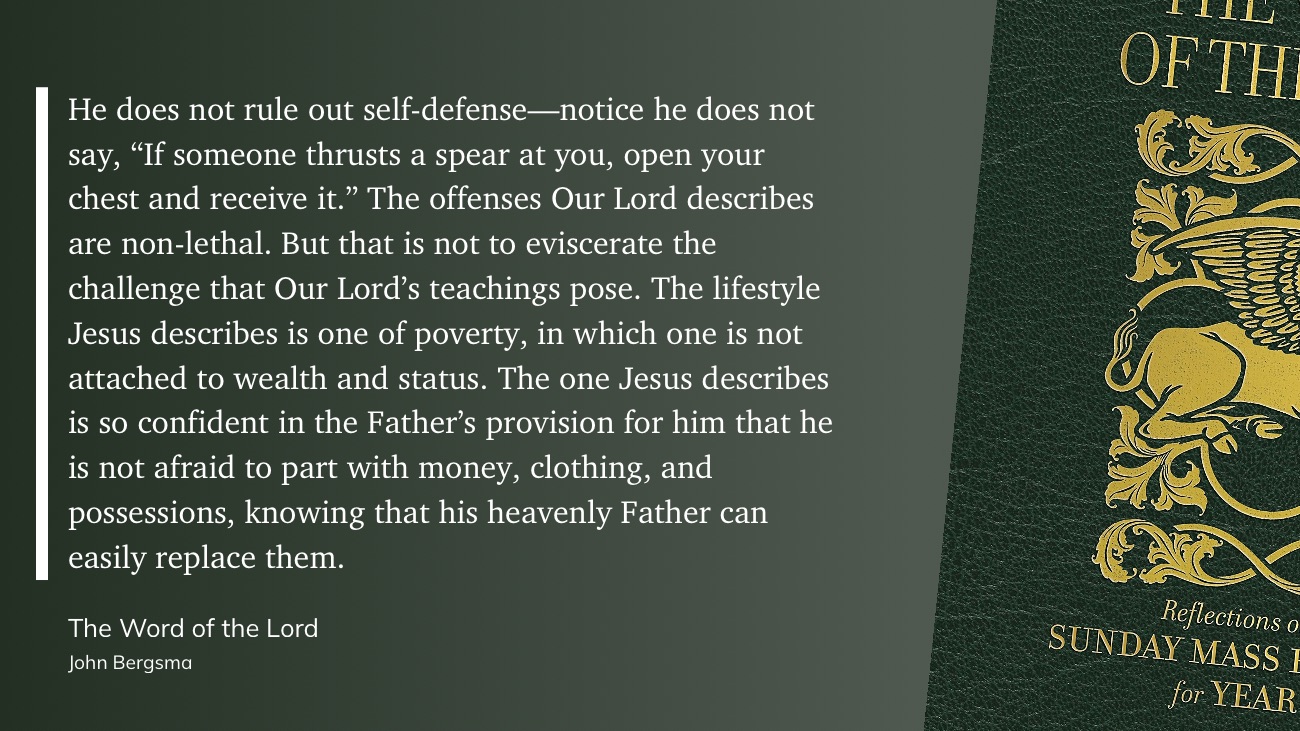
Self Defense
Click on slide for larger image.
Judging Others

Click on slide for larger image.
Agapan

Click on slide for larger image.
Forgiveness

Click on slide for larger image.
The Gospel of Mercy

Click on slide for larger image.
The Figure of Christ
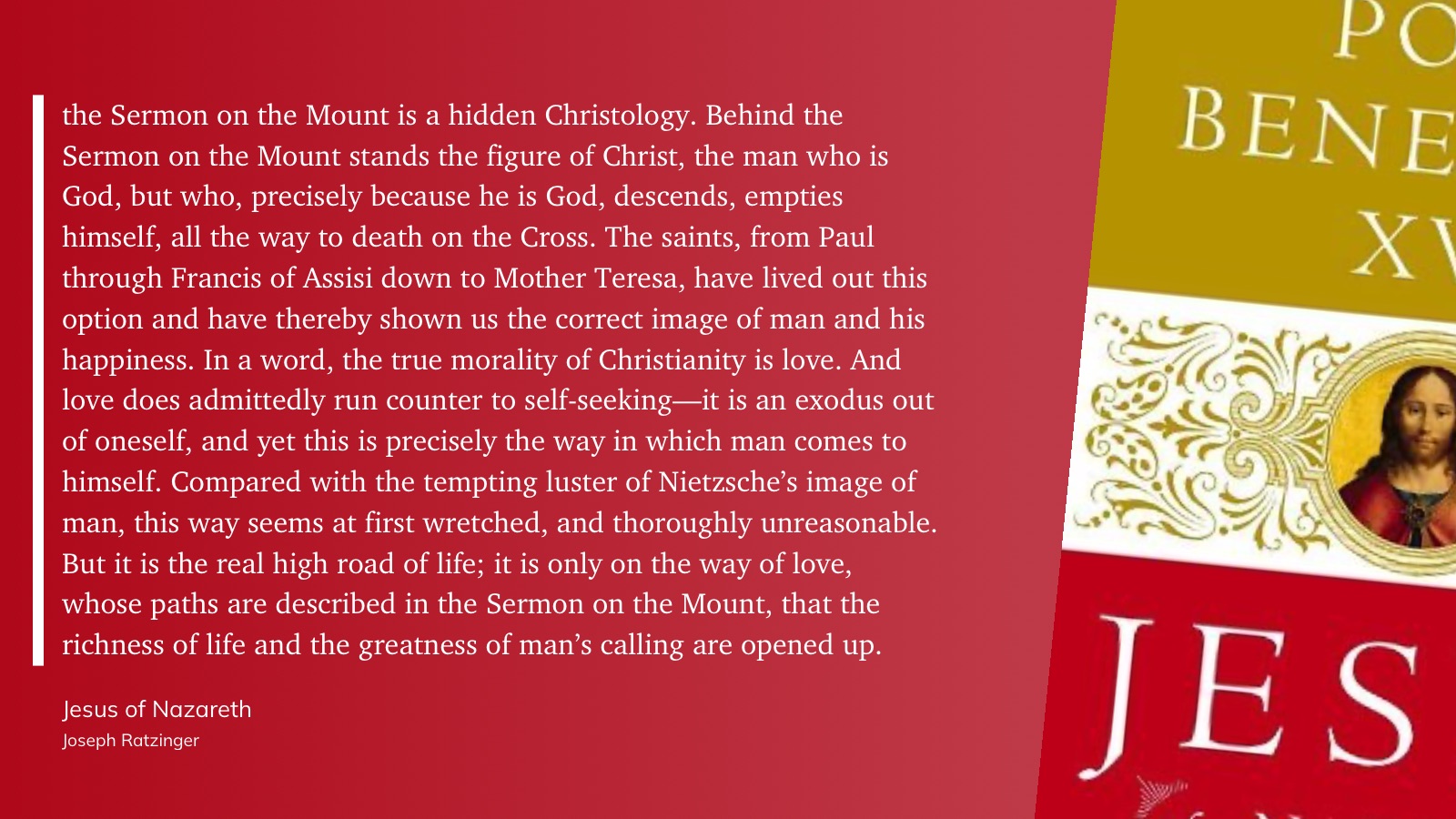
Click on slide for larger image.
Bible Study Notes (PDF)
PDF Handout
- The Jerome Biblical Commentary,
- The New Jerome Biblical Commentary, and
- The Navarre Bible.
SOURCE: St. Charles Borromeo Catholic Church (Picayune, MS)
MARTIN LUKER KING, JR.

Martin Luther King Jr’s Love Your Enemies Speech. Delivered at Dexter Avenue Baptist Church, Montgomery, Alabama, on November 17, 1957.
The Law of Love
EXCERPT:
Jesus came down from the mountain where He was teaching His disciples (Lk 6:12-16) to give a sermon to the crowds of people gathered below on the plain that sloped down to the shore of the Sea of Galilee (Lk 6:17). Our passage is the second part of Jesus's Sermon on the Plain, and, like the Beatitudes that He taught His disciples on the mountain in His Sermon on the Mount, it was a radically new teaching. Jesus asked the people not to react to others as their human nature told them, but rather to be moved by mercy and love in the same way God responds to human frailty (Lk 6:36).
In Lk 6:27 and 32-35, Jesus called the people to demonstrate a triad of works in showing love, the kindness of good deeds, and helping those in need. He gave them a simple maxim to guide their lives that is called by Christians "the golden rule" when He told them in Lk 6:31, " Do to others as you would have them do to you."Then Jesus contrasted two kinds of rewards in Lk 6:32-35: earthly and heavenly rewards. Finally, in verses 35-36, Jesus told the crowd to exercise the triad of goodness without calculating an award. God would reward those who act without expecting a return, but those who achieved an earthly compensation or recognition have already earned their reward.
Jesus told them: "Be merciful, just as your Father is merciful." He repeated this teaching several times in His homilies:
- You must be perfect, as your heavenly Father is perfect (Mt 5:48).
- Be merciful just as your Father is merciful (Lk 6:36).
- A new commandment I give to you, that you love one another, even as I have loved you, that you also love one another (Jn 13:34).
SOURCE: Agape Bible Study Copyright © 2015; revised 2024 (Used with permission.)

SCRIPTURE
SEARCH
FIRST READING (36)
SECOND READING (68)
GOSPEL (71)
This tool created by Jeff Pinyan uses the CCEL Early Church Fathers digital edition of the Philip Schaff collection.
7th Sunday of Year C
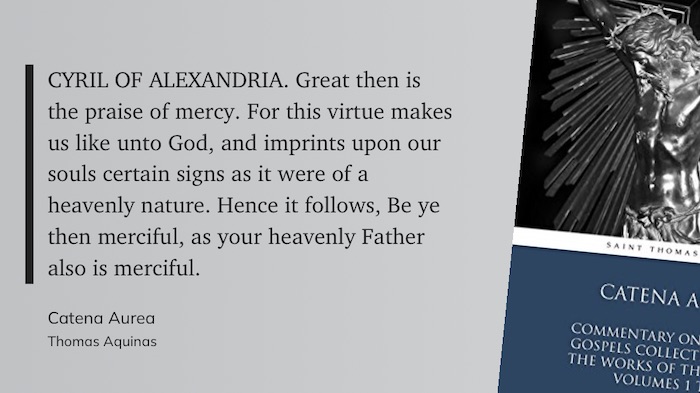
Just Jr., A., Oden, T. C., Carson, D. A., & Oden, E. (Eds.). (2003). Ancient Christian Commentary on Scripture: New Testament III, Luke (Vol. 3). IVP Academic.
Catena Aurea
The Catena Aurea, which means “Golden Chain” in Latin, is a comprehensive biblical commentary comb is a 13th-century biblical commentary compiled by St. Thomas Aquinas. This anthology features insights from over eighty Church Fathers on the four Gospels.