September 28 2025
September 28, 2025


Commentary Intro to Mass Readings for Sunday
CommentaryIntro to Mass Readings for Sunday

26th Sunday of Year C
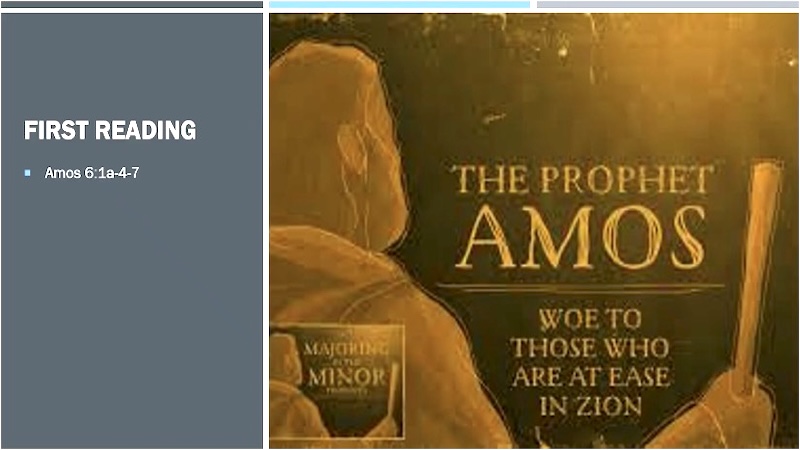
Amos 6:1a, 4-7
Amos 6:1a, 4-7
POP–UP Video | NAB w/ Notes | LECTIONARY
Click graphic above to view intro to reading
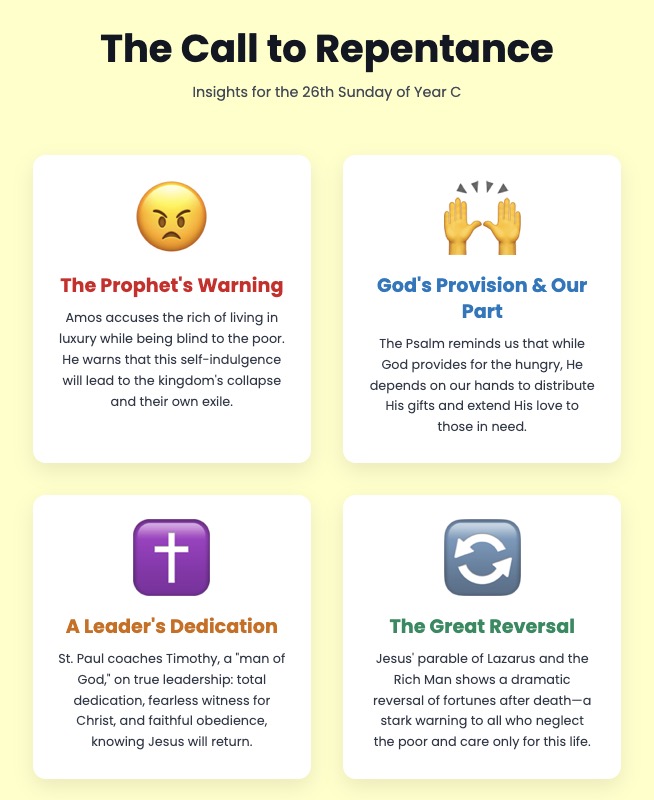
In his commentary on the reading from the prophet Amos, Father Galetto explains that Amos is a "prophet of judgment" speaking during a time of prosperity.

The central issue Amos addresses is the "complacency" of the wealthy. They lie on "beds of ivory," indulging in excessive comfort while being completely inactive. Their self-centeredness extends to a total disregard for the economic well-being of others; they consume lambs and calves, which were vital to people's livelihoods, and drink wine from bowls in their excess.
Father Galetto highlights their profound indifference to the suffering around them, noting they "are not made ill by the collapse of Joseph," meaning the poverty of their own people does not disturb them. Their religion has become superficial, a way to simply "placate the Lord" and fulfill an obligation without any genuine change of heart. The ruling class, lost in their own wasteful entertainment, has become disconnected from the people they are meant to govern.
Ultimately, Father Galetto concludes that the great sin Amos condemns is the people's total focus on themselves instead of caring for others.
Clipart by Fr. Richard Lonsdale


Vision and Action
by Larry Broding

Are your parishioners comfortable? Perhaps a little too comfortable?
The prophet Amos speaks a harsh, timeless truth directly to those who live in comfort, seemingly oblivious to the struggles of others. In his insightful commentary on Amos 6:1, 4-7, Larry Broding masterfully connects this ancient warning to the temptations of our modern world, providing a potent resource for crafting a homily that challenges and inspires.
Broding moves beyond a simple historical lesson, forcing us to confront the prophet’s sting in our own lives. He examines how the extravagance and “blind eye” of the wealthy in ancient Israel led to their downfall, urging us to consider our own potential blind spots. This commentary will help you ask the tough questions, pushing your congregation—and yourself—to look beyond personal wants toward a life of greater vision and service.
Dive into this commentary to prepare a homily that doesn’t just soothe, but awakens the conscience and calls your community to meaningful action.

Fr. Peters teaches at Saint John’s Seminary in Camarillo, CA.
This quiz is an AI-generated product of Google Gemini Pro 2.5, utilizing Fr. Tim Peters’s video lecture as the primary source. Please keep in mind that AI content may include inaccuracies. In case of any uncertainties or discrepancies, always refer back to the video for clarification.
1. How does Father Tim Peters reinterpret the “beds of ivory” from the prophet Amos for a modern audience?
- A) As a literal warning against buying expensive furniture.
- B) As a symbol for all modern comforts and luxuries, like memory-foam mattresses and high-thread-count sheets.
- C) As a historical reference that no longer applies to us today.
- D) As a specific condemnation of the furniture industry.
2. According to Father Tim Peters’ interpretation of Amos, what is the primary sin of the “complacent”?
- A) Enjoying any form of comfort or luxury.
- B) Spending billions on luxuries while being only “mildly indisposed” rather than truly “ill” over the plight of the poor.
- C) Drinking fine wine from the wrong type of stemware.
- D) Failing to anoint themselves with oils.
3. Father Tim Peters directly connects the “complacent in Zion” from Amos to which figure in the Gospel reading?
- A) Lazarus, the poor man.
- B) Abraham in the afterlife.
- C) The rich man who ignored Lazarus.
- D) The rich man’s five brothers.
4. What does Father Tim Peters suggest is the dangerous result of being surrounded by our modern comforts, based on the warning from Amos?
- A) It leads directly to financial ruin.
- B) It makes us physically ill.
- C) It can lead to a spiritual complacency that blinds us to the needs of others.
- D) It encourages us to share our wealth more freely.
5. What final judgment does Father Tim Peters say we will face, according to the message in Amos?
- A) We will be judged on the niceness of our things.
- B) We will be judged on our complacency about those in need, which our nice things can easily cause.
- C) We will be judged on whether we eat organic, free-range food.
- D) We will be judged on how many expensive oils and lotions we own.
Answer Key
1. (B) As a symbol for all modern comforts and luxuries, like memory-foam mattresses and high-thread-count sheets. Explanation: Father Tim Peters explicitly updates the ancient imagery of “beds of ivory” to contemporary examples of luxury bedding to show how the prophet’s warning against comfort-induced complacency is still relevant today.
2. (B) Spending billions on luxuries while being only “mildly indisposed” rather than truly “ill” over the plight of the poor. Explanation: Father Tim Peters highlights this distinction to define the spiritual sickness of complacency. The problem isn’t just the spending, but that our comfort insulates us from being deeply moved and morally sickened by the suffering of others.
3. (C) The rich man who ignored Lazarus. Explanation: Father Tim Peters draws a clear parallel between the attitude of the complacent people described by Amos and the behavior of the rich man in the gospel, who also enjoyed a life of luxury while ignoring the needy person right outside his home.
4. (C) It can lead to a spiritual complacency that blinds us to the needs of others. Explanation: Father Tim Peters uses the warnings from Amos to argue that the greatest danger of our comfortable lifestyles is that they can make us spiritually lazy and unaware of our obligations to those who are suffering.
5. (B) We will be judged on our complacency about those in need, which our nice things can easily cause. Explanation: Father Tim Peters concludes his reflection on this reading by clarifying that the judgment is not about owning nice things in themselves. Rather, the warning is about how easily those comforts can lead to a state of complacency, which is the true spiritual danger.

26th Sunday of Year C
1 Timothy 6:11-16
1 Timothy 6:11-16
POP-UP Video | NAB w/ Notes | LECTIONARY
Click graphic above to view intro to reading
In his commentary on the second reading, a letter to Timothy, Father Galetto clarifies several key phrases. He explains that "man of God" was a title for someone who dedicated their life to God. The "noble confession" the passage mentions refers to the profession of faith made at baptism.

He notes some ambiguity in the text, such as which specific "commandment" Timothy is urged to keep—it could be Jesus' command to love one another or the Ten Commandments. Father Galetto also points out that the Greek word for "appearance" is epiphania, a term usually reserved for the arrival of a king or royalty, which connects to the titles "King of Kings" and "Lord of Lords" borrowed from Jewish tradition.
The core message, according to Father Galetto, is a direct call for Timothy to put his faith into action. This instruction follows a previous warning to avoid the love of money. The ultimate goal is to remain faithful to the baptismal commitment to Jesus until the very end.
Clipart by Fr. Richard Lonsdale

Okay, We’re Christians.
Now What?
by Larry Broding
Is your congregation’s faith stuck in a Sunday-only compartment? How do we preach a message that connects what we believe in the pews to how we live on Monday?
Many Christians unintentionally separate their faith into two distinct boxes: a private, spiritual relationship with God and a public, social life. This disconnect can render faith powerless, reducing it to either a “social club with warm fuzzies” or an isolated “me and Jesus” experience.
Larry Broding’s insightful commentary on 1 Timothy 6:11-16 provides a powerful antidote for this spiritual compartmentalization, offering rich material for a homily that challenges and equips. Broding masterfully unpacks the biblical call to a faith where charity and spirituality are seamlessly woven together. He explores the Christian life as an athletic “struggle in grace, for grace,” where our daily actions become our most potent sermon. How do we live a faith that convinces a skeptical world?
Use this commentary to prepare a homily that bridges the gap between belief and behavior. It will help you call your people not just to know their faith, but to live it out reproachlessly as a vibrant signpost to the Kingdom.

This quiz is an AI-generated product of Google Gemini Pro 2.5, utilizing Fr. Tim Peters’s video lecture as the primary source. Please keep in mind that AI content may include inaccuracies. In case of any uncertainties or discrepancies, always refer back to the video for clarification.
1. In verse 11, after being told to “flee” from evil, what is the first virtue the “man of God” is instructed to pursue?
- A) Gentleness.
- B) Righteousness.
- C) Faith.
- D) Love.
2. According to verse 12, what is Timothy called to “take hold of”?
- A) The good confession.
- B) The presence of many witnesses.
- C) Eternal life.
- D) The good fight.
3. Before whom did Christ Jesus make his “good confession,” as mentioned in the charge to Timothy?
- A) The many witnesses.
- B) The man of God.
- C) The blessed and only Sovereign.
- D) Pontius Pilate.
4. The doxology in verses 15-16 describes God as the “King of kings and Lord of lords.” Where does it say God dwells?
- A) In the hearts of all believers.
- B) In a house not made with hands.
- C) In unapproachable light.
- D) Among the assembly of the saints.
5. What is the ultimate time frame for Timothy to keep the commandment “unstained and free from reproach”?
- A) For the rest of his natural life.
- B) Until the appearing of our Lord Jesus Christ.
- C) For as long as he is in the presence of witnesses.
- D) Until he has achieved perfection.
Answer Key
1. (B) Righteousness. Explanation: While all the listed virtues are mentioned, the passage in verse 11 lists them in a specific order, beginning with “Pursue righteousness, godliness, faith, love, steadfastness, gentleness.”
2. (C) Eternal life. Explanation: Verse 12 contains two commands: “Fight the good fight of the faith” and “Take hold of the eternal life to which you were called.” The second command is to actively grasp the promise of salvation.
3. (D) Pontius Pilate. Explanation: The passage grounds the charge to Timothy in the ultimate example of Christ Jesus, “who in his testimony before Pontius Pilate made the good confession.”
4. (C) In unapproachable light. Explanation: To emphasize God’s unique and transcendent majesty, verse 16 describes Him as one “who dwells in unapproachable light, whom no one has ever seen or can see.”
5. (B) Until the appearing of our Lord Jesus Christ. Explanation: The command is not limited by Timothy’s own life but is set against the timeline of salvation history, extending until the second coming of Christ.

26th Sunday of Year C
Luke 16:19-31
Luke 16:19-31
POP-UP Video | NAB w/ Notes | LECTIONARY
Click graphic above to view intro to reading
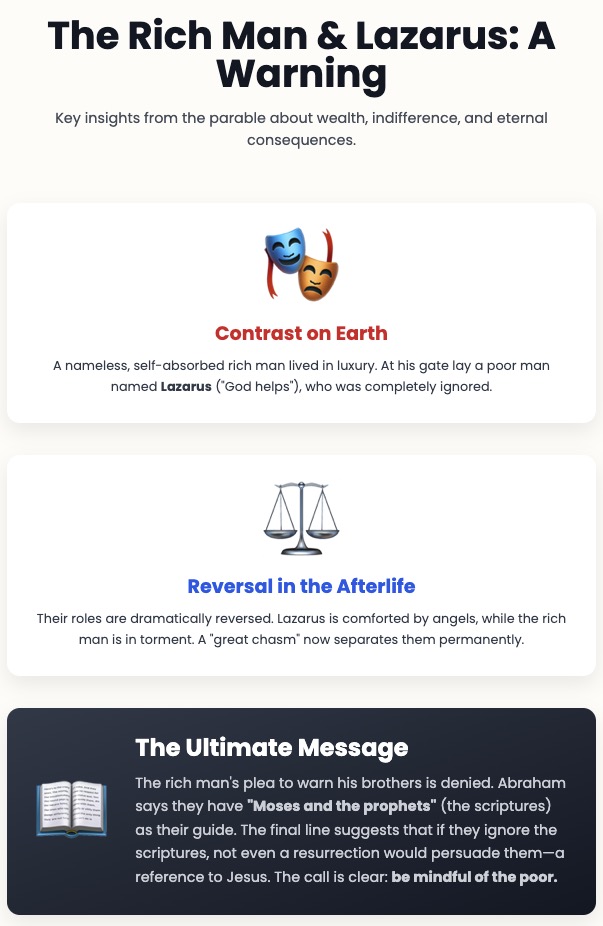
In his commentary on the parable of the rich man and Lazarus, Father Galetto highlights the stark contrast between the two main characters. The rich man, dressed in expensive purple, is so self-absorbed he remains nameless, while the poor man is named Lazarus, meaning "God helps."

In the afterlife, their roles are dramatically reversed. Lazarus is comforted in the "bosom of Abraham," cared for by angels because humans neglected him. The rich man is in torment. Notably, the rich man calls Abraham "Father," indicating he was a member of the Israelite covenant who should have known better. His first request is for Lazarus, whom he ignored in life, to serve him by bringing a drop of water.
Abraham denies the request, explaining a "great chasm" is fixed between them, a separation that Father Galetto notes St. Augustine saw as a proof for Purgatory. The rich man then begs for Lazarus to be sent back from the dead to warn his brothers. Abraham again refuses, stating that they have "Moses and the prophets"—the scriptures—which provide all the guidance they need to care for the poor.
Father Galetto concludes by pointing out that Abraham's final line, "If they will not listen to Moses and the prophets, neither will they be persuaded if someone should rise from the dead," is seen by Christians as a direct reference to Jesus' own resurrection. The parable's central message is a clear and urgent call to be mindful of the poor, as commanded in the scriptures.
Clipart by Fr. Richard Lonsdale
The Challenge of Compassion
by Larry Broding
In a world reeling from tragedy, where anger feels righteous and vengeance seems justified, how do you preach compassion? When your congregation is grappling with fear and outrage, where does the Gospel challenge them to find mercy, even for their adversaries?
Larry Broding’s commentary on the parable of the Rich Man and Lazarus (Luke 16:19-31) dives headfirst into these difficult questions, providing a rich foundation for a homily that speaks directly to our tenuous times. Broding doesn’t just re-tell the story; he exposes the hard-heartedness that condemns the rich man, a contempt so deep it persists even in the torments of the afterlife.
This commentary masterfully unpacks the layers of the parable, from its stark social contrasts to its historical context in the early Church’s conflict with the Pharisees. It culminates in a brilliant theological turn, challenging us to see the Resurrection as the ultimate lens through which all of Scripture, and our own lives, must be viewed.
Explore this commentary to craft a message that moves beyond the surface of the parable and confronts the urgent need for a faith that transforms our hearts, especially when they are tempted to harden.


The Rich Man and Lazarus
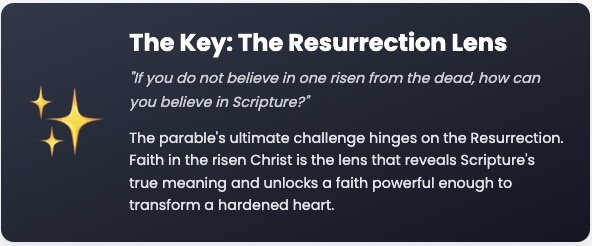
This week our reading features a rich man in contrast to the poor Lazarus (16:19-31). The in-between verses, vv.14-18, begin with the phrase, “The Pharisees, who loved money.” Jesus describes these people as an “abomination” (bdelygma) before God (v.15).
PDF COMMENTARY
(Luke 16:19-31)

Fr. Peters teaches at Saint John’s Seminary in Camarillo, CA.
This quiz is an AI-generated product of Google Gemini Pro 2.5, utilizing Fr. Tim Peters’s video lecture as the primary source. Please keep in mind that AI content may include inaccuracies. In case of any uncertainties or discrepancies, always refer back to the video for clarification.
1. According to Father Tim Peters, what was the primary failure of the rich man in the parable?
- A) He was a dishonest and mean man.
- B) He did not notice Lazarus at his gate.
- C) He was unthankful for his wealth.
- D) He actively mistreated Lazarus.
2. How does Father Tim Peters challenge his listeners to redefine the concept of their “front door”?
- A) By suggesting that our responsibility to the needy is not limited by physical proximity.
- B) By encouraging people to install better security systems.
- C) By stating that our front door only includes our immediate family.
- D) By asking people to physically open their doors to the homeless.
3. What is the central message Father Tim Peters draws from the fact that someone (Jesus) has already risen from the dead?
- A) That the rich man’s brothers are now without excuse.
- B) That we have been given an urgent and direct warning not to be complacent about the poor.
- C) That miracles are the only way to convince people to be generous.
- D) That the parable is no longer relevant after the Resurrection.
4. How does Father Tim Peters suggest we should measure our own generosity to the poor?
- A) By giving a fixed percentage of our income, such as a tithe.
- B) By comparing our giving to what our friends and neighbors give.
- C) In proportion to our generosity to ourselves with comforts and luxuries.
- D) By only giving when we have a surplus after all our wants are met.
5. Which of the following best summarizes the “good news” that Father Tim Peters finds in this challenging gospel reading?
- A) The good news is that we are not as wealthy as the rich man.
- B) The good news is that there will be no final judgment.
- C) The good news is that we are not responsible for the poor in other countries.
- D) The good news is that there is still time to change and respond to the needy.
Answer Key
1. (B) He did not notice Lazarus at his gate. Explanation: Father Tim Peters emphasizes that the parable gives no indication the man was mean or dishonest. Instead, his failure was one of omission and indifference; he lived his life so isolated by comfort that he never even saw the suffering man at his very door.
2. (A) By suggesting that our responsibility to the needy is not limited by physical proximity. Explanation: Father Tim Peters poses the question of whether we are any less responsible for a person who collapses in the city streets than one on our own secluded doorstep. He concludes that distance does not relieve us of our responsibility to the poor, wherever they may be.
3. (B) That we have been given an urgent and direct warning not to be complacent about the poor. Explanation: Father Tim Peters points out the irony that the rich man was told his brothers wouldn’t listen even if someone rose from the dead. Since Jesus has risen, Father Tim Peters states that we have received the ultimate call to shake off our complacency and respond to those in need.
4. (C) In proportion to our generosity to ourselves with comforts and luxuries. Explanation: Father Tim Peters states that the scriptures clearly indicate this as the standard. He suggests that we should measure what we give to others against what we spend on our own comforts, from high-thread-count sheets to fine wines.
5. (D) The good news is that there is still time to change and respond to the needy. Explanation: After outlining the “bad news” that we are likely ignoring people in need, Father Tim Peters concludes by stating the “good news” is that, unlike the rich man for whom it is too late


Diocese of Phoenix
26th Sunday of Year C

Christ in Our Neighborhood
Bishop John Dolan
This program aims to foster deeper relationships with Christ through weekly Scripture study and prayer in small faith communities. It was introduced in December 2022

More Discussion Guides
Fr. Thibodeau
Bible Study Notes
Bp. John P. Dolan
Fr. Tobin
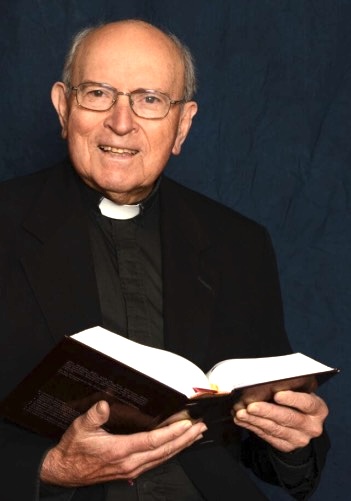
Fr. Conley Bertrand
26th Sunday of Year C
Cycle C (PDFs)
📖 Old Testament (43 pp.)
📖 Epistles (87 pp.)
📖 Gospels (182 pp.)
📖 Daily Gospels (208 pp.)
SOURCE: Come, Lord Jesus
Carmelite Reflections and Prayers
Lectio Divina

78-page PDF with reflections and prayers for each day of the month
Lectio Divina SEPTEMBER 2025 (PDF)
Lectio Divina SEPTEMBER 2025 [Mobi]
Lectio Divina SEPTEMBER 2025 [ePub]
______________
“Lectio divina is an authentic source of Christian spirituality recommended by our Rule. We therefore practise it every day, so that we may develop a deep and genuine love for it, and so that we may grow in the surpassing knowledge of Christ. In this way we shall put into practice the Apostle Paul’s commandment, which is mentioned in our Rule: “The sword of the Spirit, too, which is the word of God, is to dwell abundantly in your mouth and in your hearts; and whatever things you have to do, let them be done in the word of the Lord.” (Carmelite Constitutions (2019), n. 85.)
Source: Carmelites