Create preaching tips for a catholic priest giving a homily for the 26th Sunday in Ordinary Time (Year C) focused on xxxxxxxxxxx Use the New American Bible translation.
Break the tips into four areas: 1 ) General Tips 2) Tips for preaching to an older congregation, 3) Tips for preaching to a younger congregation, 4) Tips for preaching using the Catechism
Effective preaching involves much more than simply delivering a lecture; it is a sacred act of breaking open the Word of God within the context of the liturgy. Good homiletics, or the art of preaching, emphasizes deep preparation, a clear focus on the Gospel message, and a pastoral connection with the congregation.
Principles for effective homily preparation
Root your message in prayer and Scripture: The homily should flow from your own prayerful reflection on the daily readings, not just from a commentary or a good idea. This practice, known as lectio divina, allows you to personally encounter the Word before sharing it with others.
Focus on one main point: A memorable homily presents a single, clear, and concise message drawn from the Scripture. Trying to cover too many ideas can make your homily feel unfocused and leave the congregation with nothing to remember.
Preach the Good News, not scolding: The central theme of every homily must be the Good News of Jesus Christ—what God has done, is doing, and wants to do. Moral challenges should flow naturally from this good news, not be presented as a list of "shoulds" and "oughts".
Understand your community: An effective preacher knows the lives, joys, and struggles of the people to whom they are preaching. This allows you to apply the timeless truth of the Gospel to their concrete, contemporary situations.
Embrace the Church's teaching: Ground your homilies in the rich history and doctrine of the Catholic faith. Explain how the Scriptures lead to the Church's teachings and how these doctrines contribute to human happiness.
Tips for delivery
Be brief and well-prepared: Pope Francis has advised that a homily should be well-prepared and brief, ideally lasting no more than eight to ten minutes. Long, unfocused homilies can cause the faithful to lose attention.
Tell a story: Incorporating stories, illustrations, and concrete images helps the congregation engage with the spiritual realities of the message. Jesus himself taught through parables to help people understand the kingdom of God.
Speak naturally and connect: Preach in a personal, conversational voice that connects with your listeners as friends, not just as a lecturer. Make eye contact and speak with authenticity, conveying your personal belief in the urgency of the message.
Engage the whole person: Appeal to the mind, heart, and will of your listeners. Engage their intellect through explanation, touch their emotions through storytelling, and move their will by providing a practical application for their lives.
Avoid common pitfalls: Stay away from being overly abstract, condescending, or predictable. Don't use a homily to air personal grievances or rely too heavily on canned material. Your congregation deserves the fruit of your personal prayer and study.
26th Sunday of Year C
GENERAL TIPSTBD
Name the Sin: Indifference
create an engaging flow driven chart inforgraphic for...
FLOWCHART
Make it clear that the sin of the Rich Man and the "complacent in Zion" was not their wealth, but their blindness.
They failed to see the suffering at their doorstep. Frame the homily around the central question: "Who is the Lazarus at my gate whom I fail to see?"
Connect the "Chasm" to the "Collapse
create an engaging flow driven chart inforgraphic for...
FLOWCHART
Explicitly link the "great chasm" that separates the Rich Man and Lazarus in the Gospel to the societal indifference in the first reading.
The wealthy in Amos "are not made ill by the collapse of Joseph." They had already created a chasm between themselves and their suffering nation.
Present 1 Timothy as the Antidote
create an engaging flow driven chart inforgraphic for...
FLOWCHART
After establishing the stark warnings in Amos and Luke, present Paul's charge to Timothy as the clear, positive path forward.
The complacency of the rich is contrasted with the spiritual athleticism of one who must "pursue righteousness, devotion, faith, love, patience, and gentleness." This is the way to avoid creating a chasm.
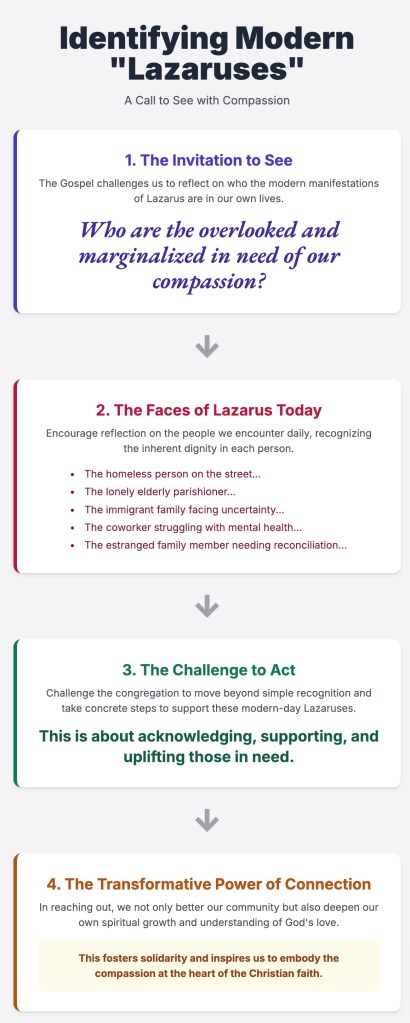
Make Lazarus Concrete
create an engaging flow driven chart inforgraphic for...
FLOWCHART
Challenge the congregation to identify the modern "Lazarus" they might be overlooking.
It could be the homeless person they pass, the lonely elderly parishioner, the new immigrant family, the coworker struggling with mental health, or even a family member from whom they are estranged.
Authenticity is Key: Don't try to be someone you're not or use slang you don't know. Youth can spot inauthenticity immediately, so be yourself.
Be You: Let your personality shine through to make your sermon more relatable and impactful.
Meet them in their world: Understand the cultural context of the young people you're speaking to.
Structure for Engagement
Have One Big Idea: Focus your sermon around a single, clear point to help students remember it.
Use a Clear Outline: Provide a simple, three-point outline with an introduction, body, and conclusion to help them follow along.
Keep it Concise: Shorter messages are generally more effective for maintaining engagement and focus.
Make the Message Stick
Tell Stories: Like Jesus, share stories that illustrate biblical truths and help make personal connections between the message and their lives.
Use Visuals and Interaction: Engage multiple senses by using movie clips, objects, or games to make the message more memorable.
Encourage Participation: Involve the audience through actions like raising hands, shouting answers, or taking polls to foster interaction.
26th Sunday of Year C
YOUTH-CENTRIC TIPSTBD
Complacency as the Enemy
In a world that prizes comfort and avoiding difficulty, present the Gospel as a radical call to a more meaningful, adventurous life.
The "complacent in Zion" are the definition of a boring, self-absorbed life. Jesus calls us to something greater. Encourage the youth to consider the long-term satisfaction and fulfillment found in pursuing a life guided by faith, rather than the fleeting comfort offered by complacency. Present real-life examples of individuals who have embraced this call and experienced personal transformation and a sense of purpose.
The Digital Chasm
Talk about the "chasm" in terms they understand. It’s easy to be "stretched comfortably on their couches" (Amos) while scrolling past real-world suffering on Instagram or TikTok.
Challenge the idea that a "like" or a "share" is a substitute for real action. Encourage the youth congregation to recognize the limitations of digital interactions and the importance of transforming online empathy into real-world impact. Emphasize the value of using their online presence as a catalyst for positive change, leveraging their platforms to promote compassion, justice, and understanding.
Redefine "Competing Well
Contrast the world's call to compete for grades, status, and followers with Paul's call to "compete well for the faith.
True success and eternal life are found in pursuing "righteousness, love, and patience," not worldly recognition. By reframing competition in the context of faith, you can motivate the youth congregation to strive for a life rooted in Christian values and dedicated to serving others, ultimately fostering a more resilient and compassionate community of young believers.
A Concrete Call to Action
Challenge youth to one specific action for the week: Instead of just giving money, learn the name of a homeless person in their area.
Volunteer at a local charity. Or, challenge them to fast from a particular comfort (like a streaming service) and donate the money saved. By presenting these concrete calls to action, you empower the youth congregation to live out their faith in practical ways, bridging the gap between belief and action. Encourage them to share their experiences and insights with one another, fostering a sense of accountability and support as they strive to make a positive impact in their communities and grow in their faith journey.
Speak slowly and distinctly: Articulate your words clearly and avoid shouting. Those with hearing aids can find loud, sudden noises painful.
Keep homilies short: The attention spans of many older residents are shorter, so limit your message to one or two main points, ideally under 15 minutes.
Enhance audibility: Ensure the sound system is working correctly. A lower pitch can be easier for older ears to hear.
Avoid jargon and slang: Use language that is easily understood and avoid complex theological terms or modern colloquialisms.
Content and approach
Preach the familiar gospel: While it's always important to share the gospel, remember that many seniors have heard these messages their entire lives. Repeat familiar, comforting messages like "God will take care of you," "He never leaves us," and "Heaven is our final home".
Emphasize Jesus and the Sacraments: Focus on the person of Jesus, his life, promises, and resurrection, and the sacraments, rather than controversial topics that may divide the audience.
Tell stories. Seniors often respond well to storytelling, which can help them remember and connect with the message.
Connect the past and present: Acknowledge the life they have lived while reminding them that the "God of then is still the God of now."
Address aging realistically: Acknowledge the reality of aging, including loneliness, loss, and physical pain.
26th Sunday of Year C
SENIOR-FOCUSED TIPSTBD
Acknowledge a Lifetime of Generosity
Many seniors have built our parishes through their service and treasure
Begin by affirming this. Frame the homily not as an accusation, but as a mature reflection on how we can continue to see with the eyes of faith throughout our lives. Share stories of individuals who discovered new ways to serve and grow in their faith later in life, emphasizing that spiritual growth is a lifelong process. Emphasize the importance of recognizing the evolving needs of their community and adapting their service accordingly, ensuring their continued impact and relevance.
Focus on Legacy
Ask reflective questions.
"What is the spiritual inheritance we are leaving for our children and grandchildren? Is it one of comfort, or one of compassion that bridges gaps?" Encourage them to consider the lasting impact of their actions on their children and grandchildren, as well as the broader community. Remind them that a spiritual legacy rooted in compassion can inspire future generations to embrace a life of service and faith.
The Chasm of Modern Loneliness
Habakkuk's waiting ends with a promise from God.
Their "Lazarus" may not be materially poor, but spiritually or emotionally destitute. The "chasm" can be the loneliness of a neighbor, the pain of an estranged child, or the struggle of a grandchild who has left the faith. The call to "see" is a call to reach across these relational divides.
The Power of Intercession
Emphasize their vital role as prayer warriors
They can stand in the gap for a world that has grown complacent, using their wisdom and faith to pray for a society that has forgotten its "Lazarus."
Infographic created with Google AI Gemini 2.5 Pro tools (e.g. Chart.js and Tailwind CSS). Feel free to use it in any non-profit ministry. Please include the website link (https://thewordthisweek.net).
Connect Scripture and Catechism: Use the liturgical readings as a starting point, but then clearly tie them to the established teachings of the Catechism.
Focus on a Single Message: Concentrate on one main point or idea to make the message more memorable and impactful for listeners.
Make it Relevant: Explain the faith in a way that connects directly to the listeners' daily experiences, concerns, and real-life situations.
Emphasize the Living God: Preaching should aim to help listeners encounter the living God through faith, fostering a sense of personal relationship and community.
Be Humble and Authentic: Speak with personal authenticity, recognizing one's own shortcomings, and present the faith as the Church's teaching, not just personal opinion.
Pray and Prepare: The entire homily should be composed and delivered in a context of prayer, relying on the Holy Spirit to open the hearts of the faithful to divine mysteries.
Keep it Concise: Aim for brevity to maintain listener attention, as attention spans can wane after 10-12 minutes.
Show, Don't Just Tell: Use illustrations and repetition of key phrases to make the message clearer and more memorable.
Appeal to the Whole Person: Engage the listeners' minds, hearts, and wills to encourage reflection and a response to the Good News.
Provide a Way Forward: Offer a sense of dynamism and movement, a journey of discovery that leads listeners to a new way of seeing their lives and responding to the challenges of faith.
26th Sunday of Year C
CATECHISM TIPSTBD
The Sin of Omission (CCC 1853)
IN-DEPTH OVERVIEW
A sin of omission is a sin of failing to do something that one is obliged to do, whether it's a spiritual duty or a corporal work of mercy. Within Catholic teaching, a sin of omission becomes a mortal or venial sin based on the deliberation and knowledge with which the person fails to act. The Catechism of the Catholic Church, in paragraph 1853, categorizes sins as sins of thought, word, deed, or omission, emphasizing that any of these, when done with free will, constitutes a sin.
Examples of Sins of Omission
Failure to fulfill a moral or spiritual obligation:For instance, a Catholic failing to attend Mass on a holy day of obligation, or choosing not to pray.
Neglecting the corporal works of mercy:Not helping those in need, such as by failing to feed the hungry or care for the sick.
Failing to speak up for justice or truth:Remaining silent when someone is being slandered or when injustice is occurring.
Determining the Gravity of the Sin The extent of the guilt in a sin of omission is determined by several factors, just as with sins of commission:
Deliberation: The act must be done willfully and with full knowledge that the action is required.
Magnitude of the precept: The seriousness of the failed duty matters; a grave obligation (like Mass on a holy day) leads to a mortal sin.
Magnitude of the virtue: The omission may oppose a virtue that is particularly important, such as charity or justice.
Sin of Omission vs. Sin of Commission
Sin of commission:An active engagement in a sinful act, such as lying or stealing. .
Sin of omission:A lack of action, failing to do what one ought to do.
The Rich Man's sin is a perfect example of a grave sin of omission.
He did not actively harm Lazarus; he simply failed to do the good he was called to do. Explain that "we can sin... by failing to perform an act." This is a profound and challenging teaching that the parable makes vividly clear.
Love for the Poor (CCC 2444-2446)
IN-DEPTH OVERVIEW
The Catholic Catechism (CCC) teaches that love for the poor is a core tenet of the Church's tradition, stemming from Christ's example and the Gospel. This "preferential love" for the poor stems from the reality that by serving them, Christians are serving Jesus himself (Matthew 25:40). The Church's commitment includes both Corporal Works of Mercy, like feeding the hungry and clothing the naked, and Spiritual Works of Mercy, such as comforting the sorrowful and instructing the ignorant. This love extends beyond material poverty to include religious and cultural poverty, and it is seen as a necessary response to injustice and a requirement for entrance into the Kingdom of Heaven.
Here's a breakdown of the key points from CCC 2444-2446:
Origin of Love for the Poor (CCC 2444):
This love is a part of the Church's constant tradition, inspired by the Gospel, the poverty of Jesus, and His concern for the poor.
It extends to all forms of poverty, including cultural and religious forms, and is an extension of the Gospel imperative to promote peace and justice for all.
The Preferential Option (CCC 2444):
The Church has a special love and concern for the poor.
Human misery, in its various forms, is a sign of humanity's need for salvation after original sin, and this misy elicited Christ's compassion.
Works of Mercy (CCC 2444, 2446):
Charitable works, both material and spiritual, remain indispensable.
The Church works for the relief, defense, and liberation of those oppressed by poverty.
Giving alms to the poor is highlighted as a chief witness to fraternal charity.
Christian Responsibility (CCC 2445):
Christians are called to recognize Christ in the poor, as He stated, "Whatever you did for one of these least brothers of mine, you did for me" (Matthew 25:40).
The love of the poor is a clear indication of the Kingdom of Heaven.
Connection to Justice (CCC 2446):
Love for the poor is a manifestation of a commitment to social justice.
It is incompatible with the selfish use of riches.
Connect the Gospel directly to the Church's teaching that our treatment of the poor is a direct reflection of our relationship with Christ.
"Those who are oppressed by poverty are the object of a preferential love on the part of the Church." The Rich Man's failure was a failure to love God, whom he could not see, by failing to love the poor man whom he could.
Particular Judgment (CCC 1021-1022)
IN-DEPTH OVERVIEW
The Catholic Catechism (CCC) teaches in paragraphs 1021-1022 that the Particular Judgment is the individual judgment each soul undergoes immediately after death, receiving its eternal destiny. This judgment assesses the soul's life, leading to either immediate entrance into Heaven (possibly after a purification in Purgatory), or immediate and everlasting separation from God in Hell. This truth is supported by Scripture, like Hebrews 9:27 and the parable of Lazarus and the rich man, emphasizing that death is the point of no return and individuals are judged based on their faith and actions.
What the Particular Judgment entails:
A Personal Encounter: At death, the soul meets Christ in a personal encounter where the truth of its life—every choice, action, and sin—is revealed.
Judgment Based on Love and Faith: The judgment is based on whether the individual chose to live in love and friendship with God, showing openness to divine grace and accepting or rejecting Christ's teachings.
Eternal Retribution: The soul receives its eternal reward or punishment based on its condition at death.
Possible Outcomes:
Heaven: Souls in perfect grace and friendship with God enter Heaven.
Purgatory: Those who die in God's grace but still require purification from the effects of sin enter Purgatory, a state leading to Heaven.
Hell: Souls who die in a state of mortal sin, unrepentant and freely rejecting God's love, are eternally separated from Him in Hell.
Significance:
No Second Chances: Death is the final opportunity to accept or reject divine grace; there are no second chances after the particular judgment.
Individual Responsibility: The judgment is a personal one, determining the individual soul's eternal destiny.
Foundation for the Final Judgment: While the particular judgment determines a soul's immediate fate, a Final Judgment or Last Judgment will occur at the end of time when all people are resurrected and the truth of every life is revealed to all.
Use the parable to illustrate the reality of the particular judgment, where our eternal destiny is decided based on our life's choices.
The "great chasm" is a powerful image for the "definitive self-exclusion from communion with God" (CCC 1033) that results from a life closed in on itself.
The Virtues (CCC 1803-1845)
IN-DEPTH OVERVIEW
The Catholic Church's Catechism defines a virtue as a "habitual and firm The Catholic Church's Catechism defines a virtue as a "habitual and firm disposition to do good" (CCC 1803). These virtues are divided into Human Virtues, such as the four cardinal virtues (Prudence, Justice, Fortitude, and Temperance), which are acquired through effort and help guide our actions; and Theological Virtues (Faith, Hope, and Charity), which have God as their origin, motive, and object, adapting us for participation in divine nature and giving life to the human virtues.
Human Virtues (CCC 1804-1811) These are stable dispositions of the intellect and will that govern our actions and direct our passions.
Cardinal Virtuesare fundamental to the moral life and are grouped around them.
Prudence: Practical wisdom that discerns our true good in every circumstances.
Justice: The virtue that gives each person what is due to him or her.
Fortitude (Courage): The strength to overcome obstacles in the pursuit of the good.
Temperance: Moderation that balances our desires and actions.
Theological Virtues (CCC 1812-1845) These virtues have God as their source, motive, and goal, and are infused by God to help us participate in the divine nature.
Charity:The love of God above all things and of our neighbor as ourselves for the love of God. Charity is considered the "form of all the virtues" that binds everything together in perfect harmony.
Faith:Believing in God and all that He has revealed.
Hope:The desire and steadfast trust in God's eternal life and the graces to merit it.
Frame the list in 1 Timothy ("righteousness, devotion, faith, love, patience, gentleness") as the spiritual toolkit God gives us to live a life worthy of our calling.
These are not just nice ideas, but divinely-infused habits that empower us to bridge the chasms in our world.
Infographic created with Google AI Gemini 2.5 Pro tools (e.g. Chart.js and Tailwind CSS). Feel free to use it in any non-profit ministry. Please include the website link (https://thewordthisweek.net).