General Intercessions, Prayers of the Faithful for Sunday Mass.
General Intercessions,Prayers of the Faithful for Sunday Mass.
Create preaching tips for a catholic priest giving a homily for the xxxxxxx Sunday in Ordinary Time (Year C) focused on xxxxxxxxxxx Use the New American Bible translation.
Break the tips into four areas: 1 ) General Tips 2) Tips for preaching to an older congregation,for each tip give suggestions 3) Tips for preaching to a younger congregation, for each tip give suggestions 4) Tips for preaching using the Catechism
Effective preaching involves much more than simply delivering a lecture; it is a sacred act of breaking open the Word of God within the context of the liturgy. Good homiletics, or the art of preaching, emphasizes deep preparation, a clear focus on the Gospel message, and a pastoral connection with the congregation.
Principles for effective homily preparation
Root your message in prayer and Scripture: The homily should flow from your own prayerful reflection on the daily readings, not just from a commentary or a good idea. This practice, known as lectio divina, allows you to personally encounter the Word before sharing it with others.
Focus on one main point: A memorable homily presents a single, clear, and concise message drawn from the Scripture. Trying to cover too many ideas can make your homily feel unfocused and leave the congregation with nothing to remember.
Preach the Good News, not scolding: The central theme of every homily must be the Good News of Jesus Christ—what God has done, is doing, and wants to do. Moral challenges should flow naturally from this good news, not be presented as a list of "shoulds" and "oughts".
Understand your community: An effective preacher knows the lives, joys, and struggles of the people to whom they are preaching. This allows you to apply the timeless truth of the Gospel to their concrete, contemporary situations.
Embrace the Church's teaching: Ground your homilies in the rich history and doctrine of the Catholic faith. Explain how the Scriptures lead to the Church's teachings and how these doctrines contribute to human happiness.
Tips for delivery
Be brief and well-prepared: Pope Francis has advised that a homily should be well-prepared and brief, ideally lasting no more than eight to ten minutes. Long, unfocused homilies can cause the faithful to lose attention.
Tell a story: Incorporating stories, illustrations, and concrete images helps the congregation engage with the spiritual realities of the message. Jesus himself taught through parables to help people understand the kingdom of God.
Speak naturally and connect: Preach in a personal, conversational voice that connects with your listeners as friends, not just as a lecturer. Make eye contact and speak with authenticity, conveying your personal belief in the urgency of the message.
Engage the whole person: Appeal to the mind, heart, and will of your listeners. Engage their intellect through explanation, touch their emotions through storytelling, and move their will by providing a practical application for their lives.
Avoid common pitfalls: Stay away from being overly abstract, condescending, or predictable. Don't use a homily to air personal grievances or rely too heavily on canned material. Your congregation deserves the fruit of your personal prayer and study.
27th Sunday of Year C
GENERAL TIPSTBD
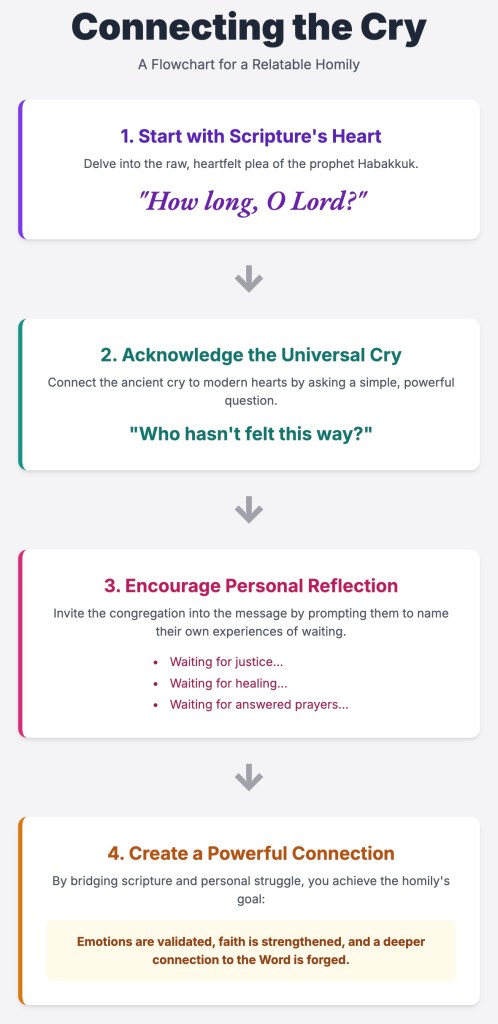
Be Relatable
create an engaging flow driven chart inforgraphic for...
FLOWCHART
Begin your homily by tapping into the raw, universal emotion of Habakkuk’s cry: "How long, O Lord?"
Ask the congregation: Who hasn't felt this way? Waiting for a prayer to be answered, for justice in the world, for a loved one to heal or return to the faith. This validates their own struggles and immediately connects them to the readings.
Be Hopeful
create an engaging flow driven chart inforgraphic for...
FLOWCHART
Present St. Paul's advice to Timothy as the direct answer to Habakkuk's impatience.
When we cry out in frustration, the Spirit doesn't necessarily remove the trial, but reminds us of the gift we already have. The solution is to "stir into flame" the grace within us—the spirit of power, love, and self-control. It’s not about getting something new, but activating the gift we received in Baptism and Confirmation.
Stress Humble Service
create an engaging flow driven chart inforgraphic for...
FLOWCHART
This is the most challenging part of the Gospel for modern ears.
Frame it not as a call to low self-esteem, but as liberation from spiritual anxiety. The world tells us we must perform, achieve, and be recognized to have value. Jesus frees us from this. The servant does his work simply because it is his duty—it flows from his identity. We serve God not to earn His love or a reward, but because we are His children. Our work is a response to love, not a transaction for it. This is freedom.
Define "Mustard Seed Faith"
create an engaging flow driven chart inforgraphic for...
FLOWCHART
RELATED VIDEO
DIOCESE OF RENO (8:28) - Bishop Mueggenborg invites us to reflect with him on the Gospel from the Twenty-seventh Sunday of Ordinary Time (Luke 17:5-10). The reading today invokes us to prioritize having more of the right kind of faith instead of just having more faith. Having the wrong kind of faith does us no good. Only when we have the right kind of faith will we be able to move mountains.
Clarify that Jesus isn’t scolding the apostles for having "too little" faith.
Jesus is revealing the immense power of even the smallest amount of genuine faith. It's not about the quantity of our faith, but the object of our faith: Almighty God. A tiny connection to an infinite power source can do impossible things.
Authenticity is Key: Don't try to be someone you're not or use slang you don't know. Youth can spot inauthenticity immediately, so be yourself.
Be You: Let your personality shine through to make your sermon more relatable and impactful.
Meet them in their world: Understand the cultural context of the young people you're speaking to.
Structure for Engagement
Have One Big Idea: Focus your sermon around a single, clear point to help students remember it.
Use a Clear Outline: Provide a simple, three-point outline with an introduction, body, and conclusion to help them follow along.
Keep it Concise: Shorter messages are generally more effective for maintaining engagement and focus.
Make the Message Stick
Tell Stories: Like Jesus, share stories that illustrate biblical truths and help make personal connections between the message and their lives.
Use Visuals and Interaction: Engage multiple senses by using movie clips, objects, or games to make the message more memorable.
Encourage Participation: Involve the audience through actions like raising hands, shouting answers, or taking polls to foster interaction.
27th Sunday of Year C
YOUTH-CENTRIC TIPSTBD
Focus on Power and Courage
Frame faith as the ultimate "power-up" that gives them the courage to live against the grain.
Draw comparisons between faith and elements in popular culture that they're familiar with, such as video game power-ups or superhero abilities. Emphasize that faith fortifies their spirit and grants them the strength to overcome challenges, just as these power-ups enable characters to conquer seemingly insurmountable obstacles.
Challenge Against Complacency
Address the command to "fan into flame the gift of God" (2 Timothy 1:6) directly.
In a fast-paced culture, idleness is the enemy of faith. Challenge them to commit to an action that is visible and sacrificial. Link the mustard seed (Luke 17:6) to the need to not be ashamed of witnessing to Christ (2 Timothy 1:8). What is the "tree" they need to uproot in their school, social circle, or online life (e.g., gossip, apathy, or fear of speaking out)?
Reframe "Duty" as Authenticity
The idea of being an "unworthy servant" can be difficult.
Frame it as living an authentic life. Instead of a transaction ("I do this, so God gives me that"), it’s about identity. "I am a child of God, so serving Him is what I do. It's who I am." This shifts the focus from drudgery to a genuine response of a loving heart. Redefine obedience (the servant parable) not as stifling rules, but as the fidelity necessary to be truly effective. The "unprofitable servant" is actually the most
Validate Impatience, Teach Trust
The world can seem overwhelming.
Acknowledge that the cry, "How long, O Lord?" reflects the frustration they may experience when spiritual progress seems slow. Assure them that these feelings are natural and remind them of the counter-cultural power in choosing to wait and trust in God's plan. Emphasize that faith is not a passive act, but an active decision to live courageously according to divine wisdom.
Speak slowly and distinctly: Articulate your words clearly and avoid shouting. Those with hearing aids can find loud, sudden noises painful.
Keep homilies short: The attention spans of many older residents are shorter, so limit your message to one or two main points, ideally under 15 minutes.
Enhance audibility: Ensure the sound system is working correctly. A lower pitch can be easier for older ears to hear.
Avoid jargon and slang: Use language that is easily understood and avoid complex theological terms or modern colloquialisms.
Content and approach
Preach the familiar gospel: While it's always important to share the gospel, remember that many seniors have heard these messages their entire lives. Repeat familiar, comforting messages like "God will take care of you," "He never leaves us," and "Heaven is our final home".
Emphasize Jesus and the Sacraments: Focus on the person of Jesus, his life, promises, and resurrection, and the sacraments, rather than controversial topics that may divide the audience.
Tell stories. Seniors often respond well to storytelling, which can help them remember and connect with the message.
Connect the past and present: Acknowledge the life they have lived while reminding them that the "God of then is still the God of now."
Address aging realistically: Acknowledge the reality of aging, including loneliness, loss, and physical pain.
27th Sunday of Year C
SENIOR-FOCUSED TIPSTBD
Focus on Fidelity and Endurance
Acknowledge this group's rich life experience.
Relate the Habakkuk reading directly to their lives. They have witnessed decades of global injustice and personal suffering, making their own lives an answer to "How long, O LORD?"
Encourage them to view their own lives as a testament to faith and endurance, serving as an inspiration for younger generations facing similar challenges.
Focus on Legacy
Frame Paul’s instruction to "guard this rich trust" as their sacred duty.
They are the keepers of the faith for their children and grandchildren. Their consistent, humble service—the "unworthy servant" model—is the bedrock upon which future generations build.
Ask them to reflect on and share what practices (prayer, devotion, sacrifice) helped them keep the "flame" burning through their toughest trials. Their presence at Mass today is their powerful sermon.
Humility as Wisdom
Frame the "unprofitable servant" parable (Luke 17:10) as the wisdom of age.
True wisdom knows that accomplishments are gifts from God, not sources of personal pride.
Infographic created with Google AI Gemini 2.5 Pro tools (e.g. Chart.js and Tailwind CSS). Feel free to use it in any non-profit ministry. Please include the website link (https://thewordthisweek.net).
Connect Scripture and Catechism: Use the liturgical readings as a starting point, but then clearly tie them to the established teachings of the Catechism.
Focus on a Single Message: Concentrate on one main point or idea to make the message more memorable and impactful for listeners.
Make it Relevant: Explain the faith in a way that connects directly to the listeners' daily experiences, concerns, and real-life situations.
Emphasize the Living God: Preaching should aim to help listeners encounter the living God through faith, fostering a sense of personal relationship and community.
Be Humble and Authentic: Speak with personal authenticity, recognizing one's own shortcomings, and present the faith as the Church's teaching, not just personal opinion.
Pray and Prepare: The entire homily should be composed and delivered in a context of prayer, relying on the Holy Spirit to open the hearts of the faithful to divine mysteries.
Keep it Concise: Aim for brevity to maintain listener attention, as attention spans can wane after 10-12 minutes.
Show, Don't Just Tell: Use illustrations and repetition of key phrases to make the message clearer and more memorable.
Appeal to the Whole Person: Engage the listeners' minds, hearts, and wills to encourage reflection and a response to the Good News.
Provide a Way Forward: Offer a sense of dynamism and movement, a journey of discovery that leads listeners to a new way of seeing their lives and responding to the challenges of faith.
27th Sunday of Year C
CATECHISM TIPSTBD
The Prayer of Lament (CCC 2629-2633)
IN-DEPTH OVERVIEW
The prayer of lament, described in sections CCC 2629-2633 of the Catechism of the Catholic Church, is an expression of human vulnerability, suffering, and frustration directed to God. It is a prayer of faith that acknowledges brokenness and evil in the world, expressing sorrow and asking for God's intervention while maintaining hope in His ultimate redemption. This form of prayer involves a petition for the Kingdom to come and the necessary means to welcome it, with the Holy Spirit interceding with groans for us in our weakness.
Characteristics of Lament in the Catechism
Expression of Human Vulnerability: Lament prayers arise from painful situations where people feel overwhelmed, abandoned, or punished by suffering and loss.
Acknowledgement of Brokenness: They recognize the reality of sin, suffering, and evil in the world, sometimes even questioning why God allows it.
A Cry Out to God: This type of prayer involves crying out to God with honest complaints, naming problems and expressing vivid pain, as seen in the Psalms and Jesus' cry on the cross.
A Prayer of Faith and Hope: Despite the raw emotion, lament is a prayer of faith and hope, not despair. It trusts in God's enduring presence and redemptive work.
Focus on the Kingdom: A key aspect of the prayer of petition, and thus lament, is the central focus on the desire for the Kingdom of God to come and the cooperation with its coming.
God's Solicitude: The prayer acknowledges that God is solicitous for all His people and that the Holy Spirit helps us in our weakness, interceding with sighs too deep for words.
Examples from Scripture
Jesus on the Cross: Jesus' cry, "My God, my God, why have you forsaken me?" is a profound expression of lament and solidarity with human suffering. se.
The Psalms: Many psalms, such as Psalm 13 and Psalm 22, are prayers of lament, where the psalmist cries out to God in his sorrow and feelings of being forsaken.
Frame Habakkuk’s cry within the Church’s rich tradition of lament.
Show that crying out to God in frustration is not a sign of weak faith, but a sign of a real relationship. It's a valid and powerful form of prayer.
The Nature of Faith (CCC 156-159)
IN-DEPTH OVERVIEW
Faith is an act of the intellect and will, responding to God's revelation based on the authority of God himself, not human reason. It is certain, as it rests on God's infallible word. Faith involves seeking understanding, as faith seeks to know better the One in whom we believe, leading to further growth in faith. While above reason, faith never contradicts reason because God, who reveals faith, also bestows reason, and truth cannot contradict truth.
The Certainty of Faith (CCC 156-157)
Divine Authority: We believe because God himself reveals the truths, not because they appear logical to our natural minds.
Infallible God: Faith is certain because it is founded on God's word, and God, who is Truth itself, cannot lie or be deceived.
Faith Seeks Understanding (CCC 158)
Desire for Knowledge: It is part of faith to desire a deeper, more penetrating knowledge of God and what He has revealed.
Growth through Knowledge: This deeper knowledge, in turn, prompts an even greater faith.
Love Over Knowledge: The ultimate goal of seeking understanding is not just intellectual curiosity, but to love God better and grow in prayer.
Faith and Reason (CCC 159)
No Conflict: Faith and reason are not opposed, as they both come from the same God.
Rooted in Divine Source: God bestows the light of reason and also reveals divine truths, so a contradiction between them is impossible.
Truth Cannot Contradict Truth: Because the same God is the source of both faith and reason, He cannot deny Himself, nor can truth contradict truth.
Faith is both a grace from God and a human act.
The apostles pray for the grace ("Increase our faith"), and Jesus calls them to the act (having faith like a mustard seed). It requires both God's help and our free response. Faith is certain because its source is God, even when the fulfillment "delays," as Habakkuk notes.
Grace and the Holy Spirit (CCC 1996-2003)
IN-DEPTH OVERVIEW
In Catholic theology, grace is the unmerited, divine assistance from God, primarily given through the Holy Spirit, enabling humans to live as children of God, participate in His life, and respond to His call. The Catechism of the Catholic Church (CCC) explains that grace is the Holy Spirit's gift, which justifies and sanctifies the soul, transforming individuals into new creatures by empowering them to live in God's presence and to act with divine charity.
What is Grace? (CCC 1996-1997)
Favor and Gift: Grace is a freely given and unmerited favor from God, a gift that allows humans to become adopted sons and daughters of God and to be made partakers of the divine nature.
Participation in God's Life: It is a participation in God's own life, a supernatural gift that transforms and perfects the soul.
How the Holy Spirit Works with Grace (CCC 1998-2003)
Justification and Sanctification: Grace, as the gift of the Holy Spirit, is the primary force that justifies us by cleansing us from sin and communicating God's righteousness through faith in Christ and baptism. It also sanctifies us by renewing the interior person.
Freedom and Response: Grace prepares and elicits a free response from the individual. It does not negate or overwhelm human freedom but sets us free to choose good and reject evil, working in conjunction with our free will.
Sharing in the Trinity: Grace introduces believers into the intimacy of the Trinity, helping them to become sharers in God's own life and to respond to their vocation as God's adopted children.
Different Forms of Grace:Beyond sanctifying grace, the Holy Spirit also grants:
Actual Grace: Temporary impulses or movements from God to do good or avoid evil.
Sacramental Graces: Gifts specific to each sacrament.
Charisms (Special Graces): Gifts of the Spirit given for the common good of the Church, such as the gift of miracles or of tongues, all oriented toward charity and building up the community.
St. Paul's command to "stir into flame the gift of God" is a perfect entry point to discuss sanctifying grace.
This grace is not our own doing but a "participation in the life of God." The "spirit of power, love, and self-control" is the effect of the Holy Spirit's grace dwelling within us, enabling us to live the Christian life.
The Moral Life and the Beatitudes (CCC 1716-1724)
IN-DEPTH OVERVIEW
The section of the Catechism of the Catholic Church (CCC) from 1716 to 1724 explains the relationship between the moral life, the desire for happiness, and the Beatitudes. This portion of the CCC establishes the Beatitudes as the heart of Jesus' teaching and the path to true Christian happiness.
The Beatitudes and the vocation to happiness (CCC 1716–1719)
The Beatitudes fulfill God's promises The Beatitudes, found in Jesus' Sermon on the Mount, take up and perfect the promises God made to his people since the time of Abraham. They lead people not to an earthly promised land but to the ultimate goal of the Kingdom of Heaven.
They portray Jesus Christ The Beatitudes depict the character and charity of Jesus Christ. They express the Christian vocation, which is united with the glory of Christ's Passion and Resurrection. As such, they shed light on the actions and attitudes characteristic of a Christian life.
They respond to the desire for happiness The desire for happiness is a natural and divine impulse that God has placed in the human heart to draw people to him. St. Augustine wrote that people seek a happy life, and true happiness is only found in God.
They reveal the goal of human existence The Beatitudes reveal the ultimate end of human acts. God calls every individual and the entire Church to his own beatitude, or perfect happiness.
The nature of Christian beatitude (CCC 1720–1722)
Descriptions of beatitude in the New Testament The New Testament uses several expressions to describe the state of beatitude to which God calls humanity:
The coming of the Kingdom of God
The vision of God ("Blessed are the pure in heart, for they shall see God")
Entering into the joy of the Lord
Entering into God's rest
Participation in the divine nature Our purpose is to know, love, and serve God, and thereby attain eternal life in paradise. Beatitude allows us to become "partakers of the divine nature" and to enter into the glory of Christ and the joy of the Trinitarian life.
A supernatural gift This perfect happiness is not something humanity can achieve on its own. It is a supernatural gift from God, freely given through his grace, and it surpasses human understanding.
The moral choices of the Beatitudes (CCC 1723–1724)
A confrontation with moral choices The Beatitudes force believers to make decisive moral choices. They call for the purification of our hearts from evil desires and the pursuit of God's love above all else.
True happiness is in God alone The Beatitudes teach that lasting happiness is not found in earthly goods like wealth, fame, power, or human achievements. Instead, true happiness is found in God alone, who is the source of all goodness and love.
The path to heaven The Beatitudes, along with the Ten Commandments and the teachings of the Church, provide the path to the Kingdom of Heaven. By living these principles, sustained by the grace of the Holy Spirit, Christians can produce fruit in the Church for the glory of God.
The parable of the unworthy servant connects to the spirit of the Beatitudes.
True blessedness is found not in seeking reward and recognition, but in humble service and poverty of spirit, knowing that all we have and all we are is a gift from God. Our service is simply our duty in response to that immense gift.
Infographic created with Google AI Gemini 2.5 Pro tools (e.g. Chart.js and Tailwind CSS). Feel free to use it in any non-profit ministry. Please include the website link (https://thewordthisweek.net).