General Intercessions, Prayers of the Faithful for Sunday Mass.
General Intercessions,Prayers of the Faithful for Sunday Mass.
Create preaching tips for a catholic priest giving a homily for the xxxxxxx Sunday in Ordinary Time (Year C) focused on xxxxxxxxxxx Use the New American Bible translation.
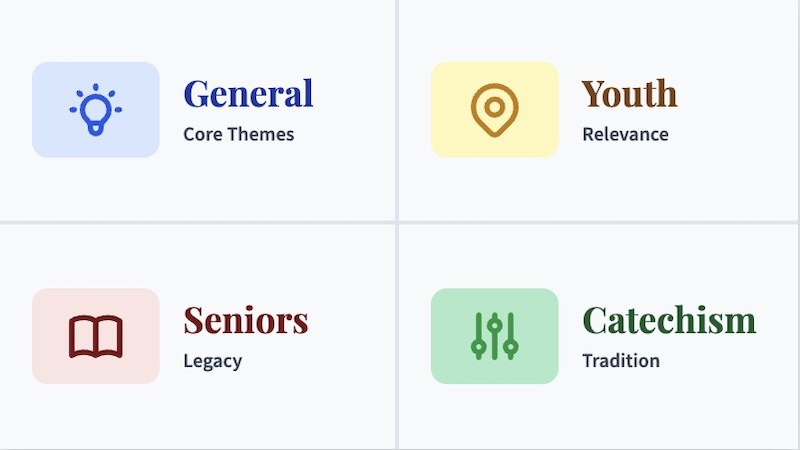
Break the tips into four areas: 1 ) General Tips 2) Tips for preaching to an older congregation,for each tip give suggestions 3) Tips for preaching to a younger congregation, for each tip give suggestions 4) Tips for preaching using the Catechism
Preach the Good News, not scolding: The central theme of every homily must be the Good News of Jesus Christ—what God has done, is doing, and wants to do. Moral challenges should flow naturally from this good news, not be presented as a list of "shoulds" and "oughts".
Understand your community: An effective preacher knows the lives, joys, and struggles of the people to whom they are preaching. This allows you to apply the timeless truth of the Gospel to their concrete, contemporary situations.
Embrace the Church's teaching: Ground your homilies in the rich history and doctrine of the Catholic faith. Explain how the Scriptures lead to the Church's teachings and how these doctrines contribute to human happiness.
28th Sunday of Year C
GENERAL TIPSTBD
Start with a Relatable Hook
Begin with a simple, human story about ingratitude.
For example: "Have you ever poured your heart into a gift for someone, only to receive no acknowledgment? No card, no call, not even a text? How did that feel? In today's Gospel, Jesus asks a question that echoes that same pain: 'Where are the other nine?'"
CONTINUE READING
Here's how you could develop the provided example into a more detailed introduction:
"Good morning. I want you to think back to a time you put real effort into a gift for someone you love. Maybe it was a birthday present you spent weeks saving for, or a surprise party you secretly planned for months. Remember the excitement as you gave it to them? You weren't looking for repayment, but you were hoping for... something. A reaction. A moment of shared joy.
Now, imagine if you got... nothing. Not a 'thank you.' Not a phone call. The gift was accepted, and then, silence. How does that silence feel? It’s heavy, isn't it? It stings. It leaves you wondering, 'Did it mean anything to them at all?'
That feeling, that heavy silence, is at the heart of our Gospel today. Jesus gives an incredible, life-altering gift—He heals ten men from a living death. He restores them to their families and their communities. And in the silence that follows, He asks a question that echoes with that same human pain: 'Were not ten cleansed? Where are the other nine?'"
Alternative Hooks with the Same Goal:
The "Forgotten Lifeline" Hook:
"Have you ever been in a real jam and a friend dropped everything to help you out? Maybe they helped you change a flat tire in the pouring rain or stayed up all night to help you study for an exam you were sure you'd fail. In that moment, your gratitude is overwhelming. But a week later... a month later... how often do we forget that lifeline we were thrown? Today's Gospel is about nine men who forgot the ultimate lifeline just moments after they were saved."
The "Restaurant Review" Hook:
"We live in an age of instant feedback. If we have a bad meal at a restaurant, we’re quick to go online and write a one-star review. If a package arrives late, we complain. We are very good at voicing our displeasure. But how often do we go out of our way to praise good service? To publicly thank someone who did their job well? In our story today, ten men receive the miracle of a lifetime. Only one of them bothered to leave a 'five-star review' with the Healer Himself."
Focus on the Core Contrast
The most powerful element in the Gospel is the contrast between being cleansed and being saved.
All ten were physically healed, but only the one who returned with a grateful heart was made whole in faith. This is the central point. Ask the congregation: Are we content with just being cleansed of our immediate problems, or do we desire the deeper salvation that comes from a relationship with the Healer?
CONTINUE READING
The central drama of this Gospel isn't the miracle of healing; it's the choice that happens after the miracle. By focusing on the contrast between "cleansed" and "saved," you can invite the congregation to examine the very nature of their own faith and what they truly seek from God.
1. Defining "Cleansed": The Experience of the Nine
What it is: To be cleansed is to have a problem removed. It is an external fix. For the lepers, their skin was made clean, their disease was gone, and the social barriers were lifted. It was a wonderful, life-altering event.
The Modern Parallel: This is often what we pray for. We ask God to "cleanse" us of our problems:
"Lord, heal me from this illness."
"Lord, fix this financial trouble."
"Lord, resolve this conflict in my family."
The Limitation: The nine received this cleansing and saw it as the end of the transaction. They got what they wanted and went on their way. Their lives were restored to what they were before the sickness. For them, Jesus was a means to an end—a powerful problem-solver. Their faith was functional, but it wasn't personal.
2. Defining "Saved": The Experience of the One
What it is: To be saved is to be made whole. It is an internal transformation that begins with gratitude. Jesus says to the Samaritan, "Your faith has saved you." He doesn't say, "Your thank-you has saved you." The thank-you was the evidence of a faith that the others lacked.
The Key Action: The Samaritan's faith was different because he didn't just see the gift; he saw the Giver. The healing wasn't the end of the story for him; it was the beginning of a new relationship. He felt compelled to return, to fall at the feet of the one who had shown him such mercy.
The Modern Parallel: This is the deeper conversion God desires for us. It's a faith that moves beyond asking for things.
It's not just being healed from sickness, but having that experience deepen our trust in the Divine Physician.
It's not just finding a new job, but recognizing God's providence and asking, "How can I serve you in this new role?"
It’s a life reoriented around God, where every blessing is seen as another reason to "turn back" in gratitude.
Developing the Homiletic Question for the Congregation:
You can pose the question directly and then offer relatable scenarios to make it concrete:
"So this Gospel asks us to look at our own prayer, our own faith. Are we content with just being cleansed, or do we truly desire to be saved?
Think about it this way:
When God answers a prayer—when you get through a difficult week at work, when a loved one's surgery is successful, when a relationship is mended—what is your first impulse? Is it relief that the problem is gone, like the nine? Or is it an overwhelming desire to thank the one who carried you through it, like the Samaritan?
Do we treat God like a spiritual vending machine, putting in our prayers and only returning when we need something else? That is a faith that seeks to be cleansed.
Or do we see Him as the center of our lives, the source of all good things? Do we come here, to the Mass—the ultimate act of thanksgiving—not just to ask for things, but to fall at His feet and thank Him for the gift of life itself? That is a faith that leads to being saved."
By framing it this way, the homily moves from a simple story about gratitude to a profound examination of what it means to live in a right relationship with God—not as a problem-solver, but as a Father to whom we constantly return with love and thanks.
Unify the Readings Through the "Outsider"
Both Naaman and the Samaritan were foreigners, outcasts from the perspective of Israel. Yet, they are the heroes of faith in today's readings.
Their status as outsiders made them profoundly aware that they had no right to a miracle. The gift was pure grace, and their response was pure gratitude. Contrast this with the nine, who may have felt entitled to God's blessing as part of the "in-crowd."
CONTINUE READING
The key to this homily point is understanding that Naaman and the Samaritan had a spiritual advantage precisely because they were at a social and religious disadvantage. Their status as outsiders gave them a clarity that the "insiders"—the nine Jewish lepers—lacked.
1. Defining the "Outsider" Status
First, establish who these men were in the context of their time. They were doubly alienated.
Naaman the Syrian: He was not just a foreigner; he was a high-ranking military commander from an enemy nation. Politically, he was a threat. Religiously, he was a pagan who worshipped other gods. On top of this, he had leprosy, making him an outcast even among his own people. He was the ultimate outsider.
The Samaritan: To the Jews of Jesus' day, Samaritans were seen as heretics and half-breeds, their faith a corruption of the true religion. There was deep-seated animosity between the two groups. For a Samaritan to also have leprosy meant he was a social and religious outcast, rejected by both his own people and the Jews he now encountered.
2. The Psychology of the Outsider: No Expectation, Pure Grace
The spiritual "advantage" of the outsider is that they operate with zero sense of entitlement.
They Knew They Had No Claim: Neither Naaman nor the Samaritan could approach the God of Israel with any sense of right or privilege. They weren't part of the covenant people; they had no "insider" status to leverage. Their plea was a long shot, a desperate cry into the void, hoping for a mercy they knew they did not deserve.
The Gift is Astounding: Because they had no expectation, the miracle of their healing was not just a relief—it was a shocking, world-altering event. It was pure, unmerited grace. It wasn't a restoration of something they felt they were owed; it was the bestowal of a gift they could never have imagined receiving.
The Response is Pure Gratitude: When you receive a gift you know you haven't earned, the only possible response is overwhelming gratitude. This is why their gratitude was so immediate and profound. It wasn't just good manners; it was a soul-deep recognition of the Giver's astonishing generosity. Naaman's desire to take soil back to Syria and the Samaritan's act of falling at Jesus' feet were attempts to respond to an impossibly large gift.
3. The Blind Spot of the "Insider"
In contrast, the nine Jewish lepers, while suffering, may have had a spiritual blind spot.
A Sense of Entitlement: As members of God's chosen people, they likely believed, even subconsciously, that they had a special claim on God's mercy. Healing was something God should do for them. It was a benefit of their covenant relationship.
The Gift is Expected: When the healing occurred, their primary emotion may have been relief rather than awe. Their problem was solved. The natural order was restored. They could now follow the prescribed process—go to the priest, get certified, and rejoin the community they felt they belonged to all along.
The Response is Transactional: For them, the interaction was a transaction. They made a request, the request was granted, and the transaction was complete. They moved on to the next step, failing to recognize the radical nature of the gift and the identity of the Giver.
Developing the Homiletic Question for the Congregation:
This contrast leads to a powerful point of reflection for the congregation, who are, by their very presence in the church, "insiders."
"Today’s readings challenge us to ask: Do we approach God with the heart of an insider or an outsider?
We are the insiders. We are the baptized. We are members of His Church. And that is a great gift. But with that status comes a subtle danger—the danger of entitlement. The danger of the nine.
Do we come to Mass expecting to be fed, as if it is our due?
Do we go to Confession and expect forgiveness, forgetting what a staggering miracle it is that God would wipe our slate clean?
Do we take for granted our health, our family, our freedom, and only turn to God when one of them is threatened?
This is the mindset of the insider, and it leads to a faith that takes God's grace for granted.
The challenge today is to cultivate the heart of the outsider. To wake up each morning like the Samaritan, amazed that God would even look upon us. To approach the Eucharist like Naaman, knowing we have no right to such a gift, which makes the gift itself all the more precious.
True gratitude is born from the recognition that everything is a gift. The outsiders in today's readings understood this perfectly. May we, the insiders, learn from their example to never lose our sense of wonder at the unearned, astonishing mercy of our God."
Weave in St. Paul
Use the second reading as a lens for mature gratitude.
Paul encourages Timothy to remain faithful even in suffering. This is the ultimate test of gratitude—to give thanks not just when things go well, but to trust in God’s faithfulness even when we are in chains. It's a gratitude based not on our circumstances, but on God's unchanging character.
CONTINUE READING
While the stories of Naaman and the Samaritan leper show gratitude in response to a miraculous blessing, St. Paul in the second reading presents a more radical and challenging model: gratitude in the midst of suffering. This is the lens through which we can understand a truly mature faith.
1. Setting the Scene: Gratitude from the Trenches
It is essential to paint the picture of Paul's circumstances for the congregation. He is not writing from a place of comfort.
He is a prisoner: He is "suffering, even to the point of chains, like a criminal." This isn't a minor inconvenience; it's a state of degradation and physical hardship.
His ministry is restricted: He, the great evangelist, is physically bound and cannot travel and preach as he once did.
From this grim reality, he doesn't write a letter of despair or complaint. He writes one of encouragement, rooted in a deep, unshakable gratitude. This immediately forces the question: how is that possible?
2. The Foundation of Paul's Gratitude: It's Not About Him
Paul's ability to be grateful in suffering comes from a faith that is anchored in truths outside of his personal comfort and circumstances.
The Gospel is Unstoppable: Paul’s great joy and source of thanks is that even if he is chained, "the word of God is not chained" (2 Tim 2:9). His gratitude is rooted in the success of the mission, not his personal role in it. He can thank God because God's work continues, with or without his active freedom. This is a mature, selfless gratitude.
Suffering Has Redemptive Purpose: He endures his hardship "for the sake of those who are chosen, so that they too may obtain the salvation that is in Christ Jesus." He sees his suffering not as a meaningless tragedy, but as a participation in Christ's own saving work. He is grateful for the opportunity to contribute to the salvation of others, even at great personal cost.
God's Character is Unchanging: This is the bedrock of his faith. He reminds Timothy of a core Christian hymn or saying:
"If we have died with him, we shall also live with him;"
"if we persevere, we shall also reign with him."
And most powerfully: "if we are unfaithful, he remains faithful, for he cannot deny himself."
Paul's gratitude is not dependent on his own strength, faithfulness, or circumstances. It is founded on the absolute, unchanging, and reliable character of God. God's faithfulness is the one constant in a world of suffering and uncertainty.
Developing the Homiletic Connection for the Congregation:
This theme allows you to challenge the congregation to a deeper form of faith.
"The nine lepers were happy because their circumstances improved. Theirs was a gratitude based on a good outcome. But what if they hadn't been healed? What if their suffering had continued?
This is where St. Paul steps in and teaches us about a more mature, more resilient gratitude. He shows us that Christian thankfulness is not a reaction to a good day. It is a virtue rooted in a deep trust in God's character, even on the worst days.
Think about our own lives. It is easy to thank God when we get a good medical report, when a child succeeds, when a financial worry is lifted. That is good, and we should do it. That is the gratitude of the one leper.
But Paul invites us to the next level—the ultimate test.
Can we thank God while we are waiting for the test results, trusting in His faithfulness no matter the outcome?
Can we thank God for His presence even when a loved one is struggling, knowing He has not abandoned us?
Can we, like Paul, thank God from within our own personal 'chains'—be it illness, loneliness, or anxiety—because we know that God's love is not chained, and His promise of salvation remains true?
This is the difference between a gratitude based on what God gives us and a gratitude based on Who God is. The first is fleeting and dependent on our circumstances. The second is a deep, abiding peace that can weather any storm. Paul teaches us that our thankfulness should not be a fragile thing, easily broken by hardship, but a strong anchor for our souls, holding fast to the unwavering faithfulness of God."
Authenticity is Key: Don't try to be someone you're not or use slang you don't know. Youth can spot inauthenticity immediately, so be yourself.
Be You: Let your personality shine through to make your sermon more relatable and impactful.
Meet them in their world: Understand the cultural context of the young people you're speaking to.
Make the Message Stick
Tell Stories: Like Jesus, share stories that illustrate biblical truths and help make personal connections between the message and their lives.
Use Visuals and Interaction: Engage multiple senses by using movie clips, objects, or games to make the message more memorable.
Encourage Participation: Involve the audience through actions like raising hands, shouting answers, or taking polls to foster interaction.
28th Sunday of Year C
YOUTH-CENTRIC TIPSTBD
Use Modern Analogies for Ingratitude and Gratitude
Frame the story in social terms.
The nine lepers essentially "ghosted" Jesus. They got what they wanted—the healing—and then disappeared. They slid into his DMs with a problem, and once it was solved, they left him on "read." The one who returned is the friend who doesn't just send a "thx" text but shows up in person to say, "What you did meant the world to me." That's the difference between a transaction and a relationship.
CONTINUE READING
The core idea is to translate the actions in the Gospel into the language of modern social and digital interactions. This makes the motivations and failures immediately recognizable to a younger audience.
1. Setting the Scene: "Sliding into the DMs"
Begin by framing the initial encounter in a way they understand.
The Desperate DM: The ten lepers are in a crisis. They are isolated, suffering, and have nowhere else to turn. When they see Jesus, they essentially "slide into his DMs." They don't have a prior relationship; they approach him with a direct, urgent request: "Jesus, Master! Have pity on us!" It’s a message born of pure need.
Jesus Responds: Jesus doesn't ignore their message. He reads it and responds immediately, giving them the exact instructions they need for their healing. He delivers on the request.
2. The Act of Ingratitude: "Ghosting" and Leaving God on "Read"
This is the central analogy. Describe the actions of the nine lepers using the specific language of social disconnection.
The Disappearing Act: Once the nine receive what they wanted—their healing—they vanish. They completely disappear from the conversation. In modern terms, they ghosted Jesus. They got the benefit and then cut off all contact.
Left on "Read": The miracle was received, the message was "read," but there was no reply. Their silence was a conscious choice. By not returning, they were essentially leaving the Giver of the greatest gift imaginable on "read," signaling that the conversation was over now that their needs were met. It reduces the miracle to a simple, finished transaction.
3. The Act of Gratitude: It's More Than a "thx" Text
Contrast the low-effort, transactional nature of the nine with the high-effort, relational response of the one.
The Low-Effort Response: In our world, a quick "thx" text is the bare minimum of gratitude. It’s low-effort and often impersonal. The nine didn't even manage that.
The High-Effort Relationship: The one Samaritan understood this was more than a transaction. A gift this big demanded more than a passing nod. He is the friend who shows up in person. He takes the time to go back, to find Jesus, to look him in the eye and express his gratitude in a real, physical, and personal way. He wasn't just acknowledging the gift; he was honoring the Giver and starting a relationship.
Developing the Homiletic Question for the Congregation:
Use these analogies to build to a direct and challenging point of reflection for their own lives.
"This story asks us to look honestly at how we communicate with God.
Do we treat prayer like a DM we only send when we're in trouble? 'Hey God, I have a big test tomorrow...' 'Lord, I'm in a fight with my parents, please fix it...'
And when He answers—when He gets us through that test, when peace is restored in our homes—what do we do? Do we ghost Him? Do we leave Him on 'read' until the next crisis, moving on with our lives as if nothing happened?
Or are we striving to be like the one? Do we understand that our faith is not just a series of transactions, but a real relationship? A relationship requires us to show up, especially here at Mass. It requires us to do more than just feel grateful; it requires us to act grateful, to turn back and say, 'Thank you. What you did for me mattered. You matter to me.'
The nine lepers wanted a transaction. The one who returned wanted a relationship. The question for us today is, which one do we truly want with God?"
Connect to Themes of Identity, Belonging, and "Cancel Culture
Naaman and the Samaritan were "canceled" by society. They were outsiders with the wrong background, the wrong religion, the wrong health status. Yet, Jesus doesn't see their labels; He sees their faith.
In a world obsessed with who's in and who's out, God's grace is offered to everyone. The one who returned understood this radical inclusion. He wasn't just healed from leprosy; he was healed into a new community, a relationship with Christ where his past didn't matter. This is the opposite of cancel culture; it is a culture of radical mercy.
CONTINUE READING
Of course. Connecting the Gospel to contemporary social dynamics like "cancel culture" can make its message incredibly relevant for a younger audience. Here is an expanded explanation of that homiletic point.
Expanding the Hook: "The Culture of Mercy vs. The Culture of Canceling"
The core of this approach is to frame the social dynamics of the ancient world in a way that is immediately recognizable today. It positions Jesus's actions not just as a miracle, but as a radical social statement that directly confronts our modern tendency to label and exclude.
1. Define the Landscape: A World of Labels and "In-Crowds"
Start by acknowledging the reality of the world young people navigate.
The Pressure of Labels: "We live in a world that is obsessed with labels, with figuring out who's in and who's out. Online and in our schools, people are quickly defined by their group, their background, their opinions, or even one mistake they made in the past. We have a word for what happens when society decides someone is no longer acceptable: we call it 'getting canceled.' It's a form of social exile where a person is pushed to the margins, seen only for their label or their error."
2. Introduce the "Canceled" Characters: Naaman and the Samaritan
Apply this modern concept to the figures in the readings. Show that they were the original "canceled" individuals.
Naaman's Profile: "In our first reading, we meet Naaman. If he had a social media profile, his bio would be full of red flags for the people of Israel. Status: Canceled. Why? Wrong nationality (enemy commander). Wrong religion (pagan). And on top of it all, wrong health status (leper). He was an outsider in every possible way."
The Samaritan's Profile: "Then in the Gospel, we meet the one who returned. He was even more of an outcast. Status: Canceled. Not only was he a leper, but he was a Samaritan—seen by the Jews as a heretic, someone with the wrong beliefs and the wrong bloodline. He was a double outcast, shunned by everyone."
3. Jesus's Radical Response: The Opposite of Cancel Culture
This is where you contrast the world's system with God's. Jesus's actions are a powerful counter-narrative.
He Sees the Person, Not the Label: "When the ten lepers cry out, Jesus doesn't see nine insiders and one canceled outsider. He sees ten human beings in pain. He looks past the labels of 'Syrian,' 'Samaritan,' 'sinner,' and 'unclean' that society had slapped on them. In a world that seeks to divide, Jesus seeks to heal."
Grace is for Everyone: "The miracle wasn't just for the 'in-crowd.' The healing was for everyone in the group, proving that God's grace isn't limited by our human boundaries or social scoreboards. It is offered freely to anyone who asks, no matter their background."
Healing Into a New Identity: "And this is the most important part. The nine who were healed ran back to their old lives, to their old identities. But the one who returned, the 'canceled' one, understood something profound. He wasn't just healed from a disease; he was being invited into a new community, a new relationship with Christ. When Jesus says, 'Your faith has saved you,' He is giving the Samaritan a new identity. His defining label is no longer 'outcast' or 'heretic.' His new identity is 'one who has faith,' 'one who is saved.'"
Developing the Homiletic Challenge for the Congregation:
Bring the point home by challenging the congregation to adopt God's culture of mercy over the world's culture of canceling.
"Our world is very good at canceling people. It's easy to label, to judge, and to push people to the margins. But our faith calls us to something radically different. It calls us to be agents of a culture of mercy.
Do we look at others and see the labels society has given them? Or do we try to see them as Jesus does—as individuals worthy of love and a new beginning?
When someone makes a mistake, is our first instinct to cancel them, or to pray for them and offer them a path to healing?
The nine lepers were happy to be accepted back into their old world. The one Samaritan, the outcast, found his home in a new world—a relationship with Jesus where his past didn't define him. Today, we are called to live in that same new world, and to invite everyone we meet into it, especially those who feel like they've been canceled by everyone else."
Preach the familiar gospel: While it's always important to share the gospel, remember that many seniors have heard these messages their entire lives. Repeat familiar, comforting messages like "God will take care of you," "He never leaves us," and "Heaven is our final home".
Emphasize Jesus and the Sacraments: Focus on the person of Jesus, his life, promises, and resurrection, and the sacraments, rather than controversial topics that may divide the audience.
Tell stories. Seniors often respond well to storytelling, which can help them remember and connect with the message.
Connect the past and present: Acknowledge the life they have lived while reminding them that the "God of then is still the God of now."
Address aging realistically: Acknowledge the reality of aging, including loneliness, loss, and physical pain.
28th Sunday of Year C
SENIOR-FOCUSED TIPSTBD
Appeal to the Virtue of Graciousness
Speak about the "lost art of the thank-you note.
Many in this generation were raised to understand that a gift requires a formal, tangible expression of gratitude. Frame the Samaritan's return as the ultimate thank-you note. He didn't just feel grateful; he enacted his gratitude by turning around, seeking Jesus out, and publicly giving praise. This connects with a deeply held value of showing proper respect and thanks.
CONTINUE READING
The power of this analogy lies in its ability to elevate the Samaritan's action from a mere emotional response to a deliberate, virtuous act of graciousness. It taps into a deeply held cultural value and uses it to illuminate a spiritual truth.
1. Evoke the Nostalgia and Value of the Thank-You Note
Start by painting a picture that resonates with the congregation's experience.
"Many of us were raised in a time when, after receiving a gift for a birthday or Christmas, there was one final, non-negotiable step: you had to sit down and write a thank-you note. It didn't matter if you had already said 'thank you' in person. The note was different. It required time, thought, and effort. It was a tangible, permanent sign of respect and appreciation. It was the formal completion of the act of gift-giving.
In our fast-paced world of text messages and social media 'likes,' many people might call the handwritten thank-you note a 'lost art.' But it isn't just about nostalgia for good manners. It represents a deeper truth: that true gratitude isn't just a fleeting feeling in our hearts; it is something we do. It is an action. It is a choice."
2. Frame the Samaritan's Journey as the Ultimate Thank-You Note
Now, apply this framework directly to the actions of the lepers.
The Nine: The Feeling Without the Action. "The nine lepers who were healed were surely happy. They undoubtedly felt grateful. They had received the greatest gift imaginable. But their gratitude remained an internal emotion. They were so focused on the next step—getting their certificate from the priest and rejoining their lives—that they forgot the most important step: acknowledging the Giver."
The One: The Enacted Gratitude. "But the one, the Samaritan, understood the art of the thank-you note. His journey back to Jesus was his pen and paper. Think about what it took: He had to stop his joyful rush back to society. He had to turn around, against the flow of the others. He had to retrace his steps and seek Jesus out. This was a deliberate, costly act.And when he arrived, his 'note' was written for all to see. The Gospel says he was 'glorifying God in a loud voice.' This was his public declaration of thanks. Then, 'he fell at the feet of Jesus and thanked him.' This was his personal, humble signature. He didn't just feel it; he performed his gratitude. He enacted it."
Developing the Homiletic Application for the Congregation:
Connect this virtue directly to their spiritual lives and the liturgy itself.
"The Gospel challenges us today to reflect on our own spiritual 'etiquette.' How do we thank God for the incredible gift of His mercy, His love, and His very life?
Is our gratitude just a passing feeling of relief when a prayer is answered? Or do we, like the Samaritan, make a deliberate choice to 'turn back' and give thanks?
Our presence here at Mass is, in its own way, our weekly thank-you note to God. We stop our busy lives, we turn away from the world, and we journey back to this holy place to fall at His feet in the Eucharist. It is an intentional act of gratitude.
But it doesn't stop here. Every act of charity, every prayer offered for another, every moment we choose patience or forgiveness—these are the ways we live out our thank-you note. We enact our gratitude by living a life worthy of the gifts we have received.
Today, let us ask ourselves: Are we content to be like the nine, who simply received the gift? Or will we learn from the Samaritan, the master of graciousness, who understood that a gift so great deserves a response just as great—a life lived as a perpetual, heartfelt thank-you note to our merciful God."
Focus on Legacy and Intergenerational Faith
Naaman’s gratitude led to a promise to worship God and, implicitly, to bring that faith back to his household. Paul’s letter is all about ensuring the faith is passed on to Timothy. The nine lepers received a personal miracle but created no legacy of faith from it.
Ask the congregation: "What legacy of gratitude are we leaving for our children and grandchildren? Do they see us as people who take God's blessings for granted, or as people who, like the Samaritan, constantly 'turn back' to thank the Lord in prayer and at Mass?"
CONTINUE READING
The central idea here is that our response to God's grace is not a private matter; it is a lesson we teach to the next generation through our actions. The choice between gratitude and ingratitude is the choice between leaving a legacy of faith or a legacy of spiritual forgetfulness.
1. Our Faith is a Story We Tell
Begin by establishing that every life tells a story, and that story becomes the inheritance of our children and grandchildren.
"We all think about the legacy we want to leave behind. We work hard to provide for our families, to pass on our values, to leave them in a better place. But the most important legacy we can leave is the story of our faith. Our children and grandchildren learn how to relate to God by watching how we relate to God. They are watching our story unfold. The question today's readings ask is: what kind of story are we telling them?"
2. Examining the Legacies in the Readings
Use the characters to illustrate the different types of legacies that can be left.
Naaman: The Legacy of Conversion. "In our first reading, Naaman receives a miraculous healing. His response is not just personal relief; it's a complete reorientation of his life. When he asks for two mule-loads of Israelite soil, he is saying, 'This changes everything. I am building an altar to this God, and by implication, my household will now know the God of Israel.' His gratitude was so powerful that it created a new spiritual legacy for his family, planting a seed of faith in a foreign land. He passed on a story of conversion."
Paul: The Legacy of Intentional Mentorship. "In our second reading, St. Paul is at the end of his life, writing from a prison cell. His primary concern? Passing the faith on to his spiritual son, Timothy. His entire letter is an act of legacy-building. He shares his wisdom, his encouragement, and even his suffering, all 'for the sake of those who are chosen.' He is intentionally ensuring the story of Christ will continue through the next generation."
The Nine Lepers: The Legacy of a Broken Story. "And then we have the nine. They were given the most incredible gift—a story they could have told for the rest of their lives, a story that could have become a cornerstone of their family's faith for generations. 'Let me tell you about the day your grandfather was healed by the Messiah!' But by not returning, they broke the story. They truncated it. The story became, 'Grandpa once had a skin disease, and then it went away.' They cut the Giver out of the gift. They received a personal miracle but created no legacy of faith from it. Their gratitude was a dead end."
Developing the Homiletic Challenge for the Congregation:
This is where you bring the theme directly to the pews, framing it as a loving but serious examination of conscience for parents and grandparents.
"This brings the question directly to us, especially to those of us who are parents and grandparents. What legacy of gratitude are we leaving? Our children and grandchildren are watching our story.
When they see us face a difficulty, do they see us turn to God in prayer? And more importantly, when the difficulty passes, do they see us 'turn back' to give Him thanks? Or do they see us simply move on to the next thing, teaching them that God is a problem-solver, but not a Father to be loved?
Do they see us treat the blessings of our lives—our health, our home, our food—as things we have earned and are entitled to? Or do they see us pause before a meal, modeling a simple, consistent gratitude for gifts we know we don't deserve?
Most powerfully, do they see us come here, to the Mass, with a sense of joyful obligation? Do they understand that we are here not just out of habit, but because this is the place where our family, like the one grateful leper, turns back together to fall at the feet of Jesus and thank Him?
The story we live becomes the faith they inherit. The nine lepers gave their families a story of a cure. The one Samaritan gave his family a story of a Savior. Let us pray for the grace to live a life that leaves a beautiful and lasting legacy—a legacy of a thankful heart."
Infographic created with Google AI Gemini 2.5 Pro tools (e.g. Chart.js and Tailwind CSS). Feel free to use it in any non-profit ministry. Please include the website link (https://thewordthisweek.net).
Connect Scripture and Catechism: Use the liturgical readings as a starting point, but then clearly tie them to the established teachings of the Catechism.
Emphasize the Living God: Preaching should aim to help listeners encounter the living God through faith, fostering a sense of personal relationship and community.
Keep it Concise: Aim for brevity to maintain listener attention, as attention spans can wane after 10-12 minutes.
Show, Don't Just Tell: Use illustrations and repetition of key phrases to make the message clearer and more memorable.
Appeal to the Whole Person: Engage the listeners' minds, hearts, and wills to encourage reflection and a response to the Good News.
28th Sunday of Year C
CATECHISM TIPSTBD
Connect Gratitude to the Eucharist (CCC 1328, 1360)
This is the most direct and powerful catechetical link. Explain that the very word "Eucharist" comes from the Greek for "thanksgiving."
The Mass is the Church's definitive act of "returning" to Jesus to thank Him. When the priest says, "Let us give thanks to the Lord our God," and we respond, "It is right and just," we are echoing the heart of the grateful Samaritan. We are the one who has come back. The nine went on with their lives, but we return, week after week, to fall at His feet in gratitude.
CONTINUE READING
The central idea is to frame the entire Mass as the Church's formal, unified, and perfect act of "returning" to Jesus, just as the one leper did. We are, by our very presence, choosing to be the one who comes back.
1. The Foundation: It's All in the Name
Begin by unlocking the profound meaning of the word itself.
"In the story, only one leper returned to give thanks. What is the most important thing we, as Catholics, do? We celebrate the Eucharist. And what does that Greek word, Eucharistein, mean? It means 'Thanksgiving.'
This is not a coincidence. The Eucharist is not just one of many ways we give thanks; it is the source and summit of our Christian life (CCC 1328), and it is fundamentally a sacrifice of thanksgiving to the Father (CCC 1360). Our entire worship is built upon the very action that saved the Samaritan leper: the act of returning to give thanks."
2. The Liturgy as the Journey Back
Frame the structure of the Mass as our collective journey back to the feet of Jesus.
"The nine lepers, once healed, went on with their busy lives. They had places to be, people to see. Think about our own lives—the busyness, the distractions, the endless to-do lists that pull us away from God.
But today, we have chosen to be different. We have chosen to be the one. We have stopped our journey back into the world, turned around, and come here, to this church. This building, for this hour, is the road back to Jesus. And the liturgy itself guides our steps."
3. The Dialogue of Gratitude: Echoing the Samaritan's Heart
Highlight the specific moment in the Mass where we explicitly join our hearts to the grateful Samaritan.
"There comes a moment in the Mass, right before the Eucharistic Prayer, that is the very heart of this Gospel. The priest says, 'Let us give thanks to the Lord our God.'
Think of this as the call that goes out to our hearts. It's the memory of the great gift we've received—the gift of our life, our faith, and our salvation. And how do we, the people, respond? We say, 'It is right and just.'
With those four words, we are doing something profound. We are making a formal declaration. We are saying, 'Yes, the Samaritan had it right! It is not only a good idea to give thanks, it is the right and proper and just thing to do.' We are siding with the one, not the nine. We are echoing the very impulse that filled the Samaritan’s heart and made him turn back. We are the one who has come back."
4. The Eucharist: Falling at His Feet
Bring the analogy to its climax in the reception of Holy Communion.
"The Samaritan's journey of gratitude ended when he 'fell at the feet of Jesus and thanked him.' Where do we fall at His feet?
Right here, at this altar. When we come forward to receive the Eucharist, we are performing the same act of humble, grateful adoration. We are acknowledging the Giver of the ultimate gift—not just healing from a physical ailment, but healing from sin and death itself. We receive into our very beings the Body, Blood, Soul, and Divinity of the One who saved us. It is the most intimate 'thank you' imaginable.
The nine went on with their lives, cleansed but unchanged. But we return, week after week, to this holy place. We come back to be fed by Thanksgiving Himself, so that we, like the Samaritan, are not just cleansed of our weekly faults, but are truly saved and transformed by a life of gratitude."
Link Faith, Healing, and Grace (CCC 1996)
Use the Catechism to explain that grace is a "free and undeserved gift"
The outsiders (Naaman, the Samaritan) understood this instinctively. They knew they hadn't earned their healing. This recognition of grace is the foundation of true faith and gratitude. Jesus tells the Samaritan, "your faith has saved you," not "your perfect theology has saved you." Faith is trusting in the Giver, and gratitude is the heartfelt response to His gift.
CONTINUE READING
The key to this point is to show that gratitude is not the start of the spiritual journey, but the result of a profound encounter with unearned grace. It’s the recognition of this grace that builds the foundation for a saving faith.
1. The Foundation: What is Grace?
Start with the foundational teaching from the Catechism to ground the homily in the Church's wisdom.
"Before we can understand the actions of the lepers, we have to understand the gift they received. The Catechism of the Catholic Church defines grace as a 'free and undeserved gift' (CCC 1996). Let's break that down. 'Free' means it cannot be bought. 'Undeserved' means we cannot earn it through our good deeds. Grace is not a wage for work well done; it is a pure gift given out of God's sheer goodness."
2. The Outsider's Clarity
This is where you connect the catechetical definition to the human experience of the characters.
"Now, who is in the best position to understand a 'free and undeserved gift'? Is it the person who feels they are entitled to it, or the person who knows they have absolutely no claim to it?
This is why the outsiders—Naaman and the Samaritan—are the heroes of our readings today. They understood grace instinctively because they knew their place. As a Syrian general and a Samaritan heretic, they knew they couldn't walk up to the God of Israel and make demands. They had no merit badges to show, no religious resume to present. All they could do was cry out for a mercy they knew they hadn't earned.
And because they expected nothing, the gift of healing was received for what it truly was: a shocking, overwhelming, unmerited act of love. This recognition of grace is the spark that lights the fire of true faith."
3. The Crucial Sequence: Grace > Faith > Gratitude
Show the congregation that there is a logical and spiritual progression that leads to salvation.
"The nine Jewish lepers experienced healing. But the Samaritan experienced something more. Let's trace his steps:
He received an un-earnable gift: Grace.
The shock and wonder of this gift ignited a deep trust in the one who gave it: Faith.
This newfound faith then overflowed into an unstoppable, heartfelt response: Gratitude.
His gratitude wasn't just him being polite. His gratitude was the evidence of his faith, which was born from his encounter with grace. It’s a chain reaction of the soul."
4. Unpacking Jesus's Final Words
This is the climax of the point. The words of Jesus confirm this entire spiritual dynamic.
"And this brings us to Jesus's final, powerful words to the Samaritan: 'Stand up and go; your faith has saved you.'
Notice what Jesus doesn't say. He doesn't say, 'Your perfect theology has saved you.' He doesn't say, 'Your strict observance of the law has saved you.' He doesn't even say, 'Your thank-you has saved you.' He says your faith has saved you.
Why? Because the Samaritan's faith was a complete trust in the person of the Giver. He looked beyond the gift of clean skin and saw the Giver of all life. He put his trust not in a system, not in a set of rules, but in the merciful heart of God revealed in Jesus Christ.
This is the heart of our Catholic faith. Faith is not about having all the right answers. It is about trusting the Giver. And gratitude is the beautiful, human, heartfelt response to the incredible gifts He gives us every single day. The nine were cleansed because they asked for healing. The one was saved because his encounter with grace led him to faith, and that faith led him back to the feet of his Savior."
Frame Gratitude as Adoration and the Fulfillment of the First Commandment (CCC 2086, 2096-2097)
Naaman's story is a perfect example. His gratitude is not just a feeling; it leads to a profound act of adoration and conversion
He declares, "I will no longer offer holocaust or sacrifice to any other god except to the LORD" (2 Kings 5:17). This is the First Commandment in action. True gratitude reorients our entire life, placing God—not His gifts—at the center. It moves us from simply wanting things from God to wanting God Himself.
CONTINUE READING
The story of Naaman provides the perfect narrative arc to illustrate how a momentary feeling of thankfulness can, and should, mature into a life-altering act of worship. It's the journey from being grateful for something to being grateful to Someone.
1. Naaman's Initial Mindset: A Transactional Faith
Before his healing, Naaman operates on a purely transactional basis. He is a powerful man used to getting what he wants.
He comes to buy a miracle: He arrives with a caravan loaded with "ten silver talents, six thousand gold pieces, and ten festal garments." In his mind, healing is a service that can be purchased. He wants the gift of health, and he is prepared to pay for it.
His focus is on the problem: His entire mission is about fixing his leprosy. Elisha, and by extension Elisha's God, is simply a means to an end. This is a faith that seeks to be "cleansed"—it's focused on getting a problem solved.
2. The Encounter with Grace
The miracle shatters Naaman's transactional worldview. The healing is a "free and undeserved gift" (CCC 1996). It's given through a humbling command, not a dignified exchange. This unearned grace forces him to look beyond the gift itself to the incredible power of the Giver.
3. The Transformation: Gratitude Blossoms into Adoration
This is the core of the homiletic point. Naaman's response after being healed is the key.
He doesn't just say "thank you"; he makes a profession of faith: His first words are not, "Thanks for fixing my skin," but, "Now I know that there is no God in all the earth, except in Israel." His gratitude immediately leads him to acknowledge the true identity of the Giver. This is the first step of adoration: acknowledging God as God (CCC 2096-2097).
His gratitude leads to a life-altering commitment: He then makes his famous declaration: "your servant will no longer offer holocaust or sacrifice to any other god except to the LORD" (2 Kings 5:17). This is far more than gratitude; this is conversion. This is the First Commandment put into action. He is fundamentally reorienting his entire life. The allegiance he once gave to the gods of Aram and to his own power, he now gives exclusively to the Lord.
The Shift from Gift to Giver: This is the crucial movement. Naaman came seeking a thing from God (healing). He leaves wanting God Himself. His gratitude for the gift of clean skin has been so profound that it has transformed into a desire to worship and serve the Giver for the rest of his life. This is what it means to adore.
Developing the Homiletic Application for the Congregation:
Use Naaman's dramatic transformation to challenge the congregation to examine the orientation of their own hearts.
"Naaman's story is a perfect roadmap for a mature faith. He shows us that true gratitude doesn't just say, 'Thank you, God, for what you've done.' True gratitude says, 'Thank you, God, for who you are, and because of who you are, I will change how I live.'
This is the very essence of the First Commandment: "You shall have no other gods before me." Adoration, as the Catechism teaches us, is the virtue of putting this into practice (CCC 2086).
Let's ask ourselves this week:
When we thank God, are we only thanking Him for the gifts? For our health, our families, our security? This is good, but it is only the beginning. It is the faith of the nine lepers.
Or does our gratitude for these gifts lead us to a deeper awe of the Giver? Does it lead us, like Naaman, to say, 'Now I know that You are the Lord, and I will put no other gods before you'—not the god of my career, not the god of my comfort, not the god of my own pride.
The ultimate goal of a grateful heart is not just to count our blessings, but to be led by those blessings into a life of pure adoration, where we no longer just want things from God, but we want God Himself."
Infographic created with Google AI Gemini 2.5 Pro tools (e.g. Chart.js and Tailwind CSS). Feel free to use it in any non-profit ministry. Please include the website link (https://thewordthisweek.net).