General Intercessions, Prayers of the Faithful for Sunday Mass.
General Intercessions,Prayers of the Faithful for Sunday Mass.
Create preaching tips for a catholic priest giving a homily for the xxxxxxx Sunday in Ordinary Time (Year C) focused on xxxxxxxxxxx Use the New American Bible translation.
Break the tips into four areas: 1 ) General Tips 2) Tips for preaching to an older congregation,for each tip give suggestions 3) Tips for preaching to a younger congregation, for each tip give suggestions 4) Tips for preaching using the Catechism
Preach the Good News, not scolding: The central theme of every homily must be the Good News of Jesus Christ—what God has done, is doing, and wants to do. Moral challenges should flow naturally from this good news, not be presented as a list of "shoulds" and "oughts".
Understand your community: An effective preacher knows the lives, joys, and struggles of the people to whom they are preaching. This allows you to apply the timeless truth of the Gospel to their concrete, contemporary situations.
Embrace the Church's teaching: Ground your homilies in the rich history and doctrine of the Catholic faith. Explain how the Scriptures lead to the Church's teachings and how these doctrines contribute to human happiness.
29th Sunday of Year C
Create a Unifying Image
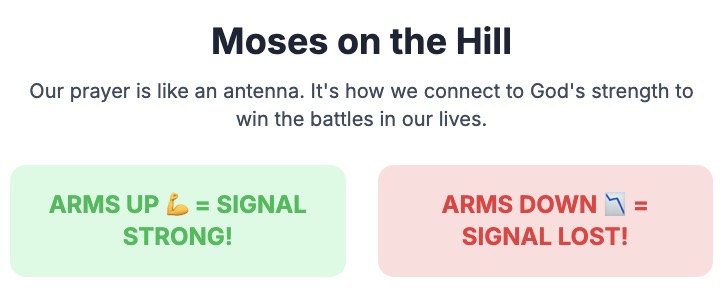
Use the physical image of Moses with his arms raised (Exodus 17:11) as a central metaphor throughout the homily.
His arms are the "antenna" for God's power. When they are up, the battle is won. When they are down, the battle is lost. This tangible image connects directly to prayer.
CONTINUE READING
Weaving the Image Through the Homily
1. Introduction: The Battle and the Antenna
You can begin the homily by painting a vivid picture of the scene. "Imagine you are one of the soldiers, Joshua, down in the valley. The fight is brutal. You glance up at the hill and see Moses, his arms held high, and you feel a surge of strength. But then you see his arms falter, and a wave of despair and weakness washes over you. Your victory is directly connected to his posture of prayer."
Introduce the metaphor: "Moses' arms were the antenna for God's grace. Our prayer is the very same. It is the act of raising the antenna of our hearts and souls to God, so His strength, not our own, can win the battles in our lives."
2. Connecting to the Readings
Exodus: The Communal Antenna The story immediately teaches us two things about prayer. First, it's tiring. Moses, a great spiritual leader, could not do it alone. His arms grew weary. This is a profound truth for all of us. Sometimes, in the face of long illness, family struggles, or spiritual dryness, our own arms grow heavy. We get tired of praying. Second, prayer is communal. Moses didn't fail because Aaron and Hur were there. They came to his side, held up his arms, and kept the antenna pointed toward heaven. This is a perfect image of the Church. We are meant to be Aaron and Hur for each other, holding each other up in prayer. When a friend is struggling, we are called to help "hold up their arms."
Luke: The Personal Antenna of the Persistent Widow The widow in the Gospel had no Aaron or Hur. She was alone. Yet, she refused to let her antenna down. Her persistence—her constant, nagging, relentless pleading—was her way of keeping her arms raised before a seemingly indifferent judge. Jesus's point is powerful: if this stubborn pestering works on a corrupt judge, how much more will our persistence work on our loving Father? The widow teaches us that even when we feel alone, we must keep the antenna of our faith raised. Our persistence shows our trust that the signal is, in fact, being received, even if we don't feel the effect immediately.
2 Timothy: The Signal Itself If our prayer is the antenna, what is the signal it's trying to receive? St. Paul tells Timothy: Sacred Scripture. He says, "All scripture is inspired by God." The Word of God is the pure, strong signal being broadcast from heaven. An antenna is useless if it's not tuned to the right frequency or if there's no signal to receive. Our prayer life becomes powerful and focused when it is nourished by the Word of God. The Scriptures "train us in righteousness" and equip us for the battle. They are the content of the message God's power sends.
3. Application and Conclusion
Connect the Stories
The thread connecting all three readings is persistence in faith, founded on prayer. The homily can be built around the central message: Don't give up!
Exodus shows us communal and supported prayer. Moses didn't pray alone; he needed Aaron and Hur.
Luke shows us individual and tenacious prayer. The widow had no one but her own persistence.
2 Timothy shows us the foundation for this persistent faith: the inspired Word of God, which we must proclaim persistently.
CONTINUE READING
Connecting the Stories: A Three-Corded Rope of Persistence
The central message woven through today's readings is a simple but profound command for the Christian life: Don't give up! In our spiritual battles, in our pleas for justice, in our proclamation of the faith—we must persist. But the readings don't just tell us to persist; they show us how. They give us a three-part strategy, like a rope woven of three strong cords, that shows us how to hold on.
1. The First Cord: We Persist Together (Exodus)
The story of Moses on the hill is a masterclass in the reality of prayer. Prayer is powerful, it is effective, and it is exhausting. Moses, the great prophet who spoke with God face-to-face, got tired. His human arms, held up as a conduit for divine power, grew heavy. He was ready to give up.
This is where the first lesson comes in: we are not meant to do this alone. Moses didn't fail, because he wasn't by himself. Aaron and Hur came to his side. They didn't just give him a pep talk; they physically took his arms and held them up. They shared the burden of his prayer.
This is a living icon of the Church. Who are the Aaron and Hur in our lives? It's the friend who calls to check in when we're struggling. It's the parish prayer group that intercedes for the sick. It's the spouse who prays with us when our own faith feels weak. The first cord of persistence is community. We hold each other up in the battle.
2. The Second Cord: We Persist Tenaciously (Luke)
But what happens when we feel alone? What happens when our Aaron and Hur aren't there, and we feel like we are facing the battle by ourselves? Jesus gives us the answer in the Parable of the Persistent Widow.
This woman is the complete opposite of Moses. He was a powerful leader surrounded by his people; she is a powerless widow, utterly alone. She has no one to hold up her arms. All she has is her own voice and a stubborn refusal to give up. She annoys the unjust judge into giving her justice.
Jesus's logic here is what we call an argument "from the lesser to the greater." He's not saying God is like the unjust judge. He's making a profound point: If even a corrupt, uncaring judge who "neither feared God nor respected any human being" will give in to sheer persistence, how much more will our loving Father, who treasures us as His children, rush to answer our prayers?
This second cord is tenacity. When we feel isolated, the widow gives us a model for "filial boldness." We are to be stubborn in our prayer, continually knocking on God's door, not because we doubt He will answer, but because we trust so deeply in His goodness that we refuse to stop asking.
3. The Third Cord: We Persist Because We Are Grounded in Truth (2 Timothy)
So, we have the first cord of community and the second cord of personal tenacity. But what holds it all together? What fuels this persistence when we're tired and when we're lonely? St. Paul gives Timothy the third and final cord: Sacred Scripture.
Paul tells his spiritual son to "remain faithful to what you have learned and believed." He reminds him that all Scripture is "inspired by God." It's not just a history book or a collection of nice stories. It is the living, breathing Word of God—the foundation upon which our faith is built.
When our arms grow tired like Moses, the Scriptures remind us of God's power. When our voice grows hoarse like the widow's, the Scriptures remind us of God's promises. The Word of God is the "why" behind our persistence. It is the solid ground we stand on, the ultimate reason we don't give up. It teaches, corrects, and trains us, equipping us for the spiritual battle.
Conclusion
Woven together, these three cords—community, tenacity, and Scripture—create an unbreakable rope of faith. We lean on each other, we cry out to God with stubborn hope, and we ground ourselves in His unchanging Word. This is how we fight the good fight. This is how we keep the faith. This is how we win the victory.
Link to the Mass
When you, the priest, extend your hands during the Eucharistic Prayer (the orans posture), you are doing what Moses did.
You are interceding on behalf of the people, holding up your arms in prayer so that the battle against sin and death can be won through Christ's sacrifice. You can explicitly mention this connection.
CONTINUE READING
Of course. Here is an expanded reflection on connecting the orans posture of the priest at Mass to the image of Moses, designed to be woven directly into a homily.
Linking the Liturgy to Life: The Posture of Prayer
My brothers and sisters, every single Sunday, you see me do something at this altar that might seem ordinary because it's so familiar. During the great Eucharistic Prayer, the heart of our Mass, I will extend my hands, palms up, like this. (The priest can demonstrate the orans posture here).
Have you ever wondered what this posture means? It’s not just a random liturgical gesture. Today, our first reading from the Book of Exodus pulls back the curtain and reveals its profound meaning. This posture is the prayer of Moses.
1. The Hill of Battle and the Hill of Calvary
Imagine Moses, standing on the hill overlooking the battlefield. He isn't holding a sword or a spear. His only weapon is his prayer. With his arms held high, he becomes a living bridge, a human conduit between the power of heaven and the struggle of his people on earth. As long as his arms are raised in intercession, Israel is victorious.
Now, shift your focus from that hill in the desert to this altar. This altar is our Calvary. When I stand here and extend my hands in this ancient posture, I am standing on that hill with Moses. But even more profoundly, in the person of Christ the Head, I am standing on the hill of Calvary. My arms are raised not to win a temporary battle against the Amalekites, but to intercede for you in the great spiritual battle of our time—the battle against sin, against hopelessness, and against death itself.
2. From a Temporary Victory to an Eternal One
Moses' intercession was powerful, but it was also fragile. He was only human. His arms grew tired and began to fall. If not for Aaron and Hur, the battle would have been lost. His prayer secured a victory for a single day.
But here, at this Mass, the prayer is different. The intercession is perfect. The priest raises his hands, but the true High Priest is Jesus Christ, whose arms were stretched out once and for all upon the Cross. His prayer does not falter. His intercession never grows weary. Through this ministerial priesthood, Christ's perfect, eternal sacrifice is made present again for us. His victory was not for a day; it is for all eternity.
3. Your Role as Aaron and Hur
Most importantly, this action is not something the priest does alone. Just as Moses needed Aaron and Hur to support him, the priest—and indeed the whole Church—is supported by you, the faithful.
When you offer your intentions, when you kneel in reverence, when you proclaim the great "Amen" after the Doxology, you are being Aaron and Hur. You are adding your faith to this great prayer. You are spiritually "holding up the arms" of the Church as she intercedes for the whole world. Our collective prayer, united with Christ's perfect sacrifice, keeps the channel of grace open so that God's power can flow into our lives, our homes, and our community.
So today, and every Sunday hereafter, when you see the priest extend his hands over the bread and wine, I want you to see Moses on the hill. See the arms of Christ stretched out on the Cross. And see yourself, standing faithfully beside them, supporting the great prayer that wins the only battle that truly matters: the victory of light over darkness, and life over death.
Authenticity is Key: Don't try to be someone you're not or use slang you don't know. Youth can spot inauthenticity immediately, so be yourself.
Be You: Let your personality shine through to make your sermon more relatable and impactful.
Meet them in their world: Understand the cultural context of the young people you're speaking to.
Make the Message Stick
Tell Stories: Like Jesus, share stories that illustrate biblical truths and help make personal connections between the message and their lives.
Use Visuals and Interaction: Engage multiple senses by using movie clips, objects, or games to make the message more memorable.
Encourage Participation: Involve the audience through actions like raising hands, shouting answers, or taking polls to foster interaction.
29th Sunday of Year C
Contrast Persistence with Instant Gratification
Directly address the cultural pressure for immediate results.
"We live in an Amazon Prime, one-click world. We want instant answers, instant healing, instant solutions. But God doesn't work like a search engine. The Gospel today calls us to something radical: persistence. The widow didn't just 'slide into the judge's DMs'; she showed up, again and again. Our prayer must have that same gritty, stubborn quality."
CONTINUE READING
The Radical Rebellion of Persistence
We live in a world built for speed. It's the world of the swipe, the click, and the two-day delivery. If we're hungry, we don't plant a seed and wait; we open an app and food arrives in 30 minutes. If we have a question, we don't go to a library and search; we pull out our phones and have the answer in 0.8 seconds. We have been trained, every single day, to expect immediate results.
It's only natural that we bring this expectation to our faith. We treat prayer like we're putting a query into a divine search engine: "God, heal this sickness, enter." "God, fix my anxiety, enter." "God, solve this money problem, enter." And when we don't get an instant result—when the answer is silence, or "wait," or even "no"—it can feel like a failed connection. We can feel like God is broken, or that He isn't listening.
But what if God isn't a search engine? What if He isn't Amazon Prime? Today's Gospel presents us with a radical, counter-cultural alternative to our instant-gratification world: the spiritual discipline of persistence.
Jesus gives us the parable of the persistent widow. Look at what she does. She has a just cause, but the system is corrupt. She has no power, no influence, no money. So what does she do? She doesn't just send one email and give up. She doesn't just "slide into the judge's DMs" and hope for the best. No, she shows up. Day after day after day. She becomes an un-ignorable, in-person, recurring appointment on his calendar. Her persistence is her power.
This is the kind of prayer Jesus calls us to. It's not a one-click transaction. It's a relationship built over time. It's a prayer with a gritty, stubborn, beautiful quality. Why? Because God is more interested in the person praying than in the problem they're praying about. The process of persistent prayer does something to us.
When we get an instant fix, we get a solution. When we have to persist in prayer, we build character.
When we get an instant answer, we get information. When we have to persist in prayer, we cultivate trust.
Instant gratification is about changing our circumstances. Persistent prayer is about allowing God to change our hearts.
The waiting room of prayer is the workout room of faith. It’s where the muscles of trust, patience, and hope are built. It's a rebellion against a culture that tells us that anything that takes time isn't worth it.
So, the next time you feel like giving up on a prayer, remember the widow. Don't just send a text to heaven. Show up. Show up tomorrow, and the next day, and the day after that. Lean into the gritty, stubborn, holy work of persistence, and trust that your loving Father hears you and is building something beautiful in you while you wait.
Identify Today's "Amalekites"
Use the image of Aaron and Hur to talk about the need for authentic community.
"Moses couldn't do it alone. His arms got tired. So do ours. Who are the Aaron and Hur in your life? Who are the friends who hold you up when you're spiritually exhausted? Faith is not a solo sport. We need people to help us keep our hands raised." This encourages participation in small groups, campus ministry, or simply building strong, faith-based friendships.
CONTINUE READING
Identifying Today's "Amalekites" and Finding Your "Aaron and Hur"
In the first reading, the Israelites are in a literal, physical battle against the Amalekites. For us, the battles are often quieter but no less real. Our "Amalekites" are the relentless forces that try to defeat our spirit and pull us away from God.
What are these modern-day Amalekites?
It's the crushing weight of anxiety that whispers lies about our worth.
It's the suffocating fog of loneliness in a world that has never been more connected, yet feels so far apart.
It's the relentless pressure of perfectionism from social media, work, or even our own expectations.
It's the spiritual exhaustion and doubt that make prayer feel like a chore and God feel distant.
It's the busyness and noise of daily life that drain our energy and leave no room for silence or peace.
These are the battles we fight day in and day out. And in the midst of them, it is so easy to feel our arms begin to fall.
This is where the most beautiful part of the story comes in. Moses, the great prophet and leader, couldn't do it alone. His arms got tired. He was human. And so are we. Our arms get tired, too. Our hope gets tired. Our faith gets tired.
And that's okay. Because faith is not a solo sport. It was never meant to be.
Look at what happens. Aaron and Hur don't just shout encouragement from the valley below. They climb the hill, come right alongside Moses, find a stone for him to sit on, and they physically take his arms and hold them up until the battle is won.
This is one of the most powerful images of authentic Christian community in all of Scripture. And it is a direct call to every one of us. We are all called to be an Aaron or a Hur for someone, and we all need an Aaron and a Hur in our own lives.
Who are the Aaron and Hur in your life? Who are the friends who hold you up when you're spiritually exhausted? The ones who will "climb the hill" for you?
It's the person who texts you, "I'm praying for you today," and you know they mean it.
It's the friend who listens without judgment when you're wrestling with doubt.
It's the small group that creates a safe space to be vulnerable and share your real struggles, not just your highlight reel.
It's the spouse or family member who sits with you in the silence when you have no words left to pray.
This is the Church at its very best. This is why participation in small groups, campus ministry, or simply investing time in building strong, faith-based friendships is not an optional extra—it is essential for survival in our spiritual battle.
So today, let's ask ourselves two things. First, who can I thank God for, who has been an Aaron or Hur for me? And second, whose arms are getting tired around me? Who is God calling me to climb the hill for, to come alongside, and to help them keep their hands raised? Because when we hold each other up, we don't just find the strength to carry on—we become a living sign of God's own supportive, unwavering love for the world.
Preach the familiar gospel: While it's always important to share the gospel, remember that many seniors have heard these messages their entire lives. Repeat familiar, comforting messages like "God will take care of you," "He never leaves us," and "Heaven is our final home".
Emphasize Jesus and the Sacraments: Focus on the person of Jesus, his life, promises, and resurrection, and the sacraments, rather than controversial topics that may divide the audience.
Tell stories. Seniors often respond well to storytelling, which can help them remember and connect with the message.
Connect the past and present: Acknowledge the life they have lived while reminding them that the "God of then is still the God of now."
Address aging realistically: Acknowledge the reality of aging, including loneliness, loss, and physical pain.
29th Sunday of Year C
Acknowledge their Life Experience
Begin by acknowledging that they have lived through times of trial and uncertainty where persistent prayer was their primary recourse. Affirm their faithfulness over the decades.
You might say, "Many of you have forgotten more about prayer than I have yet learned. You've held the hands of sick spouses, prayed for children who have strayed, and kept faith when the world seemed to be falling apart. You are the persistent widows and the steadfast Moseses of our parish."
CONTINUE READING
Homily Starter
I look out at this parish, and I see a profound reservoir of wisdom and lived faith. To be honest, many of you have probably forgotten more about prayer than I have yet learned.
Today's readings speak of persistence, of not giving up when the battle is long and you grow weary. For many of you, this isn't a theological concept; it's the story of your life.
You are the generation that knows what it means to hold on when everything and everyone tells you to let go.
You’ve sat in hospital waiting rooms, your only companion the Rosary beads worn smooth in your hands, praying for a miracle or simply for a peaceful end.
You’ve held the hands of sick and dying spouses, your prayer a quiet, constant, loving whisper that lasted for weeks, months, or even years.
You have prayed for children and grandchildren who have strayed from the faith, not just for a week or a month, but for decades, your hearts aching but your hope stubbornly refusing to be extinguished.
You kept the faith when the world seemed to be falling apart—through wars, through economic recessions, through immense cultural shifts, and through changes in the Church itself. You learned to pray not for instant solutions, but for enduring strength. Your lives have been a masterclass in what today's Gospel calls persistence.
So when we read about the persistent widow, we shouldn't just think of her as a character in a story from long ago. I see her in you. You are the persistent widows who have refused to stop knocking on heaven's door for your loved ones.
And when we read about Moses on the hill, his arms growing heavy from the strain of intercession, I see you. You are the steadfast Moseses of our parish, who have held this community and your families up in prayer for so long, even when you grew weary in body and spirit.
Your quiet, often unseen faithfulness is the spiritual bedrock of this community. It is a powerful witness to a world that gives up too easily. Thank you for teaching us, through the powerful sermon of your lives, what it truly means to "pray always and not lose heart."
Present the story of Moses, Aaron, and Hur as a model for their current vocation.Their active, primary role in the parish and family is now to pray.
Frame them as Intercessors
hey are the ones who must "hold up the arms" of their children, grandchildren, and their priests. Their persistence in prayer is what helps the younger generations win their battles against "Amalek"—the struggles of modern life.
CONTINUE READING
Your Vocation Now: The Power of Intercession
As we move through the different seasons of our lives, our mission from God doesn't end; it transforms. There may have been a time when your primary role was raising a family in the hustle and bustle of daily life, building a career, or actively running the committees of this parish. But for many, there comes a season where God calls you to a new and perhaps even more powerful vocation: the ministry of intercession.
Today's first reading gives us the perfect model for this sacred role. In the story, Moses stands on a hill, overlooking a fierce battle. He is the spiritual leader, and his prayer is the key to victory. But he is human. He gets tired. His arms, held high to heaven, begin to droop from exhaustion. And when they do, the battle turns against his people.
This is where the heroes of the story emerge: Aaron and Hur. They see their leader, their intercessor, growing weary. So they go to him, they give him a stone to sit on for support, and then they physically take his arms and hold them up. They don't fight in the battle below, but without their crucial support on the hill, the battle would have been lost.
My dear friends, you are the Aaron and Hur of our Church today.
Look down into the valley of modern life. You see your children, your grandchildren, and your great-grandchildren fighting battles you know all too well, and some you can hardly imagine. They are fighting against the modern "Amalekites":
The overwhelming pressure of a secular culture that wants to sideline faith.
The battle against anxiety, depression, and loneliness.
The struggle to build strong marriages and raise faithful families in a world of distraction.
The challenge of finding meaning and stability in a confusing world.
They are on the front lines, and they are growing weary. Their priests and bishops are on that hill, too, and believe me, our arms get heavy.
Your active, primary role in this battle is to "hold up the arms." You may not be in the valley anymore, but your role on the hill has never been more critical. When you sit in your chair at home and pray a Rosary for your family, you are holding up their arms. When you come to daily Mass and offer the Eucharist for a grandchild who is struggling, you are holding up their arms. When you unite your own aches, pains, and sufferings with the Cross of Christ for the sake of the Church, you are holding up the arms of your priests.
Never, ever believe that your prayer is a passive or a secondary thing. It is active. It is powerful. It is the spiritual life-support that sustains the Church. Your persistence in prayer is what helps the younger generations win their battles. You are the hidden spiritual powerhouse of this parish, and your faithful intercession is the invisible force that brings about God's victory in the lives of those you love.
Address the "Waiting"
The Parable of the Persistent Widow resonates with the experience of waiting on God.
They may be waiting for healing, for a family member to return to the Church, or for their own journey to be complete. Emphasize that God's justice and response are certain, even if His timing is not ours. The widow's persistence wasn't about changing the judge's mind but about trusting that her plea would eventually be heard. Our prayer is about aligning our hearts with God's will while we wait.
CONTINUE READING
The Sacred Act of Waiting
One of the most profound and often most difficult parts of the spiritual life is the experience of waiting. As we journey through life, our list of things we are waiting on from God only seems to grow.
Many of you know this reality intimately. You are in a season of waiting right now.
You may be waiting for healing from a chronic illness or relief from pain that has become a constant companion.
You are waiting for a family member—a child, a grandchild—to find their way back to the Church, your heart aching with every passing year.
You might be waiting for reconciliation in a broken relationship, for a phone call that never seems to come.
Or perhaps you are waiting for your own journey to be complete, for the Lord to finally call you home.
This waiting can be agonizing. It can test our faith and tempt us to despair. That is precisely why Jesus gives us the Parable of the Persistent Widow. This story speaks directly into our waiting and reframes it.
The widow's persistence is often misunderstood. We might think she is trying to nag the judge into changing his mind, to wear him down with sheer annoyance. But that's not what Jesus is highlighting. Her persistence wasn't about manipulating a corrupt judge; it was an act of profound and stubborn trust. She kept showing up because she believed, against all odds, that her plea was just and would eventually be heard. She trusted in the process, even when the person in charge was untrustworthy.
Jesus then makes a stunning "how much more" argument. If a corrupt judge who cares for no one will eventually act, how much more will your loving Father, who knows every hair on your head and treasures you infinitely, listen to your cries?
This teaches us something crucial about our own prayer in the waiting. Our persistence is not an attempt to change God's mind as if He were reluctant to help us. It is the very expression of our faith. Every time we repeat that prayer for healing, for that grandchild, for that reconciliation, we are not nagging God. We are making a powerful declaration of trust. We are saying, "Lord, I don't see the answer yet. I am tired. But I still believe you are good. I still believe you are listening. I still trust in your promises."
The waiting is not a void; it is a sacred space. It is the time when God does some of His deepest work, not on our circumstances, but on our hearts. In the waiting, our prayer slowly transforms from a list of demands into a conversation of trust. It becomes less about trying to align God's will to ours, and more about patiently aligning our hearts to His.
God's justice and His response are certain. Jesus promises that God will "secure the rights of his chosen ones who call to him." The answer will come. But it will come in His time, not ours. Until then, our call is to be like the widow: to keep showing up, to keep trusting, and to let the holy act of waiting deepen our faith in the One who is always faithful.a life that leaves a beautiful and lasting legacy—a legacy of a thankful heart."
Connect Scripture and Catechism: Use the liturgical readings as a starting point, but then clearly tie them to the established teachings of the Catechism.
Emphasize the Living God: Preaching should aim to help listeners encounter the living God through faith, fostering a sense of personal relationship and community.
Keep it Concise: Aim for brevity to maintain listener attention, as attention spans can wane after 10-12 minutes.
Show, Don't Just Tell: Use illustrations and repetition of key phrases to make the message clearer and more memorable.
Appeal to the Whole Person: Engage the listeners' minds, hearts, and wills to encourage reflection and a response to the Good News.
29th Sunday of Year C
The Battle of Prayer (CCC 2725)
Introduce this section of the Catechism directly. "The Catechism doesn't describe prayer as a peaceful walk in the park. It calls it a 'battle' (CCC 2725).
Today's readings show us this battle perfectly. It was a literal battle for the Israelites, and it's a spiritual battle for us against our own weakness and against 'the wiles of the tempter' (CCC 2725). The readings give us our weapons: persistence and Sacred Scripture."
CONTINUE READING
The Battle of Prayer (CCC 2725)
When we think of prayer, we often picture moments of quiet peace—a serene walk in the park with God. And sometimes, prayer is exactly that, a beautiful gift of consolation. But if we are honest, it often doesn't feel that way. It can feel like hard work. It can feel like a struggle.
The Church, in its ancient wisdom, is not afraid to acknowledge this reality. In fact, the Catechism of the Catholic Church gives this struggle a powerful name. It doesn't describe prayer as a peaceful stroll; it calls it a "battle".
Paragraph 2725 tells us: "Prayer is a battle. Against whom? Against ourselves and against the wiles of the tempter who does all he can to turn man away from prayer, from union with God."
Today's readings show us this battle perfectly. For the Israelites in the valley, it was a literal, physical battle for their lives. But the more important battle was happening on the hill—the spiritual battle being waged by Moses. The outcome of the fight below was decided by the success of the prayer above.
This is a perfect image of our own lives. We face our battles in the valley—in our health, our families, our work. But the decisive victory is won on the hill of prayer. And like any battle, this one is fought on two fronts.
1. The Battle Against Ourselves The Catechism says we first fight against "ourselves." This is the battle against our own weakness. It's the struggle with distraction when our minds wander a thousand different places. It's the fight against dryness, when our prayers feel empty and God feels a million miles away. It's the battle against discouragement, when we get tired like Moses, our arms growing heavy, and we're tempted to just give up. This internal battle is real, and it requires discipline and endurance.
2. The Battle Against the Tempter The second front is against "the wiles of the tempter." Satan wants to convince us that our prayer is useless. He whispers lies: "God isn't listening." "You're not worthy enough." "This problem is too big even for God." His entire strategy is to get us to lower our arms, to sever our connection with our source of strength, just as the Amalekites gained the advantage when Moses' arms fell.
But God never sends us into a battle unarmed. Today's readings give us our weapons for this fight.
From the widow in the Gospel, we receive the weapon of stubborn persistence—a refusal to give up, born from a deep trust that our Father is listening.
From St. Paul's letter to Timothy, we receive the "sword of the Spirit," which is the Word of God. Sacred Scripture is our training manual. It corrects us, encourages us, and reminds us of God's promises, fueling our prayer when our own feelings fail.
So when your prayer feels like a struggle, don't be discouraged. You are not failing; you are fighting. You are engaging in the great and holy "battle of prayer." And with the weapons of persistence and Sacred Scripture, God will surely give us the victory.
Intercession, a Prayer of Petition (CCC 2634-2636)
Explain the power of intercessory prayer using Moses as the prime example.
"In the First Reading, Moses isn't praying for himself. He is interceding for his people. The Catechism teaches that intercession 'is a prayer of petition which leads us to pray as Jesus did' (CCC 2634). When we pray for others—our family, our community, the world—we are participating in the prayer of Christ himself. Like Moses, we stand in the gap for others."
CONTINUE READING
The Power of Standing in the Gap (CCC 2634-2636)
One of the most powerful and selfless forms of prayer we can offer is the prayer of intercession. In today's first reading, we see a masterclass in intercession from Moses. Notice, while the battle rages in the valley, Moses isn't praying for his own safety. He isn't asking God to protect him on the hill. His prayer is directed entirely outward, for the well-being and victory of his people. He is literally standing in the gap between God and the people, and his prayer is the bridge that brings God's power into their struggle.
This is the very heart of intercession. The Catechism of the Catholic Church explains that intercession is "a prayer of petition which leads us to pray as Jesus did" (CCC 2634). This is a profound truth. Jesus is the one true intercessor who stands before the Father on our behalf. The letter to the Hebrews tells us that he "lives forever to make intercession" for us (Hebrews 7:25). His entire life, culminating in his sacrifice on the cross, was one great act of intercession for all humanity.
Therefore, when we pray for others—when we intercede—we are doing something truly extraordinary. We are not just asking God for favors on behalf of someone else. We are joining our prayer to the prayer of Jesus Christ himself. We are conforming our hearts to His heart, which burns with love for all people.
The Catechism reminds us that this prayer knows no boundaries, not even for our enemies (CCC 2635). When you pray for:
Your children or grandchildren
A sick friend or neighbor
Your priest and your parish community
Peace in a war-torn country
Even someone who has hurt you
...you are stepping into that sacred role of intercessor. Like Moses, you are "standing in the gap." You are holding up the arms of another person before God, asking Him to pour out His grace and strength upon them.
This is not a small or passive act. It is a powerful ministry. Your prayer becomes a conduit of grace, a hidden act of love that can change hearts and circumstances in ways we may never see. So let us, like Moses, have the courage to climb the hill of prayer, lift up our arms for others, and participate in the world-changing prayer of Jesus Christ Himself.
Sacred Scripture in the Life of the Church (CCC 131-133)
Connect the second reading from 2 Timothy to the Church's teaching on Scripture.
"St. Paul reminds Timothy to remain faithful to the Scriptures because they are 'inspired by God.' The Catechism affirms this, stating, 'The Church has always venerated the divine Scriptures as she venerated the Body of the Lord' (CCC 103). Our prayer must be nourished by this Word. If we feel our prayer is weak, the first step is to open the Bible. It is 'useful for teaching, for refutation, for correction, and for training in righteousness'—it is the training manual for our faith."
CONTINUE READING
The Solid Ground of Our Faith (CCC 131-133)
In our other readings today, we see the Christian life as a battle that requires persistent prayer. We see Moses growing weary and the widow crying out relentlessly. A natural question arises: what fuels this persistence? What is the solid ground we stand on that gives us the strength to keep our arms raised when we are exhausted? St. Paul, in his letter to Timothy, gives us the definitive answer: Sacred Scripture.
Paul urges his spiritual son, Timothy, to "remain faithful to what you have learned and believed," because from infancy he has known the sacred Scriptures. He then gives us one of the most important teachings about the Bible in all of Christianity: "All scripture is inspired by God."
The Greek word used here is theopneustos, which literally means "God-breathed." This is a breathtaking claim. The Bible is not just a collection of inspiring stories or wise human sayings about God. It is God's own Word, breathed out through human authors. It is a direct communication from our Creator, a love letter written to His people.
Because of this divine origin, the Church holds the Scriptures in the highest possible regard. The Catechism of the Catholic Church, quoting the Second Vatican Council, makes a statement that should stop us in our tracks: "The Church has always venerated the divine Scriptures as she venerated the Body of the Lord" (CCC 103).
Think about what that means. We are fed at two tables at every Mass: the table of the Word (the ambo) and the table of the Eucharist (the altar). The Church teaches that we should have the same reverence, the same awe, for the Scriptures as we do for the Blessed Sacrament. Both are ways that God gives Himself to us as life-giving food. The Scriptures are "food for the soul, and a pure and lasting fount of spiritual life" (CCC 131).
If our prayer life feels weak, dry, or empty, we must ask ourselves: am I trying to pray on an empty stomach? If we are not nourishing our minds and hearts with the Word of God, our prayer will inevitably falter. The Bible is, as St. Paul says, the essential "training manual" for our faith. It is useful for:
Teaching: It tells us the truth about who God is and who we are.
Refutation: It corrects our false ideas and protects us from error.
Correction: It shows us where we have gone wrong and how to get back on track.
Training in Righteousness: It actively shapes us into the people God created us to be.
This is why the great St. Jerome, whose words are quoted in the Catechism, famously declared: "Ignorance of the Scriptures is ignorance of Christ" (CCC 133). We cannot truly love someone we do not know. If we want to deepen our prayer, if we want to persist in the battle, if we want to truly know and love Jesus, we must open the book that is all about Him. The Sacred Scriptures are the firm, unchanging ground on which a life of persistent prayer is built.hings from God, but we want God Himself."