October 19, 2025

Featured homily starters, anecdotes and life messages with infographics for use in parish bulletins and presentations. Content adapted from Fr. Tony’s Homilies for the xxxxxxx Sunday Year C Readings: xxxxxxxx

October 19, 2025

Homily Starters Anecdotes Preaching Illustrations

Homily Starters Anecdotes Preaching Illustrations
Fr. Tony’s
Jokes of the
Week

  • ANECDOTES
  • EXEGESIS
  • LIFE MESSAGES

29th Sunday of Year C

Orans Posture at Mass

YouTube player

DOMINICAN MEDIA PRESENTS (2:01) – EleFaChi explains why the priest extends his hands during Liturgical prayers and why a lay person should not.

RELATED ANECDOTE (TEXT VERSION)

The Priest is Not Isolated in His Prayer at the Altar

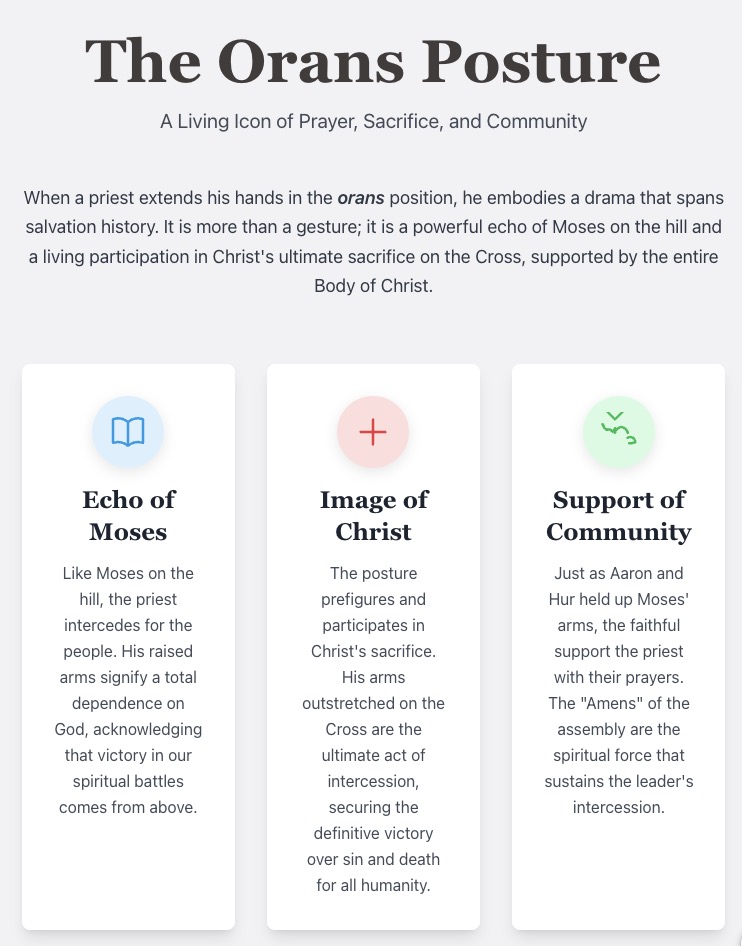
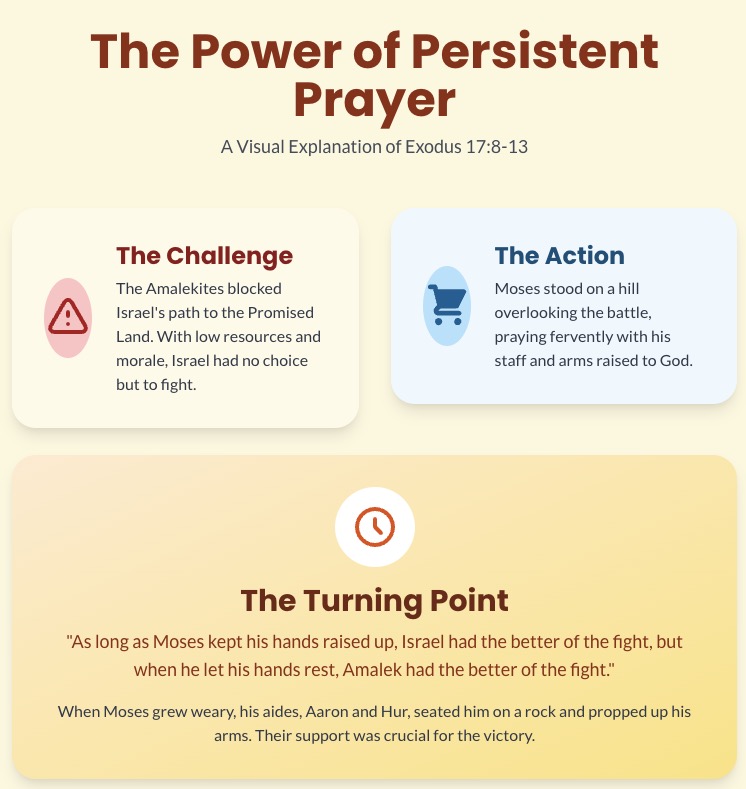
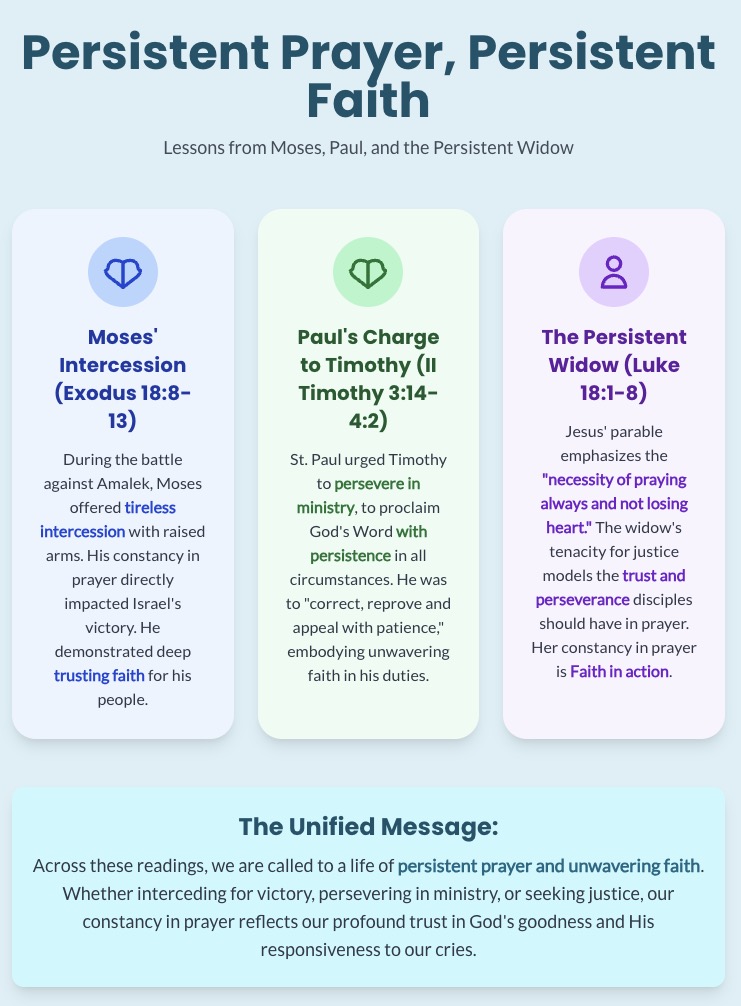
The First Reading from Exodus is explicit: "Whenever Moses held up his hand, Israel prevailed; and whenever he lowered his hand, Amalek prevailed." This is precisely the drama embodied by the priest at the altar. When he extends his hands in the orans position, he stands in the place of Moses, but the symbolism deepens, for Moses’ posture itself is a prefigurement of Christ's arms outstretched on the Cross. The priest, therefore, also stands in persona Christi, making present the ultimate act of intercession. His raised arms are not only a sign of dependence like Moses, but a participation in the very sacrifice of Christ, which secured the definitive victory over sin and death. He is not praying for himself alone, but for the entire congregation, channeling the grace that flows from the Cross.

Furthermore, just as Moses was not left alone, the priest is not isolated in his prayer. He is supported by the entire Body of Christ. The assembly, the "people of God," are his Aaron and Hur, and also his Simon of Cyrene, helping him bear the weight of his sacred duty. Their "Amens," their silent prayers, and their active participation in the liturgy are the spiritual forces that uphold him, preventing his prayer from faltering. The orans posture is therefore a living icon of the entire Church at prayer: a leader interceding in a way that echoes both Moses on the hill and Christ on the Cross, supported by a faithful community, all dependent on God's grace to prevail. It is a powerful reminder that in the great spiritual battle, and just as Mary and John stood by the Cross, we must stand by and offer our prayers for the priest.

Click on banner to learn more

Click to enlarge

Widow-Like Persistence
YouTube player

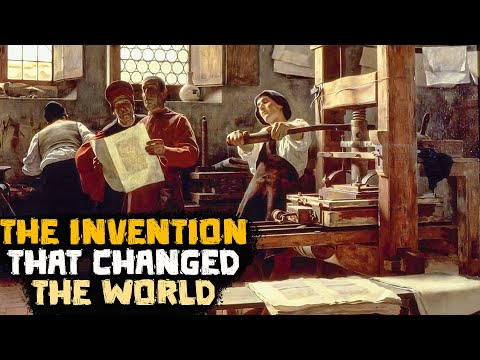
JOHANN GUTENBERG (4:50) – The Invention of the Printing Press

RELATED ANECDOTE (TEXT VERSION)

Influential People or Leaders of the Past 1000 years

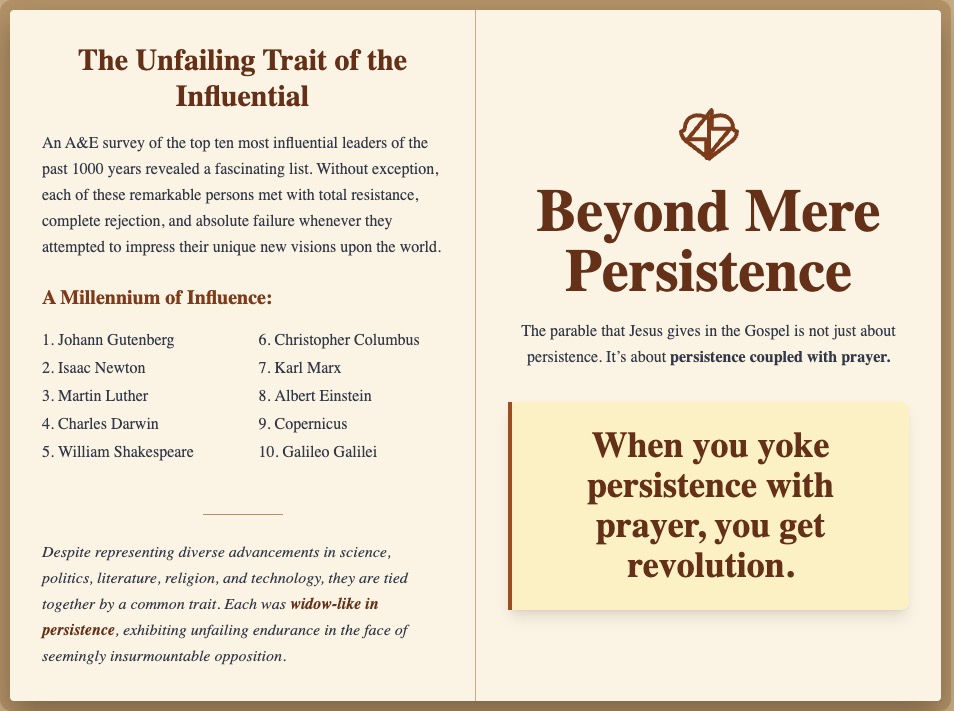
An A&E survey of the top ten most influential people or leaders of the past 1000 years yielded the following list: 10) Galileo; 9) Copernicus; 8) Albert Einstein; 7) Karl Marx; 6) Christopher Columbus; 5) William Shakespeare; 4) Charles Darwin; 3) Martin Luther; 2) Isaac Newton; 1) Johann Gutenberg.  Without exception, each one of the remarkable persons named by the survey met with total resistance, complete rejection, and absolute failure whenever he attempted to impress his unique new visions upon the world in which he lived. Despite the fact that these individuals represent diverse insights and radical advancements in science, politics, literature, religion, and technology, they’re all tied together by a common trait. Each of these historically exalted individuals was widow-like in persistence, exhibiting unfailing endurance in the face of seemingly insurmountable opposition. — But the parable that Jesus gives in today’s Gospel is not just about persistence. It’s about persistence coupled with prayer. When you yoke persistence with prayer, you get revolution. 

Click on banner to learn more

Click to enlarge


29th Sunday of Year C

Heartland

YouTube player

HEARTLAND MOVIE TRAILER (0:37)

RELATED ANECDOTE (TEXT VERSION)

Now Thank We All Our God

The movie Heartland dramatizes the story of rugged prairie life in the early 1900’s. A widow named Elinore Randall answers an ad to become a housekeeper for Clyde Stewart, a taciturn cattle homesteader in Burntfork, Wyoming. After a rocky beginning, their relationship smoothes out and they eventually get married, partly out of economic convenience and partly out of deep human needs. Together they heroically endure the hardships of a stubborn soil that yields little food, freezing winter winds that decimate their herd, and the death of their new born little boy. In the climax of the story, Clyde Stewart has given up on the cattle ranch and begins to pack their belongings. But Elinore won’t let him quit. She pleads and bargains with him not to abandon their dream. Her tenacity triumphs when a calf is born, a sign of a new beginning, new life and new hope. Clyde finally agrees to stay and give the ranch one more try.

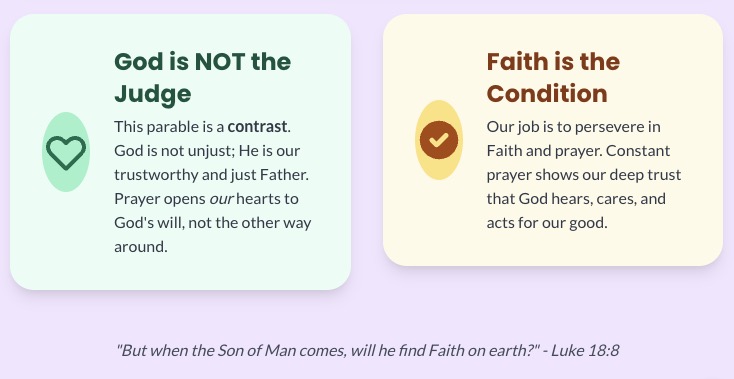
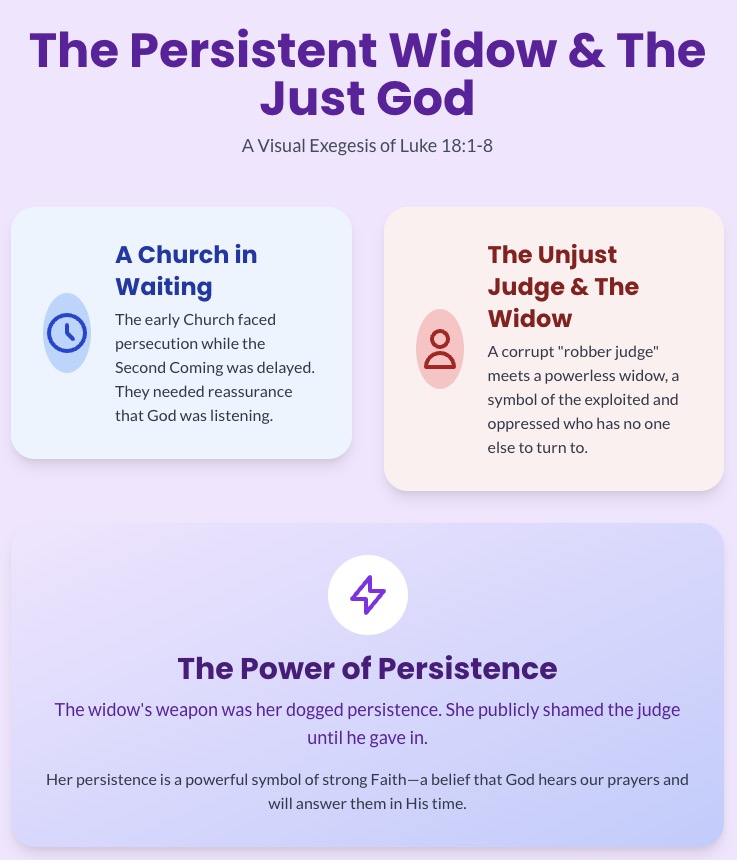
Elinore’s persistence and faith are comparable to the widow’s in today’s parable. The widow kept coming to the judge for her rights and eventually wore him out. Jesus uses her as an example of praying always and not losing heart.

(Albert Cylwicki in His Word Resounds)

Click on banner to learn more

Click to enlarge


29th Sunday of Year C

From Polio to Podium

YouTube player

OLYMPICS (01:43)

RELATED ANECDOTE (TEXT VERSION)

Perseverance of Wilma Rudolf

Wilma didn’t get much of a head-start in life. Wilma Glodean Rudolph was born prematurely at 4.5 lbs., the 20th of 22 siblings; her father Ed was a railway porter and her mother Blanche a maid. Rudolph contracted infantile paralysis (caused by the polio virus) at age four. She recovered, but wore a brace on her left leg and foot (which had become twisted as a result of the polio), until she was nine. She was required to wear an orthopedic shoe for support of her foot for another two years.

At age 12 Wilma tried out for a girls’ basketball team, but didn’t make it. Determined, she practiced with a girlfriend and two boys every day. The next year she made the team. When a college track coach saw her during a game, he talked her into letting him train her as a runner.

By age 14 she had outrun the fastest sprinters in the U.S. In 1956 Wilma made the U.S. Olympic team, but showed poorly. That bitter disappointment motivated her to work harder for the 1960 Olympics in Rome — and there Wilma Rudolph won three gold medals, the most a woman had ever won.

The widow in today’s Gospel story might have been her source of inspiration.

Today in the Word, Moody Bible Institute, (Jan, 1992), p.10

Click on banner to learn more

Click to enlarge


29th Sunday of Year C

Gratitude at Holy Mass

YouTube player

FR. MICHAEL ROSSMANN, S.J. (1:00) – “The wonders do not cease. It is our attentiveness that is in short supply.”

RELATED ANECDOTE (TEXT VERSION)

Gratitude at the Holy Mass: Fr. Roger Landry beautifully explains the connection between the Holy Mass and Jesus’ thanksgiving. At every Mass we’re called to grow in this spirit of thanksgiving, because the Eucharist is Jesus’ own prayer of Thanksgiving to the Father. The Greek word from which we derive the word “Eucharist” means “thanksgiving.” During the Mass, the priest says, “Let us give thanks to the Lord our God.” Everyone responds, “It is right and just.” And then the priest replies with a saying of great theological depth: It is truly right and just, our duty and our salvation, always and everywhere to give You thanks, Lord, Holy Father, Almighty and Ever-living God.” It’s right, it’s just, it’s fitting, it’s appropriate for us to give God thanks,  “always and everywhere.”(All the eight “Prefaces of the Sundays in Ordinary Time” begin thus: “It is truly right and just, our duty and our salvation, always and everywhere to give you thanks, Lord, holy Father, almighty and eternal God, (through Christ our Lord)”  Before Jesus said the words of consecration on the night he was betrayed, the vigil of his crucifixion, he took bread and, as we’ll hear anew today, “gave thanks. He gave thanksbecause it is right always and everywhere, our duty and our salvation, to do so. He gave thanks because he was constantly thanking the Father. He gave thanks because he knew that the Father would bring the greatest good out of the greatest evil of all time which would happen to him after that first Mass in the Upper Room was done. He gave thanks because it would be through his passion, death, and Resurrection, that Jesus would institute the means by which we would be able to enter into his own relationship with the Father. The Mass is the school in which we participate in Jesus’ own thanksgiving, the thanksgiving the Church makes continuously from the rising of the sun to its setting.n.

Click on banner to learn more

Click to enlarge

29th Sunday of Year C
Click on infographic to enlarge


First Reading

YouTube player

FAITH LESSONS (22:10) – The Shocking Story of NAAMAN: The General Who Was Cured in a Dirty River!.

Click on infographic to enlarge


Second Reading


The Gospel
Click on infographic to enlarge

29th Sunday of Year C

YouTube player

TAG LIVE (4:31) – There is no need to wait for full material, giving and sharing comes right in small deeds. Love never discriminates against religion. The person who is always ready to give even in difficult circumstances is a great person.

Life Message #1

by Fr. Tony Kadavil

Click on infographic to enlarge


Life Message #2

by Fr. Tony Kadavil

Click on infographic to enlarge


Life Message #3

by Fr. Tony Kadavil

Images and Infographics on this page have been created using content from Fr. Tony’s Homilies and having AI generative tools (i.e. GOOGLE’S AI Gemini 2.5 Flash LLM, Chart.js and Tailwind CSS) do its magic. You are free to use these infographics for any non-profit ministry. Please show your appreciation by sharing a link or giving a shoutout to either to Fr. Tony’s Homilies at https://frtonyshomilies.com/ or The Word This Week at https://thewordthisweek.net/