General Intercessions, Prayers of the Faithful for Sunday Mass.
General Intercessions,Prayers of the Faithful for Sunday Mass.
Create preaching tips for a catholic priest giving a homily for the xxxxxxx Sunday in Ordinary Time (Year C) focused on xxxxxxxxxxx Use the New American Bible translation.
Break the tips into four areas: 1 ) General Tips 2) Tips for preaching to an older congregation,for each tip give suggestions 3) Tips for preaching to a younger congregation, for each tip give suggestions 4) Tips for preaching using the Catechism
Preach the Good News, not scolding: The central theme of every homily must be the Good News of Jesus Christ—what God has done, is doing, and wants to do. Moral challenges should flow naturally from this good news, not be presented as a list of "shoulds" and "oughts".
Understand your community: An effective preacher knows the lives, joys, and struggles of the people to whom they are preaching. This allows you to apply the timeless truth of the Gospel to their concrete, contemporary situations.
Embrace the Church's teaching: Ground your homilies in the rich history and doctrine of the Catholic faith. Explain how the Scriptures lead to the Church's teachings and how these doctrines contribute to human happiness.
30th Sunday of Year C
The Parable of the Pharisee and the Tax Collector
The Gospel story of the Pharisee and the tax collector is one of the most powerful and memorable in Scripture.
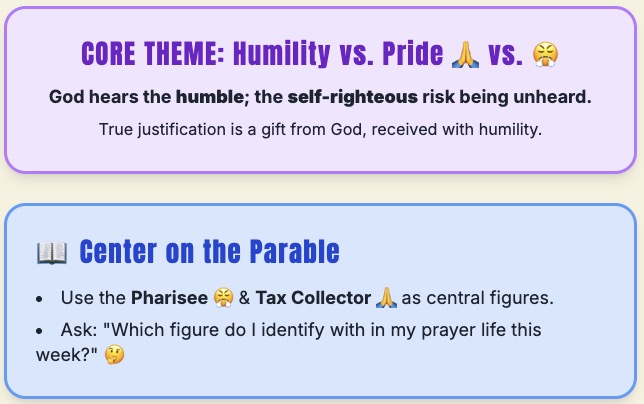
Use these two figures as central archetypes for two different postures before God. Ask the congregation: "Which figure do I identify with more in my prayer life this week?"
Connect the Readings
Start with Sirach to establish the character of God: He is the just judge who is not blinded by status but hears the cry of the lowly. "The prayer of the lowly pierces the clouds." This sets the stage for why the tax collector's prayer is so effective.
Use the Gospel as the main illustration of this principle in action. Contrast the Pharisee's prayer of self-congratulation with the tax collector's simple, honest plea for mercy.
Weave in 2 Timothy as a real-life example. St. Paul, at the end of his life, doesn't boast in his own strength or accomplishments. He acknowledges his abandonment by others and states plainly, "The Lord stood by me and gave me strength."
A Practical Call to Action
Conclude with a simple, concrete action. Encourage the congregation to adopt the tax collector's prayer this week: "O God, be merciful to me, a sinner." Suggest they pray it in the morning, during a moment of frustration, or when they are tempted to judge another person.
Authenticity is Key: Don't try to be someone you're not or use slang you don't know. Youth can spot inauthenticity immediately, so be yourself.
Be You: Let your personality shine through to make your sermon more relatable and impactful.
Meet them in their world: Understand the cultural context of the young people you're speaking to.
Make the Message Stick
Tell Stories: Like Jesus, share stories that illustrate biblical truths and help make personal connections between the message and their lives.
Use Visuals and Interaction: Engage multiple senses by using movie clips, objects, or games to make the message more memorable.
Encourage Participation: Involve the audience through actions like raising hands, shouting answers, or taking polls to foster interaction.
30th Sunday of Year C
The Pharisee's prayer is a perfect ancient example of today's social media culture. He is curating his image, highlighting his virtues, and judging others from a distance.
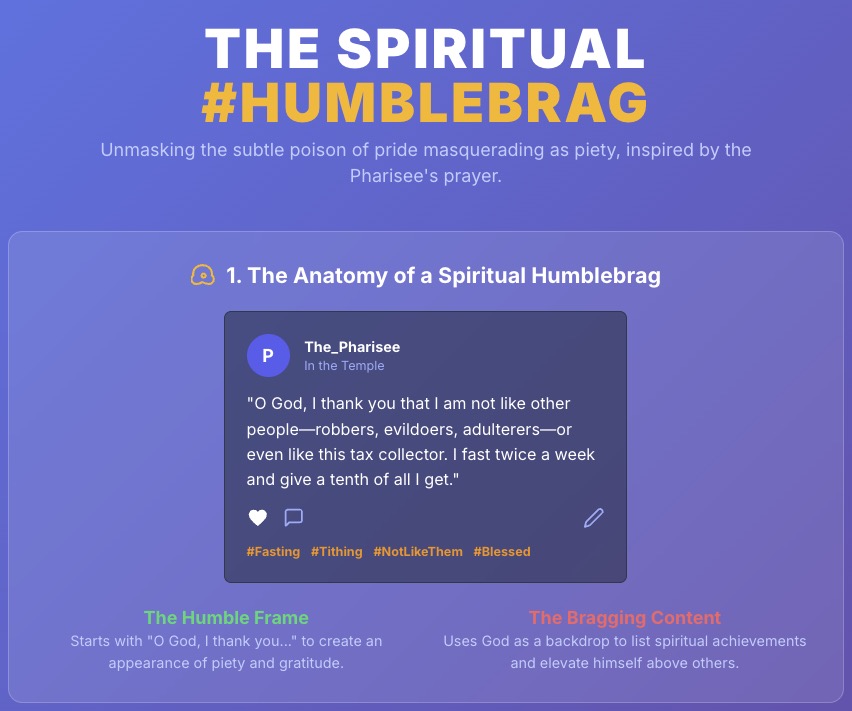
"The Pharisee's prayer is the original spiritual #humblebrag. He stands where everyone can see him and essentially posts, 'So #blessed that I'm not like other people. #Fasting #Tithing.' He's performing his faith. The tax collector is the opposite; he's authentic. He shows up with #nofilter, admitting he's a sinner who needs help. God doesn't want our performance; He wants our authentic selves."
CONTINUE READING
The concept of the "spiritual #humblebrag" perfectly captures the subtle poison in the Pharisee's prayer. It's a form of pride that masquerades as piety.
1. The Anatomy of a Spiritual Humblebrag
A humblebrag on social media is a boast disguised as a complaint or a humble observation (e.g., "Ugh, so tired from my trip to Paris, I can't believe I have to go to Milan next week! #jetlag"). The Pharisee does the exact same thing, but in a spiritual context.
The Humble Frame: He starts his prayer by addressing God: "O God, I thank you..." This is the "humble" part. It creates the appearance of gratitude and piety.
The Bragging Content: The rest of the prayer is pure self-promotion and a direct comparison designed to elevate himself. He's not actually thanking God for God's goodness; he's using God as a backdrop to list his own spiritual achievements: #Fasting, #Tithing, and most importantly, #NotLikeThem. He is essentially crafting the perfect spiritual social media post, designed to get a divine "like."
2. Performance vs. Authenticity
This gets to the core of the issue: the Pharisee is performing his faith, not living it from the heart in that moment.
Curated Righteousness: Like a carefully curated Instagram feed, the Pharisee presents a version of himself that is flawless, successful, and morally superior. He has chosen his best spiritual "photos" and is presenting them for public (and divine) consumption. This performance requires an audience, which is why he "took up a position" where he could be seen and heard.
Radical Authenticity (#nofilter): The tax collector is the complete opposite. He is the person who logs on and posts, "I'm really struggling today." He shows up with #nofilter. He doesn't try to hide his flaws or present a better version of himself. He "stood off at a distance," not seeking an audience. His prayer wasn't a performance; it was a desperate, honest cry from the depths of his being. He knew he was a mess and didn't pretend otherwise.
3. What God Desires
This contrast reveals a profound truth about God. God is not an audience to be impressed by our spiritual performances. He is a Father who desires a real, authentic relationship.
A performance, by its nature, creates distance. It's about maintaining an image.
Authenticity, in its vulnerability, invites intimacy. It says, "This is the real me, broken and in need of your help."
That raw, honest plea is what God can work with. Grace can't penetrate the polished armor of a performer, but it rushes into the open wounds of an honest, humble heart. God doesn't want our curated, #blessed highlight reel; He wants our authentic, #nofilter, messy selves, because that is the only place a true relationship can begin.
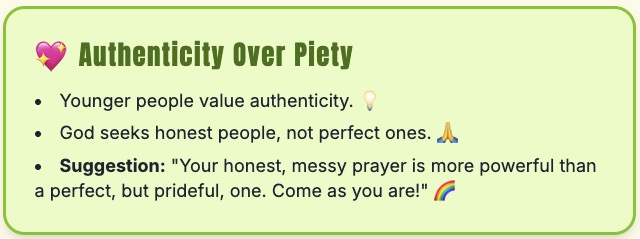
Younger people often distrust institutions and value authenticity. The tax collector is raw and real. The Pharisee is polished and performative.
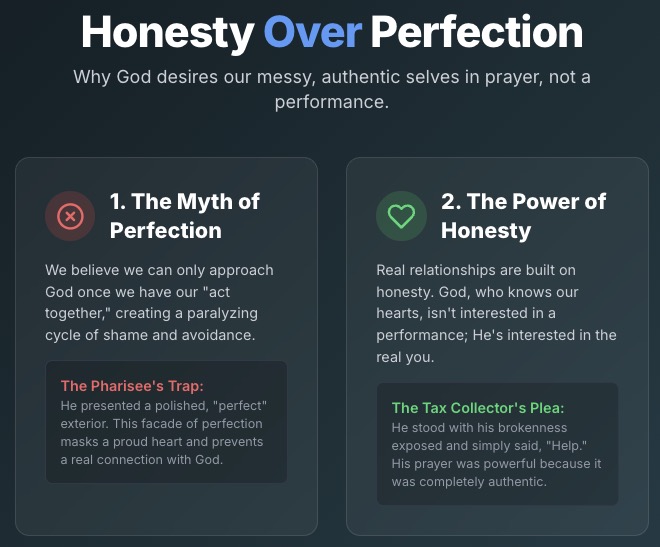
"God is not looking for perfect people; He is looking for honest people. It can be tempting to think we need to 'get our act together' before we come to God in prayer. This parable tells us the opposite is true. We come to God because our act isn't together, and we need His grace to heal us. Your honest, messy prayer is infinitely more powerful than a perfect, but prideful, one."
CONTINUE READING
This statement gets to the very core of what God desires from us in a relationship. It dismantles one of the biggest barriers to a healthy prayer life: the feeling that we are not "good enough" to talk to God.
1. The Myth of Perfection
Many of us carry a subconscious belief that God is like a demanding boss or a strict teacher, and we can only approach Him once we have our "act together." We think we need to present a flawless, perfected version of ourselves in prayer. This creates a paralyzing cycle: we sin, we feel ashamed, we avoid God because of our shame, and the distance grows.
The Pharisee in the parable is the perfect example of someone who believes in this myth. He presents a polished, "perfect" exterior to God. He has followed all the rules. The problem is, this perfection is a facade that masks a heart full of pride and judgment. He isn't actually connecting with God; he's performing for Him.
2. The Power of Honesty
God, who created us and knows our inmost hearts, is not interested in our performance. He is interested in a real relationship, and real relationships are built on honesty.
The tax collector embodies this raw honesty. He doesn't try to hide his mess. He doesn't make excuses. He stands before God with his brokenness fully exposed and simply says, "Help." His prayer, "God, be merciful to me a sinner," is powerful because it is completely authentic. He isn't trying to be someone he's not.
3. Prayer: A Hospital for the Broken
This brings us to a crucial reframing of what prayer is. We often think of prayer as the place we go to report our successes. The parable teaches us that prayer is the place we go because of our failures. It is a hospital for the spiritually sick, not a trophy room for the righteous.
We don't get our act together before we go to God. We go to God because our act isn't together, and He is the only one who can heal us and put us back on the right path. To wait until we are "perfect" to pray is like waiting until our illness is gone before we go to the doctor. It makes no sense.
4. The Messy Prayer God Loves
This is why an "honest, messy prayer" is infinitely more powerful than a "perfect, but prideful, one."
A perfect, prideful prayer is like a closed door. It says, "I'm fine on my own. I don't need you." It leaves no room for God's grace to enter.
An honest, messy prayer is a door thrown wide open. It says, "I'm a wreck. I can't do this without you. Please come in." This vulnerability, this admission of need, is the very thing that invites God's transformative power into our lives.
God is not shocked by your sin or your mess. He already knows it all. What He is waiting for is your honest, humble invitation to let Him into that mess to begin the work of healing.
Preach the familiar gospel: While it's always important to share the gospel, remember that many seniors have heard these messages their entire lives. Repeat familiar, comforting messages like "God will take care of you," "He never leaves us," and "Heaven is our final home".
Emphasize Jesus and the Sacraments: Focus on the person of Jesus, his life, promises, and resurrection, and the sacraments, rather than controversial topics that may divide the audience.
Tell stories. Seniors often respond well to storytelling, which can help them remember and connect with the message.
Connect the past and present: Acknowledge the life they have lived while reminding them that the "God of then is still the God of now."
Address aging realistically: Acknowledge the reality of aging, including loneliness, loss, and physical pain.
30th Sunday of Year C
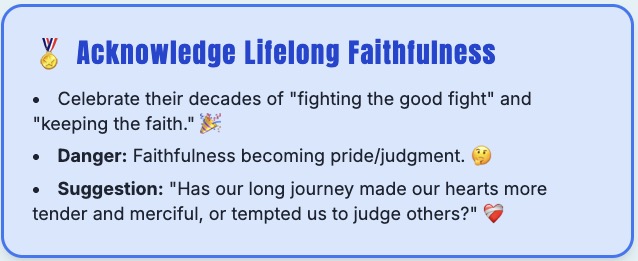
Many older parishioners have been faithful for decades. They have "fought the good fight" and "kept the faith."
Acknowledge this beautifully. The danger for them, like the Pharisee, is not a lack of faith, but the temptation to let that faithfulness become a source of pride or judgment against younger generations or those who have fallen away.
"Like St. Paul, many of you have run the race for 50, 60, or 70 years. You have kept the faith through trials and joys. That is a profound gift to this church. The question these readings ask us is this: Has our long journey made our hearts more tender and merciful, like the tax collector's, or has it tempted us to look with judgment on others who struggle on the path?"
CONTINUE READING
This week's second reading is built on a foundation of deep respect and admiration for a life lived in faith. It begins by honoring the journey before gently posing a crucial question for the spiritually mature.
1. Honoring the Race You Have Run
To say you have "run the race for 50, 60, or 70 years" is to acknowledge something extraordinary. It means you have kept the faith through times of seismic change in the world and in the Church. You have navigated personal trials—the loss of loved ones, health challenges, family struggles—and celebrated profound joys. You have been the bedrock of this parish. Your prayers have been the quiet foundation supporting this community for longer than many have been alive. St. Paul, looking back at his own life, found his confidence not in an easy journey, but in the fact that, by God's grace, he had endured. That same honor is extended to you. Your faithfulness is a living testimony, a "profound gift" that cannot be overstated.
2. The Two Paths of a Long Journey
Any long journey changes a person. The question this Gospel poses is how has it changed us? A lifetime of faith can lead our hearts in one of two directions, beautifully illustrated by the two men in the temple.
The Path to a Tender and Merciful Heart: This is the path of the tax collector, and paradoxically, the path of true spiritual wisdom. The longer you walk with God, the more you realize your own weakness and your absolute dependence on His mercy. You remember the countless times you have stumbled and been forgiven. This deep awareness of your own need for grace doesn't make you weaker; it makes you wiser and more compassionate. Your heart becomes tender, like well-tended soil, ready to receive others with the same mercy God has shown you. You look at a young person struggling with their faith not with judgment, but with a knowing, compassionate heart that says, "I understand. Let me pray for you."
The Temptation of a Hardened Heart: This is the subtle danger for the spiritually accomplished, the path of the Pharisee. The temptation is to let our endurance become a source of pride. The memory of our own past struggles can fade, and we can begin to look at the struggles of others with impatience or judgment. The thinking becomes, "I overcame my challenges, why can't they?" or "The faith was more serious in my day." When this happens, our spiritual maturity, which should be a source of warmth and mercy, can become a cold wall that separates us from those who are still finding their way.
The ultimate goal of our long race is not just to cross the finish line, but to do so with a heart that has grown larger, softer, and more merciful along the way. The question is not a condemnation, but an invitation—an invitation to ensure that the beautiful gift of your lifelong faith becomes a source of profound mercy and understanding for everyone who is still struggling on the path behind you.
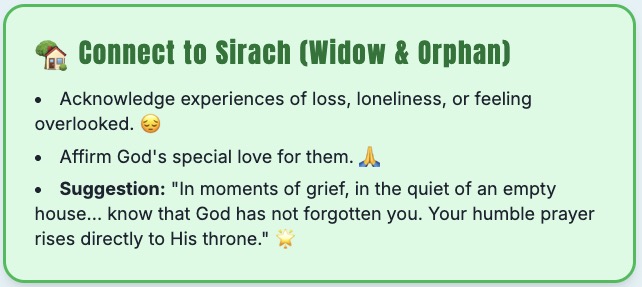
The experience of loss, loneliness, or feeling overlooked can be common in old age. Use the language of Sirach to affirm that God has a special love for them
"Sirach tells us that God ‘is not deaf to the wail of the orphan, nor to the widow when she pours out her complaint.’ In moments of grief, in the quiet of an empty house, when you feel the world may have forgotten you, know that God has not. Your humble prayer rises directly to His throne."
CONTINUE READING
The first reading from the Book of Sirach is one of the most tender and reassuring in all of Scripture, and it speaks directly to the heart of those who have lived a long life. It reveals a profound truth about the character of God: He has a special place in His heart for those the world might overlook.
1. God's Special Attention
In ancient times, the "orphan and the widow" were the most vulnerable people in society. They had no social standing, no power, and often no one to speak up for them. By specifically saying He hears their cry, God is making a powerful statement: He pays closest attention to those who feel they have been left behind. While the world rushes past, captivated by the young, the loud, and the powerful, God deliberately tunes His ear to the quiet whisper of a humble heart. He is not distracted by the noise of the world; He is drawn to the sincerity of a soul that depends on Him alone.
2. The Sacredness of a Quiet House
The phrase "in the quiet of an empty house" is something many of you may know intimately. That quietness can sometimes feel like loneliness, like an emptiness left by loved ones who have gone before. But this passage invites us to see that quiet space differently. It is not a sign of being forgotten; it is a sacred space, an intimate chapel where your prayer is the only voice. In that stillness, your prayer is not competing with anything. It is pure, focused, and powerful. It is the prayer of a soul that has been refined by life, stripped of pretense, and offered with a lifetime of faith behind it.
3. A Prayer that "Pierces the Clouds"
Think of what that image means: "Your humble prayer rises directly to His throne." It doesn't get put on a waiting list. It doesn't have to go through channels. Sirach tells us it "pierces the clouds." This suggests it has a divine priority. While the proud Pharisee's prayer may have been loud enough for everyone in the Temple to hear, it bounced off the ceiling. The humble prayer of a faithful heart, offered in a quiet room, has a direct line to the very heart of God.
In those moments of grief, when you are pouring out your complaint, you are not bothering God. You are doing exactly what He invites you to do. He is not just a God who hears; He is a Father who bends down to listen closely to the child He has known and loved for a lifetime. You are not forgotten. You are seen, you are known, and you are heard.
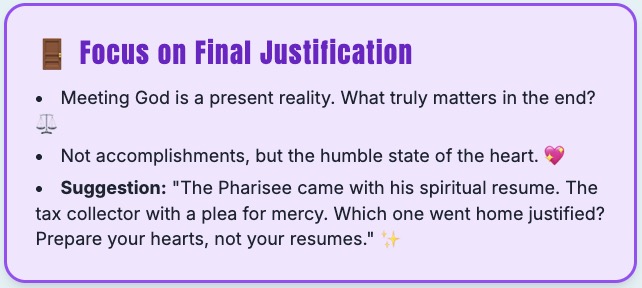
At this stage of life, the reality of meeting God becomes more present. Frame the homily around what truly matters in the end. It's not our list of accomplishments but the humble state of our heart.
"The Pharisee came to God with his spiritual resume in hand. The tax collector came with nothing but a plea for mercy. Which one went home justified? As we prepare to one day go to our eternal home, this Gospel reminds us to prepare our hearts, not our resumes. For the only thing we need to present to the Father is a heart that knows it needs His love."
CONTINUE READING
The Gospel uses the powerful metaphor of a "spiritual resume" to contrast two fundamentally different ways of approaching God, especially as we consider the end of our lives.
1. The Spiritual Resume vs. The Plea for Mercy
The "spiritual resume" is what the Pharisee brings to God. Like any resume, it's a curated list of his best achievements and qualifications: "I fast twice a week," "I pay tithes on my whole income." It is designed to impress. It is a document of self-reliance, implicitly stating, "Look at what I have accomplished through my own effort. I have earned my place here; I deserve your favor." It treats righteousness as a personal achievement to be presented for evaluation.
The tax collector, by contrast, knows he has no resume to offer. His life's work would disqualify him immediately. He has nothing to list, no accomplishments to boast of. He comes with empty hands and a single, desperate "plea for mercy." He understands that his only hope is not in what he has done, but in who God is: a God of compassion. His plea is an admission of spiritual bankruptcy and total dependence on the unearned grace of the Father.
2. Preparing Hearts, Not Resumes
The passage then applies this to our own lives, particularly as we age and reflect on our journey toward our "eternal home." It's easy to fall into the trap of compiling our own spiritual resume—tallying up our years of church attendance, our volunteer hours, our prayers, and our good deeds. We can begin to feel, like the Pharisee, that these things make us worthy.
The Gospel warns that this is a dangerous illusion. When we stand before God, He is not interested in our list of accomplishments. He is interested in the state of our heart. The ultimate question will not be "What did you do?" but "Who did you become?" Did our life of faith soften our heart and make us more merciful, loving, and humble? Or did our good deeds become a source of pride that hardened our heart and made us judgmental of others? Preparing our hearts means cultivating a spirit of humility, gratitude, and mercy.
3. A Heart That Knows It Needs His Love
This is the ultimate summary of a well-prepared heart. It is a heart that has finally let go of the need to prove its own worth. It has stopped trying to earn love and has instead learned how to simply and gratefully receive it. The only thing we can truly offer to God that is of infinite value is a heart that has become a vessel for His love—a heart that, like the tax collector's, honestly admits its own poverty and finds its only treasure in the boundless mercy of the Father.
Connect Scripture and Catechism: Use the liturgical readings as a starting point, but then clearly tie them to the established teachings of the Catechism.
Emphasize the Living God: Preaching should aim to help listeners encounter the living God through faith, fostering a sense of personal relationship and community.
Keep it Concise: Aim for brevity to maintain listener attention, as attention spans can wane after 10-12 minutes.
Show, Don't Just Tell: Use illustrations and repetition of key phrases to make the message clearer and more memorable.
Appeal to the Whole Person: Engage the listeners' minds, hearts, and wills to encourage reflection and a response to the Good News.
30th Sunday of Year C
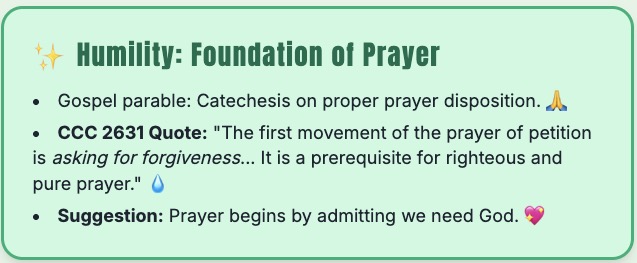
The entire parable is a catechesis on the proper disposition for prayer. The foundation is always humility.
"The first movement of the prayer of petition is asking for forgiveness, like the tax collector in the parable: 'God, be merciful to me a sinner!' It is a prerequisite for righteous and pure prayer" (CCC 2631). Prayer begins not by telling God how good we are, but by admitting how much we need Him.
CONTINUE READING
This quote from the Catechism gets to the very foundation of an authentic relationship with God. It teaches that before we can effectively ask for anything else—health, guidance, help for others—we must first get our own posture right. "Asking for forgiveness" is the essential first step that sets the stage for everything that follows.
Here’s a deeper look at why this is the "prerequisite for righteous and pure prayer":
It Establishes Honesty: Prayer is a conversation with God, who is Truth itself. To begin that conversation with anything other than complete honesty is to start on a false note. The tax collector's prayer, "God, be merciful to me a sinner," is powerful because it is radically honest. He isn't pretending to be something he's not. He is presenting himself to God exactly as he is: broken and in need of help. The Pharisee, by contrast, begins with a form of dishonesty, presenting a curated version of himself that ignores his own need for mercy.
It Creates an Open Heart: A heart full of pride has no room to receive anything. The Pharisee's heart was already full of his own self-importance. By listing his accomplishments, he was essentially telling God, "I don't need anything from you; I'm just here to report my success." Conversely, the act of asking for forgiveness empties the heart of pride. The tax collector's plea created a void—a space of humility—that God could then fill with His grace and justification. Admitting our need is what makes us capable of receiving a gift.
It Realigns the Relationship: To approach God without first acknowledging our sin is to approach Him as an equal, or worse, as a judge to whom He must answer. The Pharisee speaks to God as if he is a star employee giving a performance review to his boss. The tax collector understands the true nature of the relationship: God is the all-holy Creator, and he is the creature who has fallen short. Asking for mercy puts God back in His rightful place as the source of all grace and puts us in our rightful place as the humble recipients.
In short, starting prayer by asking for forgiveness is not about making us feel bad; it's about making us real. It is the act of spiritual housekeeping that clears away the clutter of our ego so we can have a true and transformative encounter with the living God. It is the key that unlocks the door to a "righteous and pure" conversation with our Creator.
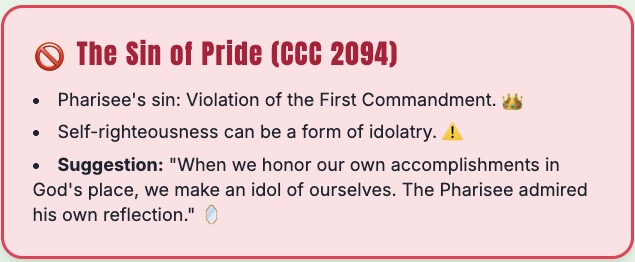
The Pharisee's sin is a violation of the First Commandment. In his self-righteousness, he has begun to worship his own virtue.
"The Catechism teaches that pride can be a form of idolatry. When we honor and revere our own accomplishments or our own righteousness in the place of God, we have made an idol of ourselves. The Pharisee was so busy admiring his own reflection in the temple floor that he failed to look up to the God who is the source of all goodness."
CONTINUE READING
The statement that "pride can be a form of idolatry" is a profound spiritual insight that gets to the very heart of the Pharisee's sin. While we typically think of idolatry as bowing down to a golden calf or a physical statue, the Catechism teaches us that it can be far more subtle. Idolatry, at its core, is giving the worship and reverence that belongs to God alone to something—or someone—else.
Here’s how the Pharisee’s pride becomes a form of self-idolatry:
Shifting the Object of Worship: The First Commandment instructs us to place God at the absolute center of our lives. Pride subtly breaks this by shifting the center from God to the self. The proud person doesn't necessarily build a physical altar, but they build a spiritual one to their own ego, their own accomplishments, and their own righteousness. The self becomes the ultimate measure of all things.
Worshiping the Gift Instead of the Giver: The Pharisee's good deeds—fasting and tithing—are objectively good things. However, he made a critical error: he began to worship these gifts and his ability to perform them, rather than the God who gave him the grace and strength to do them in the first place. His prayer was not one of gratitude ("Thank you, God, for helping me to be faithful"), but one of self-congratulation ("Look at how faithful I am"). He revered his own virtue as the source of his worth.
The Temple as a Mirror: The image of the Pharisee "admiring his own reflection" is powerful because it captures this perfectly. He was physically in God's house, a place of worship, but his prayer was not directed upward to God. It was directed inward, using God as a mirror to admire his own piety. He wasn't truly speaking to God; he was performing for himself, seeking validation from his own perceived goodness. In that moment, the Pharisee was the true object of his own worship, and God was reduced to a mere spectator.
This is the subtle danger of pride. It hollows out our faith from the inside, leaving the external practices intact while replacing the divine object of worship with a very human one: ourselves. True worship, as the tax collector demonstrated, begins with humility—the honest recognition that God is the source of all goodness, and we are simply the grateful recipients of His mercy.
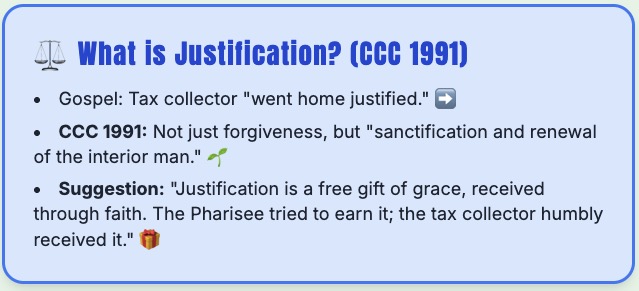
The Gospel says the tax collector "went home justified." This is a key theological term. Use the Catechism to explain what it means.
"What does it mean to be 'justified'? The Catechism tells us it's not just the forgiveness of sins, but also the 'sanctification and renewal of the interior man' (CCC 1991). It is a free gift of grace, which we receive through faith. The Pharisee thought he could earn it
CONTINUE READING
The phrase "The Pharisee thought he could earn it through his works" gets to the heart of the parable's central contrast. It highlights a fundamental misunderstanding of our relationship with God.
Here’s a deeper look at what it means to be "justified" and why the Pharisee's approach fell short:
1. Justification is a Total Transformation, Not Just a Transaction. When the Catechism speaks of "sanctification and renewal," it means that justification isn't simply God wiping away our sins like a debt being canceled. It is a much deeper work of grace that begins to heal and change us from the inside out. God's grace doesn't just pardon us; it infuses us with His own divine life, making us holy and conforming us more to the image of Christ.
2. It is a Free and Unearned Gift. This is the critical point. The Pharisee's entire prayer was a spiritual resume. He listed his good deeds (fasting, tithing) as if to prove to God that he had earned his righteous status. He saw his relationship with God as a transaction: "I have done these good things, therefore, you owe me your favor."
The tax collector, on the other hand, understood he had nothing to offer. He couldn't earn his way back into God's good graces. All he could do was throw himself on God's mercy and ask for it as a gift. By doing so, he opened himself to receive what the Pharisee's pride kept him from accepting.
3. The Role of Faith and Works. The Pharisee’s error was not that he performed good works, but that he trusted in those works to save him. He was self-reliant. True faith, as shown by the tax collector, is reliance on God. Our good works are meant to be the fruit of our justification—our grateful response to the gift we have already received—not the cause of it. The Pharisee got it backward, believing his works made him righteous, while in reality, it is God’s righteousness that makes our works holy.
Highlight text or double-click a paragraph anywhere on the site to ADD TO NOTES. You can also click ASK AI to copy your selection to the clipboard with a command prompt, ready for you to paste manually into the chat above.
Sunday
Loading...
My Notes
🔍
0 wordsSaved: Never
Clear Workspace?
Are you sure you want to delete all your notes? This cannot be undone.










 Highlight text or double-click a paragraph anywhere on the site to ADD TO NOTES. You can also click ASK AI to copy your selection to the clipboard with a command prompt, ready for you to paste manually into the chat above.