October 5, 2025


Music for Sunday Mass
Music for Sunday Mass
- OCP
- WILLOW
- GIA
- Cantica Nova
Tend the Ground
Curtis Stephan
Curtis Stephan based his song on Laudato Sí, Pope Francis’ encyclical on environmental responsibility. The agrarian imagery in the lyrics complement well the teaching in today’s Gospel.
27th Sunday of Year C

Tend the Ground
"Tend the Ground" is a contemporary hymn by Curtis Stephan, first published in 2016. The song is directly inspired by Pope Francis's landmark encyclical, Laudato Si': On Care for Our Common Home. Its lyrics are a call to action, urging believers to practice active stewardship of the earth, sow hope in desolate places, and recognize the interconnectedness of all creation. Through its gentle melody and powerful text, the song serves as both a prayer and a commission, reminding us that our faith is deeply connected to our relationship with the world God has made.
Refrain
"We till the earth, we tend the ground, sowing hope and peace where none is found. In selfless love God’s life abounds. We till the earth, we tend the ground."
The refrain establishes the central metaphor of the song: gardening as an act of faith.
- "Till the earth, we tend the ground": This is not just about physical farming. It represents any work that cultivates goodness in the world—in our families, communities, and environment. It requires patience, effort, and care.
- "Sowing hope and peace where none is found": This line connects directly to the missionary call of the Christian life. We are called to be agents of transformation, especially in places of despair, conflict, or neglect (both physical and spiritual).
- "In selfless love God’s life abounds": This is the core theological principle. The act of "tending" is an act of "selfless love" (
agape). When we give of ourselves for the good of others and creation, we participate in God's own life-giving work, and we see His presence flourish.
Verse 1

"As God provides our every need, with grateful heart, Let us receive these gifts of love, and make return to bless the world, to bless the world."
This verse focuses on the themes of gratitude and reciprocity.
- "God provides our every need": It begins by acknowledging God as the source of all gifts—not just material possessions, but life, love, and the earth itself.
- "With grateful heart, Let us receive": True stewardship begins with gratitude. Recognizing everything as a gift from God prevents us from seeing the world as something to be exploited for our own gain.
- "Make return to bless the world": Our gratitude is not meant to be passive. It must translate into action. The gifts we receive are not just for us; they are given to us so that we can, in turn, become a blessing to others and to creation.
Verse 2

"All creatures share one common home, one loving God, one song of hope. The rocks cry out and praises ring, rise up and sing, rise up and sing!"
This verse expands the vision to encompass all of creation, reflecting the "integral ecology" of Laudato Si'.
- "All creatures share one common home": This beautiful line dismantles any sense of human separation from or superiority over nature. We are part of a single family of creation, all under the care of "one loving God."
- "The rocks cry out and praises ring": This is a direct biblical allusion, referencing passages like Luke 19:40, where Jesus says that if the disciples were silent, "the stones would cry out." It suggests that all of creation has its own way of giving glory to God. Our role is to join in this universal chorus of praise.
- "Rise up and sing!": This is a joyful and urgent command. Recognizing our place within creation should inspire us to active, vocal praise and worship.
Click the banner above for the song’s connections to the readings

27th Sunday of Year C
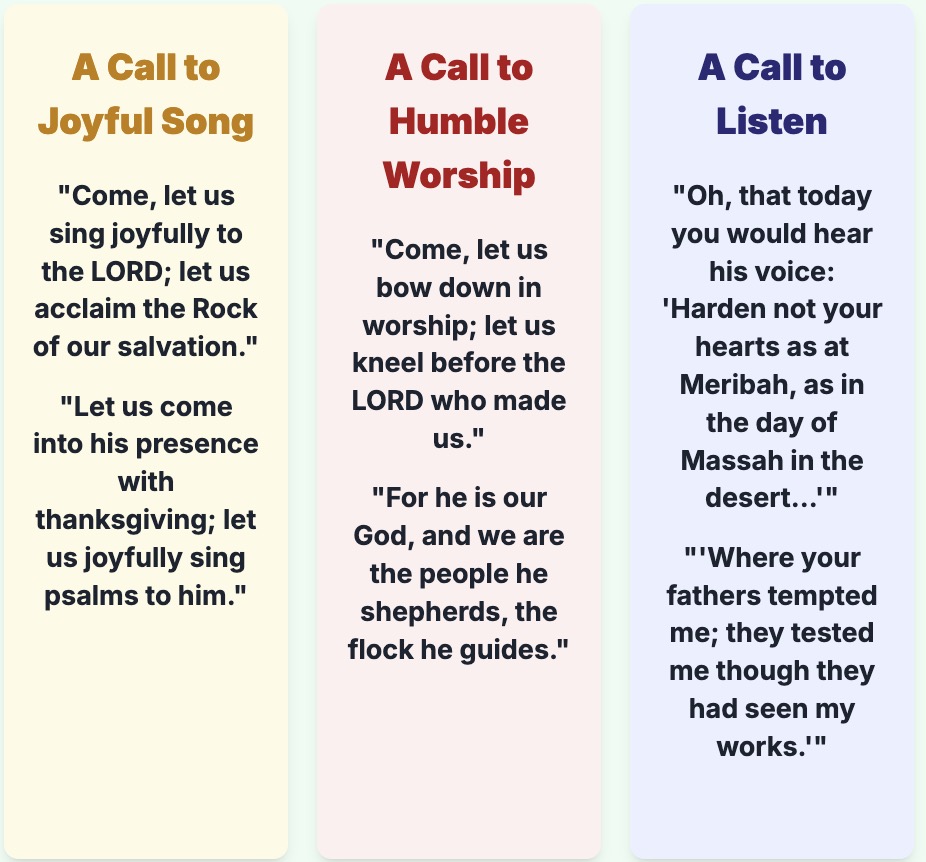
Psalm 95
OCP Music



I Will Have Faith in You
Sarah Hart
Sarah’s thoughtful ballad of faith is a hidden gem in the OCP contemporary repertoire.
27th Sunday of Year C
I Will Have Faith In You
Sarah Hart


Corner-
stone
Jackie Francois
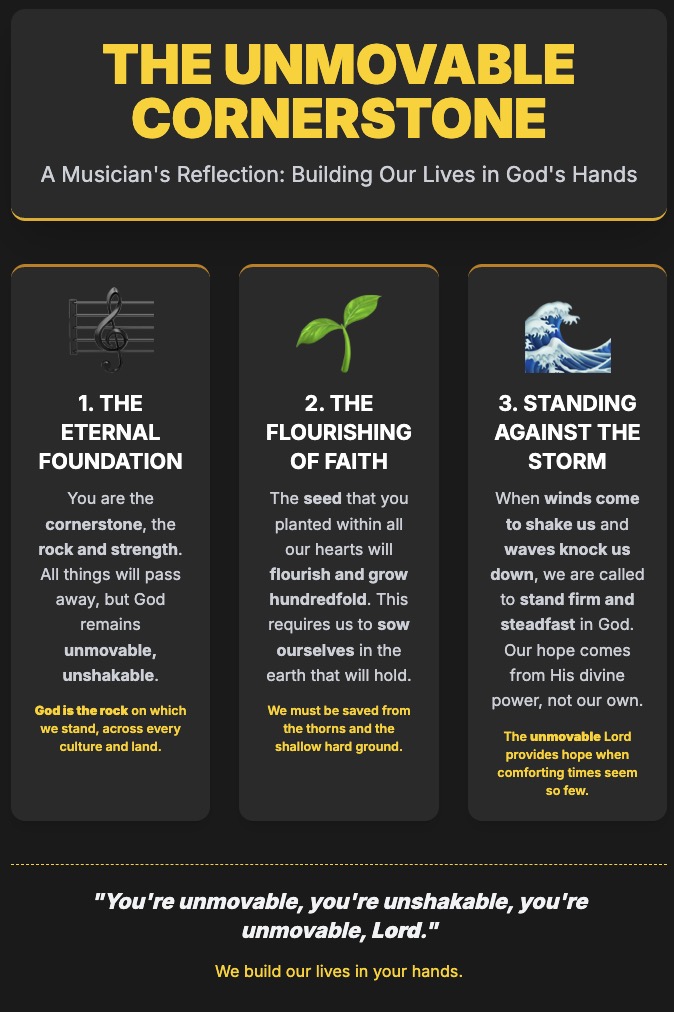
This is another song of faith in God’s power. The second verse is appropriate for today as it speaks of the seed that will flourish and grow a hundred-fold.
27th Sunday of Year C
Cornerstone
Jackie Francoise


Our God is Good
Josh Blakesley and Cooper Ray
Josh and Cooper’s energetic song sends us forth from this liturgy to proclaim the Kingdom of God.
27th Sunday of Year C
Our God is Good
Josh Blakesley and Cooper Ray


OCP (Oregon Catholic Press) is committed to providing the very best resources, music and service to Catholic parishes and worshipers all over the world. Liturgy Podcast is a weekly liturgy planning resource for musicians, liturgists, homilists, youth groups, faith sharing groups, and all who look to the liturgical readings for inspiration and nourishment. Join Ken Canedo and Robert Feduccia as they break open the Scripture and play suggested tracks from the Spirit & Song repertoire.
Willow’s mission is to publish a wide range of quality music and resources in digital formats that support, encourage and educate parishes, schools, organisations and individuals. Our community of customers, composers, writers and publishing partners fuel everything we do.
Founded in 1941, GIA Publications, Inc. is a family-owned company with more than 10,000 choral and instrumental editions in print, as well as hymnals, recordings, a licensing division, and a wide variety of music education resources. The esteemed choral publisher Walton Music became part of GIA in 2013. Both World Library Publications (WLP) and Meredith Music joined the GIA family in 2020. Our website is http://www.giamusic.com.
CanticaNOVA Publications (CNP) provides quality liturgical music for today’s Catholic Church. CNP believes that the texts and rites of Catholic liturgy give ample sources for creative musical expression. Using what the Church has already given us, CNP publishes quality music grounded in, and often directly flowing from, the traditions of the Church. This “NEW traditional music” provides the Catholic musician with the ability to be creative in liturgical music planning without having to turn to poor quality, “alternative” religious music.