October 12, 2025


Music for Sunday Mass
Music for Sunday Mass
- OCP
- WILLOW
- GIA
- Cantica Nova
All Are Welcome
Jesse Manibusan and Jennah Manibusan
Jesse and Jennah’s warm anthem invites the entire community to come together as we gather to praise God at this Eucharist.
28th Sunday of Year C
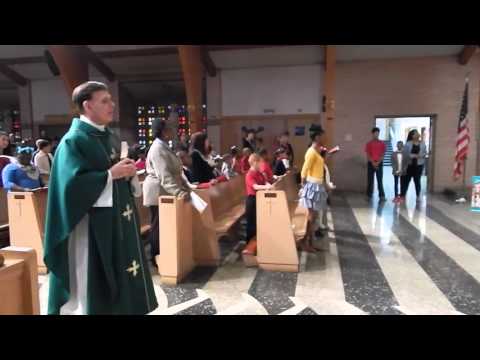
FEATURED (2:31) – St. Joseph the Provider School (Youngstown) February 3, 2016.
All Are Welcome
"All Belong" (often titled "All Are Welcome (All Belong)") is a contemporary hymn by Jesse Manibusan and his daughter, Jennah Manibusan. It has become a powerful anthem for communities seeking to embody a spirit of radical inclusivity and grace. More than just a song of welcome, it is a profound declaration that in God's house, every person has an inherent place. This guide will explore the song's message, lyrical depth, and scriptural foundations.

Welcome vs. Belonging
The song was inspired by a key theological insight: "God's house isn't holy because all are welcome. God's house is holy because all belong." This shifts the perspective from a host/guest dynamic to a family dynamic.
- Welcome: An invitation extended from an established group to an outsider. It's a vital first step.
- Belonging: The fundamental truth that you are already an essential part of the family. Your place is not conditional; it is inherent. You are "God's own."
The song challenges communities to move beyond mere hospitality and toward a deep, affirming recognition that every individual is a co-owner of the space.
Lyrical Themes & Analysis
The Refrain: A Declaration of Grace
All are welcome in this place, behold Love's amazing grace. Bring your hopes, bring your dreams, mercy flows and Love redeems. All are welcome, all belong!
The refrain is the song's thesis. It explicitly links the welcome to God's "amazing grace" and redemptive love. It invites people to bring their full selves—their aspirations ("hopes and dreams") as well as their brokenness—into the community, trusting that mercy will meet them there. The final declaration, "All belong!" is the ultimate promise.
The Verses: A Specific Invitation
The song intentionally identifies and calls out to specific groups who often feel marginalized.
- Verse 1: "Welcome, all the broken-hearted, all who sorrow and despair." This speaks directly to those carrying emotional and spiritual burdens. The assurance, "You are not alone, for you are God's own," is a direct counter to the isolation that often accompanies pain.
- Verse 2: "Welcome, all who suffer violence, all who long for safety and for peace." This acknowledges the real-world trauma and fear that many people live with. The church is called to be a sanctuary, a place of genuine peace and safety.
- Verse 3: "Welcome, all who are forgotten, excluded and dignity denied." This is a powerful call to social justice, reaching out to those pushed to the fringes by society—the poor, the outcast, the misunderstood. It affirms the inherent God-given dignity of every person.
- Verse 4: "Welcome, all who work for justice, bring hope, charity and peace." The song also creates a space for those actively engaged in ministry and service, recognizing them as integral members of the community who are living out the Gospel call.
Scriptural Connections
The themes of "All Belong" are deeply rooted in Scripture's call for unity, compassion, and radical hospitality.
- On Universal Belonging:
- Galatians 3:28: "There is neither Jew nor Gentile, neither slave nor free, nor is there male and female, for you are all one in Christ Jesus." This passage removes all social, ethnic, and gender-based barriers to belonging in the community of Christ.
- On Welcoming Others as Christ Did:
- Romans 15:7: "Welcome one another, then, just as Christ welcomed you, in order to bring praise to God." The motivation for our welcome is rooted in the unconditional welcome we first received from Christ.
- On Unity in Diversity:
- 1 Corinthians 12:27: "Now you are the body of Christ, and each one of you is a part of it." St. Paul's metaphor of the body emphasizes that every single member, with their unique function, is essential for the whole to be complete.
- On Reaching the Marginalized:
- Luke 14:13-14: "But when you give a banquet, invite the poor, the crippled, the lame, the blind, and you will be blessed." Jesus consistently prioritized those who were on the margins of society.
Questions for Reflection & Discussion
- Think of a time you felt truly welcomed somewhere. What made you feel that way? Now, think of a time you felt you truly belonged. What was the difference?
- Which specific group mentioned in the verses (the broken-hearted, sufferers of violence, forgotten, justice-seekers) do you feel most connected to or called to serve right now?
- How can our church or community move from simply saying "all are welcome" to actively creating a culture where "all belong"? What are some practical, concrete actions we could take?
- The song says, "You are not alone, for you are God's own." How does knowing you are "God's own" change the way you see yourself and others?
Click the banner above for the song’s connections to the readings

28th Sunday of Year C
Psalm 95
OCP Music



Healed in Christ
Sarah Hart
This contemporary ballad of healing by Sarah Hart is an appropriate reflection on the teaching today’s readings.
28th Sunday of Year C
Healed in Christ
Sarah Hart


Amazing Grace
John Newton; arr. by Chris Tomlin and Louie Giglio
This popular contemporary arrangement of the classic hymn captures the Samaritan’s joy in the Gospel story.
28th Sunday of Year C
Amazing Grace
John Newton; arr. by Chris Tomlin and Louie Giglio


Go Out, Go Out
Curtis Stephan
Jesus tells the grateful Samaritan to go and proclaim the glory of God. May we do likewise as we are sent forth from this liturgy.
28th Sunday of Year C
Go Out, Go Out
Curtis Stephan


OCP (Oregon Catholic Press) is committed to providing the very best resources, music and service to Catholic parishes and worshipers all over the world. Liturgy Podcast is a weekly liturgy planning resource for musicians, liturgists, homilists, youth groups, faith sharing groups, and all who look to the liturgical readings for inspiration and nourishment. Join Ken Canedo and Robert Feduccia as they break open the Scripture and play suggested tracks from the Spirit & Song repertoire.
Willow’s mission is to publish a wide range of quality music and resources in digital formats that support, encourage and educate parishes, schools, organisations and individuals. Our community of customers, composers, writers and publishing partners fuel everything we do.
Founded in 1941, GIA Publications, Inc. is a family-owned company with more than 10,000 choral and instrumental editions in print, as well as hymnals, recordings, a licensing division, and a wide variety of music education resources. The esteemed choral publisher Walton Music became part of GIA in 2013. Both World Library Publications (WLP) and Meredith Music joined the GIA family in 2020. Our website is http://www.giamusic.com.
CanticaNOVA Publications (CNP) provides quality liturgical music for today’s Catholic Church. CNP believes that the texts and rites of Catholic liturgy give ample sources for creative musical expression. Using what the Church has already given us, CNP publishes quality music grounded in, and often directly flowing from, the traditions of the Church. This “NEW traditional music” provides the Catholic musician with the ability to be creative in liturgical music planning without having to turn to poor quality, “alternative” religious music.